NOVENA, PRAYING WITH THE SAINTS App

Our Lady of Perpetual Help
Feast Day: June 27
Patronage: All
Keywords: refuge, protection, motherly comfort, icon
Quote: “Why don’t you just ask?”
Symbols: lance, sponge, cross, nails, unfastened sandal

An icon is a visual prayer and this image of Mary comforting her young son in a moment of fear,  brings consolation to anyone who meditates on it. On either side of Mary are the two Archangels, Michael holding the lance and spear and Gabriel holding nails and  the cross Jesus will be crucified on. The child Jesus has been so frightened at the sight of these instruments of his future torment that he has run to his mother in tremendous haste, loosening his sandal. Though she is well aware that this suffering is in his future, Mary has such faith in his ultimate redemption that she calmly holds and reassures her son. If God himself can go to Mary for refuge, than anyone should be able to approach her. Her ultimate belief and faith extends to every one of us, no matter how harshly we may judge ourselves.  Our Lady of Perpetual help is said to never refuse a request for help, great or trivial. Despite their reticence to invoke her aid, many have reported hearing Mary’s calm voice saying, “Why don’t you just ask?”

Copies of this miraculous icon can be found in tens of millions of homes all over the world. Though its age is unknown, it first made its appearance in the fifteenth century when it was brought to Rome by a wealthy merchant from Crete. His family eventually donated it to the Church of Saint Matthew in Rome. When that church was destroyed in the Napoleonic invasion of 1789, it was hidden by a priest. Sixty-four years later, its discovery so moved the Redemptorist Fathers who were building a new church on that site. Because of its great visual power, they made it their mission to disseminate this image all over the world. The original icon can be found today hanging in the Church of Saint Alphonse Liguori in Rome.

Novena to Our Lady Of Perpetual Help

See at Your feet, O Mother of Perpetual Help, a poor sinner who has recourse to you and confides in you.

O Mother of Mercy, have pity on me! I hear you called the refuge and the hope of sinners; be my refuge and my hope.  

Help me, for the love of Jesus Christ; stretch forth your hand to a poor fallen creature recommends myself  to you, and I devote myself  to your service forever. 

I| bless and thank Almighty God, who in His mercy had given me this confidence in you, which I hold to be a pledge of my eternal salvation.

Mary, tender Mother, help me. Mother of Perpetual Help, never allow me to lose my God. 

Amen.

Recite the following prayers 3 times each…
Our Father…
Hail Mary…
Glory Be…


https://apps.apple.com › app › novena

Our Lady of Cobre

Our Lady of Cobre is considered the mother of Cuban people regardless of their race, political allegiance, or ideology. She is so entrenched in the Cuban national identity that she is virtually the only unifying force between those in exile and those who remained on the island. Though Cuba has been officially declared an atheist country by its government, it allowed four Catholic masses to be said at the major cathedrals in honor of Our Lady of Cobre to commemorate a papal visit in January 1998. The first masses that took place in the middle of the country drew a respectful but reticent response. By the time the fourth mass was said in Havana, the sight of millions of joyful, chanting devotees singing and dancing in the streets so shocked the ruling powers that they agreed to loosen the laws suppressing religious feasts and celebrations in all houses of worship. To many it was proof that the Virgin Mary is far more powerful than any government.

The story of Our Lady of Cobre took place in 1606. Two brothers of Indian lineage, Rodrigo and Juan de Hoyos, and a ten-year-old African slave named Juan Moreno took a canoe out off the coast of Santiago del Prado. This was an area newly rich in copper mines, the name of which has since been changed to Cobre, cobre being the Spanish word for “copper.” The boys were out to gather salt to preserve meat for the copper miners. Halfway across the Bay of Nipe they had to encamp on an islet because a violent storm had blown up. They waited through a harrowing night, the storm ending at daybreak. When the sea calmed the boys again set out on their task. 

Almost immediately they saw a white bundle on a plank floating on the waves, approaching them. At first they thought it was a seabird, but as it neared them it appeared to be a little girl. Gradually they realized it was a statue of the Virgin Mary holding the Christ child. Much to their amazement the statue was completely dry. Inscribed on the plank were the words: “Yo soy la Virgen de la Caridad” (I am the Virgin of Charity).

The boys carried the statue back to the town, where its arrival was recognized as a message from the Virgin Mary. A shrine was constructed,and it immediately became a pilgrimage site. The statue is now in its own sanctuary known as Nuestra Senora del la Caridad de Cobre Basilica in Santiago de Cuba. 

The statue of Our Lady of Cobre is about sixteen inches high. Artistic depictions of it vary. The statue in the basilica is a mixed-race Mary. Though her original robes were white, she now wears heavily brocaded golden robes with gold and silver embroidery containing Cuba’s national shield. The stiffness of this fabric gives the statue its triangular shape. Our Lady of Charity is a common figure found in Spanish hospitals, and it was thought that this statue could have originally come from a Spanish ship headed for Cuba. In later retellings of the story, the three men in the boat became the “three Juans,” one European, one Taino Indian, and the third one African, who, caught out in a storm, prayed to the Virgin to save them. Miraculously, the sea calmed and the little statue floated to them out of nowhere. In art they are shown rowing in a rough sea with Our Lady of Cobre hovering over them in a protective way. In this depiction of Mary she is holding up the Baby Jesus, and both He and Mary wear golden crowns. She is standing on a half-moon, but unlike the statues of Our Lady of Charity in Spain, the moon is pointing downward. This is thought to be a particular message to the Taino Indians. Their goddess Guabonito had the symbol of the rainbow to represent her. It is thought that in this statue Mary is standing on what could be interpreted as the moon by Europeans and Africans and as a rainbow by the Tainos, offering the same gift of healing that the rainbow symbolizes to them. In art, Mary is frequently depicted as light-skinned and wearing the colors of the Cuban flag. To the island’s practitioners of Santeria, Our Lady of Cobre holds an exalted position in their pantheon as the goddess Ochun. She is the goddess of love, money, and household happiness.

Throughout the nineteenth century, Our Lady of Cobre became a Cuban symbol of unity in their desire for independence from Spain. In 1916 she was named the official patroness of Cuba after soldiers who credited her intervention for their liberation from Spain petitioned the Vatican. She has always remained a symbol of the Cuban people. In 1954 when the writer Ernest Hemingway won the Nobel Prize for his novella The Old Man and the Sea, he wanted to give the medal to the Cuban people. The best way he could think to accomplish this was to bring the prize to the Sanctuary of Our Lady of Cobre and dedicate it to her. There it remains to this day. Wherever Cubans are in the world, her feast day is a major celebration for them. Our Lady of Cobre is fondly called by the nickname Cachita. She is a much loved member of Cuban families and her image is the one consistent thing found among exiles fleeing the island and those who live in Cuba. She is the symbol both of faith and of national identity. 

The Miraculous Medal

Alhough the Miraculous Medal is worn almost as often as a crucifix by Roman Catholics, few realize that the designs on the front and back owe their inspiration to a series of apparitions of the Virgin Mary. 

It is said that the year 1830 announced the dawning of the Marian era. Until then, the last Church-sanctioned apparition of Mary was of Our Lady of Guadalupe in Mexico almost three hundred years before. Within that time frame, the entire religious world of western Europe was shaken to its core by the upheaval of the Reformation, Counter-Reformation, and the French Revolution. In France, religious worship was demonized, and the clergy was ostracized as ancient monasteries and artworks were destroyed. 

On the night of July 18, 1830, in the Motherhouse of the Sisters of Charity in Paris, a barely literate twenty-four-year-old novice named Catherine Laboure was shaken from her sleep by a beautiful five-year-old boy. Catherine was in her curtained bed in a dormitory with other novices. Shocked at the dazzling garments the child wore, she was certain the other nuns would wake up.

“Catherine,” said the boy. “Come to the chapel; the Blessed Virgin is waiting for you.”

Catherine was too shocked to speak but thought the words, “But I shall be heard.”

The child calmly spoke, “Be calm, it is half past eleven, everyone is asleep; come, I am waiting for you.”

Catherine dressed quickly and followed the child. As they reached the chapel, the door opened at the light touch of his finger. The room was glowing in light as all of the candles were lit as if for Midnight Mass. Catherine knelt to pray. 

As it neared midnight, the child said, “Here is the Blessed VirginCatherine heard the rustle of a silk dress and a beautiful woman sat down in the Father Director’s chair next to her. The woman was dressed in an ivory-colored dress with a blue mantle and a white veil covering her head and draping over her shoulders. Her hands radiated beams of light, the color of jewels. 

In a much stronger voice, the child said, “Here is the Blessed Virgin.”

Catherine knelt in front of the woman, putting her hands in her lap as she looked into the woman’s eyes. In her own words, Catherine later recounted, “I do not know how long I remained there; it seemed but a moment, but the sweetest of my life.”

When the Virgin Mary spoke, she said, “The good God, my child, wishes to entrust you with a mission. It will be the cause of much suffering to you, but you will overcome this, knowing that what you do is for the glory of God. You will be contradicted, but you will have the grace to bear it; do not fear! You will see certain things; give an account of them. You will be inspired in your prayers. Tell with confidence all that passes within you. Tell it with simplicity. Have confidence. Do not be afraid.”

Mary then went on to relate the misfortunes that were about to befall France and the rest of the world. When Catherine wondered to herself when these things were to happen, “I understood clearly, forty years.”

The Virgin ended the conversation by saying, “Come to the foot of this altar; there, graces will be poured on all those who ask for them with confidence and fervor. They will be poured out on the great and the humble.” And in Catherine’s words, “the Virgin disappeared like a light is extinguished.” 

The child then led Catherine back to bed, where she remained awake for the entire night, wondering exactly what her mission would be.

Catherine did not see Mary again until November 27, 1830, which was the Saturday before the first Sunday of Advent. Though she was with other nuns in the chapel at the 5:30 p.m. prayers, Catherine was the only one who saw the apparition. At the point reserved for interior meditation, when the chapel was at its quietest, Catherine heard the sound of the rustling silk.

In her words, “When I looked in that direction, I saw the Blessed Virgin. She was standing, dressed in a white robe of silk, like the dawn, her feet resting on a globe, only half of which I could see. In her hands, held at the level of her breast, she held a smaller globe, her eyes raised towards heaven . . . her face was beautiful, I could not describe it . . . Then suddenly, I saw rings on her fingers, covered with jewels, some large and some small, from which came beautiful rays . . At this moment, when I was contemplating the Virgin, she lowered her eyes and looked at me and an interior voice spoke to me: ‘This globe you see represents the entire world, particularly France . . . and each person in particular.’”

As Catherine marveled at the beauty of the rays of light exuding from Mary, the voice said, “This is a symbol of the graces which I shed on those who ask me.” When Catherine wondered why some of the jewels on Mary were not radiating light like the others, the voice said, “Those jewels which are in shadow represent the graces which people forget to ask me for.” Then the apparition changed, and Mary appeared with a white dress, a blue mantle, and a white veil. She was standing on the globe and had one foot on the head of a serpent that lay at her feet. The year 1830 was marked at the globe’s base. The Virgin’s hands were pointing downward, and a cascade of light rays were falling from her hands onto the globe.

An oval then formed around Mary, and on it were written these words in gold, “O MARY CONCEIVED WITHOUT SIN, PRAY FOR US WHO HAVE RECOURSE TO THEE.”

The same interior voice said, “Have a medal struck after this model. Those who wear it will receive great graces; abundant graces will be given to those who have confidence.”As the voice faded out, the oval turned and Catherine saw what was on the reverse of the medal: The letter M surmounted by a bar and a cross; beneath the M were the hearts of Jesus and Mary, the one crowned with thorns, the other pierced with a sword. Encircling these symbols were twelve stars. 

For the next year, Catherine saw this vision six times. Having little contact with the outside world and feeling pressured to complete her mission, she told her spiritual director, Father John Marie Aladel, about the Virgin’s mandate. Just as Mary predicted in the first vision, he did not believe her. As she persisted to repeat her story to him throughout the year, he and Catherine had many stormy disagreements. At his request, she wrote out a detailed report of what happened. At a loss about what to do with this young girl who not only had these visions, but was so insistent upon having this medal struck, Father Aladel visited the archbishop of Paris in 1832. Having a special devotion to the Virgin Mary, the archbishop did not share Father Aladel’s skepticism and he immediately gave permission to create the medal. 

In June 1832, fifteen hundred copies of the medal then known as the Medal of the Immaculate Conception were created. By 1836 more than two million medals had been produced. Because of the many stories of cures, wonders, and death-bed conversions attributed to the medal, it gradually became known as the Miraculous Medal.

Catherine Laboure never revealed to anyone but her spiritual director that it was she who received the visions that caused the medal’s creation, and she could never be induced to attend any of the canonical hearings investigating the apparitions. Eventually, this visit of the Virgin Mary was sanctified and officially recognized by the Church based on the miraculous effects of the medals. For the next forty-six years of her life, Catherine nursed the sick and tended the chickens at the Sisters of Charity residence outside of Paris. Her fellow sisters found her “cold and apathetic” and were quite shocked upon learning that it was this obscure, forgettable person whom the Virgin Mary entrusted with her mission. She died on December 31, 1876, and is buried in the convent chapel in Paris, where the Blessed Virgin Mary first appeared to her.

The Symbols on the Medal On the front of the medal, Mary stands alone with her foot crushing the head of a serpent. She is the Victorious Woman of Genesis (Genesis 3:15), where God says to the serpent, “I will put enmities between you and the woman.” In Catholic art, Mary is frequently depicted crushing the head of a serpent that represents Satan. In this way, Mary as the highest developed form of human life is shown triumphing over evil. It is believed that the date 1830 at the base of the medal signifies the advent of the Marian age, when apparitions of Mary were to intensify and become more frequent. Mary is standing on the globe of the world, which gives her spiritual dominion with the title Queen of Heaven and Earth. Brilliant rays of light cascade to earth from Mary’s hand. She is showering the world with grace from God. This is where her titles Mediatrix and Advocate for Humanity come from. She is so filled with God’s grace and love she needs to share it with others. She looks upon all humankind as her children and tries to show them the path to light and God as any mother would. The words around the frame of the medal, “O Mary conceived without sin, pray for us who have recourse to thee,” is a brief prayer in itself. In it we are recognizing Mary’s help in interceding for us with God and the belief that she was the only human creature to ever be conceived without original sin.

The imagery on the back of the medal is equally symbolic. There is a cross on the back with a bar through its base. This symbolizes the foot of the Cross. This bar runs through the letter M, which stands for both Mary and Mother. This signifies that Mary as Christ’s mother stood at the foot of his Cross while he endured his Crucifixion. Beneath the M are two hearts, one with thorns running through it (this is the Sacred Heart of Jesus); and the other with a sword in it (the Immaculate Heart of Mary). One of the Seven Sorrows of Mary predicted by the prophesy of Holy Simeon is “the Mother pierced with a sword of sorrow beneath the cross so that the thoughts of many hearts may be revealed” (according to Luke 2:34–35: “you yourself a sword may pierce”). Because Mary had to endure the great sorrow of watching her only son die a humiliating and tortuous death, many on Earth look to her for comfort in their own troubles. They know that she went through the worst agonies a mother could withstand and triumphed over them. Both hearts are equal in size, and both hearts are inflamed by ardent love. Encircling the cross, the M, and the two hearts are twelve stars. In art, Mary is frequently depicted crowned by twelve stars. It is believed that the Twelve Apostles looked to her quiet devotion and acceptance of her son’s fate for spiritual inspiration. Stars also pertain to the book of Revelation (Apocalypse) as a reference to the “great sign” described as “a woman clothed with the sun, with the moon under her feet, and on her head a crown of twelve stars” (Revelation 12:1). In the Miraculous Medal lie the symbols of Mary’s role in salvation from Genesis to Apocalypse. As the Victorious Woman she is destined to take part in the final defeat of the devil. 

The Miraculous Medal is considered a physical manifestation of the gift of grace, which exudes from the Virgin Mary. It is considered Mary’s token reminder that she is always ready to offer assistance. 

Catherine heard the rustle of a silk dress and a beautiful woman sat down in the Father Director’s chair next to her. The woman was dressed in an ivory-colored dress with a blue mantle and a white veil covering her head and draping over her shoulders.

Visions of Mary

Photograph by Lisa Silvestri

Home altar in Havana,Cuba
Photographs by Lisa Silvestri

Altar in family mausoleum in Havana, Cuba
Photograph by Lisa Silvestri

Religious Statues from the flea market in Mexico City, Mexico.

The “Sweetheart Statue” was brought to the Ursaline Convent in New Orleans in 1785.

visions of Mary Our Lady of Guadalupe

A traveler visiting Mexico or the American Southwest meets Our Lady of Guadalupe hundreds of times a day. Her image adorns the walls of businesses, is prominently displayed in homes, is on the hubcaps of cars, and at the center of small sidewalk shrines. This image of Mary is the preeminent cultural icon for most Latin Americans, sacred to Catholics and highly honored by non-Catholics, and it is the only apparition of Mary sanctioned by the Church on the North American continent.

On December 9, 1531, an Aztec convert to Catholicism named Juan Diego was on his way to early morning Mass in the area that is now known as Mexico City when he heard the sound of birds singing. When they quieted down, the hill at Tepeyac seemed to respond to their song. From the top of the hill a woman gently called to Diego, “Ihuantzin. Ihuan Diegotzin.” She was speaking the Aztec language of Nahuatl. As he approached her, he saw that she was an Indian noblewoman. He was amazed at how her clothes glimmered like the sun and how the rocks and foliage around her had a heightened glow. The crag where her foot rested gave off rays of light and the earth sparkled like a rainbow. 

She spoke to him courteously and with great charm, “Know my dearest, littlest, and youngest son, I am the forever whole and perfect maiden Saint Mary, honorable mother of the true God, honorable mother of the giver of life, honorable mother of the creator of men and women, honorable mother of the one who is far and close, honorable mother of the one who makes the heavens and the earth. My wish is for them to build my temple here where I will give people all my love, compassion, assistance, and protection. I am the compassionate mother of you and your people here in this land and all of the other people who love me, call to me, search for me, and confide in me. I will listen to their pain, suffering, and crying and heal them from their misery.” 

She then sent him to see the bishop to make the request for the church. After a long wait he related his story to the bishop who told him that he must obtain a sign proving that this was truly an appearance of Mary. Juan Diego returned to the woman on the hill and begged her to get someone more prestigious to give her message to the bishop. She told him that she had many people who could deliver her request, “but it is of precise detail that you yourself solicit and assist and that through your mediation my wish be complied.” 

On his next visit to the bishop he was once again greeted with suspicion. When he left, the bishop sent servants to spy on him and to see to whom he was really speaking. But as soon as Juan Diego crossed the wooden bridge to the hill at Tepeyac, they lost sight of him. The next day, a Monday, Juan Diego decided to take another route around the hill in order to avoid the woman. His uncle had taken ill, and he needed medical attention. Juan Diego did not want the woman to detain him, as he feared that his uncle would die waiting for help. Much to his dismay, she came down the hill to meet him from where she was watching. When she asked him why he was so upset and why he was in such a rush, he sadly told her about his uncle’s illness and how his requests for her to the bishop had fallen on deaf ears.

Her answer was, “Listen, put it into your heart, youngest and dearest son, nothing should scare or concern you. Don’t worry. Don’t be afraid of the sickness, or any other illness or hardship. Am I not right here who is your mother? Are you not under my shadow and protection? Am I not in the foundation of your being, your sustenance, your happiness, peace, and effortlessness? Are you not in the fold of my garment? Do you need anything else? Don’t allow anything to worry or disturb you anymore. Don’t worry about your uncle’s illness. He will not die. Be assured, he is already well.”

She then told Juan Diego to gather roses among the rocks. He was surprised to find them in full bloom since it was winter. She carefully arranged them in Juan Diego’s cloak and he brought them to the bishop. After another humiliating wait, he was finally granted an audience. As he unwrapped his cloak and the roses fell out, the bishop gasped. The flowers uncovered an elaborate portrait of the Virgin Mary imprinted on the cloak. The bishop fell to his knees in tears and begged Juan Diego’s forgiveness. The bishop then insisted on being taken to the hill where the lady from heaven wanted her temple. After he had done this, Juan Diego ran home to his sick uncle and was quite shocked to see him happy and healthy. His uncle told him that a heavenly lady had come to heal him, asking him to tell the bishop of his cure. She also wanted him to convey the proper name for her image: The Perfect Virgin Holy Mary of Guadalupe.

The bishop had the church built and the cloth put on public display where it immediately attracted crowds of pilgrims. Almost as suddenly, the Franciscans, who had been in Mexico for the past ten years and who had very little previous success, were receiving thousands of Aztecs who wanted to convert to Catholicism. This cloth and its image, which should have deteriorated in twenty years, is still on view at the Basilica of Our Lady of Guadalupe in Mexico City. After almost five hundred years it remains in pristine condition. Attracting more than ten million pilgrims a year, Our Lady of Guadalupe is the most popular Marian shrine in the world.

At the time of this apparition of Mary, the Aztecs, the original inhabitants of Mexico City, had been suffering brutally under domination of the Spanish colonialists. Disease and depression were rampant. Hernán Cortés, the conquistador, had landed in 1519 and had succeeded in destroying much of the Aztec civilization by 1521. Why, then, were the Aztecs eventually such willing converts to Catholicism? The Aztecs had hundreds of gods in their pantheon. It was their spiritual habit to co-opt the gods of tribes that they conquered. They believed that their own god Huitzilopochtli depended on human sacrifices to be kept alive. They invaded neighboring tribes to obtain these victims. As they as a people became more aggressive against their neighbors, the gods of the Aztecs took on more monstrous forms. Portrayals of the female gods became the most frightening and grotesque. When the Spanish arrived in the Aztec city, they were amazed at its beauty and grace, and equally horrified at the blood-soaked temples with the racks of human skulls and demonic-looking statuary. All Aztec places of worship were considered satanic and systematically destroyed.

The hill where Mary appeared was once the site of the goddess Tonzantin. She was considered a household god, the goddess of corn and fertility. With Our Lady of Guadalupe, the feminine traits of love, compassion, and forgiveness were returned to spirituality and the sick-at-heart population had an entity to whom they could take their sorrow. 

Statue of Blessed Juan Diego wearing the tilma with the imprint of Our Lady of Guadalupe. Following pages: Statues being sold at a flea market, an outdoor shrine with Our Lady of Guadalupe surrounded by lights so that she can be worshiped at night.

The portrait of Our Lady of Guadalupe conveyed a message interpreted differently by Aztecs and Europeans, yet triggered the same spiritual response. To the Aztecs, the basic announcement that Mary was making with this image was the dawning of the age of the Sixth Sun. Dividing up their history into solar ages, it was thought that the Fifth Sun, the Sun of Movement, ended with the Spanish conquest. Since the birth of a new sun always follows a time of darkness, it was believed that the appearance of Mary after ten years of destruction signaled the beginning of the Sun of Flowers. According to their lore, this was a time when humanity would come into its own and bloom. In this image, Mary wears a belt worn by pregnant women, thus announcing the birth of a new age. Gold-leaf Nahuatl glyphs symbolizing plenitude appear on her gown. They are arranged over her womb in a pattern that represented the four points of a compass, a basic symbol in the Aztec faith. The womblike light she is wrapped in, the rays of the sun and the crest of the moon, the folds of her robe and the subdued serpent all had hidden messages that were easy for the Aztecs to read. Her eyes do not stare ahead as depictions of the gods do; rather she is looking down at humanity, much as a mother looks at her child. Her hands are in a praying position that the Aztecs used to signify something coming from one’s heart. The fact that her robe is touching the angel signifies protection and love.

For the Christians the iconography of this image was directly related to the book of Revelation where John says, “A great sign appeared in the heavens, a woman clothed with the sun.” This image is associated with the Immaculate Conception. December 9, the first day of her appearance, was also the original day devoted to the Feast of the Immaculate Conception. The halo Mary is wrapped in is called a mandorla. Originally, this type of almond-shaped body halo represented the cloud in which Christ ascended; in time it came to signify the light that emanates from those divinely inspired. In Western art it is used to depict those with a complete bond to Christ. As the Mother of God, Mary is exalted above all angels, offering her protection and love to humanity.

By appearing as a mixed-race woman, Mary was announcing the new face of Catholicism. The brutal, fundamentalist way that Catholicism was practiced by the Spanish was softened. In her appearance Mary was reminding the Europeans that they had the same mother that the Aztecs did. She was the first Christian image that the Mesoamericans could relate to, and the messages embedded in her picture offered hope, love, and comfort to a people when these qualities had been driven out of their own religion.

Our Lady of Guadalupe is the patroness of Mexico, North and South America, and the Caribbean.

The Feast of Our Lady of Guadalupe is December 12, the day the miraculous cloth was revealed.

Visions of Mary

Barbara and I wanted Visions of Mary to be a book about how the Virgin Mary affects people in their everyday lives. In the United States and countries around the world, images of Mary are displayed among family photographs. For this reason, we chose not to use the great art works and paintings that have been created in her honor. Rather, we sought photographs of “everyday Marys.”. The photographer Lisa Silvestri after a trip to Mexico, Cuba, and New Orleans returned with countless beautiful images. It helped set the visual tone for our book. We are grateful to Lisa.

We also worked with Dr. Joseph Sciorra of the Calandra Center in New York City. Sharing his research on the black Madonnas of Southern Italy, and introduced us to the work of two wonderful photographers, Larry Raccioppo of New York City and Dana Salvo of Gloucester, Massachusetts, who are included in this book.

Diane Block, photo archivist at The Museum of New Mexico, was a big help in finding photographs for this book.

We bring this book to you with the help of the people mentioned above. We hope you find something in this book to love and are inspired by, as you go through your life. We will post a chapter every month.

Barbara and Sandy

Hail Mary Full of Grace! the Lord is with you; Blessed are you among women, and blessed is the fruit of your womb Jesus. Holy Mary, Mother of God, pray for us sinners, now and at the hour of our death. Amen.

Our Lady of Mount Carmel

Mount Carmel, in what is today northern Israel, has always been a place rich in mystical tradition. The word hakkarmel means “the garden” in Hebrew, and true to its title, there is a remarkable profusion of plants and wildflowers on this mountain. It is considered a natural paradise and a sacred place, and in biblical times it was forbidden to disturb any of the natural life on it. Those who wanted to ascend the mountain for meditation lived in caves so as not to intrude on the landscape with unnatural structures.

In about 860 b.c., the prophet Elijah (also known as Elias) arrived on this holy mountain to begin a life of contemplation and prayer. The First Book of Kings is filled with tales of wonders he performed and prophesies he gave. In his prophetic visions on Mount Carmel, Elijah became aware of the coming of the mother of the Messiah. He and his followers mystically dedicated themselves to her, setting an example as the first monks. The descendants of these ancient contemplatives were among the first to accept the teachings of Christ and to be baptized by His apostles. Upon meeting Mary after Christ’s Ascension, they were so overcome by her sanctity that they returned to the mountain to build a chapel in her honor. For the next thousand years Mount Carmel continued to be a place where hermits devoted themselves to prayer.

By the twelfth century, pilgrims from Europe who had followed the Crusades to the Holy Land settled with the ascetics on Carmel and started a religious holy order known as Brothers of the Blessed Virgin Mary of Mount Carmel. Their rule, which was given in 1209 by the Patriarch of Jerusalem, says that all converges toward the contemplation of God. The Rule of Mysticism exhorts those who fol-low it to live a life of continual prayer, obedience to a superior, perpetual abstinence and fasting, manual work, and total silence.

of their order to the laypeople; it served as a reminder that belief in Mary as the Mother of God extended back to the Old Testament with the prophet Elijah. After Pope John XXII (r. 1316–1334) had a vision of Mary where she promised those wearing the brown scapular, “I, the Mother of Grace, shall descend on the Saturday after their death and whomsoever I find in Purgatory, I shall free, so that I may lead them to the holy mountain of everlasting life,” the scapular became extremely popular among the common people. By the end of the sixteenth century it had become smaller in size and very similar to the one that is worn today. Admiration for the Carmelite Order spread as their adherence to the rules of solitude and prayer produced some of the greatest mystical saints in Catholicism, all of whom had visions of or openhearted communications with Mary. Among them are Saint Simon Stock, Saint Teresa, Saint John of the Cross, and Saint Thérèse of Lisieux.

Though the original scapular handed to Saint Simon Stock was brown wool cloth without a picture, the Carmelite scapular that is now worn and the one that is most favored now has an image of Our Lady of Mount Carmel holding the Baby Jesus while she offers the scapular. The other piece of cloth often has a picture of Jesus as a man. Neither image is prescribed. Wearing the scapular is a form of prayer and is considered a visible sign of consecrating oneself to Mary and to accepting her maternal protection.
Devotion to Our Lady of Carmel can be found wherever the Carmelites founded a monastery or convent. Many small towns in Italy have churches named after this aspect of Mary. As the townspeople emigrated to other countries, they brought the devotion with them. In many cities in the United States these churches have great celebrations in honor of Our Lady of Mount Carmel.
Artistic representations of Our Lady of Mount Carmel depict her either appearing in the sky over Mount Carmel itself or holding Jesus as a toddler. In both versions the figure of Mary is often depicted offering the scapular to the viewer. Tradition has it that the prophet Elijah saw Mary appear in the clouds over Mount Carmel eight hundred years before her birth. Sometimes this representation includes her handing the scapular to Saint Simon Stock. The other version of this aspect of Mary illustrates the Sabbatine privilege where Mary vows to take the souls of those who died wearing the brown scapular out of purgatory on the Saturday after their death. Purgatory is depicted in flames because it is a place where the soul goes to have its sins burned away.

Simon Stock, an English pilgrim, had joined the group on a visit to Jerusalem. At this time, Saracen invaders forced the monks out of their spiritual home on Mount Carmel. All those who would not leave were murdered. Simon Stock was instrumental in getting the order to move to Aylesford, England, where the Baron de Grey gave them a manor house. The Carmelite lifestyle of contemplation, poverty, and silent prayer was not easily accepted in Europe, particularly among the clergy who enjoyed almost the same status and privilege as royalty. Reading into the life of Mary, Simon Stock was inspired by her unquestioning acceptance of all that befell her: her virgin pregnancy; her raising and loving a child doomed to be executed; and her staying at the foot of the Cross while others ran away. It was through his insistence that the Carmelites evolved from a band of hermit ascetics who regretted the loss of their home on Mount Carmel into a traveling society of mendicant friars, opening schools and mission houses in the major capitals of Europe. Still, it was difficult for many monks to accept the alteration of the rule of the order to adapt to European conditions. Their presence was also shunned and not easily tolerated by other religious orders. The people thought these hermits strange and did not accept that they chose to live in such absolute poverty and isolation. In order to preserve what was left of their order, the Carmelites invoked their patroness, the Virgin Mary, for help in establishing their new life.
The answer came in a vision to Saint Simon Stock on July 16, 1251, when he was alone in his cell. Mary appeared to him holding the scapular of his order. She told him, “Receive my beloved son, this habit of thy order: this shall be to thee and to all Carmelites a privilege, that whosoever dies clothed in this shall never suffer eternal fire. . . .It shall be a sign of salvation, a protection in danger, and a pledge of peace.”

The scapular, two pieces of brown wool joined at the shoulders and hanging down the back and breast, was not new to the Carmelite order. For hundreds of years before Saint Simon Stock’s vision, monks in Europe had worn scapulars. But it is thought that the brown scapular that Mary delivered was referencing Elijah’s camel-hair garment on Mount Carmel. Eventually, the brown scapular became reduced in size for laypeople to wear under their clothing. This is a special devotion to Mary worn as a sign to commemorate her faith in both God and humankind.

Our Lady of Mount Carmel is the patroness
of the Carmelite Order,
Chile, and Bolivia.
Her feast day is July 16.


Holy Thursday

“So if I, your Lord and Teacher, have washed your feet, you also ought to wash one another’s feet. For I have set you an example, that you also should do as I have done to you.”

—John 13:14-15

The Yorck Project: 10.000 Meisterwerke der Malerei. DVD-ROM, 2002. ISBN 3936122202. Distributed by DIRECTMEDIA Publishing GmbH./Public Domain

Preparation

As you begin this time of quiet prayer, I invite you to find a comfortable place to sit with your back straight and your legs planted on the ground. Take a few moments to breathe in and breathe out.

Spend this time centering yourself to listen to what God may be saying to you during this time of prayer, to listen to what rises up in your heart. Close your eyes for a few moments. As you sit with your eyes closed, use these or similar words: “Here I am, Lord. Here I am.” When you are ready, open your eyes and pray.

Washing Feet

The dining table is scattered with the remains of a meal enjoyed by all there. Imagine you are sitting at this table. Your hands are on your belly, and you’re feeling full and satisfied. The food and wine were savory and sweet. It brought back such memories of meals you shared with friends and family through the years—meals where love was shown, forgiveness offered, and hurts healed. A smile comes across your face as you recall the hours your mother spent in the kitchen getting ready to feed those she loved. Humming softly, she would carefully knead and fold the dough that would become her delicious, crusty bread.

There is much chatter around this table. You look over at these people you have traveled with through many towns and villages, bringing the message of hope and love. A peace comes over you, a peace that tells you what a good job you’ve done. Across the table you see Jesus. He is looking around the table, but his face is serious. He stands up, puts a towel around his waist, and comes toward you. You don’t understand what’s happening. Jesus stands before you, wrapped in a towel and carrying a basin of water. He looks at you and asks you a question. What does Jesus ask you? How do you respond?

Jesus kneels in front of you. You move back in your chair. “No, Jesus. Please get up,” you say. He looks in your eyes. His eyes seem to look right into your soul. He smiles and offers his hand to take your foot. You hesitate. How can this be? you think. Jesus gently cups your foot in his hand. With his other hand, he pours the warm, perfumed water on your foot. He looks at you and smiles. It feels like there are just the two of you there. Jesus speaks to you. What does he say? What do you respond?

You look down and notice how dirty your feet are from walking on the dusty paths. Jesus simply and gently washes them and then dries them with the towel around his waist. Your eyes fill with tears. Here is Jesus, whom you left your home to follow, washing your feet like a servant. You lower your face and quietly weep. Jesus reaches up and puts his hands on your face. He gently whispers to you, “You are loved. You are loved.” He stands and hands you the jug of water and basin. Taking a towel, you wrap it around your waist and…

Do I let Jesus accept me for who I am, “dirty feet” and all? Who are the people in my life whose “feet” need to be washed? On this Holy Thursday, how can I accept Jesus’ call to follow his example of service?

Concluding Prayer

Glory be to the Father,
and to the Son,
and to the Holy Spirit.
As it was in the beginning,
is now, and ever shall be,
world without end.
Amen.

https://www.ignatianspirituality.com/arts-faith-lent-holy-thursday-imaginative-prayer-exercise/

Jesus In The City: Three Good Fridays

by Larry Racioppo
This post contains the outline of JESUS IN THE CITY: THREE GOOD FRIDAYS, a book Larry Racioppo is hoping to publish. The book will contain approximately 100 photographs taken from 1974 through 2015, my personal notes, and an essay by a contemporary scholar 

Larry Racioppo was born and raised in South Brooklyn and has photographed New York City since 1971. He was a VISTA Volunteer and a participating artist in the Cultural Council Foundation’s CETA Artist Project. A Guggenheim Fellow and former staff photographer for NYC’s Department of Housing Preservation and Development, his work is held by the Museum of the City of New York, the Brooklyn Museum, El Museo del Barrio, the Center for Brooklyn History and the National September 11th Memorial and Museum. Recent books include Memorial’76Here Down on Dark Earth: Loss and Remembrance in New York City, Coney Island Baby and Brooklyn Before: Photographs 1971-1983
www.larryracioppo.com

In the 1970’s a group of mostly Puerto Rican parishioners, connected to the growing Catholic Cursillo movement, introduced a livelier more personal liturgy to their Italian-American and Irish-American fellow congregants at St. John the Evangelist Roman Catholic Church on 21st Street, Brooklyn. The highlight of this group’s active devotion was their annual reenactment of the passion and death of Jesus Christ on Good Friday. Dressed as Jesus, Mary, Herod, and other New Testament figures, members of this group, informally known as de Colores, staged the traditional Stations of the Cross on the streets of the parish. Jesus was whipped, fell and met his Mother as hundreds watched. I photographed the first procession which took place in 1974 up until the last in 1981. 

In 1994 my wife, while working in NYC’s Housing Preservation and Development (HPD) Bushwick field office, learned that a local church held an annual Good Friday procession. I was curious to see another one, and wondered if it would be as moving as the processions I had seen in the 1970’s. I hoped so, and on April 1st of that year brought two cameras with me to St. Barbara’s Roman Catholic Church on Central Avenue and Bleecker Street, Brooklyn

Completed in 1910 in the Spanish Baroque Revival style, St. Barbara’s is an incredibly beautiful church. It began as a “national parish” for German Catholics in the Bushwick-Ridgewood area but eventually became home to Italians, and in the 1960’s to Hispanic worshippers. 

What I saw that day exceeded my wildest hopes. I couldn’t believe my luck and realized that this was going to be another long-term photography project for me, not a one-day shoot.

Based on the Bible’s traditional 14 Stations of the Cross, El Grupo Dramatico de Santa Barbara (El Grupo) produced an elaborate and emotional reenactment of the passion and death of Jesus Christ. It began and ended on the large marble altar of St. Barbara’s Church, but most of the action took place along Evergreen, Central, and Wilson Avenues and their cross streets.  

It was no accident that the staging of the Stations of the Cross was so powerful. In the months leading up to Easter, El Grupo members devoted countless weekend and evening hours to rehearsing in St. Barbara’s school basement, and to making period costumes and props. Participation is an act of worship whether playing a major role such as Jesus Christ or a small one, like one of the serving girls at Herod’s court. There are parts for everyone: if there are more children one year, there will be more handmaidens and angels. If participants are scarce, members will play more than one part.

El Grupo starts every meeting by holding hands in a prayer circle.

On Good Friday participants spend hours putting on costumes, makeup and wigs in the Church rectory. They say a final prayer in the sacristy before starting the VIA CRUCIS (The Way of the Cross). It begins with the condemnation of Jesus on the main altar before a standing-room-only audience. Jesus is crowned with thorns, takes up his cross and leaves the Church. The procession continues down Bushwick’s streets where Jesus, followed by a huge crowd, enacts several Stations of the Cross including his three falls. In front of a building where Jesus has fallen, the late pastor Father John Powis would raise his voice to connect Jesus’ suffering with the pain caused by “the drug sales in this building” pointing to the building as he spoke. I was surprised when he did this. 

The Procession gradually wound its way back to St. Barbara’s for the last several Stations. The day’s highlight was the crucifixion of Jesus and the two thieves. I returned each year to a crucifixion scene that topped the year before: smoke, flashing lights and thunder enhanced the experience.

Mario Trochez, the group’s former director who now lives in Pennsylvania, has been returning to Bushwick each year to direct, act, and help in any way he can. He has promised that soon he will organize a Good Friday procession in his Puerto Rican hometown.

The Via Crucis ends when Jesus is removed from the cross and taken to his tomb (the 14th and last traditional Station of the Cross). The dramatists slowly leave the altar, and return a few minutes later to cheers from the audience. Afterwards they pose for photographs with family and friends in the sacristy. Kenia Vargas, dressed as Mary Magdalene in a turquoise robe and white head scarf.

Eventually El Grupo added Palm Sunday reenactments in the school auditorium as well.
In 2004, I found this flyer on a bulletin board at work andI contacted the church’s pastor for permission to photograph the “musical drama.” The musicians and singers were excellent, and the entire evening transcendent. I returned to the Greater Zion Shiloh Baptist Church in Brooklyn to continue this project.

Please contact Mr. Racioppo if you would like to learn more about this project.
https://www.larryracioppo.com/

Saint Anthony of Padua

1195—1231

Saint Anthony is the Patron Saint of Debt, Lost Articles,

Poverty, Portugal

His Feast Day is June 13.

1195 – 1231

“Saint Anthony, please come around, there’s something lost that must be found.”

Doctor of the Church

Feast Day: June 13

Patron of: Lisbon, Portugal, Padua, amputees, barren women, domestic animals, draftees, oppressed people, orphans, paupers, the poor, pregnant women, prisoners, sailors

Invoked for: finding a husband, finding lost articles

Invoked against: debt, shipwreck, starvation

Symbols: baby Jesus, book of Gospels, lily

            Wonder and miracles are infused with every story of Saint Anthony. Though he has been dead for almost 800 years, he is still the most popular saint in the world and his statue is found in every Catholic Church.  Saint Anthony is best known as the patron saint of lost articles but he is invoked for help in all life situations. In his own day he was called the “Wonder Worker’ and credited with the ability to stop the rain, raise the dead and reattach severed limbs. He was such a charismatic preacher that when a crowd of heretics in Rimini refused to listen to his preaching, the fish raised themselves out of the water to hear him.

            Born Fernando de Bulhes in Lisbon, Portugal, he disappointed his noble family by rejecting his luxurious life and joining the Augustinian religious order. A scholar by nature, he read every book in the monastery, devoting his time to contemplative prayer. Eventually, he befriended a group of itinerant Franciscan monks and became fascinated with this new religious order. Much impressed by their dedication to simplicity, poverty and their belief in returning to the original words of  Christ, he joined their ranks, changing his name to Anthony in honor of Saint Anthony of the Desert, the patron of their little church. Returning home from a failed missionary venture in Morocco, his ship was blown off course and he wound up in Messina, Sicily. A group of Franciscan friars insisted he go north with them for a great gathering of all Franciscans, with their founder Francis of Assisi.

            Anthony remained in Italy and discovered his great gift of preaching when a superior ordered him to speak at an ordination, telling him to say whatever the holy spirit had infused into him. He astonished his audience, not only by his skills as an orator but by the depth of his knowledge. He was sent throughout northern Italy and southern France on evangelical preaching missions which gathered crowds in the tens of thousands. His popularity among the people increased as he used his position to get real changes enacted for their protection. While based in Padua, he observed the crushing power of debt upon the common people. At Anthony’s insistence, the local municipality enacted a law protecting those who could not pay their debts that is still enforced today.

            Anthony exhausted himself preaching out in fields and in piazzas as there was not cathedral large enough to hold all who came to hear him. At the age of thirty six, his health began to fail him and a local Count donated a woodland retreat for his recovery. One morning the Count heard the sounds of a baby giggling and he looked out to see Anthony surrounded in light, playing with the baby Jesus. That Christ would choose to appear to one of his saints in such a vulnerable state is a testament to the loving and kind nature of Saint Anthony. Because he is depicted holding a baby, women having trouble conceiving invoke his aid. Being of Portuguese descent, Anthony’s feast day is very auspicious for marriages in Portugal and Brazil and in those cultures, he is known to assist women seeking a husband.

            According to legend, Saint Anthony earned the title patron saint of lost articles when a novice borrowed his psalter and failed to return it. Saint Anthony prayed to get  it back and the novice was visited by terrifying visions that sent him running back to Anthony with the book. In iconography, Anthony always holds the baby Jesus and a lily for purity. Many times the returned book of the gospels is included.

Novena to Saint Anthony of Padua

Holy Saint Anthony, gentle and powerful in your help, Your love for God and charity for His creatures, made you worthy when on earth, to possess miraculous powers. Miracles waited on your word, which you were always ready to request for those in trouble or anxiety. Encouraged by this thought, I implore you to obtain for me (mention your request here). The answer to my prayer may require a miracle. Even so, you are the saint of miracles. Gentle and loving Saint Anthony, whose heart is ever full of human sympathy, take my petition to the Infant Savior for whom you have such a great love, and the gratitude of my heart will be ever yours.

Amen

It is customary to donate to Saint Anthony’s Bread, a charity started in Saint Anthony’s lifetime, in gratitude to answered novena prayers.

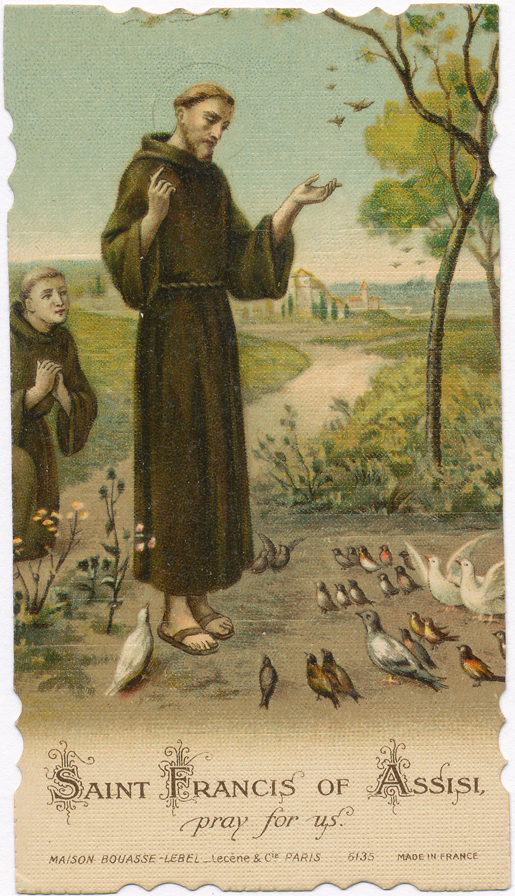
Visit St. Francis of Assisi Church in New York City, it has a breadline every morning and a shrine to St. Anthony. 135-139 West 31st Street, New York, NY 10001.

  • Mass Schedule: Features daily masses (7:30 am, 12:00 pm, 5:30 pm) and weekend masses (Sat Vigil 4 pm; Sun 8 am, 9:15 am Korean, 10 am Spanish, 11 am, 5 pm).
  • Ministries: Includes a Migrant Center, LGBTQ+ ministry, adult education, counseling, and a daily breadline for the hungry.
  • Significance: Known for its Franciscan, peaceful atmosphere in a busy area, a piece of World Trade Center steel, and wood sculptures of St. Jude and St. Anthony.
  • Livestream: Select Sunday masses (9:15 am, 11 am, 5 pm) are streamed online. 

The church is staffed by the Franciscan Friars of the Province of Our Lady of Guadalupe. 

Basilique Du Sacre Coeur De Montmartre

DID YOU KNOW?

Participate in a night of adoration

The vocation of the Basilica is to offer continuous Eucharistic adoration, day and night. Every evening, after the doors close at 11 p.m., the prayer relay continues in the Basilica, led by those who have signed up for the night of adoration (and are staying at the Basilica’s guesthouse).

Adoration at the Sacred Heart

Welcome, everyone, to this beautiful experience of nighttime adoration.

BOOKING FOR A NIGHT OF ADORATION

You will be accommodated at the Basilica guesthouse, in a dormitory or a single room, depending on your choice and availability. Bed linen is provided in both rooms and dormitories. Towels are only provided in rooms.

Registration at least 24 hours in advance:

  • by phone at +33 1 53 41 89 00 between 9 a.m. and 6 p.m.
  • or by email (especially for groups of more than 8 people) via the contact form.

You should receive confirmation of your registration by email or phone. Please note that without this confirmation, your request has not been validated. If we are unable to accommodate you on your chosen date, we will notify you and suggest an alternative date.

Useful information

There are many requests on weekends, and we have to turn down registrations almost every Friday and Saturday evening, but please note that we often have a shortage of worshipers on Monday, Tuesday, and Wednesday evenings.

Keep this in mind!

After registering, if you are unable to attend, please notify us by email as soon as possible so that others can register.

Schedules

ARRIVALDEPARTURE
8:30 p.m. to 9:30 p.m.until 9 a.m.

Contributions to expenses

ROOMS

ROOM WITH SINK AND SHOWERROOM WITH SINK, SHOWER, AND TOILET
Single room40 €45 €
Shared room35 €40 €
Children’s room (ages 3 to 17)20 €20 €
Price per person

DORMITORY

Dormitory box15 €
Price per person

Upon arrival at reception, payment can be made in cash, by check, or by credit card.

We are grateful to those who support the mission of our hospitality through their donations and participation beyond the indicated offerings.

Food service

2023 Staff Christmas Dinner

BREAKFAST

Between 7:00 a.m. and 8:30 a.m.Offered to anyone who participated in the night of adoration

DINNER

Reservations must be made 10 days in advance (15 days for groups).

Please ensure you arrive before 7:30 p.m., when dinner service begins.

DINNER OPTIONSSCHEDULEPARTICIPATION
Adult dinner7:30 p.m.15 €
Children’s dinner7:30 p.m.10 €

Upon arrival at reception, payment can be made in cash, by check, or by credit card.

Night of adoration Program

  • Reception: between 8:15 p.m. and 9:30 p.mGroups must check in at reception before 9 p.m.

When you arrive, you will be shown to your dormitory or room. Upon arrival, you will choose the time at which you wish to pray during the night between 11:00 p.m. and 6:00 a.m. (ensuring, along with us, that the prayer relay is respected). We will then give you your “pass.”

Important: Each time you come to participate in night adoration, you must pick up this personalized bracelet at the reception desk between 8:30 p.m. and 9:30 p.m. For organizational and security reasons, the reception desk closes at 9:30 p.m. and no exceptions can be made.

PARTICIPATING IN SPIRITUAL LIFE AND LITURGY
9:00 p.m.Spiritual introduction to the night of adoration (except Mondays)
9:30 p.m.Compline sung in the basilica (except Mondays)
10 p.m.Mass
From 11 p.m. to 7 a.m.Silent adoration by guests staying at the guesthouse. Each person keeps vigil for an hour—or more—in the basilica before the Blessed Sacrament, so that the prayer relay is never interrupted.
6:30 a.m.Opening of the basilica doors (departure possible)
7 a.m.Mass in the basilica
8 a.m.Morning services in the basilica (except Mondays)

We are delighted to welcome you to the night of adoration at the basilica… since August 1, 1885!

It is up to you to be the morning watchmen who announce the arrival of the sun, which is the risen Christ.
The light that Jesus speaks of in the Gospel is the light of faith, a free gift from God, which illuminates the heart and enlightens the mind.
A personal encounter with Christ illuminates our lives with new light, sets us on the right path, and commits us to be his witnesses.
The new way of looking at the world and at people, a way that comes from him, allows us to penetrate more deeply into the mystery of faith, which is an experience to be assimilated, a truth to be lived, the salt and light of all reality.SAINT JOHN PAUL IIPope

Statue de Sainte Marguerite-Marie Alacoque à la Basilique du Sacré-Cœur
Photo de la Basilique du Sacré-Cœur de nuit
Statue de Sainte Marguerite-Marie Alacoque à la Basilique du Sacré-Cœur
Photo de la Basilique du Sacré-Cœur de nuit
Statue de Sainte Marguerite-Marie Alacoque à la Basilique du Sacré-Cœur

Top of
the page

Basilique du Sacré-Cœur

Contact us35, rue du Chevalier de la Barre 75018 Paris

01 53 41 89 00

Feast of Our Lady of Pompeii

Gathered round the gentle person of Our Lady of Pompei, let us resolve to call on her every day for our needs and the needs of the world.

We are surrounded by a society that needs more than ever the light of the Gospel. Our world is seeking peace. There are so many sufferings that cry out for help. There is such a great longing for justice and charity!

We wish to entrust our hopes to Mary’s motherly intercession. With the repetition of the prayers of the Rosary, we will turn to Mary with the insistent, trusting prayer of a child to his mother.
—Cardinal Angelo Sodano

Prayer to Our Lady of Pompeii
Remember, O most gracious Virgin of the Rosary of Pompei, that never was it known that anyone who fled to your protection, implored your help, or sought your intercession through the Rosary was left unaided. Inspired with this confidence, I fly unto you, O Mother of Mercy, Virgin of virgins, powerful queen of Victories. To you I come, before you I stand: I implore compassion, I seek grace. O Mother of the Word Incarnate, despise not my petitions, but through your most holy Rosary, graciously hear and answer me.

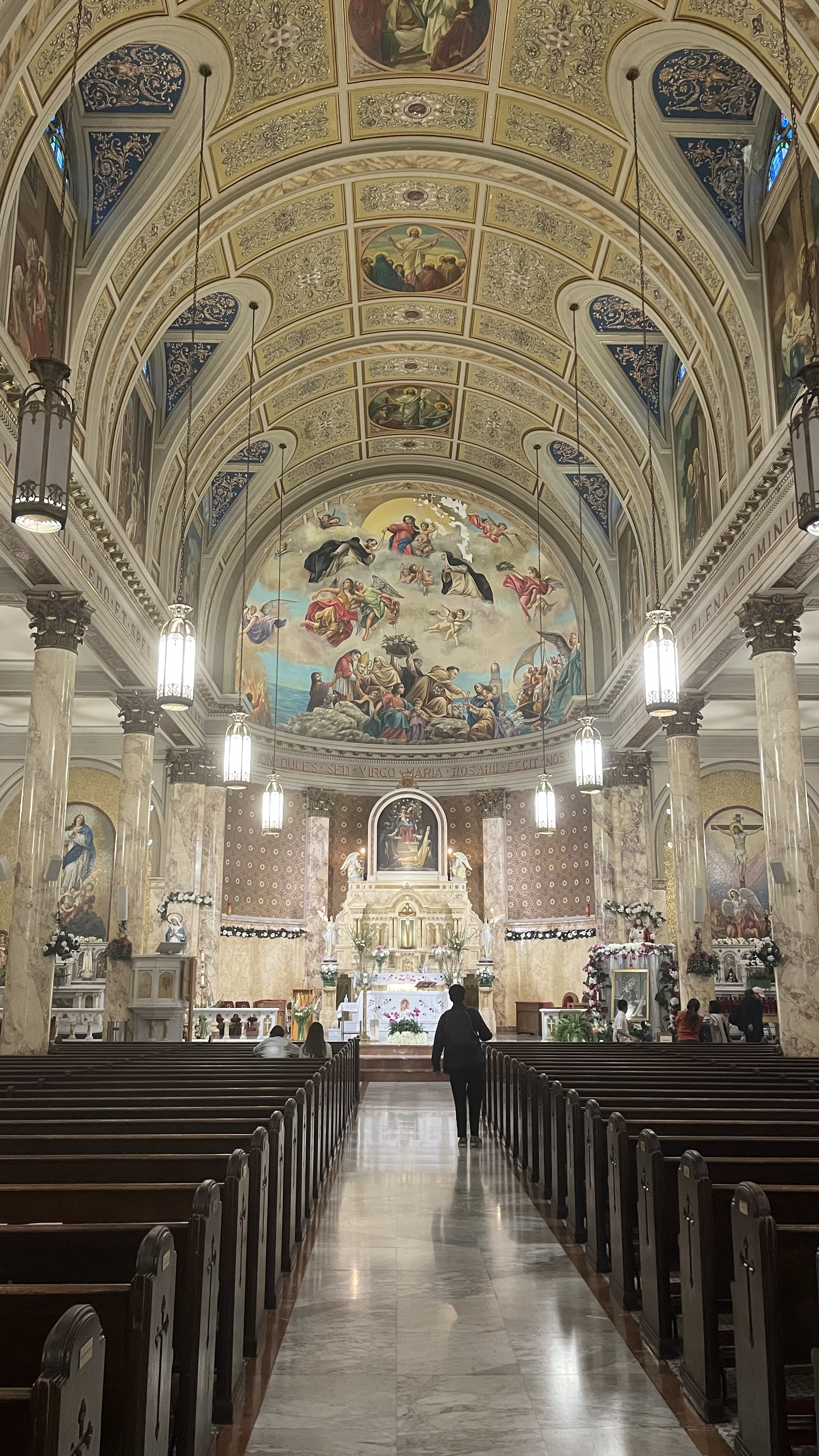
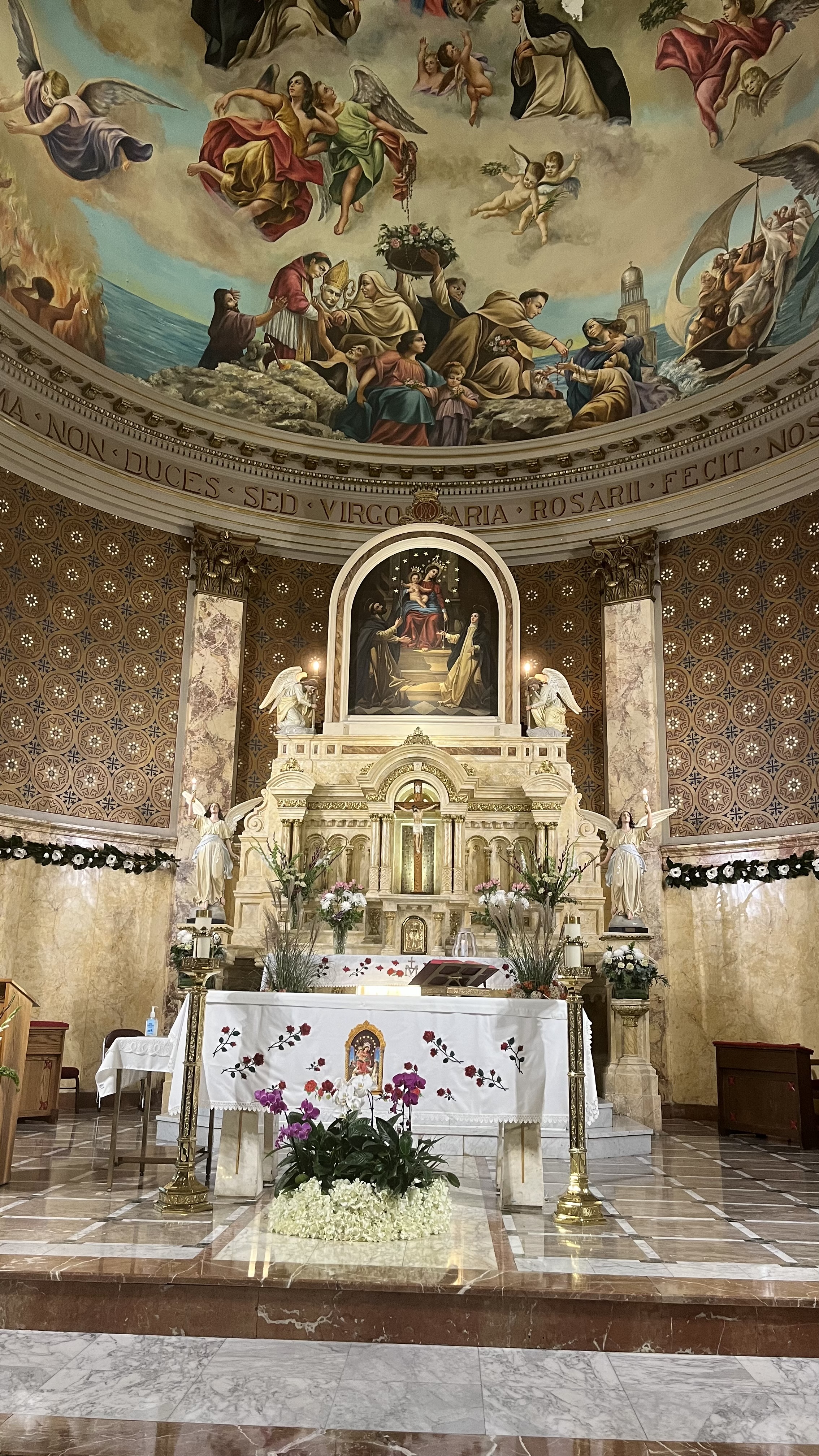
  • A Self-Guided Tour of Our Lady of Pompeii Church
  • 25 Carmine Street
  • NYC
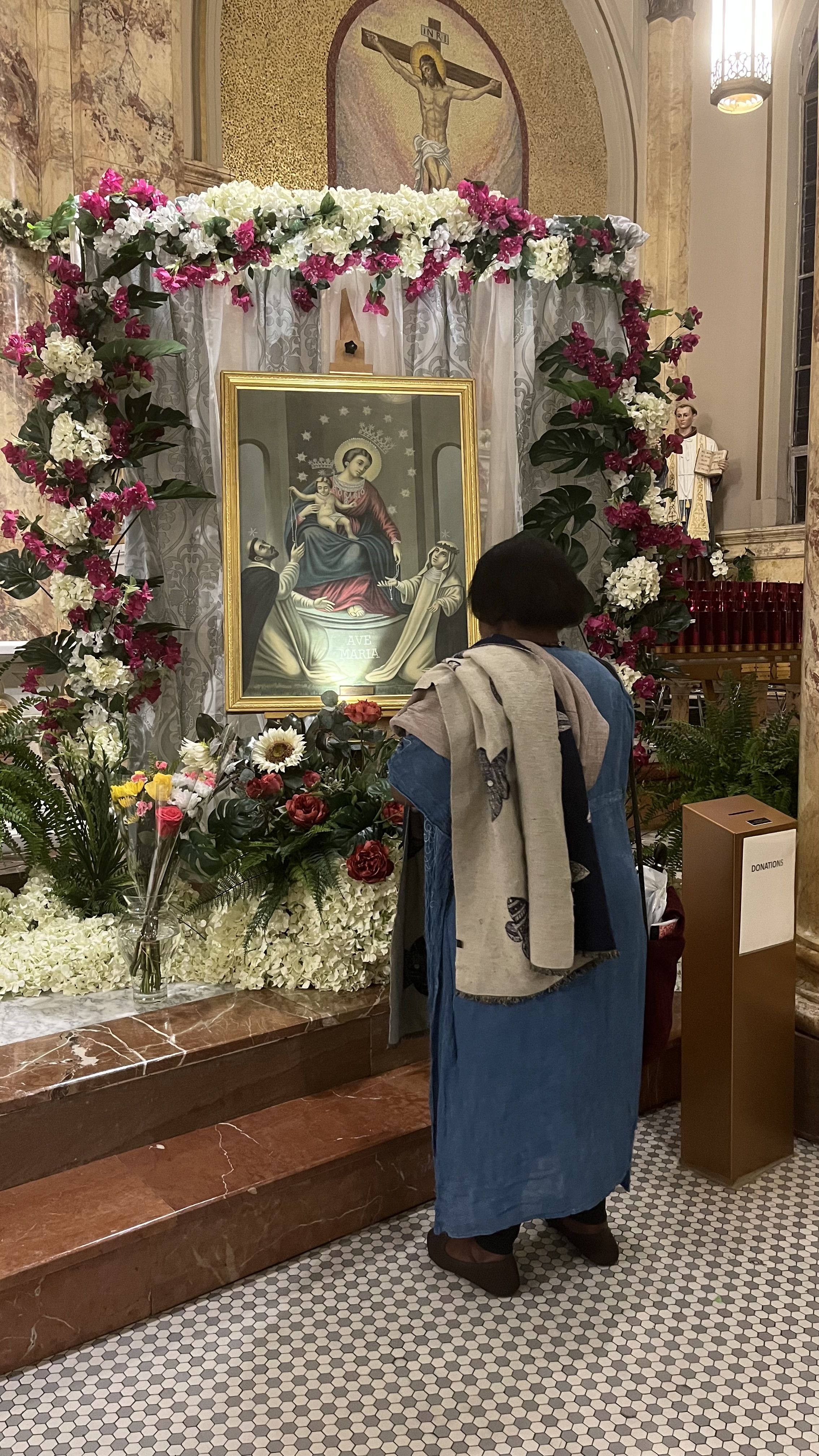
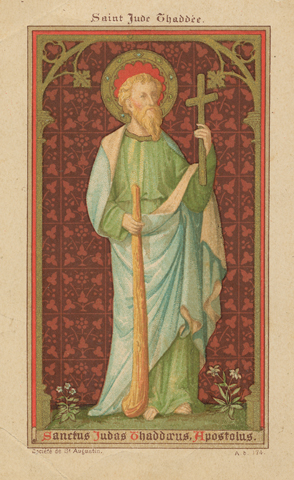
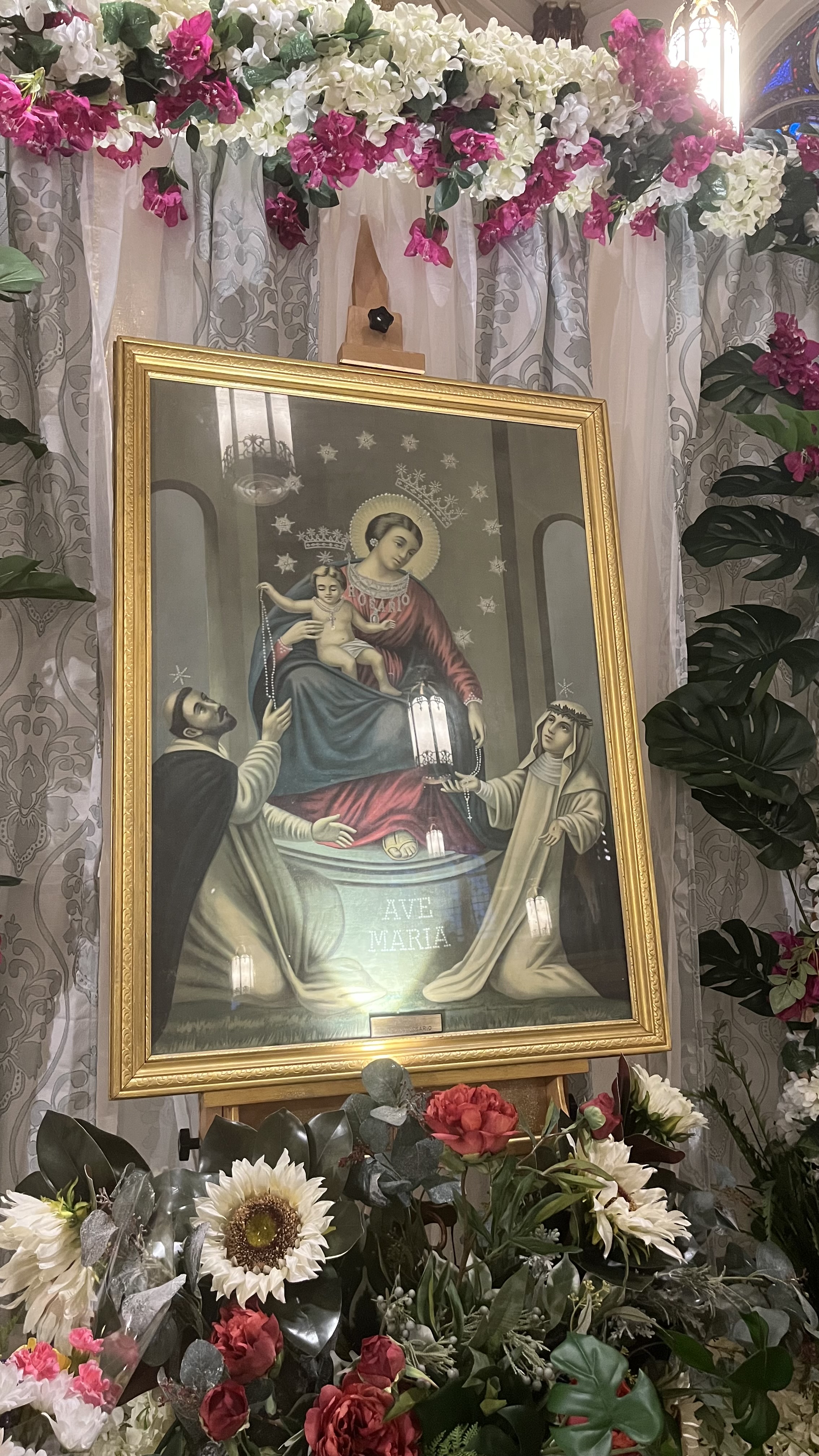
    Our Lady of Pompeii began in 1892 as the chapel of St. Raphael Society for the Protection of Italian Immigrants, which was located in a townhouse that is still standing at 113 Waverly Place. In 1895, Pompeii rented the former Bethel Methodist Colored Church at 214 Sullivan St., no longer standing. In 1898 it purchased a church that stood at 210 Bleecker Street, across from the southern end of Minietta Street nearby on the eastern side of Sixth Avenue. The church, which looked like a Greek Temple, was erected in 1836 for the Unitarian Universalists. In 1888 the Unitarians sold the church to the African American Roman Catholic congregation of St. Benedict the Moor. When the city condemned the church to extend Sixth Avenue, Pompeii erected this building, formally opening it October 7, 1928.The church’s architect was Mathew Del Gaudio, an Italian American graduate of Cooper Union active in his profession from 1905 to his death in 1960. Del Gaudio created a Romanesque building that would have reminded the earliest parishioners of Italy, with its shallow front steps and flat façade close to the street, its domed sanctuary, and its campanile, or bell tower. The figure on the roof is St. Charles Borromeo, patron saint of the order of priests that founded and staff Pompeii.Step in, look up, and you’ll see paintings celebrating the Rosary, the work of Professore Antonio D’Ambrosio, who was born in Italy and trained as an artist there. He opened his ecclesiastical arts company in 1928, specializing in creating artwork for churches, trained his children in the field, and passed the business along to them. D’Ambrosio’s descendants have returned to do restoration work on Pompeii’s art several times.The right wall’s images depict the Joyful Mysteries: the Annunciation, Visitation, Nativity, Presentation, and Finding Jesus in the Temple. Those on the left wall depict the Sorrowful Mysteries: Jesus’ Agony in the Garden, His Scourging, His Crowing with Thorn, His Carrying of the Cross, and His Crucifixion. On the ceiling are the Glorious Mysteries: the Resurrection, Ascension, Pentecost, Assumption, and the Crowning of the Blessed Virgin in Heaven.Above the altar is a complex construction. On the left and right of the mural, respectively, are images of the Church Suffering, the souls in Purgatory awaiting redemption, and the Church Triumphant, the saints in Heaven. The centerpiece is dedicated to the Church Militant, or the Church on Earth. Above the center is an image of Our Lady of the Rosary of Pompeii, with Jesus on her lap, both of them handing rosaries to St. Dominic and St. Catherine of Siena, early promoters of the rosary. Angels fly about them. Across the bottom are images associated with Pompeii parish, such as the building’s campanile. The figure in red on the right is St. Charles Borromeo. The bishop in white is Blessed John Baptist Scalabrini, founder of the priests who serve at Pompeii. The figure with the basket of roses is St. Martin de Porres, a tribute to the African American community whose church Pompeii purchased. To the left is a Franciscan friar, acknowledging that the Franciscans were the first ministers to New York’s Italians, at St. Anthony of Padua parish on Sullivan Street, a few blocks south of Pompeii. On the right is a galleon, a reminder that the Spanish credited their victory in the 1571 Battle of Lepanto to praying the rosary. The Latin phrase at the mural’s base translates as “Not Arms, Not Leaders, but the Virgin Mary of the Rosary Made us Victors.” Professore D’Ambrosio worked on this commission from 1934 to 1937, finishing with the painting of Jesus revealing His Sacred Heart to Saint Margaret Mary that is to the left as you come further into the church.Just behind you, near the entrance on the left, are statues indicative of the diversity of Pompei’s congregation. The centerpiece is a shrine to Mother Frances Cabrini, patroness of immigrants. Before her is a statue of Jesus Nazareno, an image revered among the Filipino immigrants who also worship at Pompeii. The statue of San Gaetano is a long ago gift from his devotees that cannot be dated. The statue of Saint Jude is a 1955 bequest from parishioner Catherine Brignole; Jude, patron of hopeless causes, was a popular saint in the mid twentieth century. The bust of Bishop Scalabrini also dates from 1955, and Scalabrini’s coat of arms on the column near the bust, from soon thereafter, but these represent the beginnings of devotion to someone who may yet be declared a saint.At the beginning of the wall on the left, or southwest, side of the church, are statues of two saints popular among Italians, St. Rose of Lima and St. Lucy. Then come the stained glass windows, work on which commenced in 1928, with the Stations of the Cross between them. (The Stations and windows actually “begin” at end of the wall nearer the altar if you want to skip ahead and walk back.) The stained glass window at the back of the church is important not only for its illustrations of four of the Beatitudes but for the donors associated with it. Carolina Perazzo, whose name appears on the window, was the daughter of funeral home director Carlo Baciagalupo. She married Giovanni Battista Perazzo, who learned the undertaking business from his wife and father-in-law, and opened his own funeral home at 199 Bleecker St. in Greenwich Village. The business is no longer in the family, but is still at 199 Bleecker St.Most of the topics of the stained glass windows are easily recognizable, but some require some insider knowledge of Pompeii. For example, see the window on the southwest wall given in honor of A. Agostino Gazzolo. The bishop in the window is Scalabrini, the two clergy are a Scalabrinian priest and brother, and the two nuns represent two orders Blessed Scalabrini encouraged: Mother Cabrini’s Missionaries of the Sacred Heart and the Apostles of the Sacred Heart, whose members taught in Pompeii’s school. The Gospel quotation references the Scalabrinians’ mission to help migrants preserve their faith in their new homes.Before turning to the altar, step into the room to the left, where there is a striking stained glass window and several more statues. St. Gerard’s statue came from the maternity ward on the 5thfloor of the Seton Building of St. Vincent de Paul; Greenwich Village’s hospital from 1849 to 2010; it is a gift from the hospital’s founders, the Sisters of Charity.The altar wall of the church consists of three parts. The mosaics of Assumption and of Jesus in Purgatory date from the tenure of Father Mario Albanese, pastor from 1952 to 1964. While you are at the Assumption altar, look at the wall to the left to see the fine mosaic of the Holy Family. In front of the image of the Assumption is one of Pompeii’s newest statues, that of Padre Pio, a Franciscan priest who was declared a saint in 2002. There is also an image of Our Lady of Guadalupe. Normally, that would indicate the presence of Mexican devotees, but during Pompeii’s earliest years, women from Chiavari, south of Genoa, practiced the devotion.Embedded in the marble pre-Vatican II altar is a painting of Our Lady of the Rosary that is an exact replica of the one at the shrine to Our Lady of the Rosary in Pompeii, Italy. The painting was an 1895 gift of heiress Annie Leary. Shortly after its installation, this parish received permission from the Italian shrine’s founder, Bartolomeo Longo, to promote itself as the American shrine. The painting first hung over the altar at the 210 Bleecker Street church mentioned earlier; it was cut to its present shape to fit the altar here.Pompei’s oldest statues cluster around the Purgatory image. Those of the Blessed Mother and St. John the Evangelist date from the 1880s and are part of a set that, together with the crucifix in the donor’s shrine near the church entrance, were fixtures at St. Benedict the Moor. The statues of the Sacred Heart and St. Joseph appear in a 1909 photograph of Pompeii.The stained glass windows to the right of the altar, Pompeii’s northeast wall, also reflect parish history. Note the windows depicting marriage vows and Pope Leo sending Mother Cabrini to the Americas, all given by relatives of Italian-American lawyer Edward Bergonzi, who, along with pioneer Italian immigrant Luigi Fugazy, was on Pompeii’s first board of trustees. The image of the priest in the window depicting marriage is that of Father Antonio Demo, who served at Pompeii from 1898 to 1936, most of the time as pastor; he led Pompeii in building this church. Perhaps after you have completed your visit here you can see the park named for him, diagonally across the street from the church.At the end of the row of Stations and windows is the donor’s shrine, and a plaque noting that Pompeii’s campanile was restored in honor of Vincent Gigante by his parents. He is better known as “Chin” Gigante, and was a leader in one of New York City’s organized crime families. His own family, though, included many other members who were part of the parish; before this plaque went up, another plaque, at the beginning of the Stations of the Cross, notes the Stations were refurbished in honor of Pietro Gigante.On your way out, look up. Above Pompeii’s doors are three stained glass windows. The one of Columbus giving thanks for having reached land in the Americas is a tribute to Pompeii’s Italian roots. The depiction of Ellis Island is a reminder of Pompeii’s commitment to immigrants. In the center is an image of the Holy Family on the Flight into Egypt, a reminder that Jesus, Mary and Joseph were once counted among the world’s migrants and refugees.  Dr. Mary Elizabeth Brown, PhD.