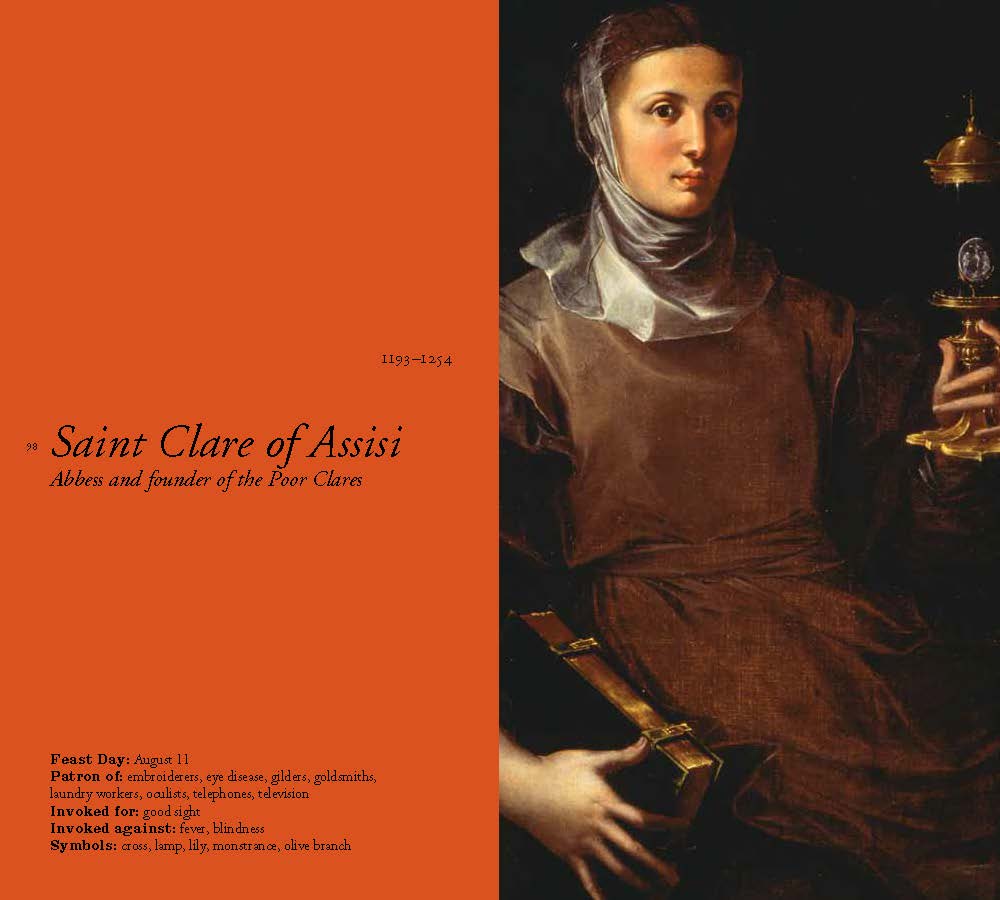
Together with her mentor and friend, Francis of Assisi, St. Clare shook the foundations of Medieval society by revolutionizing religious expression. Her given name, Chiara means clarity and we call on St. Clare whenever we need to shine a light on a situation or to find a way to communicate more clearly. She is also invoked to protect the blind and to help those with eye trouble.
Chiara Offreduccio, as the beautiful daughter of minor royalty was offered every worldly advantage available to one in her social class. When she heard St. Francis preach the Lenten service at her church in 1212, his simple message of living with complete trust in God inspired her to abandon going through with her arranged marriage in order to join the Franciscan movement. The first followers of Saint Francis were the wealthy sons of his town of Assisi. Their act of turning their backs on the material world to live at the mercy of the elements and on whatever alms they could beg was disturbing and controversial to both their families as well as to the church authorities. Attracted by the joyous way in which they comported themselves, as well as the enthusiasm they brought to religious worship, Clare was the first woman to join their order.
Fervently believing in a life devoted to the precepts of the gospel, the Franciscans did not believe in personal property. When Clare escaped her family to join them on Palm Sunday, Francis himself cut off her long blond hair and handed her the simple woolen robe worn by his followers. He then left her in the local Benedictine convent as there were no facilities in his order for women. It was not long before her entire family attempted an intervention type rescue of the girl. Revealing her shorn hair to her horrified father made them realize that she would never return to their world. Her younger sister, as well as other wellborn young women from the town soon followed her. In 1215, Saint Francis installed Clare as the Abbess of the Order of Poor Ladies. True to the Rule of St. Francis, they accepted no dowries from their families as other religious orders did. When they were left inheritances, the money was distributed to the poor. Highly intelligent, and known for the efficacy of her prayers, popes, cardinals, royalty and St. Francis himself came to her for spiritual advice. Her own correspondence shows her to be a clever, happy person.
Devoted to the Eucharist and frequently immersed in prayer, the stories of miraculous occurrences around Clare abound. The most famous is that while she was ill, her convent which was outside of the walls of Assisi was attacked by the Saracen mercenaries of Frederick II . As the invaders stormed the walls with ladders, Clare calmly held up a monstrance containing the host. A child’s voice emanated from inside the monstrance, “I will always guard and defend you.” A feeling of dread overtook the invaders and they ran away from the town. St. Clare was named the patron saint of television writers and workers due to a vision she had while too ill to attend Christmas Eve mass. She was able to view and hear the entire mass on the wall of her room. She spent much time embroidering linens for use in mass, so she is the patron of embroiderers. Because that trade is hard on the eyes and because of her name, she is the patron of those with eye problems and the blind.
Novena to St. Clare O Glorious St. Clare! God has given you the power of working miracles continually, and the favor of answering the prayers of those who invoke your assistance in misfortune, anxiety, and distress. We beseech you, obtain from Jesus through Mary His Blessed Mother, what we beg of you so fervently and hopefully, (mention your petition) if it be for the greater honor and glory of God and for the good of our souls. Amen
The Roman Catholic love and respect for the Virgin Mary divides it from other sects of Christianity. Mary is not only revered as the Mother of God but also as the Mother of all Humanity, and her image continually watches over every aspect in the daily life of Catholic countries. She is credited with working miracles through pictures, statues, and sacred earthly places. She is the inspiration of much of the world’s greatest music, art, and architectural works. Her spiritual gifts are recognized in the East and both Hindus and Buddhists refer to her as Mother Mary. Muslims revere her as the mother of a great prophet and she is the only woman with her own chapter in the Koran. As a human being Mary is able to relate directly to the major and minor sufferings of mankind. For this reason she is not prayed to as a goddess, but rather, called on by Catholics to aid them in their prayers. It is thought that she shares her constant flow of grace with those who ask, bringing them closer to God. Thomas Merton wrote, “Mary does not rule us from without, but from within. She does not change us by changing the world around us, but she changes the world around us by first changing our own inner lives.”
Contents
Introduction 8
Our Lady of Mount Carmel 24
Our Lady of Guadalupe 32
Our Lady of Cobre 42
Our Lady of Prompt Succor 48
The Miraculous Medal 54
Our Lady of La Salette 62
Our Lady of Lourdes 68
Our Lady of Perpetual Help 76
Our Lady of Pompeii 80
Portfolio 84
Our Lady of Knock 96
Our Lady of Fatima 98
Our Lady of Light 108
Our Lady of Akita 112
The Black Madonnas 116l Our Lady of Czestochowa 120
Saints, are looked upon as protectors, family members, and living examples of how an ordinary life can experience an extraordinary transformation. Since no one is born a saint, these holy people have made terrible mistakes with which we can all identify. There are murderers, gamblers, and alcoholics among their numbers. They have suffered unimaginable cruelties and conquered every problem in the human condition, from bad marriages to fatal illnesses. Many who lived dissolutely and scandalously before their conversion were rewarded with ridicule and persecution for turning their backs on conventional society. In emulation of Christ, they refused to compromise their spiritual beliefs to preserve their worldly comforts. Through it all they emerge triumphant, willing to help those on earth find God by praying for us and with us.
For more than two thousand years, the legends and stories of the Christian saints have greatly affected the course of Western civilization. The saints have influenced our holidays, our school systems, the boundaries of nations, our poetry, music, and visual arts. They have been great philosophers, uneducated savants, mystics, administrators, farmers, housewives, and soldiers, hailing from every social strata of society.
The stories of the ancient saints seem more like legends to us today and, indeed, these tales once served as the only form of popular entertainment. As a result, the exploits of these holy people became more grandiose and exaggerated upon each telling. Thousands of years ago there were few written accounts of saints’ lives. Most of their stories were told visually by painters, sculptors, and stained-glass artists who concentrated on the most imaginative and fantastic aspects of their biographies. For this reason a majority of saints are depicted with the power to overturn all natural laws. Saint Lucy calmly holds her eyeballs on a dish, Saint Nicholas raises three boys from the dead, and Saint Ursula is shot with arrows as she shields young girls under her cloak.
This haunting and dreamy iconography carried over in the depiction of modern saints as well. Visual portraits of the saints attempted to relay their stories with attributes or symbols contained in a single image. Saint Francis is often shown talking to animals or receiving the stigmata, Thérèse of Lisieux showers the viewer with roses, and Saint Anthony’s kindness is symbolized by the image of the Christ child, who sits in his arms. These visual portrayals of the saints are vital reminders of their earthly existence. One sees them everywhere, in private homes, in churches, on clothing and jewelry, and even on the exterior walls of buildings.
Every town and country has saints that are familiar to the local residents and obscure to the rest of us. Since it is estimated that there are more than ten thousand formally recognized saints, it was possible to profile only a very few for this book. Instead of brief biographies and images of many significant saints, we opted to go into detail about a varied handful that have an ongoing influence in modern life. The saints we have chosen are in no way the most important or exalted; many are extremely popular, some less well known. They bring with them a mix of personalities and ethnic cultures that reflect the makeup of today’s diverse society.
For this book, we have divided the first two thousand years of Christianity into ancient and modern time periods. The ancient saints span from prehistory to the year A.D. 1000. These saints tend to have more legendary aspects to their stories, resulting from the strong oral tradition in which they thrived. However, the modern saints are well documented by contemporary historical texts. These comprise the second thousand years. Some of these saints have influenced whole nations while others, through their particular state of life, encourage us to have a more personal relationship with them.
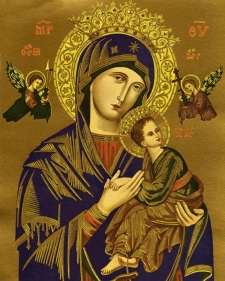
Our Lady of Perpetual Help Feast Day: June 27 Patronage: All Keywords: refuge, protection, motherly comfort, icon Quote: “Why don’t you just ask?” Symbols: lance, sponge, cross, nails, unfastened sandal
An icon is a visual prayer and this image of Mary comforting her young son in a moment of fear, brings consolation to anyone who meditates on it. On either side of Mary are the two Archangels, Michael holding the lance and spear and Gabriel holding nails and the cross Jesus will be crucified on. The child Jesus has been so frightened at the sight of these instruments of his future torment that he has run to his mother in tremendous haste, loosening his sandal. Though she is well aware that this suffering is in his future, Mary has such faith in his ultimate redemption that she calmly holds and reassures her son. If God himself can go to Mary for refuge, than anyone should be able to approach her. Her ultimate belief and faith extends to every one of us, no matter how harshly we may judge ourselves. Our Lady of Perpetual help is said to never refuse a request for help, great or trivial. Despite their reticence to invoke her aid, many have reported hearing Mary’s calm voice saying, “Why don’t you just ask?”
Copies of this miraculous icon can be found in tens of millions of homes all over the world. Though its age is unknown, it first made its appearance in the fifteenth century when it was brought to Rome by a wealthy merchant from Crete. His family eventually donated it to the Church of Saint Matthew in Rome. When that church was destroyed in the Napoleonic invasion of 1789, it was hidden by a priest. Sixty-four years later, its discovery so moved the Redemptorist Fathers who were building a new church on that site. Because of its great visual power, they made it their mission to disseminate this image all over the world. The original icon can be found today hanging in the Church of Saint Alphonse Liguori in Rome.
Novena to Our Lady Of Perpetual Help
See at Your feet, O Mother of Perpetual Help, a poor sinner who has recourse to you and confides in you.
O Mother of Mercy, have pity on me! I hear you called the refuge and the hope of sinners; be my refuge and my hope.
Help me, for the love of Jesus Christ; stretch forth your hand to a poor fallen creature recommends myself to you, and I devote myself to your service forever.
I| bless and thank Almighty God, who in His mercy had given me this confidence in you, which I hold to be a pledge of my eternal salvation.
Mary, tender Mother, help me. Mother of Perpetual Help, never allow me to lose my God.
Amen.
Recite the following prayers 3 times each… Our Father… Hail Mary… Glory Be…
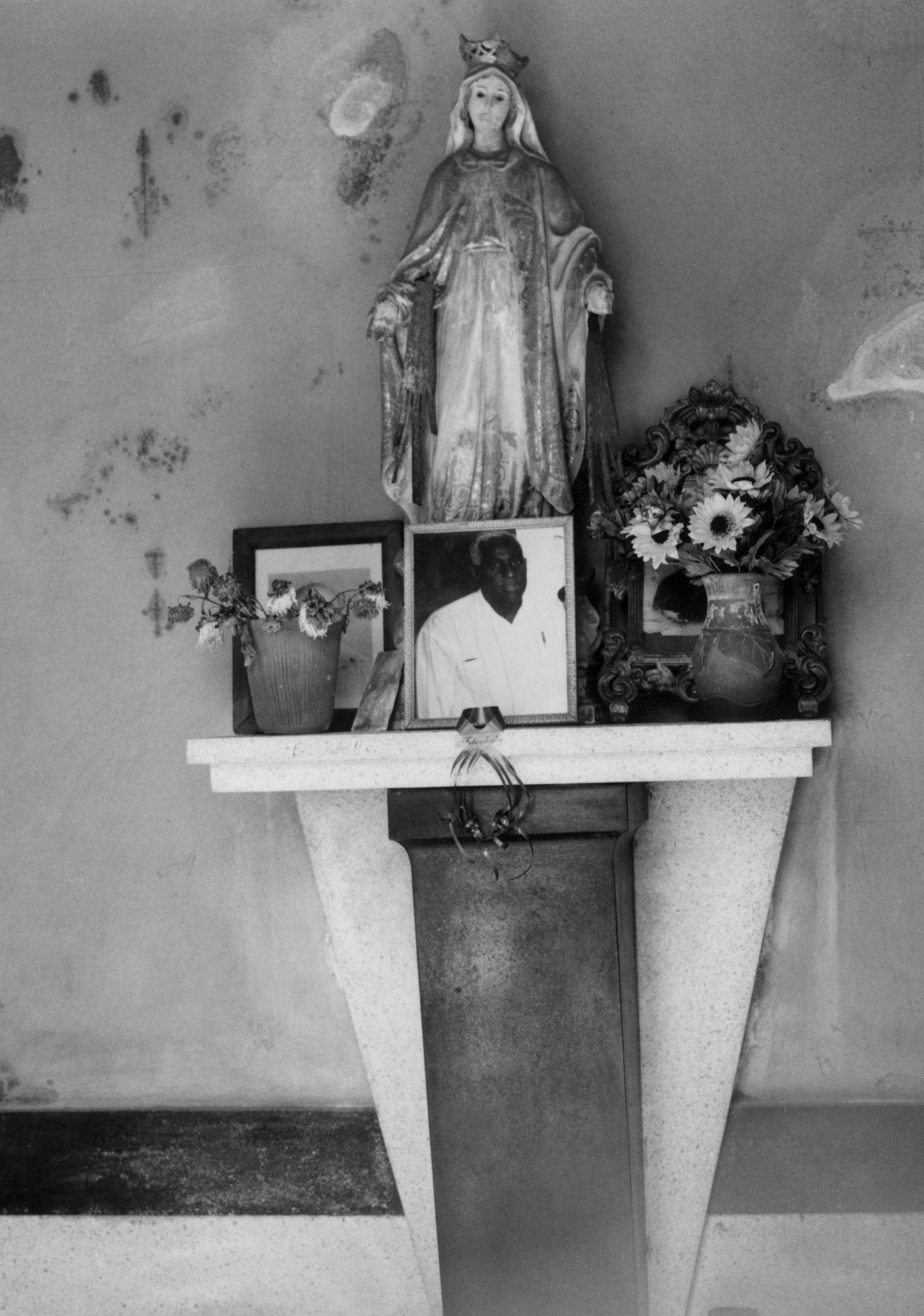
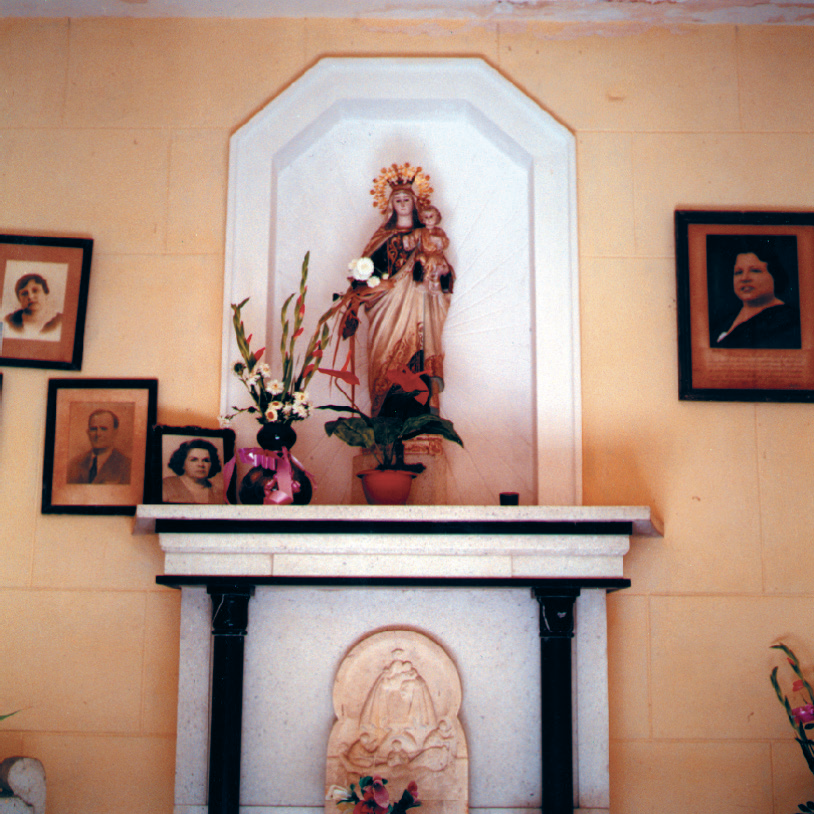
Home altar in Havana,Cuba Photographs by Lisa Silvestri
Altar in family mausoleum in Havana, Cuba Photograph by Lisa Silvestri
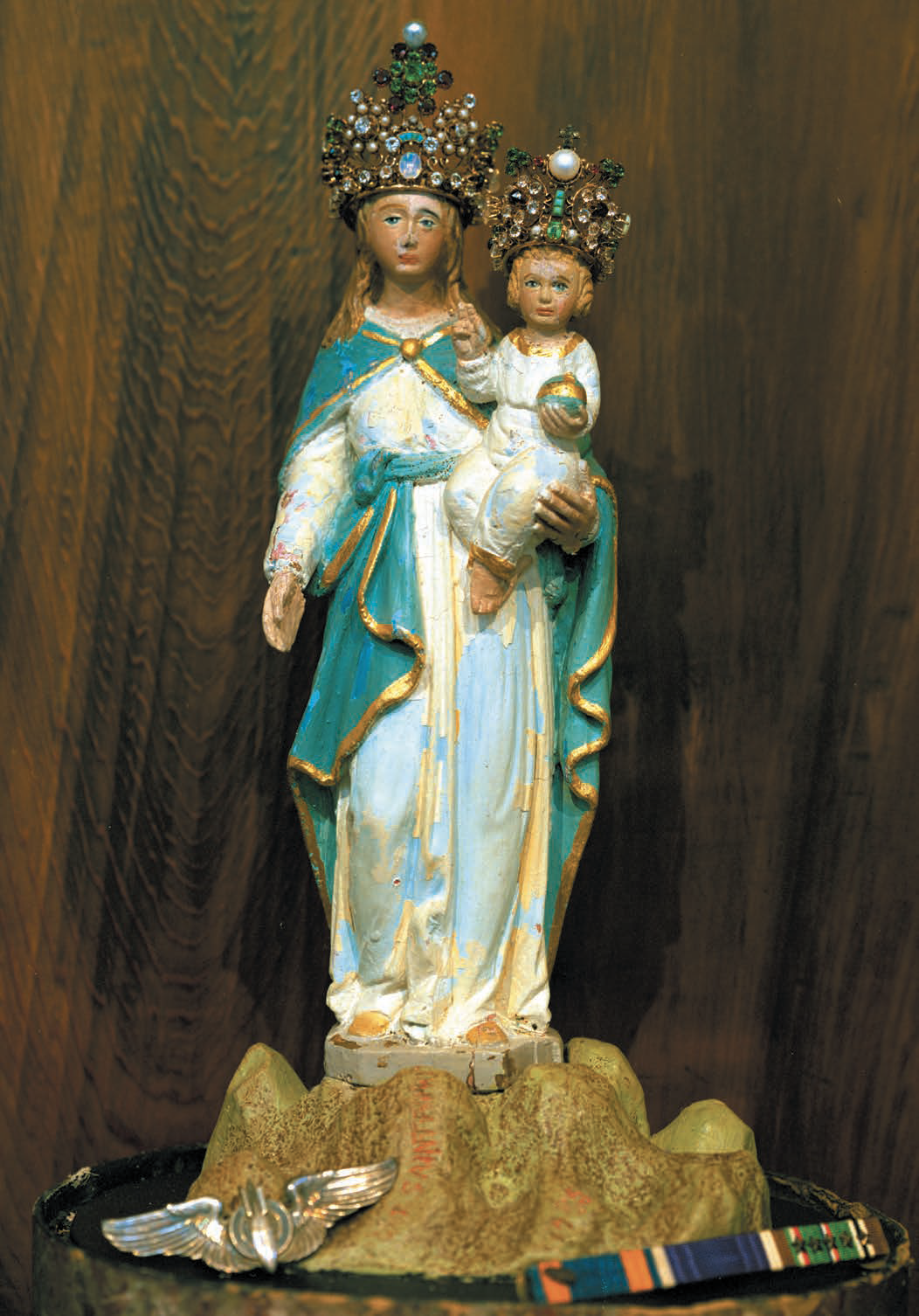
Religious Statues from the flea market in Mexico City, Mexico.
The “Sweetheart Statue” was brought to the Ursaline Convent in New Orleans in 1785.
visions of Mary Our Lady of Guadalupe
A traveler visiting Mexico or the American Southwest meets Our Lady of Guadalupe hundreds of times a day. Her image adorns the walls of businesses, is prominently displayed in homes, is on the hubcaps of cars, and at the center of small sidewalk shrines. This image of Mary is the preeminent cultural icon for most Latin Americans, sacred to Catholics and highly honored by non-Catholics, and it is the only apparition of Mary sanctioned by the Church on the North American continent.
On December 9, 1531, an Aztec convert to Catholicism named Juan Diego was on his way to early morning Mass in the area that is now known as Mexico City when he heard the sound of birds singing. When they quieted down, the hill at Tepeyac seemed to respond to their song. From the top of the hill a woman gently called to Diego, “Ihuantzin. Ihuan Diegotzin.” She was speaking the Aztec language of Nahuatl. As he approached her, he saw that she was an Indian noblewoman. He was amazed at how her clothes glimmered like the sun and how the rocks and foliage around her had a heightened glow. The crag where her foot rested gave off rays of light and the earth sparkled like a rainbow.
She spoke to him courteously and with great charm, “Know my dearest, littlest, and youngest son, I am the forever whole and perfect maiden Saint Mary, honorable mother of the true God, honorable mother of the giver of life, honorable mother of the creator of men and women, honorable mother of the one who is far and close, honorable mother of the one who makes the heavens and the earth. My wish is for them to build my temple here where I will give people all my love, compassion, assistance, and protection. I am the compassionate mother of you and your people here in this land and all of the other people who love me, call to me, search for me, and confide in me. I will listen to their pain, suffering, and crying and heal them from their misery.”
She then sent him to see the bishop to make the request for the church. After a long wait he related his story to the bishop who told him that he must obtain a sign proving that this was truly an appearance of Mary. Juan Diego returned to the woman on the hill and begged her to get someone more prestigious to give her message to the bishop. She told him that she had many people who could deliver her request, “but it is of precise detail that you yourself solicit and assist and that through your mediation my wish be complied.”
On his next visit to the bishop he was once again greeted with suspicion. When he left, the bishop sent servants to spy on him and to see to whom he was really speaking. But as soon as Juan Diego crossed the wooden bridge to the hill at Tepeyac, they lost sight of him. The next day, a Monday, Juan Diego decided to take another route around the hill in order to avoid the woman. His uncle had taken ill, and he needed medical attention. Juan Diego did not want the woman to detain him, as he feared that his uncle would die waiting for help. Much to his dismay, she came down the hill to meet him from where she was watching. When she asked him why he was so upset and why he was in such a rush, he sadly told her about his uncle’s illness and how his requests for her to the bishop had fallen on deaf ears.
Her answer was, “Listen, put it into your heart, youngest and dearest son, nothing should scare or concern you. Don’t worry. Don’t be afraid of the sickness, or any other illness or hardship. Am I not right here who is your mother? Are you not under my shadow and protection? Am I not in the foundation of your being, your sustenance, your happiness, peace, and effortlessness? Are you not in the fold of my garment? Do you need anything else? Don’t allow anything to worry or disturb you anymore. Don’t worry about your uncle’s illness. He will not die. Be assured, he is already well.”
She then told Juan Diego to gather roses among the rocks. He was surprised to find them in full bloom since it was winter. She carefully arranged them in Juan Diego’s cloak and he brought them to the bishop. After another humiliating wait, he was finally granted an audience. As he unwrapped his cloak and the roses fell out, the bishop gasped. The flowers uncovered an elaborate portrait of the Virgin Mary imprinted on the cloak. The bishop fell to his knees in tears and begged Juan Diego’s forgiveness. The bishop then insisted on being taken to the hill where the lady from heaven wanted her temple. After he had done this, Juan Diego ran home to his sick uncle and was quite shocked to see him happy and healthy. His uncle told him that a heavenly lady had come to heal him, asking him to tell the bishop of his cure. She also wanted him to convey the proper name for her image: The Perfect Virgin Holy Mary of Guadalupe.
The bishop had the church built and the cloth put on public display where it immediately attracted crowds of pilgrims. Almost as suddenly, the Franciscans, who had been in Mexico for the past ten years and who had very little previous success, were receiving thousands of Aztecs who wanted to convert to Catholicism. This cloth and its image, which should have deteriorated in twenty years, is still on view at the Basilica of Our Lady of Guadalupe in Mexico City. After almost five hundred years it remains in pristine condition. Attracting more than ten million pilgrims a year, Our Lady of Guadalupe is the most popular Marian shrine in the world.
At the time of this apparition of Mary, the Aztecs, the original inhabitants of Mexico City, had been suffering brutally under domination of the Spanish colonialists. Disease and depression were rampant. Hernán Cortés, the conquistador, had landed in 1519 and had succeeded in destroying much of the Aztec civilization by 1521. Why, then, were the Aztecs eventually such willing converts to Catholicism? The Aztecs had hundreds of gods in their pantheon. It was their spiritual habit to co-opt the gods of tribes that they conquered. They believed that their own god Huitzilopochtli depended on human sacrifices to be kept alive. They invaded neighboring tribes to obtain these victims. As they as a people became more aggressive against their neighbors, the gods of the Aztecs took on more monstrous forms. Portrayals of the female gods became the most frightening and grotesque. When the Spanish arrived in the Aztec city, they were amazed at its beauty and grace, and equally horrified at the blood-soaked temples with the racks of human skulls and demonic-looking statuary. All Aztec places of worship were considered satanic and systematically destroyed.
The hill where Mary appeared was once the site of the goddess Tonzantin. She was considered a household god, the goddess of corn and fertility. With Our Lady of Guadalupe, the feminine traits of love, compassion, and forgiveness were returned to spirituality and the sick-at-heart population had an entity to whom they could take their sorrow.
Statue of Blessed Juan Diego wearing the tilma with the imprint of Our Lady of Guadalupe. Following pages: Statues being sold at a flea market, an outdoor shrine with Our Lady of Guadalupe surrounded by lights so that she can be worshiped at night.
The portrait of Our Lady of Guadalupe conveyed a message interpreted differently by Aztecs and Europeans, yet triggered the same spiritual response. To the Aztecs, the basic announcement that Mary was making with this image was the dawning of the age of the Sixth Sun. Dividing up their history into solar ages, it was thought that the Fifth Sun, the Sun of Movement, ended with the Spanish conquest. Since the birth of a new sun always follows a time of darkness, it was believed that the appearance of Mary after ten years of destruction signaled the beginning of the Sun of Flowers. According to their lore, this was a time when humanity would come into its own and bloom. In this image, Mary wears a belt worn by pregnant women, thus announcing the birth of a new age. Gold-leaf Nahuatl glyphs symbolizing plenitude appear on her gown. They are arranged over her womb in a pattern that represented the four points of a compass, a basic symbol in the Aztec faith. The womblike light she is wrapped in, the rays of the sun and the crest of the moon, the folds of her robe and the subdued serpent all had hidden messages that were easy for the Aztecs to read. Her eyes do not stare ahead as depictions of the gods do; rather she is looking down at humanity, much as a mother looks at her child. Her hands are in a praying position that the Aztecs used to signify something coming from one’s heart. The fact that her robe is touching the angel signifies protection and love.
For the Christians the iconography of this image was directly related to the book of Revelation where John says, “A great sign appeared in the heavens, a woman clothed with the sun.” This image is associated with the Immaculate Conception. December 9, the first day of her appearance, was also the original day devoted to the Feast of the Immaculate Conception. The halo Mary is wrapped in is called a mandorla. Originally, this type of almond-shaped body halo represented the cloud in which Christ ascended; in time it came to signify the light that emanates from those divinely inspired. In Western art it is used to depict those with a complete bond to Christ. As the Mother of God, Mary is exalted above all angels, offering her protection and love to humanity.
By appearing as a mixed-race woman, Mary was announcing the new face of Catholicism. The brutal, fundamentalist way that Catholicism was practiced by the Spanish was softened. In her appearance Mary was reminding the Europeans that they had the same mother that the Aztecs did. She was the first Christian image that the Mesoamericans could relate to, and the messages embedded in her picture offered hope, love, and comfort to a people when these qualities had been driven out of their own religion.
Our Lady of Guadalupe is the patroness of Mexico, North and South America, and the Caribbean.
The Feast of Our Lady of Guadalupe is December 12, the day the miraculous cloth was revealed.
Barbara and I wanted Visions of Mary to be a book about how the Virgin Mary affects people in their everyday lives. In the United States and countries around the world, images of Mary are displayed among family photographs. For this reason, we chose not to use the great art works and paintings that have been created in her honor. Rather, we sought photographs of “everyday Marys.”. The photographer Lisa Silvestri after a trip to Mexico, Cuba, and New Orleans returned with countless beautiful images. It helped set the visual tone for our book. We are grateful to Lisa.
We also worked with Dr. Joseph Sciorra of the Calandra Center in New York City. Sharing his research on the black Madonnas of Southern Italy, and introduced us to the work of two wonderful photographers, Larry Raccioppo of New York City and Dana Salvo of Gloucester, Massachusetts, who are included in this book.
Diane Block, photo archivist at The Museum of New Mexico, was a big help in finding photographs for this book.
We bring this book to you with the help of the people mentioned above. We hope you find something in this book to love and are inspired by, as you go through your life. We will post a chapter every month.
Barbara and Sandy
Hail Mary Full of Grace! the Lord is with you; Blessed are you among women, and blessed is the fruit of your womb Jesus. Holy Mary, Mother of God, pray for us sinners, now and at the hour of our death. Amen.
Our Lady of Mount Carmel
Mount Carmel, in what is today northern Israel, has always been a place rich in mystical tradition. The word hakkarmel means “the garden” in Hebrew, and true to its title, there is a remarkable profusion of plants and wildflowers on this mountain. It is considered a natural paradise and a sacred place, and in biblical times it was forbidden to disturb any of the natural life on it. Those who wanted to ascend the mountain for meditation lived in caves so as not to intrude on the landscape with unnatural structures.
In about 860 b.c., the prophet Elijah (also known as Elias) arrived on this holy mountain to begin a life of contemplation and prayer. The First Book of Kings is filled with tales of wonders he performed and prophesies he gave. In his prophetic visions on Mount Carmel, Elijah became aware of the coming of the mother of the Messiah. He and his followers mystically dedicated themselves to her, setting an example as the first monks. The descendants of these ancient contemplatives were among the first to accept the teachings of Christ and to be baptized by His apostles. Upon meeting Mary after Christ’s Ascension, they were so overcome by her sanctity that they returned to the mountain to build a chapel in her honor. For the next thousand years Mount Carmel continued to be a place where hermits devoted themselves to prayer.
By the twelfth century, pilgrims from Europe who had followed the Crusades to the Holy Land settled with the ascetics on Carmel and started a religious holy order known as Brothers of the Blessed Virgin Mary of Mount Carmel. Their rule, which was given in 1209 by the Patriarch of Jerusalem, says that all converges toward the contemplation of God. The Rule of Mysticism exhorts those who fol-low it to live a life of continual prayer, obedience to a superior, perpetual abstinence and fasting, manual work, and total silence.
of their order to the laypeople; it served as a reminder that belief in Mary as the Mother of God extended back to the Old Testament with the prophet Elijah. After Pope John XXII (r. 1316–1334) had a vision of Mary where she promised those wearing the brown scapular, “I, the Mother of Grace, shall descend on the Saturday after their death and whomsoever I find in Purgatory, I shall free, so that I may lead them to the holy mountain of everlasting life,” the scapular became extremely popular among the common people. By the end of the sixteenth century it had become smaller in size and very similar to the one that is worn today. Admiration for the Carmelite Order spread as their adherence to the rules of solitude and prayer produced some of the greatest mystical saints in Catholicism, all of whom had visions of or openhearted communications with Mary. Among them are Saint Simon Stock, Saint Teresa, Saint John of the Cross, and Saint Thérèse of Lisieux.
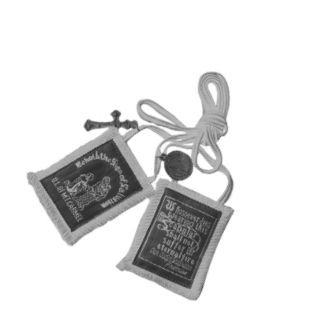
Though the original scapular handed to Saint Simon Stock was brown wool cloth without a picture, the Carmelite scapular that is now worn and the one that is most favored now has an image of Our Lady of Mount Carmel holding the Baby Jesus while she offers the scapular. The other piece of cloth often has a picture of Jesus as a man. Neither image is prescribed. Wearing the scapular is a form of prayer and is considered a visible sign of consecrating oneself to Mary and to accepting her maternal protection. Devotion to Our Lady of Carmel can be found wherever the Carmelites founded a monastery or convent. Many small towns in Italy have churches named after this aspect of Mary. As the townspeople emigrated to other countries, they brought the devotion with them. In many cities in the United States these churches have great celebrations in honor of Our Lady of Mount Carmel. Artistic representations of Our Lady of Mount Carmel depict her either appearing in the sky over Mount Carmel itself or holding Jesus as a toddler. In both versions the figure of Mary is often depicted offering the scapular to the viewer. Tradition has it that the prophet Elijah saw Mary appear in the clouds over Mount Carmel eight hundred years before her birth. Sometimes this representation includes her handing the scapular to Saint Simon Stock. The other version of this aspect of Mary illustrates the Sabbatine privilege where Mary vows to take the souls of those who died wearing the brown scapular out of purgatory on the Saturday after their death. Purgatory is depicted in flames because it is a place where the soul goes to have its sins burned away.
Simon Stock, an English pilgrim, had joined the group on a visit to Jerusalem. At this time, Saracen invaders forced the monks out of their spiritual home on Mount Carmel. All those who would not leave were murdered. Simon Stock was instrumental in getting the order to move to Aylesford, England, where the Baron de Grey gave them a manor house. The Carmelite lifestyle of contemplation, poverty, and silent prayer was not easily accepted in Europe, particularly among the clergy who enjoyed almost the same status and privilege as royalty. Reading into the life of Mary, Simon Stock was inspired by her unquestioning acceptance of all that befell her: her virgin pregnancy; her raising and loving a child doomed to be executed; and her staying at the foot of the Cross while others ran away. It was through his insistence that the Carmelites evolved from a band of hermit ascetics who regretted the loss of their home on Mount Carmel into a traveling society of mendicant friars, opening schools and mission houses in the major capitals of Europe. Still, it was difficult for many monks to accept the alteration of the rule of the order to adapt to European conditions. Their presence was also shunned and not easily tolerated by other religious orders. The people thought these hermits strange and did not accept that they chose to live in such absolute poverty and isolation. In order to preserve what was left of their order, the Carmelites invoked their patroness, the Virgin Mary, for help in establishing their new life. The answer came in a vision to Saint Simon Stock on July 16, 1251, when he was alone in his cell. Mary appeared to him holding the scapular of his order. She told him, “Receive my beloved son, this habit of thy order: this shall be to thee and to all Carmelites a privilege, that whosoever dies clothed in this shall never suffer eternal fire. . . .It shall be a sign of salvation, a protection in danger, and a pledge of peace.”
The scapular, two pieces of brown wool joined at the shoulders and hanging down the back and breast, was not new to the Carmelite order. For hundreds of years before Saint Simon Stock’s vision, monks in Europe had worn scapulars. But it is thought that the brown scapular that Mary delivered was referencing Elijah’s camel-hair garment on Mount Carmel. Eventually, the brown scapular became reduced in size for laypeople to wear under their clothing. This is a special devotion to Mary worn as a sign to commemorate her faith in both God and humankind.
Our Lady of Mount Carmel is the patroness of the Carmelite Order, Chile, and Bolivia. Her feast day is July 16.
Invoked for: finding a husband, finding lost articles
Invoked against: debt, shipwreck, starvation
Symbols: baby Jesus, book of Gospels, lily
Wonder and miracles are infused with every story of Saint Anthony. Though he has been dead for almost 800 years, he is still the most popular saint in the world and his statue is found in every Catholic Church. Saint Anthony is best known as the patron saint of lost articles but he is invoked for help in all life situations. In his own day he was called the “Wonder Worker’ and credited with the ability to stop the rain, raise the dead and reattach severed limbs. He was such a charismatic preacher that when a crowd of heretics in Rimini refused to listen to his preaching, the fish raised themselves out of the water to hear him.
Born Fernando de Bulhes in Lisbon, Portugal, he disappointed his noble family by rejecting his luxurious life and joining the Augustinian religious order. A scholar by nature, he read every book in the monastery, devoting his time to contemplative prayer. Eventually, he befriended a group of itinerant Franciscan monks and became fascinated with this new religious order. Much impressed by their dedication to simplicity, poverty and their belief in returning to the original words of Christ, he joined their ranks, changing his name to Anthony in honor of Saint Anthony of the Desert, the patron of their little church. Returning home from a failed missionary venture in Morocco, his ship was blown off course and he wound up in Messina, Sicily. A group of Franciscan friars insisted he go north with them for a great gathering of all Franciscans, with their founder Francis of Assisi.
Anthony remained in Italy and discovered his great gift of preaching when a superior ordered him to speak at an ordination, telling him to say whatever the holy spirit had infused into him. He astonished his audience, not only by his skills as an orator but by the depth of his knowledge. He was sent throughout northern Italy and southern France on evangelical preaching missions which gathered crowds in the tens of thousands. His popularity among the people increased as he used his position to get real changes enacted for their protection. While based in Padua, he observed the crushing power of debt upon the common people. At Anthony’s insistence, the local municipality enacted a law protecting those who could not pay their debts that is still enforced today.
Anthony exhausted himself preaching out in fields and in piazzas as there was not cathedral large enough to hold all who came to hear him. At the age of thirty six, his health began to fail him and a local Count donated a woodland retreat for his recovery. One morning the Count heard the sounds of a baby giggling and he looked out to see Anthony surrounded in light, playing with the baby Jesus. That Christ would choose to appear to one of his saints in such a vulnerable state is a testament to the loving and kind nature of Saint Anthony. Because he is depicted holding a baby, women having trouble conceiving invoke his aid. Being of Portuguese descent, Anthony’s feast day is very auspicious for marriages in Portugal and Brazil and in those cultures, he is known to assist women seeking a husband.
According to legend, Saint Anthony earned the title patron saint of lost articles when a novice borrowed his psalter and failed to return it. Saint Anthony prayed to get it back and the novice was visited by terrifying visions that sent him running back to Anthony with the book. In iconography, Anthony always holds the baby Jesus and a lily for purity. Many times the returned book of the gospels is included.
Novena to Saint Anthony of Padua
Holy Saint Anthony, gentle and powerful in your help, Your love for God and charity for His creatures, made you worthy when on earth, to possess miraculous powers. Miracles waited on your word, which you were always ready to request for those in trouble or anxiety. Encouraged by this thought, I implore you to obtain for me (mention your request here). The answer to my prayer may require a miracle. Even so, you are the saint of miracles. Gentle and loving Saint Anthony, whose heart is ever full of human sympathy, take my petition to the Infant Savior for whom you have such a great love, and the gratitude of my heart will be ever yours.
Amen
It is customary to donate to Saint Anthony’s Bread, a charity started in Saint Anthony’s lifetime, in gratitude to answered novena prayers.
Visit St. Francis of Assisi Church in New York City, it has a breadline every morning and a shrine to St. Anthony. 135-139 West 31st Street, New York, NY 10001.
Mass Schedule: Features daily masses (7:30 am, 12:00 pm, 5:30 pm) and weekend masses (Sat Vigil 4 pm; Sun 8 am, 9:15 am Korean, 10 am Spanish, 11 am, 5 pm).
Ministries: Includes a Migrant Center, LGBTQ+ ministry, adult education, counseling, and a daily breadline for the hungry.
Significance: Known for its Franciscan, peaceful atmosphere in a busy area, a piece of World Trade Center steel, and wood sculptures of St. Jude and St. Anthony.
Gathered round the gentle person of Our Lady of Pompei, let us resolve to call on her every day for our needs and the needs of the world.
We are surrounded by a society that needs more than ever the light of the Gospel. Our world is seeking peace. There are so many sufferings that cry out for help. There is such a great longing for justice and charity!
We wish to entrust our hopes to Mary’s motherly intercession. With the repetition of the prayers of the Rosary, we will turn to Mary with the insistent, trusting prayer of a child to his mother. —Cardinal Angelo Sodano
Prayer to Our Lady of Pompeii Remember, O most gracious Virgin of the Rosary of Pompei, that never was it known that anyone who fled to your protection, implored your help, or sought your intercession through the Rosary was left unaided. Inspired with this confidence, I fly unto you, O Mother of Mercy, Virgin of virgins, powerful queen of Victories. To you I come, before you I stand: I implore compassion, I seek grace. O Mother of the Word Incarnate, despise not my petitions, but through your most holy Rosary, graciously hear and answer me.
A Self-Guided Tour of Our Lady of Pompeii Church
25 Carmine Street
NYC Our Lady of Pompeii began in 1892 as the chapel of St. Raphael Society for the Protection of Italian Immigrants, which was located in a townhouse that is still standing at 113 Waverly Place. In 1895, Pompeii rented the former Bethel Methodist Colored Church at 214 Sullivan St., no longer standing. In 1898 it purchased a church that stood at 210 Bleecker Street, across from the southern end of Minietta Street nearby on the eastern side of Sixth Avenue. The church, which looked like a Greek Temple, was erected in 1836 for the Unitarian Universalists. In 1888 the Unitarians sold the church to the African American Roman Catholic congregation of St. Benedict the Moor. When the city condemned the church to extend Sixth Avenue, Pompeii erected this building, formally opening it October 7, 1928.The church’s architect was Mathew Del Gaudio, an Italian American graduate of Cooper Union active in his profession from 1905 to his death in 1960. Del Gaudio created a Romanesque building that would have reminded the earliest parishioners of Italy, with its shallow front steps and flat façade close to the street, its domed sanctuary, and its campanile, or bell tower. The figure on the roof is St. Charles Borromeo, patron saint of the order of priests that founded and staff Pompeii.Step in, look up, and you’ll see paintings celebrating the Rosary, the work of Professore Antonio D’Ambrosio, who was born in Italy and trained as an artist there. He opened his ecclesiastical arts company in 1928, specializing in creating artwork for churches, trained his children in the field, and passed the business along to them. D’Ambrosio’s descendants have returned to do restoration work on Pompeii’s art several times.The right wall’s images depict the Joyful Mysteries: the Annunciation, Visitation, Nativity, Presentation, and Finding Jesus in the Temple. Those on the left wall depict the Sorrowful Mysteries: Jesus’ Agony in the Garden, His Scourging, His Crowing with Thorn, His Carrying of the Cross, and His Crucifixion. On the ceiling are the Glorious Mysteries: the Resurrection, Ascension, Pentecost, Assumption, and the Crowning of the Blessed Virgin in Heaven.Above the altar is a complex construction. On the left and right of the mural, respectively, are images of the Church Suffering, the souls in Purgatory awaiting redemption, and the Church Triumphant, the saints in Heaven. The centerpiece is dedicated to the Church Militant, or the Church on Earth. Above the center is an image of Our Lady of the Rosary of Pompeii, with Jesus on her lap, both of them handing rosaries to St. Dominic and St. Catherine of Siena, early promoters of the rosary. Angels fly about them. Across the bottom are images associated with Pompeii parish, such as the building’s campanile. The figure in red on the right is St. Charles Borromeo. The bishop in white is Blessed John Baptist Scalabrini, founder of the priests who serve at Pompeii. The figure with the basket of roses is St. Martin de Porres, a tribute to the African American community whose church Pompeii purchased. To the left is a Franciscan friar, acknowledging that the Franciscans were the first ministers to New York’s Italians, at St. Anthony of Padua parish on Sullivan Street, a few blocks south of Pompeii. On the right is a galleon, a reminder that the Spanish credited their victory in the 1571 Battle of Lepanto to praying the rosary. The Latin phrase at the mural’s base translates as “Not Arms, Not Leaders, but the Virgin Mary of the Rosary Made us Victors.” Professore D’Ambrosio worked on this commission from 1934 to 1937, finishing with the painting of Jesus revealing His Sacred Heart to Saint Margaret Mary that is to the left as you come further into the church.Just behind you, near the entrance on the left, are statues indicative of the diversity of Pompei’s congregation. The centerpiece is a shrine to Mother Frances Cabrini, patroness of immigrants. Before her is a statue of Jesus Nazareno, an image revered among the Filipino immigrants who also worship at Pompeii. The statue of San Gaetano is a long ago gift from his devotees that cannot be dated. The statue of Saint Jude is a 1955 bequest from parishioner Catherine Brignole; Jude, patron of hopeless causes, was a popular saint in the mid twentieth century. The bust of Bishop Scalabrini also dates from 1955, and Scalabrini’s coat of arms on the column near the bust, from soon thereafter, but these represent the beginnings of devotion to someone who may yet be declared a saint.At the beginning of the wall on the left, or southwest, side of the church, are statues of two saints popular among Italians, St. Rose of Lima and St. Lucy. Then come the stained glass windows, work on which commenced in 1928, with the Stations of the Cross between them. (The Stations and windows actually “begin” at end of the wall nearer the altar if you want to skip ahead and walk back.) The stained glass window at the back of the church is important not only for its illustrations of four of the Beatitudes but for the donors associated with it. Carolina Perazzo, whose name appears on the window, was the daughter of funeral home director Carlo Baciagalupo. She married Giovanni Battista Perazzo, who learned the undertaking business from his wife and father-in-law, and opened his own funeral home at 199 Bleecker St. in Greenwich Village. The business is no longer in the family, but is still at 199 Bleecker St.Most of the topics of the stained glass windows are easily recognizable, but some require some insider knowledge of Pompeii. For example, see the window on the southwest wall given in honor of A. Agostino Gazzolo. The bishop in the window is Scalabrini, the two clergy are a Scalabrinian priest and brother, and the two nuns represent two orders Blessed Scalabrini encouraged: Mother Cabrini’s Missionaries of the Sacred Heart and the Apostles of the Sacred Heart, whose members taught in Pompeii’s school. The Gospel quotation references the Scalabrinians’ mission to help migrants preserve their faith in their new homes.Before turning to the altar, step into the room to the left, where there is a striking stained glass window and several more statues. St. Gerard’s statue came from the maternity ward on the 5thfloor of the Seton Building of St. Vincent de Paul; Greenwich Village’s hospital from 1849 to 2010; it is a gift from the hospital’s founders, the Sisters of Charity.The altar wall of the church consists of three parts. The mosaics of Assumption and of Jesus in Purgatory date from the tenure of Father Mario Albanese, pastor from 1952 to 1964. While you are at the Assumption altar, look at the wall to the left to see the fine mosaic of the Holy Family. In front of the image of the Assumption is one of Pompeii’s newest statues, that of Padre Pio, a Franciscan priest who was declared a saint in 2002. There is also an image of Our Lady of Guadalupe. Normally, that would indicate the presence of Mexican devotees, but during Pompeii’s earliest years, women from Chiavari, south of Genoa, practiced the devotion.Embedded in the marble pre-Vatican II altar is a painting of Our Lady of the Rosary that is an exact replica of the one at the shrine to Our Lady of the Rosary in Pompeii, Italy. The painting was an 1895 gift of heiress Annie Leary. Shortly after its installation, this parish received permission from the Italian shrine’s founder, Bartolomeo Longo, to promote itself as the American shrine. The painting first hung over the altar at the 210 Bleecker Street church mentioned earlier; it was cut to its present shape to fit the altar here.Pompei’s oldest statues cluster around the Purgatory image. Those of the Blessed Mother and St. John the Evangelist date from the 1880s and are part of a set that, together with the crucifix in the donor’s shrine near the church entrance, were fixtures at St. Benedict the Moor. The statues of the Sacred Heart and St. Joseph appear in a 1909 photograph of Pompeii.The stained glass windows to the right of the altar, Pompeii’s northeast wall, also reflect parish history. Note the windows depicting marriage vows and Pope Leo sending Mother Cabrini to the Americas, all given by relatives of Italian-American lawyer Edward Bergonzi, who, along with pioneer Italian immigrant Luigi Fugazy, was on Pompeii’s first board of trustees. The image of the priest in the window depicting marriage is that of Father Antonio Demo, who served at Pompeii from 1898 to 1936, most of the time as pastor; he led Pompeii in building this church. Perhaps after you have completed your visit here you can see the park named for him, diagonally across the street from the church.At the end of the row of Stations and windows is the donor’s shrine, and a plaque noting that Pompeii’s campanile was restored in honor of Vincent Gigante by his parents. He is better known as “Chin” Gigante, and was a leader in one of New York City’s organized crime families. His own family, though, included many other members who were part of the parish; before this plaque went up, another plaque, at the beginning of the Stations of the Cross, notes the Stations were refurbished in honor of Pietro Gigante.On your way out, look up. Above Pompeii’s doors are three stained glass windows. The one of Columbus giving thanks for having reached land in the Americas is a tribute to Pompeii’s Italian roots. The depiction of Ellis Island is a reminder of Pompeii’s commitment to immigrants. In the center is an image of the Holy Family on the Flight into Egypt, a reminder that Jesus, Mary and Joseph were once counted among the world’s migrants and refugees. Dr. Mary Elizabeth Brown, PhD.
Having refused to marry at 15, Clare was moved by the dynamic preaching of Francis. He became her lifelong friend and spiritual guide.
At 18, Clare escaped from her father’s home one night, was met on the road by friars carrying torches, and in the poor little chapel called the Portiuncula received a rough woolen habit, exchanged her jeweled belt for a common rope with knots in it, and sacrificed her long tresses to Francis’ scissors. He placed her in a Benedictine convent, which her father and uncles immediately stormed in rage. Clare clung to the altar of the church, threw aside her veil to show her cropped hair, and remained adamant.
Sixteen days later her sister Agnes joined her. Others came. They lived a simple life of great poverty, austerity, and complete seclusion from the world, according to a Rule which Francis gave them as a Second Order. At age 21, Francis obliged Clare under obedience to accept the office of abbess, one she exercised until her death.
The Poor Ladies went barefoot, slept on the ground, ate no meat, and observed almost complete silence. Later Clare, like Francis, persuaded her sisters to moderate this rigor: “Our bodies are not made of brass.” The greatest emphasis, of course, was on gospel poverty. They possessed no property, even in common, subsisting on daily contributions. When even the pope tried to persuade Clare to mitigate this practice, she showed her characteristic firmness: “I need to be absolved from my sins, but I do not wish to be absolved from the obligation of following Jesus Christ.”
Contemporary accounts glow with admiration of Clare’s life in the convent of San Damiano in Assisi. She served the sick and washed the feet of the begging nuns. She came from prayer, it was said, with her face so shining it dazzled those about her. She suffered serious illness for the last 27 years of her life. Her influence was such that popes, cardinals, and bishops often came to consult her—Clare herself never left the walls of San Damiano.
Francis always remained her great friend and inspiration. Clare was always obedient to his will and to the great ideal of gospel life which he was making real.
A well-known story concerns her prayer and trust. Clare had the Blessed Sacrament placed on the walls of the convent when it faced attack by invading Saracens. “Does it please you, O God, to deliver into the hands of these beasts the defenseless children I have nourished with your love? I beseech you, dear Lord, protect these whom I am now unable to protect.” To her sisters she said, “Don’t be afraid. Trust in Jesus.” The Saracens fled.
Words are never large enough or small enough to write you but I try again. buona sera, good evening. I always think about you at this time of sunset. It is during this hour that I put aside everything about the day which is not important and hold to my heart our inner path, the love we know. It is a good practice. I can safely say that my small light in the garden of my heart has become a diamond. I feel quite strong and God shines very bright. In a few hours in the dark of night, I will be sinking inside to our Lord in gratitude. Then I go to sleep. Thank you, Francis, for leading me on this path of chasing God, instead of worldly things. Thank you for showing me it is not really a chase at all, but rather a great finding, finding God always very close at hand, as close as my heart.
Saint Clare, a wealthy woman from the central Italian town of Assisi, gave up all her possessions to pursue the goals of poverty and service preached by Saint Francis. She founded an order of nuns known as the Poor Clares, which was recognized by the Pope in 1253. This painting depicts the vision of the death of Saint Clare as experienced by one of her followers, Sister Benvenuta of Diambra.
In the vision of Saint Benvenuta, the Virgin Mary and a procession of virgin martyrs appeared to Saint Clare on her deathbed. Here Mary, dressed in a rich brocade robe, supports Saint Clare’s head, while the other elegantly robed and crowned saints follow behind, identified by the tiny attributes they hold.
The work of the Master of Heiligenkreuz, who was probably active in Lower Austria, illustrates the cosmopolitan aspect of the International Style, which flourished around 1400. While his exaggerated figures with their bulbous foreheads and clinging drapery are characteristically Austrian, the anonymous painter must also have been aware of the most advanced art produced at the courts of Paris and Prague. Thus the surface of the panel is worked in a variety of different techniques to fashion a particularly splendid object.
More information on this painting can be found in the Gallery publication German Paintings of the Fifteenth through Seventeenth Centuries, which is available as a free PDF
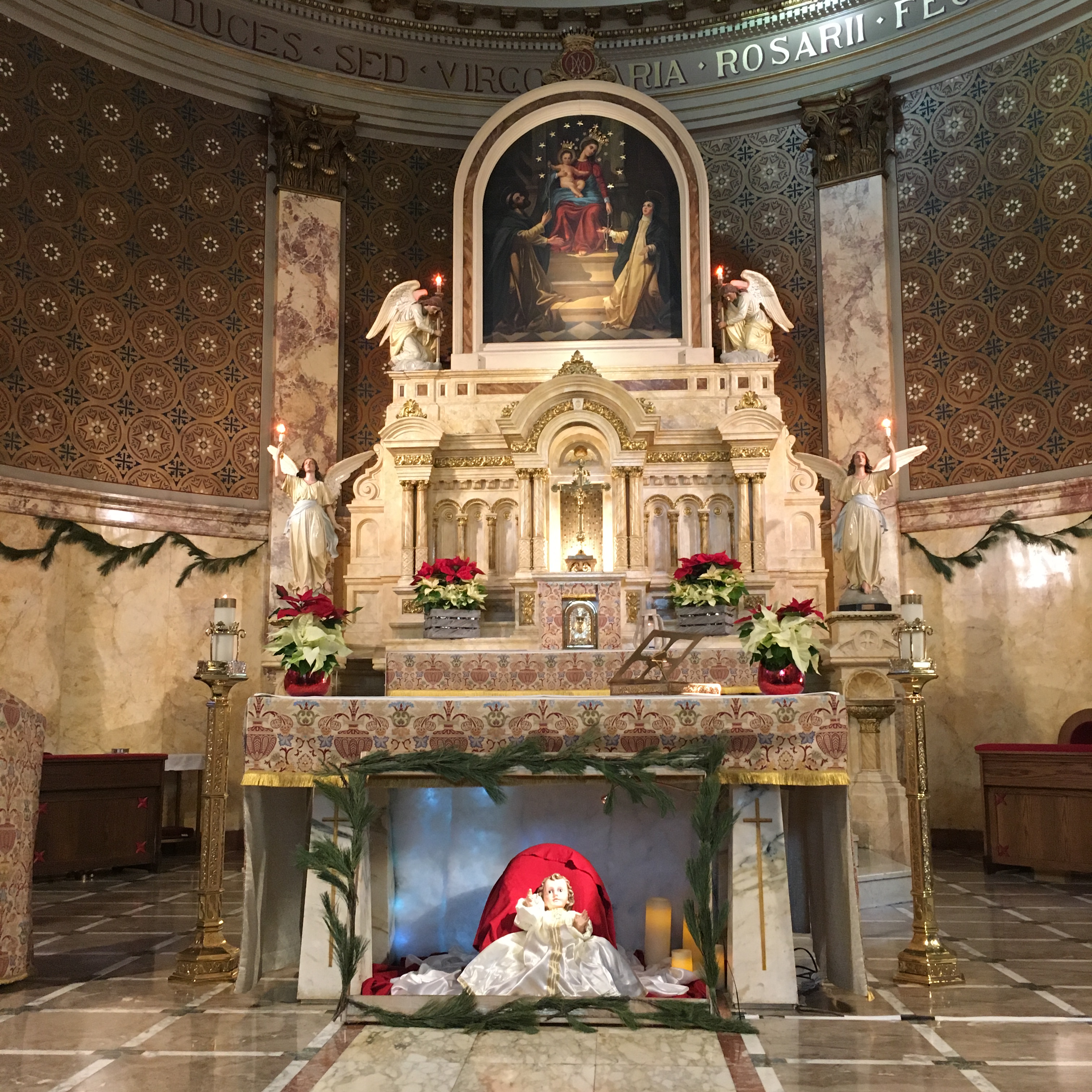
Our Lady of Pompeii began in 1892 as the chapel of St. Raphael Society for the Protection of Italian Immigrants, which was located in a townhouse that is still standing at 113 Waverly Place. In 1895, Pompeii rented the former Bethel Methodist Colored Church at 214 Sullivan St., no longer standing. In 1898 it purchased a church that stood at 210 Bleecker Street, across from the southern end of Minietta Street nearby on the eastern side of Sixth Avenue. The church, which looked like a Greek Temple, was erected in 1836 for the Unitarian Universalists. In 1888 the Unitarians sold the church to the African American Roman Catholic congregation of St. Benedict the Moor. When the city condemned the church to extend Sixth Avenue, Pompeii erected this building, formally opening it October 7, 1928.The church’s architect was Mathew Del Gaudio, an Italian American graduate of Cooper Union active in his profession from 1905 to his death in 1960. Del Gaudio created a Romanesque building that would have reminded the earliest parishioners of Italy, with its shallow front steps and flat façade close to the street, its domed sanctuary, and its campanile, or bell tower. The figure on the roof is St. Charles Borromeo, patron saint of the order of priests that founded and staff Pompeii.Step in, look up, and you’ll see paintings celebrating the Rosary, the work of Professore Antonio D’Ambrosio, who was born in Italy and trained as an artist there. He opened his ecclesiastical arts company in 1928, specializing in creating artwork for churches, trained his children in the field, and passed the business along to them. D’Ambrosio’s descendants have returned to do restoration work on Pompeii’s art several times.The right wall’s images depict the Joyful Mysteries: the Annunciation, Visitation, Nativity, Presentation, and Finding Jesus in the Temple. Those on the left wall depict the Sorrowful Mysteries: Jesus’ Agony in the Garden, His Scourging, His Crowing with Thorn, His Carrying of the Cross, and His Crucifixion. On the ceiling are the Glorious Mysteries: the Resurrection, Ascension, Pentecost, Assumption, and the Crowning of the Blessed Virgin in Heaven.Above the altar is a complex construction. On the left and right of the mural, respectively, are images of the Church Suffering, the souls in Purgatory awaiting redemption, and the Church Triumphant, the saints in Heaven.
The centerpiece is dedicated to the Church Militant, or the Church on Earth. Above the center is an image of Our Lady of the Rosary of Pompeii, with Jesus on her lap, both of them handing rosaries to St. Dominic and St. Catherine of Siena, early promoters of the rosary. Angels fly about them. Across the bottom are images associated with Pompeii parish, such as the building’s campanile. The figure in red on the right is St. Charles Borromeo. The bishop in white is Blessed John Baptist Scalabrini, founder of the priests who serve at Pompeii. The figure with the basket of roses is St. Martin de Porres, a tribute to the African American community whose church Pompeii purchased. To the left is a Franciscan friar, acknowledging that the Franciscans were the first ministers to New York’s Italians, at St. Anthony of Padua parish on Sullivan Street, a few blocks south of Pompeii. On the right is a galleon, a reminder that the Spanish credited their victory in the 1571 Battle of Lepanto to praying the rosary. The Latin phrase at the mural’s base translates as “Not Arms, Not Leaders, but the Virgin Mary of the Rosary Made us Victors.” Professore D’Ambrosio worked on this commission from 1934 to 1937, finishing with the painting of Jesus revealing His Sacred Heart to Saint Margaret Mary that is to the left as you come further into the church.Just behind you, near the entrance on the left, are statues indicative of the diversity of Pompei’s congregation.
The centerpiece is a shrine to Mother Frances Cabrini, patroness of immigrants. Before her is a statue of Jesus Nazareno, an image revered among the Filipino immigrants who also worship at Pompeii. The statue of San Gaetano is a long ago gift from his devotees that cannot be dated. The statue of Saint Jude is a 1955 bequest from parishioner Catherine Brignole; Jude, patron of hopeless causes, was a popular saint in the mid twentieth century. The bust of Bishop Scalabrini also dates from 1955, and Scalabrini’s coat of arms on the column near the bust, from soon thereafter, but these represent the beginnings of devotion to someone who may yet be declared a saint.At the beginning of the wall on the left, or southwest, side of the church, are statues of two saints popular among Italians, St. Rose of Lima and St. Lucy. Then come the stained glass windows, work on which commenced in 1928, with the Stations of the Cross between them. (The Stations and windows actually “begin” at end of the wall nearer the altar if you want to skip ahead and walk back.) The stained glass window at the back of the church is important not only for its illustrations of four of the Beatitudes but for the donors associated with it. Carolina Perazzo, whose name appears on the window, was the daughter of funeral home director Carlo Baciagalupo. She married Giovanni Battista Perazzo, who learned the undertaking business from his wife and father-in-law, and opened his own funeral home at 199 Bleecker St. in Greenwich Village. The business is no longer in the family, but is still at 199 Bleecker St.Most of the topics of the stained glass windows are easily recognizable, but some require some insider knowledge of Pompeii. For example, see the window on the southwest wall given in honor of A. Agostino Gazzolo. The bishop in the window is Scalabrini, the two clergy are a Scalabrinian priest and brother, and the two nuns represent two orders Blessed Scalabrini encouraged:
Mother Cabrini’s Missionaries of the Sacred Heart and the Apostles of the Sacred Heart, whose members taught in Pompeii’s school. The Gospel quotation references the Scalabrinians’ mission to help migrants preserve their faith in their new homes.Before turning to the altar, step into the room to the left, where there is a striking stained glass window and several more statues. St. Gerard’s statue came from the maternity ward on the 5thfloor of the Seton Building of St. Vincent de Paul; Greenwich Village’s hospital from 1849 to 2010; it is a gift from the hospital’s founders, the Sisters of Charity.The altar wall of the church consists of three parts. The mosaics of Assumption and of Jesus in Purgatory date from the tenure of Father Mario Albanese, pastor from 1952 to 1964. While you are at the Assumption altar, look at the wall to the left to see the fine mosaic of the Holy Family. In front of the image of the Assumption is one of Pompeii’s newest statues, that of Padre Pio, a Franciscan priest who was declared a saint in 2002. There is also an image of Our Lady of Guadalupe. Normally, that would indicate the presence of Mexican devotees, but during Pompeii’s earliest years, women from Chiavari, south of Genoa, practiced the devotion.
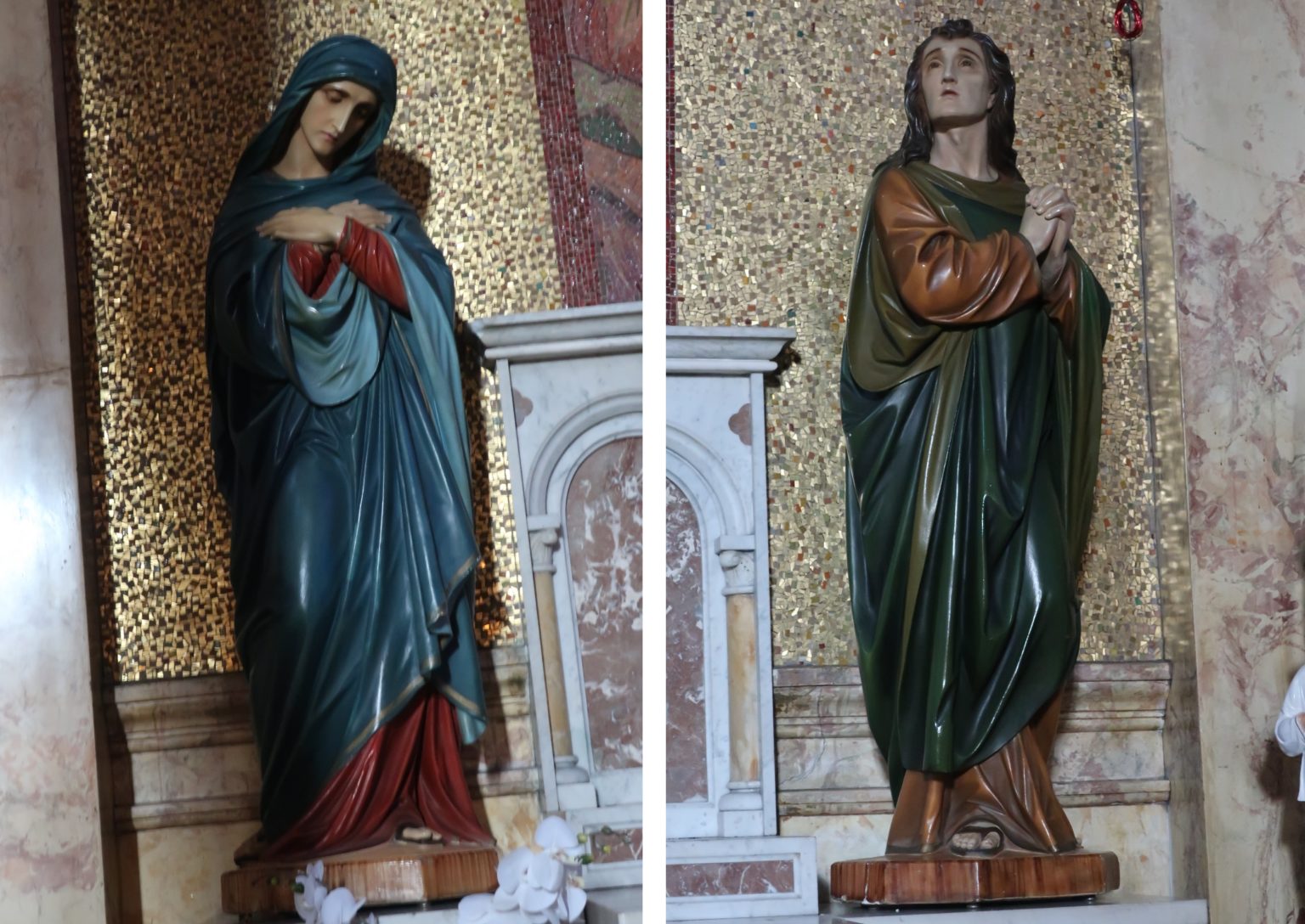
Embedded in the marble pre-Vatican II altar is a painting of Our Lady of the Rosary that is an exact replica of the one at the shrine to Our Lady of the Rosary in Pompeii, Italy. The painting was an 1895 gift of heiress Annie Leary. Shortly after its installation, this parish received permission from the Italian shrine’s founder, Bartolomeo Longo, to promote itself as the American shrine. The painting first hung over the altar at the 210 Bleecker Street church mentioned earlier; it was cut to its present shape to fit the altar here.Pompei’s oldest statues cluster around the Purgatory image. Those of the Blessed Mother and St. John the Evangelist date from the 1880s and are part of a set that, together with the crucifix in the donor’s shrine near the church entrance, were fixtures at St. Benedict the Moor. The statues of the Sacred Heart and St. Joseph appear in a 1909 photograph of Pompeii.The stained glass windows to the right of the altar, Pompeii’s northeast wall, also reflect parish history. Note the windows depicting marriage vows and Pope Leo sending Mother Cabrini to the Americas, all given by relatives of Italian-American lawyer Edward Bergonzi, who, along with pioneer Italian immigrant Luigi Fugazy, was on Pompeii’s first board of trustees. The image of the priest in the window depicting marriage is that of Father Antonio Demo, who served at Pompeii from 1898 to 1936, most of the time as pastor; he led Pompeii in building this church. Perhaps after you have completed your visit here you can see the park named for him, diagonally across the street from the church.
At the end of the row of Stations and windows is the donor’s shrine, and a plaque noting that Pompeii’s campanile was restored in honor of Vincent Gigante by his parents. He is better known as “Chin” Gigante, and was a leader in one of New York City’s organized crime families. His own family, though, included many other members who were part of the parish; before this plaque went up, another plaque, at the beginning of the Stations of the Cross, notes the Stations were refurbished in honor of Pietro Gigante.On your way out, look up. Above Pompeii’s doors are three stained glass windows. The one of Columbus giving thanks for having reached land in the Americas is a tribute to Pompeii’s Italian roots. The depiction of Ellis Island is a reminder of Pompeii’s commitment to immigrants. In the center is an image of the Holy Family on the Flight into Egypt, a reminder that Jesus, Mary and Joseph were once counted among the world’s migrants and refugees. Dr. Mary Elizabeth Brown, PhD.
In 1927, in order to extend Sixth Avenue south to Canal Street, the city tore down the 210 Bleecker Street building that Saint Benedict’s and Pompeii had occupied, and Pompeii moved to its present church. In 1979, St. Benedict’s contacted Pompeii regarding the other two statues in the original Crucifixion scene. The late Brother Michael La Mantia, c.s., oversaw the statues’ transfer to the present Pompeii church. The pastor at the time, the late Father Edward Marino, c.s., was using the Crucifix as the centerpiece for a niche honoring donors to the church, so instead of reuniting the set he placed the statues of the Blessed Mother and Saint John in their present positions, before the mosaic of the Crucified Christ and the Souls in Purgatory.



 visions of Mary Our Lady of Guadalupe



 novena.com