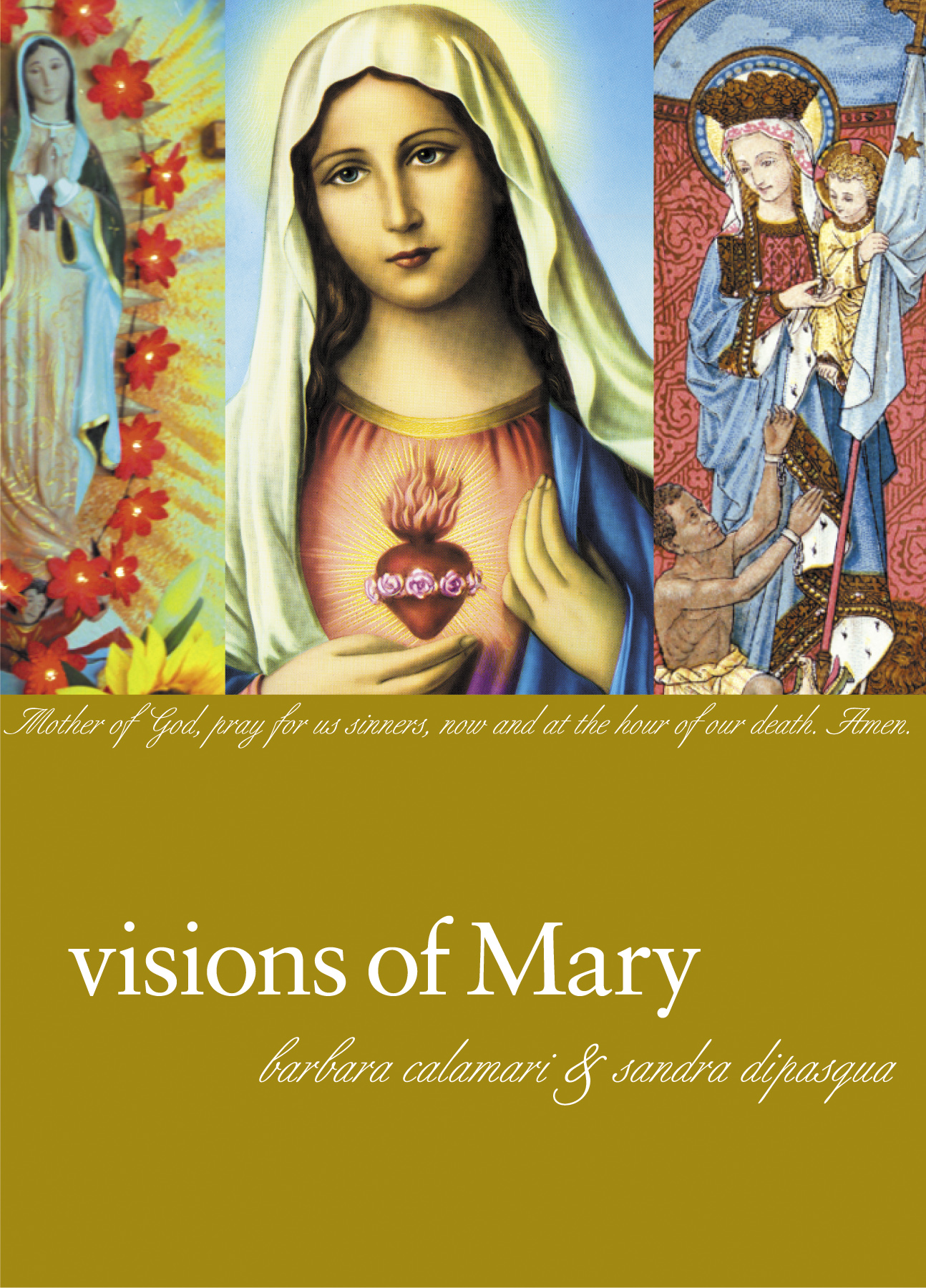
Barbara and I wanted Visions of Mary to be a book about how the Virgin Mary affects people in their everyday lives. In the United States and countries around the world, images of Mary are displayed among family photographs. For this reason, we chose not to use the great art works and paintings that have been created in her honor. Rather, we sought photographs of “everyday Marys.”. The photographer Lisa Silvestri after a trip to Mexico, Cuba, and New Orleans returned with countless beautiful images. It helped set the visual tone for our book. We are grateful to Lisa.
We also worked with Dr. Joseph Sciorra of the Calandra Center in New York City. Sharing his research on the black Madonnas of Southern Italy, and introduced us to the work of two wonderful photographers, Larry Raccioppo of New York City and Dana Salvo of Gloucester, Massachusetts, who are included in this book.
Diane Block, photo archivist at The Museum of New Mexico, was a big help in finding photographs for this book.
We bring this book to you with the help of the people mentioned above. We hope you find something in this book to love and are inspired by, as you go through your life. We will post a chapter every month.
Barbara and Sandy
Hail Mary Full of Grace! the Lord is with you; Blessed are you among women, and blessed is the fruit of your womb Jesus. Holy Mary, Mother of God, pray for us sinners, now and at the hour of our death. Amen.
Our Lady of Mount Carmel
Mount Carmel, in what is today northern Israel, has always been a place rich in mystical tradition. The word hakkarmel means “the garden” in Hebrew, and true to its title, there is a remarkable profusion of plants and wildflowers on this mountain. It is considered a natural paradise and a sacred place, and in biblical times it was forbidden to disturb any of the natural life on it. Those who wanted to ascend the mountain for meditation lived in caves so as not to intrude on the landscape with unnatural structures.
In about 860 b.c., the prophet Elijah (also known as Elias) arrived on this holy mountain to begin a life of contemplation and prayer. The First Book of Kings is filled with tales of wonders he performed and prophesies he gave. In his prophetic visions on Mount Carmel, Elijah became aware of the coming of the mother of the Messiah. He and his followers mystically dedicated themselves to her, setting an example as the first monks. The descendants of these ancient contemplatives were among the first to accept the teachings of Christ and to be baptized by His apostles. Upon meeting Mary after Christ’s Ascension, they were so overcome by her sanctity that they returned to the mountain to build a chapel in her honor. For the next thousand years Mount Carmel continued to be a place where hermits devoted themselves to prayer.
By the twelfth century, pilgrims from Europe who had followed the Crusades to the Holy Land settled with the ascetics on Carmel and started a religious holy order known as Brothers of the Blessed Virgin Mary of Mount Carmel. Their rule, which was given in 1209 by the Patriarch of Jerusalem, says that all converges toward the contemplation of God. The Rule of Mysticism exhorts those who fol-low it to live a life of continual prayer, obedience to a superior, perpetual abstinence and fasting, manual work, and total silence.
of their order to the laypeople; it served as a reminder that belief in Mary as the Mother of God extended back to the Old Testament with the prophet Elijah. After Pope John XXII (r. 1316–1334) had a vision of Mary where she promised those wearing the brown scapular, “I, the Mother of Grace, shall descend on the Saturday after their death and whomsoever I find in Purgatory, I shall free, so that I may lead them to the holy mountain of everlasting life,” the scapular became extremely popular among the common people. By the end of the sixteenth century it had become smaller in size and very similar to the one that is worn today. Admiration for the Carmelite Order spread as their adherence to the rules of solitude and prayer produced some of the greatest mystical saints in Catholicism, all of whom had visions of or openhearted communications with Mary. Among them are Saint Simon Stock, Saint Teresa, Saint John of the Cross, and Saint Thérèse of Lisieux.
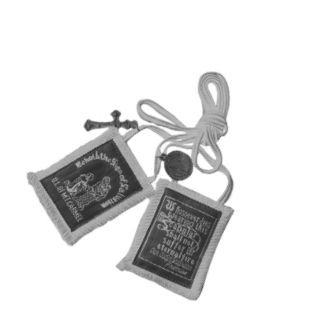
Though the original scapular handed to Saint Simon Stock was brown wool cloth without a picture, the Carmelite scapular that is now worn and the one that is most favored now has an image of Our Lady of Mount Carmel holding the Baby Jesus while she offers the scapular. The other piece of cloth often has a picture of Jesus as a man. Neither image is prescribed. Wearing the scapular is a form of prayer and is considered a visible sign of consecrating oneself to Mary and to accepting her maternal protection.
Devotion to Our Lady of Carmel can be found wherever the Carmelites founded a monastery or convent. Many small towns in Italy have churches named after this aspect of Mary. As the townspeople emigrated to other countries, they brought the devotion with them. In many cities in the United States these churches have great celebrations in honor of Our Lady of Mount Carmel.
Artistic representations of Our Lady of Mount Carmel depict her either appearing in the sky over Mount Carmel itself or holding Jesus as a toddler. In both versions the figure of Mary is often depicted offering the scapular to the viewer. Tradition has it that the prophet Elijah saw Mary appear in the clouds over Mount Carmel eight hundred years before her birth. Sometimes this representation includes her handing the scapular to Saint Simon Stock. The other version of this aspect of Mary illustrates the Sabbatine privilege where Mary vows to take the souls of those who died wearing the brown scapular out of purgatory on the Saturday after their death. Purgatory is depicted in flames because it is a place where the soul goes to have its sins burned away.
Simon Stock, an English pilgrim, had joined the group on a visit to Jerusalem. At this time, Saracen invaders forced the monks out of their spiritual home on Mount Carmel. All those who would not leave were murdered. Simon Stock was instrumental in getting the order to move to Aylesford, England, where the Baron de Grey gave them a manor house. The Carmelite lifestyle of contemplation, poverty, and silent prayer was not easily accepted in Europe, particularly among the clergy who enjoyed almost the same status and privilege as royalty. Reading into the life of Mary, Simon Stock was inspired by her unquestioning acceptance of all that befell her: her virgin pregnancy; her raising and loving a child doomed to be executed; and her staying at the foot of the Cross while others ran away. It was through his insistence that the Carmelites evolved from a band of hermit ascetics who regretted the loss of their home on Mount Carmel into a traveling society of mendicant friars, opening schools and mission houses in the major capitals of Europe. Still, it was difficult for many monks to accept the alteration of the rule of the order to adapt to European conditions. Their presence was also shunned and not easily tolerated by other religious orders. The people thought these hermits strange and did not accept that they chose to live in such absolute poverty and isolation. In order to preserve what was left of their order, the Carmelites invoked their patroness, the Virgin Mary, for help in establishing their new life.
The answer came in a vision to Saint Simon Stock on July 16, 1251, when he was alone in his cell. Mary appeared to him holding the scapular of his order. She told him, “Receive my beloved son, this habit of thy order: this shall be to thee and to all Carmelites a privilege, that whosoever dies clothed in this shall never suffer eternal fire. . . .It shall be a sign of salvation, a protection in danger, and a pledge of peace.”
The scapular, two pieces of brown wool joined at the shoulders and hanging down the back and breast, was not new to the Carmelite order. For hundreds of years before Saint Simon Stock’s vision, monks in Europe had worn scapulars. But it is thought that the brown scapular that Mary delivered was referencing Elijah’s camel-hair garment on Mount Carmel. Eventually, the brown scapular became reduced in size for laypeople to wear under their clothing. This is a special devotion to Mary worn as a sign to commemorate her faith in both God and humankind.
Our Lady of Mount Carmel is the patroness
of the Carmelite Order,
Chile, and Bolivia.
Her feast day is July 16.