Saint Luke, physician and companion of St. Paul, authored the Gospel bearing his name and the Acts of the Apostles. Emphasizing mercy, prayer, and care for the poor, he united professional skill with faithful witness. His life calls us to use our talents in loving service to Christ.
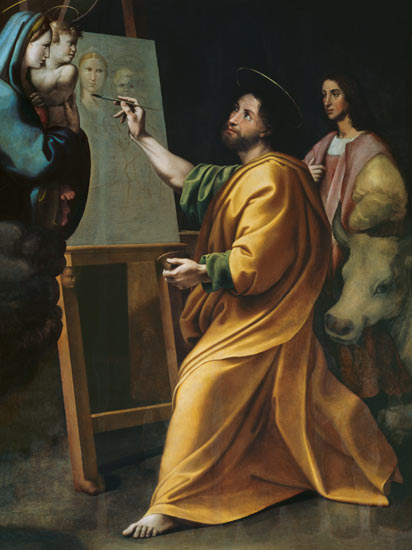
St. Luke, the beloved physician, was born in the first century and is known as the author of the third Gospel and the Acts of the Apostles. A companion of St. Paul, Luke traveled with him on missionary journeys and carefully recorded the spread of the early Church. His Gospel emphasizes God’s mercy, the dignity of the poor and outcast, and the central role of prayer. Luke was also a physician, bringing healing and care to others, and tradition holds that he was an artist who painted images of the Blessed Virgin Mary. He died a martyr, faithful to the end, leaving the Church with a rich testimony of Christ’s life and the growth of the first Christian communities. Honored as the patron saint of physicians, artists, and writers, St. Luke inspires us to combine professional skill with faith and compassion.
PRAYER
St. Luke, faithful physician and evangelist, intercede for us that we may use our gifts to glorify God, show mercy to the poor and suffering, and bear witness to Christ in all we do. Pray that we may be healed in body and soul and strengthened in faith. Amen.
Address: 25 Carmine St, New York, NY 10014 Phone: (212) 989-6805
Celebrating 100 years!
A Self-Guided Tour of Our Lady of Pompeii
Our Lady of Pompeii began in 1892 as the chapel of St. Raphael Society for the Protection of Italian Immigrants, which was located in a townhouse that is still standing at 113 Waverly Place. In 1895, Pompeii rented the former Bethel Methodist Colored Church at 214 Sullivan St., no longer standing. In 1898 it purchased a church that stood at 210 Bleecker Street, across from the southern end of Minietta Street nearby on the eastern side of Sixth Avenue. The church, which looked like a Greek Temple, was erected in 1836 for the Unitarian Universalists. In 1888 the Unitarians sold the church to the African American Roman Catholic congregation of St. Benedict the Moor.
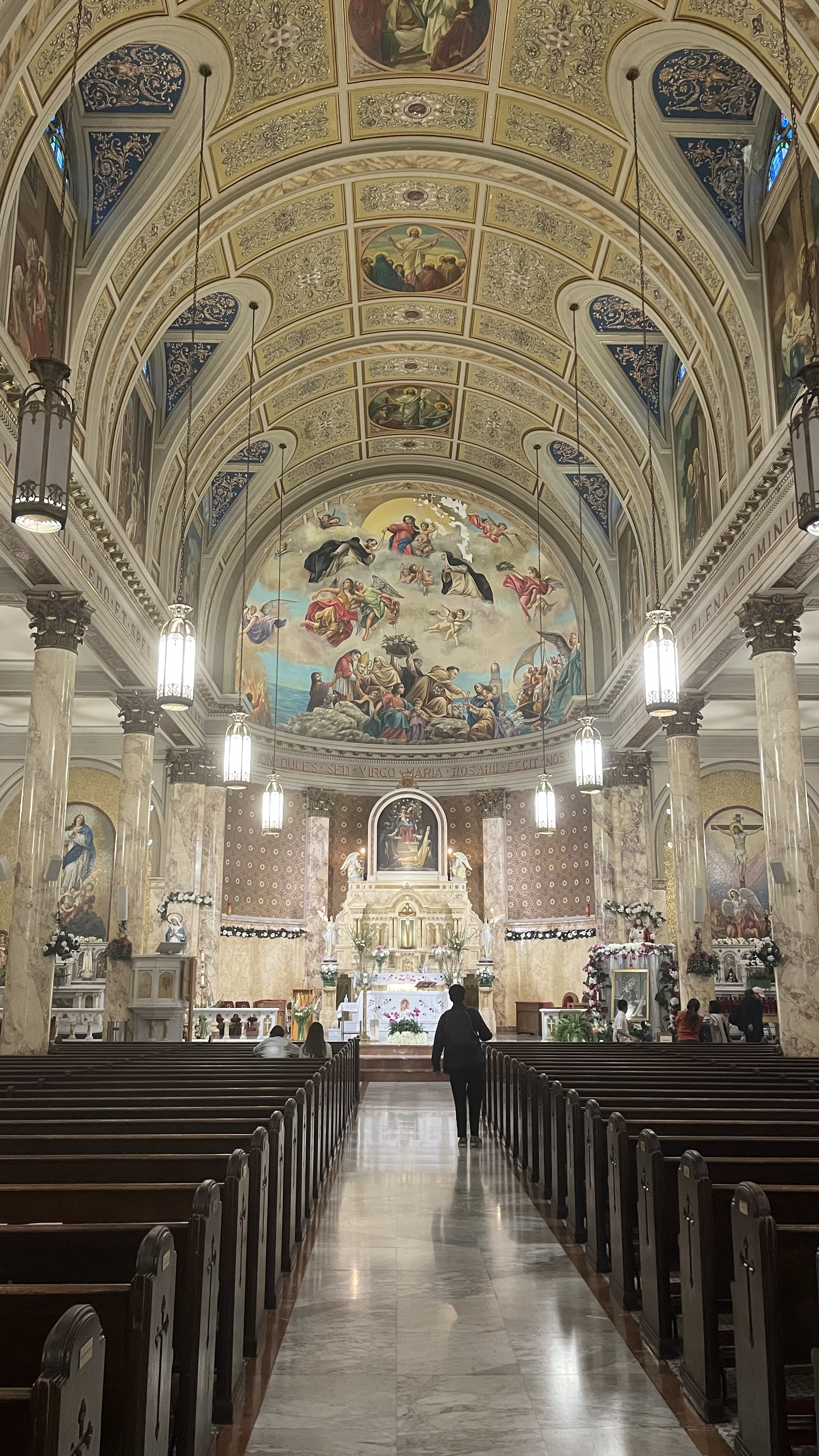
When the city condemned the church to extend Sixth Avenue, Pompeii erected this building, formally opening it October 7, 1928.The church’s architect was Mathew Del Gaudio, an Italian American graduate of Cooper Union active in his profession from 1905 to his death in 1960. Del Gaudio created a Romanesque building that would have reminded the earliest parishioners of Italy, with its shallow front steps and flat façade close to the street, its domed sanctuary, and its campanile, or bell tower. The figure on the roof is St. Charles Borromeo, patron saint of the order of priests that founded and staff Pompeii.Step in, look up, and you’ll see paintings celebrating the Rosary, the work of Professore Antonio D’Ambrosio, who was born in Italy and trained as an artist there. He opened his ecclesiastical arts company in 1928, specializing in creating artwork for churches, trained his children in the field, and passed the business along to them. D’Ambrosio’s descendants have returned to do restoration work on Pompeii’s art several times.The right wall’s images depict the Joyful Mysteries: the Annunciation, Visitation, Nativity, Presentation, and Finding Jesus in the Temple.
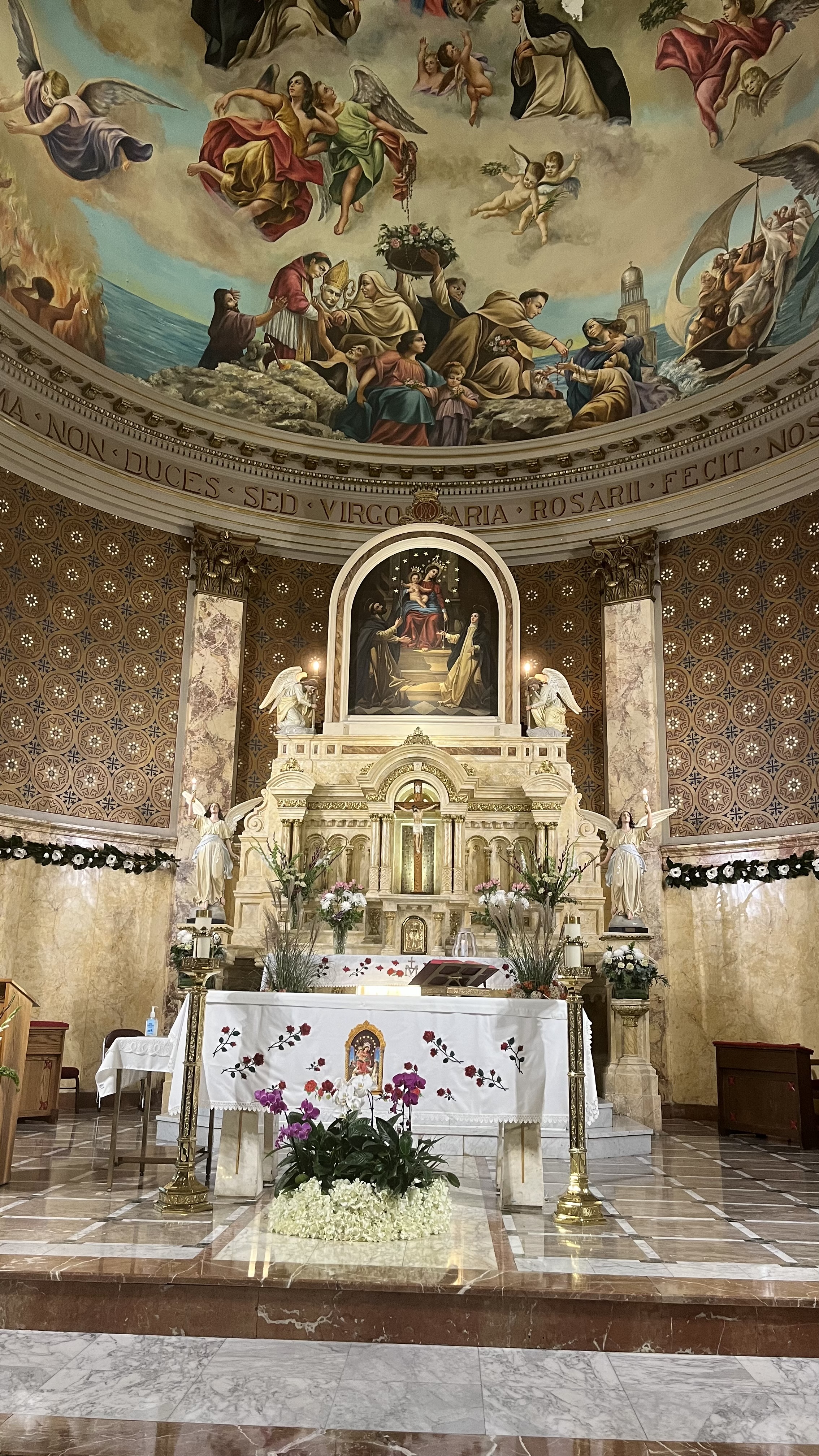
Those on the left wall depict the Sorrowful Mysteries: Jesus’ Agony in the Garden, His Scourging, His Crowing with Thorn, His Carrying of the Cross, and His Crucifixion. On the ceiling are the Glorious Mysteries: the Resurrection, Ascension, Pentecost, Assumption, and the Crowning of the Blessed Virgin in Heaven.Above the altar is a complex construction. On the left and right of the mural, respectively, are images of the Church Suffering, the souls in Purgatory awaiting redemption, and the Church Triumphant, the saints in Heaven. The centerpiece is dedicated to the Church Militant, or the Church on Earth. Above the center is an image of Our Lady of the Rosary of Pompeii, with Jesus on her lap, both of them handing rosaries to St. Dominic and St. Catherine of Siena, early promoters of the rosary. Angels fly about them. Across the bottom are images associated with Pompeii parish, such as the building’s campanile.
The figure in red on the right is St. Charles Borromeo. The bishop in white is Blessed John Baptist Scalabrini, founder of the priests who serve at Pompeii. The figure with the basket of roses is St. Martin de Porres, a tribute to the African American community whose church Pompeii purchased. To the left is a Franciscan friar, acknowledging that the Franciscans were the first ministers to New York’s Italians, at St. Anthony of Padua parish on Sullivan Street, a few blocks south of Pompeii. On the right is a galleon, a reminder that the Spanish credited their victory in the 1571 Battle of Lepanto to praying the rosary. The Latin phrase at the mural’s base translates as “Not Arms, Not Leaders, but the Virgin Mary of the Rosary Made us Victors.” Professore D’Ambrosio worked on this commission from 1934 to 1937, finishing with the painting of Jesus revealing His Sacred Heart to Saint Margaret Mary that is to the left as you come further into the church.Just behind you, near the entrance on the left, are statues indicative of the diversity of Pompei’s congregation.
The centerpiece is a shrine to Mother Frances Cabrini, patroness of immigrants. Before her is a statue of Jesus Nazareno, an image revered among the Filipino immigrants who also worship at Pompeii. The statue of San Gaetano is a long ago gift from his devotees that cannot be dated. The statue of Saint Jude is a 1955 bequest from parishioner Catherine Brignole; Jude, patron of hopeless causes, was a popular saint in the mid twentieth century. The bust of Bishop Scalabrini also dates from 1955, and Scalabrini’s coat of arms on the column near the bust, from soon thereafter, but these represent the beginnings of devotion to someone who may yet be declared a saint.At the beginning of the wall on the left, or southwest, side of the church, are statues of two saints popular among Italians, St. Rose of Lima and St. Lucy. Then come the stained glass windows, work on which commenced in 1928, with the Stations of the Cross between them. (The Stations and windows actually “begin” at end of the wall nearer the altar if you want to skip ahead and walk back.) The stained glass window at the back of the church is important not only for its illustrations of four of the Beatitudes but for the donors associated with it.
Carolina Perazzo, whose name appears on the window, was the daughter of funeral home director Carlo Baciagalupo. She married Giovanni Battista Perazzo, who learned the undertaking business from his wife and father-in-law, and opened his own funeral home at 199 Bleecker St. in Greenwich Village. The business is no longer in the family, but is still at 199 Bleecker St.Most of the topics of the stained glass windows are easily recognizable, but some require some insider knowledge of Pompeii. For example, see the window on the southwest wall given in honor of A. Agostino Gazzolo. The bishop in the window is Scalabrini, the two clergy are a Scalabrinian priest and brother, and the two nuns represent two orders Blessed Scalabrini encouraged: Mother Cabrini’s Missionaries of the Sacred Heart and the Apostles of the Sacred Heart, whose members taught in Pompeii’s school.
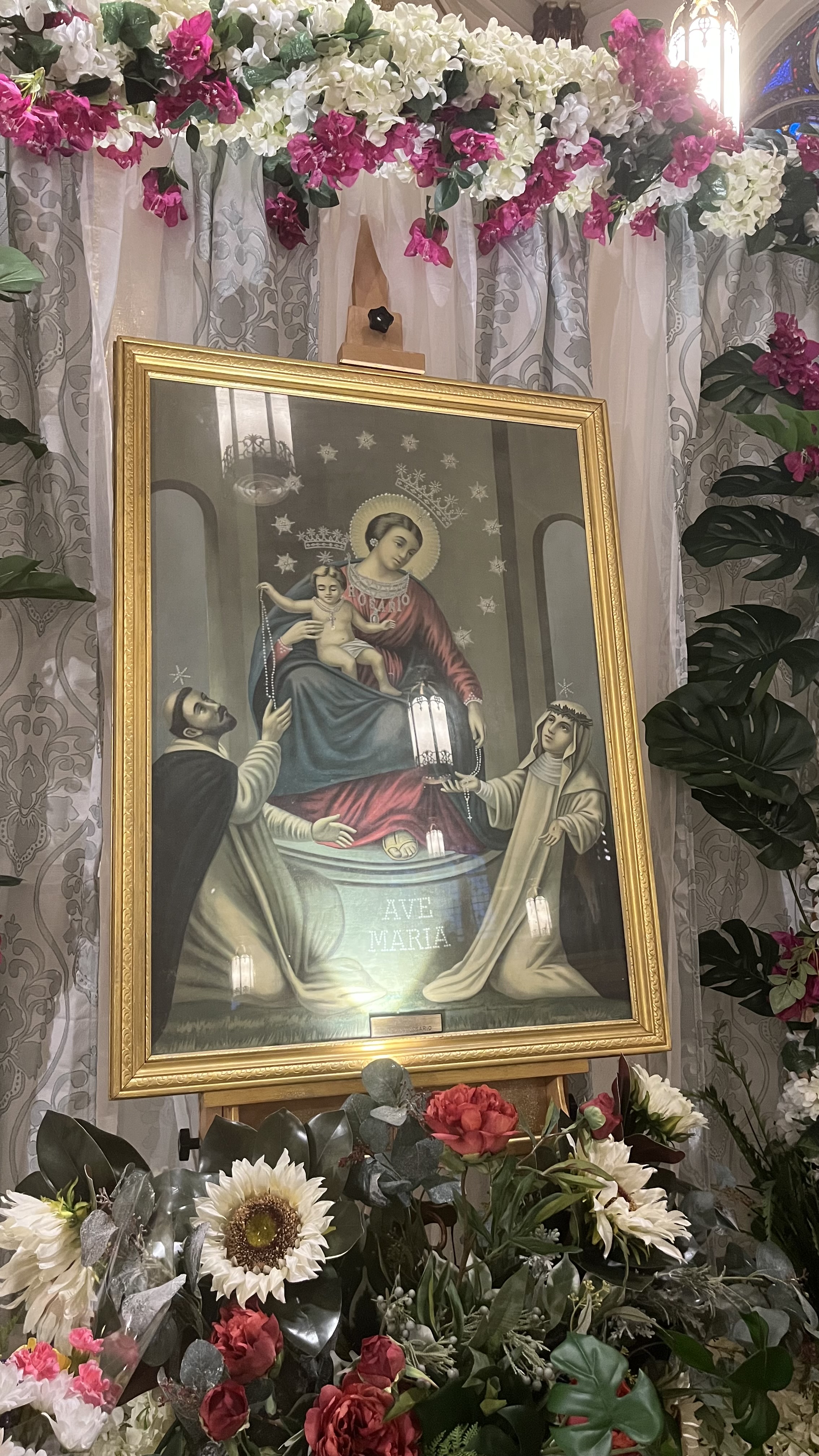
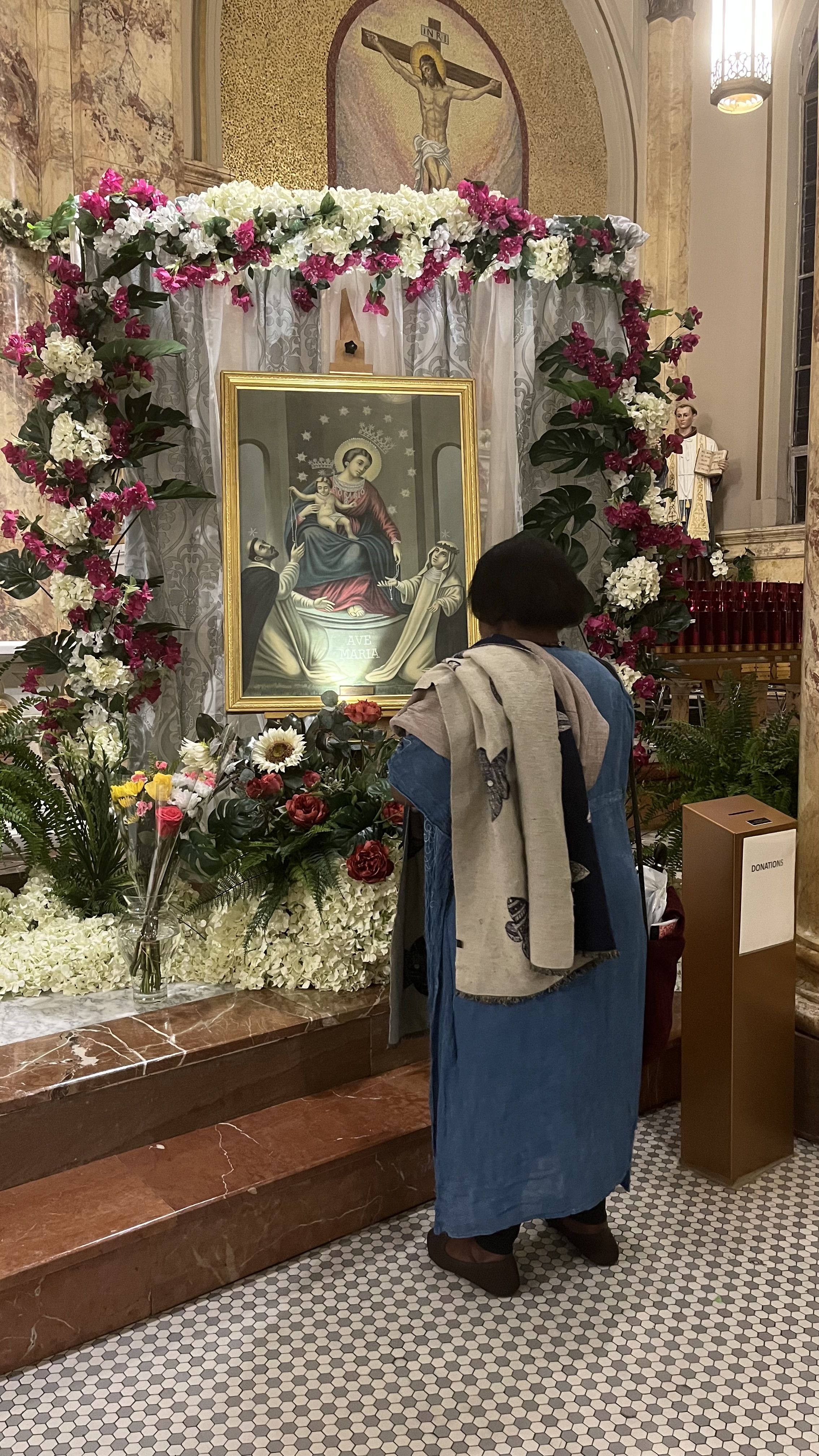
The Gospel quotation references the Scalabrinians’ mission to help migrants preserve their faith in their new homes.Before turning to the altar, step into the room to the left, where there is a striking stained glass window and several more statues. St. Gerard’s statue came from the maternity ward on the 5thfloor of the Seton Building of St. Vincent de Paul; Greenwich Village’s hospital from 1849 to 2010; it is a gift from the hospital’s founders, the Sisters of Charity.The altar wall of the church consists of three parts. The mosaics of Assumption and of Jesus in Purgatory date from the tenure of Father Mario Albanese, pastor from 1952 to 1964. While you are at the Assumption altar, look at the wall to the left to see the fine mosaic of the Holy Family. In front of the image of the Assumption is one of Pompeii’s newest statues, that of Padre Pio, a Franciscan priest who was declared a saint in 2002. There is also an image of Our Lady of Guadalupe. Normally, that would indicate the presence of Mexican devotees, but during Pompeii’s earliest years, women from Chiavari, south of Genoa, practiced the devotion.Embedded in the marble pre-Vatican II altar is a painting of Our Lady of the Rosary that is an exact replica of the one at the shrine to Our Lady of the Rosary in Pompeii, Italy.
The painting was an 1895 gift of heiress Annie Leary. Shortly after its installation, this parish received permission from the Italian shrine’s founder, Bartolomeo Longo, to promote itself as the American shrine. The painting first hung over the altar at the 210 Bleecker Street church mentioned earlier; it was cut to its present shape to fit the altar here.Pompei’s oldest statues cluster around the Purgatory image.
Those of the Blessed Mother and St. John the Evangelist date from the 1880s and are part of a set that, together with the crucifix in the donor’s shrine near the church entrance, were fixtures at St. Benedict the Moor. The statues of the Sacred Heart and St. Joseph appear in a 1909 photograph of Pompeii.The stained glass windows to the right of the altar, Pompeii’s northeast wall, also reflect parish history. Note the windows depicting marriage vows and Pope Leo sending Mother Cabrini to the Americas, all given by relatives of Italian-American lawyer Edward Bergonzi, who, along with pioneer Italian immigrant Luigi Fugazy, was on Pompeii’s first board of trustees. The image of the priest in the window depicting marriage is that of Father Antonio Demo, who served at Pompeii from 1898 to 1936, most of the time as pastor; he led Pompeii in building this church. Perhaps after you have completed your visit here you can see the park named for him, diagonally across the street from the church.At the end of the row of Stations and windows is the donor’s shrine, and a plaque noting that Pompeii’s campanile was restored in honor of Vincent Gigante by his parents.
He is better known as “Chin” Gigante, and was a leader in one of New York City’s organized crime families. His own family, though, included many other members who were part of the parish; before this plaque went up, another plaque, at the beginning of the Stations of the Cross, notes the Stations were refurbished in honor of Pietro Gigante.On your way out, look up. Above Pompeii’s doors are three stained glass windows. The one of Columbus giving thanks for having reached land in the Americas is a tribute to Pompeii’s Italian roots. The depiction of Ellis Island is a reminder of Pompeii’s commitment to immigrants. In the center is an image of the Holy Family on the Flight into Egypt, a reminder that Jesus, Mary and Joseph were once counted among the world’s migrants and refugees. Dr. Mary Elizabeth Brown, PhD.
“Lord make me an instrument of your peace, where there is hatred let me sow love.”
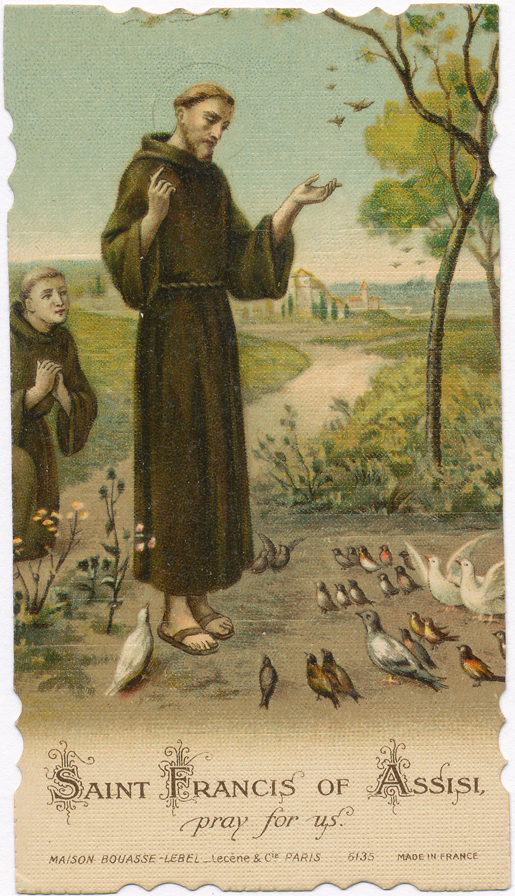
Love for God and everything in creation so consumed St. Francis of Assisi, that he was able to commune with the natural world on a divine level. Taming wolves, quieting flocks of birds and infusing peace and contentment to the humanity he interacted with, we call on Francis of Assisi to bring us into the harmonious rhythms of the universe, where all of nature and mankind are at one with the divine force of creation.
An unlikely mystic, Francis was born Giovanni Bernadone in the town of Assisi. His father, a proud member of the upper classes was a wealthy cloth merchant married to a woman from Provence. Because he frequently conversed in French with his mother, Giovanni was soon known as “Francesco” or “the Frenchman” by his friends and neighbors. Confident that his son would follow in his footsteps, the elder Bernadone indulged and catered to Francesco’s every whim and the youth enjoyed a pleasure filled existence in the company of others in his social caste. On a lark he set off with friends to take part in a war with Perugia. Much to his shock, he was taken prisoner and it took his family a year to ransom him back. Upon his return, he was bedridden and seriously ill. But in recovering his health, Francesco seems to have lost his identity. He suffered a great spiritual crisis as all interest in his old life and his father’s business waned and disappeared. While wandering the countryside he stopped into the deserted church of San Damiano and heard the crucifix say to him, “Francis, go and repair my house, which you see is falling down.” Happy to have some direction in his life, he took the request literally and began rebuilding the structure with his bare hands. Ultimately, his father disowned him and when Francis, renouncing his inheritance threw his clothing in the street, he donned the simple brown garment given him by the Bishop of Assisi.
Begging for supplies, Francis continued his work on San Damiano. Eventually he was joined by other disenchanted young men looking for a higher meaning in life. By simply following the exact tenets of Christ, this little band of friars, never owning anything, bartering labor for food and shelter began a movement of religious seekers that revolutionized the Church by the simple and loving way they spread the gospel. Instead of writing in church Latin he used colloquial Italian and in an effort to explain the story of Christ’s birth, he created a living tableau of animals and people – the first Christmas crèche.
A great poet and mystic, Francis was the first saint to receive the stigmata while in a meditative rapture. Filled with humility and though he founded one of the world’s greatest religious orders, Francis of Assisi was never ordained a priest. Upon his death he requested to be buried in the cemetery for criminals, but the people of Assisi so loved him that they took his body and interred it under the altar of their great cathedral.
Just as popular with nonCatholics as Catholics, Francis has inspired great artists, composers and writers. Assisi, Italy remains a great pilgrimage site for those wishing to pay him tribute.
Prayer
Lord, make me an instrument of your peace; Where there is hatred, let me sow love; Where there is injury, pardon; Where there is doubt, faith; Where there is despair, hope; Where there is darkness, light; And where there is sadness, joy. O Divine Master, Grant that I may not so much seek To be consoled, as to console; To be understood, as to understand; To be loved, as to love; For it is in giving that we receive, It is in pardoning that we are pardoned, And it is in dying that we are born to Eternal Life. Amen.
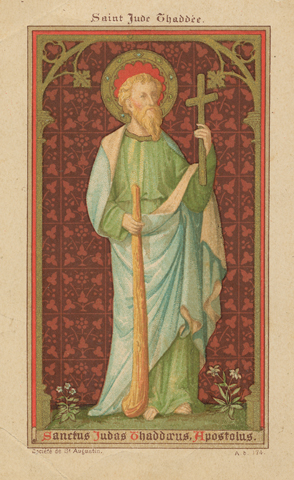
One of the original 12 apostles, Jude is depicted with the flame of knowledge received from the Holy Spirit at the Pentecost burning above his head. Brother of James the Lesser and cousin of Jesus, Jude was one of Christ’s earliest followers. He earned his title of Patron Saint of Impossible Causes because of a letter he wrote in 60AD to persecuted Christian converts in the East, exhorting them to stay strong in the face of all difficulties.
The name Jude means giver of joy and the name Thaddeus means great hearted one and this saint was said to live up to his name, attracting immense crowds by preaching in an entertaining way, outwitting magicians and local priests. Abgar, the King of Edessa was quite impressed with Jude and appealed to Jesus cure his leprosy. He sent an artist to draw Christ’s image. The artist was so shaken by the glow in Christ’s eyes, he could not draw. Christ wiped his face with a cloth and the image of his face was transferred to it. Jude brought the cloth back to Abgar and the king rubbed the cloth over his body, curing himself of leprosy. Many depictions and statues of Saint Jude include this cloth with Christ’s image on it. Jude was martyred along with Saint Simon in the city of Samir by being beaten with a club. This club, as well as the palms of martyrdom are also part of his iconography.
The cult of Saint Jude all but died out after the Middle Ages because people confused him with Judas Iscariot, the apostle who betrayed Christ. Despite being cited as a great influence by the mystics Saint Bernard of Clairvaux and Saint Bridget of Sweden, Jude was rarely invoked by the faithful for anything. It is said that because of this, he became the saint to call on in the most impossible of situations. So anxious was he to be of help, he would turn heaven and earth to rectify a desperate situation. By the nineteenth century, it became customary to thank the saint for help with answered prayers by taking an ad in the newspaper. This helped to resurrect his popularity and these small “Thank you Saint Jude” ads can be found in many weekly and daily periodicals in present day.
Unfailing Prayer to Saint Jude
Glorious apostle, Saint Jude Thaddeus, I salute you through the Sacred Heart of Jesus. Through his heart I praise and thank God for all the graces he has bestowed upon you. I implore you, through his love, to look upon me with compassion. Do not despise my poor prayer. Do not let my trust be confounded! God has granted to you the privilege of aiding mankind in the most desperate cases. Oh, come to my aid that I may praise the mercies of God! All my life I will be your grateful client until I can thank you in heaven.
(Mention your request here).
Saint Jude, pray for us, and for all who invoke your aid.
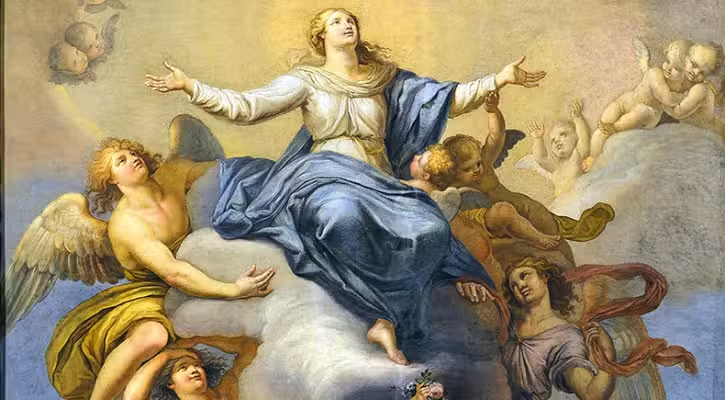
On November 1, 1950, Pope Pius XII defined the Assumption of Mary to be a dogma of faith: “We pronounce, declare and define it to be a divinely revealed dogma that the immaculate Mother of God, the ever Virgin Mary, having completed the course of her earthly life, was assumed body and soul to heavenly glory.” The pope proclaimed this dogma only after a broad consultation of bishops, theologians and laity. There were few dissenting voices. What the pope solemnly declared was already a common belief in the Catholic Church.
We find homilies on the Assumption of the Blessed Virgin Mary going back to the sixth century. In following centuries, the Eastern Churches held steadily to the doctrine, but some authors in the West were hesitant. However by the 13th century there was universal agreement. The feast was celebrated under various names—Commemoration, Dormition, Passing, Assumption—from at least the fifth or sixth century. Today it is celebrated as a solemnity.
Scripture does not give an account of Mary’s assumption into heaven. Nevertheless, Revelation 12 speaks of a woman who is caught up in the battle between good and evil. Many see this woman as God’s people. Since Mary best embodies the people of both Old and New Testaments, her assumption can be seen as an exemplification of the woman’s victory.
Furthermore, in 1 Corinthians 15:20, Paul speaks of Christ’s resurrection as the first fruits of those who have fallen asleep.
Since Mary is closely associated with all the mysteries of Jesus’ life, it is not surprising that the Holy Spirit has led the Church to believe in Mary’s share in his glorification. So close was she to Jesus on earth, she must be with him body and soul in heaven.
Reflection
In the light of the Assumption of the Blessed Virgin Mary, it is easy to pray her Magnificat (Luke 1:46–55) with new meaning. In her glory she proclaims the greatness of the Lord and finds joy in God her savior. God has done marvels to her and she leads others to recognize God’s holiness. She is the lowly handmaid who deeply reverenced her God and has been raised to the heights. From her position of strength she will help the lowly and the poor find justice on earth, and she will challenge the rich and powerful to distrust wealth and power as a source of happiness.
Born Fernando de Bulhes in Lisbon, Portugal, he disappointed his noble family by rejecting his luxurious life and joining the Augustinian religious order. A scholar by nature, he read every book in the monastery, devoting his time to contemplative prayer. Eventually, he befriended a group of itinerant Franciscan monks and became fascinated with this new religious order. Much impressed by their dedication to simplicity, poverty and their belief in returning to the original words of Christ, he joined their ranks, changing his name to Anthony in honor of Saint Anthony of the Desert, the patron of their little church. Returning home from a failed missionary venture in Morocco, his ship was blown off course and he wound up in Messina, Sicily. A group of Franciscan friars insisted he go north with them for a great gathering of all Franciscans, with their founder Francis of Assisi.
Anthony remained in Italy and discovered his great gift of preaching when a superior ordered him to speak at an ordination, telling him to say whatever the holy spirit had infused into him. He astonished his audience, not only by his skills as an orator but by the depth of his knowledge. He was sent throughout northern Italy and southern France on evangelical preaching missions which gathered crowds in the tens of thousands. His popularity among the people increased as he used his position to get real changes enacted for their protection. While based in Padua, he observed the crushing power of debt upon the common people. At Anthony's insistence, the local municipality enacted a law protecting those who could not pay their debts that is still enforced today. Anthony exhausted himself preaching out in fields and in piazzas as there was not cathedral large enough to hold all who came to hear him. At the age of thirty six, his health began to fail him and a local Count donated a woodland retreat for his recovery. One morning the Count heard the sounds of a baby giggling and he looked out to see Anthony surrounded in light, playing with the baby Jesus. That Christ would choose to appear to one of his saints in such a vulnerable state is a testament to the loving and kind nature of Saint Anthony. Because he is depicted holding a baby, women having trouble conceiving invoke his aid. Being of Portuguese descent, Anthony's feast day is very auspicious for marriages in Portugal and Brazil and in those cultures, he is known to assist women seeking a husband. According to legend, Saint Anthony earned the title patron saint of lost articles when a novice borrowed his psalter and failed to return it. Saint Anthony prayed to get it back and the novice was visited by terrifying visions that sent him running back to Anthony with the book. In iconography, Anthony always holds the baby Jesus and a lily for purity. Many times the returned book of the gospels is included.
Wonder and miracles are infused with every story of Saint Anthony. Though he has been dead for almost 800 years, he is still the most popular saint in the world and his statue is found in every Catholic Church. Saint Anthony is best known as the patron saint of lost articles but he is invoked for help in all life situations. In his own day he was called the “Wonder Worker’ and credited with the ability to stop the rain, raise the dead and reattach severed limbs. He was such a charismatic preacher that when a crowd of heretics in Rimini refused to listen to his preaching, the fish raised themselves out of the water to hear him.
Prayer to St. Anthony
Holy Saint Anthony, gentle and powerful in your help, Your love for God and charity for His creatures, made you worthy when on earth, to possess miraculous powers. Miracles waited on your word, which you were always ready to request for those in trouble or anxiety. Encouraged by this thought, I implore you to obtain for me (mention your request here). The answer to my prayer may require a miracle. Even so, you are the saint of miracles. Gentle and loving Saint Anthony, whose heart is ever full of human sympathy, take my petition to the Infant Savior for whom you have such a great love, and the gratitude of my heart will be ever yours. Amen It is customary to donate to Saint Anthony’s Bread, a charity started in Saint Anthony’s lifetime, in gratitude to answered novena prayers.
One of the original 12 apostles, Brother of James the Lesser and cousin of Jesus, Jude was one of Christ’s earliest followers. He earned his title of Patron Saint of Impossible Causes because of a letter he wrote in 60AD to persecuted Christian converts in the East, exhorting them to stay strong in the face of all difficulties.
The name Jude means giver of joy and the name Thaddeus means great hearted one and this saint was said to live up to his name, attracting immense crowds by preaching in an entertaining way, outwitting magicians and local priests. Abgar, the King of Edessa was quite impressed with Jude and appealed to Jesus cure his leprosy. He sent an artist to draw Christ’s image. The artist was so shaken by the glow in Christ’s eyes, he could not draw. Christ wiped his face with a cloth and the image of his face was transferred to it. Jude brought the cloth back to Abgar and the king rubbed the cloth over his body, curing himself of leprosy. Many depictions and statues of Saint Jude include this cloth with Christ’s image on it. Jude was martyred along with Saint Simon in the city of Samir by being beaten with a club. This club, as well as the palms of martyrdom are also part of his iconography
The cult of Saint Jude all but died out after the Middle Ages because people confused him with Judas Iscariot, the apostle who betrayed Christ. Despite being cited as a great influence by the mystics Saint Bernard of Clairvaux and Saint Bridget of Sweden, Jude was rarely invoked by the faithful for anything. It is said that because of this, he became the saint to call on in the most impossible of situations. So anxious was he to be of help, he would turn heaven and earth to rectify a desperate situation. By the nineteenth century, it became customary to thank the saint for help with answered prayers by taking an ad in the newspaper. This helped to resurrect his popularity and these small “Thank you Saint Jude” ads can be found in many weekly and daily periodicals in present day.
Prayer to Saint Jude
Glorious apostle, Saint Jude Thaddeus, I salute you through the Sacred Heart of Jesus. Through his heart I praise and thank God for all the graces he has bestowed upon you. I implore you, through his love, to look upon me with compassion. Do not despise my poor prayer. Do not let my trust be confounded! God has granted to you the privilege of aiding mankind in the most desperate cases. Oh, come to my aid that I may praise the mercies of God! All my life I will be your grateful client until I can thank you in heaven.
(Mention your request here).
Saint Jude, pray for us, and for all who invoke your aid.
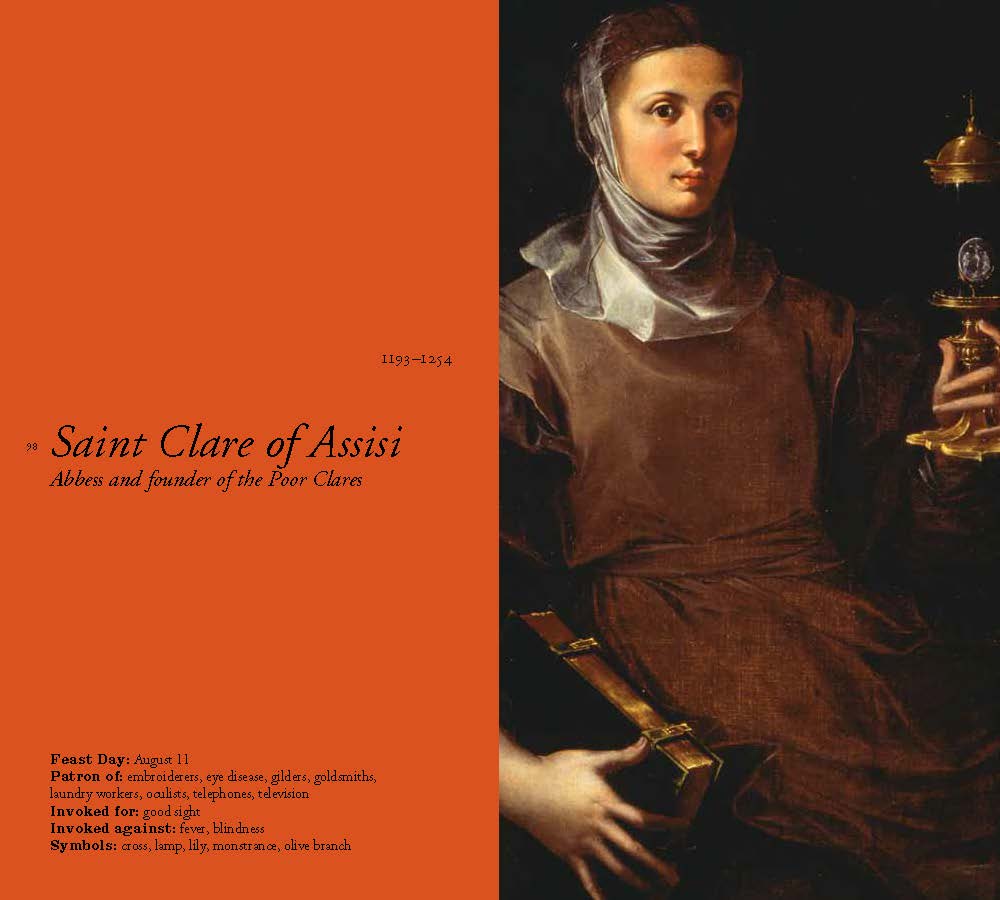
Together with her mentor and friend, Francis of Assisi, St. Clare shook the foundations of Medieval society by revolutionizing religious expression. Her given name, Chiara means clarity and we call on St. Clare whenever we need to shine a light on a situation or to find a way to communicate more clearly. She is also invoked to protect the blind and to help those with eye trouble.
Chiara Offreduccio, as the beautiful daughter of minor royalty was offered every worldly advantage available to one in her social class. When she heard St. Francis preach the Lenten service at her church in 1212, his simple message of living with complete trust in God inspired her to abandon going through with her arranged marriage in order to join the Franciscan movement. The first followers of Saint Francis were the wealthy sons of his town of Assisi. Their act of turning their backs on the material world to live at the mercy of the elements and on whatever alms they could beg was disturbing and controversial to both their families as well as to the church authorities. Attracted by the joyous way in which they comported themselves, as well as the enthusiasm they brought to religious worship, Clare was the first woman to join their order.
Fervently believing in a life devoted to the precepts of the gospel, the Franciscans did not believe in personal property. When Clare escaped her family to join them on Palm Sunday, Francis himself cut off her long blond hair and handed her the simple woolen robe worn by his followers. He then left her in the local Benedictine convent as there were no facilities in his order for women. It was not long before her entire family attempted an intervention type rescue of the girl. Revealing her shorn hair to her horrified father made them realize that she would never return to their world. Her younger sister, as well as other wellborn young women from the town soon followed her. In 1215, Saint Francis installed Clare as the Abbess of the Order of Poor Ladies. True to the Rule of St. Francis, they accepted no dowries from their families as other religious orders did. When they were left inheritances, the money was distributed to the poor. Highly intelligent, and known for the efficacy of her prayers, popes, cardinals, royalty and St. Francis himself came to her for spiritual advice. Her own correspondence shows her to be a clever, happy person.
Devoted to the Eucharist and frequently immersed in prayer, the stories of miraculous occurrences around Clare abound. The most famous is that while she was ill, her convent which was outside of the walls of Assisi was attacked by the Saracen mercenaries of Frederick II . As the invaders stormed the walls with ladders, Clare calmly held up a monstrance containing the host. A child’s voice emanated from inside the monstrance, “I will always guard and defend you.” A feeling of dread overtook the invaders and they ran away from the town. St. Clare was named the patron saint of television writers and workers due to a vision she had while too ill to attend Christmas Eve mass. She was able to view and hear the entire mass on the wall of her room. She spent much time embroidering linens for use in mass, so she is the patron of embroiderers. Because that trade is hard on the eyes and because of her name, she is the patron of those with eye problems and the blind.
Novena to St. Clare O Glorious St. Clare! God has given you the power of working miracles continually, and the favor of answering the prayers of those who invoke your assistance in misfortune, anxiety, and distress. We beseech you, obtain from Jesus through Mary His Blessed Mother, what we beg of you so fervently and hopefully, (mention your petition) if it be for the greater honor and glory of God and for the good of our souls. Amen