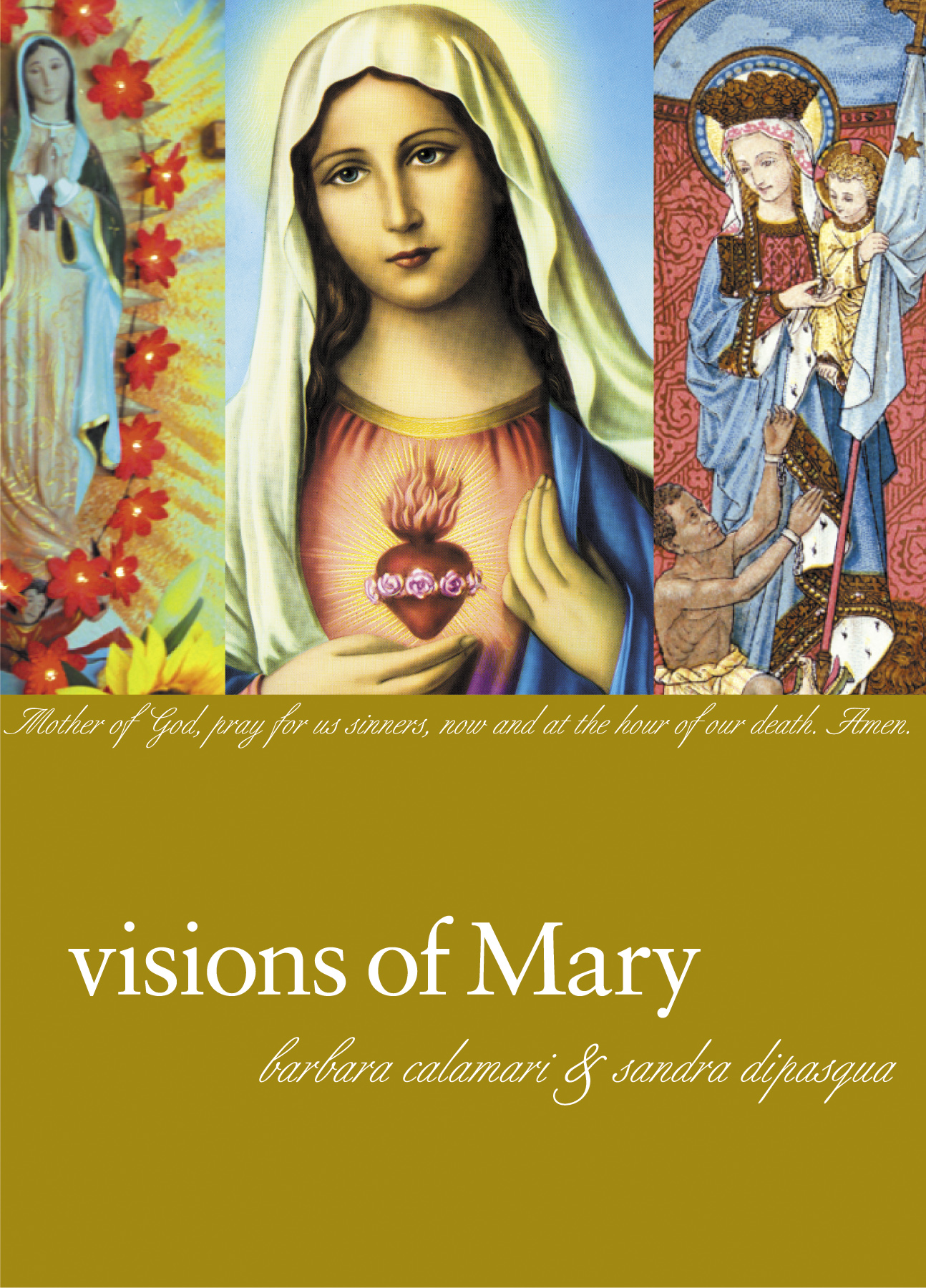
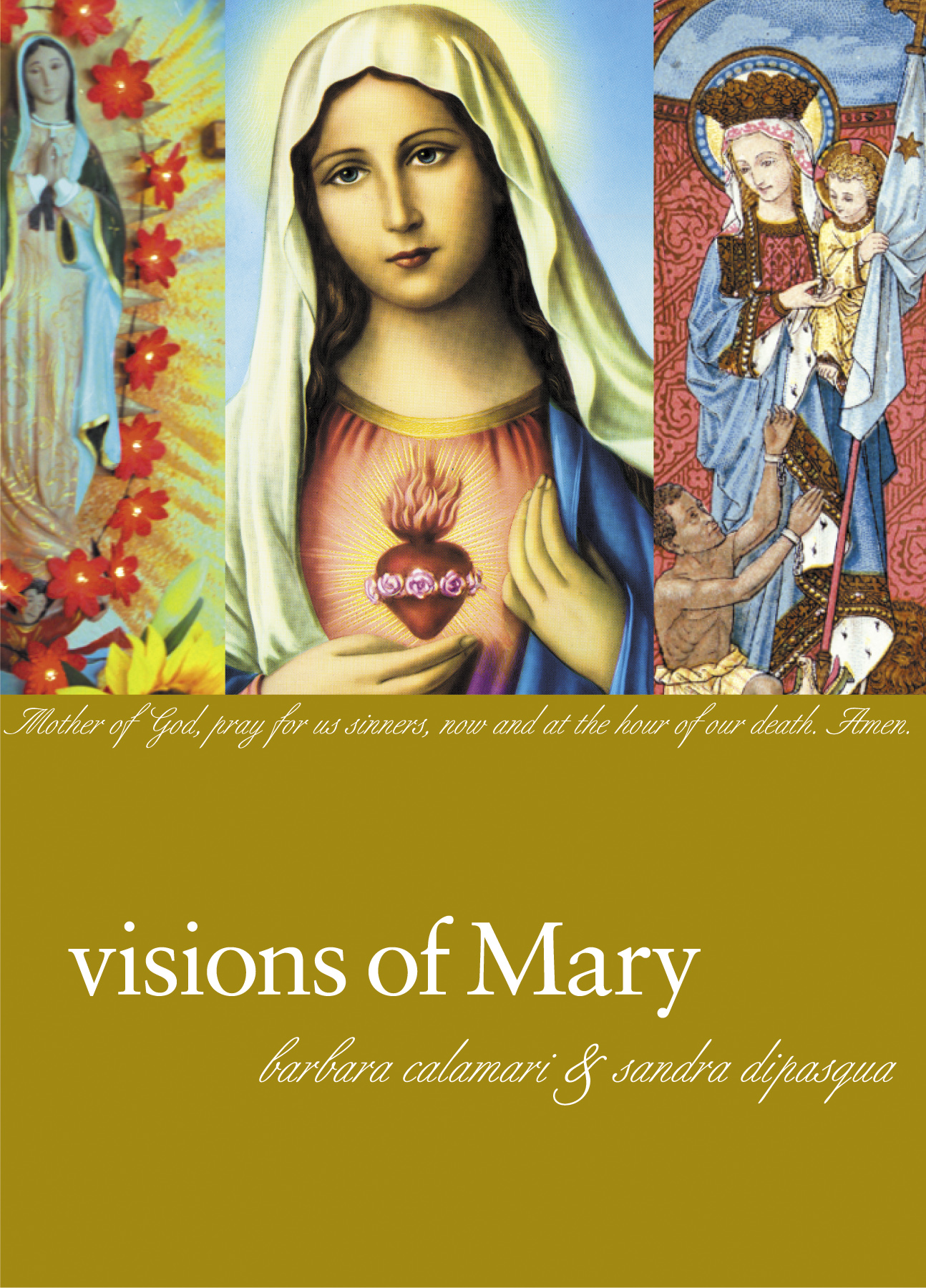
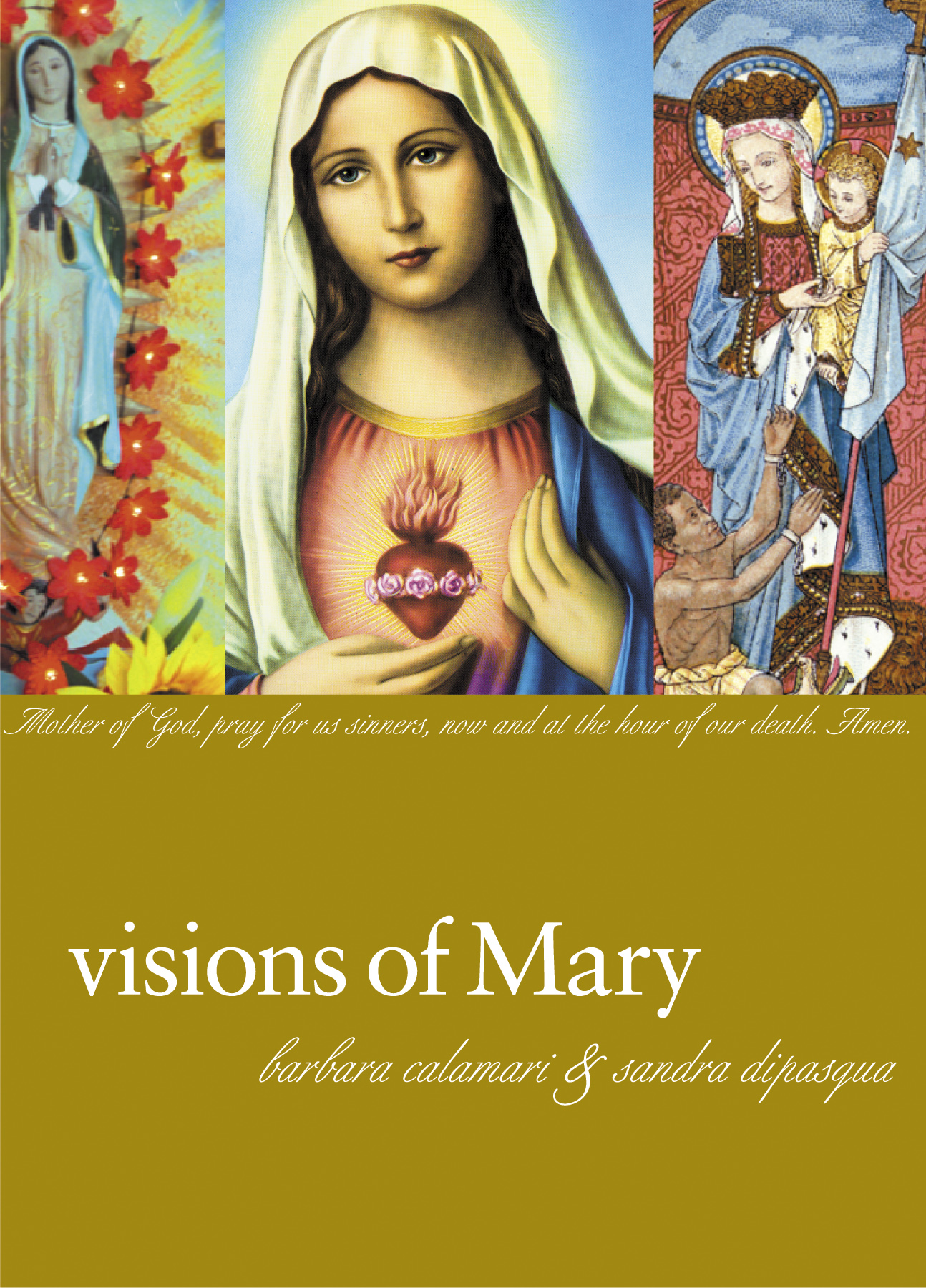
The Roman Catholic love and respect for the Virgin Mary divides it from other sects of Christianity. Mary is not only revered as the Mother of God but also as the Mother of all Humanity, and her image continually watches over every aspect in the daily life of Catholic countries. She is credited with working miracles through pictures, statues, and sacred earthly places. She is the inspiration of much of the world’s greatest music, art, and architectural works. Her spiritual gifts are recognized in the East and both Hindus and Buddhists refer to her as Mother Mary. Muslims revere her as the mother of a great prophet and she is the only woman with her own chapter in the Koran. As a human being Mary is able to relate directly to the major and minor sufferings of mankind. For this reason she is not prayed to as a goddess, but rather, called on by Catholics to aid them in their prayers. It is thought that she shares her constant flow of grace with those who ask, bringing them closer to God. Thomas Merton wrote, “Mary does not rule us from without, but from within. She does not change us by changing the world around us, but she changes the world around us by first changing our own inner lives.”
Contents
Introduction 8
Our Lady of Mount Carmel 24
Our Lady of Guadalupe 32
Our Lady of Cobre 42
Our Lady of Prompt Succor 48
The Miraculous Medal 54
Our Lady of La Salette 62
Our Lady of Lourdes 68
Our Lady of Perpetual Help 76
Our Lady of Pompeii 80
Portfolio 84
Our Lady of Knock 96
Our Lady of Fatima 98
Our Lady of Light 108
Our Lady of Akita 112
The Black Madonnas 116l Our Lady of Czestochowa 120
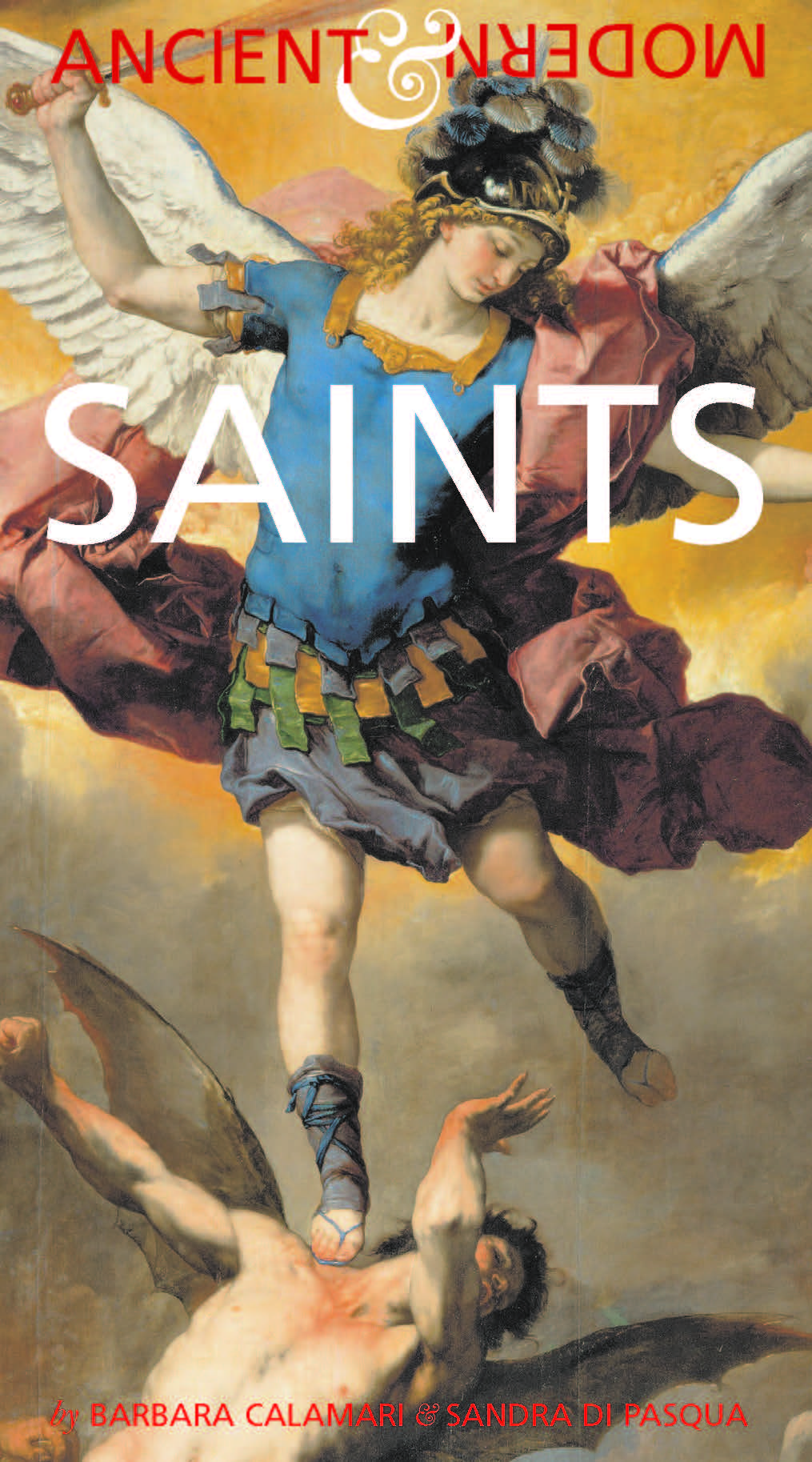
The Saints. We look upon them as protectors, family members, and living examples of how an ordinary life can experience an extraordinary transformation. Since no one is born a saint, these holy people have made terrible mistakes with which we can all identify. They have suffered unimaginable cruelties and conquered every problem in the human condition, from bad marriages to fatal illnesses. Many who lived dissolutely and scandalously before their conversion were rewarded with ridicule and persecution for turning their backs on conventional society. In emulatio of Christ, they refused to compromise their spiritual beliefs to preserve their worldly comforts. Through it all they emerge triumphant, willing to help those on earth find God by praying for us and with us.
For more than two thousand years, the legends and stories of the Christian saints have greatly affected the course of Western civilization. The saints have influenced our holidays, our school systems, the boundaries of nations, our poetry, music, and visual arts. They have been great philosophers, uneducated savants, mystics, administrators, farmers, housewives, and soldiers, hailing from every social strata of society.
The ancient saints span from prehistory to the year A.D. 1000. These saints tend to have more legendary aspects to their stories, resulting from the strong oral tradition in which they thrived. However, the modern saints are well documented by contemporary historical texts. These comprise the second thousand years. Some of these saints have influenced whole nations while others, through their particular state of life, encourage us to have a more personal relationship with them.
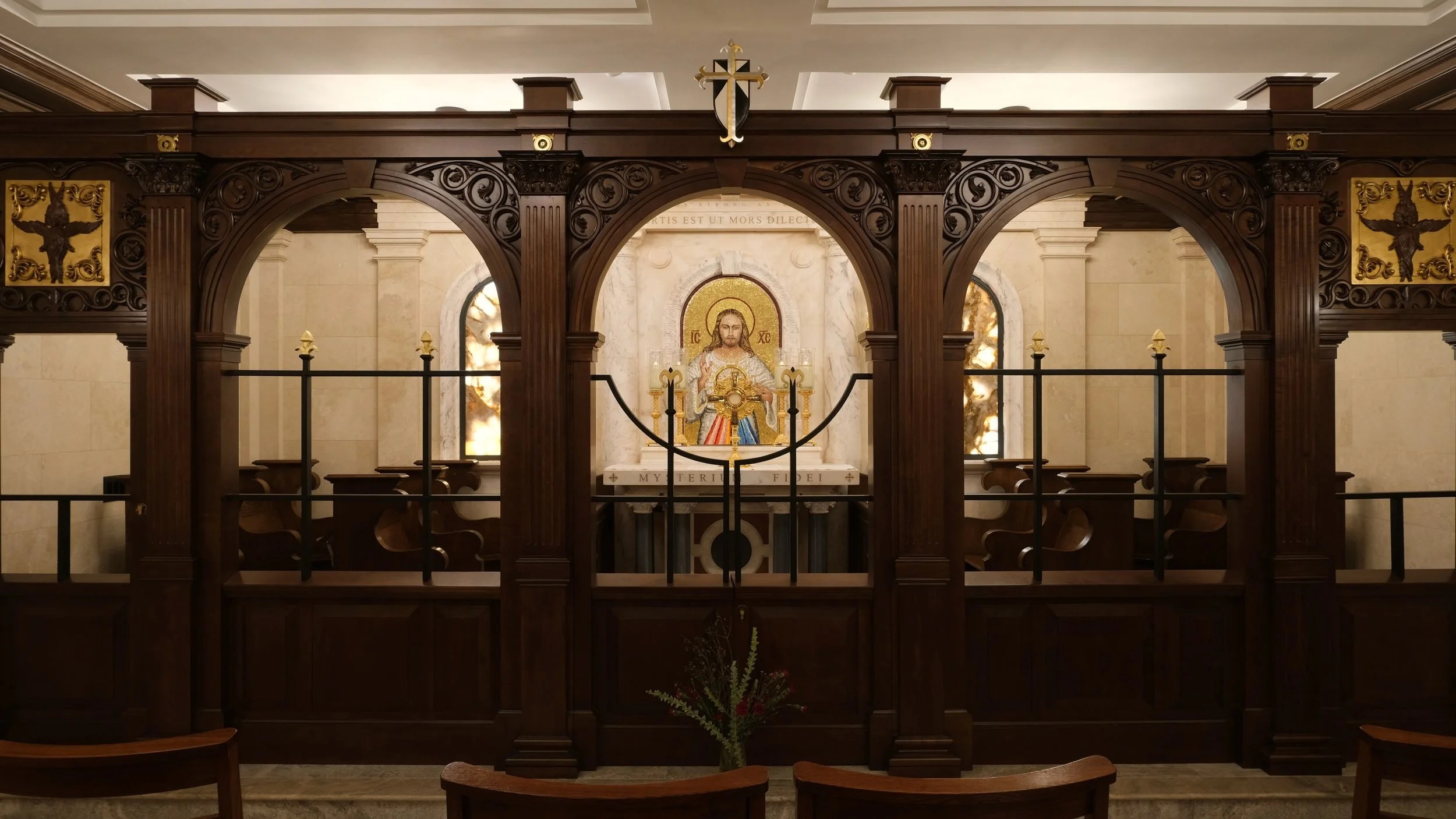
Manhattan’s first-ever perpetual adoration chapel is here at St. Joseph’s in Greenwich Village
What is Adoration Catholics believe that Jesus is truly present in the Eucharist.
During Eucharistic Adoration, the consecrated Host is placed on the altar, and people come simply to be with Him.
There is no program and no pressure. Some stay for a fewminutes; others stay longer.
All are welcome. Our parish is blessed to host the only chapel in Manhattan dedicated to perpetual Eucharistic Adoration. The Divine Mercy Chapel exists not just for our parish, but for the entire city — a place of prayer, rest, and encounter.
Our hope is to offer Adoration day and night, making it possible for anyone to come at any hour to pray in the presence of Jesus.
While the Chapel is open 24/7 – Currently, Exposition is offered from 8:00am–6:00pm, based on available adorers.
About Our Chapel
Our parish is blessed to host the only chapel in Manhattan dedicated to perpetual Eucharistic Adoration. The Divine Mercy Chapel exists not just for our parish, but for the entire city — a place of prayer, rest, and encounter.
Our hope is to offer Adoration day and night, making it possible for anyone to come at any hour to pray in the presence of Jesus.
While the Chapel is open 24/7 – Currently, Exposition is offered from 8:00am–6:00pm, based on available adorers.
Saints, are looked upon as protectors, family members, and living examples of how an ordinary life can experience an extraordinary transformation. Since no one is born a saint, these holy people have made terrible mistakes with which we can all identify. There are murderers, gamblers, and alcoholics among their numbers. They have suffered unimaginable cruelties and conquered every problem in the human condition, from bad marriages to fatal illnesses. Many who lived dissolutely and scandalously before their conversion were rewarded with ridicule and persecution for turning their backs on conventional society. In emulation of Christ, they refused to compromise their spiritual beliefs to preserve their worldly comforts. Through it all they emerge triumphant, willing to help those on earth find God by praying for us and with us.
For more than two thousand years, the legends and stories of the Christian saints have greatly affected the course of Western civilization. The saints have influenced our holidays, our school systems, the boundaries of nations, our poetry, music, and visual arts. They have been great philosophers, uneducated savants, mystics, administrators, farmers, housewives, and soldiers, hailing from every social strata of society.
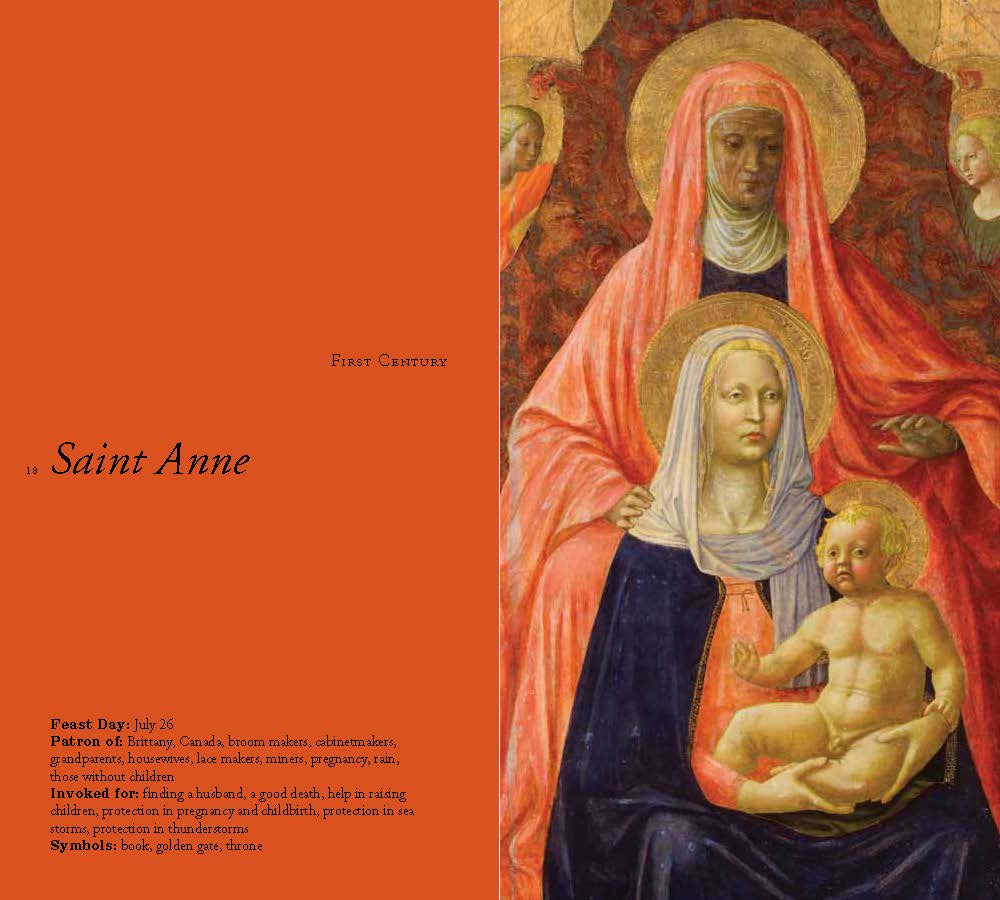
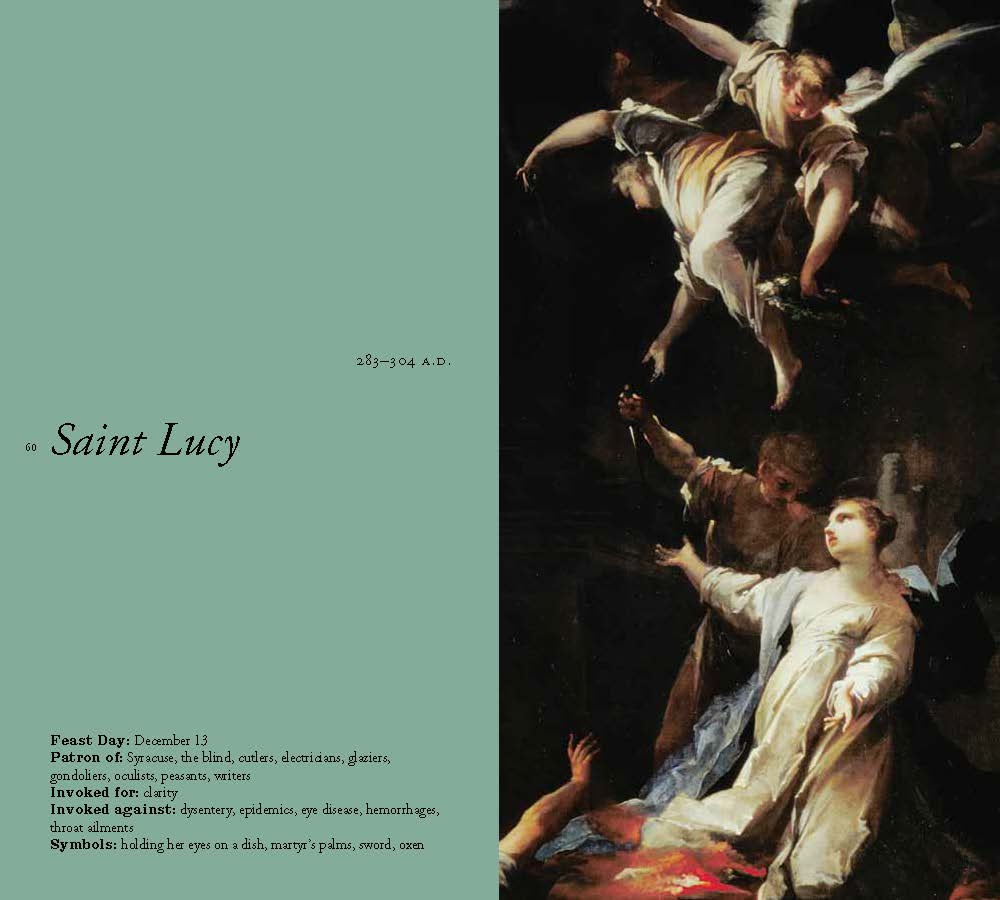
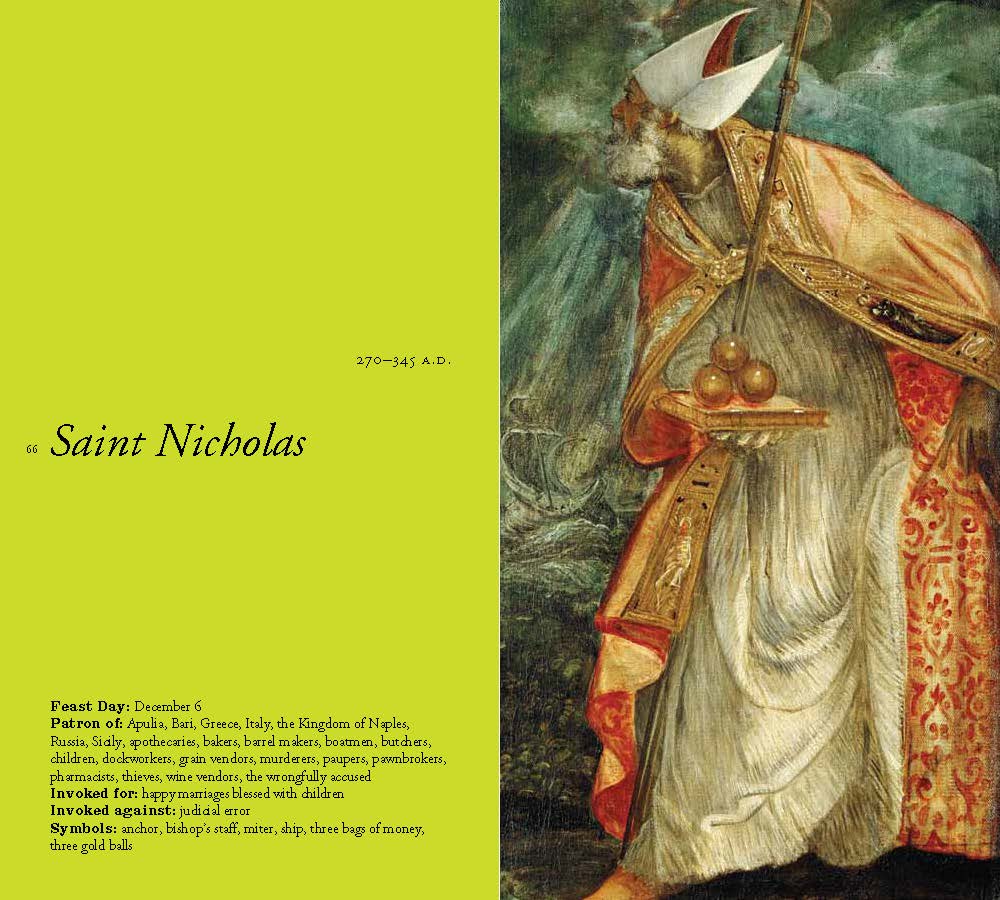
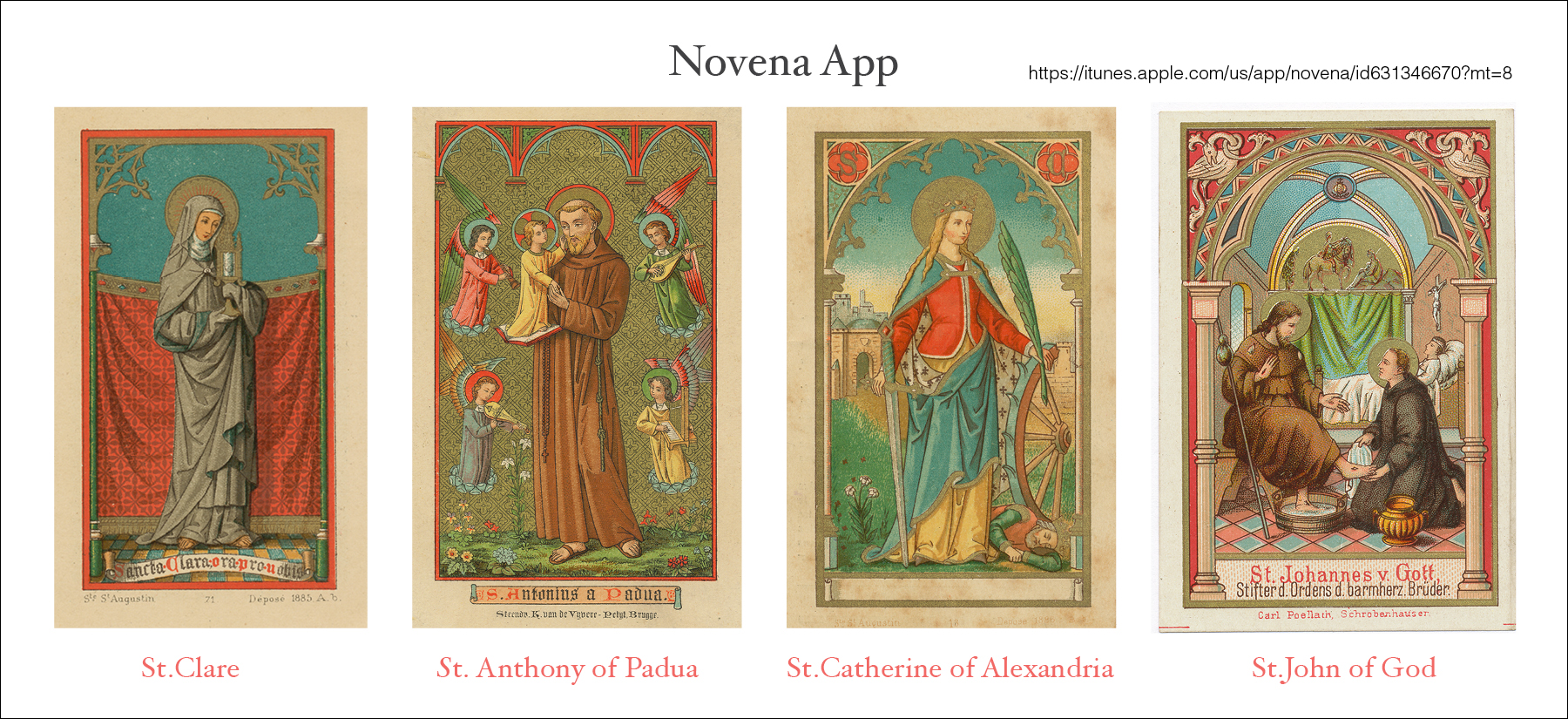
The stories of the ancient saints seem more like legends to us today and, indeed, these tales once served as the only form of popular entertainment. As a result, the exploits of these holy people became more grandiose and exaggerated upon each telling. Thousands of years ago there were few written accounts of saints’ lives. Most of their stories were told visually by painters, sculptors, and stained-glass artists who concentrated on the most imaginative and fantastic aspects of their biographies. For this reason a majority of saints are depicted with the power to overturn all natural laws. Saint Lucy calmly holds her eyeballs on a dish, Saint Nicholas raises three boys from the dead, and Saint Ursula is shot with arrows as she shields young girls under her cloak.
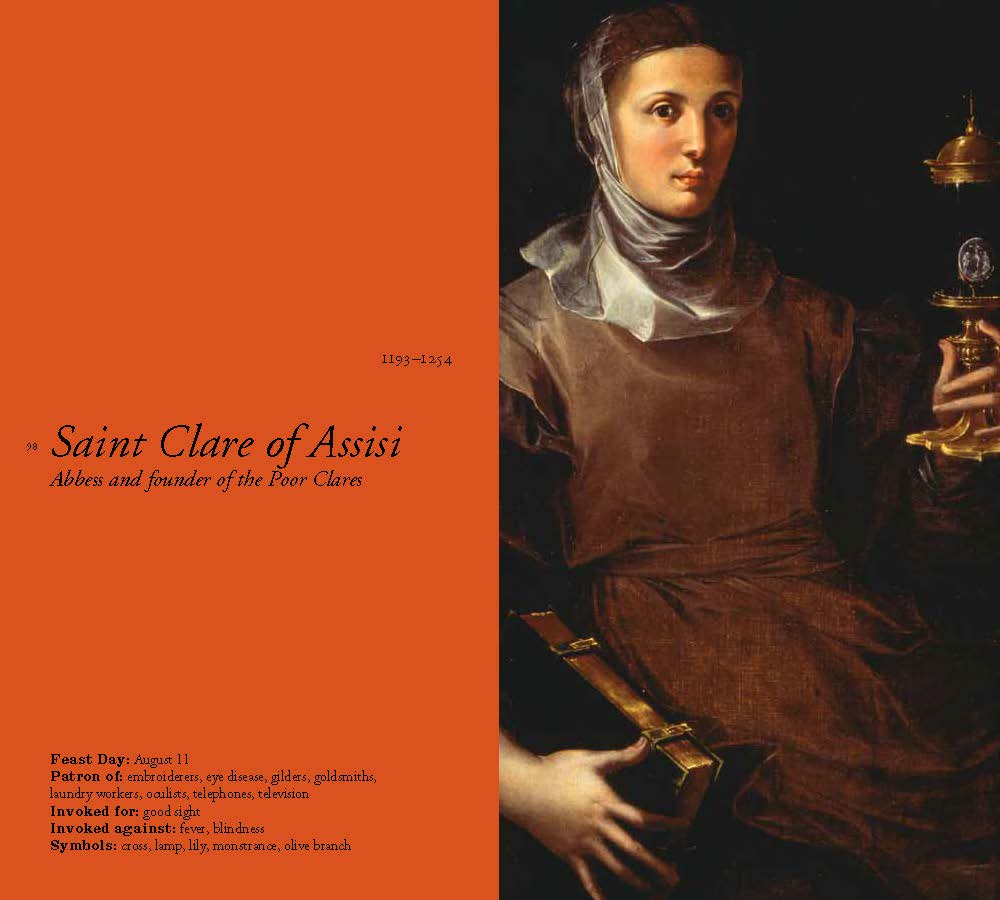
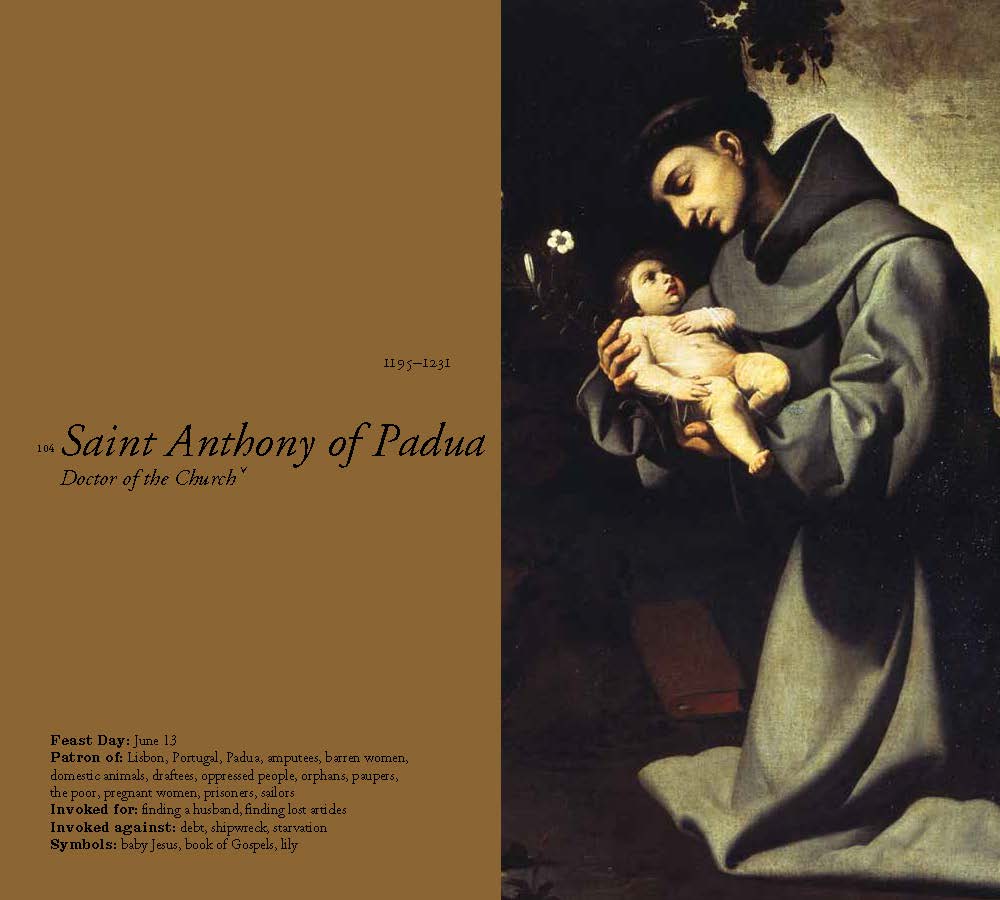
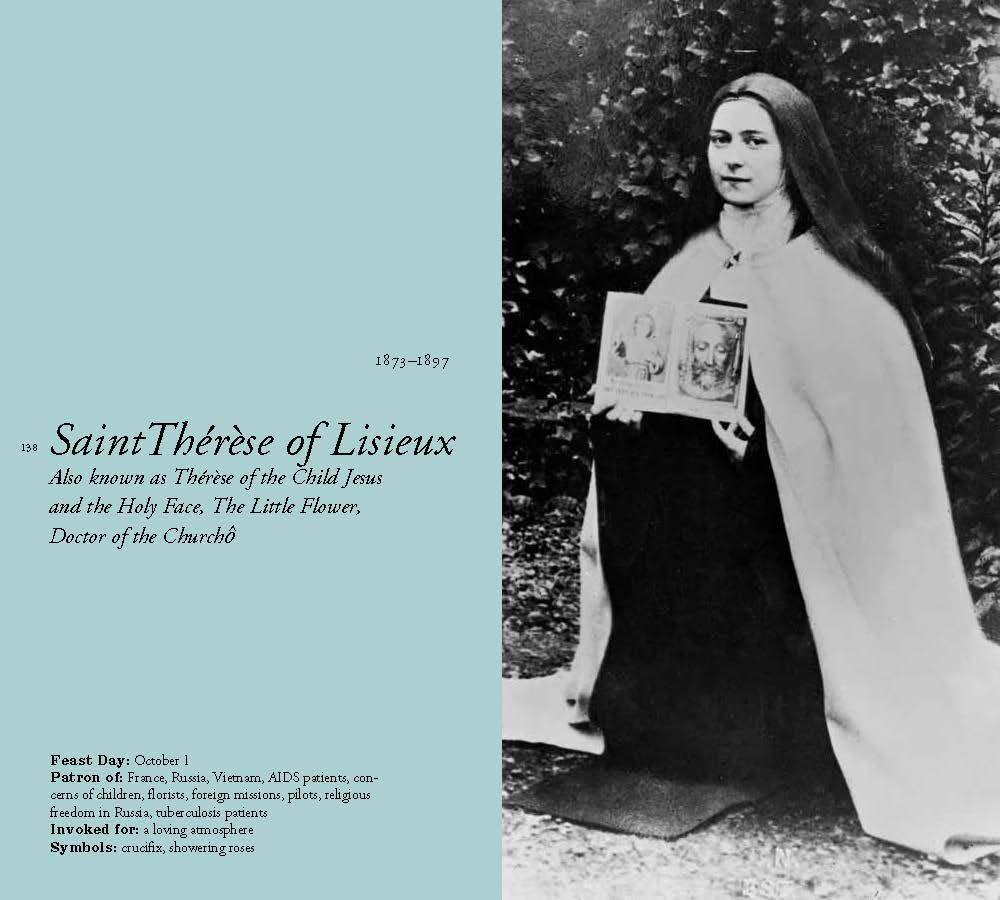
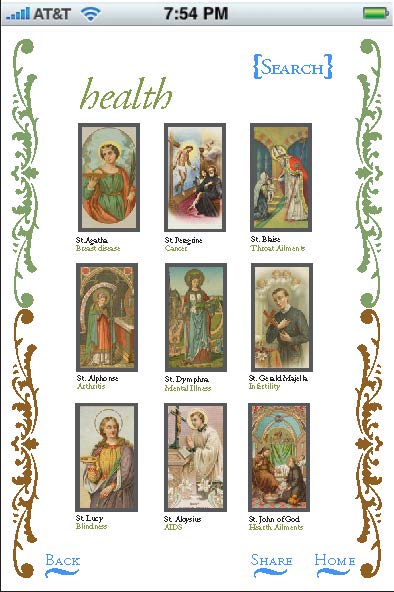
This haunting and dreamy iconography carried over in the depiction of modern saints as well. Visual portraits of the saints attempted to relay their stories with attributes or symbols contained in a single image. Saint Francis is often shown talking to animals or receiving the stigmata, Thérèse of Lisieux showers the viewer with roses, and Saint Anthony’s kindness is symbolized by the image of the Christ child, who sits in his arms. These visual portrayals of the saints are vital reminders of their earthly existence. One sees them everywhere, in private homes, in churches, on clothing and jewelry, and even on the exterior walls of buildings.
Every town and country has saints that are familiar to the local residents and obscure to the rest of us. Since it is estimated that there are more than ten thousand formally recognized saints, it was possible to profile only a very few for this book. Instead of brief biographies and images of many significant saints, we opted to go into detail about a varied handful that have an ongoing influence in modern life. The saints we have chosen are in no way the most important or exalted; many are extremely popular, some less well known. They bring with them a mix of personalities and ethnic cultures that reflect the makeup of today’s diverse society.
For this book, we have divided the first two thousand years of Christianity into ancient and modern time periods. The ancient saints span from prehistory to the year A.D. 1000. These saints tend to have more legendary aspects to their stories, resulting from the strong oral tradition in which they thrived. However, the modern saints are well documented by contemporary historical texts. These comprise the second thousand years. Some of these saints have influenced whole nations while others, through their particular state of life, encourage us to have a more personal relationship with them.
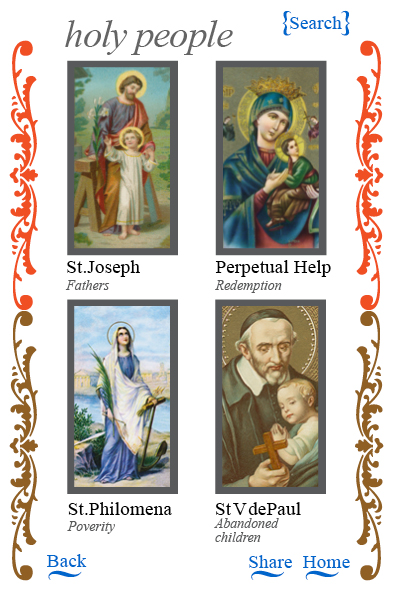
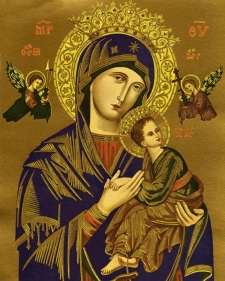
Our Lady of Perpetual Help Feast Day: June 27 Patronage: All Keywords: refuge, protection, motherly comfort, icon Quote: “Why don’t you just ask?” Symbols: lance, sponge, cross, nails, unfastened sandal
An icon is a visual prayer and this image of Mary comforting her young son in a moment of fear, brings consolation to anyone who meditates on it. On either side of Mary are the two Archangels, Michael holding the lance and spear and Gabriel holding nails and the cross Jesus will be crucified on. The child Jesus has been so frightened at the sight of these instruments of his future torment that he has run to his mother in tremendous haste, loosening his sandal. Though she is well aware that this suffering is in his future, Mary has such faith in his ultimate redemption that she calmly holds and reassures her son. If God himself can go to Mary for refuge, than anyone should be able to approach her. Her ultimate belief and faith extends to every one of us, no matter how harshly we may judge ourselves. Our Lady of Perpetual help is said to never refuse a request for help, great or trivial. Despite their reticence to invoke her aid, many have reported hearing Mary’s calm voice saying, “Why don’t you just ask?”
Copies of this miraculous icon can be found in tens of millions of homes all over the world. Though its age is unknown, it first made its appearance in the fifteenth century when it was brought to Rome by a wealthy merchant from Crete. His family eventually donated it to the Church of Saint Matthew in Rome. When that church was destroyed in the Napoleonic invasion of 1789, it was hidden by a priest. Sixty-four years later, its discovery so moved the Redemptorist Fathers who were building a new church on that site. Because of its great visual power, they made it their mission to disseminate this image all over the world. The original icon can be found today hanging in the Church of Saint Alphonse Liguori in Rome.
Novena to Our Lady Of Perpetual Help
See at Your feet, O Mother of Perpetual Help, a poor sinner who has recourse to you and confides in you.
O Mother of Mercy, have pity on me! I hear you called the refuge and the hope of sinners; be my refuge and my hope.
Help me, for the love of Jesus Christ; stretch forth your hand to a poor fallen creature recommends myself to you, and I devote myself to your service forever.
I| bless and thank Almighty God, who in His mercy had given me this confidence in you, which I hold to be a pledge of my eternal salvation.
Mary, tender Mother, help me. Mother of Perpetual Help, never allow me to lose my God.
Amen.
Recite the following prayers 3 times each… Our Father… Hail Mary… Glory Be…
Our Lady of Cobre is considered the mother of Cuban people regardless of their race, political allegiance, or ideology. She is so entrenched in the Cuban national identity that she is virtually the only unifying force between those in exile and those who remained on the island. Though Cuba has been officially declared an atheist country by its government, it allowed four Catholic masses to be said at the major cathedrals in honor of Our Lady of Cobre to commemorate a papal visit in January 1998. The first masses that took place in the middle of the country drew a respectful but reticent response. By the time the fourth mass was said in Havana, the sight of millions of joyful, chanting devotees singing and dancing in the streets so shocked the ruling powers that they agreed to loosen the laws suppressing religious feasts and celebrations in all houses of worship. To many it was proof that the Virgin Mary is far more powerful than any government.
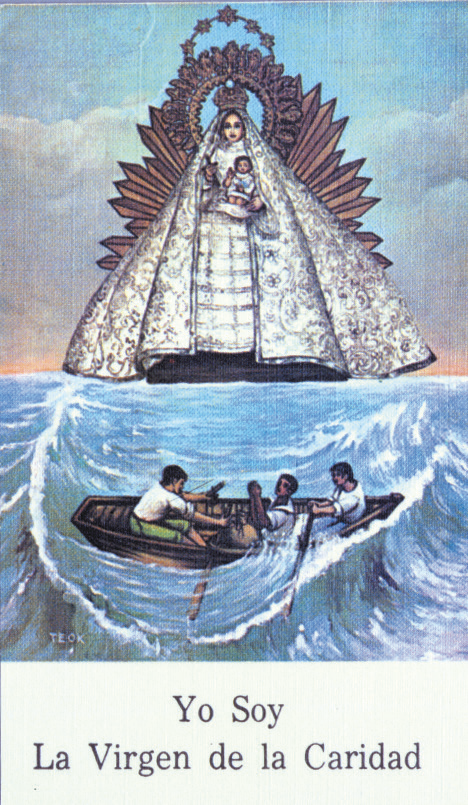
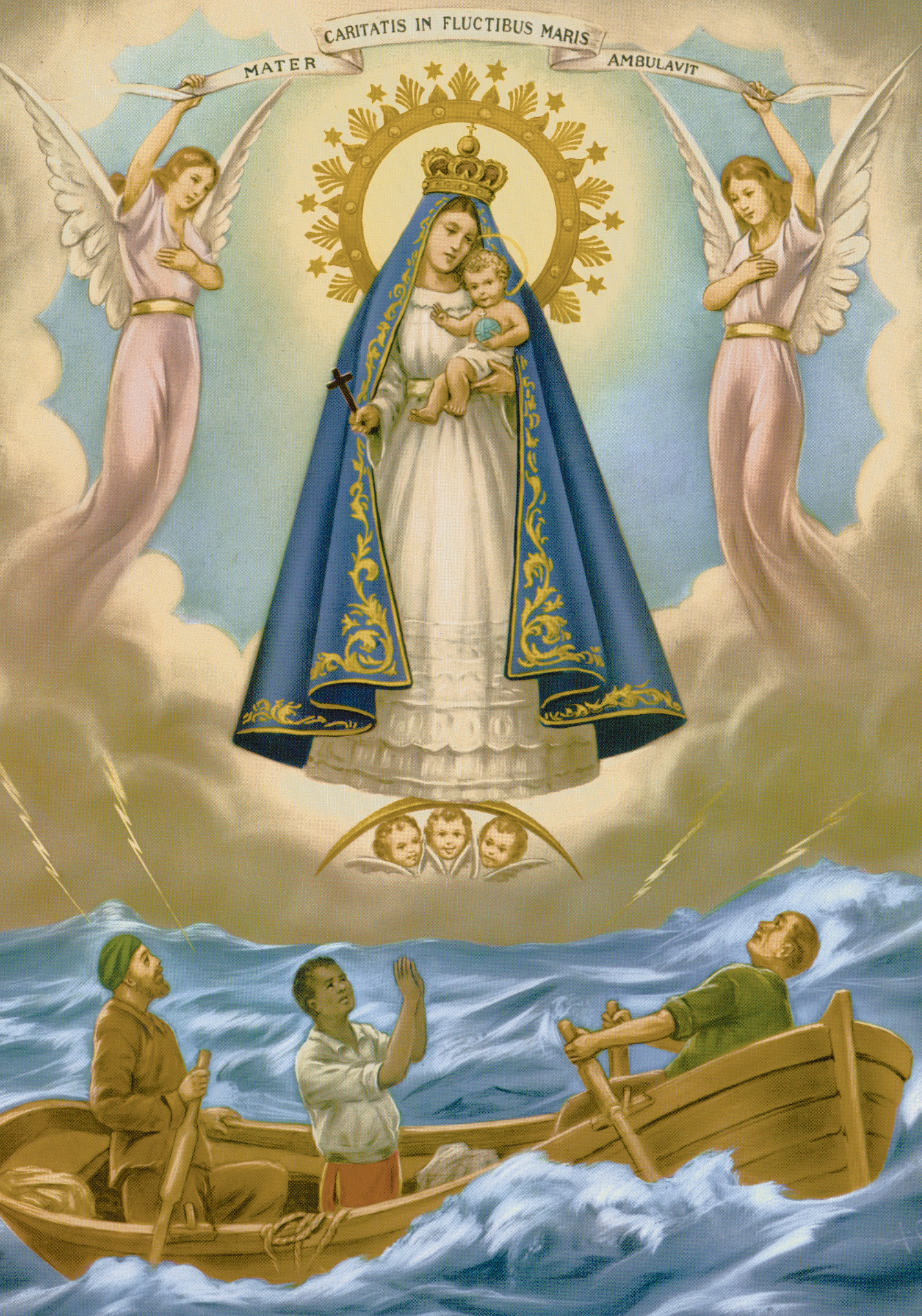
The story of Our Lady of Cobre took place in 1606. Two brothers of Indian lineage, Rodrigo and Juan de Hoyos, and a ten-year-old African slave named Juan Moreno took a canoe out off the coast of Santiago del Prado. This was an area newly rich in copper mines, the name of which has since been changed to Cobre, cobre being the Spanish word for “copper.” The boys were out to gather salt to preserve meat for the copper miners. Halfway across the Bay of Nipe they had to encamp on an islet because a violent storm had blown up. They waited through a harrowing night, the storm ending at daybreak. When the sea calmed the boys again set out on their task.
Almost immediately they saw a white bundle on a plank floating on the waves, approaching them. At first they thought it was a seabird, but as it neared them it appeared to be a little girl. Gradually they realized it was a statue of the Virgin Mary holding the Christ child. Much to their amazement the statue was completely dry. Inscribed on the plank were the words: “Yo soy la Virgen de la Caridad” (I am the Virgin of Charity).
The boys carried the statue back to the town, where its arrival was recognized as a message from the Virgin Mary. A shrine was constructed,and it immediately became a pilgrimage site. The statue is now in its own sanctuary known as Nuestra Senora del la Caridad de Cobre Basilica in Santiago de Cuba.
The statue of Our Lady of Cobre is about sixteen inches high. Artistic depictions of it vary. The statue in the basilica is a mixed-race Mary. Though her original robes were white, she now wears heavily brocaded golden robes with gold and silver embroidery containing Cuba’s national shield. The stiffness of this fabric gives the statue its triangular shape. Our Lady of Charity is a common figure found in Spanish hospitals, and it was thought that this statue could have originally come from a Spanish ship headed for Cuba. In later retellings of the story, the three men in the boat became the “three Juans,” one European, one Taino Indian, and the third one African, who, caught out in a storm, prayed to the Virgin to save them. Miraculously, the sea calmed and the little statue floated to them out of nowhere. In art they are shown rowing in a rough sea with Our Lady of Cobre hovering over them in a protective way. In this depiction of Mary she is holding up the Baby Jesus, and both He and Mary wear golden crowns. She is standing on a half-moon, but unlike the statues of Our Lady of Charity in Spain, the moon is pointing downward. This is thought to be a particular message to the Taino Indians. Their goddess Guabonito had the symbol of the rainbow to represent her. It is thought that in this statue Mary is standing on what could be interpreted as the moon by Europeans and Africans and as a rainbow by the Tainos, offering the same gift of healing that the rainbow symbolizes to them. In art, Mary is frequently depicted as light-skinned and wearing the colors of the Cuban flag. To the island’s practitioners of Santeria, Our Lady of Cobre holds an exalted position in their pantheon as the goddess Ochun. She is the goddess of love, money, and household happiness.
Throughout the nineteenth century, Our Lady of Cobre became a Cuban symbol of unity in their desire for independence from Spain. In 1916 she was named the official patroness of Cuba after soldiers who credited her intervention for their liberation from Spain petitioned the Vatican. She has always remained a symbol of the Cuban people. In 1954 when the writer Ernest Hemingway won the Nobel Prize for his novella The Old Man and the Sea, he wanted to give the medal to the Cuban people. The best way he could think to accomplish this was to bring the prize to the Sanctuary of Our Lady of Cobre and dedicate it to her. There it remains to this day. Wherever Cubans are in the world, her feast day is a major celebration for them. Our Lady of Cobre is fondly called by the nickname Cachita. She is a much loved member of Cuban families and her image is the one consistent thing found among exiles fleeing the island and those who live in Cuba. She is the symbol both of faith and of national identity.
Alhough the Miraculous Medal is worn almost as often as a crucifix by Roman Catholics, few realize that the designs on the front and back owe their inspiration to a series of apparitions of the Virgin Mary.
It is said that the year 1830 announced the dawning of the Marian era. Until then, the last Church-sanctioned apparition of Mary was of Our Lady of Guadalupe in Mexico almost three hundred years before. Within that time frame, the entire religious world of western Europe was shaken to its core by the upheaval of the Reformation, Counter-Reformation, and the French Revolution. In France, religious worship was demonized, and the clergy was ostracized as ancient monasteries and artworks were destroyed.
On the night of July 18, 1830, in the Motherhouse of the Sisters of Charity in Paris, a barely literate twenty-four-year-old novice named Catherine Laboure was shaken from her sleep by a beautiful five-year-old boy. Catherine was in her curtained bed in a dormitory with other novices. Shocked at the dazzling garments the child wore, she was certain the other nuns would wake up.
“Catherine,” said the boy. “Come to the chapel; the Blessed Virgin is waiting for you.”
Catherine was too shocked to speak but thought the words, “But I shall be heard.”
The child calmly spoke, “Be calm, it is half past eleven, everyone is asleep; come, I am waiting for you.”
Catherine dressed quickly and followed the child. As they reached the chapel, the door opened at the light touch of his finger. The room was glowing in light as all of the candles were lit as if for Midnight Mass. Catherine knelt to pray.
As it neared midnight, the child said, “Here is the Blessed VirginCatherine heard the rustle of a silk dress and a beautiful woman sat down in the Father Director’s chair next to her. The woman was dressed in an ivory-colored dress with a blue mantle and a white veil covering her head and draping over her shoulders. Her hands radiated beams of light, the color of jewels.
In a much stronger voice, the child said, “Here is the Blessed Virgin.”
Catherine knelt in front of the woman, putting her hands in her lap as she looked into the woman’s eyes. In her own words, Catherine later recounted, “I do not know how long I remained there; it seemed but a moment, but the sweetest of my life.”
When the Virgin Mary spoke, she said, “The good God, my child, wishes to entrust you with a mission. It will be the cause of much suffering to you, but you will overcome this, knowing that what you do is for the glory of God. You will be contradicted, but you will have the grace to bear it; do not fear! You will see certain things; give an account of them. You will be inspired in your prayers. Tell with confidence all that passes within you. Tell it with simplicity. Have confidence. Do not be afraid.”
Mary then went on to relate the misfortunes that were about to befall France and the rest of the world. When Catherine wondered to herself when these things were to happen, “I understood clearly, forty years.”
The Virgin ended the conversation by saying, “Come to the foot of this altar; there, graces will be poured on all those who ask for them with confidence and fervor. They will be poured out on the great and the humble.” And in Catherine’s words, “the Virgin disappeared like a light is extinguished.”
The child then led Catherine back to bed, where she remained awake for the entire night, wondering exactly what her mission would be.
Catherine did not see Mary again until November 27, 1830, which was the Saturday before the first Sunday of Advent. Though she was with other nuns in the chapel at the 5:30 p.m. prayers, Catherine was the only one who saw the apparition. At the point reserved for interior meditation, when the chapel was at its quietest, Catherine heard the sound of the rustling silk.
In her words, “When I looked in that direction, I saw the Blessed Virgin. She was standing, dressed in a white robe of silk, like the dawn, her feet resting on a globe, only half of which I could see. In her hands, held at the level of her breast, she held a smaller globe, her eyes raised towards heaven . . . her face was beautiful, I could not describe it . . . Then suddenly, I saw rings on her fingers, covered with jewels, some large and some small, from which came beautiful rays . . At this moment, when I was contemplating the Virgin, she lowered her eyes and looked at me and an interior voice spoke to me: ‘This globe you see represents the entire world, particularly France . . . and each person in particular.’”
As Catherine marveled at the beauty of the rays of light exuding from Mary, the voice said, “This is a symbol of the graces which I shed on those who ask me.” When Catherine wondered why some of the jewels on Mary were not radiating light like the others, the voice said, “Those jewels which are in shadow represent the graces which people forget to ask me for.” Then the apparition changed, and Mary appeared with a white dress, a blue mantle, and a white veil. She was standing on the globe and had one foot on the head of a serpent that lay at her feet. The year 1830 was marked at the globe’s base. The Virgin’s hands were pointing downward, and a cascade of light rays were falling from her hands onto the globe.
An oval then formed around Mary, and on it were written these words in gold, “O MARY CONCEIVED WITHOUT SIN, PRAY FOR US WHO HAVE RECOURSE TO THEE.”
The same interior voice said, “Have a medal struck after this model. Those who wear it will receive great graces; abundant graces will be given to those who have confidence.”As the voice faded out, the oval turned and Catherine saw what was on the reverse of the medal: The letter M surmounted by a bar and a cross; beneath the M were the hearts of Jesus and Mary, the one crowned with thorns, the other pierced with a sword. Encircling these symbols were twelve stars.
For the next year, Catherine saw this vision six times. Having little contact with the outside world and feeling pressured to complete her mission, she told her spiritual director, Father John Marie Aladel, about the Virgin’s mandate. Just as Mary predicted in the first vision, he did not believe her. As she persisted to repeat her story to him throughout the year, he and Catherine had many stormy disagreements. At his request, she wrote out a detailed report of what happened. At a loss about what to do with this young girl who not only had these visions, but was so insistent upon having this medal struck, Father Aladel visited the archbishop of Paris in 1832. Having a special devotion to the Virgin Mary, the archbishop did not share Father Aladel’s skepticism and he immediately gave permission to create the medal.
In June 1832, fifteen hundred copies of the medal then known as the Medal of the Immaculate Conception were created. By 1836 more than two million medals had been produced. Because of the many stories of cures, wonders, and death-bed conversions attributed to the medal, it gradually became known as the Miraculous Medal.
Catherine Laboure never revealed to anyone but her spiritual director that it was she who received the visions that caused the medal’s creation, and she could never be induced to attend any of the canonical hearings investigating the apparitions. Eventually, this visit of the Virgin Mary was sanctified and officially recognized by the Church based on the miraculous effects of the medals. For the next forty-six years of her life, Catherine nursed the sick and tended the chickens at the Sisters of Charity residence outside of Paris. Her fellow sisters found her “cold and apathetic” and were quite shocked upon learning that it was this obscure, forgettable person whom the Virgin Mary entrusted with her mission. She died on December 31, 1876, and is buried in the convent chapel in Paris, where the Blessed Virgin Mary first appeared to her.
The Symbols on the Medal On the front of the medal, Mary stands alone with her foot crushing the head of a serpent. She is the Victorious Woman of Genesis (Genesis 3:15), where God says to the serpent, “I will put enmities between you and the woman.” In Catholic art, Mary is frequently depicted crushing the head of a serpent that represents Satan. In this way, Mary as the highest developed form of human life is shown triumphing over evil. It is believed that the date 1830 at the base of the medal signifies the advent of the Marian age, when apparitions of Mary were to intensify and become more frequent. Mary is standing on the globe of the world, which gives her spiritual dominion with the title Queen of Heaven and Earth. Brilliant rays of light cascade to earth from Mary’s hand. She is showering the world with grace from God. This is where her titles Mediatrix and Advocate for Humanity come from. She is so filled with God’s grace and love she needs to share it with others. She looks upon all humankind as her children and tries to show them the path to light and God as any mother would. The words around the frame of the medal, “O Mary conceived without sin, pray for us who have recourse to thee,” is a brief prayer in itself. In it we are recognizing Mary’s help in interceding for us with God and the belief that she was the only human creature to ever be conceived without original sin.
The imagery on the back of the medal is equally symbolic. There is a cross on the back with a bar through its base. This symbolizes the foot of the Cross. This bar runs through the letter M, which stands for both Mary and Mother. This signifies that Mary as Christ’s mother stood at the foot of his Cross while he endured his Crucifixion. Beneath the M are two hearts, one with thorns running through it (this is the Sacred Heart of Jesus); and the other with a sword in it (the Immaculate Heart of Mary). One of the Seven Sorrows of Mary predicted by the prophesy of Holy Simeon is “the Mother pierced with a sword of sorrow beneath the cross so that the thoughts of many hearts may be revealed” (according to Luke 2:34–35: “you yourself a sword may pierce”). Because Mary had to endure the great sorrow of watching her only son die a humiliating and tortuous death, many on Earth look to her for comfort in their own troubles. They know that she went through the worst agonies a mother could withstand and triumphed over them. Both hearts are equal in size, and both hearts are inflamed by ardent love. Encircling the cross, the M, and the two hearts are twelve stars. In art, Mary is frequently depicted crowned by twelve stars. It is believed that the Twelve Apostles looked to her quiet devotion and acceptance of her son’s fate for spiritual inspiration. Stars also pertain to the book of Revelation (Apocalypse) as a reference to the “great sign” described as “a woman clothed with the sun, with the moon under her feet, and on her head a crown of twelve stars” (Revelation 12:1). In the Miraculous Medal lie the symbols of Mary’s role in salvation from Genesis to Apocalypse. As the Victorious Woman she is destined to take part in the final defeat of the devil.
The Miraculous Medal is considered a physical manifestation of the gift of grace, which exudes from the Virgin Mary. It is considered Mary’s token reminder that she is always ready to offer assistance.
“Catherine heard the rustle of a silk dress and a beautiful woman sat down in the Father Director’s chair next to her. The woman was dressed in an ivory-colored dress with a blue mantle and a white veil covering her head and draping over her shoulders.“
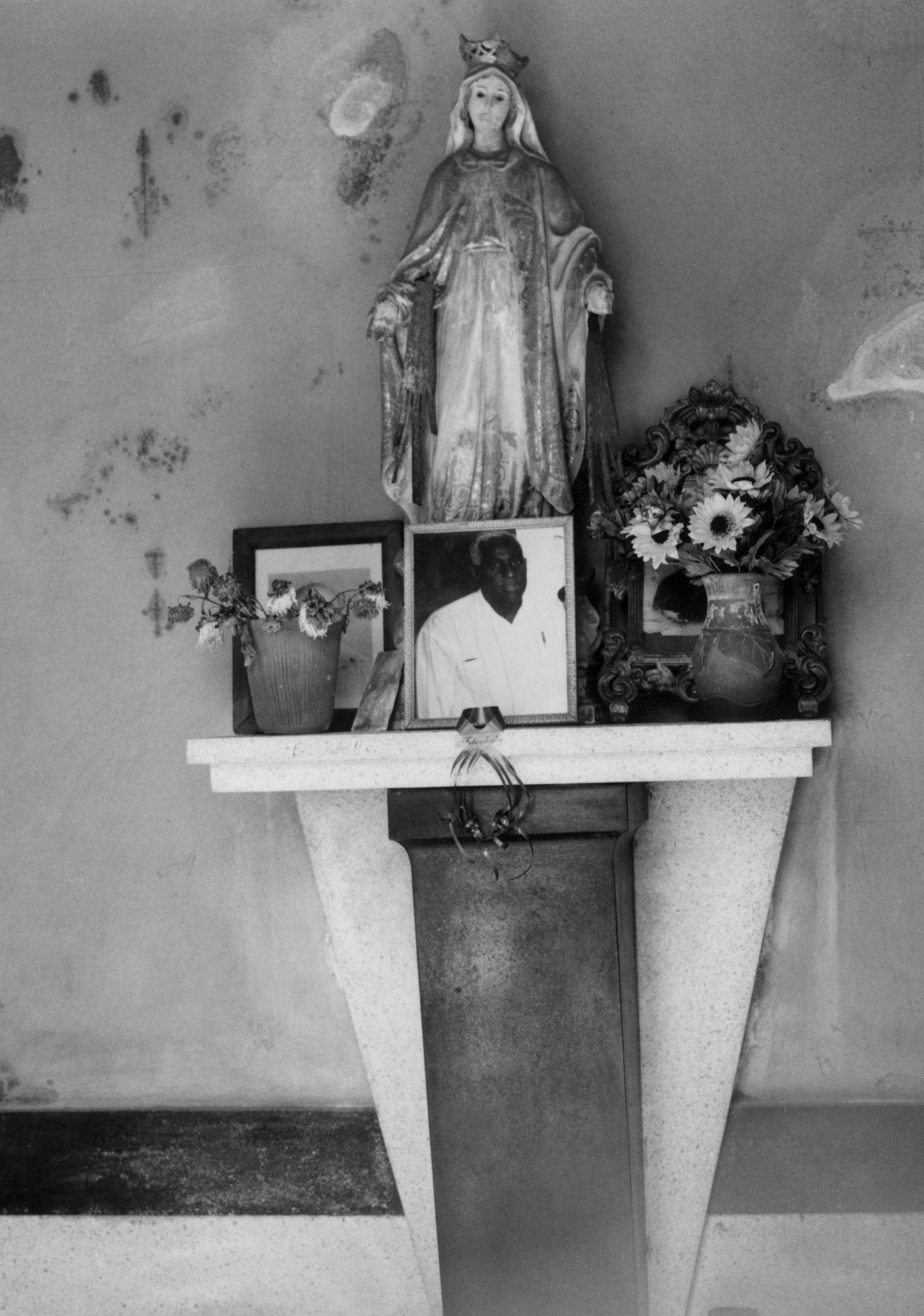
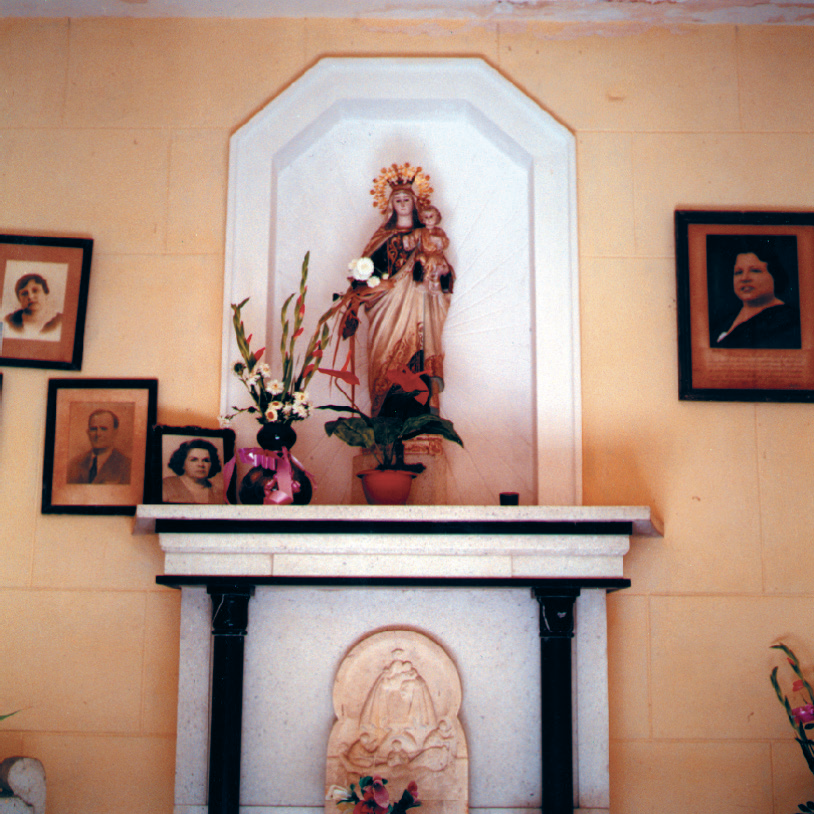
Home altar in Havana,Cuba Photographs by Lisa Silvestri
Altar in family mausoleum in Havana, Cuba Photograph by Lisa Silvestri
Religious Statues from the flea market in Mexico City, Mexico.
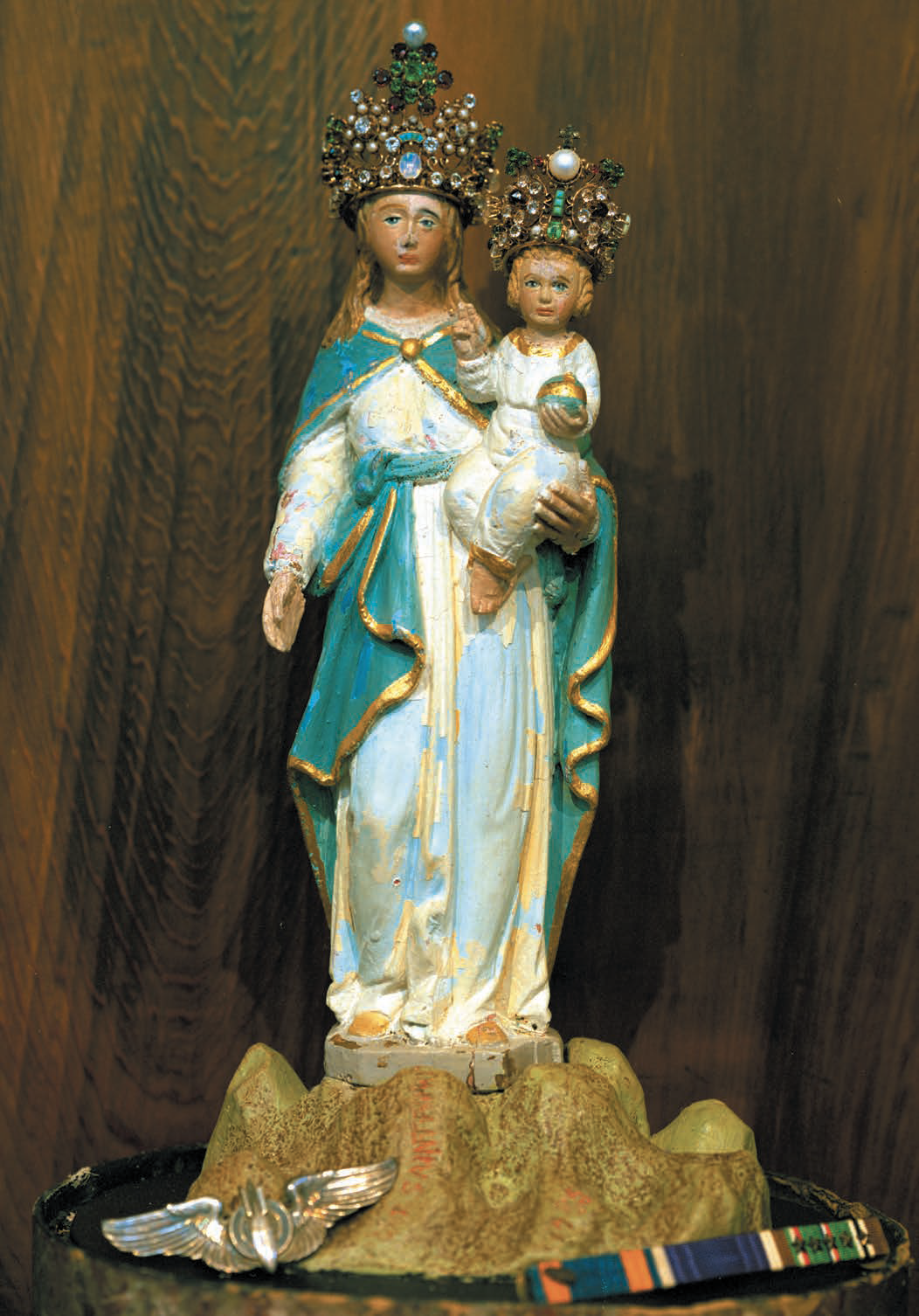
The “Sweetheart Statue” was brought to the Ursaline Convent in New Orleans in 1785.
visions of Mary Our Lady of Guadalupe
A traveler visiting Mexico or the American Southwest meets Our Lady of Guadalupe hundreds of times a day. Her image adorns the walls of businesses, is prominently displayed in homes, is on the hubcaps of cars, and at the center of small sidewalk shrines. This image of Mary is the preeminent cultural icon for most Latin Americans, sacred to Catholics and highly honored by non-Catholics, and it is the only apparition of Mary sanctioned by the Church on the North American continent.
On December 9, 1531, an Aztec convert to Catholicism named Juan Diego was on his way to early morning Mass in the area that is now known as Mexico City when he heard the sound of birds singing. When they quieted down, the hill at Tepeyac seemed to respond to their song. From the top of the hill a woman gently called to Diego, “Ihuantzin. Ihuan Diegotzin.” She was speaking the Aztec language of Nahuatl. As he approached her, he saw that she was an Indian noblewoman. He was amazed at how her clothes glimmered like the sun and how the rocks and foliage around her had a heightened glow. The crag where her foot rested gave off rays of light and the earth sparkled like a rainbow.
She spoke to him courteously and with great charm, “Know my dearest, littlest, and youngest son, I am the forever whole and perfect maiden Saint Mary, honorable mother of the true God, honorable mother of the giver of life, honorable mother of the creator of men and women, honorable mother of the one who is far and close, honorable mother of the one who makes the heavens and the earth. My wish is for them to build my temple here where I will give people all my love, compassion, assistance, and protection. I am the compassionate mother of you and your people here in this land and all of the other people who love me, call to me, search for me, and confide in me. I will listen to their pain, suffering, and crying and heal them from their misery.”
She then sent him to see the bishop to make the request for the church. After a long wait he related his story to the bishop who told him that he must obtain a sign proving that this was truly an appearance of Mary. Juan Diego returned to the woman on the hill and begged her to get someone more prestigious to give her message to the bishop. She told him that she had many people who could deliver her request, “but it is of precise detail that you yourself solicit and assist and that through your mediation my wish be complied.”
On his next visit to the bishop he was once again greeted with suspicion. When he left, the bishop sent servants to spy on him and to see to whom he was really speaking. But as soon as Juan Diego crossed the wooden bridge to the hill at Tepeyac, they lost sight of him. The next day, a Monday, Juan Diego decided to take another route around the hill in order to avoid the woman. His uncle had taken ill, and he needed medical attention. Juan Diego did not want the woman to detain him, as he feared that his uncle would die waiting for help. Much to his dismay, she came down the hill to meet him from where she was watching. When she asked him why he was so upset and why he was in such a rush, he sadly told her about his uncle’s illness and how his requests for her to the bishop had fallen on deaf ears.
Her answer was, “Listen, put it into your heart, youngest and dearest son, nothing should scare or concern you. Don’t worry. Don’t be afraid of the sickness, or any other illness or hardship. Am I not right here who is your mother? Are you not under my shadow and protection? Am I not in the foundation of your being, your sustenance, your happiness, peace, and effortlessness? Are you not in the fold of my garment? Do you need anything else? Don’t allow anything to worry or disturb you anymore. Don’t worry about your uncle’s illness. He will not die. Be assured, he is already well.”
She then told Juan Diego to gather roses among the rocks. He was surprised to find them in full bloom since it was winter. She carefully arranged them in Juan Diego’s cloak and he brought them to the bishop. After another humiliating wait, he was finally granted an audience. As he unwrapped his cloak and the roses fell out, the bishop gasped. The flowers uncovered an elaborate portrait of the Virgin Mary imprinted on the cloak. The bishop fell to his knees in tears and begged Juan Diego’s forgiveness. The bishop then insisted on being taken to the hill where the lady from heaven wanted her temple. After he had done this, Juan Diego ran home to his sick uncle and was quite shocked to see him happy and healthy. His uncle told him that a heavenly lady had come to heal him, asking him to tell the bishop of his cure. She also wanted him to convey the proper name for her image: The Perfect Virgin Holy Mary of Guadalupe.
The bishop had the church built and the cloth put on public display where it immediately attracted crowds of pilgrims. Almost as suddenly, the Franciscans, who had been in Mexico for the past ten years and who had very little previous success, were receiving thousands of Aztecs who wanted to convert to Catholicism. This cloth and its image, which should have deteriorated in twenty years, is still on view at the Basilica of Our Lady of Guadalupe in Mexico City. After almost five hundred years it remains in pristine condition. Attracting more than ten million pilgrims a year, Our Lady of Guadalupe is the most popular Marian shrine in the world.
At the time of this apparition of Mary, the Aztecs, the original inhabitants of Mexico City, had been suffering brutally under domination of the Spanish colonialists. Disease and depression were rampant. Hernán Cortés, the conquistador, had landed in 1519 and had succeeded in destroying much of the Aztec civilization by 1521. Why, then, were the Aztecs eventually such willing converts to Catholicism? The Aztecs had hundreds of gods in their pantheon. It was their spiritual habit to co-opt the gods of tribes that they conquered. They believed that their own god Huitzilopochtli depended on human sacrifices to be kept alive. They invaded neighboring tribes to obtain these victims. As they as a people became more aggressive against their neighbors, the gods of the Aztecs took on more monstrous forms. Portrayals of the female gods became the most frightening and grotesque. When the Spanish arrived in the Aztec city, they were amazed at its beauty and grace, and equally horrified at the blood-soaked temples with the racks of human skulls and demonic-looking statuary. All Aztec places of worship were considered satanic and systematically destroyed.
The hill where Mary appeared was once the site of the goddess Tonzantin. She was considered a household god, the goddess of corn and fertility. With Our Lady of Guadalupe, the feminine traits of love, compassion, and forgiveness were returned to spirituality and the sick-at-heart population had an entity to whom they could take their sorrow.
Statue of Blessed Juan Diego wearing the tilma with the imprint of Our Lady of Guadalupe. Following pages: Statues being sold at a flea market, an outdoor shrine with Our Lady of Guadalupe surrounded by lights so that she can be worshiped at night.
The portrait of Our Lady of Guadalupe conveyed a message interpreted differently by Aztecs and Europeans, yet triggered the same spiritual response. To the Aztecs, the basic announcement that Mary was making with this image was the dawning of the age of the Sixth Sun. Dividing up their history into solar ages, it was thought that the Fifth Sun, the Sun of Movement, ended with the Spanish conquest. Since the birth of a new sun always follows a time of darkness, it was believed that the appearance of Mary after ten years of destruction signaled the beginning of the Sun of Flowers. According to their lore, this was a time when humanity would come into its own and bloom. In this image, Mary wears a belt worn by pregnant women, thus announcing the birth of a new age. Gold-leaf Nahuatl glyphs symbolizing plenitude appear on her gown. They are arranged over her womb in a pattern that represented the four points of a compass, a basic symbol in the Aztec faith. The womblike light she is wrapped in, the rays of the sun and the crest of the moon, the folds of her robe and the subdued serpent all had hidden messages that were easy for the Aztecs to read. Her eyes do not stare ahead as depictions of the gods do; rather she is looking down at humanity, much as a mother looks at her child. Her hands are in a praying position that the Aztecs used to signify something coming from one’s heart. The fact that her robe is touching the angel signifies protection and love.
For the Christians the iconography of this image was directly related to the book of Revelation where John says, “A great sign appeared in the heavens, a woman clothed with the sun.” This image is associated with the Immaculate Conception. December 9, the first day of her appearance, was also the original day devoted to the Feast of the Immaculate Conception. The halo Mary is wrapped in is called a mandorla. Originally, this type of almond-shaped body halo represented the cloud in which Christ ascended; in time it came to signify the light that emanates from those divinely inspired. In Western art it is used to depict those with a complete bond to Christ. As the Mother of God, Mary is exalted above all angels, offering her protection and love to humanity.
By appearing as a mixed-race woman, Mary was announcing the new face of Catholicism. The brutal, fundamentalist way that Catholicism was practiced by the Spanish was softened. In her appearance Mary was reminding the Europeans that they had the same mother that the Aztecs did. She was the first Christian image that the Mesoamericans could relate to, and the messages embedded in her picture offered hope, love, and comfort to a people when these qualities had been driven out of their own religion.
Our Lady of Guadalupe is the patroness of Mexico, North and South America, and the Caribbean.
The Feast of Our Lady of Guadalupe is December 12, the day the miraculous cloth was revealed.
Barbara and I wanted Visions of Mary to be a book about how the Virgin Mary affects people in their everyday lives. In the United States and countries around the world, images of Mary are displayed among family photographs. For this reason, we chose not to use the great art works and paintings that have been created in her honor. Rather, we sought photographs of “everyday Marys.”. The photographer Lisa Silvestri after a trip to Mexico, Cuba, and New Orleans returned with countless beautiful images. It helped set the visual tone for our book. We are grateful to Lisa.
We also worked with Dr. Joseph Sciorra of the Calandra Center in New York City. Sharing his research on the black Madonnas of Southern Italy, and introduced us to the work of two wonderful photographers, Larry Raccioppo of New York City and Dana Salvo of Gloucester, Massachusetts, who are included in this book.
Diane Block, photo archivist at The Museum of New Mexico, was a big help in finding photographs for this book.
We bring this book to you with the help of the people mentioned above. We hope you find something in this book to love and are inspired by, as you go through your life. We will post a chapter every month.
Barbara and Sandy
Hail Mary Full of Grace! the Lord is with you; Blessed are you among women, and blessed is the fruit of your womb Jesus. Holy Mary, Mother of God, pray for us sinners, now and at the hour of our death. Amen.
Our Lady of Mount Carmel
Mount Carmel, in what is today northern Israel, has always been a place rich in mystical tradition. The word hakkarmel means “the garden” in Hebrew, and true to its title, there is a remarkable profusion of plants and wildflowers on this mountain. It is considered a natural paradise and a sacred place, and in biblical times it was forbidden to disturb any of the natural life on it. Those who wanted to ascend the mountain for meditation lived in caves so as not to intrude on the landscape with unnatural structures.
In about 860 b.c., the prophet Elijah (also known as Elias) arrived on this holy mountain to begin a life of contemplation and prayer. The First Book of Kings is filled with tales of wonders he performed and prophesies he gave. In his prophetic visions on Mount Carmel, Elijah became aware of the coming of the mother of the Messiah. He and his followers mystically dedicated themselves to her, setting an example as the first monks. The descendants of these ancient contemplatives were among the first to accept the teachings of Christ and to be baptized by His apostles. Upon meeting Mary after Christ’s Ascension, they were so overcome by her sanctity that they returned to the mountain to build a chapel in her honor. For the next thousand years Mount Carmel continued to be a place where hermits devoted themselves to prayer.
By the twelfth century, pilgrims from Europe who had followed the Crusades to the Holy Land settled with the ascetics on Carmel and started a religious holy order known as Brothers of the Blessed Virgin Mary of Mount Carmel. Their rule, which was given in 1209 by the Patriarch of Jerusalem, says that all converges toward the contemplation of God. The Rule of Mysticism exhorts those who fol-low it to live a life of continual prayer, obedience to a superior, perpetual abstinence and fasting, manual work, and total silence.
of their order to the laypeople; it served as a reminder that belief in Mary as the Mother of God extended back to the Old Testament with the prophet Elijah. After Pope John XXII (r. 1316–1334) had a vision of Mary where she promised those wearing the brown scapular, “I, the Mother of Grace, shall descend on the Saturday after their death and whomsoever I find in Purgatory, I shall free, so that I may lead them to the holy mountain of everlasting life,” the scapular became extremely popular among the common people. By the end of the sixteenth century it had become smaller in size and very similar to the one that is worn today. Admiration for the Carmelite Order spread as their adherence to the rules of solitude and prayer produced some of the greatest mystical saints in Catholicism, all of whom had visions of or openhearted communications with Mary. Among them are Saint Simon Stock, Saint Teresa, Saint John of the Cross, and Saint Thérèse of Lisieux.
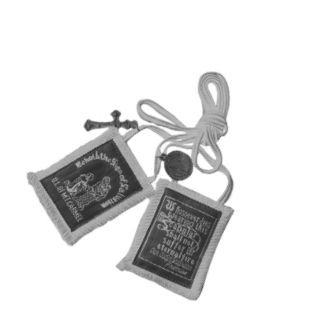
Though the original scapular handed to Saint Simon Stock was brown wool cloth without a picture, the Carmelite scapular that is now worn and the one that is most favored now has an image of Our Lady of Mount Carmel holding the Baby Jesus while she offers the scapular. The other piece of cloth often has a picture of Jesus as a man. Neither image is prescribed. Wearing the scapular is a form of prayer and is considered a visible sign of consecrating oneself to Mary and to accepting her maternal protection. Devotion to Our Lady of Carmel can be found wherever the Carmelites founded a monastery or convent. Many small towns in Italy have churches named after this aspect of Mary. As the townspeople emigrated to other countries, they brought the devotion with them. In many cities in the United States these churches have great celebrations in honor of Our Lady of Mount Carmel. Artistic representations of Our Lady of Mount Carmel depict her either appearing in the sky over Mount Carmel itself or holding Jesus as a toddler. In both versions the figure of Mary is often depicted offering the scapular to the viewer. Tradition has it that the prophet Elijah saw Mary appear in the clouds over Mount Carmel eight hundred years before her birth. Sometimes this representation includes her handing the scapular to Saint Simon Stock. The other version of this aspect of Mary illustrates the Sabbatine privilege where Mary vows to take the souls of those who died wearing the brown scapular out of purgatory on the Saturday after their death. Purgatory is depicted in flames because it is a place where the soul goes to have its sins burned away.
Simon Stock, an English pilgrim, had joined the group on a visit to Jerusalem. At this time, Saracen invaders forced the monks out of their spiritual home on Mount Carmel. All those who would not leave were murdered. Simon Stock was instrumental in getting the order to move to Aylesford, England, where the Baron de Grey gave them a manor house. The Carmelite lifestyle of contemplation, poverty, and silent prayer was not easily accepted in Europe, particularly among the clergy who enjoyed almost the same status and privilege as royalty. Reading into the life of Mary, Simon Stock was inspired by her unquestioning acceptance of all that befell her: her virgin pregnancy; her raising and loving a child doomed to be executed; and her staying at the foot of the Cross while others ran away. It was through his insistence that the Carmelites evolved from a band of hermit ascetics who regretted the loss of their home on Mount Carmel into a traveling society of mendicant friars, opening schools and mission houses in the major capitals of Europe. Still, it was difficult for many monks to accept the alteration of the rule of the order to adapt to European conditions. Their presence was also shunned and not easily tolerated by other religious orders. The people thought these hermits strange and did not accept that they chose to live in such absolute poverty and isolation. In order to preserve what was left of their order, the Carmelites invoked their patroness, the Virgin Mary, for help in establishing their new life. The answer came in a vision to Saint Simon Stock on July 16, 1251, when he was alone in his cell. Mary appeared to him holding the scapular of his order. She told him, “Receive my beloved son, this habit of thy order: this shall be to thee and to all Carmelites a privilege, that whosoever dies clothed in this shall never suffer eternal fire. . . .It shall be a sign of salvation, a protection in danger, and a pledge of peace.”
The scapular, two pieces of brown wool joined at the shoulders and hanging down the back and breast, was not new to the Carmelite order. For hundreds of years before Saint Simon Stock’s vision, monks in Europe had worn scapulars. But it is thought that the brown scapular that Mary delivered was referencing Elijah’s camel-hair garment on Mount Carmel. Eventually, the brown scapular became reduced in size for laypeople to wear under their clothing. This is a special devotion to Mary worn as a sign to commemorate her faith in both God and humankind.
Our Lady of Mount Carmel is the patroness of the Carmelite Order, Chile, and Bolivia. Her feast day is July 16.


 Alhough the Miraculous Medal is worn almost as often as a crucifix by Roman Catholics, few realize that the designs on the front and back owe their inspiration to a series of apparitions of the Virgin Mary.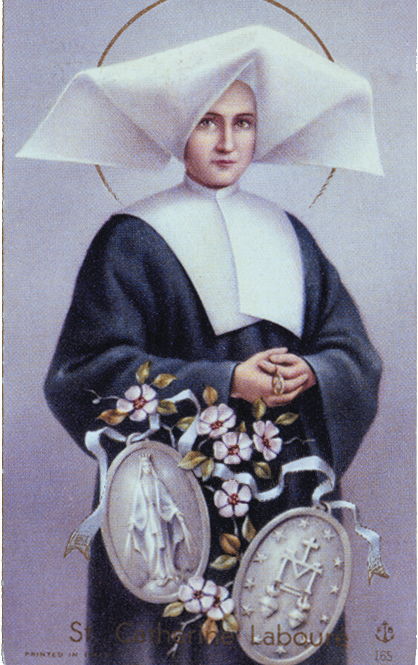

 visions of Mary Our Lady of Guadalupe