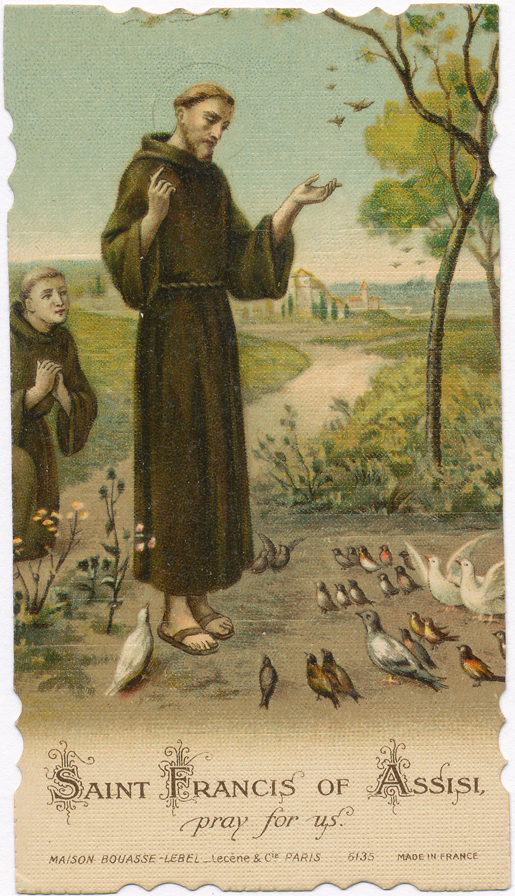
“Lord make me an instrument of your peace, where there is hatred let me sow love.”
Love for God and everything in creation so consumed St. Francis of Assisi, that he was able to commune with the natural world on a divine level. Taming wolves, quieting flocks of birds and infusing peace and contentment to the humanity he interacted with, we call on Francis of Assisi to bring us into the harmonious rhythms of the universe, where all of nature and mankind are at one with the divine force of creation.
An unlikely mystic, Francis was born Giovanni Bernadone in the town of Assisi. His father, a proud member of the upper classes was a wealthy cloth merchant married to a woman from Provence. Because he frequently conversed in French with his mother, Giovanni was soon known as “Francesco” or “the Frenchman” by his friends and neighbors. Confident that his son would follow in his footsteps, the elder Bernadone indulged and catered to Francesco’s every whim and the youth enjoyed a pleasure filled existence in the company of others in his social caste. On a lark he set off with friends to take part in a war with Perugia. Much to his shock, he was taken prisoner and it took his family a year to ransom him back. Upon his return, he was bedridden and seriously ill. But in recovering his health, Francesco seems to have lost his identity. He suffered a great spiritual crisis as all interest in his old life and his father’s business waned and disappeared. While wandering the countryside he stopped into the deserted church of San Damiano and heard the crucifix say to him, “Francis, go and repair my house, which you see is falling down.” Happy to have some direction in his life, he took the request literally and began rebuilding the structure with his bare hands. Ultimately, his father disowned him and when Francis, renouncing his inheritance threw his clothing in the street, he donned the simple brown garment given him by the Bishop of Assisi.
Begging for supplies, Francis continued his work on San Damiano. Eventually he was joined by other disenchanted young men looking for a higher meaning in life. By simply following the exact tenets of Christ, this little band of friars, never owning anything, bartering labor for food and shelter began a movement of religious seekers that revolutionized the Church by the simple and loving way they spread the gospel. Instead of writing in church Latin he used colloquial Italian and in an effort to explain the story of Christ’s birth, he created a living tableau of animals and people – the first Christmas crèche.
A great poet and mystic, Francis was the first saint to receive the stigmata while in a meditative rapture. Filled with humility and though he founded one of the world’s greatest religious orders, Francis of Assisi was never ordained a priest. Upon his death he requested to be buried in the cemetery for criminals, but the people of Assisi so loved him that they took his body and interred it under the altar of their great cathedral.
Just as popular with nonCatholics as Catholics, Francis has inspired great artists, composers and writers. Assisi, Italy remains a great pilgrimage site for those wishing to pay him tribute.
Prayer
Lord, make me an instrument of your peace; Where there is hatred, let me sow love; Where there is injury, pardon; Where there is doubt, faith; Where there is despair, hope; Where there is darkness, light; And where there is sadness, joy. O Divine Master, Grant that I may not so much seek To be consoled, as to console; To be understood, as to understand; To be loved, as to love; For it is in giving that we receive, It is in pardoning that we are pardoned, And it is in dying that we are born to Eternal Life. Amen.
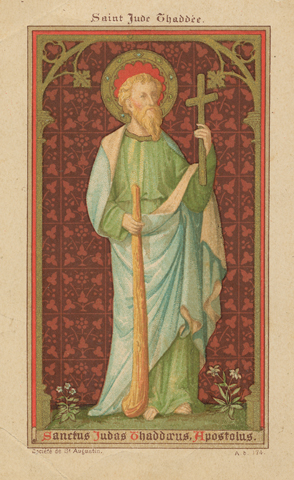
One of the original 12 apostles, Jude is depicted with the flame of knowledge received from the Holy Spirit at the Pentecost burning above his head. Brother of James the Lesser and cousin of Jesus, Jude was one of Christ’s earliest followers. He earned his title of Patron Saint of Impossible Causes because of a letter he wrote in 60AD to persecuted Christian converts in the East, exhorting them to stay strong in the face of all difficulties.
The name Jude means giver of joy and the name Thaddeus means great hearted one and this saint was said to live up to his name, attracting immense crowds by preaching in an entertaining way, outwitting magicians and local priests. Abgar, the King of Edessa was quite impressed with Jude and appealed to Jesus cure his leprosy. He sent an artist to draw Christ’s image. The artist was so shaken by the glow in Christ’s eyes, he could not draw. Christ wiped his face with a cloth and the image of his face was transferred to it. Jude brought the cloth back to Abgar and the king rubbed the cloth over his body, curing himself of leprosy. Many depictions and statues of Saint Jude include this cloth with Christ’s image on it. Jude was martyred along with Saint Simon in the city of Samir by being beaten with a club. This club, as well as the palms of martyrdom are also part of his iconography.
The cult of Saint Jude all but died out after the Middle Ages because people confused him with Judas Iscariot, the apostle who betrayed Christ. Despite being cited as a great influence by the mystics Saint Bernard of Clairvaux and Saint Bridget of Sweden, Jude was rarely invoked by the faithful for anything. It is said that because of this, he became the saint to call on in the most impossible of situations. So anxious was he to be of help, he would turn heaven and earth to rectify a desperate situation. By the nineteenth century, it became customary to thank the saint for help with answered prayers by taking an ad in the newspaper. This helped to resurrect his popularity and these small “Thank you Saint Jude” ads can be found in many weekly and daily periodicals in present day.
Unfailing Prayer to Saint Jude
Glorious apostle, Saint Jude Thaddeus, I salute you through the Sacred Heart of Jesus. Through his heart I praise and thank God for all the graces he has bestowed upon you. I implore you, through his love, to look upon me with compassion. Do not despise my poor prayer. Do not let my trust be confounded! God has granted to you the privilege of aiding mankind in the most desperate cases. Oh, come to my aid that I may praise the mercies of God! All my life I will be your grateful client until I can thank you in heaven.
(Mention your request here).
Saint Jude, pray for us, and for all who invoke your aid.
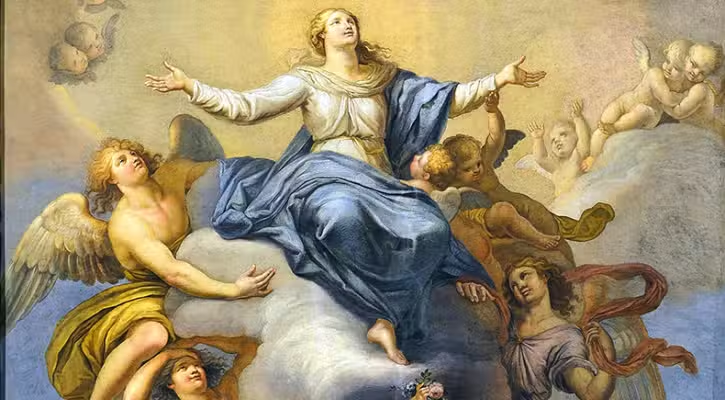
On November 1, 1950, Pope Pius XII defined the Assumption of Mary to be a dogma of faith: “We pronounce, declare and define it to be a divinely revealed dogma that the immaculate Mother of God, the ever Virgin Mary, having completed the course of her earthly life, was assumed body and soul to heavenly glory.” The pope proclaimed this dogma only after a broad consultation of bishops, theologians and laity. There were few dissenting voices. What the pope solemnly declared was already a common belief in the Catholic Church.
We find homilies on the Assumption of the Blessed Virgin Mary going back to the sixth century. In following centuries, the Eastern Churches held steadily to the doctrine, but some authors in the West were hesitant. However by the 13th century there was universal agreement. The feast was celebrated under various names—Commemoration, Dormition, Passing, Assumption—from at least the fifth or sixth century. Today it is celebrated as a solemnity.
Scripture does not give an account of Mary’s assumption into heaven. Nevertheless, Revelation 12 speaks of a woman who is caught up in the battle between good and evil. Many see this woman as God’s people. Since Mary best embodies the people of both Old and New Testaments, her assumption can be seen as an exemplification of the woman’s victory.
Furthermore, in 1 Corinthians 15:20, Paul speaks of Christ’s resurrection as the first fruits of those who have fallen asleep.
Since Mary is closely associated with all the mysteries of Jesus’ life, it is not surprising that the Holy Spirit has led the Church to believe in Mary’s share in his glorification. So close was she to Jesus on earth, she must be with him body and soul in heaven.
Reflection
In the light of the Assumption of the Blessed Virgin Mary, it is easy to pray her Magnificat (Luke 1:46–55) with new meaning. In her glory she proclaims the greatness of the Lord and finds joy in God her savior. God has done marvels to her and she leads others to recognize God’s holiness. She is the lowly handmaid who deeply reverenced her God and has been raised to the heights. From her position of strength she will help the lowly and the poor find justice on earth, and she will challenge the rich and powerful to distrust wealth and power as a source of happiness.
Born Fernando de Bulhes in Lisbon, Portugal, he disappointed his noble family by rejecting his luxurious life and joining the Augustinian religious order. A scholar by nature, he read every book in the monastery, devoting his time to contemplative prayer. Eventually, he befriended a group of itinerant Franciscan monks and became fascinated with this new religious order. Much impressed by their dedication to simplicity, poverty and their belief in returning to the original words of Christ, he joined their ranks, changing his name to Anthony in honor of Saint Anthony of the Desert, the patron of their little church. Returning home from a failed missionary venture in Morocco, his ship was blown off course and he wound up in Messina, Sicily. A group of Franciscan friars insisted he go north with them for a great gathering of all Franciscans, with their founder Francis of Assisi.
Anthony remained in Italy and discovered his great gift of preaching when a superior ordered him to speak at an ordination, telling him to say whatever the holy spirit had infused into him. He astonished his audience, not only by his skills as an orator but by the depth of his knowledge. He was sent throughout northern Italy and southern France on evangelical preaching missions which gathered crowds in the tens of thousands. His popularity among the people increased as he used his position to get real changes enacted for their protection. While based in Padua, he observed the crushing power of debt upon the common people. At Anthony's insistence, the local municipality enacted a law protecting those who could not pay their debts that is still enforced today. Anthony exhausted himself preaching out in fields and in piazzas as there was not cathedral large enough to hold all who came to hear him. At the age of thirty six, his health began to fail him and a local Count donated a woodland retreat for his recovery. One morning the Count heard the sounds of a baby giggling and he looked out to see Anthony surrounded in light, playing with the baby Jesus. That Christ would choose to appear to one of his saints in such a vulnerable state is a testament to the loving and kind nature of Saint Anthony. Because he is depicted holding a baby, women having trouble conceiving invoke his aid. Being of Portuguese descent, Anthony's feast day is very auspicious for marriages in Portugal and Brazil and in those cultures, he is known to assist women seeking a husband. According to legend, Saint Anthony earned the title patron saint of lost articles when a novice borrowed his psalter and failed to return it. Saint Anthony prayed to get it back and the novice was visited by terrifying visions that sent him running back to Anthony with the book. In iconography, Anthony always holds the baby Jesus and a lily for purity. Many times the returned book of the gospels is included.
Wonder and miracles are infused with every story of Saint Anthony. Though he has been dead for almost 800 years, he is still the most popular saint in the world and his statue is found in every Catholic Church. Saint Anthony is best known as the patron saint of lost articles but he is invoked for help in all life situations. In his own day he was called the “Wonder Worker’ and credited with the ability to stop the rain, raise the dead and reattach severed limbs. He was such a charismatic preacher that when a crowd of heretics in Rimini refused to listen to his preaching, the fish raised themselves out of the water to hear him.
Prayer to St. Anthony
Holy Saint Anthony, gentle and powerful in your help, Your love for God and charity for His creatures, made you worthy when on earth, to possess miraculous powers. Miracles waited on your word, which you were always ready to request for those in trouble or anxiety. Encouraged by this thought, I implore you to obtain for me (mention your request here). The answer to my prayer may require a miracle. Even so, you are the saint of miracles. Gentle and loving Saint Anthony, whose heart is ever full of human sympathy, take my petition to the Infant Savior for whom you have such a great love, and the gratitude of my heart will be ever yours. Amen It is customary to donate to Saint Anthony’s Bread, a charity started in Saint Anthony’s lifetime, in gratitude to answered novena prayers.
One of the original 12 apostles, Brother of James the Lesser and cousin of Jesus, Jude was one of Christ’s earliest followers. He earned his title of Patron Saint of Impossible Causes because of a letter he wrote in 60AD to persecuted Christian converts in the East, exhorting them to stay strong in the face of all difficulties.
The name Jude means giver of joy and the name Thaddeus means great hearted one and this saint was said to live up to his name, attracting immense crowds by preaching in an entertaining way, outwitting magicians and local priests. Abgar, the King of Edessa was quite impressed with Jude and appealed to Jesus cure his leprosy. He sent an artist to draw Christ’s image. The artist was so shaken by the glow in Christ’s eyes, he could not draw. Christ wiped his face with a cloth and the image of his face was transferred to it. Jude brought the cloth back to Abgar and the king rubbed the cloth over his body, curing himself of leprosy. Many depictions and statues of Saint Jude include this cloth with Christ’s image on it. Jude was martyred along with Saint Simon in the city of Samir by being beaten with a club. This club, as well as the palms of martyrdom are also part of his iconography
The cult of Saint Jude all but died out after the Middle Ages because people confused him with Judas Iscariot, the apostle who betrayed Christ. Despite being cited as a great influence by the mystics Saint Bernard of Clairvaux and Saint Bridget of Sweden, Jude was rarely invoked by the faithful for anything. It is said that because of this, he became the saint to call on in the most impossible of situations. So anxious was he to be of help, he would turn heaven and earth to rectify a desperate situation. By the nineteenth century, it became customary to thank the saint for help with answered prayers by taking an ad in the newspaper. This helped to resurrect his popularity and these small “Thank you Saint Jude” ads can be found in many weekly and daily periodicals in present day.
Prayer to Saint Jude
Glorious apostle, Saint Jude Thaddeus, I salute you through the Sacred Heart of Jesus. Through his heart I praise and thank God for all the graces he has bestowed upon you. I implore you, through his love, to look upon me with compassion. Do not despise my poor prayer. Do not let my trust be confounded! God has granted to you the privilege of aiding mankind in the most desperate cases. Oh, come to my aid that I may praise the mercies of God! All my life I will be your grateful client until I can thank you in heaven.
(Mention your request here).
Saint Jude, pray for us, and for all who invoke your aid.
Alhough the Miraculous Medal is worn almost as often as a crucifix by Roman Catholics, few realize that the designs on the front and back owe their inspiration to a series of apparitions of the Virgin Mary.
It is said that the year 1830 announced the dawning of the Marian era. Until then, the last Church-sanctioned apparition of Mary was of Our Lady of Guadalupe in Mexico almost three hundred years before. Within that time frame, the entire religious world of western Europe was shaken to its core by the upheaval of the Reformation, Counter-Reformation, and the French Revolution. In France, religious worship was demonized, and the clergy was ostracized as ancient monasteries and artworks were destroyed.
On the night of July 18, 1830, in the Motherhouse of the Sisters of Charity in Paris, a barely literate twenty-four-year-old novice named Catherine Laboure was shaken from her sleep by a beautiful five-year-old boy. Catherine was in her curtained bed in a dormitory with other novices. Shocked at the dazzling garments the child wore, she was certain the other nuns would wake up.
“Catherine,” said the boy. “Come to the chapel; the Blessed Virgin is waiting for you.”
Catherine was too shocked to speak but thought the words, “But I shall be heard.”
The child calmly spoke, “Be calm, it is half past eleven, everyone is asleep; come, I am waiting for you.”
Catherine dressed quickly and followed the child. As they reached the chapel, the door opened at the light touch of his finger. The room was glowing in light as all of the candles were lit as if for Midnight Mass. Catherine knelt to pray.
As it neared midnight, the child said, “Here is the Blessed VirginCatherine heard the rustle of a silk dress and a beautiful woman sat down in the Father Director’s chair next to her. The woman was dressed in an ivory-colored dress with a blue mantle and a white veil covering her head and draping over her shoulders. Her hands radiated beams of light, the color of jewels.
In a much stronger voice, the child said, “Here is the Blessed Virgin.”
Catherine knelt in front of the woman, putting her hands in her lap as she looked into the woman’s eyes. In her own words, Catherine later recounted, “I do not know how long I remained there; it seemed but a moment, but the sweetest of my life.”
When the Virgin Mary spoke, she said, “The good God, my child, wishes to entrust you with a mission. It will be the cause of much suffering to you, but you will overcome this, knowing that what you do is for the glory of God. You will be contradicted, but you will have the grace to bear it; do not fear! You will see certain things; give an account of them. You will be inspired in your prayers. Tell with confidence all that passes within you. Tell it with simplicity. Have confidence. Do not be afraid.”
Mary then went on to relate the misfortunes that were about to befall France and the rest of the world. When Catherine wondered to herself when these things were to happen, “I understood clearly, forty years.”
The Virgin ended the conversation by saying, “Come to the foot of this altar; there, graces will be poured on all those who ask for them with confidence and fervor. They will be poured out on the great and the humble.” And in Catherine’s words, “the Virgin disappeared like a light is extinguished.”
The child then led Catherine back to bed, where she remained awake for the entire night, wondering exactly what her mission would be.
Catherine did not see Mary again until November 27, 1830, which was the Saturday before the first Sunday of Advent. Though she was with other nuns in the chapel at the 5:30 p.m. prayers, Catherine was the only one who saw the apparition. At the point reserved for interior meditation, when the chapel was at its quietest, Catherine heard the sound of the rustling silk.
In her words, “When I looked in that direction, I saw the Blessed Virgin. She was standing, dressed in a white robe of silk, like the dawn, her feet resting on a globe, only half of which I could see. In her hands, held at the level of her breast, she held a smaller globe, her eyes raised towards heaven . . . her face was beautiful, I could not describe it . . . Then suddenly, I saw rings on her fingers, covered with jewels, some large and some small, from which came beautiful rays . . At this moment, when I was contemplating the Virgin, she lowered her eyes and looked at me and an interior voice spoke to me: ‘This globe you see represents the entire world, particularly France . . . and each person in particular.’”
As Catherine marveled at the beauty of the rays of light exuding from Mary, the voice said, “This is a symbol of the graces which I shed on those who ask me.” When Catherine wondered why some of the jewels on Mary were not radiating light like the others, the voice said, “Those jewels which are in shadow represent the graces which people forget to ask me for.” Then the apparition changed, and Mary appeared with a white dress, a blue mantle, and a white veil. She was standing on the globe and had one foot on the head of a serpent that lay at her feet. The year 1830 was marked at the globe’s base. The Virgin’s hands were pointing downward, and a cascade of light rays were falling from her hands onto the globe.
An oval then formed around Mary, and on it were written these words in gold, “O MARY CONCEIVED WITHOUT SIN, PRAY FOR US WHO HAVE RECOURSE TO THEE.”
The same interior voice said, “Have a medal struck after this model. Those who wear it will receive great graces; abundant graces will be given to those who have confidence.”As the voice faded out, the oval turned and Catherine saw what was on the reverse of the medal: The letter M surmounted by a bar and a cross; beneath the M were the hearts of Jesus and Mary, the one crowned with thorns, the other pierced with a sword. Encircling these symbols were twelve stars.
For the next year, Catherine saw this vision six times. Having little contact with the outside world and feeling pressured to complete her mission, she told her spiritual director, Father John Marie Aladel, about the Virgin’s mandate. Just as Mary predicted in the first vision, he did not believe her. As she persisted to repeat her story to him throughout the year, he and Catherine had many stormy disagreements. At his request, she wrote out a detailed report of what happened. At a loss about what to do with this young girl who not only had these visions, but was so insistent upon having this medal struck, Father Aladel visited the archbishop of Paris in 1832. Having a special devotion to the Virgin Mary, the archbishop did not share Father Aladel’s skepticism and he immediately gave permission to create the medal.
In June 1832, fifteen hundred copies of the medal then known as the Medal of the Immaculate Conception were created. By 1836 more than two million medals had been produced. Because of the many stories of cures, wonders, and death-bed conversions attributed to the medal, it gradually became known as the Miraculous Medal.
Catherine Laboure never revealed to anyone but her spiritual director that it was she who received the visions that caused the medal’s creation, and she could never be induced to attend any of the canonical hearings investigating the apparitions. Eventually, this visit of the Virgin Mary was sanctified and officially recognized by the Church based on the miraculous effects of the medals. For the next forty-six years of her life, Catherine nursed the sick and tended the chickens at the Sisters of Charity residence outside of Paris. Her fellow sisters found her “cold and apathetic” and were quite shocked upon learning that it was this obscure, forgettable person whom the Virgin Mary entrusted with her mission. She died on December 31, 1876, and is buried in the convent chapel in Paris, where the Blessed Virgin Mary first appeared to her.
The Symbols on the Medal On the front of the medal, Mary stands alone with her foot crushing the head of a serpent. She is the Victorious Woman of Genesis (Genesis 3:15), where God says to the serpent, “I will put enmities between you and the woman.” In Catholic art, Mary is frequently depicted crushing the head of a serpent that represents Satan. In this way, Mary as the highest developed form of human life is shown triumphing over evil. It is believed that the date 1830 at the base of the medal signifies the advent of the Marian age, when apparitions of Mary were to intensify and become more frequent. Mary is standing on the globe of the world, which gives her spiritual dominion with the title Queen of Heaven and Earth. Brilliant rays of light cascade to earth from Mary’s hand. She is showering the world with grace from God. This is where her titles Mediatrix and Advocate for Humanity come from. She is so filled with God’s grace and love she needs to share it with others. She looks upon all humankind as her children and tries to show them the path to light and God as any mother would. The words around the frame of the medal, “O Mary conceived without sin, pray for us who have recourse to thee,” is a brief prayer in itself. In it we are recognizing Mary’s help in interceding for us with God and the belief that she was the only human creature to ever be conceived without original sin.
The imagery on the back of the medal is equally symbolic. There is a cross on the back with a bar through its base. This symbolizes the foot of the Cross. This bar runs through the letter M, which stands for both Mary and Mother. This signifies that Mary as Christ’s mother stood at the foot of his Cross while he endured his Crucifixion. Beneath the M are two hearts, one with thorns running through it (this is the Sacred Heart of Jesus); and the other with a sword in it (the Immaculate Heart of Mary). One of the Seven Sorrows of Mary predicted by the prophesy of Holy Simeon is “the Mother pierced with a sword of sorrow beneath the cross so that the thoughts of many hearts may be revealed” (according to Luke 2:34–35: “you yourself a sword may pierce”). Because Mary had to endure the great sorrow of watching her only son die a humiliating and tortuous death, many on Earth look to her for comfort in their own troubles. They know that she went through the worst agonies a mother could withstand and triumphed over them. Both hearts are equal in size, and both hearts are inflamed by ardent love. Encircling the cross, the M, and the two hearts are twelve stars. In art, Mary is frequently depicted crowned by twelve stars. It is believed that the Twelve Apostles looked to her quiet devotion and acceptance of her son’s fate for spiritual inspiration. Stars also pertain to the book of Revelation (Apocalypse) as a reference to the “great sign” described as “a woman clothed with the sun, with the moon under her feet, and on her head a crown of twelve stars” (Revelation 12:1). In the Miraculous Medal lie the symbols of Mary’s role in salvation from Genesis to Apocalypse. As the Victorious Woman she is destined to take part in the final defeat of the devil.
The Miraculous Medal is considered a physical manifestation of the gift of grace, which exudes from the Virgin Mary. It is considered Mary’s token reminder that she is always ready to offer assistance.
“Catherine heard the rustle of a silk dress and a beautiful woman sat down in the Father Director’s chair next to her. The woman was dressed in an ivory-colored dress with a blue mantle and a white veil covering her head and draping over her shoulders.“
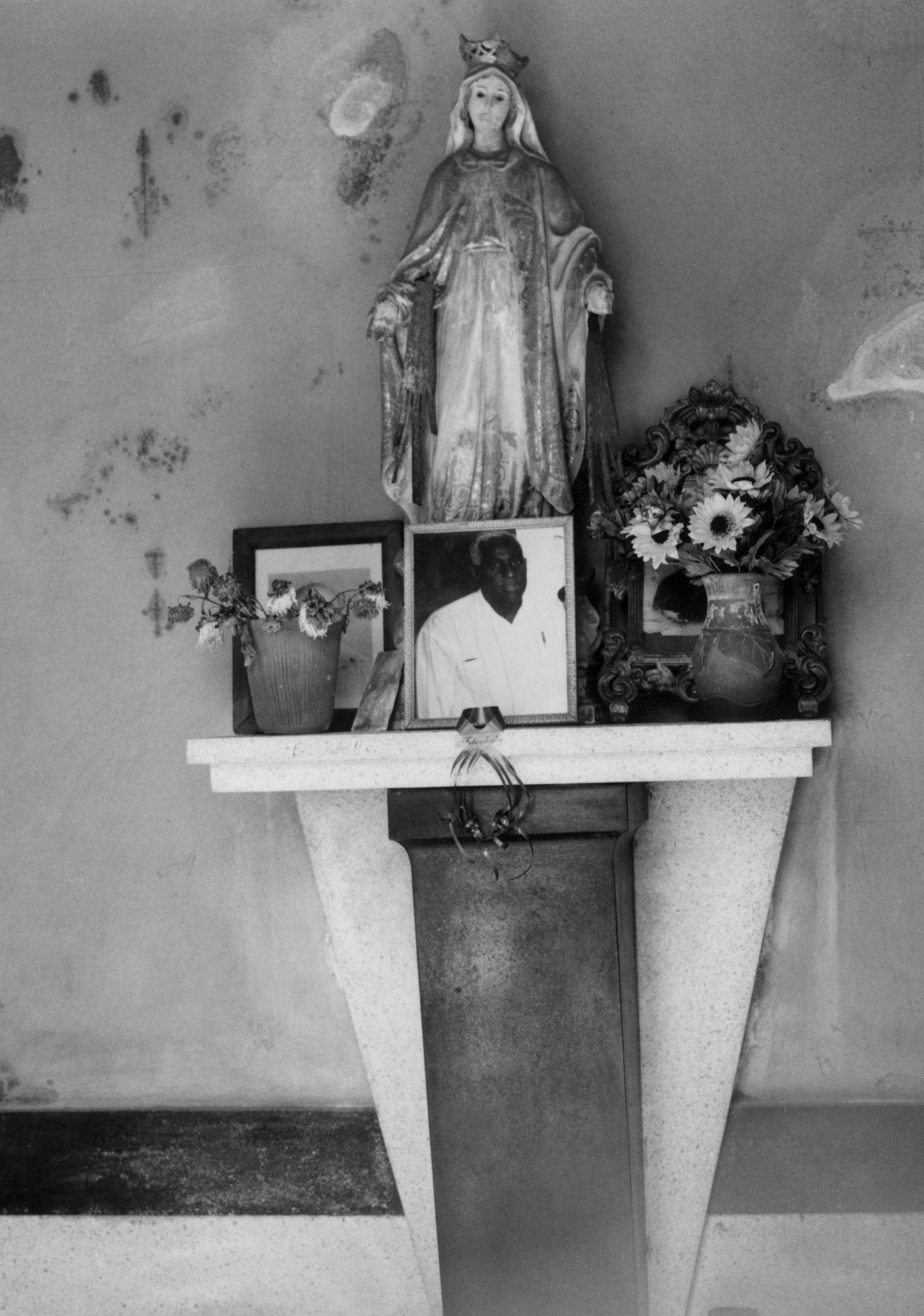
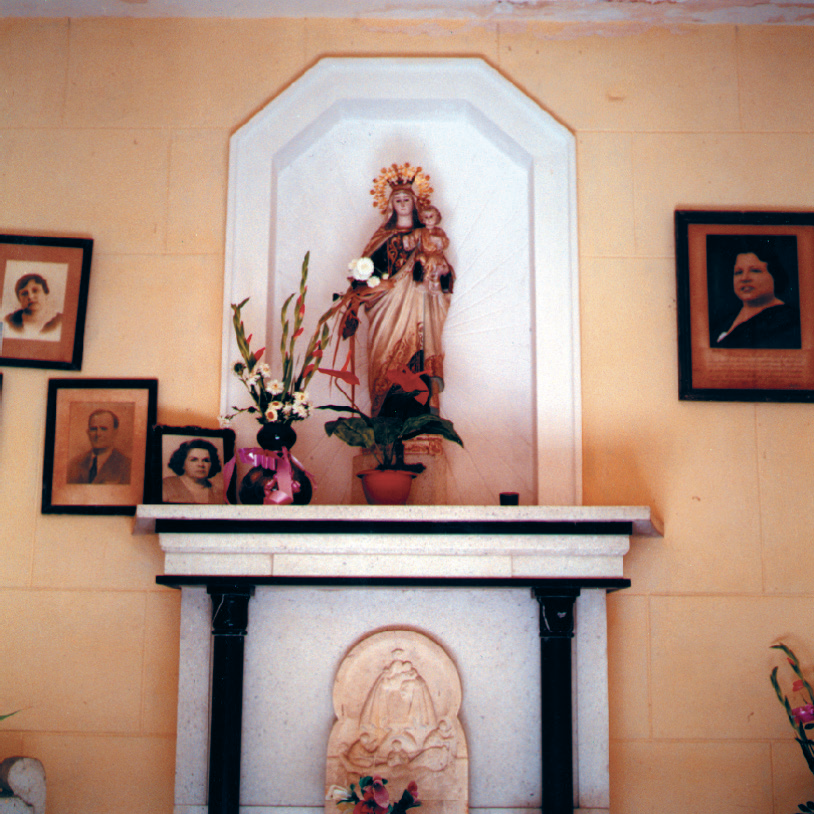
Home altar in Havana,Cuba Photographs by Lisa Silvestri
Altar in family mausoleum in Havana, Cuba Photograph by Lisa Silvestri
Religious Statues from the flea market in Mexico City, Mexico.
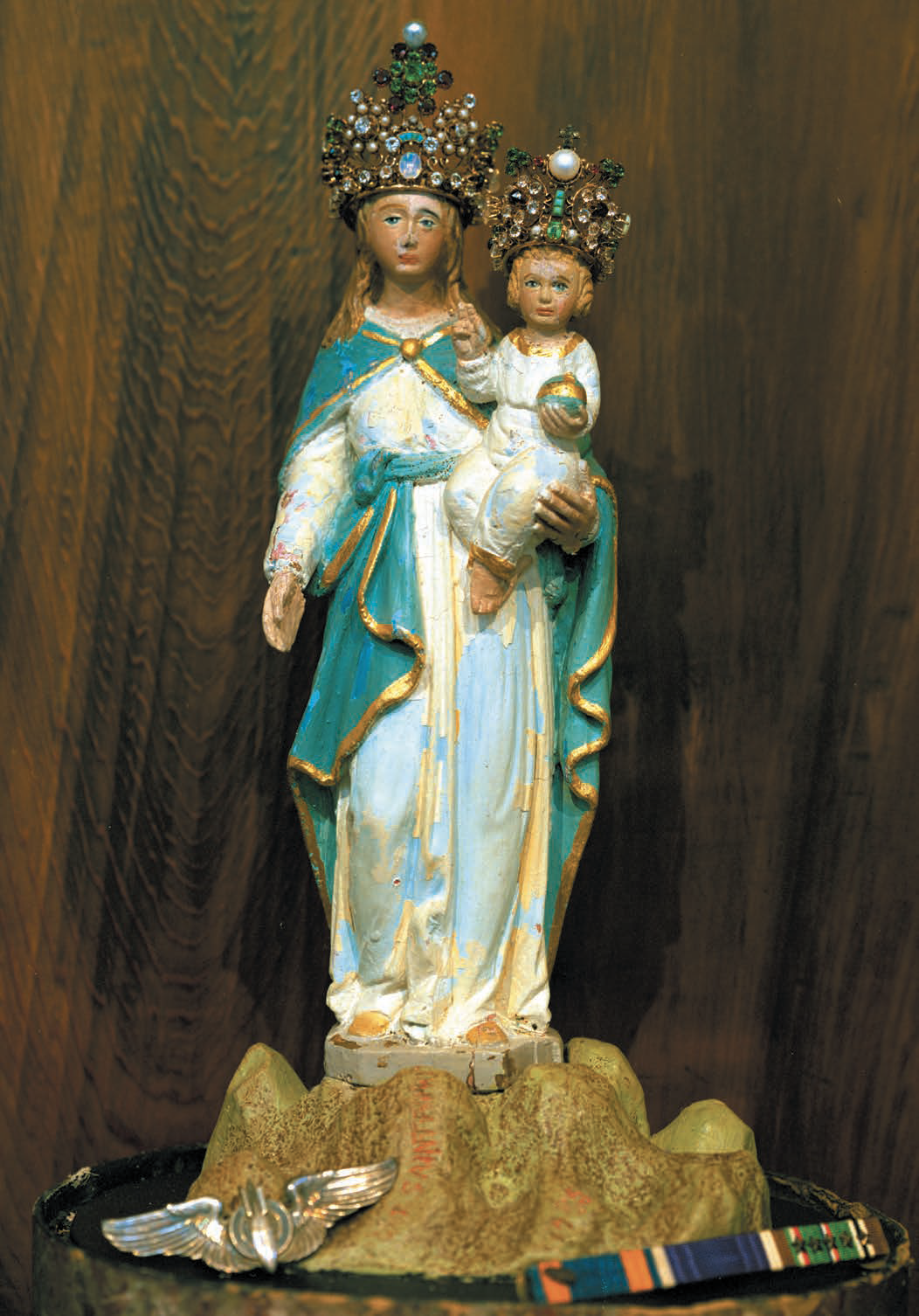
The “Sweetheart Statue” was brought to the Ursaline Convent in New Orleans in 1785.
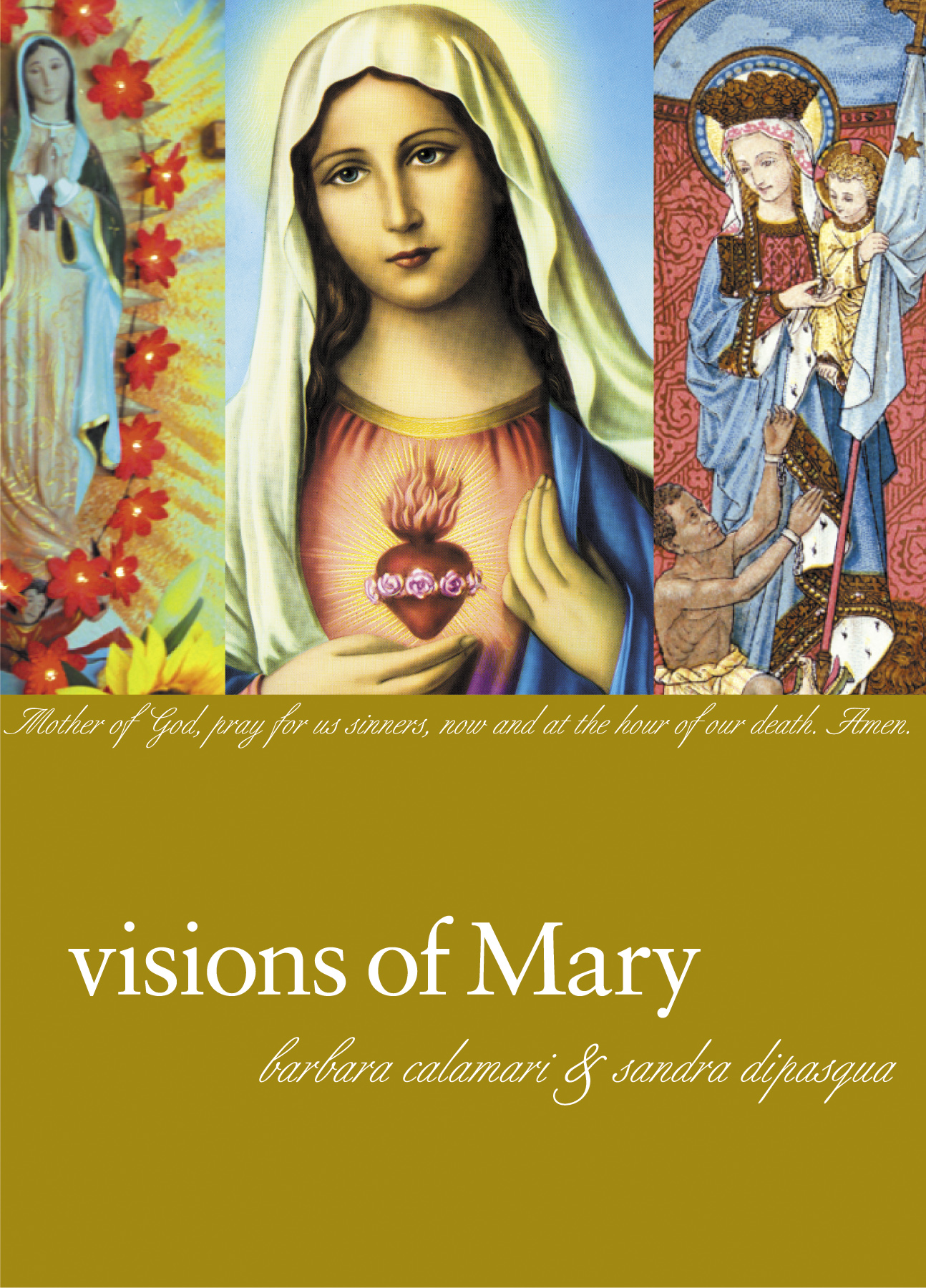
visions of Mary Our Lady of Guadalupe
A traveler visiting Mexico or the American Southwest meets Our Lady of Guadalupe hundreds of times a day. Her image adorns the walls of businesses, is prominently displayed in homes, is on the hubcaps of cars, and at the center of small sidewalk shrines. This image of Mary is the preeminent cultural icon for most Latin Americans, sacred to Catholics and highly honored by non-Catholics, and it is the only apparition of Mary sanctioned by the Church on the North American continent.
On December 9, 1531, an Aztec convert to Catholicism named Juan Diego was on his way to early morning Mass in the area that is now known as Mexico City when he heard the sound of birds singing. When they quieted down, the hill at Tepeyac seemed to respond to their song. From the top of the hill a woman gently called to Diego, “Ihuantzin. Ihuan Diegotzin.” She was speaking the Aztec language of Nahuatl. As he approached her, he saw that she was an Indian noblewoman. He was amazed at how her clothes glimmered like the sun and how the rocks and foliage around her had a heightened glow. The crag where her foot rested gave off rays of light and the earth sparkled like a rainbow.
She spoke to him courteously and with great charm, “Know my dearest, littlest, and youngest son, I am the forever whole and perfect maiden Saint Mary, honorable mother of the true God, honorable mother of the giver of life, honorable mother of the creator of men and women, honorable mother of the one who is far and close, honorable mother of the one who makes the heavens and the earth. My wish is for them to build my temple here where I will give people all my love, compassion, assistance, and protection. I am the compassionate mother of you and your people here in this land and all of the other people who love me, call to me, search for me, and confide in me. I will listen to their pain, suffering, and crying and heal them from their misery.”
She then sent him to see the bishop to make the request for the church. After a long wait he related his story to the bishop who told him that he must obtain a sign proving that this was truly an appearance of Mary. Juan Diego returned to the woman on the hill and begged her to get someone more prestigious to give her message to the bishop. She told him that she had many people who could deliver her request, “but it is of precise detail that you yourself solicit and assist and that through your mediation my wish be complied.”
On his next visit to the bishop he was once again greeted with suspicion. When he left, the bishop sent servants to spy on him and to see to whom he was really speaking. But as soon as Juan Diego crossed the wooden bridge to the hill at Tepeyac, they lost sight of him. The next day, a Monday, Juan Diego decided to take another route around the hill in order to avoid the woman. His uncle had taken ill, and he needed medical attention. Juan Diego did not want the woman to detain him, as he feared that his uncle would die waiting for help. Much to his dismay, she came down the hill to meet him from where she was watching. When she asked him why he was so upset and why he was in such a rush, he sadly told her about his uncle’s illness and how his requests for her to the bishop had fallen on deaf ears.
Her answer was, “Listen, put it into your heart, youngest and dearest son, nothing should scare or concern you. Don’t worry. Don’t be afraid of the sickness, or any other illness or hardship. Am I not right here who is your mother? Are you not under my shadow and protection? Am I not in the foundation of your being, your sustenance, your happiness, peace, and effortlessness? Are you not in the fold of my garment? Do you need anything else? Don’t allow anything to worry or disturb you anymore. Don’t worry about your uncle’s illness. He will not die. Be assured, he is already well.”
She then told Juan Diego to gather roses among the rocks. He was surprised to find them in full bloom since it was winter. She carefully arranged them in Juan Diego’s cloak and he brought them to the bishop. After another humiliating wait, he was finally granted an audience. As he unwrapped his cloak and the roses fell out, the bishop gasped. The flowers uncovered an elaborate portrait of the Virgin Mary imprinted on the cloak. The bishop fell to his knees in tears and begged Juan Diego’s forgiveness. The bishop then insisted on being taken to the hill where the lady from heaven wanted her temple. After he had done this, Juan Diego ran home to his sick uncle and was quite shocked to see him happy and healthy. His uncle told him that a heavenly lady had come to heal him, asking him to tell the bishop of his cure. She also wanted him to convey the proper name for her image: The Perfect Virgin Holy Mary of Guadalupe.
The bishop had the church built and the cloth put on public display where it immediately attracted crowds of pilgrims. Almost as suddenly, the Franciscans, who had been in Mexico for the past ten years and who had very little previous success, were receiving thousands of Aztecs who wanted to convert to Catholicism. This cloth and its image, which should have deteriorated in twenty years, is still on view at the Basilica of Our Lady of Guadalupe in Mexico City. After almost five hundred years it remains in pristine condition. Attracting more than ten million pilgrims a year, Our Lady of Guadalupe is the most popular Marian shrine in the world.
At the time of this apparition of Mary, the Aztecs, the original inhabitants of Mexico City, had been suffering brutally under domination of the Spanish colonialists. Disease and depression were rampant. Hernán Cortés, the conquistador, had landed in 1519 and had succeeded in destroying much of the Aztec civilization by 1521. Why, then, were the Aztecs eventually such willing converts to Catholicism? The Aztecs had hundreds of gods in their pantheon. It was their spiritual habit to co-opt the gods of tribes that they conquered. They believed that their own god Huitzilopochtli depended on human sacrifices to be kept alive. They invaded neighboring tribes to obtain these victims. As they as a people became more aggressive against their neighbors, the gods of the Aztecs took on more monstrous forms. Portrayals of the female gods became the most frightening and grotesque. When the Spanish arrived in the Aztec city, they were amazed at its beauty and grace, and equally horrified at the blood-soaked temples with the racks of human skulls and demonic-looking statuary. All Aztec places of worship were considered satanic and systematically destroyed.
The hill where Mary appeared was once the site of the goddess Tonzantin. She was considered a household god, the goddess of corn and fertility. With Our Lady of Guadalupe, the feminine traits of love, compassion, and forgiveness were returned to spirituality and the sick-at-heart population had an entity to whom they could take their sorrow.
Statue of Blessed Juan Diego wearing the tilma with the imprint of Our Lady of Guadalupe. Following pages: Statues being sold at a flea market, an outdoor shrine with Our Lady of Guadalupe surrounded by lights so that she can be worshiped at night.
The portrait of Our Lady of Guadalupe conveyed a message interpreted differently by Aztecs and Europeans, yet triggered the same spiritual response. To the Aztecs, the basic announcement that Mary was making with this image was the dawning of the age of the Sixth Sun. Dividing up their history into solar ages, it was thought that the Fifth Sun, the Sun of Movement, ended with the Spanish conquest. Since the birth of a new sun always follows a time of darkness, it was believed that the appearance of Mary after ten years of destruction signaled the beginning of the Sun of Flowers. According to their lore, this was a time when humanity would come into its own and bloom. In this image, Mary wears a belt worn by pregnant women, thus announcing the birth of a new age. Gold-leaf Nahuatl glyphs symbolizing plenitude appear on her gown. They are arranged over her womb in a pattern that represented the four points of a compass, a basic symbol in the Aztec faith. The womblike light she is wrapped in, the rays of the sun and the crest of the moon, the folds of her robe and the subdued serpent all had hidden messages that were easy for the Aztecs to read. Her eyes do not stare ahead as depictions of the gods do; rather she is looking down at humanity, much as a mother looks at her child. Her hands are in a praying position that the Aztecs used to signify something coming from one’s heart. The fact that her robe is touching the angel signifies protection and love.
For the Christians the iconography of this image was directly related to the book of Revelation where John says, “A great sign appeared in the heavens, a woman clothed with the sun.” This image is associated with the Immaculate Conception. December 9, the first day of her appearance, was also the original day devoted to the Feast of the Immaculate Conception. The halo Mary is wrapped in is called a mandorla. Originally, this type of almond-shaped body halo represented the cloud in which Christ ascended; in time it came to signify the light that emanates from those divinely inspired. In Western art it is used to depict those with a complete bond to Christ. As the Mother of God, Mary is exalted above all angels, offering her protection and love to humanity.
By appearing as a mixed-race woman, Mary was announcing the new face of Catholicism. The brutal, fundamentalist way that Catholicism was practiced by the Spanish was softened. In her appearance Mary was reminding the Europeans that they had the same mother that the Aztecs did. She was the first Christian image that the Mesoamericans could relate to, and the messages embedded in her picture offered hope, love, and comfort to a people when these qualities had been driven out of their own religion.
Our Lady of Guadalupe is the patroness of Mexico, North and South America, and the Caribbean.
The Feast of Our Lady of Guadalupe is December 12, the day the miraculous cloth was revealed.
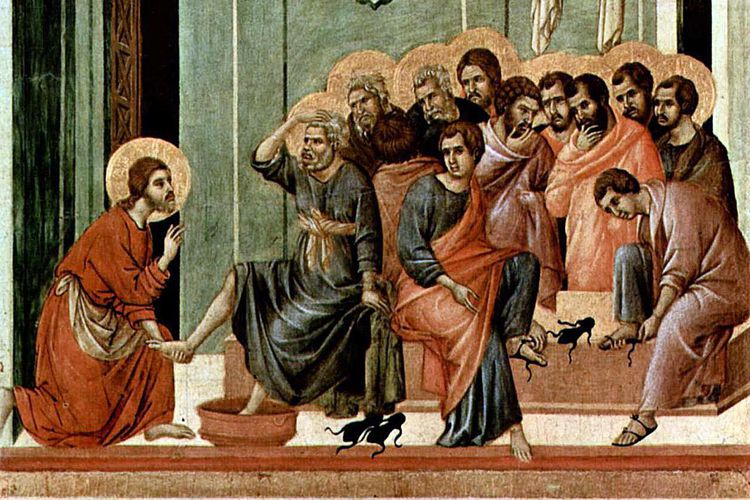
“So if I, your Lord and Teacher, have washed your feet, you also ought to wash one another’s feet. For I have set you an example, that you also should do as I have done to you.”
—John 13:14-15
The Yorck Project: 10.000 Meisterwerke der Malerei. DVD-ROM, 2002. ISBN 3936122202. Distributed by DIRECTMEDIA Publishing GmbH./Public Domain
Preparation
As you begin this time of quiet prayer, I invite you to find a comfortable place to sit with your back straight and your legs planted on the ground. Take a few moments to breathe in and breathe out.
Spend this time centering yourself to listen to what God may be saying to you during this time of prayer, to listen to what rises up in your heart. Close your eyes for a few moments. As you sit with your eyes closed, use these or similar words: “Here I am, Lord. Here I am.” When you are ready, open your eyes and pray.
Washing Feet
The dining table is scattered with the remains of a meal enjoyed by all there. Imagine you are sitting at this table. Your hands are on your belly, and you’re feeling full and satisfied. The food and wine were savory and sweet. It brought back such memories of meals you shared with friends and family through the years—meals where love was shown, forgiveness offered, and hurts healed. A smile comes across your face as you recall the hours your mother spent in the kitchen getting ready to feed those she loved. Humming softly, she would carefully knead and fold the dough that would become her delicious, crusty bread.
There is much chatter around this table. You look over at these people you have traveled with through many towns and villages, bringing the message of hope and love. A peace comes over you, a peace that tells you what a good job you’ve done. Across the table you see Jesus. He is looking around the table, but his face is serious. He stands up, puts a towel around his waist, and comes toward you. You don’t understand what’s happening. Jesus stands before you, wrapped in a towel and carrying a basin of water. He looks at you and asks you a question. What does Jesus ask you? How do you respond?
Jesus kneels in front of you. You move back in your chair. “No, Jesus. Please get up,” you say. He looks in your eyes. His eyes seem to look right into your soul. He smiles and offers his hand to take your foot. You hesitate. How can this be? you think. Jesus gently cups your foot in his hand. With his other hand, he pours the warm, perfumed water on your foot. He looks at you and smiles. It feels like there are just the two of you there. Jesus speaks to you. What does he say? What do you respond?
You look down and notice how dirty your feet are from walking on the dusty paths. Jesus simply and gently washes them and then dries them with the towel around his waist. Your eyes fill with tears. Here is Jesus, whom you left your home to follow, washing your feet like a servant. You lower your face and quietly weep. Jesus reaches up and puts his hands on your face. He gently whispers to you, “You are loved. You are loved.” He stands and hands you the jug of water and basin. Taking a towel, you wrap it around your waist and…
Do I let Jesus accept me for who I am, “dirty feet” and all? Who are the people in my life whose “feet” need to be washed? On this Holy Thursday, how can I accept Jesus’ call to follow his example of service?
Concluding Prayer
Glory be to the Father, and to the Son, and to the Holy Spirit. As it was in the beginning, is now, and ever shall be, world without end. Amen.
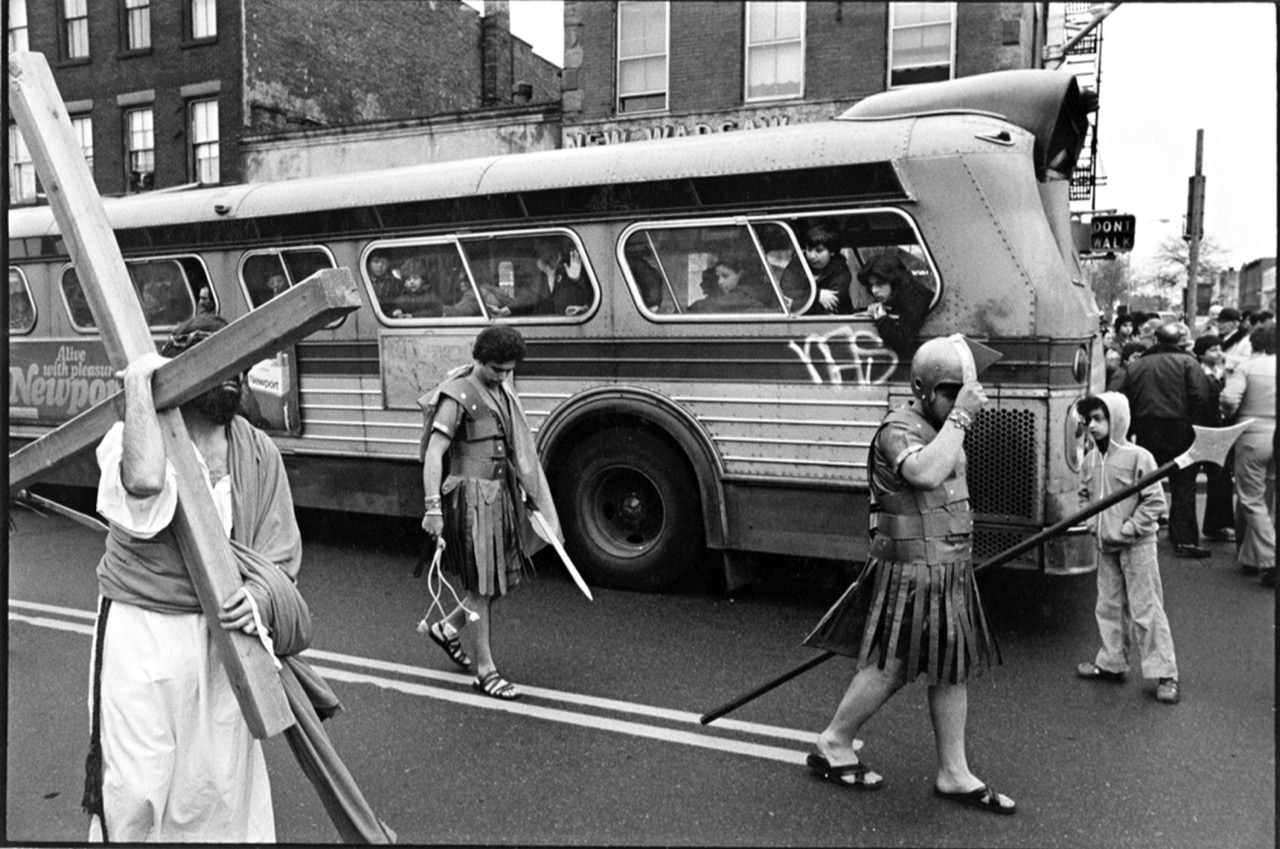
by Larry Racioppo This post contains the outline of JESUS IN THE CITY: THREE GOOD FRIDAYS, a book Larry Racioppo is hoping to publish. The book will contain approximately 100 photographs taken from 1974 through 2015, my personal notes, and an essay by a contemporary scholar
Larry Racioppo was born and raised in South Brooklyn and has photographed New York City since 1971. He was a VISTA Volunteer and a participating artist in the Cultural Council Foundation’s CETA Artist Project. A Guggenheim Fellow and former staff photographer for NYC’s Department of Housing Preservation and Development, his work is held by the Museum of the City of New York, the Brooklyn Museum, El Museo del Barrio, the Center for Brooklyn History and the National September 11th Memorial and Museum. Recent books include Memorial’76, Here Down on Dark Earth: Loss and Remembrance in NewYork City, Coney Island Baby and Brooklyn Before: Photographs 1971-1983. www.larryracioppo.com
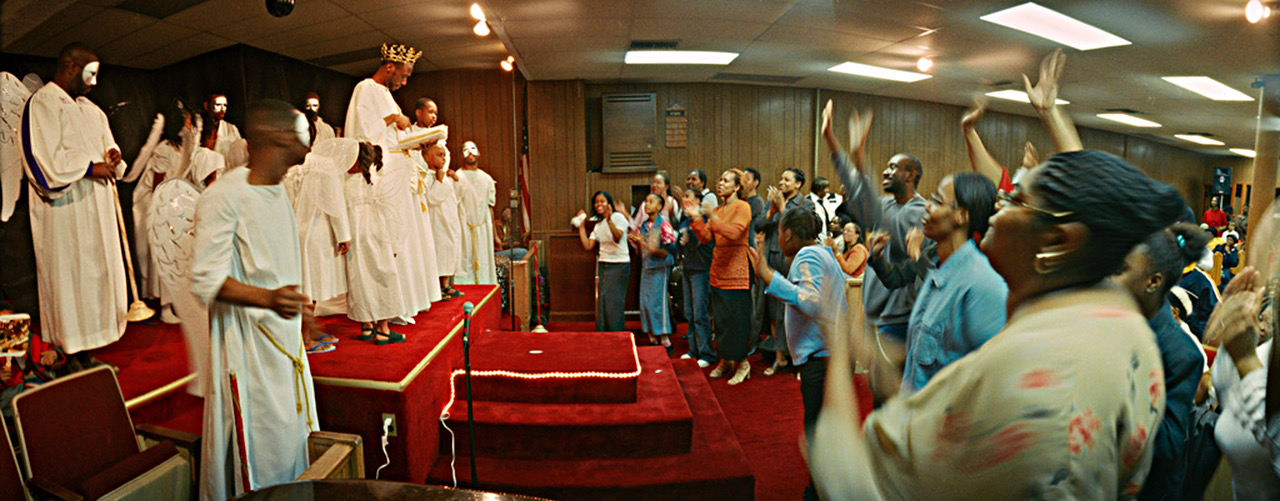
In the 1970’s a group of mostly Puerto Rican parishioners, connected to the growing Catholic Cursillo movement, introduced a livelier more personal liturgy to their Italian-American and Irish-American fellow congregants at St. John the Evangelist Roman Catholic Church on 21st Street, Brooklyn. The highlight of this group’s active devotion was their annual reenactment of the passion and death of Jesus Christ on Good Friday. Dressed as Jesus, Mary, Herod, and other New Testament figures, members of this group, informally known as de Colores, staged the traditional Stations of the Cross on the streets of the parish. Jesus was whipped, fell and met his Mother as hundreds watched. I photographed the first procession which took place in 1974 up until the last in 1981.
In 1994 my wife, while working in NYC’s Housing Preservation and Development (HPD) Bushwick field office, learned that a local church held an annual Good Friday procession. I was curious to see another one, and wondered if it would be as moving as the processions I had seen in the 1970’s. I hoped so, and on April 1st of that year brought two cameras with me to St. Barbara’s Roman Catholic Church on Central Avenue and Bleecker Street, Brooklyn
Completed in 1910 in the Spanish Baroque Revival style, St. Barbara’s is an incredibly beautiful church. It began as a “national parish” for German Catholics in the Bushwick-Ridgewood area but eventually became home to Italians, and in the 1960’s to Hispanic worshippers.
What I saw that day exceeded my wildest hopes. I couldn’t believe my luck and realized that this was going to be another long-term photography project for me, not a one-day shoot.
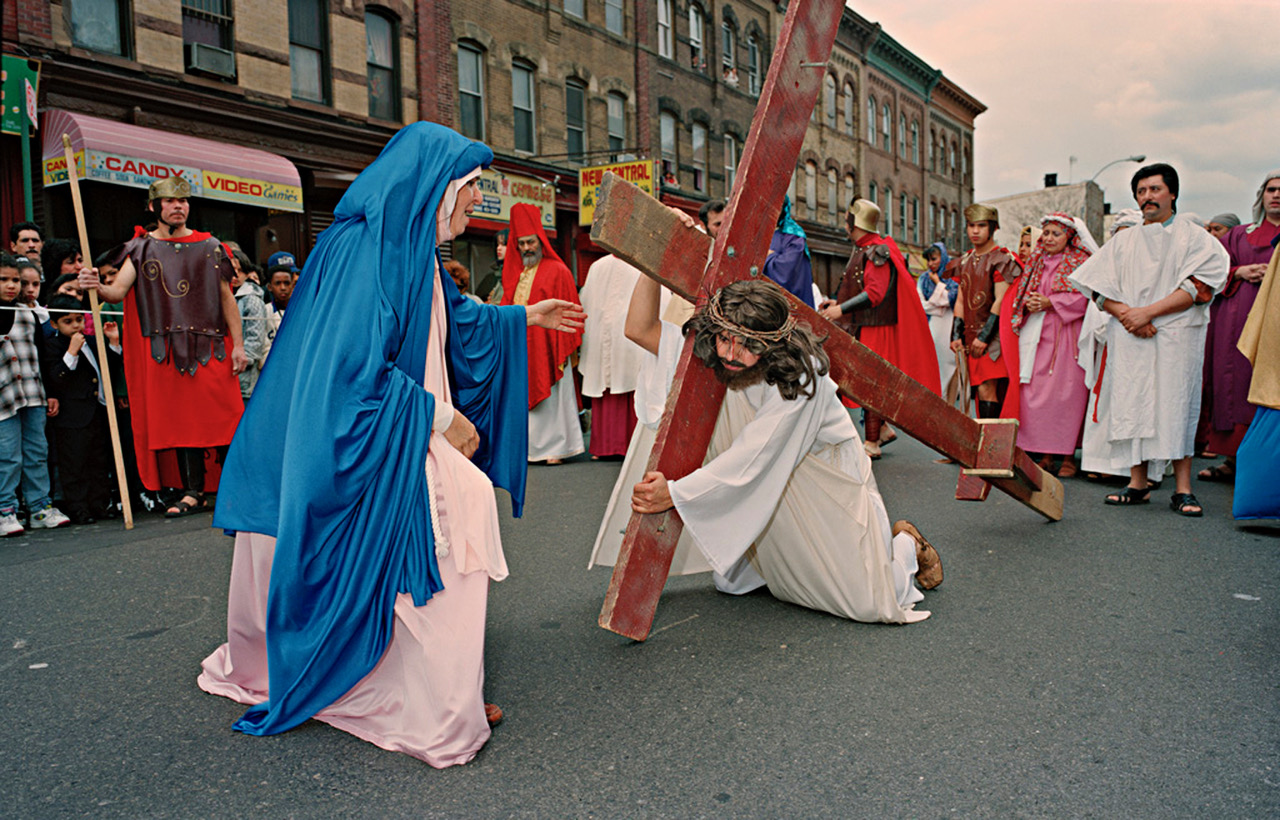
Based on the Bible’s traditional 14 Stations of the Cross, El Grupo Dramatico de Santa Barbara (El Grupo) produced an elaborate and emotional reenactment of the passion and death of Jesus Christ. It began and ended on the large marble altar of St. Barbara’s Church, but most of the action took place along Evergreen, Central, and Wilson Avenues and their cross streets.
It was no accident that the staging of the Stations of the Cross was so powerful. In the months leading up to Easter, El Grupo members devoted countless weekend and evening hours to rehearsing in St. Barbara’s school basement, and to making period costumes and props. Participation is an act of worship whether playing a major role such as Jesus Christ or a small one, like one of the serving girls at Herod’s court. There are parts for everyone: if there are more children one year, there will be more handmaidens and angels. If participants are scarce, members will play more than one part.
El Grupo starts every meeting by holding hands in a prayer circle.
On Good Friday participants spend hours putting on costumes, makeup and wigs in the Church rectory. They say a final prayer in the sacristy before starting the VIA CRUCIS (The Way of the Cross). It begins with the condemnation of Jesus on the main altar before a standing-room-only audience. Jesus is crowned with thorns, takes up his cross and leaves the Church. The procession continues down Bushwick’s streets where Jesus, followed by a huge crowd, enacts several Stations of the Cross including his three falls. In front of a building where Jesus has fallen, the late pastor Father John Powis would raise his voice to connect Jesus’ suffering with the pain caused by “the drug sales in this building” pointing to the building as he spoke. I was surprised when he did this.
The Procession gradually wound its way back to St. Barbara’s for the last several Stations. The day’s highlight was the crucifixion of Jesus and the two thieves. I returned each year to a crucifixion scene that topped the year before: smoke, flashing lights and thunder enhanced the experience.
Mario Trochez, the group’s former director who now lives in Pennsylvania, has been returning to Bushwick each year to direct, act, and help in any way he can. He has promised that soon he will organize a Good Friday procession in his Puerto Rican hometown.
The Via Crucis ends when Jesus is removed from the cross and taken to his tomb (the 14th and last traditional Station of the Cross). The dramatists slowly leave the altar, and return a few minutes later to cheers from the audience. Afterwards they pose for photographs with family and friends in the sacristy. Kenia Vargas, dressed as Mary Magdalene in a turquoise robe and white head scarf.
Eventually El Grupo added Palm Sunday reenactments in the school auditorium as well. In 2004, I found this flyer on a bulletin board at work andI contacted the church’s pastor for permission to photograph the “musical drama.” The musicians and singers were excellent, and the entire evening transcendent. I returned to the Greater Zion Shiloh Baptist Church in Brooklyn to continue this project.
Invoked for: finding a husband, finding lost articles
Invoked against: debt, shipwreck, starvation
Symbols: baby Jesus, book of Gospels, lily
Wonder and miracles are infused with every story of Saint Anthony. Though he has been dead for almost 800 years, he is still the most popular saint in the world and his statue is found in every Catholic Church. Saint Anthony is best known as the patron saint of lost articles but he is invoked for help in all life situations. In his own day he was called the “Wonder Worker’ and credited with the ability to stop the rain, raise the dead and reattach severed limbs. He was such a charismatic preacher that when a crowd of heretics in Rimini refused to listen to his preaching, the fish raised themselves out of the water to hear him.
Born Fernando de Bulhes in Lisbon, Portugal, he disappointed his noble family by rejecting his luxurious life and joining the Augustinian religious order. A scholar by nature, he read every book in the monastery, devoting his time to contemplative prayer. Eventually, he befriended a group of itinerant Franciscan monks and became fascinated with this new religious order. Much impressed by their dedication to simplicity, poverty and their belief in returning to the original words of Christ, he joined their ranks, changing his name to Anthony in honor of Saint Anthony of the Desert, the patron of their little church. Returning home from a failed missionary venture in Morocco, his ship was blown off course and he wound up in Messina, Sicily. A group of Franciscan friars insisted he go north with them for a great gathering of all Franciscans, with their founder Francis of Assisi.
Anthony remained in Italy and discovered his great gift of preaching when a superior ordered him to speak at an ordination, telling him to say whatever the holy spirit had infused into him. He astonished his audience, not only by his skills as an orator but by the depth of his knowledge. He was sent throughout northern Italy and southern France on evangelical preaching missions which gathered crowds in the tens of thousands. His popularity among the people increased as he used his position to get real changes enacted for their protection. While based in Padua, he observed the crushing power of debt upon the common people. At Anthony’s insistence, the local municipality enacted a law protecting those who could not pay their debts that is still enforced today.
Anthony exhausted himself preaching out in fields and in piazzas as there was not cathedral large enough to hold all who came to hear him. At the age of thirty six, his health began to fail him and a local Count donated a woodland retreat for his recovery. One morning the Count heard the sounds of a baby giggling and he looked out to see Anthony surrounded in light, playing with the baby Jesus. That Christ would choose to appear to one of his saints in such a vulnerable state is a testament to the loving and kind nature of Saint Anthony. Because he is depicted holding a baby, women having trouble conceiving invoke his aid. Being of Portuguese descent, Anthony’s feast day is very auspicious for marriages in Portugal and Brazil and in those cultures, he is known to assist women seeking a husband.
According to legend, Saint Anthony earned the title patron saint of lost articles when a novice borrowed his psalter and failed to return it. Saint Anthony prayed to get it back and the novice was visited by terrifying visions that sent him running back to Anthony with the book. In iconography, Anthony always holds the baby Jesus and a lily for purity. Many times the returned book of the gospels is included.
Novena to Saint Anthony of Padua
Holy Saint Anthony, gentle and powerful in your help, Your love for God and charity for His creatures, made you worthy when on earth, to possess miraculous powers. Miracles waited on your word, which you were always ready to request for those in trouble or anxiety. Encouraged by this thought, I implore you to obtain for me (mention your request here). The answer to my prayer may require a miracle. Even so, you are the saint of miracles. Gentle and loving Saint Anthony, whose heart is ever full of human sympathy, take my petition to the Infant Savior for whom you have such a great love, and the gratitude of my heart will be ever yours.
Amen
It is customary to donate to Saint Anthony’s Bread, a charity started in Saint Anthony’s lifetime, in gratitude to answered novena prayers.
Visit St. Francis of Assisi Church in New York City, it has a breadline every morning and a shrine to St. Anthony. 135-139 West 31st Street, New York, NY 10001.
Mass Schedule: Features daily masses (7:30 am, 12:00 pm, 5:30 pm) and weekend masses (Sat Vigil 4 pm; Sun 8 am, 9:15 am Korean, 10 am Spanish, 11 am, 5 pm).
Ministries: Includes a Migrant Center, LGBTQ+ ministry, adult education, counseling, and a daily breadline for the hungry.
Significance: Known for its Franciscan, peaceful atmosphere in a busy area, a piece of World Trade Center steel, and wood sculptures of St. Jude and St. Anthony.


 Alhough the Miraculous Medal is worn almost as often as a crucifix by Roman Catholics, few realize that the designs on the front and back owe their inspiration to a series of apparitions of the Virgin Mary.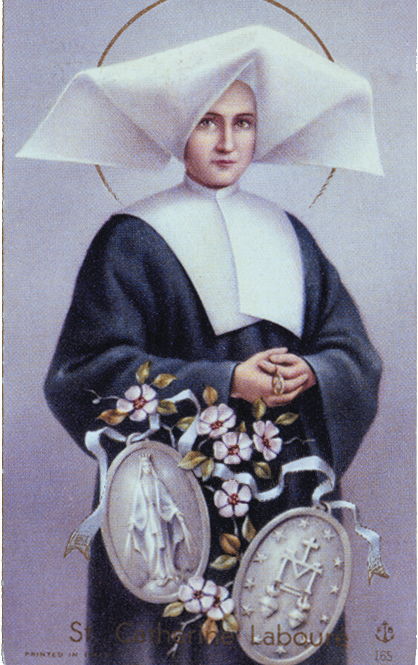

 visions of Mary Our Lady of Guadalupe