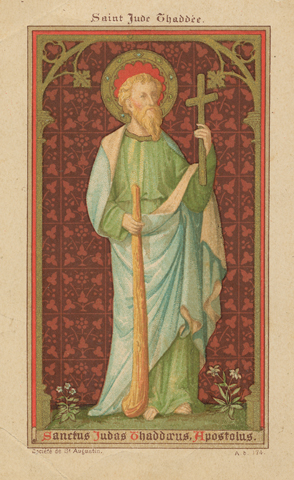
One of the original 12 apostles, Jude is depicted with the flame of knowledge received from the Holy Spirit at the Pentecost burning above his head. Brother of James the Lesser and cousin of Jesus, Jude was one of Christ’s earliest followers. He earned his title of Patron Saint of Impossible Causes because of a letter he wrote in 60AD to persecuted Christian converts in the East, exhorting them to stay strong in the face of all difficulties.
The name Jude means giver of joy and the name Thaddeus means great hearted one and this saint was said to live up to his name, attracting immense crowds by preaching in an entertaining way, outwitting magicians and local priests. Abgar, the King of Edessa was quite impressed with Jude and appealed to Jesus cure his leprosy. He sent an artist to draw Christ’s image. The artist was so shaken by the glow in Christ’s eyes, he could not draw. Christ wiped his face with a cloth and the image of his face was transferred to it. Jude brought the cloth back to Abgar and the king rubbed the cloth over his body, curing himself of leprosy. Many depictions and statues of Saint Jude include this cloth with Christ’s image on it. Jude was martyred along with Saint Simon in the city of Samir by being beaten with a club. This club, as well as the palms of martyrdom are also part of his iconography.
The cult of Saint Jude all but died out after the Middle Ages because people confused him with Judas Iscariot, the apostle who betrayed Christ. Despite being cited as a great influence by the mystics Saint Bernard of Clairvaux and Saint Bridget of Sweden, Jude was rarely invoked by the faithful for anything. It is said that because of this, he became the saint to call on in the most impossible of situations. So anxious was he to be of help, he would turn heaven and earth to rectify a desperate situation. By the nineteenth century, it became customary to thank the saint for help with answered prayers by taking an ad in the newspaper. This helped to resurrect his popularity and these small “Thank you Saint Jude” ads can be found in many weekly and daily periodicals in present day.
Unfailing Prayer to Saint Jude
Glorious apostle, Saint Jude Thaddeus, I salute you through the Sacred Heart of Jesus. Through his heart I praise and thank God for all the graces he has bestowed upon you. I implore you, through his love, to look upon me with compassion. Do not despise my poor prayer. Do not let my trust be confounded! God has granted to you the privilege of aiding mankind in the most desperate cases. Oh, come to my aid that I may praise the mercies of God! All my life I will be your grateful client until I can thank you in heaven.
(Mention your request here).
Saint Jude, pray for us, and for all who invoke your aid.
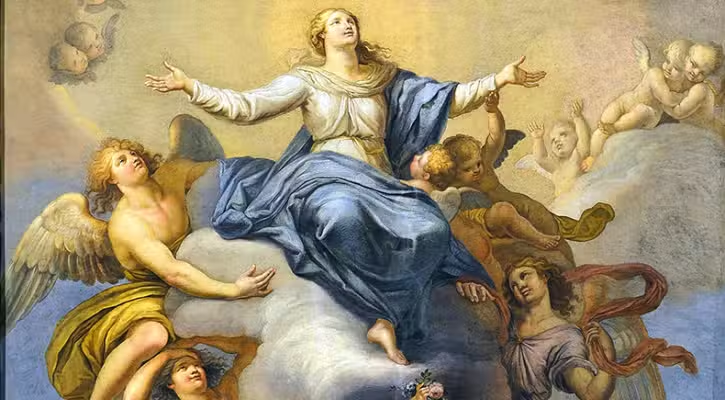
On November 1, 1950, Pope Pius XII defined the Assumption of Mary to be a dogma of faith: “We pronounce, declare and define it to be a divinely revealed dogma that the immaculate Mother of God, the ever Virgin Mary, having completed the course of her earthly life, was assumed body and soul to heavenly glory.” The pope proclaimed this dogma only after a broad consultation of bishops, theologians and laity. There were few dissenting voices. What the pope solemnly declared was already a common belief in the Catholic Church.
We find homilies on the Assumption of the Blessed Virgin Mary going back to the sixth century. In following centuries, the Eastern Churches held steadily to the doctrine, but some authors in the West were hesitant. However by the 13th century there was universal agreement. The feast was celebrated under various names—Commemoration, Dormition, Passing, Assumption—from at least the fifth or sixth century. Today it is celebrated as a solemnity.
Scripture does not give an account of Mary’s assumption into heaven. Nevertheless, Revelation 12 speaks of a woman who is caught up in the battle between good and evil. Many see this woman as God’s people. Since Mary best embodies the people of both Old and New Testaments, her assumption can be seen as an exemplification of the woman’s victory.
Furthermore, in 1 Corinthians 15:20, Paul speaks of Christ’s resurrection as the first fruits of those who have fallen asleep.
Since Mary is closely associated with all the mysteries of Jesus’ life, it is not surprising that the Holy Spirit has led the Church to believe in Mary’s share in his glorification. So close was she to Jesus on earth, she must be with him body and soul in heaven.
Reflection
In the light of the Assumption of the Blessed Virgin Mary, it is easy to pray her Magnificat (Luke 1:46–55) with new meaning. In her glory she proclaims the greatness of the Lord and finds joy in God her savior. God has done marvels to her and she leads others to recognize God’s holiness. She is the lowly handmaid who deeply reverenced her God and has been raised to the heights. From her position of strength she will help the lowly and the poor find justice on earth, and she will challenge the rich and powerful to distrust wealth and power as a source of happiness.
Born Fernando de Bulhes in Lisbon, Portugal, he disappointed his noble family by rejecting his luxurious life and joining the Augustinian religious order. A scholar by nature, he read every book in the monastery, devoting his time to contemplative prayer. Eventually, he befriended a group of itinerant Franciscan monks and became fascinated with this new religious order. Much impressed by their dedication to simplicity, poverty and their belief in returning to the original words of Christ, he joined their ranks, changing his name to Anthony in honor of Saint Anthony of the Desert, the patron of their little church. Returning home from a failed missionary venture in Morocco, his ship was blown off course and he wound up in Messina, Sicily. A group of Franciscan friars insisted he go north with them for a great gathering of all Franciscans, with their founder Francis of Assisi.
Anthony remained in Italy and discovered his great gift of preaching when a superior ordered him to speak at an ordination, telling him to say whatever the holy spirit had infused into him. He astonished his audience, not only by his skills as an orator but by the depth of his knowledge. He was sent throughout northern Italy and southern France on evangelical preaching missions which gathered crowds in the tens of thousands. His popularity among the people increased as he used his position to get real changes enacted for their protection. While based in Padua, he observed the crushing power of debt upon the common people. At Anthony's insistence, the local municipality enacted a law protecting those who could not pay their debts that is still enforced today. Anthony exhausted himself preaching out in fields and in piazzas as there was not cathedral large enough to hold all who came to hear him. At the age of thirty six, his health began to fail him and a local Count donated a woodland retreat for his recovery. One morning the Count heard the sounds of a baby giggling and he looked out to see Anthony surrounded in light, playing with the baby Jesus. That Christ would choose to appear to one of his saints in such a vulnerable state is a testament to the loving and kind nature of Saint Anthony. Because he is depicted holding a baby, women having trouble conceiving invoke his aid. Being of Portuguese descent, Anthony's feast day is very auspicious for marriages in Portugal and Brazil and in those cultures, he is known to assist women seeking a husband. According to legend, Saint Anthony earned the title patron saint of lost articles when a novice borrowed his psalter and failed to return it. Saint Anthony prayed to get it back and the novice was visited by terrifying visions that sent him running back to Anthony with the book. In iconography, Anthony always holds the baby Jesus and a lily for purity. Many times the returned book of the gospels is included.
Wonder and miracles are infused with every story of Saint Anthony. Though he has been dead for almost 800 years, he is still the most popular saint in the world and his statue is found in every Catholic Church. Saint Anthony is best known as the patron saint of lost articles but he is invoked for help in all life situations. In his own day he was called the “Wonder Worker’ and credited with the ability to stop the rain, raise the dead and reattach severed limbs. He was such a charismatic preacher that when a crowd of heretics in Rimini refused to listen to his preaching, the fish raised themselves out of the water to hear him.
Prayer to St. Anthony
Holy Saint Anthony, gentle and powerful in your help, Your love for God and charity for His creatures, made you worthy when on earth, to possess miraculous powers. Miracles waited on your word, which you were always ready to request for those in trouble or anxiety. Encouraged by this thought, I implore you to obtain for me (mention your request here). The answer to my prayer may require a miracle. Even so, you are the saint of miracles. Gentle and loving Saint Anthony, whose heart is ever full of human sympathy, take my petition to the Infant Savior for whom you have such a great love, and the gratitude of my heart will be ever yours. Amen It is customary to donate to Saint Anthony’s Bread, a charity started in Saint Anthony’s lifetime, in gratitude to answered novena prayers.
One of the original 12 apostles, Brother of James the Lesser and cousin of Jesus, Jude was one of Christ’s earliest followers. He earned his title of Patron Saint of Impossible Causes because of a letter he wrote in 60AD to persecuted Christian converts in the East, exhorting them to stay strong in the face of all difficulties.
The name Jude means giver of joy and the name Thaddeus means great hearted one and this saint was said to live up to his name, attracting immense crowds by preaching in an entertaining way, outwitting magicians and local priests. Abgar, the King of Edessa was quite impressed with Jude and appealed to Jesus cure his leprosy. He sent an artist to draw Christ’s image. The artist was so shaken by the glow in Christ’s eyes, he could not draw. Christ wiped his face with a cloth and the image of his face was transferred to it. Jude brought the cloth back to Abgar and the king rubbed the cloth over his body, curing himself of leprosy. Many depictions and statues of Saint Jude include this cloth with Christ’s image on it. Jude was martyred along with Saint Simon in the city of Samir by being beaten with a club. This club, as well as the palms of martyrdom are also part of his iconography
The cult of Saint Jude all but died out after the Middle Ages because people confused him with Judas Iscariot, the apostle who betrayed Christ. Despite being cited as a great influence by the mystics Saint Bernard of Clairvaux and Saint Bridget of Sweden, Jude was rarely invoked by the faithful for anything. It is said that because of this, he became the saint to call on in the most impossible of situations. So anxious was he to be of help, he would turn heaven and earth to rectify a desperate situation. By the nineteenth century, it became customary to thank the saint for help with answered prayers by taking an ad in the newspaper. This helped to resurrect his popularity and these small “Thank you Saint Jude” ads can be found in many weekly and daily periodicals in present day.
Prayer to Saint Jude
Glorious apostle, Saint Jude Thaddeus, I salute you through the Sacred Heart of Jesus. Through his heart I praise and thank God for all the graces he has bestowed upon you. I implore you, through his love, to look upon me with compassion. Do not despise my poor prayer. Do not let my trust be confounded! God has granted to you the privilege of aiding mankind in the most desperate cases. Oh, come to my aid that I may praise the mercies of God! All my life I will be your grateful client until I can thank you in heaven.
(Mention your request here).
Saint Jude, pray for us, and for all who invoke your aid.
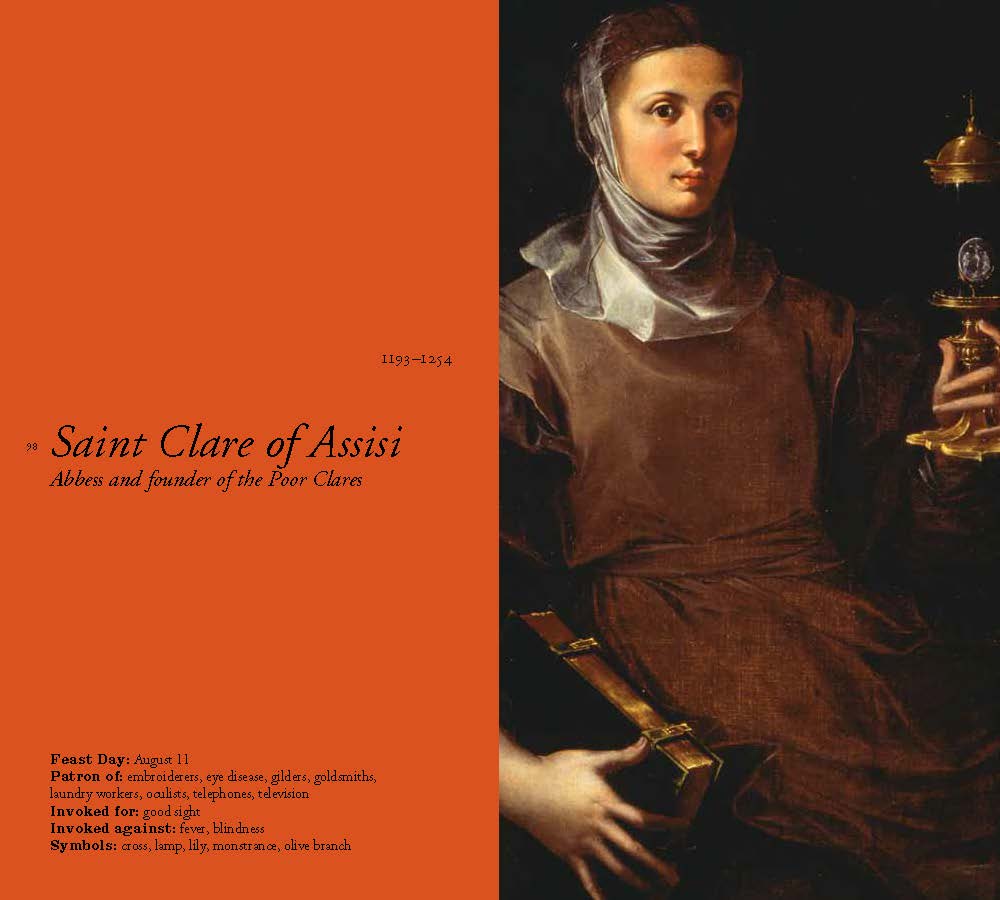
Together with her mentor and friend, Francis of Assisi, St. Clare shook the foundations of Medieval society by revolutionizing religious expression. Her given name, Chiara means clarity and we call on St. Clare whenever we need to shine a light on a situation or to find a way to communicate more clearly. She is also invoked to protect the blind and to help those with eye trouble.
Chiara Offreduccio, as the beautiful daughter of minor royalty was offered every worldly advantage available to one in her social class. When she heard St. Francis preach the Lenten service at her church in 1212, his simple message of living with complete trust in God inspired her to abandon going through with her arranged marriage in order to join the Franciscan movement. The first followers of Saint Francis were the wealthy sons of his town of Assisi. Their act of turning their backs on the material world to live at the mercy of the elements and on whatever alms they could beg was disturbing and controversial to both their families as well as to the church authorities. Attracted by the joyous way in which they comported themselves, as well as the enthusiasm they brought to religious worship, Clare was the first woman to join their order.
Fervently believing in a life devoted to the precepts of the gospel, the Franciscans did not believe in personal property. When Clare escaped her family to join them on Palm Sunday, Francis himself cut off her long blond hair and handed her the simple woolen robe worn by his followers. He then left her in the local Benedictine convent as there were no facilities in his order for women. It was not long before her entire family attempted an intervention type rescue of the girl. Revealing her shorn hair to her horrified father made them realize that she would never return to their world. Her younger sister, as well as other wellborn young women from the town soon followed her. In 1215, Saint Francis installed Clare as the Abbess of the Order of Poor Ladies. True to the Rule of St. Francis, they accepted no dowries from their families as other religious orders did. When they were left inheritances, the money was distributed to the poor. Highly intelligent, and known for the efficacy of her prayers, popes, cardinals, royalty and St. Francis himself came to her for spiritual advice. Her own correspondence shows her to be a clever, happy person.
Devoted to the Eucharist and frequently immersed in prayer, the stories of miraculous occurrences around Clare abound. The most famous is that while she was ill, her convent which was outside of the walls of Assisi was attacked by the Saracen mercenaries of Frederick II . As the invaders stormed the walls with ladders, Clare calmly held up a monstrance containing the host. A child’s voice emanated from inside the monstrance, “I will always guard and defend you.” A feeling of dread overtook the invaders and they ran away from the town. St. Clare was named the patron saint of television writers and workers due to a vision she had while too ill to attend Christmas Eve mass. She was able to view and hear the entire mass on the wall of her room. She spent much time embroidering linens for use in mass, so she is the patron of embroiderers. Because that trade is hard on the eyes and because of her name, she is the patron of those with eye problems and the blind.
Novena to St. Clare O Glorious St. Clare! God has given you the power of working miracles continually, and the favor of answering the prayers of those who invoke your assistance in misfortune, anxiety, and distress. We beseech you, obtain from Jesus through Mary His Blessed Mother, what we beg of you so fervently and hopefully, (mention your petition) if it be for the greater honor and glory of God and for the good of our souls. Amen
Patron of: Those with mental illness, nervous disorders, and emotional distress Feast Day:May 15 Martyrs
As a child of a mentally ill father, Saint Dymphna offers much solace to those suffering from psychological problems as well as their families. She is invoked to bring peace to the unbalanced as well as create an aura of calm and consolation for those who live in the midst of instability.
Having lived such a short life so long ago, there is very little factual information available about Saint Dymphna. According to a written report commissioned by the Bishop of Cambrai seven hundred years after her death, Dymphna was born an Irish princess. Her mother was a devout Christian married to Damon, a pagan king. Dymphna’s mother made sure her daughter was brought up as a Christian, having installed her own confessor, Gerebran into her household. At the age of fourteen Dymphna lost her mother and her father went mad with grief. After a period of mourning, he searched all of Ireland for a new companion but could not find a woman who even remotely resembled his first wife. Because Dymphna was almost the exact image of her mother, Damon decided to marry her and make her his queen, disregarding the fact that she was his own daughter. In order to thwart this plan, Gerebran and Dymphna escaped the castle and went abroad to Antwerp. Eventually settling in Gheel in Belgium, they lived as religious hermits. Dymphna studied to be an anchoress which was a woman who lived in a room connected to a church with a window open to the street. Towns in the middle ages usually supported these people who offered their knowledge to those in need of advice. It took Damon and his men a year to find Dymphna and Gerebran. The priest was executed immediately and Dymphna was offered her father’s kingdom in exchange for returning home with him. When she refused, he decapitated her in a rage. Both bodies were immediately buried. Since epilepsy and mental illness were all thought to be caused by demonic possession, those suffering from mental afflictions were never welcomed to live in one place and were doomed to wander from town to town. Soon after Dymphna’s death, a group of five of these social pariahs slept at the site of her murder and were instantly healed by the blood in the earth.
In the 13th century, the remains of an unknown man and woman were accidentally disinterred at Gheel. The name DYMPNA was written on a brick over the woman’s remains. As the remains were reinterred in a tomb, miraculous healings of the mentally ill and epileptics in the region were recorded. Gheel became a pilgrimage site for anyone suffering from any form of mental illness. By the end of the thirteenth century a major hospital and treatment center was built there for those suffering from nervous disorders. To this day, Gheel offers the most advanced and humane treatment for the mentally ill in the world. Saint Dymphna’s remains, in the church named for her there continues to be a place of pilgrimage.
Prayer
O God, we humbly beseech you through your servant Saint Dymphna, who sealed with her blood the love she bore you, to grant relief to those who suffer from mental afflictions and nervous disorders, especially (mention the afflicted person).
Saint Dymphna, helper of the mentally afflicted, pray for us.
Saint Dymphna, comforter of the despondent, pray for us.
Saint Dymphna, renowned for many miracles, please hear my plea.
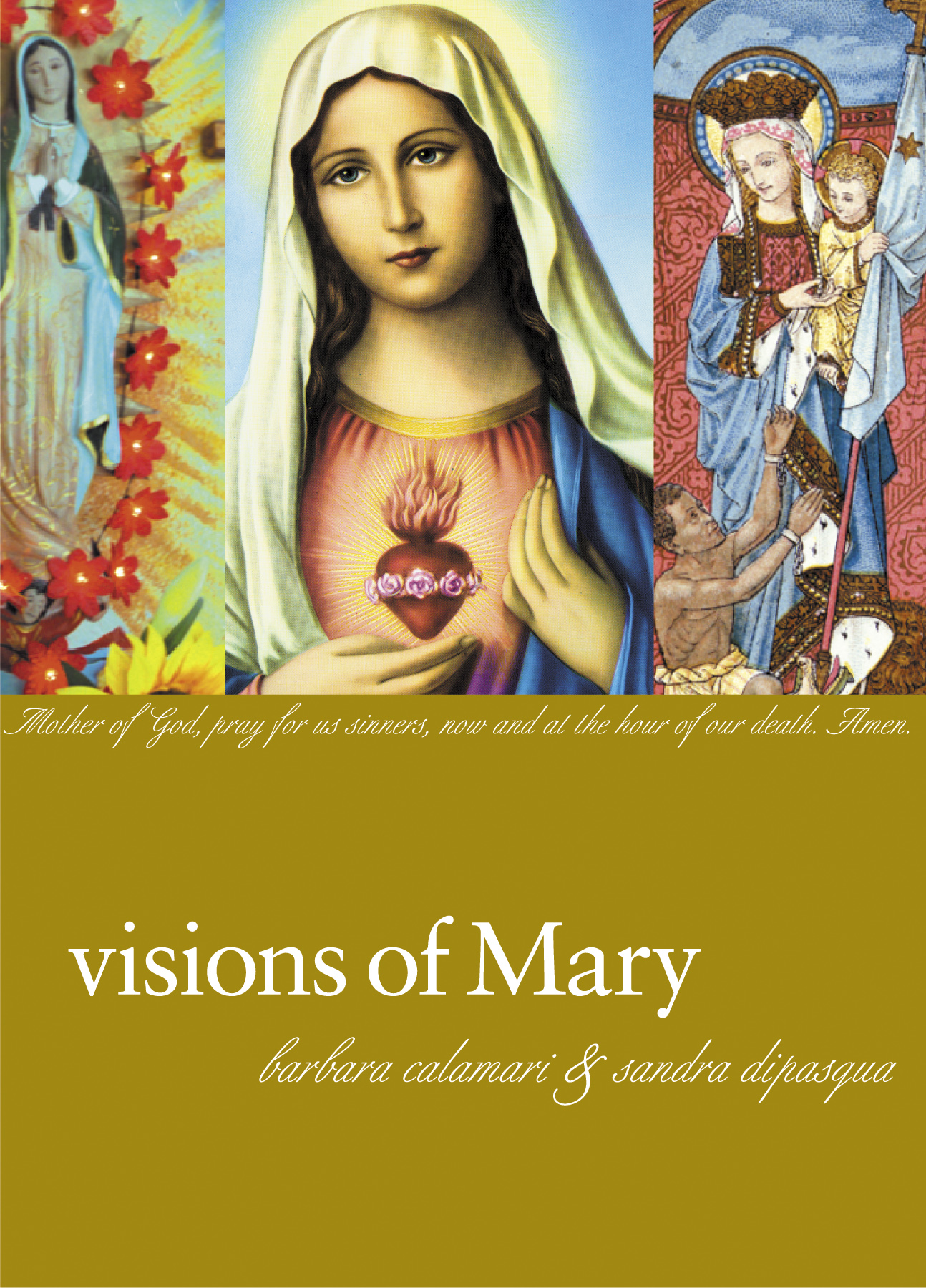
The Roman Catholic love and respect for the Virgin Mary divides it from other sects of Christianity. Mary is not only revered as the Mother of God but also as the Mother of all Humanity, and her image continually watches over every aspect in the daily life of Catholic countries. She is credited with working miracles through pictures, statues, and sacred earthly places. She is the inspiration of much of the world’s greatest music, art, and architectural works. Her spiritual gifts are recognized in the East and both Hindus and Buddhists refer to her as Mother Mary. Muslims revere her as the mother of a great prophet and she is the only woman with her own chapter in the Koran. As a human being Mary is able to relate directly to the major and minor sufferings of mankind. For this reason she is not prayed to as a goddess, but rather, called on by Catholics to aid them in their prayers. It is thought that she shares her constant flow of grace with those who ask, bringing them closer to God. Thomas Merton wrote, “Mary does not rule us from without, but from within. She does not change us by changing the world around us, but she changes the world around us by first changing our own inner lives.”
Contents
Introduction 8
Our Lady of Mount Carmel 24
Our Lady of Guadalupe 32
Our Lady of Cobre 42
Our Lady of Prompt Succor 48
The Miraculous Medal 54
Our Lady of La Salette 62
Our Lady of Lourdes 68
Our Lady of Perpetual Help 76
Our Lady of Pompeii 80
Portfolio 84
Our Lady of Knock 96
Our Lady of Fatima 98
Our Lady of Light 108
Our Lady of Akita 112
The Black Madonnas 116l Our Lady of Czestochowa 120
Our Lady of Cobre is considered the mother of Cuban people regardless of their race, political allegiance, or ideology. She is so entrenched in the Cuban national identity that she is virtually the only unifying force between those in exile and those who remained on the island. Though Cuba has been officially declared an atheist country by its government, it allowed four Catholic masses to be said at the major cathedrals in honor of Our Lady of Cobre to commemorate a papal visit in January 1998. The first masses that took place in the middle of the country drew a respectful but reticent response. By the time the fourth mass was said in Havana, the sight of millions of joyful, chanting devotees singing and dancing in the streets so shocked the ruling powers that they agreed to loosen the laws suppressing religious feasts and celebrations in all houses of worship. To many it was proof that the Virgin Mary is far more powerful than any government.
The story of Our Lady of Cobre took place in 1606. Two brothers of Indian lineage, Rodrigo and Juan de Hoyos, and a ten-year-old African slave named Juan Moreno took a canoe out off the coast of Santiago del Prado. This was an area newly rich in copper mines, the name of which has since been changed to Cobre, cobre being the Spanish word for “copper.” The boys were out to gather salt to preserve meat for the copper miners. Halfway across the Bay of Nipe they had to encamp on an islet because a violent storm had blown up. They waited through a harrowing night, the storm ending at daybreak. When the sea calmed the boys again set out on their task.
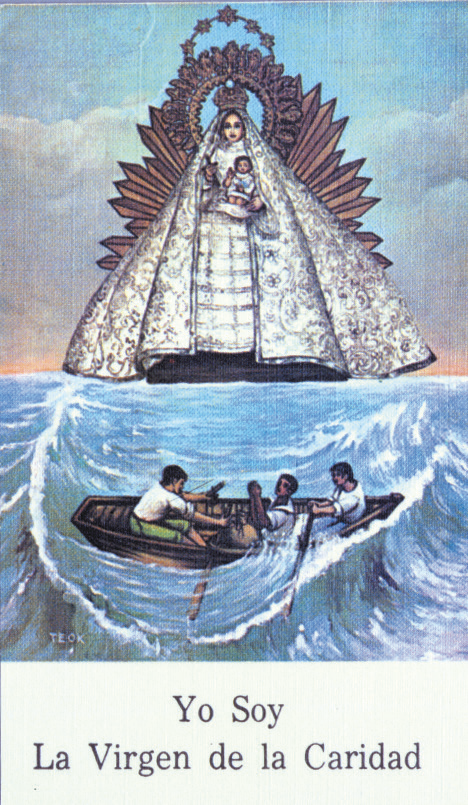
Almost immediately they saw a white bundle on a plank floating on the waves, approaching them. At first they thought it was a seabird, but as it neared them it appeared to be a little girl. Gradually they realized it was a statue of the Virgin Mary holding the Christ child. Much to their amazement the statue was completely dry. Inscribed on the plank were the words: “Yo soy la Virgen de la Caridad” (I am the Virgin of Charity).
The boys carried the statue back to the town, where its arrival was recognized as a message from the Virgin Mary. A shrine was constructed,and it immediately became a pilgrimage site. The statue is now in its own sanctuary known as Nuestra Senora del la Caridad de Cobre Basilica in Santiago de Cuba.
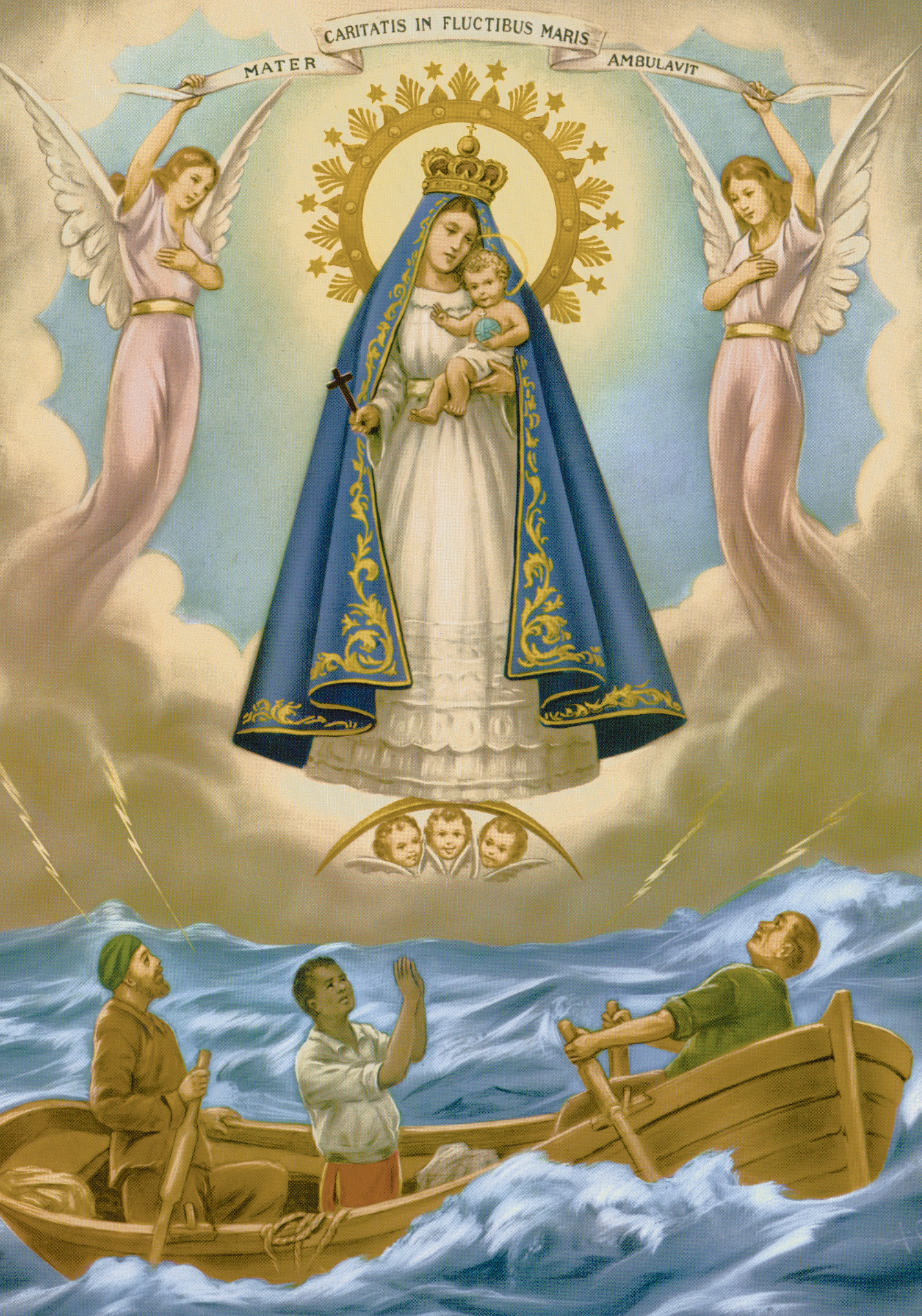
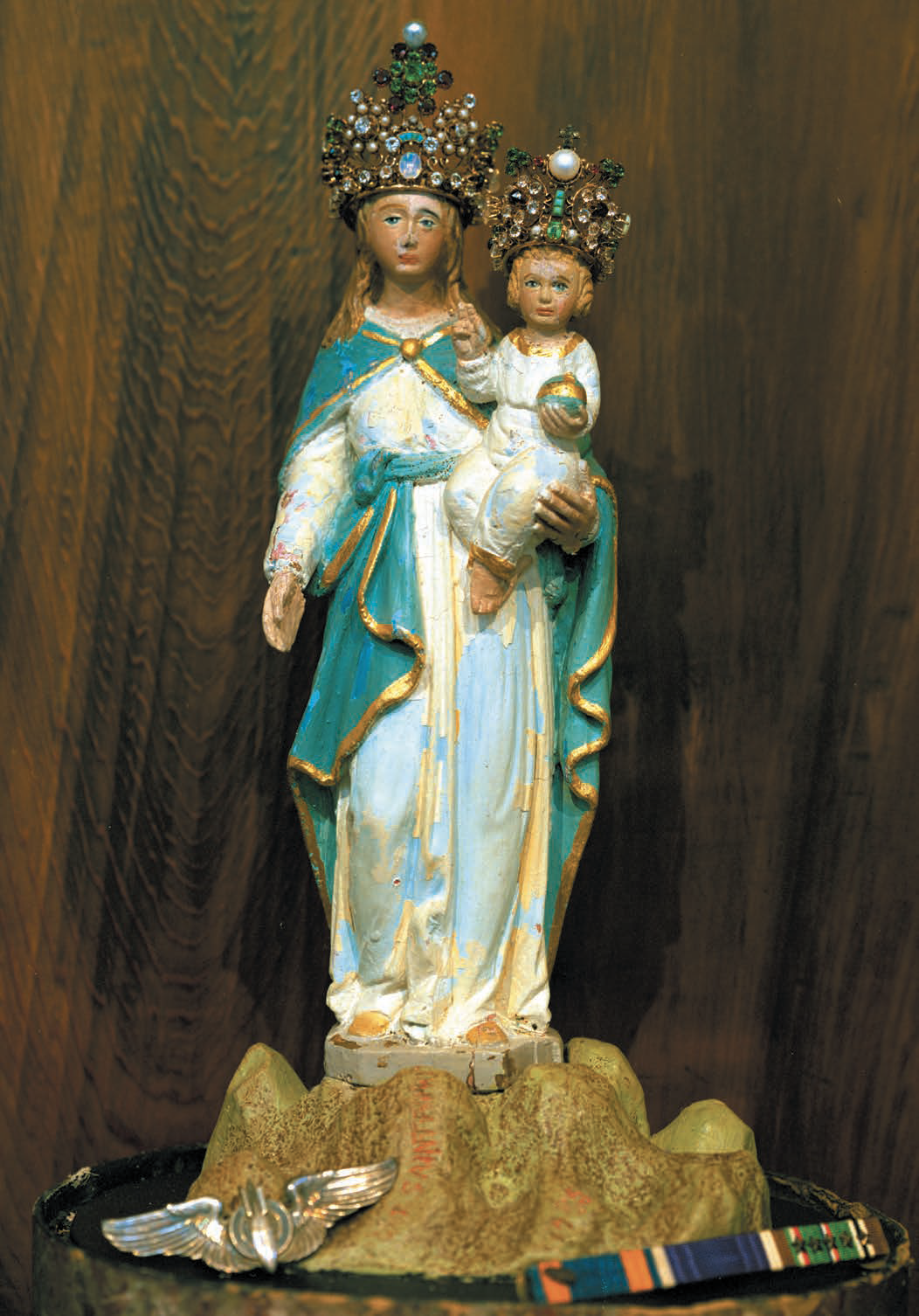
The statue of Our Lady of Cobre is about sixteen inches high. Artistic depictions of it vary. The statue in the basilica is a mixed-race Mary. Though her original robes were white, she now wears heavily brocaded golden robes with gold and silver embroidery containing Cuba’s national shield. The stiffness of this fabric gives the statue its triangular shape. Our Lady of Charity is a common figure found in Spanish hospitals, and it was thought that this statue could have originally come from a Spanish ship headed for Cuba. In later retellings of the story, the three men in the boat became the “three Juans,” one European, one Taino Indian, and the third one African, who, caught out in a storm, prayed to the Virgin to save them. Miraculously, the sea calmed and the little statue floated to them out of nowhere. In art they are shown rowing in a rough sea with Our Lady of Cobre hovering over them in a protective way. In this depiction of Mary she is holding up the Baby Jesus, and both He and Mary wear golden crowns. She is standing on a half-moon, but unlike the statues of Our Lady of Charity in Spain, the moon is pointing downward. This is thought to be a particular message to the Taino Indians. Their goddess Guabonito had the symbol of the rainbow to represent her. It is thought that in this statue Mary is standing on what could be interpreted as the moon by Europeans and Africans and as a rainbow by the Tainos, offering the same gift of healing that the rainbow symbolizes to them. In art, Mary is frequently depicted as light-skinned and wearing the colors of the Cuban flag. To the island’s practitioners of Santeria, Our Lady of Cobre holds an exalted position in their pantheon as the goddess Ochun. She is the goddess of love, money, and household happiness.
Throughout the nineteenth century, Our Lady of Cobre became a Cuban symbol of unity in their desire for independence from Spain. In 1916 she was named the official patroness of Cuba after soldiers who credited her intervention for their liberation from Spain petitioned the Vatican. She has always remained a symbol of the Cuban people. In 1954 when the writer Ernest Hemingway won the Nobel Prize for his novella The Old Man and the Sea, he wanted to give the medal to the Cuban people. The best way he could think to accomplish this was to bring the prize to the Sanctuary of Our Lady of Cobre and dedicate it to her. There it remains to this day. Wherever Cubans are in the world, her feast day is a major celebration for them. Our Lady of Cobre is fondly called by the nickname Cachita. She is a much loved member of Cuban families and her image is the one consistent thing found among exiles fleeing the island and those who live in Cuba. She is the symbol both of faith and of national identity.
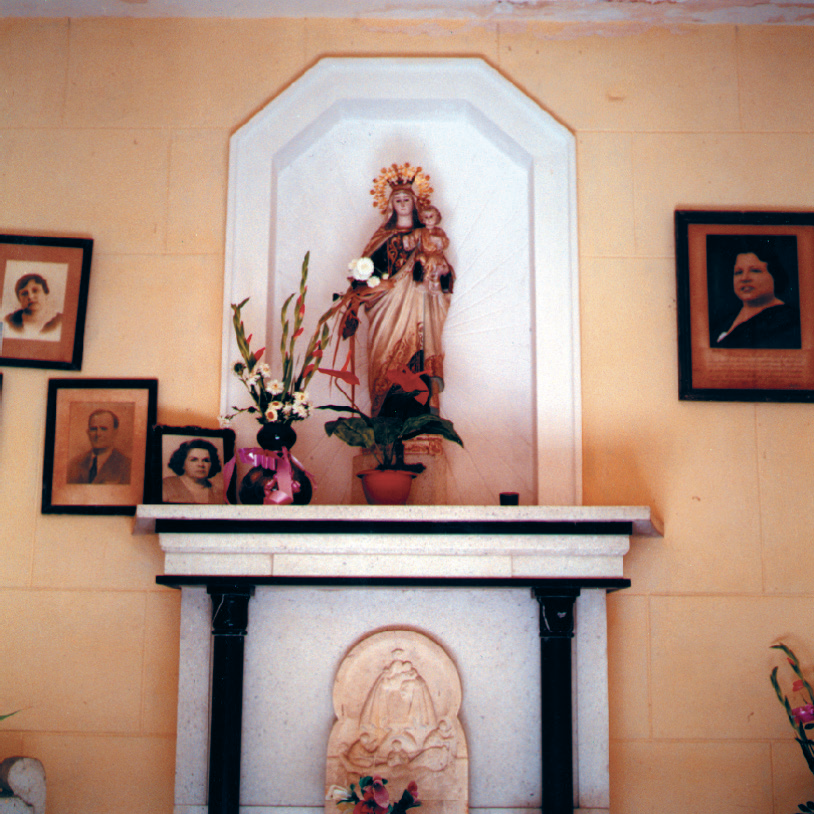
Home altar in Havana,Cuba Photographs by Lisa Silvestri
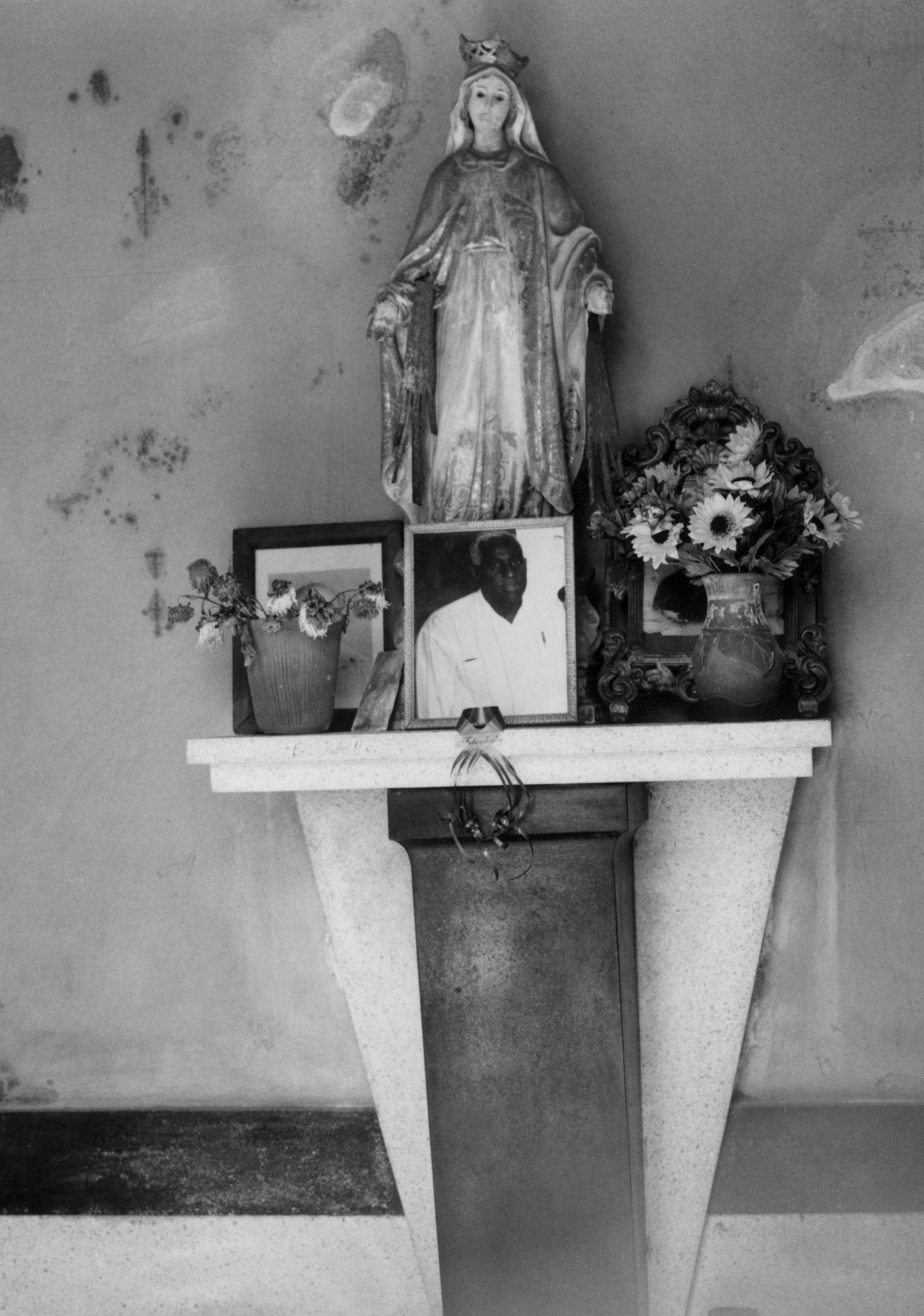
Altar in family mausoleum in Havana, Cuba Photograph by Lisa Silvestri
Religious Statues from the flea market in Mexico City, Mexico.
The “Sweetheart Statue” was brought to the Ursaline Convent in New Orleans in 1785.
visions of Mary Our Lady of Guadalupe
A traveler visiting Mexico or the American Southwest meets Our Lady of Guadalupe hundreds of times a day. Her image adorns the walls of businesses, is prominently displayed in homes, is on the hubcaps of cars, and at the center of small sidewalk shrines. This image of Mary is the preeminent cultural icon for most Latin Americans, sacred to Catholics and highly honored by non-Catholics, and it is the only apparition of Mary sanctioned by the Church on the North American continent.
On December 9, 1531, an Aztec convert to Catholicism named Juan Diego was on his way to early morning Mass in the area that is now known as Mexico City when he heard the sound of birds singing. When they quieted down, the hill at Tepeyac seemed to respond to their song. From the top of the hill a woman gently called to Diego, “Ihuantzin. Ihuan Diegotzin.” She was speaking the Aztec language of Nahuatl. As he approached her, he saw that she was an Indian noblewoman. He was amazed at how her clothes glimmered like the sun and how the rocks and foliage around her had a heightened glow. The crag where her foot rested gave off rays of light and the earth sparkled like a rainbow.
She spoke to him courteously and with great charm, “Know my dearest, littlest, and youngest son, I am the forever whole and perfect maiden Saint Mary, honorable mother of the true God, honorable mother of the giver of life, honorable mother of the creator of men and women, honorable mother of the one who is far and close, honorable mother of the one who makes the heavens and the earth. My wish is for them to build my temple here where I will give people all my love, compassion, assistance, and protection. I am the compassionate mother of you and your people here in this land and all of the other people who love me, call to me, search for me, and confide in me. I will listen to their pain, suffering, and crying and heal them from their misery.”
She then sent him to see the bishop to make the request for the church. After a long wait he related his story to the bishop who told him that he must obtain a sign proving that this was truly an appearance of Mary. Juan Diego returned to the woman on the hill and begged her to get someone more prestigious to give her message to the bishop. She told him that she had many people who could deliver her request, “but it is of precise detail that you yourself solicit and assist and that through your mediation my wish be complied.”
On his next visit to the bishop he was once again greeted with suspicion. When he left, the bishop sent servants to spy on him and to see to whom he was really speaking. But as soon as Juan Diego crossed the wooden bridge to the hill at Tepeyac, they lost sight of him. The next day, a Monday, Juan Diego decided to take another route around the hill in order to avoid the woman. His uncle had taken ill, and he needed medical attention. Juan Diego did not want the woman to detain him, as he feared that his uncle would die waiting for help. Much to his dismay, she came down the hill to meet him from where she was watching. When she asked him why he was so upset and why he was in such a rush, he sadly told her about his uncle’s illness and how his requests for her to the bishop had fallen on deaf ears.
Her answer was, “Listen, put it into your heart, youngest and dearest son, nothing should scare or concern you. Don’t worry. Don’t be afraid of the sickness, or any other illness or hardship. Am I not right here who is your mother? Are you not under my shadow and protection? Am I not in the foundation of your being, your sustenance, your happiness, peace, and effortlessness? Are you not in the fold of my garment? Do you need anything else? Don’t allow anything to worry or disturb you anymore. Don’t worry about your uncle’s illness. He will not die. Be assured, he is already well.”
She then told Juan Diego to gather roses among the rocks. He was surprised to find them in full bloom since it was winter. She carefully arranged them in Juan Diego’s cloak and he brought them to the bishop. After another humiliating wait, he was finally granted an audience. As he unwrapped his cloak and the roses fell out, the bishop gasped. The flowers uncovered an elaborate portrait of the Virgin Mary imprinted on the cloak. The bishop fell to his knees in tears and begged Juan Diego’s forgiveness. The bishop then insisted on being taken to the hill where the lady from heaven wanted her temple. After he had done this, Juan Diego ran home to his sick uncle and was quite shocked to see him happy and healthy. His uncle told him that a heavenly lady had come to heal him, asking him to tell the bishop of his cure. She also wanted him to convey the proper name for her image: The Perfect Virgin Holy Mary of Guadalupe.
The bishop had the church built and the cloth put on public display where it immediately attracted crowds of pilgrims. Almost as suddenly, the Franciscans, who had been in Mexico for the past ten years and who had very little previous success, were receiving thousands of Aztecs who wanted to convert to Catholicism. This cloth and its image, which should have deteriorated in twenty years, is still on view at the Basilica of Our Lady of Guadalupe in Mexico City. After almost five hundred years it remains in pristine condition. Attracting more than ten million pilgrims a year, Our Lady of Guadalupe is the most popular Marian shrine in the world.
At the time of this apparition of Mary, the Aztecs, the original inhabitants of Mexico City, had been suffering brutally under domination of the Spanish colonialists. Disease and depression were rampant. Hernán Cortés, the conquistador, had landed in 1519 and had succeeded in destroying much of the Aztec civilization by 1521. Why, then, were the Aztecs eventually such willing converts to Catholicism? The Aztecs had hundreds of gods in their pantheon. It was their spiritual habit to co-opt the gods of tribes that they conquered. They believed that their own god Huitzilopochtli depended on human sacrifices to be kept alive. They invaded neighboring tribes to obtain these victims. As they as a people became more aggressive against their neighbors, the gods of the Aztecs took on more monstrous forms. Portrayals of the female gods became the most frightening and grotesque. When the Spanish arrived in the Aztec city, they were amazed at its beauty and grace, and equally horrified at the blood-soaked temples with the racks of human skulls and demonic-looking statuary. All Aztec places of worship were considered satanic and systematically destroyed.
The hill where Mary appeared was once the site of the goddess Tonzantin. She was considered a household god, the goddess of corn and fertility. With Our Lady of Guadalupe, the feminine traits of love, compassion, and forgiveness were returned to spirituality and the sick-at-heart population had an entity to whom they could take their sorrow.
Statue of Blessed Juan Diego wearing the tilma with the imprint of Our Lady of Guadalupe. Following pages: Statues being sold at a flea market, an outdoor shrine with Our Lady of Guadalupe surrounded by lights so that she can be worshiped at night.
The portrait of Our Lady of Guadalupe conveyed a message interpreted differently by Aztecs and Europeans, yet triggered the same spiritual response. To the Aztecs, the basic announcement that Mary was making with this image was the dawning of the age of the Sixth Sun. Dividing up their history into solar ages, it was thought that the Fifth Sun, the Sun of Movement, ended with the Spanish conquest. Since the birth of a new sun always follows a time of darkness, it was believed that the appearance of Mary after ten years of destruction signaled the beginning of the Sun of Flowers. According to their lore, this was a time when humanity would come into its own and bloom. In this image, Mary wears a belt worn by pregnant women, thus announcing the birth of a new age. Gold-leaf Nahuatl glyphs symbolizing plenitude appear on her gown. They are arranged over her womb in a pattern that represented the four points of a compass, a basic symbol in the Aztec faith. The womblike light she is wrapped in, the rays of the sun and the crest of the moon, the folds of her robe and the subdued serpent all had hidden messages that were easy for the Aztecs to read. Her eyes do not stare ahead as depictions of the gods do; rather she is looking down at humanity, much as a mother looks at her child. Her hands are in a praying position that the Aztecs used to signify something coming from one’s heart. The fact that her robe is touching the angel signifies protection and love.
For the Christians the iconography of this image was directly related to the book of Revelation where John says, “A great sign appeared in the heavens, a woman clothed with the sun.” This image is associated with the Immaculate Conception. December 9, the first day of her appearance, was also the original day devoted to the Feast of the Immaculate Conception. The halo Mary is wrapped in is called a mandorla. Originally, this type of almond-shaped body halo represented the cloud in which Christ ascended; in time it came to signify the light that emanates from those divinely inspired. In Western art it is used to depict those with a complete bond to Christ. As the Mother of God, Mary is exalted above all angels, offering her protection and love to humanity.
By appearing as a mixed-race woman, Mary was announcing the new face of Catholicism. The brutal, fundamentalist way that Catholicism was practiced by the Spanish was softened. In her appearance Mary was reminding the Europeans that they had the same mother that the Aztecs did. She was the first Christian image that the Mesoamericans could relate to, and the messages embedded in her picture offered hope, love, and comfort to a people when these qualities had been driven out of their own religion.
Our Lady of Guadalupe is the patroness of Mexico, North and South America, and the Caribbean.
The Feast of Our Lady of Guadalupe is December 12, the day the miraculous cloth was revealed.
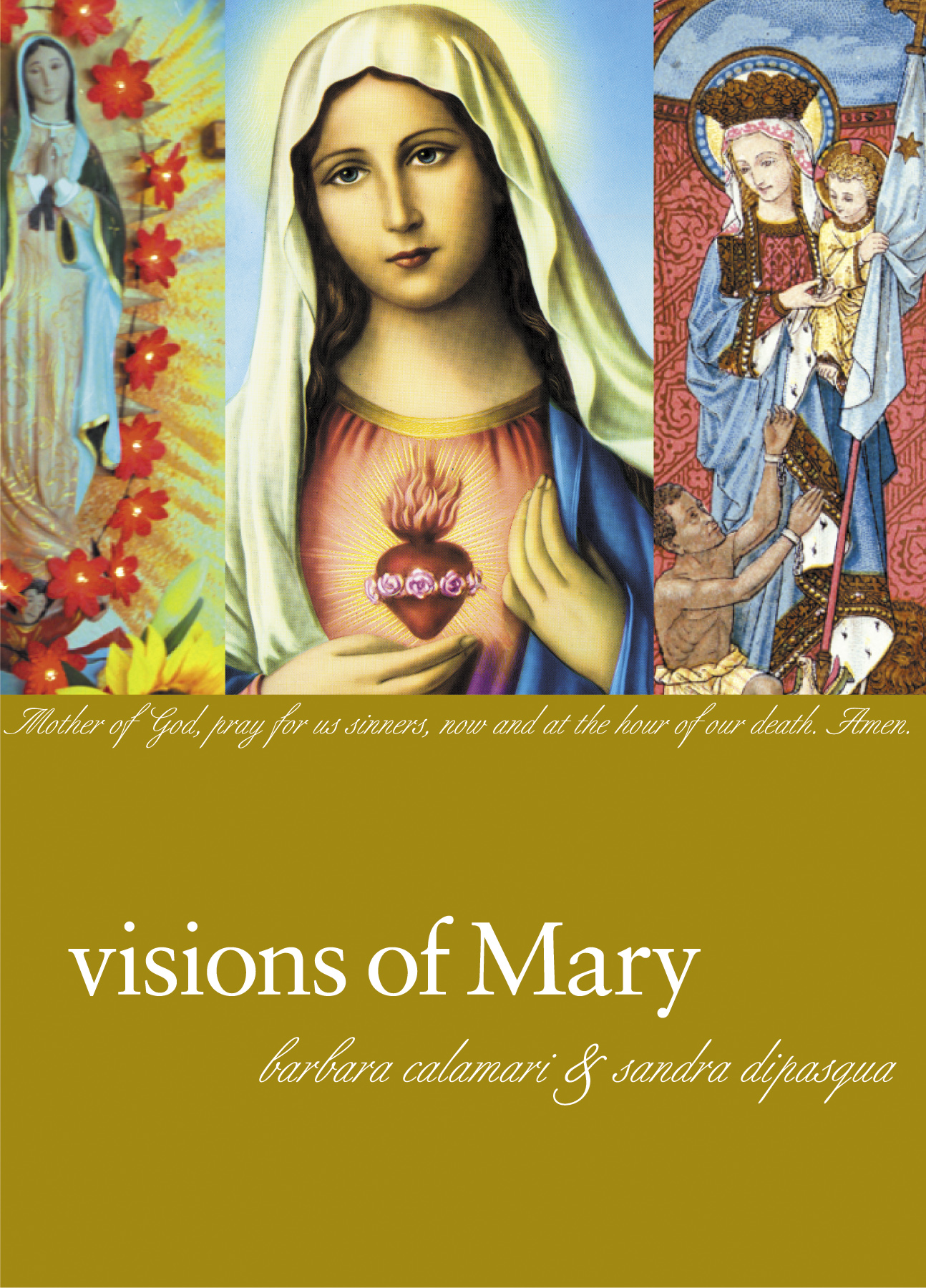
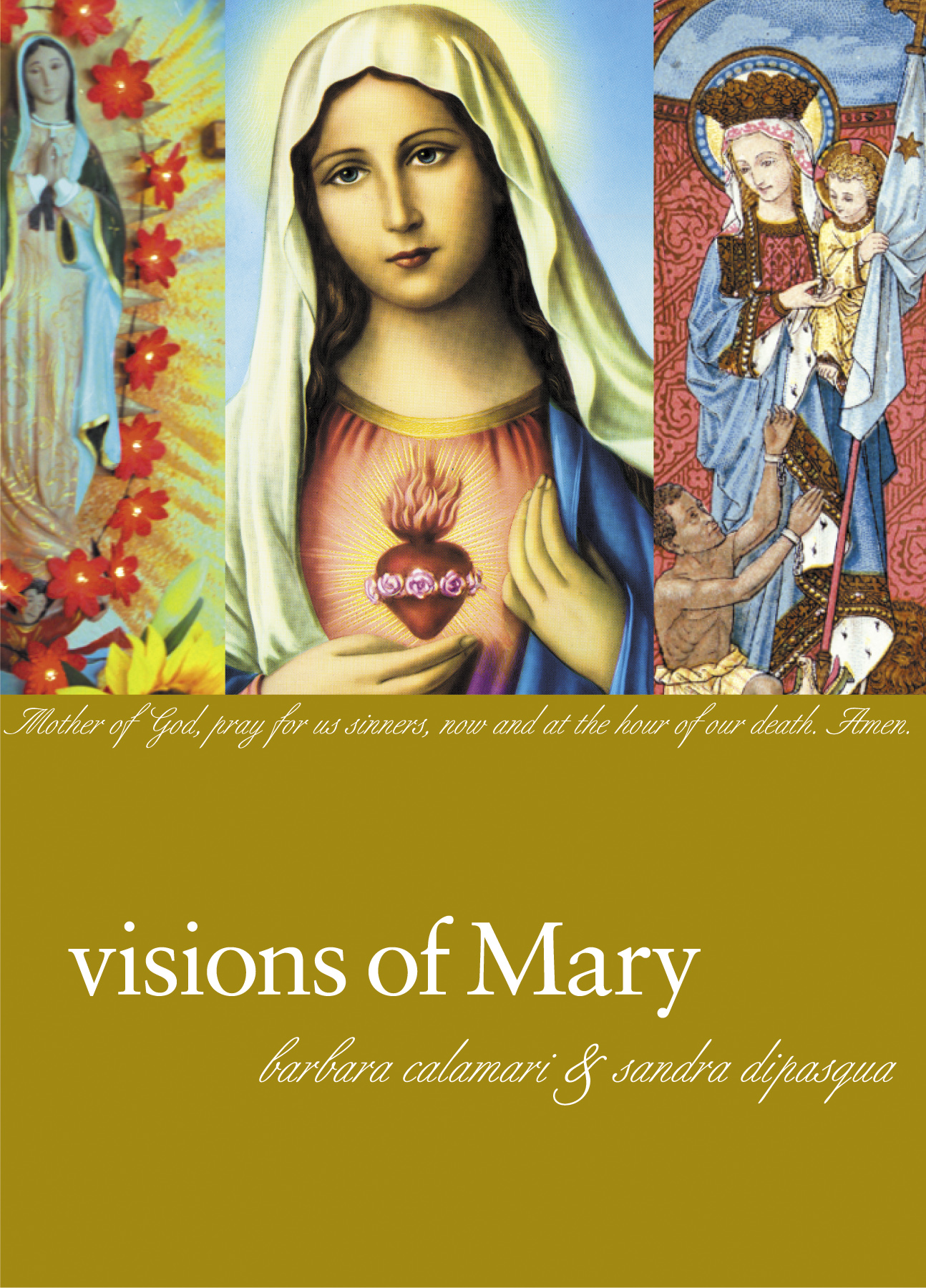
Barbara and I wanted Visions of Mary to be a book about how the Virgin Mary affects people in their everyday lives. In the United States and countries around the world, images of Mary are displayed among family photographs. For this reason, we chose not to use the great art works and paintings that have been created in her honor. Rather, we sought photographs of “everyday Marys.”. The photographer Lisa Silvestri after a trip to Mexico, Cuba, and New Orleans returned with countless beautiful images. It helped set the visual tone for our book. We are grateful to Lisa.
We also worked with Dr. Joseph Sciorra of the Calandra Center in New York City. Sharing his research on the black Madonnas of Southern Italy, and introduced us to the work of two wonderful photographers, Larry Raccioppo of New York City and Dana Salvo of Gloucester, Massachusetts, who are included in this book.
Diane Block, photo archivist at The Museum of New Mexico, was a big help in finding photographs for this book.
We bring this book to you with the help of the people mentioned above. We hope you find something in this book to love and are inspired by, as you go through your life. We will post a chapter every month.
Barbara and Sandy
Hail Mary Full of Grace! the Lord is with you; Blessed are you among women, and blessed is the fruit of your womb Jesus. Holy Mary, Mother of God, pray for us sinners, now and at the hour of our death. Amen.
Our Lady of Mount Carmel
Mount Carmel, in what is today northern Israel, has always been a place rich in mystical tradition. The word hakkarmel means “the garden” in Hebrew, and true to its title, there is a remarkable profusion of plants and wildflowers on this mountain. It is considered a natural paradise and a sacred place, and in biblical times it was forbidden to disturb any of the natural life on it. Those who wanted to ascend the mountain for meditation lived in caves so as not to intrude on the landscape with unnatural structures.
In about 860 b.c., the prophet Elijah (also known as Elias) arrived on this holy mountain to begin a life of contemplation and prayer. The First Book of Kings is filled with tales of wonders he performed and prophesies he gave. In his prophetic visions on Mount Carmel, Elijah became aware of the coming of the mother of the Messiah. He and his followers mystically dedicated themselves to her, setting an example as the first monks. The descendants of these ancient contemplatives were among the first to accept the teachings of Christ and to be baptized by His apostles. Upon meeting Mary after Christ’s Ascension, they were so overcome by her sanctity that they returned to the mountain to build a chapel in her honor. For the next thousand years Mount Carmel continued to be a place where hermits devoted themselves to prayer.
By the twelfth century, pilgrims from Europe who had followed the Crusades to the Holy Land settled with the ascetics on Carmel and started a religious holy order known as Brothers of the Blessed Virgin Mary of Mount Carmel. Their rule, which was given in 1209 by the Patriarch of Jerusalem, says that all converges toward the contemplation of God. The Rule of Mysticism exhorts those who fol-low it to live a life of continual prayer, obedience to a superior, perpetual abstinence and fasting, manual work, and total silence.
of their order to the laypeople; it served as a reminder that belief in Mary as the Mother of God extended back to the Old Testament with the prophet Elijah. After Pope John XXII (r. 1316–1334) had a vision of Mary where she promised those wearing the brown scapular, “I, the Mother of Grace, shall descend on the Saturday after their death and whomsoever I find in Purgatory, I shall free, so that I may lead them to the holy mountain of everlasting life,” the scapular became extremely popular among the common people. By the end of the sixteenth century it had become smaller in size and very similar to the one that is worn today. Admiration for the Carmelite Order spread as their adherence to the rules of solitude and prayer produced some of the greatest mystical saints in Catholicism, all of whom had visions of or openhearted communications with Mary. Among them are Saint Simon Stock, Saint Teresa, Saint John of the Cross, and Saint Thérèse of Lisieux.
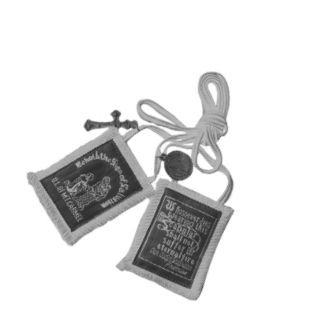
Though the original scapular handed to Saint Simon Stock was brown wool cloth without a picture, the Carmelite scapular that is now worn and the one that is most favored now has an image of Our Lady of Mount Carmel holding the Baby Jesus while she offers the scapular. The other piece of cloth often has a picture of Jesus as a man. Neither image is prescribed. Wearing the scapular is a form of prayer and is considered a visible sign of consecrating oneself to Mary and to accepting her maternal protection. Devotion to Our Lady of Carmel can be found wherever the Carmelites founded a monastery or convent. Many small towns in Italy have churches named after this aspect of Mary. As the townspeople emigrated to other countries, they brought the devotion with them. In many cities in the United States these churches have great celebrations in honor of Our Lady of Mount Carmel. Artistic representations of Our Lady of Mount Carmel depict her either appearing in the sky over Mount Carmel itself or holding Jesus as a toddler. In both versions the figure of Mary is often depicted offering the scapular to the viewer. Tradition has it that the prophet Elijah saw Mary appear in the clouds over Mount Carmel eight hundred years before her birth. Sometimes this representation includes her handing the scapular to Saint Simon Stock. The other version of this aspect of Mary illustrates the Sabbatine privilege where Mary vows to take the souls of those who died wearing the brown scapular out of purgatory on the Saturday after their death. Purgatory is depicted in flames because it is a place where the soul goes to have its sins burned away.
Simon Stock, an English pilgrim, had joined the group on a visit to Jerusalem. At this time, Saracen invaders forced the monks out of their spiritual home on Mount Carmel. All those who would not leave were murdered. Simon Stock was instrumental in getting the order to move to Aylesford, England, where the Baron de Grey gave them a manor house. The Carmelite lifestyle of contemplation, poverty, and silent prayer was not easily accepted in Europe, particularly among the clergy who enjoyed almost the same status and privilege as royalty. Reading into the life of Mary, Simon Stock was inspired by her unquestioning acceptance of all that befell her: her virgin pregnancy; her raising and loving a child doomed to be executed; and her staying at the foot of the Cross while others ran away. It was through his insistence that the Carmelites evolved from a band of hermit ascetics who regretted the loss of their home on Mount Carmel into a traveling society of mendicant friars, opening schools and mission houses in the major capitals of Europe. Still, it was difficult for many monks to accept the alteration of the rule of the order to adapt to European conditions. Their presence was also shunned and not easily tolerated by other religious orders. The people thought these hermits strange and did not accept that they chose to live in such absolute poverty and isolation. In order to preserve what was left of their order, the Carmelites invoked their patroness, the Virgin Mary, for help in establishing their new life. The answer came in a vision to Saint Simon Stock on July 16, 1251, when he was alone in his cell. Mary appeared to him holding the scapular of his order. She told him, “Receive my beloved son, this habit of thy order: this shall be to thee and to all Carmelites a privilege, that whosoever dies clothed in this shall never suffer eternal fire. . . .It shall be a sign of salvation, a protection in danger, and a pledge of peace.”
The scapular, two pieces of brown wool joined at the shoulders and hanging down the back and breast, was not new to the Carmelite order. For hundreds of years before Saint Simon Stock’s vision, monks in Europe had worn scapulars. But it is thought that the brown scapular that Mary delivered was referencing Elijah’s camel-hair garment on Mount Carmel. Eventually, the brown scapular became reduced in size for laypeople to wear under their clothing. This is a special devotion to Mary worn as a sign to commemorate her faith in both God and humankind.
Our Lady of Mount Carmel is the patroness of the Carmelite Order, Chile, and Bolivia. Her feast day is July 16.





 visions of Mary Our Lady of Guadalupe