Our Lady of Cobre is considered the mother of Cuban people regardless of their race, political allegiance, or ideology. She is so entrenched in the Cuban national identity that she is virtually the only unifying force between those in exile and those who remained on the island. Though Cuba has been officially declared an atheist country by its government, it allowed four Catholic masses to be said at the major cathedrals in honor of Our Lady of Cobre to commemorate a papal visit in January 1998. The first masses that took place in the middle of the country drew a respectful but reticent response. By the time the fourth mass was said in Havana, the sight of millions of joyful, chanting devotees singing and dancing in the streets so shocked the ruling powers that they agreed to loosen the laws suppressing religious feasts and celebrations in all houses of worship. To many it was proof that the Virgin Mary is far more powerful than any government.
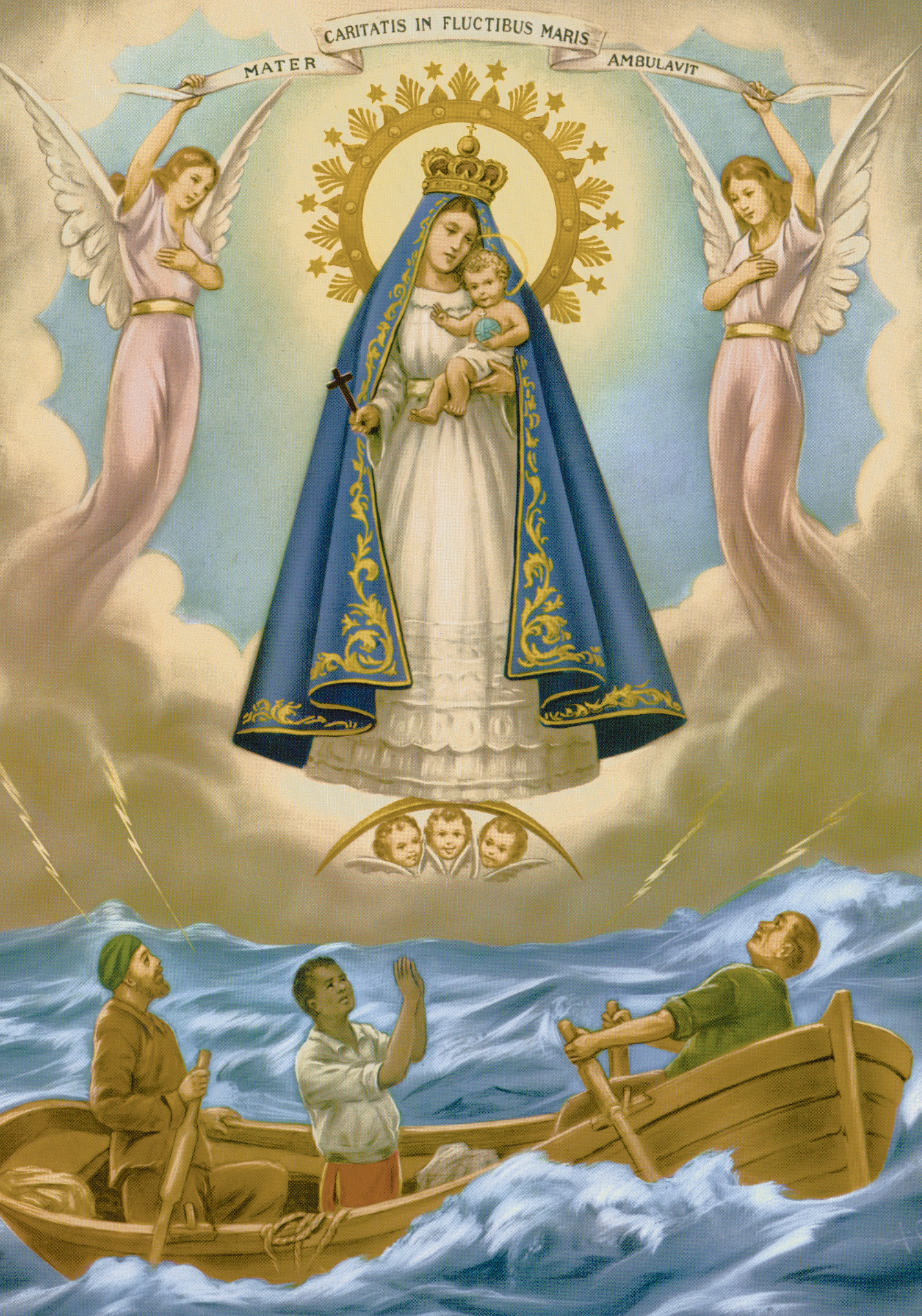
The story of Our Lady of Cobre took place in 1606. Two brothers of Indian lineage, Rodrigo and Juan de Hoyos, and a ten-year-old African slave named Juan Moreno took a canoe out off the coast of Santiago del Prado. This was an area newly rich in copper mines, the name of which has since been changed to Cobre, cobre being the Spanish word for “copper.” The boys were out to gather salt to preserve meat for the copper miners. Halfway across the Bay of Nipe they had to encamp on an islet because a violent storm had blown up. They waited through a harrowing night, the storm ending at daybreak. When the sea calmed the boys again set out on their task.
Almost immediately they saw a white bundle on a plank floating on the waves, approaching them. At first they thought it was a seabird, but as it neared them it appeared to be a little girl. Gradually they realized it was a statue of the Virgin Mary holding the Christ child. Much to their amazement the statue was completely dry. Inscribed on the plank were the words: “Yo soy la Virgen de la Caridad” (I am the Virgin of Charity).
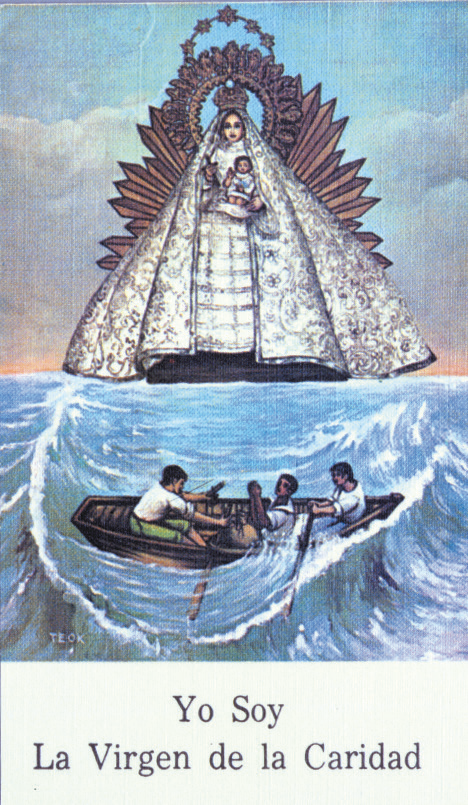
The boys carried the statue back to the town, where its arrival was recognized as a message from the Virgin Mary. A shrine was constructed,and it immediately became a pilgrimage site. The statue is now in its own sanctuary known as Nuestra Senora del la Caridad de Cobre Basilica in Santiago de Cuba.
The statue of Our Lady of Cobre is about sixteen inches high. Artistic depictions of it vary. The statue in the basilica is a mixed-race Mary. Though her original robes were white, she now wears heavily brocaded golden robes with gold and silver embroidery containing Cuba’s national shield. The stiffness of this fabric gives the statue its triangular shape. Our Lady of Charity is a common figure found in Spanish hospitals, and it was thought that this statue could have originally come from a Spanish ship headed for Cuba. In later retellings of the story, the three men in the boat became the “three Juans,” one European, one Taino Indian, and the third one African, who, caught out in a storm, prayed to the Virgin to save them. Miraculously, the sea calmed and the little statue floated to them out of nowhere. In art they are shown rowing in a rough sea with Our Lady of Cobre hovering over them in a protective way. In this depiction of Mary she is holding up the Baby Jesus, and both He and Mary wear golden crowns. She is standing on a half-moon, but unlike the statues of Our Lady of Charity in Spain, the moon is pointing downward. This is thought to be a particular message to the Taino Indians. Their goddess Guabonito had the symbol of the rainbow to represent her. It is thought that in this statue Mary is standing on what could be interpreted as the moon by Europeans and Africans and as a rainbow by the Tainos, offering the same gift of healing that the rainbow symbolizes to them. In art, Mary is frequently depicted as light-skinned and wearing the colors of the Cuban flag. To the island’s practitioners of Santeria, Our Lady of Cobre holds an exalted position in their pantheon as the goddess Ochun. She is the goddess of love, money, and household happiness.
Throughout the nineteenth century, Our Lady of Cobre became a Cuban symbol of unity in their desire for independence from Spain. In 1916 she was named the official patroness of Cuba after soldiers who credited her intervention for their liberation from Spain petitioned the Vatican. She has always remained a symbol of the Cuban people. In 1954 when the writer Ernest Hemingway won the Nobel Prize for his novella The Old Man and the Sea, he wanted to give the medal to the Cuban people. The best way he could think to accomplish this was to bring the prize to the Sanctuary of Our Lady of Cobre and dedicate it to her. There it remains to this day. Wherever Cubans are in the world, her feast day is a major celebration for them. Our Lady of Cobre is fondly called by the nickname Cachita. She is a much loved member of Cuban families and her image is the one consistent thing found among exiles fleeing the island and those who live in Cuba. She is the symbol both of faith and of national identity.