
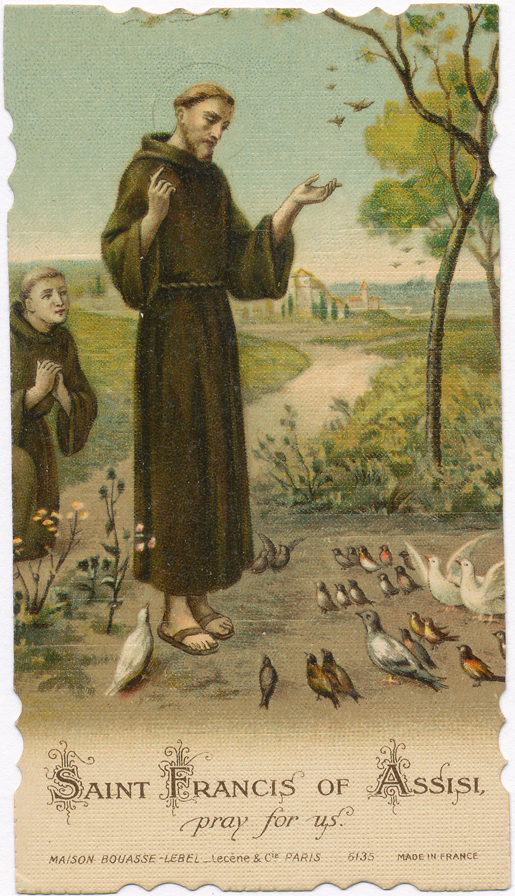
St. Francis of Assisi 1182-1226

“Lord make me an instrument of your peace, where there is hatred let me sow love.”

Love for God and everything in creation so consumed St. Francis of Assisi, that he was able to commune with the natural world on a divine level. Taming wolves, quieting flocks of birds and infusing peace and contentment to the humanity he interacted with, we call on Francis of Assisi to bring us into the harmonious rhythms of the universe, where all of nature and mankind are at one with the divine force of creation.

An unlikely mystic, Francis was born Giovanni Bernadone in the town of Assisi. His father, a proud member of the upper classes was a wealthy cloth merchant married to a woman from Provence. Because he frequently conversed in French with his mother, Giovanni was soon known as “Francesco” or “the Frenchman” by his friends and neighbors. Confident that his son would follow in his footsteps, the elder Bernadone indulged and catered to Francesco’s every whim and the youth enjoyed a pleasure filled existence in the company of others in his social caste. On a lark he set off with friends to take part in a war with Perugia. Much to his shock, he was taken prisoner and it took his family a year to ransom him back. Upon his return, he was bedridden and seriously ill. But in recovering his health, Francesco seems to have lost his identity. He suffered a great spiritual crisis as all interest in his old life and his father’s business waned and disappeared. While wandering the countryside he stopped into the deserted church of San Damiano and heard the crucifix say to him, “Francis, go and repair my house, which you see is falling down.” Happy to have some direction in his life, he took the request literally and began rebuilding the structure with his bare hands. Ultimately, his father disowned him and when Francis, renouncing his inheritance threw his clothing in the street, he donned the simple brown garment given him by the Bishop of Assisi.

Begging for supplies, Francis continued his work on San Damiano. Eventually he was joined by other disenchanted young men looking for a higher meaning in life. By simply following the exact tenets of Christ, this little band of friars, never owning anything, bartering labor for food and shelter began a movement of religious seekers that revolutionized the Church by the simple and loving way they spread the gospel. Instead of writing in church Latin he used colloquial Italian and in an effort to explain the story of Christ’s birth, he created a living tableau of animals and people – the first Christmas crèche.

A great poet and mystic, Francis was the first saint to receive the stigmata while in a meditative rapture. Filled with humility and though he founded one of the world’s greatest religious orders, Francis of Assisi was never ordained a priest. Upon his death he requested to be buried in the cemetery for criminals, but the people of Assisi so loved him that they took his body and interred it under the altar of their great cathedral.

Just as popular with nonCatholics as Catholics, Francis has inspired great artists, composers and writers. Assisi, Italy remains a great pilgrimage site for those wishing to pay him tribute.

Prayer

Lord, make me an instrument of your peace; 
Where there is hatred, let me sow love; 
Where there is injury, pardon; 
Where there is doubt, faith; 
Where there is despair, hope; 
Where there is darkness, light; 
And where there is sadness, joy. 
O Divine Master, 
Grant that I may not so much seek 
To be consoled, as to console; 
To be understood, as to understand; 
To be loved, as to love; 
For it is in giving that we receive, 
It is in pardoning that we are pardoned, 
And it is in dying that we are born to Eternal Life. 
Amen. 
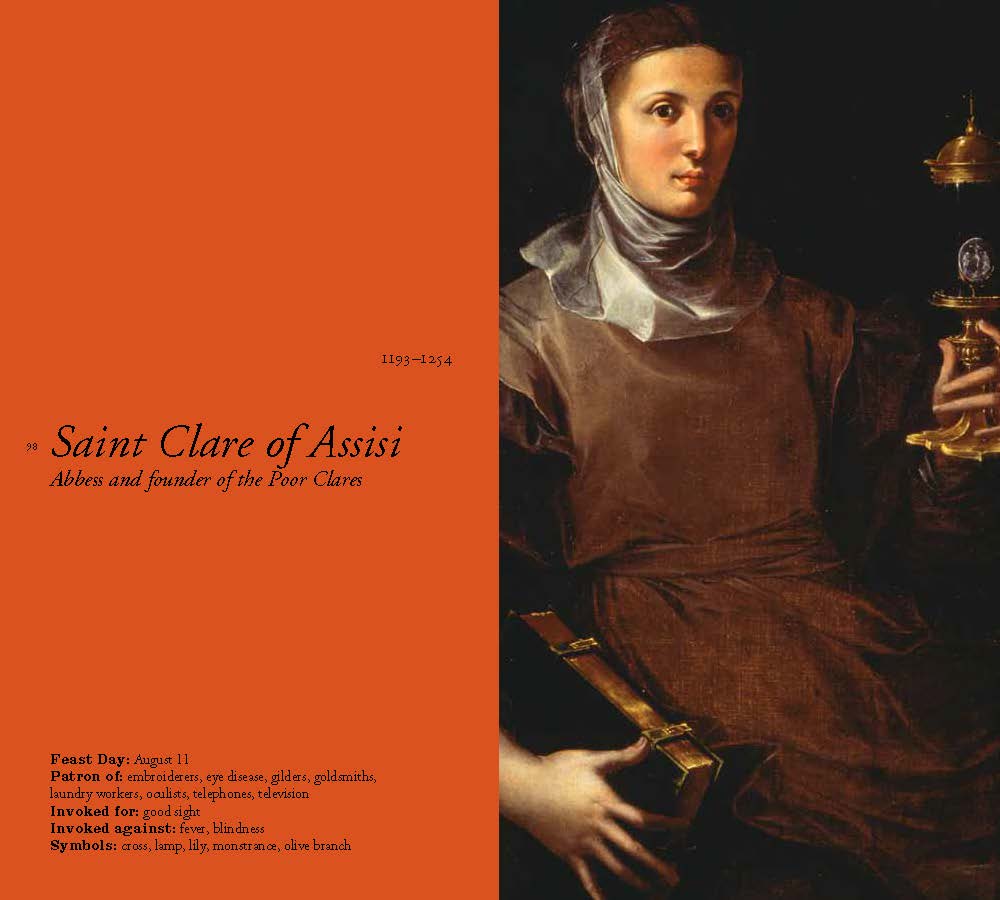
St. Clare 1193-1254

Feast Day August 11

Mystic

Together with her mentor and friend, Francis of Assisi, St. Clare shook the foundations of Medieval society by revolutionizing religious expression. Her given name, Chiara means clarity and we call on St. Clare whenever we need to shine a light on a situation or to find a way to communicate more clearly. She is also invoked to protect the blind and to help those with eye trouble.

Chiara Offreduccio, as the beautiful daughter of minor royalty was offered every worldly advantage available to one in her social class. When she heard St. Francis preach the Lenten service at her church in 1212, his simple message of living with complete trust in God inspired her to abandon going through with her arranged marriage in order to join the Franciscan movement. The first followers of Saint Francis were the wealthy sons of his town of Assisi. Their act of turning their backs on the material world to live at the mercy of the elements and on whatever alms they could beg was disturbing and controversial to both their families as well as to the church authorities. Attracted by the joyous way in which they comported themselves, as well as the enthusiasm they brought to religious worship, Clare was the first woman to join their order.

Fervently believing in a life devoted to the precepts of the gospel, the Franciscans did not believe in personal property. When Clare escaped her family to join them on Palm Sunday, Francis himself cut off her long blond hair and handed her the simple woolen robe worn by his followers. He then left her in the local Benedictine convent as there were no facilities in his order for women. It was not long before her entire family attempted an intervention type rescue of the girl. Revealing her shorn hair to her horrified father made them realize that she would never return to their world. Her younger sister, as well as other wellborn young women from the town soon followed her. In 1215, Saint Francis installed Clare as the Abbess of the Order of Poor Ladies. True to the Rule of St. Francis, they accepted no dowries from their families as other religious orders did. When they were left inheritances, the money was distributed to the poor. Highly intelligent, and known for the efficacy of her prayers, popes, cardinals, royalty and St. Francis himself came to her for spiritual advice. Her own correspondence shows her to be a clever, happy person.

Devoted to the Eucharist and frequently immersed in prayer, the stories of miraculous occurrences around Clare abound. The most famous is that while she was ill, her convent which was outside of the walls of Assisi was attacked by the Saracen mercenaries of Frederick II . As the invaders stormed the walls with ladders, Clare calmly held up a monstrance containing the host. A child’s voice emanated from inside the monstrance, “I will always guard and defend you.” A feeling of dread overtook the invaders and they ran away from the town.
St. Clare was named the patron saint of television writers and workers due to a vision she had while too ill to attend Christmas Eve mass. She was able to view and hear the entire mass on the wall of her room. She spent much time embroidering linens for use in mass, so she is the patron of embroiderers. Because that trade is hard on the eyes and because of her name, she is the patron of those with eye problems and the blind.

Novena to St. Clare
O Glorious St. Clare! God has given you the power of working miracles continually, and the favor of answering the prayers of those who invoke your assistance in misfortune, anxiety, and distress. We beseech you, obtain from Jesus through Mary His Blessed Mother, what we beg of you so fervently and hopefully, (mention your petition) if it be for the greater honor and glory of God and for the good of our souls. Amen