
It is said that the year 1830 announced the dawning of the Marian era. Until then, the last Church-sanctioned apparition of Mary was of Our Lady of Guadalupe in Mexico almost three hundred years before. Within that time frame, the entire religious world of western Europe was shaken to its core by the upheaval of the Reformation, Counter-Reformation, and the French Revolution. In France, religious worship was demonized, and the clergy was ostracized as ancient monasteries and artworks were destroyed.
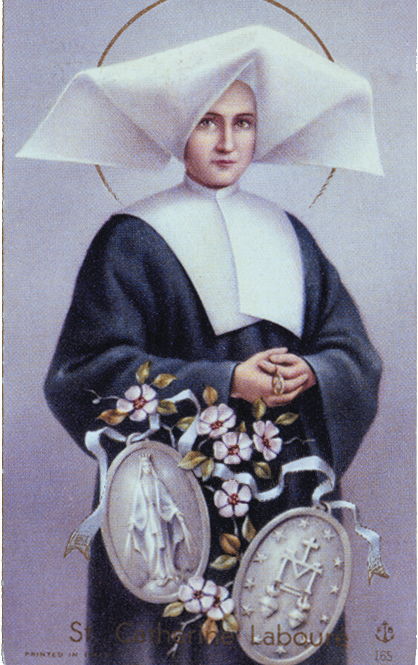
On the night of July 18, 1830, in the Motherhouse of the Sisters of Charity in Paris, a barely literate twenty-four-year-old novice named Catherine Laboure was shaken from her sleep by a beautiful five-year-old boy. Catherine was in her curtained bed in a dormitory with other novices. Shocked at the dazzling garments the child wore, she was certain the other nuns would wake up.
“Catherine,” said the boy. “Come to the chapel; the Blessed Virgin is waiting for you.”
Catherine was too shocked to speak but thought the words, “But I shall be heard.”
The child calmly spoke, “Be calm, it is half past eleven, everyone is asleep; come, I am waiting for you.”
Catherine dressed quickly and followed the child. As they reached the chapel, the door opened at the light touch of his finger. The room was glowing in light as all of the candles were lit as if for Midnight Mass. Catherine knelt to pray.
As it neared midnight, the child said, “Here is the Blessed VirginCatherine heard the rustle of a silk dress and a beautiful woman sat down in the Father Director’s chair next to her. The woman was dressed in an ivory-colored dress with a blue mantle and a white veil covering her head and draping over her shoulders. Her hands radiated beams of light, the color of jewels.
In a much stronger voice, the child said, “Here is the Blessed Virgin.”
Catherine knelt in front of the woman, putting her hands in her lap as she looked into the woman’s eyes. In her own words, Catherine later recounted, “I do not know how long I remained there; it seemed but a moment, but the sweetest of my life.”
When the Virgin Mary spoke, she said, “The good God, my child, wishes to entrust you with a mission. It will be the cause of much suffering to you, but you will overcome this, knowing that what you do is for the glory of God. You will be contradicted, but you will have the grace to bear it; do not fear! You will see certain things; give an account of them. You will be inspired in your prayers. Tell with confidence all that passes within you. Tell it with simplicity. Have confidence. Do not be afraid.”
Mary then went on to relate the misfortunes that were about to befall France and the rest of the world. When Catherine wondered to herself when these things were to happen, “I understood clearly, forty years.”
The Virgin ended the conversation by saying, “Come to the foot of this altar; there, graces will be poured on all those who ask for them with confidence and fervor. They will be poured out on the great and the humble.” And in Catherine’s words, “the Virgin disappeared like a light is extinguished.”
The child then led Catherine back to bed, where she remained awake for the entire night, wondering exactly what her mission would be.
Catherine did not see Mary again until November 27, 1830, which was the Saturday before the first Sunday of Advent. Though she was with other nuns in the chapel at the 5:30 p.m. prayers, Catherine was the only one who saw the apparition. At the point reserved for interior meditation, when the chapel was at its quietest, Catherine heard the sound of the rustling silk.
In her words, “When I looked in that direction, I saw the Blessed Virgin. She was standing, dressed in a white robe of silk, like the dawn, her feet resting on a globe, only half of which I could see. In her hands, held at the level of her breast, she held a smaller globe, her eyes raised towards heaven . . . her face was beautiful, I could not describe it . . . Then suddenly, I saw rings on her fingers, covered with jewels, some large and some small, from which came beautiful rays . . At this moment, when I was contemplating the Virgin, she lowered her eyes and looked at me and an interior voice spoke to me: ‘This globe you see represents the entire world, particularly France . . . and each person in particular.’”
As Catherine marveled at the beauty of the rays of light exuding from Mary, the voice said, “This is a symbol of the graces which I shed on those who ask me.” When Catherine wondered why some of the jewels on Mary were not radiating light like the others, the voice said, “Those jewels which are in shadow represent the graces which people forget to ask me for.” Then the apparition changed, and Mary appeared with a white dress, a blue mantle, and a white veil. She was standing on the globe and had one foot on the head of a serpent that lay at her feet. The year 1830 was marked at the globe’s base. The Virgin’s hands were pointing downward, and a cascade of light rays were falling from her hands onto the globe.
An oval then formed around Mary, and on it were written these words in gold, “O MARY CONCEIVED WITHOUT SIN, PRAY FOR US WHO HAVE RECOURSE TO THEE.”
The same interior voice said, “Have a medal struck after this model. Those who wear it will receive great graces; abundant graces will be given to those who have confidence.”As the voice faded out, the oval turned and Catherine saw what was on the reverse of the medal: The letter M surmounted by a bar and a cross; beneath the M were the hearts of Jesus and Mary, the one crowned with thorns, the other pierced with a sword. Encircling these symbols were twelve stars.
For the next year, Catherine saw this vision six times. Having little contact with the outside world and feeling pressured to complete her mission, she told her spiritual director, Father John Marie Aladel, about the Virgin’s mandate. Just as Mary predicted in the first vision, he did not believe her. As she persisted to repeat her story to him throughout the year, he and Catherine had many stormy disagreements. At his request, she wrote out a detailed report of what happened. At a loss about what to do with this young girl who not only had these visions, but was so insistent upon having this medal struck, Father Aladel visited the archbishop of Paris in 1832. Having a special devotion to the Virgin Mary, the archbishop did not share Father Aladel’s skepticism and he immediately gave permission to create the medal.
In June 1832, fifteen hundred copies of the medal then known as the Medal of the Immaculate Conception were created. By 1836 more than two million medals had been produced. Because of the many stories of cures, wonders, and death-bed conversions attributed to the medal, it gradually became known as the Miraculous Medal.
Catherine Laboure never revealed to anyone but her spiritual director that it was she who received the visions that caused the medal’s creation, and she could never be induced to attend any of the canonical hearings investigating the apparitions. Eventually, this visit of the Virgin Mary was sanctified and officially recognized by the Church based on the miraculous effects of the medals. For the next forty-six years of her life, Catherine nursed the sick and tended the chickens at the Sisters of Charity residence outside of Paris. Her fellow sisters found her “cold and apathetic” and were quite shocked upon learning that it was this obscure, forgettable person whom the Virgin Mary entrusted with her mission. She died on December 31, 1876, and is buried in the convent chapel in Paris, where the Blessed Virgin Mary first appeared to her.
The Symbols on the Medal On the front of the medal, Mary stands alone with her foot crushing the head of a serpent. She is the Victorious Woman of Genesis (Genesis 3:15), where God says to the serpent, “I will put enmities between you and the woman.” In Catholic art, Mary is frequently depicted crushing the head of a serpent that represents Satan. In this way, Mary as the highest developed form of human life is shown triumphing over evil. It is believed that the date 1830 at the base of the medal signifies the advent of the Marian age, when apparitions of Mary were to intensify and become more frequent. Mary is standing on the globe of the world, which gives her spiritual dominion with the title Queen of Heaven and Earth. Brilliant rays of light cascade to earth from Mary’s hand. She is showering the world with grace from God. This is where her titles Mediatrix and Advocate for Humanity come from. She is so filled with God’s grace and love she needs to share it with others. She looks upon all humankind as her children and tries to show them the path to light and God as any mother would. The words around the frame of the medal, “O Mary conceived without sin, pray for us who have recourse to thee,” is a brief prayer in itself. In it we are recognizing Mary’s help in interceding for us with God and the belief that she was the only human creature to ever be conceived without original sin.
The imagery on the back of the medal is equally symbolic. There is a cross on the back with a bar through its base. This symbolizes the foot of the Cross. This bar runs through the letter M, which stands for both Mary and Mother. This signifies that Mary as Christ’s mother stood at the foot of his Cross while he endured his Crucifixion. Beneath the M are two hearts, one with thorns running through it (this is the Sacred Heart of Jesus); and the other with a sword in it (the Immaculate Heart of Mary). One of the Seven Sorrows of Mary predicted by the prophesy of Holy Simeon is “the Mother pierced with a sword of sorrow beneath the cross so that the thoughts of many hearts may be revealed” (according to Luke 2:34–35: “you yourself a sword may pierce”). Because Mary had to endure the great sorrow of watching her only son die a humiliating and tortuous death, many on Earth look to her for comfort in their own troubles. They know that she went through the worst agonies a mother could withstand and triumphed over them. Both hearts are equal in size, and both hearts are inflamed by ardent love. Encircling the cross, the M, and the two hearts are twelve stars. In art, Mary is frequently depicted crowned by twelve stars. It is believed that the Twelve Apostles looked to her quiet devotion and acceptance of her son’s fate for spiritual inspiration. Stars also pertain to the book of Revelation (Apocalypse) as a reference to the “great sign” described as “a woman clothed with the sun, with the moon under her feet, and on her head a crown of twelve stars” (Revelation 12:1). In the Miraculous Medal lie the symbols of Mary’s role in salvation from Genesis to Apocalypse. As the Victorious Woman she is destined to take part in the final defeat of the devil.
The Miraculous Medal is considered a physical manifestation of the gift of grace, which exudes from the Virgin Mary. It is considered Mary’s token reminder that she is always ready to offer assistance.
“Catherine heard the rustle of a silk dress and a beautiful woman sat down in the Father Director’s chair next to her. The woman was dressed in an ivory-colored dress with a blue mantle and a white veil covering her head and draping over her shoulders.“