Invoked for: finding a husband, finding lost articles
Invoked against: debt, shipwreck, starvation
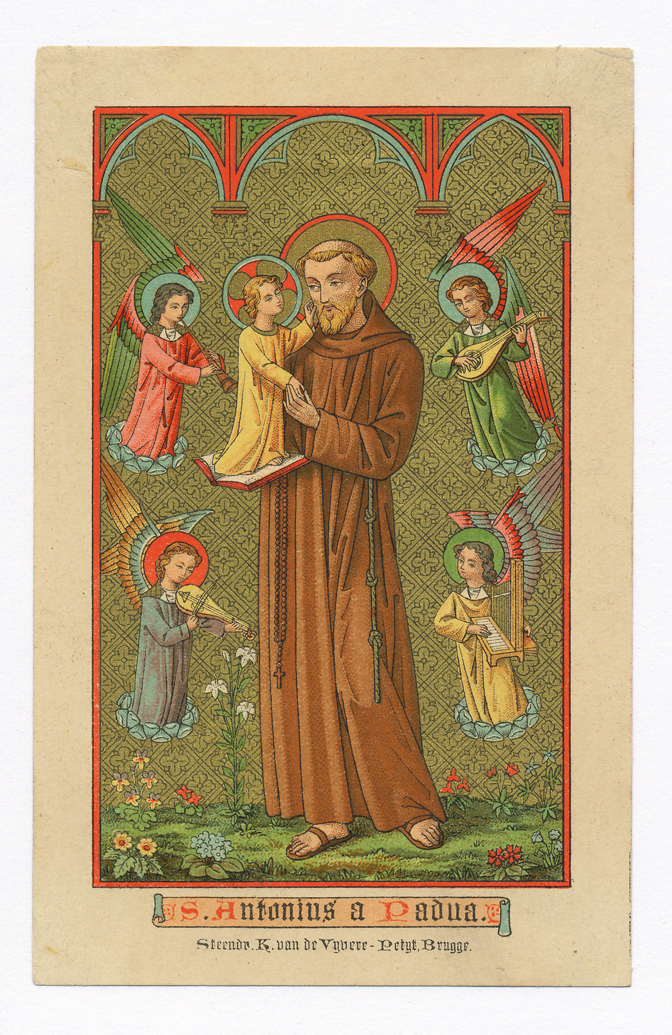
Symbols: baby Jesus, book of Gospels, lily
Wonder and miracles are infused with every story of Saint Anthony. Though he has been dead for almost 800 years, he is still the most popular saint in the world and his statue is found in every Catholic Church. Saint Anthony is best known as the patron saint of lost articles but he is invoked for help in all life situations. In his own day he was called the “Wonder Worker’ and credited with the ability to stop the rain, raise the dead and reattach severed limbs. He was such a charismatic preacher that when a crowd of heretics in Rimini refused to listen to his preaching, the fish raised themselves out of the water to hear him.
Born Fernando de Bulhes in Lisbon, Portugal, he disappointed his noble family by rejecting his luxurious life and joining the Augustinian religious order. A scholar by nature, he read every book in the monastery, devoting his time to contemplative prayer. Eventually, he befriended a group of itinerant Franciscan monks and became fascinated with this new religious order. Much impressed by their dedication to simplicity, poverty and their belief in returning to the original words of Christ, he joined their ranks, changing his name to Anthony in honor of Saint Anthony of the Desert, the patron of their little church. Returning home from a failed missionary venture in Morocco, his ship was blown off course and he wound up in Messina, Sicily. A group of Franciscan friars insisted he go north with them for a great gathering of all Franciscans, with their founder Francis of Assisi.
Anthony remained in Italy and discovered his great gift of preaching when a superior ordered him to speak at an ordination, telling him to say whatever the holy spirit had infused into him. He astonished his audience, not only by his skills as an orator but by the depth of his knowledge. He was sent throughout northern Italy and southern France on evangelical preaching missions which gathered crowds in the tens of thousands. His popularity among the people increased as he used his position to get real changes enacted for their protection. While based in Padua, he observed the crushing power of debt upon the common people. At Anthony’s insistence, the local municipality enacted a law protecting those who could not pay their debts that is still enforced today.
Anthony exhausted himself preaching out in fields and in piazzas as there was not cathedral large enough to hold all who came to hear him. At the age of thirty six, his health began to fail him and a local Count donated a woodland retreat for his recovery. One morning the Count heard the sounds of a baby giggling and he looked out to see Anthony surrounded in light, playing with the baby Jesus. That Christ would choose to appear to one of his saints in such a vulnerable state is a testament to the loving and kind nature of Saint Anthony. Because he is depicted holding a baby, women having trouble conceiving invoke his aid. Being of Portuguese descent, Anthony’s feast day is very auspicious for marriages in Portugal and Brazil and in those cultures, he is known to assist women seeking a husband.
According to legend, Saint Anthony earned the title patron saint of lost articles when a novice borrowed his psalter and failed to return it. Saint Anthony prayed to get it back and the novice was visited by terrifying visions that sent him running back to Anthony with the book. In iconography, Anthony always holds the baby Jesus and a lily for purity. Many times the returned book of the gospels is included.
Novena to Saint Anthony of Padua
Holy Saint Anthony, gentle and powerful in your help, Your love for God and charity for His creatures, made you worthy when on earth, to possess miraculous powers. Miracles waited on your word, which you were always ready to request for those in trouble or anxiety. Encouraged by this thought, I implore you to obtain for me (mention your request here). The answer to my prayer may require a miracle. Even so, you are the saint of miracles. Gentle and loving Saint Anthony, whose heart is ever full of human sympathy, take my petition to the Infant Savior for whom you have such a great love, and the gratitude of my heart will be ever yours.
Amen
It is customary to donate to Saint Anthony’s Bread, a charity started in Saint Anthony’s lifetime, in gratitude to answer novena prayers.
St. Anthony is one of 36 saints you can learn about and pray with on novena app.
On June 13, Catholics honor the memory of the Franciscan priest St. Anthony of Padua. Although he is popularly invoked today by those who have trouble finding lost objects, he was known in his own day as the “Hammer of Heretics” due to the powerful witness of his life and preaching.
The saint known to the Church as Anthony of Padua was not born in the Italian city of Padua, nor was he originally named Anthony. He was born as Ferdinand in Lisbon, Portugal during 1195, the son of an army officer named Martin and a virtuous woman named Mary. They had Ferdinand educated by a group of priests, and the young man made his own decision to enter religious life at age 15.
Ferdinand initially lived in a monastery of the Augustinian order outside of Lisbon. But he disliked the distraction of constant visits from his friends, and moved to a more remote house of the same order. There, he concentrated on reading the Bible and the Church Fathers, while living a life of asceticism and heartfelt devotion to God.
Eight years later, in 1220, Ferdinand learned the news about five Franciscan friars who had recently died for their faith in Morocco. When their bodies were brought to Portugal for veneration, Ferdinand developed a passionate desire to imitate their commitment to the Gospel. When a group of Franciscans visited his monastery, Ferdinand told them he wanted to adopt their poor and humble way of life.
Some of the Augustinian monks criticized and mocked Ferdinand’s interest in the Franciscans, which had been established only recently, in 1209. But prayer confirmed his desire to follow the example of St. Francis, who was still living at the time.
He eventually obtained permission to leave the Augustinians and join a small Franciscan monastery in 1221. At that time he took the name Anthony, after the fourth-century desert monk St. Anthony of Egypt.
Anthony wanted to imitate the Franciscan martyrs who had died trying to convert the Muslims of Morocco. He traveled on a ship to Africa for this purpose, but became seriously ill and could not carry out his intention. The ship that was supposed to take him to Spain for treatment was blown off course, and ended up in Italy.
Through this series of mishaps, Anthony ended up near Assisi, where St. Francis was holding a major meeting for the members of his order. Despite his poor health, Anthony resolved to stay in Italy in order to be closer to St. Francis himself. He deliberately concealed his deep knowledge of theology and Scripture, and offered to serve in the kitchen among the brothers.
At the time, no one realized that the future “Hammer of Heretics” was anything other than a kitchen assistant and obedient Franciscan priest. Around 1224, however, Anthony was forced to deliver an improvised speech before an assembly of Dominicans and Franciscans, none of whom had prepared any remarks.
His eloquence stunned the crowd, and St. Francis himself soon learned what kind of man the dishwashing priest really was. In 1224 he gave Anthony permission to teach theology in the Franciscan order – “provided, however, that as the Rule prescribes, the spirit of prayer and devotion may not be extinguished.”
Anthony taught theology in several French and Italian cities, while strictly following his Franciscan vows and preaching regularly to the people. Later, he dedicated himself entirely to the work of preaching as a missionary in France, Italy and Spain, teaching an authentic love for God to many people – whether peasants or princes – who had fallen away from Catholic faith and morality.
Known for his bold preaching and austere lifestyle, Anthony also had a reputation as a worker of miracles, which often came about in the course of his disputes with heretics.
His biographers mention a horse, which refused to eat for three days, and accepted food only after it had placed itself in adoration before the Eucharist that Anthony brought in his hands. Another miracle involved a poisoned meal, which Anthony ate without any harm after making the sign of the Cross over it. And a final often recounted miracle of St. Anthony’s involved a group of fish, who rose out of the sea to hear his preaching when heretical residents of a city refused to listen.
After Lent in 1231, Anthony’s health was in decline. Following the example of his patron – the earlier St. Anthony, who had lived as a hermit – he retreated to a remote location, taking two companions to help him. When his worsening health forced him to be carried back to the Franciscan monastery in Padua, crowds of people converged on the group in hopes of paying their homage to the holy priest.
The commotion surrounding his transport forced his attendants to stop short of their destination. After receiving the last rites, Anthony prayed the Church’s seven traditional penitential psalms, sung a hymn to the Virgin Mary, and died on June 13 at the age of 36.
St. Anthony’s well-established holiness, combined with the many miracles he had worked during his lifetime, moved Pope Gregory IX – who knew the saint personally – to canonize him one year after his death.
“St. Anthony, residing now in heaven, is honored on earth by many miracles daily seen at his tomb, of which we are certified by authentic writings,” proclaimed the 13th-century Pope.
A poem celebrating devotion to St. Anthony
a barefoot contessa walking down Mulberry Street
wearing the robe of Saint Anthony
the brown of the robe, two shades darker then her brown sicilian skin
a white thick rope around her waist, knotted at the end,
a rosary draped around her hands, the cross hanging at the end she was one of many, in this sea of brown,
lips moving with silent prayers
and how they formed me
she had green eyes, what visions were forming?
and how they formed me
in silence, not a word spoken
her stories were ancient, stone slabs and sand
celebrating with two lilies in a vase, a reminder
and how they formed me
she was unlike her sisters, they had voices, loud voices
my mother, my aunt, my other aunt
they had modern stories, cigarettes and cat-eye glasses
dresses made to order, nightclubs and frank sinatra
The Order of Cistercians of the Strict Observance (also known as “Trappists”) is a Roman Catholic contemplative religious order, consisting of monasteries of monks and monasteries of nuns. We are part of the larger Cistercian family which traces its origin to 1098. As Cistercians we follow the Rule of St Benedict, and so are part of the Benedictine family as well. Our lives are dedicated to seeking union with God, through Jesus Christ, in a community of sisters or brothers.
Early Monasticism
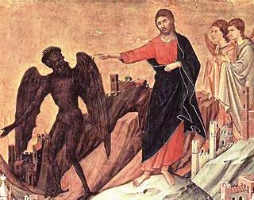
Jesus in the desert
The concept of monasticism is ancient and is found in many religions and philosophies. In the centuries immediately before Christ, Hinduism, Buddhism, and Judaism all developed alternative styles of life which involved renouncing the world in some ways, in order to seek liberation or purification or union with God, sometimes as a solitary ascetic, sometimes in community.
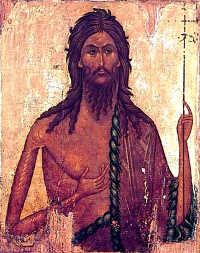
Early Christian monasticism drew its inspiration from the examples of the Prophet Elijah and John the Baptist, who both lived alone in the desert, and above all from the story of Jesus’ time in solitary struggle with Satan in the desert, before his public ministry. Beginning with the Exodus and all through the Old Testament times, the desert was regarded as a place of spiritual renewal and a return to God. Although there were ascetics, especially women ascetics, among the first generations of Christians, they generally lived in the towns and cities.
St John the Baptist
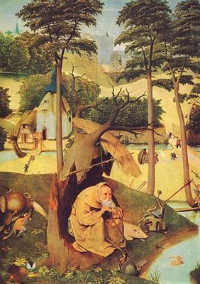
St. Anthony the Great (ca. 251-356) was the first well-known Christian to withdraw to the desert. According to the Life of Anthony written by St Athanasius in the mid fourth century, Anthony retreated to the wastelands of Egypt to lead an intensely ascetic life with the sole purpose of pursuing God in solitary prayer. He remained alone until his holiness and evident wholesomeness attracted a growing circle of followers. So deep was his influence that he is considered the father, not only of the movement of Desert Fathers and Mothers of fourth – fifth century Egypt, but also the father of the entire Christian monastic family.
St Anthony While the earliest Desert Fathers lived as hermits, they were rarely completely isolated, but often lived in proximity to one another, and soon loose-knit communities began to form in such places as the Desert of Nitria and the Desert of Skete. The progression from hermit (“anchorite”) to monk (“cenobite”) living in community under one abbot, came quickly, when in 346 St Pachomius established in Egypt the first cenobitic Christian monastery.
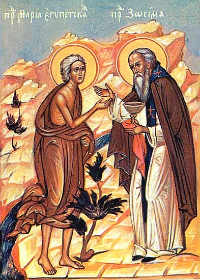
Mary of Egypt
The Eastern monastic teachings were brought to the western church by Saint John Cassian (ca. 360 – ca. 435). As a young adult, he and his friend Germanus entered a monastery in Palestine but then journeyed to Egypt to visit the eremitic groups in Nitria. Many years later, Cassian founded a monastery of monks and probably also one of nuns near Marseilles, and partly to counter what he felt were the abuses he found in Western monasticism, he wrote two long works, the Institutes and Conferences. In these books he not only transmitted his Egyptian experience (they are perhaps the oldest written record of the thought of the Desert Fathers), but he also gave Christian monasticism a profound evangelical and theological basis.
Cassian’s influence was enormous and lasted for centuries – even the smallest monastic library in Europe’s Dark Ages would have its copy of Cassian. Furthermore, St. Benedict incorporated Cassian’s thought into his monastic Rule, and recommended that his monks read Cassian’s works. Since the Rule of St Benedict is still used by Benedictine, Cistercian, and Trappist monastics, the thought of John Cassian, and the desert tradition behind him, still guides the spiritual lives of thousands of men and women in the Catholic Church.
The fear of the Lord is our cross. Just as someone who is crucified no longer has the power of moving or turning his limbs in any direction as he pleases, so we also ought to fasten our wishes and desires, not in accordance with what is pleasant and delightful to us now, but in accordance with the law of the Lord, where it hems us in. Being fastened to the wood of the cross means: no longer considering things present; not thinking about one’s preferences; not being disturbed by anxiety and care for the future; not being aroused by any desire to possess, nor inflamed by any pride or strife or rivalry; not grieving at present injuries, and not calling past injuries to mind; and while still breathing and in the present body, considering oneself dead to all earthly things, and sending the thoughts of one’s heart on ahead to that place where, one does not doubt, one will soon arrive…
One person on earth for one forgotten soul in purgatory!
Lets remember!
O merciful God, take pity on those souls who have no particular friends and intercessors to recommend them to Thee, who, either through the negligence of those that are alive, or through length of time are forgotten by their friends and by all.
Spare them, O Lord, and remember Thine own mercy, when others forget to appeal to it. Let not the souls which Thou has created be parted from Thee, their Creator. They are Thy work, and though they have sinned, they have been redeemed by Thee.
Vouchsafe, therefore, to look upon them and to deliver them from the intolerable pain of absence from Thee; the light and love of all Thy creatures. Oh! place them in the number of Thy blessed Saints and citizens through Jesus Christ their Savior. Amen.
In this fascinating, candid interview, Sister Mary Catharine, OP, takes Regina Magazine on an intimate journey through the life of a thriving cloistered community of Dominican nuns.
Q. Where is your Order? How long has it been there?
Our Monastery of our Lady of the Rosary is in Summit, New Jersey, a bedroom community of New York City and a quick 52 minute train ride from the city.
Summit is a very Catholic city with a small town feel. We began our monastery 94 years ago in 1919. Summit was considered a healthy place to live away from New York. It was touted as the “Denver of the East” for its high altitude!
Q. Can you tell us a bit about its founding? About the Dominicans in general — brief history?
The Nuns of the Order of Preachers were founded by St. Dominic and his bishop, Bishop Diego in 1206, ten years before the friars. So, we are their elder sisters!
Actually, St. Dominic never planned to found anything. Stunned by the Albigensian heresy rampant in southern France he began preaching to bring the people back to the truth.
The Albigensian hersey was based on a dualist god: the god of spirit (the “good” god) and the god matter (the “evil” god). Because of their austere way of life the heretics attracted many people. Converting these people back to the Catholic Faith was not easy.
A group of women, used to living the austere life of the heretics, converted to the Faith through the preaching of St. Dominic. A man of great compassion, St. Dominic saw that he now needed to take care of their physical needs.
Many of these women were disowned by their heretic families and had no place to live. So, he gathered them together at a little abandoned church, Notre Dame du Prouilhe and gave them a habit, rule of life, etc. They were desperately poor and St. Dominic would beg for them.
From the very beginning these first moniales were associated with the Order through their prayer and penance. In fact, the first monastery itself was called “the Holy Preaching” which is a powerful testimony to the witness of monastic-cloistered life.
The early nuns were called the Sister Preacheresses although they were cloistered and never went out to preach! The vocation of a Nun of the Order of Preachers is unique because we are fully monastic and contemplative but part of an evangelical and apostolic Order. One has to have a deeply apostolic heart yet find its expression not in the apostolate but in a life of hidden prayer.
Q. Tell us about the famous St. Dominic
For the first 10 years St. Dominic preached almost entirely alone in southern France. He had companions for a while but then they left. I’m sure he received great comfort in having the monastery as his “home base.”
St. Dominic would preach all day and pray all night. We know from the testimonies of the early friars that he wasn’t a quiet person when he prayed! He would groan and shed copious tears. He would cry out, “O Lord, what will become of sinners!”
His life of prayer and preaching is lived out in the Order by the Friars and Nuns in a complementary way: the friars go out to preach while the nuns carry within the innermost sanctuary of their compassion all sinners, the downtrodden and the afflicted. Like Esther, they go before the King pleading for the salvation of all. Like Moses, they raise their arms in prayer while the battle rages below.
What is commonly not known is that the friars and the nuns are united not just spiritually but juridically through our profession of obedience to the Master of the Order. Together we form the Order of Preachers. We have distinct but complimentary ways of expressing the Order’s mission to “preach for the salvation of souls”.
Q. What is a contemplative’s life like?
To answer this question fully would take several books and at the same time it can’t really be expressed!
I think the first word that comes to mind is JOY. Not that there aren’t hardships as in any vocation but through it all there is a deep abiding joy because I am totally consecrated to God to love and praise Him. The contemplative vocation is a gift beyond words and one for which I will be thanking God for all eternity!
For Dominican contemplative nuns the Word of God is primary. Our constitutions state that the monastery is to be a place where “the Word of God can dwell abundantly in the monastery.”
So, first we ponder the word through lectio divina and through theological study, we sing Mass and the entire Divine Office; we listen to God’s Word as it is expressed through our sisters.
Q. How is your Order governed?
Our manner of government is ordered so that our fraternal life can be “one mind and heart in God”. This means we come together as a chapter to discuss things so we can make a decision that is truly centered in God and not just what I want. This isn’t always easy. It requires that we listen to our sisters and that we be willing to be changed. We have to allow grace to be operative in us. The goal is not majority rule but consensus.
Q. What is your work and daily life like?
Our life is intensely liturgical. Holy Mass and the Office shape our day. Everything else is fitted in around it. So, with liturgical prayer, private prayer and our privileged hours of the “adoring Rosary, which is praying the Rosary before the Blessed Sacrament exposed in the monstrance we have about 5 to 6 hours of prayer each day.
Our work is simple, like that of Our Lady at Nazareth. We do the cooking, cleaning, sacristy, laundry, answer the mail, pay the bills, the garden, soap department, etc. Young women are always surprised at how full our days are. You go to bed tired at night!
During recreation times we like to just be together to talk, play games, go for a walk. There is a lot of laughter. Someone once said that our recreations are “high energy!”
Q. Many people, if asked, would probably guess that living in a cloister is very limiting. Is this true?
The cloister frees us immensely! One of the biggest fears in those discerning a contemplative vocation is that the cloister is seen as squashing freedom but it is just the opposite.
The cloister broadens us. It frees us from so many cares and concerns, even something as simple as not minding a stain on my scapular! This freedom isn’t from things so much as for something, really for Someone!
The enclosure is the ‘Garden Enclosed’ of the Song of Songs. Our life is entirely centered on Christ our Spouse alone. Papal enclosure is a great gift of the Church that allows us to live our contemplative life well.
When I have to leave the enclosure for something necessary I am always so glad to be back. The world is so noisy, both audibly and visually. I really don’t understand how people stay sane!
Q. Your Order never gave up their habits. Do you think this has affected your stability, as compared to other orders that did?
I entered long after the upheavals of the 60’s but I have never heard either the nuns or the friars even question whether we should give up the habit. The habit is our Blessed Mother’s gift to us and we treasure it dearly.
Actually Dominicans consider only the scapular as the habit and is the only part blessed. Well, the cloistered nuns also have their veil blessed during a beautiful part of the Solemn Profession rite called the Blessing and Imposition of the Veil. The veil is blessed and then the prioress solemnly veils the newly professed. It’s very beautiful.
Every nun in the world wears the habit! There might be slight variations of hem height, sleeve width, veil style but we all wear the habit. Get a group of nuns together at a meeting and eventually we’ll be asking each other the important question: “Where do you get your fabric from?” The habit is a non-issue.
Q. So where does the stability come from?
I think our Order’s stability comes first from a tremendous gift of God. We are nearly 800 years old and we have never had a division. We’ve come close but it hasn’t happened. There is only one Order of Preachers. One constitution for the friars: one constitution for the nuns.
Do you realize what a gift of God’s love this is? In his address to the Poor Clare nuns at Assisi, Pope Francis emphasized that the devil wants to destroy a community by causing division. The Order of Preachers from the very beginning has had a great devotion to our Lady and I think it is her protection that has kept us united.
Although St. Dominic died just five years after the Order was founded he left us with such a remarkable charism and form of government that it has shaped the Order these 800 years. Our manner of government is crucial to our stability. And most of all the preaching mission of the Order is perennial for each generation and time. One of the wonderful things about being such an old Order is that we’ve made every mistake in the book but we trust in God’s mercy and that of our sisters and brothers.
Q. How are your vocations doing?
In the past eight years we’ve had twelve postulants enter and seven have persevered so far. This is such a blessing. Our young sisters come from several countries and all over the USA. Each sister is so different!
Q. Can you tell us some recent vocation stories?
Our Sr. Mary Magdalene of the Immaculate Conception, O.P. is a native of Kansas and in college was part of the party scene. One night she lay in bed and realized that if she continued along this path she would die. It was a moment of grace when she says she was given the opportunity to choose. Gradually, she began attending Mass at the Newman Center at college that had a holy and dynamic priest.
One day she told him she thought she had a religious vocation; an idea that terrified her. At his suggestion she visited a Carmelite monastery nearby to experience cloistered life which she didn’t even know existed. At the end of her weekend she said, “These nuns are crazy and I think I might be as crazy as they are!”
She began a 54 day rosary novena and made the total consecration to Our Lady according to St. Louis de Monfort which was a source of great grace as well. She wrote to many monasteries and became attracted to the Dominican charism. About the same time the Newman Center at college received the total 10 tickets for the state of Kansas for the Papal Mass of Pope Emeritus Benedict at Yankee Stadium, NYC. This was in 2008. Because this was considered the official Mass of the Holy Father’s visit to the United States every diocese in the country received a certain number of tickets. As you can imagine the further west, the fewer tickets!
She wrote to our monastery asking if she could visit and in her less than 24 hour visit and on the 57th Day of her Rosary Novena she knew that this was the place God was calling her. She is now preparing for Solemn Profession next year.
Q. How do you sustain your life, financially?
We are mendicant and dependent on Divine Providence. God always provides and we have many wonderful friends and benefactors. Whenever there is a needed repair the Lord provides with unexpected resources and it can be done! God is so good to His spouses!
We also have a small business selling the soaps, creams, lip balms, room sprays, candles, woodcraft we make and books we publish. Mostly this is through the internet and the monastery’s tiny gift shop although we have some wholesale customers as well, mostly Catholic gift shops, retreat centers, etc.
Q. How did the idea for a soap and candle business come about?
We have a guild of about 70 volunteers who help us by serving as receptionist, drivers, etc. and every year we make a little Christmas gift for them. For some reason, lost in time, it’s the novice mistress’s responsibility to take care of this and someone suggested soap to me. Seven years ago, one Sunday afternoon in August I spent time searching the internet about how to make soap and learned a lot!
At about the same time our daily offerings were really down—sometimes receiving no more than $5 a day—and we had just received 4 postulants so our healthcare insurance really went up! We began selling our soap in the gift shop. We were going to have only 5 varieties. That lasted about 6 weeks. We now make hand crème and lip balms using our own formula, room sprays and now candles.
We are a relatively young community. I think our average age is about 47, so that means we have a large healthcare insurance expense. Since, unlike the active sisters, we don’t teach or bring in a paycheck, the small income from our Seignadou Soaps has proved to be very helpful toward meeting those costs.
Q. Who is your chief soap-maker?
Right now the novitiate sisters are assigned the work of the soap room. When a postulant enters she gradually learns all aspects of it. Although there may be sisters who are more “expert” than others, tomorrow another may be given the assignment of learning the craft while the “expert” is assigned to another job in the monastery.
It works out well because the soap room is only busy at certain times of the year. The sisters in the novitiate have formation classes and that is the priority.
Q. What kind of people come to pray at your chapel?
People from all walks of life come to our chapel. The doors are open from 6AM, when we pray Lauds, until about 7PM at night and everyone is welcome. All day people come to be with our Lord. Some are regulars who come daily and spend hours. We have several “rosary groups” who use our chapel on certain days. For example, we have mother-daughter group that prays the Rosary every 1st Thursday of the month. Other groups schedule a time to visit our chapel.
Some people come to our monastery to purchase our Seignadou Soap products and find that we have a chapel open all day long. Amazed, they ask, “You mean I can come and pray here?” We never thought of soap as a means of evangelization!
Q. Why else do they come?
We’re not only a monastery but a shrine, the first shrine in the USA to our Lady of the Rosary. But we’re not a touristy type shrine. The focus is on spending time with Jesus in the Blessed Sacrament, which is exposed every day and three nights a week.
We also have a replica of the Shroud of Turin that dates back to 1624. It was commissioned by the Duchess Maria Magdalena, the wife of Cosmo di Medici. It was laid on the real Shroud and the story goes that the stain on our shroud copy appeared when it was lifted up from the Shroud.
In 1988 a team of scientists did a “dry run” on our shroud copy in preparation for their testing on the real Shroud and they did some tests of the side wound stain on our copy. They said that the DNA was the same on both. Our shroud copy in our chapel is the source of much devotion for many people who visit and that is even more important.
Q. I’ve heard that the beauty of your liturgy is quite a draw.
Our liturgy draws people to our monastery. It’s not unusual for someone to call up to ask the times for when “the nuns do the singing”. Often someone else has told them about the beauty of our chant.
We have a dear friend who is Jewish and an artist. One evening she was worried about some family problems. She decided to visit the chapel on the advice of a Catholic friend. She heard us singing Vespers behind the grille and was so taken by the beauty of the chanting that she contacted us and eventually did a trilogy of books featuring the monastery as seen through her artwork.
Often, at Rosary and Sext at 11:30 PM or Office of Readings and None at 3:00 PM, it’s not unusual to see 10-15 people in the extern chapel. We’re happy they join us for the Office as we believe that this is the most important gift we can give to people—the opportunity to simply BE with Jesus who is here for us 24/7!
Our monastery is situated on a hill in a city called Summit. Like our father, St. Dominic we are meant to radiate the light of Christ. Not in words but in with our life. Eight hundred years later, we are still Sister Preacheresses, still a Holy Preaching!
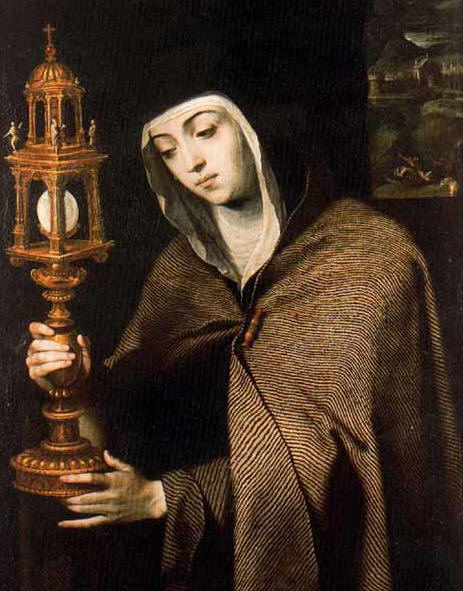
The mysterious world of being a Poor Clare. Contemplative nuns who live a life of prayer, community and joy.
The first thing you need to know is that a Poor Clare is a nun – meaning that she lives in one monastery (usually) for her whole life. She takes solemn vows that can only be dispensed by Rome. BUT the second thing you have to know – is that a Poor Clare Nun is not a Benedictine, Dominican, Visitation or Carmelite nun. She is a Poor Clare nun.There is a world of difference between these other beautiful orders and Poor Clares. NO, not all nuns are alike.
Each Poor Clare community is autonomous. Not all Poor Clares dress alike, work alike or keep the same daily schedule. If you go from monastery to monastery you will feel the spirit of Joy and Communal gifting of each other – you will experience the warm bond of Joy, Simplicity and happiness of being a Franciscan. BUT you will always notice a difference and know you are in a different monastery. Poor Clares Monasteries are individual and unique as is each sister in them. So please… in your journey of exploring the joyful world of Poor Clares – there is no “template” for what a Poor Clare should look like, sound like and be like. Because there are no two alike.. and that is how the Holy Spirit works.
The Poor Clare Sisters number over 20,000 sisters throughout the world in 16 federations and in over 70 countries. Most monasteries have from four to thirteen members. Some have larger communities but the Poor Clare charism is one of family and St. Clare guided us that small communites were much better to keep this family spirit than larger ones. So when a community gets to a certain number we usually start new ones rather than just keep getting bigger. Just one of the differences you will see as you walk with us.
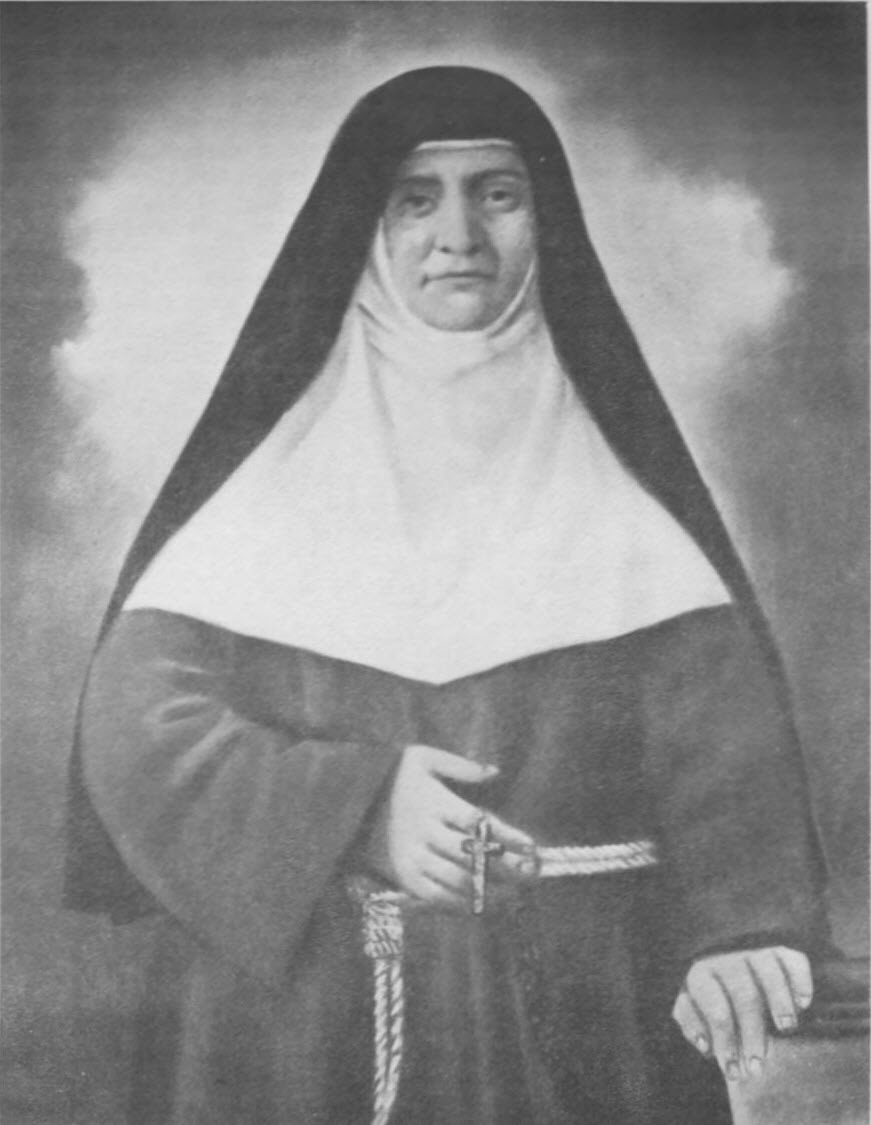
Mother Mary Maddelena Bentivoglio of the Sacred Heart of Jesus 1834-1905
Countess Anna Bentivoglio was a climber! From the age of five when she climbed onto a ledge in great St. Peter’s in Rome (to the horror of Count and Lady Bentivoglio!), to later life. This was the aim of her life – to climb – she would do so physically and spiritually.
Her yearning for religious life began when she followed her sister, Constance, into the Poor Clares. She longed for more austerity and asked for special penances. Then Pope Pius IX commissioned the two Bentivoglio sisters – Mother Magdalen and her sister Constance – to go to America. They first moved to Marseilles, France, were incorporated into the Poor Clares of the Primitive Rule, then on to the “New World”, arriving on Columbus Day, October 12, 1875. The first established monastery of the Order of Saint Clare was in Omaha, Nebraska, in 1878.
Following her example, today’s Poor Clares endeavor to follow this spiritual climber as they live out their daily life in simplicity and joy.
A Day in the Life
Our life is structured around an horarium, a rhythm of prayer throughout the day. The specific times of prayer are marked by the ringing of the bells, which symbolize the voice of God calling us to prayer. The Divine Office (also known as the Liturgy of the Hours), the Mass and the Eucharistic Adoration are the main framework around which our life of prayer revolves. It also includes manual labor, duties and community recreation which give balance to our times of prayer. In this rhythmic exchange of prayer, labor, and rest, we are liberated from the distractions of the world, free to dedicate our entire selves to living the Eucharistic Mystery.
We daily devote ourselves wholly to God alone:
by daily and personal conversion to the Gospel
by offering loving adoration, praise, and thanksgiving to God on behalf of all people
by our efforts to live and work contemplatively and to deepen our union with God in times of silence and solitude
by our intercessory prayer for the Church and all people,
by our efforts to love and serve our Sisters in true Community
by extending spiritual and material assistance to others in ways compatible with our contemplative life
by showing Sisterly hospitality and care to those who come to our monastery and in our relations with all persons
This is our cherished gift and call from our gracious God for which we are deeply grateful.
Horarium
5:15 AM Wake up—Rise and Shine!
6:00 AM Meditation
6:30 AM Morning Prayer followed by Mid-Morning Prayer Breakfast Work
9:00 AM The Holy Sacrifice of Mass—Prayer of Thanksgiving is made privately Office of Readings—On Sundays we move this to 11:30 and combine it with Mid-Day Prayer
10:15 AM Work for fully Professed Sisters Class and/or Work for Formation Sisters
11:45 AM Mid-Day Prayer
12:00 PM Dinner in Silence followed by dishes Recreation at table on Sundays and Thursdays Free time or Work
3:00 PM Mid-Afternoon Prayer followed by Divine Mercy Chaplet Work for fully Professed Sisters Class and/or Work for Formation Sisters
4:30 PM Evening Prayer followed by Communal Rosary—this becomes our Holy Hour for vocations for our Monastery on Fridays throughout the year and on Sundays in Lent and Advent
5:30-6:45 pm Supper in Silence followed by Dishes with Community Recreation on Mondays and Tuesdays Ongoing Formation for the solemnly Professed Sisters on Thursdays; Otherwise directly to Night Prayer
6:45 pm Night Prayer followed by personal time. On Sundays we have an optional movie recreation following this On Tuesdays and Thursdays we have our nocturnal adoration
9:30 pm Be in your rooms
10:00 pm Grand Silence and lights out—Good night sleepyheads!
*Each Sister is privileged to have one hour of adoration a day, an hour of nocturnal adoration twice a week, and adoration during a meal time each week.
Like Elizabeth Ann Seton, Rita of Cascia was a wife, mother, widow, and member of a religious community. Her holiness was reflected in each phase of her life.
Born at Roccaporena in central Italy, Rita wanted to become a nun but was pressured at a young age into marrying a harsh and cruel man. During her 18-year marriage, she bore and raised two sons. After her husband was killed in a brawl and her sons had died, Rita tried to join the Augustinian nuns in Cascia. Unsuccessful at first because she was a widow, Rita eventually succeeded.
Over the years, her austerity, prayerfulness, and charity became legendary. When she developed wounds on her forehead, people quickly associated them with the wounds from Christ’s crown of thorns. She meditated frequently on Christ’s passion. Her care for the sick nuns was especially loving. She also counseled lay people who came to her monastery.
Beatified in 1626, Rita was not canonized until 1900. She has acquired the reputation, together with Saint Jude, as a saint of impossible cases. Many people visit her tomb each year.
Like Elizabeth Ann Seton, Rita of Cascia was a wife, mother, widow, and member of a religious community. Her holiness was reflected in each phase of her life.
Born at Roccaporena in central Italy, Rita wanted to become a nun but was pressured at a young age into marrying a harsh and cruel man. During her 18-year marriage, she bore and raised two sons. After her husband was killed in a brawl and her sons had died, Rita tried to join the Augustinian nuns in Cascia. Unsuccessful at first because she was a widow, Rita eventually succeeded.
Over the years, her austerity, prayerfulness, and charity became legendary. When she developed wounds on her forehead, people quickly associated them with the wounds from Christ’s crown of thorns. She meditated frequently on Christ’s passion. Her care for the sick nuns was especially loving. She also counseled lay people who came to her monastery.
Beatified in 1626, Rita was not canonized until 1900. She has acquired the reputation, together with Saint Jude, as a saint of impossible cases. Many people visit her tomb each year.
Reflection
Although we can easily imagine an ideal world in which to live out our baptismal vocation, such a world does not exist. An “If only ….” approach to holiness never quite gets underway, never produces the fruit that God has a right to expect.
Rita became holy because she made choices that reflected her baptism and her growth as a disciple of Jesus. Her overarching, lifelong choice was to cooperate generously with God’s grace, but many small choices were needed to make that happen. Few of those choices were made in ideal circumstances—not even when Rita became an Augustinian nun.
Pope Francis passed away on April 21, 2025, at age 88, and the Jesuit Conference joins people around the world in mourning. May he rest in the peace of Christ.
Born in Buenos Aires, Argentina, on December 17, 1936, Jorge Mario Bergoglio entered the Society of Jesus on March 11, 1958, and was ordained a priest on December 13, 1969. As a Jesuit, he served as novice master, a theology professor and provincial of the Jesuits in Argentina (1973-1979).
Undated photo of Fr. Jorge Mario Bergoglio , SJ (Jesuit Curia)
He was named auxiliary bishop of Buenos Aires in 1992 and archbishop in 1998. Pope Saint John Paul II elevated him to the College of Cardinals in 2001. On March 13, 2013, Jorge Mario Bergoglio was elected pope, making him the first Jesuit pope and the first pope from the Americas and the Southern Hemisphere. Read his full obituary at America magazine.
Below, read a statement from Fr. Brian Paulson, SJ, president of the Jesuit Conference of Canada and the United States, on Pope Francis’ passing:
I join the countless people around the world who are mourning the death of the Holy Father Pope Francis at this hour. I pray for the repose of his soul and for the consolation of his family, friends and brother Jesuits. While more thorough reflections and examinations of Pope Francis’ legacy will be published in the coming weeks and months, I wanted to offer this brief expression of gratitude for the Holy Father’s extraordinary life of service to God’s people, energized by the love of Christ.
First and foremost, Pope Francis was a pastor. He consistently encouraged bishops, priests and all church ministers to meet people wherever they are in their life journeys, in messiness and complexity and ambiguity, and to help them grow in holiness. The Holy Father’s witness as a shepherd “with the smell of the sheep” from closeness to those on the peripheries of the church and society always inspired and challenged me in my own priestly ministry.
Pope Francis met refugees at Centro Astalli’s soup kitchen in Rome in 2013. (Jesuit Refugee Service)
And Pope Francis indeed went to the peripheries time after time: His first official trip outside of Rome as pope was to visit the Mediterranean island of Lampedusa, a common entry point to Europe for migrants, to pray and advocate for those who had left their homes and risked their lives in pursuit of a better future. He washed the feet of prisoners at Holy Thursday liturgies. He directed the construction of showers for the homeless in St. Peter’s Square. And he appointed cardinals from regions on the planet that had never seen a cardinal named there before — the Amazon, the Philippines, South Sudan, Myanmar and more. These decisions and hundreds of similar ones made headlines so often during Francis’ papacy that it’s easy for us to take them for granted, but let us not forget how much his boldness surprised us. I believe Pope Francis will always be remembered for how he brought marginalized individuals and communities to the heart of the church.
Pope Francis with Father General Arturo Sosa, SJ (Jesuit Curia)
I also believe future appreciations of Pope Francis’ leadership will reflect the ways his reforms in church governance, the roles of the laity, and the social engagement of the church in service to the world were rooted in the teachings of Vatican II. The “Francis Project,” as it has sometimes been called, was not his own personal vision alone, but one formed by his experiences as a leader in the Latin American church in the decades following the Council.
The distinctly Ignatian influence on Pope Francis’ ministry was also unmistakable. In listening to Pope Francis and reading his writings, it is clear to me how much his thought was marked by the Spiritual Exercises of St. Ignatius. The Spiritual Exercises are a “school of the heart” that help a retreatant to grow in self-knowledge of their gifts, weaknesses and sinfulness while meditating on the life, death and resurrection of Jesus. Ignatian spirituality is extraordinarily practical; it engages our own hopes, desires, dreams, struggles, joys and sorrows. In works like “Evangelii Gaudium” and “Laudato Si’,” just to name two, Pope Francis offered his own “school of the heart” meditations, inviting all believers to find the joy of the Gospel within their everyday lives and to commit to responding to “the cry of the Earth and the cry of the poor” as an integral, concrete part of discipleship.
Fr. Brian Paulson, SJ, with Pope Francis
In recent years, the Synod on Synodality emerged as a signature moment of Pope Francis’ outreach toward the peripheries, calling the universal Catholic Church to live a deeper and more inclusive process of listening that includes the voices of all stakeholders. I pray this new mode of dialogue and decision-making continues to develop and take root in the church in the years to come.
Before all else, the Gospel invites us to respond to the God of love who saves us, to see God in others and to go forth from ourselves to seek the good of others. -Pope Francis
I will close this brief reflection with a quote from “Evangelii Gaudium,” the richness of which will continue to make the document a gift to the church for generations. In the quote, as in the exhortation as a whole, we get a sense of what Pope Francis saw as the heart of the spiritual life. “Before all else,” Pope Francis writes, “the Gospel invites us to respond to the God of love who saves us, to see God in others and to go forth from ourselves to seek the good of others.” Let us honor Pope Francis by trying to follow that advice every day.
May the Holy Father Pope Francis rest in the peace of Christ, his brother and Lord.
Designed and revealed by Mary, the Medal is unique among all medals.
It was almost midnight when St. Catherine Labouré was awakened by a soft voice, whispering, “Sister, sister, sister.” Mysterious events led her to the chapel where the Blessed Mother appeared and sat down near the altar. St. Catherine knelt at her feet, rested her hands in Mary’s lap, looked into her eyes, and had a heart-to-heart conversation with her. Later, St. Catherine would refer to that night as “the sweetest moment of my life.”
Four months later, in November of 1830, Mary again appeared to St. Catherine at the Rue de Bac Chapel. This time, our Blessed Mother was standing on a globe, with dazzling rays of light streaming from her outstretched hands. Framing the apparition was an inscription: “O Mary, conceived without sin, pray for us who have recourse to thee.” When Mary spoke to St. Catherine, she said “Have a medal struck upon this model. Those who wear it will receive great graces, especially if they wear it around the neck. Those who repeat this prayer with devotion will be, in a special manner, under the protection of the Mother of God. Graces will be abundantly bestowed upon those who have confidence.”
With approval of the Catholic Church, the first medals were made in 1832 and distributed in Paris. Only ten of the original medals are known to exist, and one of them is housed at the Miraculous Medal Shrine.
Almost immediately, the blessings that Mary promised showered down on those who wore her medal, and soon all of France was clamoring for what the people referred to as the “Miraculous Medal.” Use of the Medal spread from country to country, and, at the time of St. Catherine’s death in 1876, more than a billion medals had been made. Today, the Medal is still drawing down from God blessings for body and soul.
Wearing The Miraculous Medal
Here are some rules for wearing a Miraculous Medal:
Wear it around the neck: According to Our Lady, the medal should be worn around the neck.
Have it blessed: It’s best to wear a medal that has been blessed by a priest. A priest or delegated lay person can invest the wearer in the medal using the approved rite.
Wear it with confidence: According to Our Lady, those who wear the medal with confidence will receive great graces.
Wear it as a sign of devotion: The medal is a visible sign of devotion to Mary and Jesus.
Wear it as a reminder of faith: The medal can be a daily reminder of faith.
The Miraculous Medal is a popular piece of jewelry for Catholics, but anyone can wear it. The medal originated from apparitions to French nun Saint Catherine Laboure.The medal’s front and back are full of symbolism.
THE MEANING OF THE MIRACULOUS MEDAL.pdfDuring Our Lady’s visit to Catherine on November 27, 1830, rays of light flowed from rings on her fingers that were made of precio…St Joseph Church | Chehalis, WA
The Hidden Symbolism in the Miraculous Medal – EWTNNov 27, 2023 — The History of the Miraculous Medal During one of many apparitions to French nun Saint Catherine Laboure, Our Lady gav…EWTN
Investiture of the Miraculous Medal – SS. Cyril and Methodius ParishNov 13, 2024 — A person becomes a member by wearing a Miraculous Medal that has been blessed by a priest. It is fitting that the pers…saintcyrils.church
The day of the Poor Clare nun begins at 12:30 a.m. when the Sister designated as “Caller” knocks on each cell door to summon her sisters to prayer. The nuns, clothed in the religious habit adapted for the night, rise in silence like the wise Virgins always ready and waiting for the call: “The Bridegroom is here, come out to meet Him!” At 12:45 a.m. the Sisters assemble in Office Choir (the Sister’s chapel) for the Hour of Matins (Office of Readings). It is an unbroken tradition for the Poor Clare Nuns to rise in the middle of the night after a few hours of sleep in order to pray for a needy world at a time when, under cover of darkness, so many sins are committed. At 1:45 a.m. the Divine Office and a period of meditation come to a close and the Sisters retire to their cells for about three more hours of sleep.
Five O’Clock Duty
At 5:00 a.m. the silence of the early hours of the morning is broken when the bell sounds for rising. The nuns rise promptly, wash in a simple basin in their cells and make their way to their five o’clock duty. These duties vary from dust-mopping the corridors or sweeping the refectory and stairs, to opening windows to air the house, dusting Choir or making preparations for breakfast. Then at 5:30 a.m. the Sisters gather promptly in Choir for the morning Angelus follows by Lauds (Morning Prayer). “With praise I will awake the dawn,” sings the Psalmist and the nuns likewise, by their wholehearted praise of the Creator, anticipate all of creation, which is just awakening from sleep. An hour of meditation in preparation for the Holy Sacrifice of the Mass follows and, at 7:00 a.m., the Rosary is recited communally during which the Sisters ponder the mysteries of Redemption and the role of the most Blessed Mother, making them a part of their own lives. “Nuns relive and perpetuate in the Church the presence and the work of Mary. Welcoming the Word in faith and adoring in silence, they put themselves at the service of the Mystery of the Incarnation, and united to Christ Jesus in His offering of Himself to the Father they become co-workers in the Mystery of Redemption” (Verbi Sponsa, no. 4).
The Mass — the Day’s Climax
The Holy Sacrifice of the Mass at 7:30 a.m. is the center and summit of the Poor Clare day around which everything else revolves. It is precisely from the Mass that the nuns draw their strength and the grace for the new day of prayer, sacrifice, and work for the love of God. The Sisters participate in this august mystery from their Mass Choir, which is separated from the main Chapel by an enclosure grille because of their hidden life of seclusion. “What return shall I make to the Lord for His goodness to me?” sings the Poor Clare in her heart as she spends the next quarter of an hour in thanksgiving for the greatest gift on earth: the Holy Eucharist to which she is united in a most intimate way. By now it is 8:30 a.m. and the Sisters go to the refectory to partake of a simple breakfast while standing, in keeping with the traditional fast. Although Great Silence has ended, a peaceful stillness continues to pervade the monastery as the nuns begin some work until 9:30 a.m. Answering benefactors’ letters and filling orders for spiritual bouquet cards to go out in the morning’s mail or beginning the day’s work in the kitchen are just a few examples. When Reverend Mother Abbess rings the bell, the Sisters assemble in the refectory for the Office announcements and a spiritual thought for the day, which are read aloud. Mother Abbess gives her blessing and the nuns process to the Choir for Exposition of the Blessed Sacrament and the first of the Daytime Hours: Terce(Midmorning Prayer). The Poor Clare nun’s entire day is punctuated by the different hours of the Divine Office in order constantly to return praise to the Blessed Trinity and to sanctify each passing moment. The Holy Sacrifice of the Mass is thus perpetuated throughout the whole of her day by the Liturgy of the Hours. It is in this way that the nun’s whole life becomes one great “Thanksgiving.” Pope John Paul II write of our Holy Mother Saint Clare: “her whole life was a Eucharist because … from her cloister she raised up a continual ‘thanksgiving’ to God in her prayer, praise, supplication, intercession, weeping, offering and sacrifice. She accepted everything from the Father in union with the infinite ‘thanks’ of the only begotten Son.”
A Virtuous Life and the Common Good
The remaining hours of the morning until 11:40 a.m. are spent in some manual work. “Let the Sisters to whom the Lord has given the grace of working work faithfully and devotedly after the hour of Terce at work that pertains to a virtuous life and the common good” (Holy Rule). It may vary greatly according to the day or the season. In the monastic tradition of the Poor Clares there has never been a distinction between Choir Nuns and Lay Sisters; rather, all help with the humble tasks and give themselves with generosity wherever help is needed. Our Extern Sisters, however, are the special guardians of the enclosure. They care for the external services of the monastery but observe the same form of life as the cloistered nuns in all things except the vow of enclosure. Whether hanging the laundry on wash day, answering the phone or the door bells, cooking, sweeping, sewing, gardening or painting, the Poor Clare Nun is motivated by love and therefore no task is too burdensome nor any sacrifice too great. “All for Love,” “All for Jesus” are the frequent aspirations that fill her mind while at work. Although she cannot spend the entire day with Our Lord in Choir, she finds He is present and at her side at every moment and in all the designs of Divine Providence as the day unfolds. Our Holy Mother Saint Clare urges her daughters to always work “in such a way that, while banishing all idleness, the enemy of the soul, they do not extinguish the spirit of holy prayer and devotion to which all other earthly things must contribute.”
Bell Calls to Midday Prayer
At 11:40 the bell calls the Sisters to the hour of Sext (Midday Prayer). “Let the Sisters, immediately ceasing their labors, come without delay” (Saint Colette). The monastic bell summoning the Sisters to work and prayer is understood as the voice of the Beloved calling to them and each Sister makes haste in order not to keep Him waiting. Midday Prayer is followed by the particular examen and the Angelus is said at noon. The community then processes to the refectory while reciting the Veni Creator. A full meal referred to as “dinner” is served at noon. The Poor Clare Colettine nuns observe a perpetual abstinence from meat, but fish is served twice a week and on special feast days. The meal typically consists of a carbohydrate (rice, noodles, or potatoes), a vegetable, salad and a simple dessert. As the Sisters take nourishment for their bodies to renew their physical strength, they are constantly reminded that “man does not live on bread alone but on every word that comes from the mouth of God.” The meals at Corpus Christi Monastery are taken in silence as the Sisters listen to some spiritual reading to nourish their souls. One of the nuns is appointed as “reader” and reads aloud from the biography of some saint, a reflection on the day’s Gospel or perhaps some other text of a religious or edifying nature.
Fruit and Potatoes
After dinner there is a half-hour period of general work. The Sisters help with dishes or prepare the vegetables, fruit or potatoes, which need peeling and slicing for the next day’s meal. At 1:30 p.m. “quiet time” begins. This is a special time of silence during which the Sisters may rest, do some quiet hobby or spend time in private devotions. Daily meditation on the Stations of the Cross is a Franciscan tradition and some may choose to take their quiet time in Choir for this purpose. As Pope John Paul II reminds us: “It is in the contemplation of the Crucified Christ that all vocations find their inspiration” (Vita Consecrata, no. 23). Other nuns may choose to spend time alone with God in their cells. “The solitary cell, the closed cloister, are the place where the nun, bride of the Incarnate Word, lives wholly concentrated with Christ in God” (Verbi Sponsa, no. 3). At 2:00 p.m. the nuns again repair to the Choir where they make ready to chant the hour of None (Midafternoon Prayer). The Blessed Sacrament is again exposed and “the Divine Service is carried out with the greatest possible devotion and the very greatest reverence… they should maintain there a humble and respectful attitude, and observe a profound silence…. Their bearing should be modest and such that it fulfills what is required in the presence of the God of Majesty,” counsels our Holy Mother Saint Colette. The cloistered nun stands before the Throne of Mercy representing the entire Body of Christ. She is entrusted with the divine service and carries it out in the name of the whole Church. This is the Poor Clare’s “greatest privilege and joy” and she remains fully aware of her awesome responsibility.
Weeding and Harvesting
The rest of the afternoon, until 4:30 p.m., is occupied with work. Again the Sisters spend themselves for the common good, each one seeing to her assigned duties or participating in some community task, such as loading a truck with brush to be hauled away, cleaning the monastery from top to bottom, printing holy cards, weeding the shrine, or harvesting rhubarb, apples, or squash and preparing them for freezing. “There is no time to get bored” as one postulant told her family when asked if she ever found the monastic life monotonous. Even if on some days the round of chores are similar to the preceding day, the Divine Bridegroom speaks to each soul in a new way with every passing day. Therefore the Sisters work in silence, communing with God alone, listening to Him and responding to His voice by the love with which they carry out their work, prayers and sacrifices. “In the monastery everything is directed to the search of the face of God, everything is reduced to the essential, because the only thing that matters is what leads to Him” (Pope John Paul II). The enclosure of Corpus Christi Monastery “is intended to create a space of separation, solitude and silence where God can be sought more freely in a life not only for Him and with Him but also in Him alone” (Verbi Sponsa, no. 5).
Interceding for a Troubled World
Vespers (Evening Prayer) is chanted at 4:30 p.m. The Poor Clare Nun leaves the concerns of her daily duties and stands before God interceding for a troubled world. Men, women and children of every land and nation are the subjects of her most sincere prayers. To this end she has renounced the world, only to be more united to it in a supernatural way. She has come apart, making of her life a continual sacrifice of praise for the needs of all. And she understands clearly that “those who become the property of God become God’s gift to all” (Verbi Sponsa, no. 7). This canonical hour is followed by fifteen minutes of Scripture meditation during which the Poor Clare ponders the Word of God in the presence of the Most Blessed Sacrament. In addition to this, at some point during the day, depending on her work, each Sister takes one hour of time reserved for private prayer and adoration of the Blessed Sacrament. This is an essential part of the Poor Clare’s day, for she knows well that “the call to holiness is accepted and can be cultivated only in the silence of adoration before the infinite transcendence of God” (Vita Consecrata, no. 38). At 5:30 p.m. the Sisters gather in Choir for the evening recitation of the Angelus and process to the refectory for collation. “The Sisters shall fast at all times.” This fast which our Holy Rule prescribes consists of refraining from taking any food between meals and “Lenten fare” which traditionally means that breakfast and the evening refection together do not equal the main meal at noon. Two slices of bread, cheese, a fruit and a cup of barley tea constitute a typical collation. Sometimes an egg or cereal, for example, is served in place of the cheese. The Sisters keep their eyes modestly cast down at all times, but especially in Choir and in the refectory. Our Holy Mother Saint Colette exhorts her daughters “that they may have a soul uplifted to God and attentive to what is said there, let them have their eyes cast downward.”
Recreation and a Family Spirit
At 6:30 p.m. the bell summons the nuns to an hour of recreation. This is a special time of joyful fellowship and relaxation for the Sisters. As silence is observed outside of this one hour per day, the recreation period is all the more enjoyable. The nuns speak on a variety of different topics ranging from the work of the day to the edifying examples of the lives of the saints. The Sisters occupy their hands with some needlepoint, artwork, cutting out stamps for the missions, making rosaries, or sewing copes for the Infant of Prague statues while good humor and a family spirit reign. According to the season this time of recreation may be spent outdoors pruning the trees, picking Job’s tears to be used as rosary beads, or planting flowers in the Lourdes grotto to honor the Blessed Mother. The Hour of Compline (Night Prayer) is said at 7:30 p.m. followed by the General Examen during a few moments of silent reflection and then Great Silence descends upon Corpus Christi Monastery. “Let the Sisters keep silence from the hour of Compline until Terce, let them also continually keep silence in the Church, the dormitory and the refectory while they are eating,” says our Holy Rule. The nuns then retire to their cells and are to be in bed by 9:00 p.m. They may read or do some quiet work before they lie down on their straw mattresses or thin rug mats for a few hours of peaceful slumber only to rise again at 12:30 a.m. for a new day of Poor Clare life in Corpus Christi Monastery.






 St Joseph Church | Chehalis, WA
 EWTN
EWTN saintcyrils.church


 novena.com