The Visit of Mary to Elizabeth (Philippe de Champaigne, 1602-1674)
Mary went to visit her cousin Elizabeth, who was also pregnant. When Mary entered the house and called a greeting, Elizabeth felt her baby move within her. Elizabeth was filled with the Holy Spirit and said “You are the most blessed of all women, and blessed is the child you will bear!” She went on to say that her baby jumped with gladness at the sound of Mary’s voice.
Understanding the text
Elizabeth is Mary’s cousin. She is now elderly and she and her husband, Zechariah, have never been able to have children. Now Elizabeth is pregnant as God has worked a miracle so they can conceive.
Their child will grow up to be John the Baptist, the person whose role in life is to prepare people for Jesus.
Mary goes to visit her cousin Elizabeth when both of them are expecting their babies. Elizabeth’s baby “leaped in her womb” when Mary entered the house and called a greeting.
This incident shows that even though they are not yet born, John acknowledges the superiority of Jesus and recognises that Jesus is God’s son.
Fr. David Convertino, OFM Executive Director of Development
Every 4th of July, I reflect on the spirit of the Day and reflect on our freedoms, what it took to secure them, and what it takes to defend them. When I do this, I often think about the blood of innocent people who endure wars and conflicts, the friars who provide help in war-torn countries and never leave the people there, and our Nation’s military heroes, who time and again protect our freedom to gather in protest or in celebration, in worship, and in pursuing the great “American Dream” of freedom and prosperity that so many strive to have.
Many women and men have sacrificed on the battlefield, in factories, offices, schools, and in their homes, living difficult lives of sacrifice so that they can have this great dream for themselves or for their children.
As a friar, my faith defines much of who I am. Besides the 4th of this month, July is also a time when the Church dedicates the entire month to the Precious Blood of Jesus.
The Precious Blood of Jesus is the ultimate expression of God’s love and mercy.
Just as so many have shed their blood to secure liberty, Jesus shed His Precious Blood to free us from sin and death. One offers civic freedom—the other freedom from death.
My friends, as fireworks light up the sky this week, may they remind us of both the freedoms that belong to us in this democratic nation and the brilliance of Christ’s precious love.
We honor those who gave and still give their lives for our country, and we give thanks to the Savior who gave His life for ours.
But as we celebrate this July, we cannot forget those who still struggle for freedom from fear, poverty, a lack of healthcare, and other forms of suffering that many continue to fight for every day. Precious blood is still being shed every day.
Wishing you a blessed Feast of the Precious Blood and a joyful 4th of July.
Many Blessings,
Fr. David, OFM
The month of July is dedicated to the Most Precious Blood of the Redeemer. Supreme homage is given to the Sacred Blood. As we adore the Sacred Heart, because it is the Heart of Jesus, who is God, so we adore the Most Precious Blood.
The Blood of Jesus is the fountain of salvation. Each drop that flowed from the wounds of the Savior is a pledge of man’s eternal salvation. All races of the earth have been ransomed, and all individuals, who will allow the saving power of the Sacred Blood to be applied to their soul, are heirs of heaven. St. John Chrysostom calls the Precious Blood “the savior of souls”; St. Thomas Aquinas, “the key to heaven’s treasures”; St. Ambrose, “pure gold of ineffable worth”; St. Mary Magdalene de Pazzi, “a magnet of souls and pledge of eternal life”. The sins of mankind, in their number, in their offense to the Supreme Being, in the effects on transgressors, are immense; yet, the Precious Blood of Jesus is not frightened by numbers, it has in Itself the power to appease an angered God and to heal wounded creatures.
The Precious Blood is a cleansing bath. Unlike all other blood, which stains, the Blood of Jesus washes clean and white. According to the words of St. John, in the Apocalypse, the Angels wonder, and the question is asked: “These that are clothed in white robes, who are they?” The Lord answers: “These are they that have washed their robes, and have made them white in the Blood of the Lamb.” For no other reason did the Precious Blood flow but to regain for the souls of men the beautiful dress of innocence, and, once regained, to preserve it throughout life and into eternity.
The Blood of the Savior is a well of consolation for troubled hearts. Can anyone, confidingly, look at the Sacred Blood trickling down from the Cross without taking courage to carry on, in spite of the difficulties which are the common lot of all? One glance at the Cross must be able to drive away fear. And, another, must be able to instill trust in Him who did not rest until the last drop, mingled with water, flowed out of an opened Heart. He, who was willing to do so much for men, must be willing to overlook and forget the frailties which they deeply regret; He must be willing to come to their assistance when harassed, to defend them when tempted, to comfort them when afflicted. The Blood of Jesus must be for Christians what the north-star is to sailors.
Would that men on earth honored the Precious Blood in the manner in which they who are in heaven give honor and praise and thanksgiving! They proclaim that It purchased the glory which they enjoy. Without It, they would have remained slaves of Satan and outcasts from the eternal mansions of God. Let us profess that we owe to the Sacred Blood of Jesus all that we have in this life, and that to It we shall owe all that we shall enjoy in a better and eternal life! PASSIONIST NUNS, 8564 CRISP ROAD, WHITESVILLE, KY 42378
Faith in God, Father, Son and Holy Spirit (Trinity), is not a distant and unattainable experience. Instead, it is as near since it is perennially “broken” for us: This is my Body… This is my blood.” In 1207, a Belgian Augustinian nun, Giuliana di Cornillon, who had just turned fifteen, had a vision of a full moon with a dark spot sullying it. Contemporary experts interpreted it thus: the full moon symbolized the Church, the dark spot was the absence of a specific feast in honour of the Body of the Eucharistic Jesus. The following year, the same religious had an even clearer vision, but had to fight hard to get the feast instituted. She succeeded only at the diocesan level, when Robert de Thourette became bishop of Liège in 1247. In 1261, the former archdeacon of Liège, Jacques Panteléon, became Pope Urban IV. In 1264, impressed by a Eucharistic miracle that had taken place in Bolsena, near Orvieto in Italy where he was residing, he promulgated the bull Transiturusthrough which he instituted a new solemnity to be celebrated the Thursday after the Octave of Pentecost in honour of the Blessed Sacrament. Thomas Aquinas was given the task of composing the liturgical office. The last strophe of the hymns very famous hymn he wrote, Sacris Solemniis, which begins with the words Panis angelicus (Bread of angels), has often been set to different musical scores, apart from the rest of the hymn. Since Pope Urban IV died two months after having instituted the feast, the bull was never implemented, but Pope Clement V, the first Avignon Pope (1312), confirmed it later.
The now traditional procession of Corpus Christi was introduced by Pope John XXII in 1316. During his pastoral visit to Orvieto, Saint John Paul II said: “Even though the construction of this cathedral was not directly connected with the Solemnity of ‘Corpus Christi’, instituted by Pope Urban IV with the bull Transiturus, in 1264, nor with the miracle that took place in Bolsena the previous year, there is no doubt that the Eucharistic miracle is powerfully evidenced here due to the corporal of Bolsena for which the chapel was specifically built and which it now jealously guards. Since then, the city of Orvieto became known throughout the world due to that miraculous sign that reminds all of us of the merciful love of God who becomes the food and drink of salvation for humanity on its early pilgrimage. Because of the cult rendered to such a great mystery, your city preserves and nourishes the inextinguishable flame” (17 June 1990).
Lord Jesus, with your instructions to follow the man with the pitcher of water, you make me understand that I am to follow in the footsteps of those who seriously live their baptism: help me imitate those who aim high in life.
Lord Jesus, by inviting me to the upper room, you ask me to abandon a flat way of life: help me be carried away with the desires you place in my heart.
Lord Jesus, by giving me bread and wine, Your Body and Your Blood, you teach me that life is either a gift, or it is not life: nourished by You, help me to make my life an offering pleasing to the Father.
Lord Jesus, in gathering your disciples around the table, you teach me that there is no Eucharist without the community, and there is no community without service. Help me to make my life a Eucharistic life. (Prayer by Father Andrea Vena)
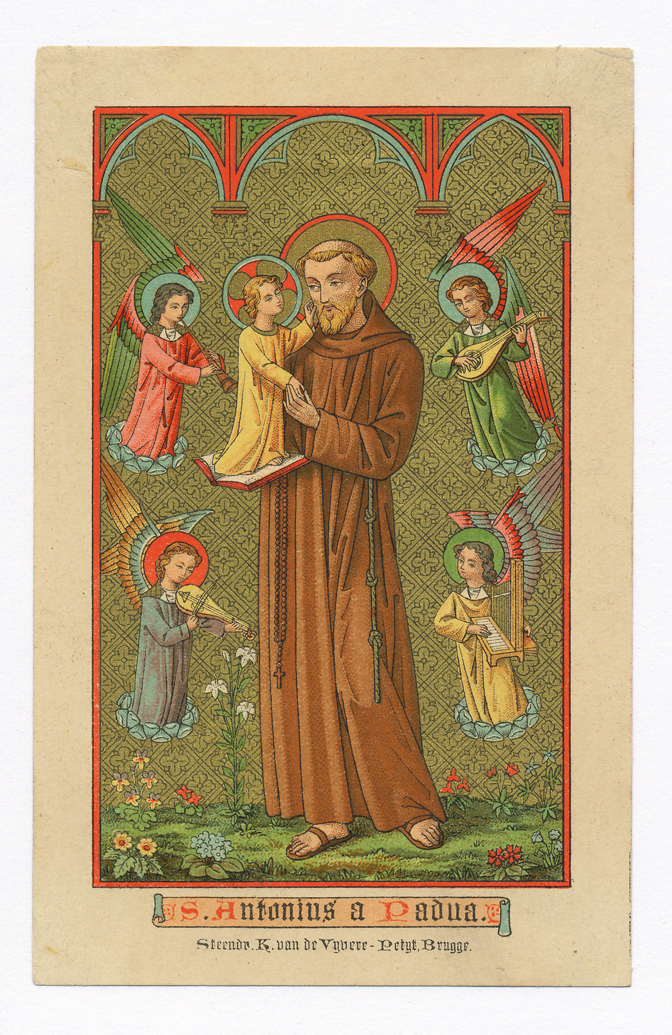
Invoked for: finding a husband, finding lost articles
Invoked against: debt, shipwreck, starvation
Symbols: baby Jesus, book of Gospels, lily
Wonder and miracles are infused with every story of Saint Anthony. Though he has been dead for almost 800 years, he is still the most popular saint in the world and his statue is found in every Catholic Church. Saint Anthony is best known as the patron saint of lost articles but he is invoked for help in all life situations. In his own day he was called the “Wonder Worker’ and credited with the ability to stop the rain, raise the dead and reattach severed limbs. He was such a charismatic preacher that when a crowd of heretics in Rimini refused to listen to his preaching, the fish raised themselves out of the water to hear him.
Born Fernando de Bulhes in Lisbon, Portugal, he disappointed his noble family by rejecting his luxurious life and joining the Augustinian religious order. A scholar by nature, he read every book in the monastery, devoting his time to contemplative prayer. Eventually, he befriended a group of itinerant Franciscan monks and became fascinated with this new religious order. Much impressed by their dedication to simplicity, poverty and their belief in returning to the original words of Christ, he joined their ranks, changing his name to Anthony in honor of Saint Anthony of the Desert, the patron of their little church. Returning home from a failed missionary venture in Morocco, his ship was blown off course and he wound up in Messina, Sicily. A group of Franciscan friars insisted he go north with them for a great gathering of all Franciscans, with their founder Francis of Assisi.
Anthony remained in Italy and discovered his great gift of preaching when a superior ordered him to speak at an ordination, telling him to say whatever the holy spirit had infused into him. He astonished his audience, not only by his skills as an orator but by the depth of his knowledge. He was sent throughout northern Italy and southern France on evangelical preaching missions which gathered crowds in the tens of thousands. His popularity among the people increased as he used his position to get real changes enacted for their protection. While based in Padua, he observed the crushing power of debt upon the common people. At Anthony’s insistence, the local municipality enacted a law protecting those who could not pay their debts that is still enforced today.
Anthony exhausted himself preaching out in fields and in piazzas as there was not cathedral large enough to hold all who came to hear him. At the age of thirty six, his health began to fail him and a local Count donated a woodland retreat for his recovery. One morning the Count heard the sounds of a baby giggling and he looked out to see Anthony surrounded in light, playing with the baby Jesus. That Christ would choose to appear to one of his saints in such a vulnerable state is a testament to the loving and kind nature of Saint Anthony. Because he is depicted holding a baby, women having trouble conceiving invoke his aid. Being of Portuguese descent, Anthony’s feast day is very auspicious for marriages in Portugal and Brazil and in those cultures, he is known to assist women seeking a husband.
According to legend, Saint Anthony earned the title patron saint of lost articles when a novice borrowed his psalter and failed to return it. Saint Anthony prayed to get it back and the novice was visited by terrifying visions that sent him running back to Anthony with the book. In iconography, Anthony always holds the baby Jesus and a lily for purity. Many times the returned book of the gospels is included.
Novena to Saint Anthony of Padua
Holy Saint Anthony, gentle and powerful in your help, Your love for God and charity for His creatures, made you worthy when on earth, to possess miraculous powers. Miracles waited on your word, which you were always ready to request for those in trouble or anxiety. Encouraged by this thought, I implore you to obtain for me (mention your request here). The answer to my prayer may require a miracle. Even so, you are the saint of miracles. Gentle and loving Saint Anthony, whose heart is ever full of human sympathy, take my petition to the Infant Savior for whom you have such a great love, and the gratitude of my heart will be ever yours.
Amen
It is customary to donate to Saint Anthony’s Bread, a charity started in Saint Anthony’s lifetime, in gratitude to answer novena prayers.
St. Anthony is one of 36 saints you can learn about and pray with on novena app.
On June 13, Catholics honor the memory of the Franciscan priest St. Anthony of Padua. Although he is popularly invoked today by those who have trouble finding lost objects, he was known in his own day as the “Hammer of Heretics” due to the powerful witness of his life and preaching.
The saint known to the Church as Anthony of Padua was not born in the Italian city of Padua, nor was he originally named Anthony. He was born as Ferdinand in Lisbon, Portugal during 1195, the son of an army officer named Martin and a virtuous woman named Mary. They had Ferdinand educated by a group of priests, and the young man made his own decision to enter religious life at age 15.
Ferdinand initially lived in a monastery of the Augustinian order outside of Lisbon. But he disliked the distraction of constant visits from his friends, and moved to a more remote house of the same order. There, he concentrated on reading the Bible and the Church Fathers, while living a life of asceticism and heartfelt devotion to God.
Eight years later, in 1220, Ferdinand learned the news about five Franciscan friars who had recently died for their faith in Morocco. When their bodies were brought to Portugal for veneration, Ferdinand developed a passionate desire to imitate their commitment to the Gospel. When a group of Franciscans visited his monastery, Ferdinand told them he wanted to adopt their poor and humble way of life.
Some of the Augustinian monks criticized and mocked Ferdinand’s interest in the Franciscans, which had been established only recently, in 1209. But prayer confirmed his desire to follow the example of St. Francis, who was still living at the time.
He eventually obtained permission to leave the Augustinians and join a small Franciscan monastery in 1221. At that time he took the name Anthony, after the fourth-century desert monk St. Anthony of Egypt.
Anthony wanted to imitate the Franciscan martyrs who had died trying to convert the Muslims of Morocco. He traveled on a ship to Africa for this purpose, but became seriously ill and could not carry out his intention. The ship that was supposed to take him to Spain for treatment was blown off course, and ended up in Italy.
Through this series of mishaps, Anthony ended up near Assisi, where St. Francis was holding a major meeting for the members of his order. Despite his poor health, Anthony resolved to stay in Italy in order to be closer to St. Francis himself. He deliberately concealed his deep knowledge of theology and Scripture, and offered to serve in the kitchen among the brothers.
At the time, no one realized that the future “Hammer of Heretics” was anything other than a kitchen assistant and obedient Franciscan priest. Around 1224, however, Anthony was forced to deliver an improvised speech before an assembly of Dominicans and Franciscans, none of whom had prepared any remarks.
His eloquence stunned the crowd, and St. Francis himself soon learned what kind of man the dishwashing priest really was. In 1224 he gave Anthony permission to teach theology in the Franciscan order – “provided, however, that as the Rule prescribes, the spirit of prayer and devotion may not be extinguished.”
Anthony taught theology in several French and Italian cities, while strictly following his Franciscan vows and preaching regularly to the people. Later, he dedicated himself entirely to the work of preaching as a missionary in France, Italy and Spain, teaching an authentic love for God to many people – whether peasants or princes – who had fallen away from Catholic faith and morality.
Known for his bold preaching and austere lifestyle, Anthony also had a reputation as a worker of miracles, which often came about in the course of his disputes with heretics.
His biographers mention a horse, which refused to eat for three days, and accepted food only after it had placed itself in adoration before the Eucharist that Anthony brought in his hands. Another miracle involved a poisoned meal, which Anthony ate without any harm after making the sign of the Cross over it. And a final often recounted miracle of St. Anthony’s involved a group of fish, who rose out of the sea to hear his preaching when heretical residents of a city refused to listen.
After Lent in 1231, Anthony’s health was in decline. Following the example of his patron – the earlier St. Anthony, who had lived as a hermit – he retreated to a remote location, taking two companions to help him. When his worsening health forced him to be carried back to the Franciscan monastery in Padua, crowds of people converged on the group in hopes of paying their homage to the holy priest.
The commotion surrounding his transport forced his attendants to stop short of their destination. After receiving the last rites, Anthony prayed the Church’s seven traditional penitential psalms, sung a hymn to the Virgin Mary, and died on June 13 at the age of 36.
St. Anthony’s well-established holiness, combined with the many miracles he had worked during his lifetime, moved Pope Gregory IX – who knew the saint personally – to canonize him one year after his death.
“St. Anthony, residing now in heaven, is honored on earth by many miracles daily seen at his tomb, of which we are certified by authentic writings,” proclaimed the 13th-century Pope.
A poem celebrating devotion to St. Anthony
a barefoot contessa walking down Mulberry Street
wearing the robe of Saint Anthony
the brown of the robe, two shades darker then her brown sicilian skin
a white thick rope around her waist, knotted at the end,
a rosary draped around her hands, the cross hanging at the end she was one of many, in this sea of brown,
lips moving with silent prayers
and how they formed me
she had green eyes, what visions were forming?
and how they formed me
in silence, not a word spoken
her stories were ancient, stone slabs and sand
celebrating with two lilies in a vase, a reminder
and how they formed me
she was unlike her sisters, they had voices, loud voices
my mother, my aunt, my other aunt
they had modern stories, cigarettes and cat-eye glasses
dresses made to order, nightclubs and frank sinatra
The Order of Cistercians of the Strict Observance (also known as “Trappists”) is a Roman Catholic contemplative religious order, consisting of monasteries of monks and monasteries of nuns. We are part of the larger Cistercian family which traces its origin to 1098. As Cistercians we follow the Rule of St Benedict, and so are part of the Benedictine family as well. Our lives are dedicated to seeking union with God, through Jesus Christ, in a community of sisters or brothers.
Early Monasticism
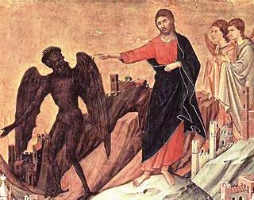
Jesus in the desert
The concept of monasticism is ancient and is found in many religions and philosophies. In the centuries immediately before Christ, Hinduism, Buddhism, and Judaism all developed alternative styles of life which involved renouncing the world in some ways, in order to seek liberation or purification or union with God, sometimes as a solitary ascetic, sometimes in community.
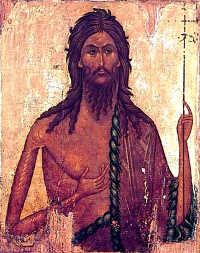
Early Christian monasticism drew its inspiration from the examples of the Prophet Elijah and John the Baptist, who both lived alone in the desert, and above all from the story of Jesus’ time in solitary struggle with Satan in the desert, before his public ministry. Beginning with the Exodus and all through the Old Testament times, the desert was regarded as a place of spiritual renewal and a return to God. Although there were ascetics, especially women ascetics, among the first generations of Christians, they generally lived in the towns and cities.
St John the Baptist
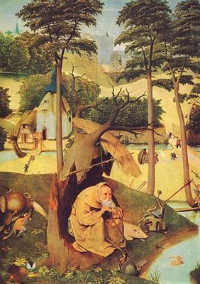
St. Anthony the Great (ca. 251-356) was the first well-known Christian to withdraw to the desert. According to the Life of Anthony written by St Athanasius in the mid fourth century, Anthony retreated to the wastelands of Egypt to lead an intensely ascetic life with the sole purpose of pursuing God in solitary prayer. He remained alone until his holiness and evident wholesomeness attracted a growing circle of followers. So deep was his influence that he is considered the father, not only of the movement of Desert Fathers and Mothers of fourth – fifth century Egypt, but also the father of the entire Christian monastic family.
St Anthony While the earliest Desert Fathers lived as hermits, they were rarely completely isolated, but often lived in proximity to one another, and soon loose-knit communities began to form in such places as the Desert of Nitria and the Desert of Skete. The progression from hermit (“anchorite”) to monk (“cenobite”) living in community under one abbot, came quickly, when in 346 St Pachomius established in Egypt the first cenobitic Christian monastery.
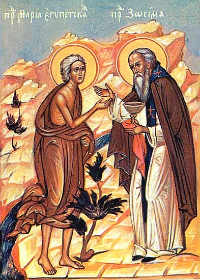
Mary of Egypt
The Eastern monastic teachings were brought to the western church by Saint John Cassian (ca. 360 – ca. 435). As a young adult, he and his friend Germanus entered a monastery in Palestine but then journeyed to Egypt to visit the eremitic groups in Nitria. Many years later, Cassian founded a monastery of monks and probably also one of nuns near Marseilles, and partly to counter what he felt were the abuses he found in Western monasticism, he wrote two long works, the Institutes and Conferences. In these books he not only transmitted his Egyptian experience (they are perhaps the oldest written record of the thought of the Desert Fathers), but he also gave Christian monasticism a profound evangelical and theological basis.
Cassian’s influence was enormous and lasted for centuries – even the smallest monastic library in Europe’s Dark Ages would have its copy of Cassian. Furthermore, St. Benedict incorporated Cassian’s thought into his monastic Rule, and recommended that his monks read Cassian’s works. Since the Rule of St Benedict is still used by Benedictine, Cistercian, and Trappist monastics, the thought of John Cassian, and the desert tradition behind him, still guides the spiritual lives of thousands of men and women in the Catholic Church.
The fear of the Lord is our cross. Just as someone who is crucified no longer has the power of moving or turning his limbs in any direction as he pleases, so we also ought to fasten our wishes and desires, not in accordance with what is pleasant and delightful to us now, but in accordance with the law of the Lord, where it hems us in. Being fastened to the wood of the cross means: no longer considering things present; not thinking about one’s preferences; not being disturbed by anxiety and care for the future; not being aroused by any desire to possess, nor inflamed by any pride or strife or rivalry; not grieving at present injuries, and not calling past injuries to mind; and while still breathing and in the present body, considering oneself dead to all earthly things, and sending the thoughts of one’s heart on ahead to that place where, one does not doubt, one will soon arrive…
One person on earth for one forgotten soul in purgatory!
Lets remember!
O merciful God, take pity on those souls who have no particular friends and intercessors to recommend them to Thee, who, either through the negligence of those that are alive, or through length of time are forgotten by their friends and by all.
Spare them, O Lord, and remember Thine own mercy, when others forget to appeal to it. Let not the souls which Thou has created be parted from Thee, their Creator. They are Thy work, and though they have sinned, they have been redeemed by Thee.
Vouchsafe, therefore, to look upon them and to deliver them from the intolerable pain of absence from Thee; the light and love of all Thy creatures. Oh! place them in the number of Thy blessed Saints and citizens through Jesus Christ their Savior. Amen.
Like Elizabeth Ann Seton, Rita of Cascia was a wife, mother, widow, and member of a religious community. Her holiness was reflected in each phase of her life.
Born at Roccaporena in central Italy, Rita wanted to become a nun but was pressured at a young age into marrying a harsh and cruel man. During her 18-year marriage, she bore and raised two sons. After her husband was killed in a brawl and her sons had died, Rita tried to join the Augustinian nuns in Cascia. Unsuccessful at first because she was a widow, Rita eventually succeeded.
Over the years, her austerity, prayerfulness, and charity became legendary. When she developed wounds on her forehead, people quickly associated them with the wounds from Christ’s crown of thorns. She meditated frequently on Christ’s passion. Her care for the sick nuns was especially loving. She also counseled lay people who came to her monastery.
Beatified in 1626, Rita was not canonized until 1900. She has acquired the reputation, together with Saint Jude, as a saint of impossible cases. Many people visit her tomb each year.
Like Elizabeth Ann Seton, Rita of Cascia was a wife, mother, widow, and member of a religious community. Her holiness was reflected in each phase of her life.
Born at Roccaporena in central Italy, Rita wanted to become a nun but was pressured at a young age into marrying a harsh and cruel man. During her 18-year marriage, she bore and raised two sons. After her husband was killed in a brawl and her sons had died, Rita tried to join the Augustinian nuns in Cascia. Unsuccessful at first because she was a widow, Rita eventually succeeded.
Over the years, her austerity, prayerfulness, and charity became legendary. When she developed wounds on her forehead, people quickly associated them with the wounds from Christ’s crown of thorns. She meditated frequently on Christ’s passion. Her care for the sick nuns was especially loving. She also counseled lay people who came to her monastery.
Beatified in 1626, Rita was not canonized until 1900. She has acquired the reputation, together with Saint Jude, as a saint of impossible cases. Many people visit her tomb each year.
Reflection
Although we can easily imagine an ideal world in which to live out our baptismal vocation, such a world does not exist. An “If only ….” approach to holiness never quite gets underway, never produces the fruit that God has a right to expect.
Rita became holy because she made choices that reflected her baptism and her growth as a disciple of Jesus. Her overarching, lifelong choice was to cooperate generously with God’s grace, but many small choices were needed to make that happen. Few of those choices were made in ideal circumstances—not even when Rita became an Augustinian nun.
In the West, the oldest reference to the cult of Saint Joseph (Ioseph sponsus Mariae) connected with 19 March appears around the year 800 in the north of France. Thereafter, reference to Joseph, the spouse of Mary, becomes more and more frequent from the 9th to the 14th centuries. In the 12th century, the crusaders built a church in his honor at Nazareth. But it was in the 15th century that the cult of Saint Joseph spread due to the influence of Saint Bernadine of Siena, and especially of Jean Gerson (+ 1420), Chancellor of Notre Dame in Paris, who promoted the cause that a feast to Saint Joseph be officially established. There were already some celebrations in Milan in Augustinian circles, and in many places in Germany. It was in 1480, with Pope Sixtus IV’s approval that the feast began to be celebrated on 19 March. It then became obligatory with Pope Gregory XV in 1621. In 1870, Pope Pius IX declared Saint Joseph the Patron of the Universal Church, and Pope Saint John XXIII inserted his name into the Roman Canon of Holy Mass in 1962. More recently, Pope Francis approved seven new invocations in the Litany to Saint Joseph: Guardian of the Redeemer, Servant of Christ, Minister of Salvation, Support in difficulties, Patron of exiles, Patron of the afflicted, and Patron of the poor.
Prayer
Hail, Guardian of the Redeemer, Spouse of the Blessed Virgin Mary. To you God entrusted his only Son; in you Mary placed her trust with you Christ became man. Blessed Joseph, to us too, show yourself a father and guide us in the path of life. Obtain for us grace, mercy and courage, and defend us from every evil. Amen.
Please leave message if you would like a copy of our novena app for iPhone or iPad. History and prayers of 36 saints.
Our book is now available as an ebook on amazon https://www.amazon.com/dp/B0D4WQLFRXyou can buy or read free if you subscribe to kindle reading.
This book celebrates the meaningful recitation of novenas, a traditional nine day prayer to a particular saint, angel or Madonna for help in solving a problem.
It was our objective to create a book that would be assessable to all, Catholic and non-Catholics alike.
You will learn about The Saints, Angels and The Madonna. The history of The Saints who lived with us on earth. The many visions of The Madonna as she appeared on earth. And more…