Feast of Padre Pio, September 23

PadrePio

Padre Pio 1887-1968
Patron of: Forgiveness, Healing, Miracles, Reconciliation.
Denounced by Vatican officials as a fraud, and his mystical gifts frequently viewed with suspicion by his immediate superiors, Pio of Pietracelina was sequestered away in the remote monastery of San Giovanni Rotondo where it was expected that he would labor as a monk in obscurity. His adeptness in both physical and spiritual healing and his ability to read hearts and minds while in confession made him wildly popular among the common people of that impoverished region of Italy. Today, the town of San Giovanni Rotondo is the second most visited place by religious pilgrims who venture there to pay homage to one of the most popular saints of the twentieth century, Padre Pio. Made a saint in 2002, Padre Pio has no official patronage. Because of his devotion to the powers of the Sacred Heart of Jesus and his own suffering due to the mistrust of his superiors, he is frequently invoked to bring the grace of forgiveness to a situation.

Born Francesco Forlione in Pietracelina, a town north of Naples, he was named for his patron saint, Francis of Assisi. Coming from a religious family, he said he had spiritual visions of Christ and the Virgin Mary from a very young age. He never mentioned them to anyone as he assumed all people had such gifts. He was ordained as a Capuchin friar in 1910 taking the name Pio (meaning “Pious”) but was sent home due to a diagnosis of tuberculosis. While convalescing he offered himself as a conduit of suffering in exchange for the salvation of others. Eventually, in 1916 he was conscripted into the army where he contracted such a high fever that he was sent home to die. Upon his miraculous recovery from this illness, the Capuchin order sent him to the very remote monastery of Our Lady of Grace in San Giovanni Rotondo in Puglia, a province of Southern Italy. On September 20, 1918, while praying in the stillness of the church, Pio went into a trancelike state where he saw Christ standing before him bleeding from the wounds of the crucifixion. Pio’s heart almost burst in sympathy before coming out of the state in intense pain. Upon regaining consciousness he found himself to be afflicted with the same wounds of the crucifixion. It was this condition which only ended at his death in 1968, which would bring him under intense scrutiny by church officials for the rest of his life.

Pio’s talents for deciphering what people meant to tell him during confession but were too embarrassed or ashamed to bring up, became immediate apparent to the local townspeople and he developed a great following among them. They credited him with an incredible capacity of healing, mending physical ills, familial squabbles, and curing spiritual desolation. When Vatican Officials severely limited his official duties, the one mass he was allowed to say at 5 AM, had thousands lining up the night before so that they may be with him. Without ever leaving the monastery, he was known as “the living saint” as he sighted in hospitals and at sickbeds hundreds of miles away. The onset of World War Two spread his cult on an international level as soldiers from Australia, other parts of Europe, and the United States witnessed his miraculous abilities. By the late 1940’s he was receiving hundreds of international prayer requests per day. He eventually founded a hospital for the hopelessly ill, the internationally acclaimed House for the Relief of Suffering, which treats tens of thousands of people each year and survives solely on charitable donations.

The animosity that many Vatican officials had against Padre Pio was dissolved in 2002 when Pope John Paul II declared him a saint. This pope knew Pio’s powers firsthand as he had visited him fifty years before as a young seminarian in the hopes of obtaining a cure for a friend. Not only did his friend’s cancer go into remission, but Pio’s strange prediction of this obscure Polish priest’s rise to pope also came true.

Novena

(It is important to note that Padre Pio himself recited the Novena to the Sacred Heart of Jesus for the intentions of those who requested his prayers every day.)

Dear God, Thou hast generously blessed Thy servant, St. Pio of Pietrelcina, with the gifts of the Spirit. Thou hast marked his body with the five wounds of Christ Crucified, as a powerful witness to the saving Passion and Death of Thy Son. Endowed with the gift of discernment, St. Pio labored endlessly in the confessional for the salvation of souls. With reverence and intense devotion in the celebration of Mass, he invited countless men and women to a greater union with Jesus Christ in the Sacrament of the Holy Eucharist.
Through the intercession of St. Pio of Pietrelcina, I confidently beseech Thee to grant me the grace of (mention your intentions here). Amen.

Recite three Glorias.

(Excerpted from the App: “Novena: Praying with the Saints” by Barbara Calamari and Sandra DiPasqua).

St. Michael the Archangel, Feast date September 29

St.Michael
St. Michael the Archangel
Patron of: Policemen, Firemen, Grocers, Health, Knights, Mariners, Soldiers, Health, Holy Death, Physical Protection, Court Cases, Justice, Defense, Strength, Lawsuits.
Ever vigilant against evil, Michael the Archangel is most invoked for protection and justice. His novena is said by those in need of protection as well as those who are in need of justice.

According to the Book of Revelations, Michael was the angel who rose to God’s defense when Lucifer, God’s favorite and most beautiful angel decided that he was God’s equal. Leading a band of renegade angels he made an attempt to take over the throne of heaven. One outraged angel shouted, “Who is like God?” (mi-cha-el) and struck down Lucifer and his group, casting them into hell for their vanity. This angel took the name Michael as a reminder of his loyalty. A popular figure to the ancient Jews, early, Christians and Muslims, he is closely tied to the history of mankind and serves as its guardian.

Michael’s role in the world is firmly mandated: 1) He is to fight against Lucifer, no matter where he might be. 2) He is to rescue the souls of the faithful from the power of evil, especially at the time of death. 3) He is the champion of God and the protector of the Church. 4) He brings souls to justice, weighing the souls of the dead and deciding on who gets into heaven and who gets into hell.

Since Michael was the one who threw Lucifer into hell, Lucifer and the denizens of hell have no power over him. Catholics believe that Michael and the Virgin Mary are the only beings besides Jesus who can go into hell and release souls who are suffering there. Because of their actions in the great battle of heaven, it is Lucifer’s fate to reside in the lowest netherworld and it is Michael’s to dwell nearest to heaven. His shrines are the most ancient and natural in Christendom and tend to be on high, inaccessible cliffs that only a celestial being could reach. The Gargano caves in Apulia, Italy are said to be the first earthly dwelling place for the archangel. They have been an immensely popular pilgrimage site since the year 490 AD.

Saint Michael the Archangel is considered the most powerful of all angels. Christians in the East see him as a great healer, crediting him with the creation of many healing springs. In the sixth century, as Rome was being devastated by a plague, Pope Gregory I saw the archangel hovering over the tomb of the Emperor Hadrian, brandishing his sword. He interpreted this to mean that Rome was under the archangel’s protection and the plague would soon cease. A church was built over the tomb still bearing the title Castel San Angelo in honor of Michael.

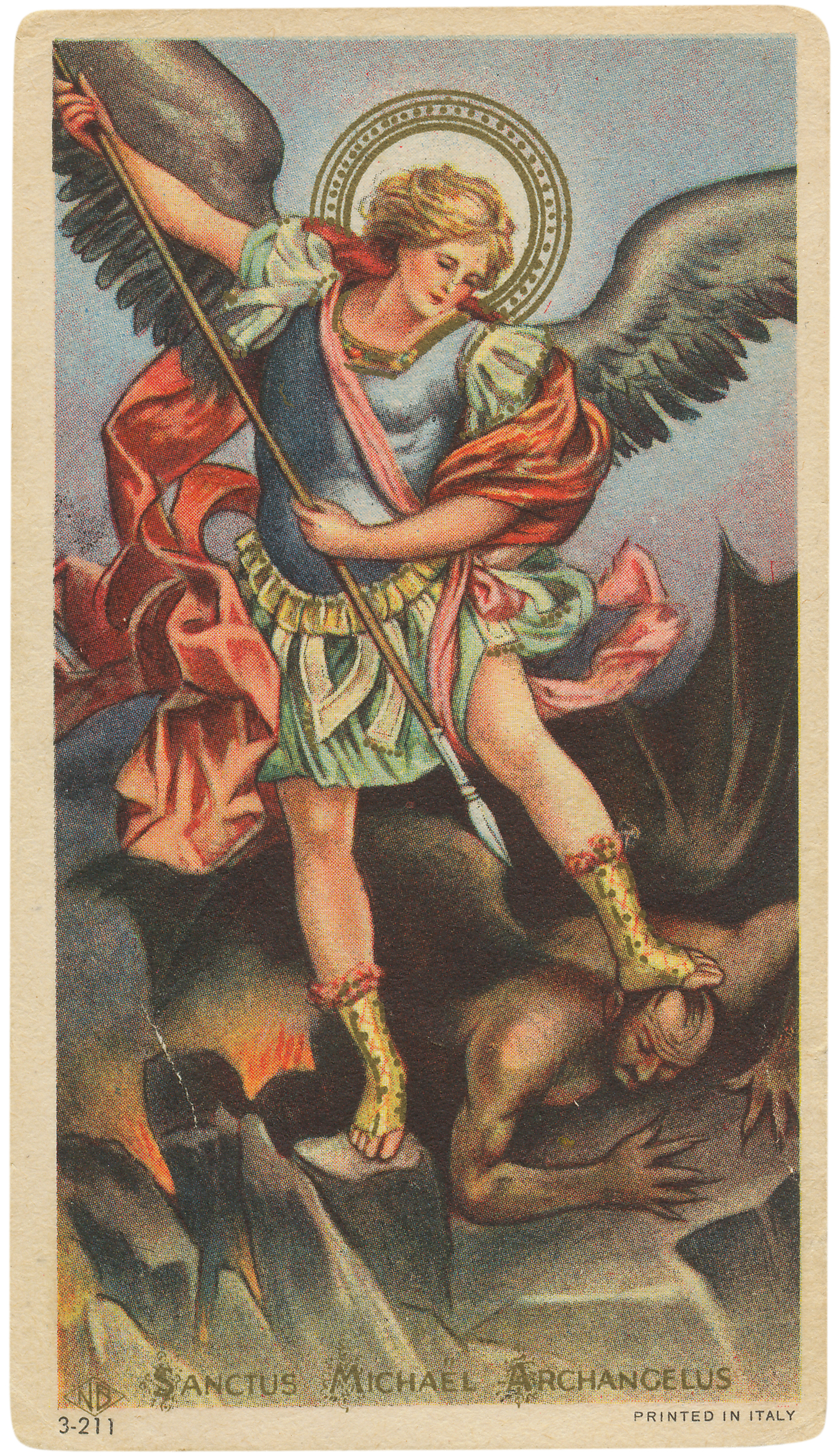
Immensely popular throughout the world, Michael is always shown brandishing a sword while standing on the neck of the devil (sometimes interpreted as a giant serpent). In many images he holds the scales that will weigh the souls of the dead, because of this he is the patron saint of greengrocers who use these scales.

Prayer:

Saint Michael the Archangel, loyal champion of God and his people, I turn to you with confidence and seek your powerful intercession. For the love of God, who made you so glorious in grace and power, and for the love of the Mother of Jesus, the Queen of the Angels, be pleased to hear my prayer. You know the value of my soul in the eyes of God. May no stain of evil ever disfigure its beauty. Help me to conquer the evil spirit who tempts me. I desire to imitate your loyalty to God and Holy Mother Church and your great love for God and men. And since you are God’s messenger for the care of his people, I entrust to you this special request (your request here).

Saint Michael, since you are, by the will of the Creator, the powerful intercessor of Christians, I have great confidence in your prayers. I earnestly trust that if it is God’s holy will, my petition will be granted.

Pray for me, Saint Michael, and also for those I love. Protect us in all dangers of body and soul. Help us in our daily needs. Through your powerful intercession, may we live a holy life, die a happy death, and reach heaven, where we may praise and love God with you forever. Amen.

(Recite one Our Father, one Hail Mary, one Glory Be).

Mother of Sorrows

Sorrows_Small_Image

Mother of Sorrows
Patron of: Grief

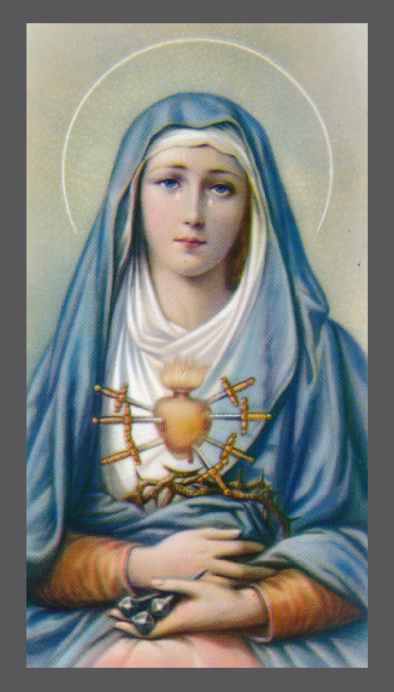
When we are overwhelmed with grief, we turn to Mary, Mother of Jesus for help in our suffering. Throughout her life she endured much pain and sorrow and is fully able to empathize with anyone’s personal anguish. She endured the shame of being pregnant and unmarried, being poor, homelessness and having her only son unjustly imprisoned and executed. Most astonishing, Mary knew what was to befall her son yet had to see these events from God’s point of view and have faith that this was all for the good of mankind.

By meditating on the Seven Sorrows of Mary, a devotion from the Middle Ages, which uses scenes from the life of the Virgin Mother as a meditation on accepting the sorrowful part of life with grace.

The Seven Sorrows of Mary are:

1) The Prophecy of Simeon. As a young child, when his parents presented him in the temple, Jesus was met by the holy man Simeon who predicted everything that would happen to him in his address to Mary: “Behold, this child is destined for the fall and rise of many in Israel, and to be a sign that will be contradicted – and you yourself a sword will pierce so that thoughts of many hearts will be revealed.” (Luke 2:34-35).

2) The Flight into Egypt. In Bethlehem, after the birth of Christ, Joseph had a vision of an angel warning him of the impending slaughter of any male child under the age of two by King Herod in order to prevent the coming Messiah. The Holy Family had to travel a secretive route to Egypt and remain in that country until Herod died. Mary not only worried for the welfare of her own son but mourn for the murdered children left behind.

3) The Loss of the Child Jesus in the Temple. While on a pilgrimage to Jerusalem, the 12 year old Jesus vanished from his family. His heartsick parents finally found him three days later, arguing with elders in the temple.

4) The Meeting of Jesus with His Cross. Mary watched helplessly as her son was ridiculed and mocked as he stumbled, carrying the cross he was to be executed on.

5) The Crucifixion. As he was nailed to the cross, most of his disciples ran away. Mary never wavered as she stood at the foot of the cross, witnessing her son’s agony and death.

6) Jesus Taken Down from the Cross. Mary held her dead son’s wound covered body. This, her greatest sorrow is known as the “Pieta”.

7) The Burial of Jesus. As the stone was rolled, closing up his tomb, Mary had to say her final goodbye to her earthly son. Her faith had to be sincerely tested as there was no hint of the resurrection to come.
Prayer

Most holy and afflicted Virgin, Queen of Martyrs, you stood beneath the cross, witnessing the agony of your dying son. Look with a mother’s tenderness and pity on me, who kneel before you. I venerate your sorrows and I place my requests with filial confidence in the sanctuary of your wounded heart. Present them, I beseech you, on my behalf to Jesus Christ, through the merits of his own most sacred passion and death, together with your sufferings at the foot of the cross. Through the united efficacy of both, obtain the granting of my petition. To whom shall I have recourse in my wants and miseries if not to you, Mother of Mercy? You have drunk so deeply of the chalice of your son, you can compassionate our sorrows. Holy Mary, your soul was pierced by a sword of sorrow at the sight of the passion of your divine son. Intercede for me and obtain from Jesus (mention your request) if it be for his honor and glory and for my good. Amen.

Feast of St. Monica, August 28

St.Monica copySt. Monica 331 – 387

Feast Day: August 28

Patron of: Wayward Children

“Nothing is far from God.”

Though she was greatly hurt and disappointed by her firstborn son, St. Monica never gave up the idea that he would change his way of living. After 17 years of what seemed like fruitless prayers, her son turned his life around, converted to her faith and became one of the world’s greatest philosophers and Catholic saints, St. Augustine of Hippo. We invoke St. Monica to help us when our own children disappoint us. She serves as a reminder that there are no lost causes in this world and that absolutely anyone can reform and change their life.

Born into a Berber tribe in North Africa, Monica was brought up a Christian. Her parents arranged her in marriage with a prominent pagan Roman citizen of Carthage by the name of Patricius. Monica had a hard time in her early married years as she had to put up with a cantankerous mother-in-law as well as a dissolute husband. There are some accounts which say that she turned to alcohol and was herself an alcoholic who recovered her sobriety through faith and prayer. She had three children who she raised as Christians. The eldest, Augustine, was the most brilliant and his parents had high hopes for his career. Both Patricius and Monica worked hard to get the best education for their son and it was the greatest sorrow of Monica’s life when Augustine turned out to live a lazy, pleasure-filled life. It hurt her even more when he threw out his Christian beliefs to embrace the Manichean heresy – a popular cult believing in the natural good and evil of every soul. In order to keep his blasphemous beliefs from misleading her younger children, Monica forbade Augustine to come back to their home. Inconsolable in her grief, Monica had a vision of a radiant being pointing to Augustine in a beam of light next to her, saying, “Your son is with you.” When she related this vision to Augustine he laughingly said it would all be true if she would only give up her religious piety. “He did not say that I was with you,” she answered him. “He said you were with me.” When Augustine openly took a mistress and further humiliated his mother by having an illegitimate son, Monica turned to her Bishop for help. He advised her to pray and be patient saying, “It is not possible that the son of so many tears should perish.” After the death of his father, Augustine decided to move to Rome to increase his worldly success, Monica vowed to follow him. In his own great treatise “Confessions”, Augustine relates how as his mother spent the night in prayer before their voyage, he tricked her and slipped away on an earlier ship. Devastated, she traveled to Rome anyway. By the time she arrived Augustine, had already left that city for Milan. By the time Monica tracked him down, she was overjoyed to find that Augustine was no longer a Manichean. He had met Ambrose, the bishop of Milan and was studying with him. Eventually, after several more years, Monica lived to see Augustine baptized a Christian. While waiting for a ship at Ostia to take mother and son back to Africa, Monica told her son that she had accomplished everything that she had set out to do in this life and did not need to live any longer. She died in Ostia, never returning to her native land. It is interesting to note that there are many great saints from Africa, especially the earliest ones and they are rarely depicted as anything but European in visage. Explanation: Light from sky: Grace. Through prayer, Monica channeled grace to convert her son. Outstretched arms: pointing to Africa, her homeland. Palm tree: the shore of Ostia Antica, where Monica’s earthly life ended.

Novena Prayer to Saint Monica

Dear Saint Monica, once the sorrowing mother of a wayward son, be pleased to present our petition to the Lord God of heaven and earth. (Your intention here.) Look down upon our anxieties and needs, and intercede for us, as you did so fervently for Augustine, your firstborn. We have full confidence that your prayers will gain favorable hearing in heaven. Mother of a sinner-turned saint; obtain for us patience, perseverance, and total trust in God’s perfect timing. In His appointed hour, in His merciful way, may He respond to your prayer and ours, which we offer through you.

Amen

August Novena’s

Sanctus Alphonsus de Ligorio

St. Alphonsus Liguori

1696 – 1787
Feast Day: August 1

Doctor of the Church

Patron: Arthritis sufferers

Keywords: Confessors, Moral Theologians, Lawyers, Scruples

“Your God is ever beside you, indeed He is even within you.”

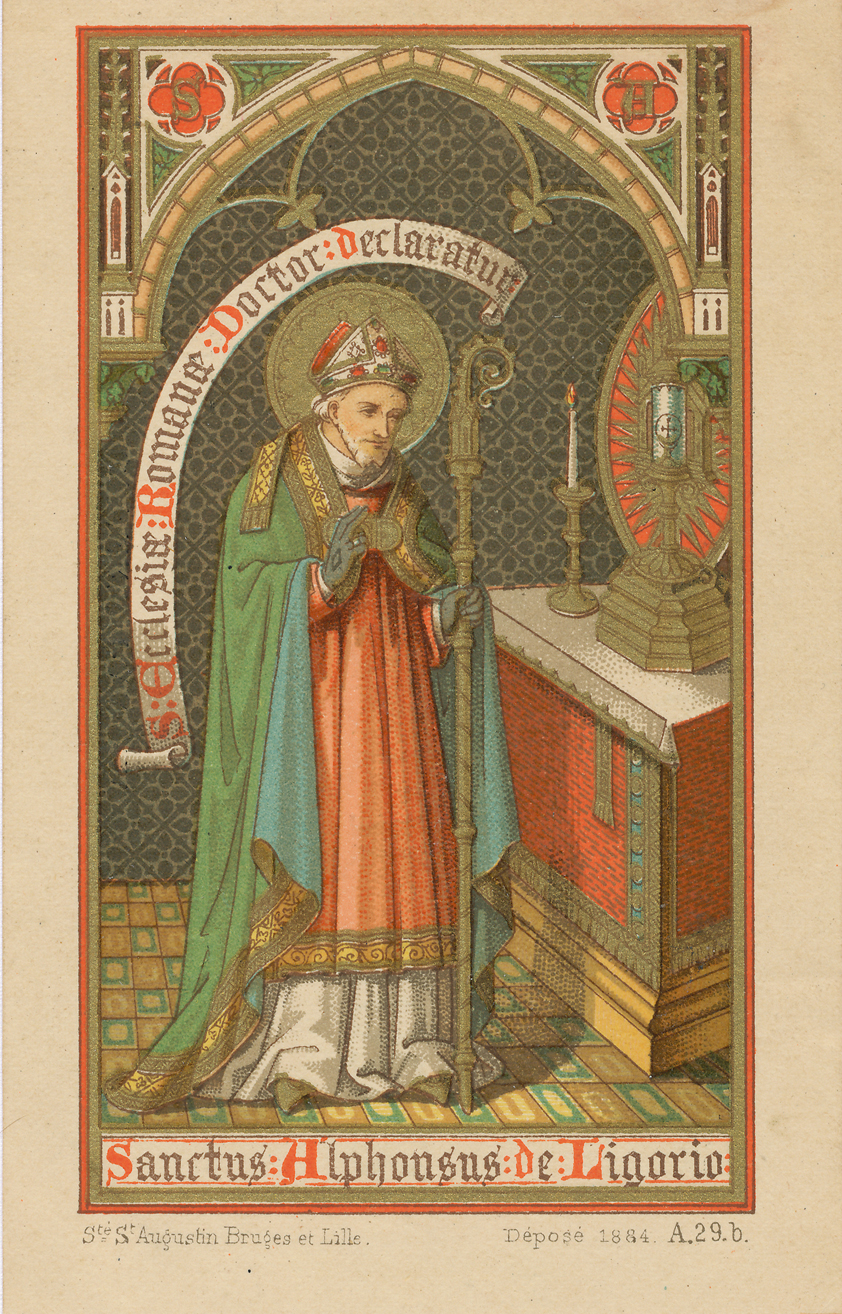
Symbols: chin in chest, writing pen, book, bishops’ hat and staff

So crippled with arthritis that he could not lift his head off of his chest, St. Alphonsus Liguori looked on his illness as a grace since it made him use his earthly time in the most productive manner possible. In chronic pain and expecting to die at any moment, he went on to publish over 60 books dealing with theological studies, as well as music and poetry. He is invoked by those suffering with arthritis for a cure as well as those seeking a way to live a productive life while stricken with illness.

Born into a noble but poor family near Naples in 1696, Alphonsus Liguori was the eldest of seven children. Though he was physically small with poor eyesight, he was incredibly intelligent and musically talented. Because of his poor eyesight he could not follow in his father’s military footsteps, but his intellectual brilliance made him the hope of his family, as he received his law degree at the early age of sixteen. He quickly became famous in the Neapolitan courts for never losing a case. A devout Catholic, he credited his success with his daily mass going. After eight years of constant triumph, Alphonsus was stunned to lose an extremely important and public case due to his own oversight regarding a signed document. Humiliated, he looked on this personal disaster as sign from God and fasted and prayed for three days. While doing charitable work in the Hospital for the Incurables, he had a vision commanding him to quit the world and give himself to God. His father was outraged when left the law for the priesthood.

Devoting his work to those on the outskirts of society, he founded the Redemptorist Fathers, an order devoted to doing missionary work among the poor. Though gifted with the ability to argue the most finite facts of law or theology Alphonsus Liguori always preached in the simplest terms, writing many books and pamphlets in the vernacular of the common person. Because of his great popularity as a preacher, his religious order began to attract many young people. Living at a time of great political and religious upheaval and plagued with deteriorating health, Alphonsus Liguori never enjoyed much peace in his life. Instead, he welcomed these obstacles as an opportunity to perfect his soul.

Explanation of symbols:
Banner: declaring him Doctor of the Church because of the incredible range and amount of his writings.
Bishop hat and staff: he was a Bishop and leader of his order.
Crucifix: Total devotion to Christ and His teachings.

Novena to St. Alphonsus Liguori

Glorius Saint Alphonsus, loving fathr of the poor and sick, all your life you devoted yourself with a charity really heroic to lightening their spiritual and bodily miseries. Full of confidence in your tender pity for the sick, since you yourself have patiently borne the cross of illness, I come to you for help in my present need.

(Mention your request).

Loving father of the suffering, Saint Alphonsus, whom I invoke as the Arthritic Saint, since you suffered from the disease in your lifetime, look with compassion upon me in my suffering. Beg God to give me good health. If it is not God’s will to cure me, then give me strength to bear my cross patiently and to offer my sufferings in union with my crucified Savior and His Mother of Sorrows, for the glory of God and the salvation of souls, in reparation for my sins and those of others, for the needs of this troubled world, and for the souls in purgatory.

(Recite one Our Father, one Hail Mary, one Glory Be.)

Saint Alphonsus, patron of the sick, pray for me. Amen

Please see novena app on iTunes if you want your novena’s wherever you go.

St.s Joachim and Anne First Century BC

St.Anne_Small_imagePatron of: Grandparents, Child Rearing, Childless People, Family Crisis, Mothers, Pregnancy.

Grandparents are the foundation of a family and we invoke Saints Joachim and Anne for strength in every sort of family crisis. As parents of the Virgin Mary and the grandparents of Jesus Christ, they offer a vast array of earthly experiences relatable to every human being. Infertility, late parenthood, an unmarried pregnant daughter, a grandson who was imprisoned and executed, are all parts of their life together which they accepted with grace and dignity.

Joachim and Anne are important as moral examples rather than truthful historical figures. According to legend, Joachim and Anne were married twenty years and still had not conceived a child. Living in Nazareth they were upstanding citizens, always tithing one third of their income to the temple. After many years, their barrenness was considered a form of divine judgment and eventually their contribution to the temple was refused and they were ostracized by their community. In shame, Joachim went off to live with his shepherds. There he was visited by an angel who told him, that Anne was pregnant with a child named Mary who was to be dedicated to the Lord. He was to return home and find his wife, who would be waiting at the golden gate, the entrance to the city. Doing as he was told, his joyful reunion with Anne at the golden gate has become a famous image in art history.

Novena:

Saints Joachim and Ann, grandparents of Jesus and parents of Mary, we seek your intercession. We beg you to direct all our actions to the greater glory of God and the salvation of souls. Strengthen us when we are tempted, console us during our trials, help us when we are in need, be with us in life and in death.

O divine savior, we thank you for having chosen saint Joachim and Ann to be the parents of our Blessed Mother Mary and so to be your beloved grandparents. We place ourselves under their patronage this day. We recommend to them our families, our children, and our grandchildren. Keep them from all spiritual and physical harm. Grant that they may ever grow in greater love of God and others.
Saints Joachim and Ann, we have many great needs. We beg you to intercede for us before the throne of your divine grandson. All of us here have our special intentions, our own special needs, and we pray that through your intercession our prayers may be granted. Amen.
(Mention your request here)

Sacred Heart of Jesus, Feast day June 27

FullSizeCard_1 2Sacred Heart of Jesus Seventeenth Century AD
Patron of: Family Peace.
The iconography of the Sacred Heart speaks to us on such a basic level that its image can be found everywhere in everyday life, from tattoos on bikers to stained glass windows in cathedrals. Traditionally, many Catholic homes display the Sacred Heart of Jesus to insure domestic peace and a loving atmosphere. This ancient concept depicting Christ’s heart in flames was first meditated on in privacy by the 4th century hermits in the desert and taken up by mystics in religious communities in the 11th and 12th centuries; it did not become a popular devotion until the 17th century. In Burgundy, France, on December 27, 1673, a young Visitation nun named Margaret Mary Alacoque was praying in the convent chapel when she heard a strong inner voice identifying itself as Jesus Christ. In later visits the voice requested that she begin a devotion to an image of Christ’s heart in flames, bleeding and encircled by thorns. The flames were for His ardent love for mankind, the thorns were to remind us of His sacrifice on the cross and the blood was because He was God made man. There is no indication that Margaret Mary Alacoque had ever seen this image before. Indeed, she was puzzled by it and greatly mistrusted herself as being qualified to relay any spiritual messages no matter who they purportedly came from. When she reported her communications to her Mother Superior she was scoffed at as delusional and forbidden to perform any of the devotions she was instructed to carry out. It was only after her Confessor, Claude de La Columbiere heard her describe her visions that she was taken seriously. Unlike the Mother Superior or Margaret Mary, he was well aware of the private devotions of Bernard of Clairvaux and Mechtilde of Helfta, religious mystics who lived centuries before, inspired by same image. La Columbiere did much to publicize devotion to the Sacred Heart based on the messages Christ gave to Margaret Mary. According to her, Christ was greatly troubled by the indifference and sacrilege He was being treated with by the average person. As a reward for contemplating this image He promised:

1. I will give them all the graces necessary for their state of life.

2. I will give peace in their families.

3. I will console them in all their troubles.

4. I will be their refuge in life and especially in death.

5. I will abundantly bless all their undertakings.

6. Sinners shall find in my Heart the source and infinite ocean of mercy.

7. Tepid souls shall become fervent.

8. Fervent souls shall rise speedily to great perfection.

9. I will bless those places wherein the image of My Sacred Heart shall be exposed and venerated.

10. I will give to priests the power to touch the most hardened hearts.

11. Persons who propagate this devotion shall have their names eternally written in my Heart.

12. In the excess of the mercy of my Heart, I promise you that my all powerful love will grant to all those who will receive Communion on the First Fridays, for nine consecutive months, the grace of final repentance: they will not die in my displeasure, nor without receiving the sacraments; and my Heart will be their secure refuge in that last hour.
Since there is no way to physically depict the soul, it is thought that the image of the Sacred Heart comes closest. The heart is the seat of love in the body and the wounded heart represents Christ’s sacrifice at the crucifixion as well as His ongoing pain at the state of mankind.

Novena to the Sacred Heart of Jesus
O Lord, Jesus Christ, to your most Sacred Heart I confide this intention. Only look upon me, then do what your love inspires. Let your Sacred Heart decide. I count on you. I trust in you. I throw myself on your mercy. Lord Jesus, you will not fail me. (Mention your request.)

Sacred Heart of Jesus I trust in you. Sacred Heart of Jesus I believe in your love for me. Sacred Heart of Jesus, your kingdom come. Sacred Heart of Jesus, I have asked you for many favors, but I earnestly implore this one. Take it, place it in your open heart. When the Eternal Father looks upon it, he will see it covered with your Precious Blood. It will no longer be my prayer, but yours, Jesus. Sacred Heart of Jesus, I place all my trust in you. Let me not be disappointed. Amen.

Novena for June: St.Aloysius, June 21

FullSizeCard_1
St. Aloysius Gonzaga 1568-1591
Patron of: AIDS Patients, AIDS Caregivers, Youth, Vocations.
A duke from the legendary Gonzaga family of Mantua, Aloysius Gonzaga was born to inherit great wealth and to rule alongside the best families of Europe. While still a teenager he defied his powerful father, renouncing his birth rite in order to become a Jesuit novice. Weak in physical health but living a strong interior life, he knew he would not live long. He happily accepted his destiny and put himself into the hands of the Virgin Mary. Despite his fragile constitution, he insisted on caring for plague victims during a particularly virulent outbreak quickly decimating the city of Rome. He fell ill and lingered for months fully knowing his fate. Because his life was cut short at such an early age, and because he understood both the caregiver and patient side of serious illness, he is invoked by those with AIDS as well as those who tend sufferers of that disease. His novena is written by himself, commending his future to the Virgin Mary who he had a strong devotion to.

Though his father wanted him to be a great soldier, Aloysius Gonzaga was always a pious youth. He obediently served as a page in the Florentine court of Lorenzo de Medici and in the more auspicious Spanish noble court. Still, political ambition held no interest for him and he was appalled by the corruption and licentious behavior of the nobility. While in Spain he read a book about Jesuit missionaries in India and decided to join them for foreign missionary work. His father did everything in his power to prevent his son from giving up all his earthly privileges. When it appeared that Aloysius could not be persuaded away from the religious life, his family implored him to at least accept a higher office in the Italian church. Instead, he insisted on his birth rite being transferred to his younger brother and entered the Jesuit house of Sant’ Andrea in Rome as a lowly novice.

The Jesuits found Aloysius too extreme in his devotions and forced him to eat better, mix with his fellows more, and to distract himself with physical recreation. As the plague swept Rome in 1591, the Jesuits opened their own hospital, forbidding Aloysius from working there due to his fragile physical disposition. As many of his brethren were felled by the illness, Aloysius threw himself into the role of caregiver with all his capabilities. No chore was considered too humble for him to do. He himself fell in March of that year and was given the last rites. He surprised everyone by recovering from that bout. Three months later, he was bedridden with a low grade fever. Though his condition seemed routine, he announced his impending death. Once again he was given the last rites and died during the prayers for the departing.

Because of Aloysius Gonzaga’s personal inner strength at such a young age, he is called upon by teenagers at times of peer pressure. Since he knew exactly wanted to be as a teenager, he is also called upon by the young to help recognize an occupation or state of life.

Prayer

Commending Oneself to Mary by Saint Aloysius Gonzaga
O holy Mary, my Mistress, into thy blessed trust and special blessing, into the bosom of thy tender mercy, this day, every day of my life and at the hour of my death, I commend my soul and body; to thee I entrust all my hopes and consolations, all my trials and miseries, my life and the end of my life, that through thy most holy intercession and thy merits, all my actions may be ordered and disposed according to thy will and that of thy divine Son. Amen.


Novena for June: St. Anthony, June 13

St. Antonius a PaduasmallSt. Anthony, June 13

Wonder and miracles are infused with every story of Saint Anthony. Though he has been dead for almost 800 years, he is still the most popular saint in the world and his statue is found in every Catholic Church. Saint Anthony is best known as the patron saint of lost articles but he is invoked for help in all life situations. In his own day he was called the “Wonder Worker’ and credited with the ability to stop the rain, raise the dead and reattach severed limbs. He was such a charismatic preacher that when a crowd of heretics in Rimini refused to listen to his preaching, the fish raised themselves out of the water to hear him.

Born Fernando de Bulhes in Lisbon, Portugal, he disappointed his noble family by rejecting his luxurious life and joining the Augustinian religious order. A scholar by nature, he read every book in the monastery, devoting his time to contemplative prayer. Eventually, he befriended a group of itinerant Franciscan monks and became fascinated with this new religious order. Much impressed by their dedication to simplicity, poverty and their belief in returning to the original words of Christ, he joined their ranks, changing his name to Anthony in honor of Saint Anthony of the Desert, the patron of their little church. Returning home from a failed missionary venture in Morocco, his ship was blown off course and he wound up in Messina, Sicily. A group of Franciscan friars insisted he go north with them for a great gathering of all Franciscans, with their founder Francis of Assisi. Anthony remained in Italy and discovered his great gift of preaching when a superior ordered him to speak at an ordination, telling him to say whatever the holy spirit had infused into him. He astonished his audience, not only by his skills as an orator but by the depth of his knowledge. He was sent throughout northern Italy and southern France on evangelical preaching missions which gathered crowds in the tens of thousands. His popularity among the people increased as he used his position to get real changes enacted for their protection. While based in Padua, he observed the crushing power of debt upon the common people. At Anthony’s insistence, the local municipality enacted a law protecting those who could not pay their debts that is still enforced today.

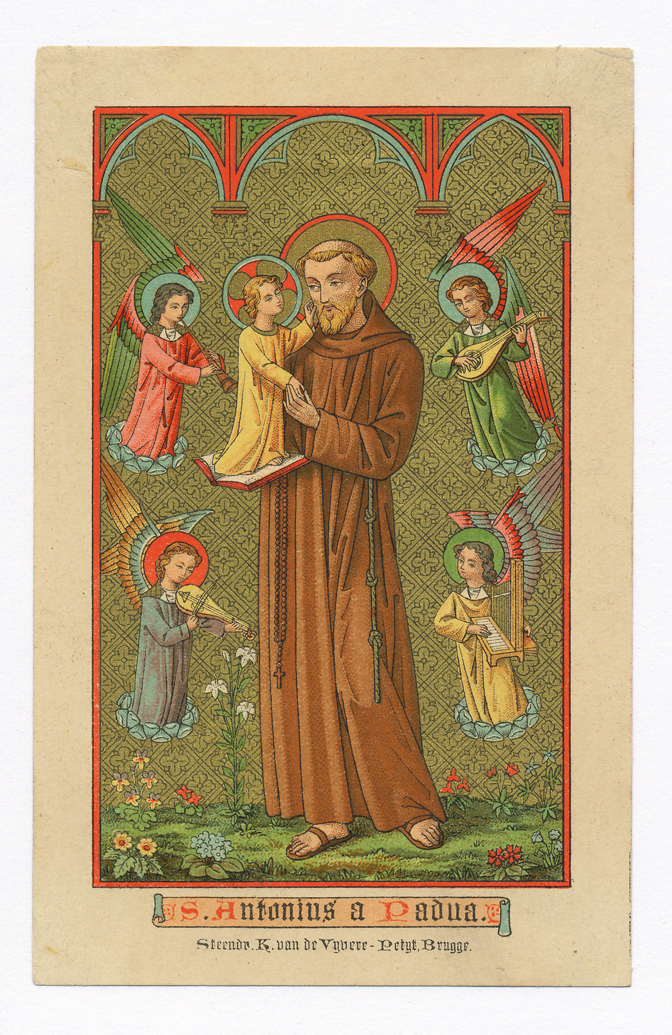
Anthony exhausted himself preaching out in fields and in piazzas as there was not cathedral large enough to hold all who came to hear him. At the age of thirty six, his health began to fail him and a local Count donated a woodland retreat for his recovery. One morning the Count heard the sounds of a baby giggling and he looked out to see Anthony surrounded in light, playing with the baby Jesus. That Christ would choose to appear to one of his saints in such a vulnerable state is a testament to the loving and kind nature of Saint Anthony. Because he is depicted holding a baby, women having trouble conceiving invoke his aid. Being of Portuguese descent, Anthony’s feast day is very auspicious for marriages in Portugal and Brazil and in those cultures, he is known to assist women seeking a husband.

According to legend, Saint Anthony earned the title patron saint of lost articles when a novice borrowed his psalter and failed to return it. Saint Anthony prayed to get it back and the novice was visited by terrifying visions that sent him running back to Anthony with the book. In iconography, Anthony always holds the baby Jesus and a lily for purity. Many times the returned book of the gospels is included.

Patron of: Lisbon, Portugal, Padua, amputees, barren women, domestic animals, draftees, oppressed people, orphans, paupers, the poor, pregnant women, prisoners, sailors

Novena

Holy Saint Anthony, gentle and powerful in your help, Your love for God and charity for His creatures, made you worthy when on earth, to possess miraculous powers. Miracles waited on your word, which you were always ready to request for those in trouble or anxiety. Encouraged by this thought, I implore you to obtain for me (mention your request here). The answer to my prayer may require a miracle. Even so, you are the saint of miracles. Gentle and loving Saint Anthony, whose heart is ever full of human sympathy, take my petition to the Infant Savior for whom you have such a great love, and the gratitude of my heart will be ever yours. Amen

It is customary to donate to Saint Anthony’s Bread, a charity started in Saint Anthony’s lifetime, in gratitude to answered novena prayers.

Sharing Everyday Miracles

THANK YOU_EDAYTo be out of debt.

Family

My everyday miracle is my Beautiful Family that I am Blessed with.

My devotion to Jesus and The Blessed Mother help me to get thru everyday trials n tribulations.

The blessed virgin delivered a family member from addiction. Saved her life…

Good marriage.

I can say that Saint Peregrine must have had a hand in healing my dad from Stage IV cancer. My dad was diagnosed with stage IV throat cancer at the age of 48. We were told it was terminal and at 24 years old, I was prematurely mourning the loss of my father and best friend before he was even gone. It is 6 years later and he’s healed and still with us. Although he suffers from a multitude of other health problems, I can say it is a miracle that the cancer is gone.

I went into a church to say some prayers before going to work on the weekend. I had taken my lunch in a plastic ziplock bag with me. I placed the bag next to me on the pew and closed my eyes and knelt. I was think about two things— I wished I had an extra $20.00 to donate to St. Anthony’s bread and the other that I had judged a friend mother who had recently died to harshly and I was asking for forgiveness. When Iopened my eyes and sat back down on the pew I found a $20.00 bill and folded sheets of paper cliped to my plastic lunch bag (the sheets had forgivenesss prayers on them). That is my everyday miracle.