Our Lady of Fatima

Pray to Our Lady of Fatima for Forgiveness and Reparations

The Feast Day of Our Lady of Fatima is the anniversary
of the first apparition, May 13.  

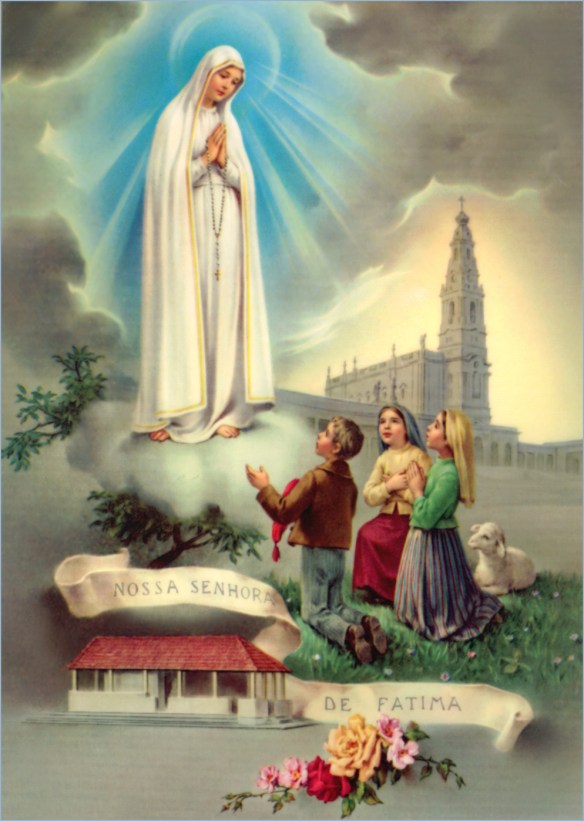
The twentieth century has been the bloodiest and most violent in the history of the world. During Mary’s visits to Fatima, Portugal, in 1917, she foretold not only the terrors of the Russian Revolution and World War II, but also made a third prediction, never released, as it was judged far too terrifying.  In her visits she stressed the recitation of the rosary and taking fifteen minutes to meditate on her Immaculate Heart each week. Expressing the feeling that humanity had drifted away from God, she wanted the world to offer up reparations for the disastrous state of the earth. Our Lady of Fatima is an angry and pained mother, demanding that the world come to its senses and honor its Creator.

Her rules are strict. This novena is said to honor Mary and to atone for the blasphemies and ingratitude that are heaped upon God and his creations. Coming in the midst of the first World War, her warnings were pointedly political. She predicted the suffering imposed by the Communist states as well as the incredible carnage of the next world war. She strongly commanded all of humanity to pray the rosary, insisting this is the only road to peace. On May 13, 1917, three young shepherd children, aged ten, nine, and seven – Lucia, Antonio, and Maria dos Santos – were out tending sheep at a place called Cova da Iria in Fatima. Mary appeared to them in a dazzling light, floating above the trees. She taught them how to pray the rosary and told them she would return on the thirteenth day of each month for the next five months. Though they were initially mocked for their story, a handful of people accompanied them when they returned to the location of Mary’s visit on the thirteenth of June. There they witnessed a burst of lightning and heard the buzzing of bees. The three children stood transfixed, almost fainting with fright. By Mary’s final visit, on October 13, there were several thousand people waiting for her to appear.

It had been pouring rain for two days, and a local priest, who’d believed the children were lying, tried to disperse the crowd. In the east a bolt of lightning rang out and the rain stopped instantly. As the clouds parted, the people looking at the sun fell to their knees. It had begun to tremble and dance, and the entire crowd was engulfed by the spectrum of colors streaming from it. Some saw the face of the Virgin in the sky; others saw a huge whirling wheel of fire spinning toward the earth. The heat emanating from the rays of lights was so intense that by the end of the vision, ten minutes later, those soaked by the rain were completely dry. As far as thirty miles away, people reported sighting strange light forms in the sky.

There were many journalists present who recorded this story, and it filled the newspapers. It was called, “the Miracle of the Sun,” and it is thought that Mary orchestrated it in order to force the world to believe the predictions she had communicated to the three children.

Novena Prayer to Our Lady of Fatima

Most holy Virgin, who came to Fatima to reveal to the three shepherd children the treasures of graces hidden in the recitation of the rosary, inspire our hearts with a sincere love of this devotion, so that by meditating on the mysteries of our redemption that are recalled in it, we may gather their fruits and obtain the conversion of sinners, the conversion of Russia, and (Mention your requests) Which we ask of you in this novena, for the greater glory of God, for your own honor, and for the good of people. Amen   Recite one Our Father, one Hail Mary, one Glory Be   Our Lady of the Rosary of Fatima, pray for us!   Recite this novena nine times in a row for nine days in a row.

Saint Jude Thaddeus, First Century

St.Jude
Feast day: October 28

When all else fails, when we are in the most difficult of situations, we turn to Saint Jude, “Helper of the Helpless” and Saint of the Impossible.

Patron of: Impossible Causes

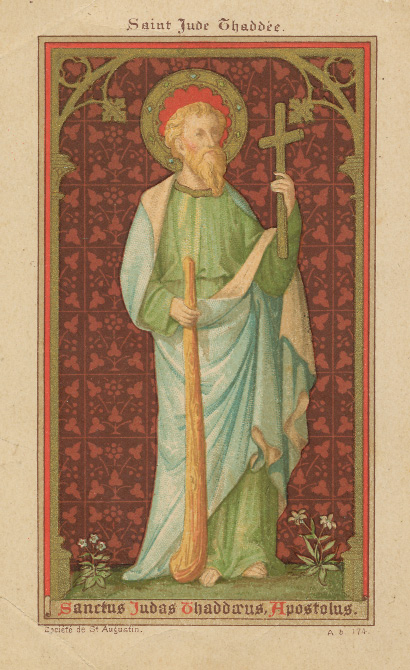
One of the original 12 apostles, Jude is depicted with the flame of knowledge received from the Holy Spirit at the Pentecost burning above his head. Brother of James the Lesser and cousin of Jesus, Jude was one of Christ’s earliest followers. He earned his title of Patron Saint of Impossible Causes because of a letter he wrote in 60AD to persecuted Christian converts in the East, exhorting them to stay strong in the face of all difficulties.

The name Jude means giver of joy and the name Thaddeus means great hearted one and this saint was said to live up to his name, attracting immense crowds by preaching in an entertaining way, outwitting magicians and local priests. Abgar, the King of Edessa was quite impressed with Jude and appealed to Jesus cure his leprosy. He sent an artist to draw Christ’s image. The artist was so shaken by the glow in Christ’s eyes, he could not draw. Christ wiped his face with a cloth and the image of his face was transferred to it. Jude brought the cloth back to Abgar and the king rubbed the cloth over his body, curing himself of leprosy. Many depictions and statues of Saint Jude include this cloth with Christ’s image on it. Jude was martyred along with Saint Simon in the city of Samir by being beaten with a club. This club, as well as the palms of martyrdom are also part of his iconography.

The cult of Saint Jude all but died out after the Middle Ages because people confused him with Judas Iscariot, the apostle who betrayed Christ. Despite being cited as a great influence by the mystics Saint Bernard of Clairvaux and Saint Bridget of Sweden, Jude was rarely invoked by the faithful for anything. It is said that because of this, he became the saint to call on in the most impossible of situations. So anxious was he to be of help, he would turn heaven and earth to rectify a desperate situation. By the nineteenth century, it became customary to thank the saint for help with answered prayers by taking an ad in the newspaper. This helped to resurrect his popularity and these small “Thank you Saint Jude” ads can be found in many weekly and daily periodicals in present day.

Novena

Glorious apostle, Saint Jude Thaddeus, I salute you through the Sacred Heart of Jesus. Through his heart I praise and thank God for all the graces he has bestowed upon you. I implore you, through his love, to look upon me with compassion. Do not despise my poor prayer. Do not let my trust be confounded! God has granted to you the privilege of aiding mankind in the most desperate cases. Oh, come to my aid that I may praise the mercies of God! All my life I will be your grateful client until I can thank you in heaven. (Mention your request here).

Saint Jude, pray for us, and for all who invoke your aid.

Excerpted from the Novena App.

Feast of St. Peregrine 1265 – 1345, May 1

St.Peregrine
 “You had recourse to the source of all grace when the power of man could do no more”

St. Peregrine 1265 – 1345
Patron of: Cancer

A victim of cancer himself, Saint Peregrine not only had to accept the reality of his illness, but also the instantaneous healing of that disease through the intercession of Christ. For this reason he is invoked for medical breakthroughs as well as for those suffering from cancer, running sores and other incurable diseases.

A wealthy young man from the town of Forli, Italy, Peregrine was a political leader of the local anti-Papist party. His rabble rousing against the power of the Pope and his early disdain for the Church makes him an unlikely saint. When a papal representative, Philip Benizi the prior general of the Servants of Mary journeyed to Forli to preach and to attempt a reconciliation between the rival political factions, Peregrine and his men broke up the crowds attending the speech. Peregrine himself slapped Benizi in the face. Instead of inciting Benizi to retaliate, he received a kindly look of forgiveness which so stunned Peregrine, that he collapsed in shame over his actions.

Since the Servants of Mary are devoted to the Blessed Mother, Benizi advised Peregrine to transform his life by cultivating a childlike devotion to Mary. While meditating in the cathedral at Forli, Peregrine had a vision of Mary instructing him to go to Siena and join the religious order of the Servants of Mary. Returning to Forli as a priest in that order, Peregrine devoted himself to the poor, the sick and the outcasts of society.

Many reported being healed during his inspirational masses. Peregrine imposed a personal penance on himself of never sitting down unless he had to. He also slept on the ground, using a stone for a pillow. After 30 years of such deprivation he developed severe varicose veins and an incurable running sore down his leg. This led to a diagnosis of cancer, the only cure possible was amputation. Resigning himself to the same fate as those he had served, Peregrine reluctantly agreed to the surgery.

Praying in the chapel on the eve of the operation he fell into a trancelike sleep where he experienced the figure of Christ getting off of the cross to touch his leg. When he awoke, there was no trace of illness in his leg and it was deemed to be completely healed. Because of this miracle, the incurably ill flocked to Forli for Peregrine’s healing prayers. Peregrine continued his mission for the next 20 years, dying at the age of 80. In modern times, many still make the pilgrimage to his tomb and there are thousands of healing societies bearing his name throughout the world.

Novena

O great Saint Peregrine, you have been called “the Mighty” and the “Wonder Worker” because of the numerous miracles you have had recourse to, for so many years you bore in your own flesh this cancerous disease that destroys the very fiber of our being, and you had recourse to the source of all grace when the power of man could do no more.

You were favored with the vision of Jesus coming down from his cross to heal your affliction. Ask of God, and our Lady the cure of these sick persons whom we entrust to you. Aided in this way by your powerful intercession, we shall sing to God, now and for all eternity, a song of gratitude for his great goodness and mercy.

(Mention your request.)

Saint Peregrine, pray for me and for all who invoke your aid. Amen

Saint Catherine of Siena

1347—1380

Feast Day is April 29

S. Catharina Senensis* is the patron saint of Fire Protection, Italy, Nursing Services, Activism

Action and activism are the essence of Saint Catherine of Siena. Passionately devoted to the salvation of mankind, she left an astounding legacy of four hundred written letters and a devotional Dialogue that are considered great classics in literature. She is credited with influencing the return of the papacy to Rome from Avignon, and for this reason she is the patroness of Italy. Known for her incredible charm, she horrified her wealthy parents by her willingness to express her devotion to Christ through corporal humiliations and long periods of fasting. Counselor and advisor to those in power, it was said that she perfected the art of kissing the Pope’s feet while simultaneously twisting his arm. Saint Catherine struggled against great odds to keep the Catholic Church united. Her novena is a call to faith in troubled times. She is invoked to engender the strength and faith for action in times when action is needed, both political and spiritual.

Born Caterina Benincasa, the youngest of twenty—five children, Saint Catherine’s father was a wealthy dyer. At the age of six she had a mystical vision of Christ surrounded by saints. A beautiful and cheerful child, she alarmed her parents by spending much of her time in prayer and meditation. She grew devoted to Christ and, like him, wanted to take on the suffering of the entire world, secretly mortifying her flesh and fasting for days.

Saint Catherine is the patroness of fire protection because her sister saw her deep in prayer in the kitchen, engulfed in flames from the stove. When she was pulled out, there was no evidence of burn marks on her body. Her parents, wanting a normal daughter, were angry at her refusal to marry or to improve her personal appearance. They finally gave in to her religious cravings and allowed her to become a tertiary (lay person) in the Order of Saint Dominic. She lived at home and went out to work, caring for those with the most repulsive diseases when no one else would help them. For this reason, Saint Catherine is also known as the patron saint of nursing services. Because of her great spiritual insight and radiantly happy outlook, she attracted a following in Siena known as the Caterinati.

They did much to revitalize an interest in spirituality in Siena and its surrounding regions. On the Fourth Sunday of Lent in 1375, Saint Catherine received the stigmata; the wounds of Christ appeared on her body and then disappeared, visible only to her.

Illiterate, Saint Catherine dictated hundreds of letters and spiritual writings to her secretaries. It was her constant barrage of letters to Pope Gregory XI that influenced him to move the papacy back from Avignon to Rome. She later became the advisor to his successor, the arrogant and difficult Urban VI. When he caused a great schism in the church, the College of Cardinals having voted in a rival Pope to return to Avignon, Saint Catherine remained loyal to Urban. She lectured him in countless letters on how to best improve himself. At his invitation, she moved to Rome to work as a papal adviser. When she died there of a stroke at the age of thirty—three, the wounds of the stigmata reappeared on her body.

Novena to Saint Catherine

Heavenly Father, your glory is in your saints. We praise your glory in the life of the admirable Saint Catherine of Siena, virgin and doctor of the church. Her whole life was a noble sacrifice inspired by an ardent love of Jesus, your unblemished lamb. In troubled times she strenuously upheld the rights of his beloved spouse, the church. Father, honor her merits and hear her prayers for each of us. Help us to pass unscathed through the corruption of this world. Help us always to see in the Vicar of Christ an anchor in the storms of life and a beacon of light to the harbor of your love, in this dark night of your times and men’s souls. Grant also to each of us our special petition. We ask this through
Jesus, your Son, in the bond of the Holy Spirit. Amen.

Pause to pray for your intentions Saint Catherine of Siena, pray for us.

Say this novena nine times in a row for nine days in a row.

The Prayer of St. Patrick

St.Patrick
I arise today
Through the strength of heaven;
Light of the sun,
Splendor of fire,
Speed of lightning,
Swiftness of the wind,
Depth of the sea,
Stability of the earth,
Firmness of the rock.

I arise today
Through God’s strength to pilot me;
God’s might to uphold me,
God’s wisdom to guide me,
God’s eye to look before me,
God’s ear to hear me,
God’s word to speak for me,
God’s hand to guard me,
God’s way to lie before me,
God’s shield to protect me,
God’s hosts to save me
Afar and anear,
Alone or in a mulitude.

Christ shield me today
Against wounding
Christ with me, Christ before me, Christ behind me,
Christ in me, Christ beneath me, Christ above me,
Christ on my right, Christ on my left,
Christ when I lie down, Christ when I sit down,
Christ in the heart of everyone who thinks of me,
Christ in the mouth of everyone who speaks of me,
Christ in the eye that sees me,
Christ in the ear that hears me.

I arise today
Through the mighty strength
Of the Lord of creation.

Read more at http://www.beliefnet.com/Prayers/Catholic/Morning/The-Prayer-Of-St-Patrick.aspx#CRjRA6usSrQVkwdG.99

Giveaway—40 Days of Lent— 40 novena app’s, 2018

NOVENA_APP_SPLASH_PAGE (2)To the first 40 people who send us their email, we will gift you novena app for the iPhone or iPad. Send email to dipasqua@nyc.rr.com.

36 Saints, prayer, history and artwork.

The saints, having been human, lived every type of earthly existence and it is in the details of their life stories that we find their patronages. By invoking the saints, we ask for guidance in overcoming our own earthly trials, much like one would ask advice of a family member or friend. Meditating on the lives of these remarkable people inspires us to conquer our own personal obstacles.

A novena is a nine day period of prayer. Usually the novena prayer is recited nine times in a row for nine consecutive days, the repetitive nature of the prayer serves to bring on a quiet and meditative state. When ones mind quiets down, it allows the solution to a problem to appear or even help in the acceptance of an unchangeable life challenge.

To help you find a saint that can aid you with your specific dilemma, we have divided this app of thirty-six saints into four categories: Health, Occupations, Situations and States of Life. You can find your saint by personally relating to their history, by being drawn to the illustrated depictions in their holy cards, or by searching the Glossary of extensive problems and life situations.

Our beautiful vintage holy cards depict the saints with the enigmatic attributes and symbols that are commonly used to represent them. Brief explanations of these symbols are given to help decipher the visual iconography in their images. The prayers in this app are universally known and have been used for centuries as tools in obtaining clarity and peace of mind. All are free to utilize them, regardless of one’s faith or religious belief.

Saint Valentine

st.v2

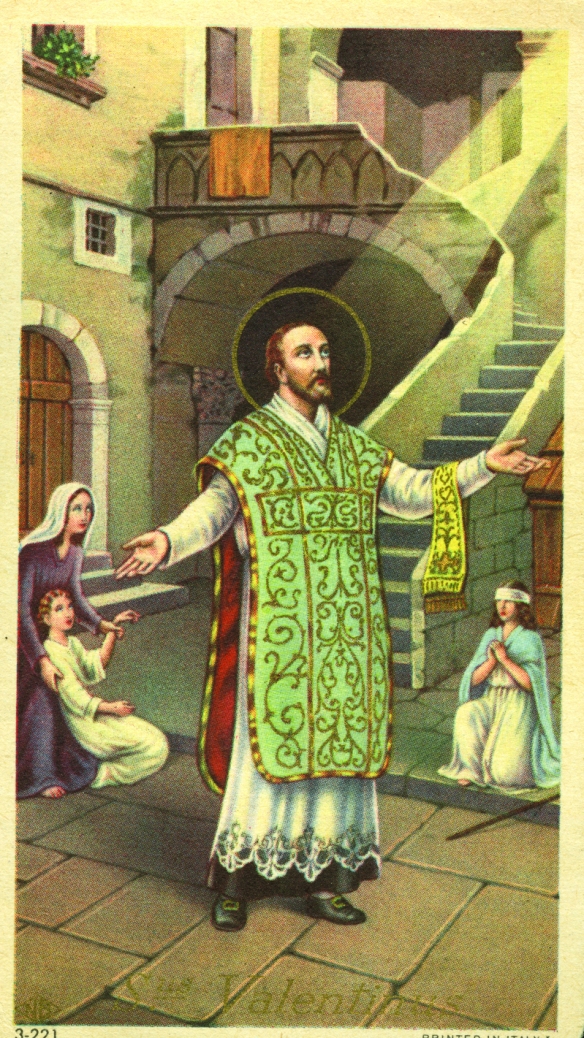
His feast day is embedded in Western civilization. His name has become synonymous with a certain type of romantic card, yet few realize that Valentine actually existed. As a saint, his first great work was to unite young couples in marriage. In the year a.d. 269, when the Roman Empire was under constant attack from barbarian tribes, Emperor Marcus Aurelius Claudius issued an edict outlawing marriage for young men. He speculated that more soldiers would join the legions to defend it if they were unfettered by wives and children. Valentine was a respected healer and priest in the outlawed Christian faith. He had great sympathy for those young couples whose plans for a life together were shattered by the state and he encouraged anyone who wished to wed to come to him to be married in secret. He was arrested and imprisoned in Rome for defying the emperor. But his reputation as a learned man remained untarnished and many of his followers would visit him in prison for counseling; others came for health cures.

Personally afflicted with epilepsy, Valentine was particularly drawn to treating those also suffering from the disease. The jailer, having witnessed many successful healings at Valentine’s cell door, asked the saint to treat his daughter, who had been blind since birth. During her subsequent visits to the prison, Valentine read to the girl, taught her mathematics, and beautifully described the natural world. Valentine’s wisdom and kindness so impressed the jailer and his family that they converted to Christianity despite the fact that the young girl remained blind. This conversion established Valentine’s status as a true threat to the state, a charge punishable by death. His execution came on February 14, the eve of the Roman festival of Lupercalia. Valentine was beaten with clubs and then beheaded. Before his sentence was carried out however, he sent a yellow crocus to the jailer’s daughter enclosed with a note that read, “With love, from your Valentine.” The bright color of this flower was the first thing she ever saw, her eyesight having been miraculously restored. She is said to have planted an almond tree on Valentine’s grave, and to this day the almond tree is considered a symbol of friendship and devotion. Valentine was buried on the Flaminian Way in a catacomb that still bears his name. A church was dedicated to him there in a.d. 496. The wall of the city, the original Flaminian Gate, was a pilgrim’s first stop upon entering Rome and was known as Porta S. Valentino until the seventeenth century, when it was renamed Porta del Popolo. In the ninth century, relics of the early martyrs were removed from the catacombs and transferred to local Roman churches. Valentine, too, was reinterred in the church. His body was moved to the church of Saint Praxedes, very near his original burial place. Many cities besides Rome claim his relics, among them Terni, Italy; Madrid, Spain; Dublin, Ireland; Glasgow, Scotland; and Rocamador, France.

It is no coincidence that the liturgical feast day of the patron saint of love falls on the eve of Lupercalia, an erotic Roman fertility festival. It was common practice for church holidays to coopt pagan celebrations. The Romans considered this the official beginning of Spring, a time of reawakening fertility and warming weather. One of the activities held in honor of the goddess Februata Juno consisted of the city’s bachelors drawing the names of unmarried women out of an urn. They would then become a couple for the rest of the year, with many of these matches resulting in marriage. In twelfth century southern France, this practice was reawakened as part of the Langue d’Oc poetry movement. This was a time when art and literature took on a heightened importance to the ruling classes. Noble youths known as gallants wrote missives of love they called galantines. The local pronunciation confused this with the word valentine and Valentines clubs sprang up.

On February 14, after a Mass in honor of Love, a silver casket containing the names of unmarried local men was presented to the single women in town. The men whose names each woman drew was required to be the guardian of that lady, providing her with flowers, poems, and gifts throughout the year. He was to guard her honor chivalrously. Marriage between these Valentines was strictly forbidden. Because of the wide dispersal of his remains, the cult of Saint Valentine became extremely popular in Northern Italy, southern France, and England. His head, which was reputed to be in England, was said to bestow incredible miracles and healings on those who kissed it. Since the middle of February was considered the time of year when birds began to pair, the English, like the Romans a thousand years before them, looked upon this as the beginning of mating season. Celebrating the Feast of Saint Valentine by citing the fidelity of doves seems to be an English tradition.

The oldest valentine note in existence today was written by Charles, Duke of Orleans, to his wife in 1415, while he was imprisoned in the tower of London. By the middle, nineteenth century sending and receiving anonymous Valentine’s cards and poems declaring one’s love became common in both America and England. By then, the story of the saint who had inspired this industry might have faded away, but his name and feast day is celebrated universally.

Prayer to Saint Valentine

O glorious advocate and protector, Saint Valentine, look with pity upon our wants, hear our requests, attend to our prayers, relieve by your intercession the miseries under which we labor, and obtain for us the divine blessing, that we may be found worthy to join you in praising the Almighty for all eternity; through the merits of Our Lord Jesus Christ. Amen.

Feast of Saint Adelaide, December 16

adIMG

Born 931

Patron Saint of Brides

Considered the most famous woman of her time. Adelaide was married twice. Her first marriage was arranged and ended with her husbands death three years later. Eventually she married Otto the Great with whom she had four children. Adelaide’s life was full of drama, including exile and raising her grandchildren.

She is one of the saints in Saints for All Occasions Notecards.

“These notecards are amazing – simply beautiful. They can be used for any occasion. We recently used these notecards for a retreat – they were so inspirational for those who received them.”—Rosie PS, Amazon review

Excerpt from Novena: The Power of Prayer—Novena to The Infant of Prague

Infant
The Feast of the Infant of Prague is the same day as The Holy Name of Jesus, January 14.

Appeal to the Infant of Prague in times of desperation, to stop an epidemic or for abundance

Few novenas promise the instantaneous results of those to the Infant of Prague. It necessitates a suspension of all doubt as it is completed in one day over a nine—hour time span. Perhaps the most invoked aspect of Christ in the world, this novena promises that anything is possible for those who believe. Christ is presented as both a kindly child and a king. The Infant of Prague is a statue of the child Jesus dressed in actual clothing. Instead of the modest garments of a poor child, he is wearing the sumptuous gown of royalty. Because the Infant of Prague looks like a little doll, we are welcome to approach him with the open faith of a child. Reflecting the faith of Jesus, the novena requires an intensity of devotion.

Many people have a version of this statue in their homes, as it is said to guarantee abundance. This novena, frequently utilized by those in financial difficulties, can be said during any desperate situation. The Divine Child, a nineteen—inch wax sculpture, was brought to Prague, Czechoslovakia, by a Spanish princess who received it from her mother as a wedding gift. She in turn, bequeathed it to her daughter, Princess Polyxena. On becoming a widow in 1623, Polyxena decided to devote the rest of her life to doing charitable works. The extremely poor order of Carmelite monks of Prague were her favorite beneficiaries. Bringing the statue, she promised, “As long as you will venerate this image, you will not lack anything.” The statue of the Divine Child was installed in the chapel, and the monks became aware of an immediate change in their material and spiritual fortunes. In 1631 the monks had to flee their monastery because of an invasion by Sweden. In the ensuing confusion the statue was left behind, only to be thrown on a trash heap by the invading army. Miraculously, it was found seven years later by a priest named Father Cyril, who had been particularly devoted to the Divine Infant. Though it was made of wax, the only damage sustained by the statue was its missing hands.

Devotions to the Divine Infant, returned to its altar in the chapel as the once again poverty—stricken Carmelites began to rebuild their monastery, were revived with great fervor. While Father Cyril was praying before the statue, he heard the words: “Have pity on me and I will have pity on you. Give me my hands and I will give you peace.” Though money came to the order, it was felt that it should be put to use for more important causes than the repair of a statue. Again Father Cyril heard a voice while in prayer: “Place me near the entrance of the sacristy and you will receive aid.” A passing stranger, seeing the broken statue, offered to have it repaired. When the Divine Infant seemed to be responsible for several cures during an epidemic, the priests moved the statue to the main church so that the public could also benefit from its graces. In 1642 Baroness Benigna von Lopkowitz had a beautiful chapel built for the Divine Infant, where it remains to this day. Many make pilgrimages to Prague to see the original little statue that has inspired so many copies around the world.

Powerful Novena in Times of Distress to the Infant of Prague

Divine Infant of Prague, dearest Jesus, you who so lovingly said, “Ask and it shall be given you; seek and you shall find; knock and it shall be opened to you,” have mercy on me now, and through the intercession of our most holy Mother, I humbly ask you to grant me the grace I need. Mention your request Divine Infant of Prague, dearest Jesus, you who so compassionately taught, “If you can believe, all things are possible to him who believes,” have pity on me now. I do believe; help me. Increase my weak faith through the Blessed Mother’s intercession.

I humbly ask you to answer my request. Mention your request Divine Infant of Prague, dearest Jesus, you who once said to the Apostles: “If you have faith like a mustard seed, you will say to the mulberry tree, ‘Be uprooted and be planted in the sea,’ and it will obey you.” Hear my prayer, I humbly ask.

Through the intercession of Mary most holy, I feel certain that my prayer will be answered. Mention your request.

Because this novena is said for those in great distress or emergency situations, it is completed in one day.

Say this novena nine times in a row at the same time every hour for nine consecutive hours.

Visions of Mary: Our Lady of Fatima

fatima12c-seers

Our Lady of Fatima is the patroness of Portugal.
Feast day: May 13.

The twentieth century was the first time in history where we ourselves had the ability to destroy not only the entire human race but all other forms of life on this planet. During World War I, the violence of which people had never seen before, Mary came to Fatima with a very serious warning. Expressing the belief that humankind had drifted away from God, she wanted the world to offer up reparations for the disastrous state of the earth. Fatima is the most prophetic of Mary’s apparitions. She correctly foretold the suffering imposed by the Communist states and the carnage of World War II. The third secret of Fatima was deemed too terrifying to release. It was finally revealed by the Vatican on May 13, 2000, in the hopes of what it had predicted had passed. Others strongly disagree with the Vatican’s interpretation and insist it is a portent of the end of the world. Our Lady of Fatima is an angry, pained mother, demanding that her children take action before it is too late.
It is said that Mary usually appears to the simplest and least complicated of people because they do not try to judge or interpret what she says, they merely report it. For this reason, many times her visionaries are children. In 1916, a nine-year-old girl from Fatima, Portugal, named Lucia dos Santos was out tending sheep with her two younger cousins, Francisco and Jacinta. They were happily playing a little game with stones when they saw an immense light come from the sky in their direction. At the center of the light was a translucent angelic form.

“Do not be afraid!” he said. “I am the Angel of Peace. Pray with me.” Kneeling, he bowed down until his forehead touched the ground. He taught them a prayer that he made them repeat three times. “My God, I believe, I adore, I trust and I love You! I ask pardon of You for those who do not believe, do not adore, do not trust and do not love You.” Rising, he told them, “Pray thus. The hearts of Jesus and Mary are attentive to the words of your prayers.”
This was not the first time Lucia had seen this angel. When she had previously tended sheep with other companions she had witnessed the light of the angel overhead. When her friends had told their parents what they had seen, they were all accused of fabricating a story out of boredom. Because of this, Jacinta convinced her younger cousins to keep the angelic visit a secret. All three children began praying in the manner taught to them by the angel. Toward the end of summer they received another visit from the angel admonishing them for frittering so much time away in play. He told them he was Guardian Angel of Portugal and that God was offended by the sins of others. He advised the children to pray more and “Above all, accept and bear with submission, all the suffering which the Lord allows in your lives. In this way you will draw down peace upon your country.” Before winter came they received one more visit from this angel telling them that Jesus Christ was outraged by ungrateful and indifferent men. He implored them to keep praying and gave them Communion.
The children continued to work, play, and pray together throughout the winter months. On Sunday. May 13, 1917, they were leading their flocks to a grazing field called the Cova da Iria. They were frightened by flashes of lightning and were shocked to see a beautiful lady who glowed brighter than the sun. When she spoke to them, Lucia was the only one who could hear her, “Fear not, I will not harm you. I am from heaven.”

When Lucia asked her what it was she wanted, the lady answered, “I ask you to come here for six consecutive months, on the thirteenth day at this same hour. I will tell you later who I am and why I have come to you. I shall return here again a seventh time.”

Lucia asked if they could go to heaven with the lady, and she was told that they would all come to heaven with her but that “Francisco must pray many rosaries.” She added, “Let him pray the rosary. In that way he too will be able to see me.” Francisco had only seen Lucia talking to a bright light. He said one decade of the rosary, and he, too, was able to see the lady. Streams of light radiated onto the children from the lady’s hands. As she left them, she told the children, “Say the rosary every day to earn peace for the world and the end of the war.”
Lucia’s family and friends greeted her story about the lady with scorn and mockery. Her cousins had a different experience. Their father believing that they truly had some sort of celestial vision, protected and respected them. On June 13 about fifty people accompanied the children to the Cova da Iria. Lucia called Jacinta out of a group of playing children, the lightning had started to flash even though it was a beautiful day. Lucia, Jacinta, and Francisco ran toward the oak tree where they had seen the lady a month before. Though others in the crowd could not see her, some reported hearing a “buzzing noise” or a “tiny little voice.” The lady, enveloped in a mystical light, taught the children a prayer, and made the following promise to the world, “I promise salvation to those who embrace devotion to my Immaculate Heart. Their souls will be loved by God as flowers placed by me to adorn His throne. These souls will suffer a great deal but I will never leave them. My Immaculate Heart will be their refuge, the way that will lead them to God.” She again showered the children with light from her hands. People in the crowd heard a “rushing sound” and the three children shouted, “There she goes, there she goes!” as they pointed to the sky in the east. To everyone’s amazement, the branches of the tree, which had been standing straight up a few minutes before, were also pointing to the east.

The third visit, which took place on July 13 was attended by thousands of believers, cynics, and those searching for miracles. Lucia has written that between the past month and this day she was continually tormented by self-doubt. No one in her immediate family seemed to believe her, perhaps this was all a trick of her mind. The large crowd quieted down as they heard a buzzing sound. A cloud moved in over the oak tree. They watched as Lucia, enraptured, appeared to be having a conversation with the cloud. At one point, the girl cried out in horror. After a few minutes, there was the sound of thunder and the cloud lifted. The children waved good-bye to it. When asked what made her cry out, Lucia said, “It was a secret.” In her own memoirs, she wrote that as the lady started to appear all her doubts about whether this was really happening or not left her forever. In this visit, the famous Three Secrets of Fatima were imparted to the children.

The local government looked upon the growing interest in the alleged apparitions in Fatima as a dangerous threat to its sovereignty. The royalists had recently been driven out of government and religion was looked upon as equaling royalism. Many monasteries and parochial schools had been closed down. The prime minister had promised that within twenty years all trace of religion would be gone from Portugal. The fourth apparition of the lady took place on August 13. Almost fifteen thousand people were gathered in the Cova da Iria, but Lucia, Jacinta and Francisco were locked in the town jail. Even without the seers the crowd witnessed the cloud hovering over the oak tree, there were sounds of explosions, and the ground shook A mystical light showered the crowd, reflecting all the colors of the rainbow. While this was happening, each of the children were separately questioned for hours. They refused to give up the secrets they were told by the lady. Though each was told that the other had completely recanted their story of the lady, not one of them would change their personal account. As a last resort the mayor told them that obviously there were no secrets, and he was going to boil them in oil if they did not admit the apparitions were all a lie. Instead of collapsing in hysteria, the three remained silent, and the children were released on August 15.

The lady came to them in the area near their village and told them she wanted them to continue their pilgrimages to the Cova da Iria on the thirteenth of the month. She also told them to pray the rosary every day. “Pray. Pray very much, and make sacrifices for sinners. So many souls go to hell because there is no one to pray and make sacrifices for them.” The seriousness with which the children took her words greatly altered their personalities. Neighbors who once mocked them became their biggest defenders.
By the September 13 apparition, there were over thirty thousand people in the Cova da Iria. In the middle of a cloudless sky, many witnessed a luminous globe moving from east to west. According to Lucia, the lady asked the people to pray the rosary to obtain the end of the war. She also promised that she would perform a miracle on her next and last visit so that everyone would believe.

The apparition of October 13 is widely documented and was reported by newspapers all over the world. Even the most anticlerical Portuguese news agencies reported that there were “strange natural phenomenon” that had occurred in front of a crowd of at least fifty thousand people. Despite heavy rains, pilgrims arrived to the little town, most of them on foot. A few minutes before 1:30 in the afternoon it stopped raining. What happened next has been detailed by news reporters (most of whom were extremely skeptical of the children), eyewitnesses in the crowd, professors from the university, government officials, and even those who lived miles away. The sun appeared through the clouds, shone very brightly, and began to tremble and dance, whirling through the sky in a dizzying speed it cast all the colors of the rainbow on the crowd. The crowd began shouting for the Virgin Mary. The strange movements and light from the sun lasted a few minutes before returning to its natural place in the sky. The crowd, who had been soaked to the skin were now completely dry. As for the children, they were unaware of any “dance of the sun,” they had been communing with Mary.

According to Lucia, “When Our Lady disappeared in the immense distance of the sky, next to the sun we saw Saint Joseph holding the Child Jesus and Our Lady dressed in white with a blue mantle. Saint Joseph seemed to be blessing the world, making the sign of the cross. Shortly after this vision had vanished, I saw Our Lord and Our Lady who reminded me of Our Lady of Sorrows. Our Lord was blessing the world as was Saint Joseph. This vision vanished too, and it seemed to me I again saw Our Lady in a form resembling that of Our Lady of Mount Carmel.”

The story of Our Lady of Fatima had worldwide repercussions, and Fatima became a major pilgrimage site. It is visited by 5 million Marian devotees a year. The three seers were hounded by the sick, the desperate, and the curious. Jacinta and Francisco died during the flu epidemic of 1918. Lucia joined a convent in May 1921. She is still alive at this writing.
In 1941, Lucia allowed the first two secrets of Fatima to be released. According to her memoir,

The first part is the vision of hell. Our Lady showed us a great sea of fire which seemed to be under the earth. Plunged in this fire were demons and souls in human form, like transparent burning embers, all blackened or burnished bronze, floating about in the conflagration, now raised into the air by flames that issued from within themselves together with great clouds of smoke, now falling back on every side like sparks in a huge fire, without weight or equilibrium, and amid shrieks and groans fo pain and despair, which horrified us and made us tremble with fear. The demons could be distinguished by their terrifying and repulsive likeness to frightful and unknown animals, all black and transparent. This vision lasted but an instant. How can we ever be grateful enough to our kind heavenly mother, who had already prepared us by promising, in the first apparition, to take us to heaven. Otherwise, I think we would have died of fear and terror. We then looked up at Our Lady, who said to us so kindly and sadly, “You have seen hell where the souls of poor sinners go. To save them, God wishes to establish in the world devotion to my Immaculate Heart. If what I say to you is done, many souls will be saved and there will be peace. The war is going to end: but if people do not cease offending God, a worse one will break out during the Pontificate of Pius XI. When you see a night illumined by an unknown light, know that this is the great sign given you by God that he is about to punish the world for its crimes, by means of war, famine and persecutions of the Church. The good will be martyred; the Holy Father will have much to suffer; various nations will be annihilated. In the end, my Immaculate Heart will triumph. The Holy Father will consecrate Russia to me, and she shall be converted, and a period of peace will be granted the world.

Lucia was so confused by the content of the third secret, that she placed it in an envelope and sent it to the Vatican with the instructions that it was not to be opened until the year 1960. Pope John XXIII chose not to release it upon reading it, Paul VI also kept it a secret. On May 13, 1981, the Feast of Our Lady of Fatima, an assassin fired a bullet at Pope John Paul II as he was out greeting the pilgrims in Saint Peter’s Square. He impulsively bent down to hug a little girl wearing an Our Lady of Fatima medal and the bullet only wounded him instead of killing him. He has always credited Our Lady of Fatima with saving his life. It was he who decided to release the third secret on May 13, 2000, to mark the beatification of Francisco and Jacinta. Lucia met with him beforehand and approved of the action.
This is the third secret as released by the Vatican:

After the two parts which I have already explained, at the left of Our Lady and a little above, we saw an Angel with a flaming sword in his left hand; flashing, it gave out flames that looked as though they would set the world on fire; but they died out in contact with the splendor that Our Lady radiated towards him from her right hand: pointing to the earth with his right hand, the angel cried out: “Penance, Penance, Penance.” And we saw in an immense light that is God: something similar to how people appear in a mirror when they pass in front of it, a bishop dressed in white, we had the impression it was the Holy Father. Other bishops, priests, men and women religious going up a steep mountain, at the top of which there was a big cross of rough-hewn trunks of a cork-tree with the bark; before reaching there the Holy Father passed through a big city half in ruins and trembling with halting step, afflicted with pain and sorrow, he prayed for the souls of the corpses he met on his way. Having reached the top of the mountain, on his knees at the foot of the big cross he was killed by a group of soldiers who fired bullets and arrows at him, and in the same way there died one after another the other bishops, priests, men and women religious, and various lay people of different ranks and positions. Beneath the two arms of the cross there were two angels each with a crystal aspersorium in his hand, in which they gathered up the blood of the martyrs and with it sprinkled the souls that were making their way to God.

Pope John Paul II felt that this last secret was a symbol of the attempt on his life. The Russian Revolution brought into the world a society that outlawed spirituality and religious practices. By the last half of the twentieth century, communism had engulfed many nations under this umbrella. Coming from Poland, Pope John Paul II was a force to be reckoned with. He inspired many in those countries to rebel against the totalitarian system. He felt the prayers Our Lady of Fatima asked for helped to change the course of history and the visions given to the three children.