FRA ANGELICO

This fall, Florence will celebrate the work of Fra Angelico with a major retrospective—the city’s first in seventy years—at both the Palazzo Strozzi and the Museo di San Marco, opening on September 26. For the occasion, Ben Street writes about the resonance of Fra Angelico’s work in modern and contemporary art.

In September 1968, the Metropolitan Museum of Art, New York, staged its exhibition The Great Age of Fresco: Giotto to Pontormo. An Exhibition of Mural Paintings and Monumental Drawings. Two years before it opened, devastating floodwaters had surged through many Italian cities, causing extensive damage to historical sites and killing over 100 people. The wall paintings on show at the Met had been salvaged from ancient buildings whose structures were sodden with rising water. What this delicate process of removal and remounting had revealed were the underdrawings, or sinopias, that had been until then hidden beneath layers of plaster and pigment, ostensibly forever. The revelation of these huge drawings, and their display in New York, obliged a reappraisal of what Renaissance painting was—and what contemporary art could be. In a 2009 essay for October, “Why Would Anyone Want to Draw on the Wall?,” conceptual artist Mel Bochner looked back at his encounter with these works at the Met and answered his own question by declaring that large-scale wall work could “negate the gap between lived time and pictorial time.” The problem of painting in the late ’60s—its apparent inability to speak beyond itself, to rub up against the issues of its moment—found an unlikely solution in centuries-old works of art, for which that gap barely existed.

It was easy enough to pass by Fra Angelico’s work in the 1968 exhibition. Compared to the huge sinopias of his fellow Florentines Andrea del Castagno and Paolo Uccello, his contribution was small: three or four sinopias, saved from sites in and around Florence just after the floods. One of these, a Virgin and Child in rust-red pigment (the term “sinopia” refers to that material, almost always used in underdrawings), charms for its repeated attempts to nail the crook of the baby’s elbow. It has a tentativeness absent from the artist’s completed works. Yet Bochner’s claim that Renaissance wall painting could suggest “a new site, a new scale, a new sense of time” for contemporary art resounds in those of Angelico’s frescoes that remain in their original locations more strongly than in the work of any of his peers. You can see this for yourself: Step off the street in Florence and into the whitewashed cloister of the Dominican monastery of San Marco. Ascend the steep stairs to the top floor, where long corridors are punctuated by arched doorways. Within each of these is a monk’s cell containing a single fresco by Angelico. Each is an argument in paint for the interdependence of life and art. Each says: What gap?

Take this one. An angel with rainbow wings stands before a woman who, like her, is pale, thin, and haloed. Her arms folded in front of her, with right hand up and left hand down, the angel is silently communicating something, announcing something. The woman (a girl, really) echoes that arms-folded gesture, her right fingers holding open the book she’s been reading up to this moment. Those up-and-down gestures condense the subject of the painting: It’s a meeting of worlds, the up and the down, immortal and mortal, heaven and earth. Held still in front of the bellies of the two figures, the gesture also anticipates what’s coming next, namely the birth of a child, who’ll be held in a similar gesture, as babies tend to be. The painting’s subject is the annunciation of the birth of Jesus to Mary by the Archangel Gabriel, but none of Angelico’s presumed viewers would need that story spelled out. It’s entry-level Christian narrative, familiar to even a novice Dominican. Instead, Angelico leans into the implications of the story. That cloister you passed through on the way here, designed by the architect Michelozzo in the late 1430s—contemporary, that is, with Angelico’s fresco—is clearly the model for the painting’s plain architectural interior. The cool Tuscan light that picks out the folds of Gabriel’s garment is the same light illuminating you. And a robed figure behind Gabriel—a man with an alarming gash in his head, the blood dribbling down—is a modern figure, inserted into the ancient narrative: Saint Peter Martyr, a Dominican saint murdered a century before the painting was made. The complex temporality of the work makes demands on its viewers even now. What it means is that the painting is both about the interaction of heaven and earth and is that. Literally embedded in the walls of the monastery, the painting collapses real and painted space, lived and pictorial time: It extends art into life, and vice versa.

Even the name of Fra Angelico has something of the divine about it, yet it wasn’t a name he knew. He was born Guido di Pietro in the Mugello valley north of Florence, sometime toward the end of the fourteenth century. His first recorded paintings coincide with the beginning of his life as a monk; it’s impossible, then, to separate his artistic production from his spiritual life, as the posthumous name “Fra Angelico” (meaning “Angelic friar,” a name that emerged within a decade or so of his death) reflects. By the middle of the nineteenth century, critics such as John Ruskin were asserting (without evidence) that his “purity of life . . . and natural sweetness of disposition” accounted for the spiritual sincerity of his art. In 1982, he was beatified by Pope John Paul II—the only artist thus far to have received that honor, making him the default patron saint of artists. That status provided a framework, perhaps misleading, for understanding his art as a direct expression of spiritual purity. It also set him apart from his contemporaries, many of whom, such as Donatello and Piero di Cosimo, were quite happy to produce images of Roman gods and goddesses for private patrons, something it’s impossible to imagine Angelico doing.

This and other qualities make him an anachronistic figure, whose work never quite shook off the decorative Gothic elements and serene abstraction of his earliest work, from the 1420s. Well into his career he was making ethereal paintings with backgrounds of pure gold leaf while his peers had moved on to more naturalistic settings and anatomies. The 2025 exhibition at the Palazzo Strozzi and the Museo di San Marco, the first in Florence in seventy years, reiterates the case for Angelico’s place within the constellation of Renaissance household names, showing newly restored paintings and reuniting altarpieces dismantled in the nineteenth century. Yet Angelico resists such company. His work troubles the clean break between medieval and modern worlds. And that generative anachronism accounts for his reappraisal in the work of artists centuries after his death in Rome in 1455.

https://gagosian.com/quarterly/2025/08/20/essay-fra-angelico/

Feast of Our Lady of Pompeii

Gathered round the gentle person of Our Lady of Pompei, let us resolve to call on her every day for our needs and the needs of the world.

We are surrounded by a society that needs more than ever the light of the Gospel. Our world is seeking peace. There are so many sufferings that cry out for help. There is such a great longing for justice and charity!

We wish to entrust our hopes to Mary’s motherly intercession. With the repetition of the prayers of the Rosary, we will turn to Mary with the insistent, trusting prayer of a child to his mother.
—Cardinal Angelo Sodano

Prayer to Our Lady of Pompeii
Remember, O most gracious Virgin of the Rosary of Pompei, that never was it known that anyone who fled to your protection, implored your help, or sought your intercession through the Rosary was left unaided. Inspired with this confidence, I fly unto you, O Mother of Mercy, Virgin of virgins, powerful queen of Victories. To you I come, before you I stand: I implore compassion, I seek grace. O Mother of the Word Incarnate, despise not my petitions, but through your most holy Rosary, graciously hear and answer me.

  • A Self-Guided Tour of Our Lady of Pompeii Church
  • 25 Carmine Street
  • NYC
    Our Lady of Pompeii began in 1892 as the chapel of St. Raphael Society for the Protection of Italian Immigrants, which was located in a townhouse that is still standing at 113 Waverly Place. In 1895, Pompeii rented the former Bethel Methodist Colored Church at 214 Sullivan St., no longer standing. In 1898 it purchased a church that stood at 210 Bleecker Street, across from the southern end of Minietta Street nearby on the eastern side of Sixth Avenue. The church, which looked like a Greek Temple, was erected in 1836 for the Unitarian Universalists. In 1888 the Unitarians sold the church to the African American Roman Catholic congregation of St. Benedict the Moor. When the city condemned the church to extend Sixth Avenue, Pompeii erected this building, formally opening it October 7, 1928.The church’s architect was Mathew Del Gaudio, an Italian American graduate of Cooper Union active in his profession from 1905 to his death in 1960. Del Gaudio created a Romanesque building that would have reminded the earliest parishioners of Italy, with its shallow front steps and flat façade close to the street, its domed sanctuary, and its campanile, or bell tower. The figure on the roof is St. Charles Borromeo, patron saint of the order of priests that founded and staff Pompeii.Step in, look up, and you’ll see paintings celebrating the Rosary, the work of Professore Antonio D’Ambrosio, who was born in Italy and trained as an artist there. He opened his ecclesiastical arts company in 1928, specializing in creating artwork for churches, trained his children in the field, and passed the business along to them. D’Ambrosio’s descendants have returned to do restoration work on Pompeii’s art several times.The right wall’s images depict the Joyful Mysteries: the Annunciation, Visitation, Nativity, Presentation, and Finding Jesus in the Temple. Those on the left wall depict the Sorrowful Mysteries: Jesus’ Agony in the Garden, His Scourging, His Crowing with Thorn, His Carrying of the Cross, and His Crucifixion. On the ceiling are the Glorious Mysteries: the Resurrection, Ascension, Pentecost, Assumption, and the Crowning of the Blessed Virgin in Heaven.Above the altar is a complex construction. On the left and right of the mural, respectively, are images of the Church Suffering, the souls in Purgatory awaiting redemption, and the Church Triumphant, the saints in Heaven. The centerpiece is dedicated to the Church Militant, or the Church on Earth. Above the center is an image of Our Lady of the Rosary of Pompeii, with Jesus on her lap, both of them handing rosaries to St. Dominic and St. Catherine of Siena, early promoters of the rosary. Angels fly about them. Across the bottom are images associated with Pompeii parish, such as the building’s campanile. The figure in red on the right is St. Charles Borromeo. The bishop in white is Blessed John Baptist Scalabrini, founder of the priests who serve at Pompeii. The figure with the basket of roses is St. Martin de Porres, a tribute to the African American community whose church Pompeii purchased. To the left is a Franciscan friar, acknowledging that the Franciscans were the first ministers to New York’s Italians, at St. Anthony of Padua parish on Sullivan Street, a few blocks south of Pompeii. On the right is a galleon, a reminder that the Spanish credited their victory in the 1571 Battle of Lepanto to praying the rosary. The Latin phrase at the mural’s base translates as “Not Arms, Not Leaders, but the Virgin Mary of the Rosary Made us Victors.” Professore D’Ambrosio worked on this commission from 1934 to 1937, finishing with the painting of Jesus revealing His Sacred Heart to Saint Margaret Mary that is to the left as you come further into the church.Just behind you, near the entrance on the left, are statues indicative of the diversity of Pompei’s congregation. The centerpiece is a shrine to Mother Frances Cabrini, patroness of immigrants. Before her is a statue of Jesus Nazareno, an image revered among the Filipino immigrants who also worship at Pompeii. The statue of San Gaetano is a long ago gift from his devotees that cannot be dated. The statue of Saint Jude is a 1955 bequest from parishioner Catherine Brignole; Jude, patron of hopeless causes, was a popular saint in the mid twentieth century. The bust of Bishop Scalabrini also dates from 1955, and Scalabrini’s coat of arms on the column near the bust, from soon thereafter, but these represent the beginnings of devotion to someone who may yet be declared a saint.At the beginning of the wall on the left, or southwest, side of the church, are statues of two saints popular among Italians, St. Rose of Lima and St. Lucy. Then come the stained glass windows, work on which commenced in 1928, with the Stations of the Cross between them. (The Stations and windows actually “begin” at end of the wall nearer the altar if you want to skip ahead and walk back.) The stained glass window at the back of the church is important not only for its illustrations of four of the Beatitudes but for the donors associated with it. Carolina Perazzo, whose name appears on the window, was the daughter of funeral home director Carlo Baciagalupo. She married Giovanni Battista Perazzo, who learned the undertaking business from his wife and father-in-law, and opened his own funeral home at 199 Bleecker St. in Greenwich Village. The business is no longer in the family, but is still at 199 Bleecker St.Most of the topics of the stained glass windows are easily recognizable, but some require some insider knowledge of Pompeii. For example, see the window on the southwest wall given in honor of A. Agostino Gazzolo. The bishop in the window is Scalabrini, the two clergy are a Scalabrinian priest and brother, and the two nuns represent two orders Blessed Scalabrini encouraged: Mother Cabrini’s Missionaries of the Sacred Heart and the Apostles of the Sacred Heart, whose members taught in Pompeii’s school. The Gospel quotation references the Scalabrinians’ mission to help migrants preserve their faith in their new homes.Before turning to the altar, step into the room to the left, where there is a striking stained glass window and several more statues. St. Gerard’s statue came from the maternity ward on the 5thfloor of the Seton Building of St. Vincent de Paul; Greenwich Village’s hospital from 1849 to 2010; it is a gift from the hospital’s founders, the Sisters of Charity.The altar wall of the church consists of three parts. The mosaics of Assumption and of Jesus in Purgatory date from the tenure of Father Mario Albanese, pastor from 1952 to 1964. While you are at the Assumption altar, look at the wall to the left to see the fine mosaic of the Holy Family. In front of the image of the Assumption is one of Pompeii’s newest statues, that of Padre Pio, a Franciscan priest who was declared a saint in 2002. There is also an image of Our Lady of Guadalupe. Normally, that would indicate the presence of Mexican devotees, but during Pompeii’s earliest years, women from Chiavari, south of Genoa, practiced the devotion.Embedded in the marble pre-Vatican II altar is a painting of Our Lady of the Rosary that is an exact replica of the one at the shrine to Our Lady of the Rosary in Pompeii, Italy. The painting was an 1895 gift of heiress Annie Leary. Shortly after its installation, this parish received permission from the Italian shrine’s founder, Bartolomeo Longo, to promote itself as the American shrine. The painting first hung over the altar at the 210 Bleecker Street church mentioned earlier; it was cut to its present shape to fit the altar here.Pompei’s oldest statues cluster around the Purgatory image. Those of the Blessed Mother and St. John the Evangelist date from the 1880s and are part of a set that, together with the crucifix in the donor’s shrine near the church entrance, were fixtures at St. Benedict the Moor. The statues of the Sacred Heart and St. Joseph appear in a 1909 photograph of Pompeii.The stained glass windows to the right of the altar, Pompeii’s northeast wall, also reflect parish history. Note the windows depicting marriage vows and Pope Leo sending Mother Cabrini to the Americas, all given by relatives of Italian-American lawyer Edward Bergonzi, who, along with pioneer Italian immigrant Luigi Fugazy, was on Pompeii’s first board of trustees. The image of the priest in the window depicting marriage is that of Father Antonio Demo, who served at Pompeii from 1898 to 1936, most of the time as pastor; he led Pompeii in building this church. Perhaps after you have completed your visit here you can see the park named for him, diagonally across the street from the church.At the end of the row of Stations and windows is the donor’s shrine, and a plaque noting that Pompeii’s campanile was restored in honor of Vincent Gigante by his parents. He is better known as “Chin” Gigante, and was a leader in one of New York City’s organized crime families. His own family, though, included many other members who were part of the parish; before this plaque went up, another plaque, at the beginning of the Stations of the Cross, notes the Stations were refurbished in honor of Pietro Gigante.On your way out, look up. Above Pompeii’s doors are three stained glass windows. The one of Columbus giving thanks for having reached land in the Americas is a tribute to Pompeii’s Italian roots. The depiction of Ellis Island is a reminder of Pompeii’s commitment to immigrants. In the center is an image of the Holy Family on the Flight into Egypt, a reminder that Jesus, Mary and Joseph were once counted among the world’s migrants and refugees.  Dr. Mary Elizabeth Brown, PhD.

The Assumption of Mary

MARY ASSUMED INTO HEAVEN: INTERCEDE FOR US!

“My soul proclaims the greatness of the Lord; my spirit rejoices in God my Savior for he has looked with favor on his lowly servant. From this day all generations will call me blessed: the Almighty has done great things for me and holy is his Name.”  Luke 1:46–49

Assumption of the Virgin Mary, fresco painting in San Petronio Basilica in Bologna, Italy. | Credit: Zvonimir Atletic/Shutterstock

Today we celebrate one of seventeen different memorials, feasts and solemnities in honor of the Blessed Virgin Mary that are found on the Roman Liturgical Calendar. Today’s celebration is one of the four great Solemnities by which our Blessed Mother is honored. Obviously, no other person other than our Lord is honored and celebrated with as much solemnity as the Mother of God.

The Solemnity of the Assumption honors the fact that when the Blessed Virgin Mary completed her life on earth, she was taken body and soul into Heaven to be with her resurrected Son so as to adore the Most Holy Trinity forever. It’s an amazing fact to consider that she retains her body and soul, united as one in Heaven, in anticipation of that glorious day when the new Heavens and Earth will be created and when all the faithful will rise so as to live in a new bodily form forever with God.

Though this dogma of our faith had been held and believed by the faithful from the earliest times of our Church, especially since it was witnessed by those closest to our Blessed Mother at the time of her glorious Assumption, it wasn’t until November 1, 1950, that Pope Pius XII solemnly proclaimed it to be so, raising this teaching of our faith to the level of a dogma, meaning, it must be held and believed by all. In part, the Holy Father declared, “…we pronounce, declare, and define it to be a divinely revealed dogma: that the Immaculate Mother of God, the ever Virgin Mary, having completed the course of her earthly life, was assumed body and soul into heavenly glory.”

The Gospel passage quoted above comes from the beginning of Mary’s song of praise, her Magnificat, by which she not only gives the greatest glory to God but also reveals who she is. She is the one whom “all generations” will call “blessed.” She is the one for whom “the Almighty has done great things.” She is the one who will eternally proclaim “the greatness of the Lord” and whose spirit will forever rejoice in God her Savior. And she is that lowliest of servants whom God has raised up to the greatest glory.

Reflect, today, with the whole Church, upon the Most Glorious Ever-Virgin Mary who was conceived without sin, remained sinless throughout her life, and was taken body and soul into Heaven where she now adores the Most Holy Trinity and intercedes for you and for the whole Church. This is a Solemnity of great rejoicing! Share in this joy with the whole Church and with all the saints in Heaven!

Most glorious and Ever-Virgin Mary, I rejoice today with you and with the whole Church for the most glorious things that God has done for you. You are beauty beyond beauty, Immaculate in every way, and worthy of our deepest love. As you now share body and soul in the glories of Heaven, please pray for me and for all your dear children on earth. Cover us with your mantle of love and pour forth the mercy of God upon us always. Mother Mary, assumed into Heaven, pray for us who have recourse to thee. Jesus, I trust in You.

Prayer to Mary, Assumed into Heaven

O Immaculate Mary, Assumed into heaven,
you who are most blessed in the vision of God:
of God the Father who exalted you among all creatures,
of God the Son who willed that you bear Him as your Son and that you should be His Mother,
of God the Holy Spirit who accomplished the human conception of the Saviour in you.
O Mary, most pure
O Mary, most sweet and beautiful
O Mary, strong and thoughtful woman
O Mary, poor and sorrowful
O Mary, virgin and mother
woman very human like Eve, more than Eve.
You are near to God by your grace and by your privileges
in your mysteries
in your mission, in your glory.
O Mary, assumed into the glory of Christ
in the complete and transfigured perfection of our human nature.
O Mary, gate of heaven
mirror of divine light
ark of the Covenant between God and mankind,
let our souls fly after you
let them fly long your radiant path,
transported by a hope that the world does not contain eternal beatitude.
Comfort us from heaven, O merciful Mother,
and guide us along your ways of purity and hope
till the day of that blessed meeting with you
and with your divine Son
our Saviour, Jesus. Amen!

(Saint Paul VI)

Mary visits Elizabeth

(Luke 1:39-45)

The Visit of Mary to Elizabeth (Philippe de Champaigne, 1602-1674)

Mary went to visit her cousin Elizabeth, who was also pregnant. When Mary entered the house and called a greeting, Elizabeth felt her baby move within her. Elizabeth was filled with the Holy Spirit and said “You are the most blessed of all women, and blessed is the child you will bear!” She went on to say that her baby jumped with gladness at the sound of Mary’s voice.

Understanding the text

  • Elizabeth is Mary’s cousin. She is now elderly and she and her husband, Zechariah, have never been able to have children. Now Elizabeth is pregnant as God has worked a miracle so they can conceive.
  • Their child will grow up to be John the Baptist, the person whose role in life is to prepare people for Jesus.
  • Mary goes to visit her cousin Elizabeth when both of them are expecting their babies. Elizabeth’s baby “leaped in her womb” when Mary entered the house and called a greeting. 
  • This incident shows that even though they are not yet born, John acknowledges the superiority of Jesus and recognises that Jesus is God’s son.

Solemnity of the Sacred Heart of Jesus

The call which comes from this important feast day is first of all a call to Eucharistic adoration, because in the Sacred Host the Lord Jesus is truly present and He offers each of us His Heart, His Merciful Love. To spend time in the Presence of the Eucharistic Lord, to adore Him, is the best expression of devotion to the Sacred Heart of Jesus which, as we know, spread all over the world thanks to Jesus’ revelations to Saint Margaret Mary Alacoque in the 17th century: “Behold the Heart which so loved mankind”!

As a prolongation and accomplishment of this message, the Lord appeared to another Sister in the 20th century revealing the abyss of His unfathomable mercy; she was Saint Faustina Kowalska who wrote in her Diary, now world famous, these words of Jesus: “I have opened my Heart as a living source of Mercy, from it all souls draw life, all approach with deep confidence this sea of Mercy. Sinners will obtain justification and the just will be strengthened in goodness. I will fill the souls of those who put their trust in My Mercy with My divine peace at the hour of their death. My daughter, continue to spread devotion to My Mercy, in doing so you will refresh My Heart which burns with the fire of compassion for sinners. Tell my priests that hardened sinners will be softened by their words if they speak of my boundless Mercy and of the compassion which My Heart feels for them. I will give priests who proclaim and exalt My Mercy wondrous power, unction to their words and I will move all the hearts to which they speak” (Book 5, 21 January 1938).

The deepest longing of Christ’s Heart is that we discover how much he loves us, the extent of his tender love for creatures who, cooled by their selfishness, look only inwards at themselves, as if they were afraid to let themselves be loved unconditionally by their Creator, who asks nothing and gives all!

Close to the Heart of the Son is the Heart of the Mother whom the Church celebrates the day after the solemnity of the Sacred Heart of Jesus. Let it again be the Holy Father who illuminates us with regard to this mystery: “The heart that resembles that of Christ more than any other is without a doubt the Heart of Mary, his Immaculate Mother, and for this very reason the liturgy holds them up together for our veneration. Responding to the Virgin’s invitation at Fatima, let us entrust the whole world to her Immaculate Heart, which we contemplated yesterday in a special way, so that it may experience the merciful love of God and know true peace” (Benedict XVI, Angelus 5 June 2005). 

Photograph by Lisa Silvestri

Visions of Mary

The Roman Catholic love and respect for the Virgin Mary divides it from other sects of Christianity. Mary is not only revered as the Mother of God but also as the Mother of all Humanity, and her image continually watches over every aspect in the daily life of Catholic countries. She is credited with working miracles through pictures, statues, and sacred earthly places. She is the inspiration of much of the world’s greatest music, art, and architectural works. Her spiritual gifts are recognized in the East and both Hindus and Buddhists refer to her as Mother Mary. Muslims revere her as the mother of a great prophet and she is the only woman with her own chapter in the Koran. As a human being Mary is able to relate directly to the major and minor sufferings of mankind. For this reason she is not prayed to as a goddess, but rather, called on by Catholics to aid them in their prayers. It is thought that she shares her constant flow of grace with those who ask, bringing them closer to God. Thomas Merton wrote, “Mary does not rule us from without, but from within. She does not change us by changing the world around us, but she changes the world around us by first changing our own inner lives.”

Saint Anthony of Padua

1195 – 1231

“Saint Anthony, please come around, there’s something lost that must be found.”

Doctor of the Church

Feast Day: June 13

Patron of: Lisbon, Portugal, Padua, amputees, barren women, domestic animals, draftees, oppressed people, orphans, paupers, the poor, pregnant women, prisoners, sailors

Invoked for: finding a husband, finding lost articles

Invoked against: debt, shipwreck, starvation

Symbols: baby Jesus, book of Gospels, lily

            Wonder and miracles are infused with every story of Saint Anthony. Though he has been dead for almost 800 years, he is still the most popular saint in the world and his statue is found in every Catholic Church.  Saint Anthony is best known as the patron saint of lost articles but he is invoked for help in all life situations. In his own day he was called the “Wonder Worker’ and credited with the ability to stop the rain, raise the dead and reattach severed limbs. He was such a charismatic preacher that when a crowd of heretics in Rimini refused to listen to his preaching, the fish raised themselves out of the water to hear him. 

            Born Fernando de Bulhes in Lisbon, Portugal, he disappointed his noble family by rejecting his luxurious life and joining the Augustinian religious order. A scholar by nature, he read every book in the monastery, devoting his time to contemplative prayer. Eventually, he befriended a group of itinerant Franciscan monks and became fascinated with this new religious order. Much impressed by their dedication to simplicity, poverty and their belief in returning to the original words of  Christ, he joined their ranks, changing his name to Anthony in honor of Saint Anthony of the Desert, the patron of their little church. Returning home from a failed missionary venture in Morocco, his ship was blown off course and he wound up in Messina, Sicily. A group of Franciscan friars insisted he go north with them for a great gathering of all Franciscans, with their founder Francis of Assisi. 

            Anthony remained in Italy and discovered his great gift of preaching when a superior ordered him to speak at an ordination, telling him to say whatever the holy spirit had infused into him. He astonished his audience, not only by his skills as an orator but by the depth of his knowledge. He was sent throughout northern Italy and southern France on evangelical preaching missions which gathered crowds in the tens of thousands. His popularity among the people increased as he used his position to get real changes enacted for their protection. While based in Padua, he observed the crushing power of debt upon the common people. At Anthony’s insistence, the local municipality enacted a law protecting those who could not pay their debts that is still enforced today. 

            Anthony exhausted himself preaching out in fields and in piazzas as there was not cathedral large enough to hold all who came to hear him. At the age of thirty six, his health began to fail him and a local Count donated a woodland retreat for his recovery. One morning the Count heard the sounds of a baby giggling and he looked out to see Anthony surrounded in light, playing with the baby Jesus. That Christ would choose to appear to one of his saints in such a vulnerable state is a testament to the loving and kind nature of Saint Anthony. Because he is depicted holding a baby, women having trouble conceiving invoke his aid. Being of Portuguese descent, Anthony’s feast day is very auspicious for marriages in Portugal and Brazil and in those cultures, he is known to assist women seeking a husband.

            According to legend, Saint Anthony earned the title patron saint of lost articles when a novice borrowed his psalter and failed to return it. Saint Anthony prayed to get  it back and the novice was visited by terrifying visions that sent him running back to Anthony with the book. In iconography, Anthony always holds the baby Jesus and a lily for purity. Many times the returned book of the gospels is included. 

Novena to Saint Anthony of Padua

Holy Saint Anthony, gentle and powerful in your help, Your love for God and charity for His creatures, made you worthy when on earth, to possess miraculous powers. Miracles waited on your word, which you were always ready to request for those in trouble or anxiety. Encouraged by this thought, I implore you to obtain for me (mention your request here). The answer to my prayer may require a miracle. Even so, you are the saint of miracles. Gentle and loving Saint Anthony, whose heart is ever full of human sympathy, take my petition to the Infant Savior for whom you have such a great love, and the gratitude of my heart will be ever yours.

Amen

It is customary to donate to Saint Anthony’s Bread, a charity started in Saint Anthony’s lifetime, in gratitude to answer novena prayers.

St. Anthony is one of 36 saints you can learn about and pray with on novena app.

Find on the Apple Store

O.C.S.O. Order of Cistercians of the Strict Observance

The Order of Cistercians of the Strict Observance (also known as “Trappists”) is a Roman Catholic contemplative religious order, consisting of monasteries of monks and monasteries of nuns. We are part of the larger Cistercian family which traces its origin to 1098. As Cistercians we follow the Rule of St Benedict, and so are part of the Benedictine family as well. Our lives are dedicated to seeking union with God, through Jesus Christ, in a community of sisters or brothers.

Early Monasticism

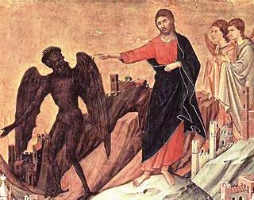
Jesus in the desert

Jesus in the desert

The concept of monasticism is ancient and is found in many religions and philosophies. In the centuries immediately before Christ, Hinduism, Buddhism, and Judaism all developed alternative styles of life which involved renouncing the world in some ways, in order to seek liberation or purification or union with God, sometimes as a solitary ascetic, sometimes in community.

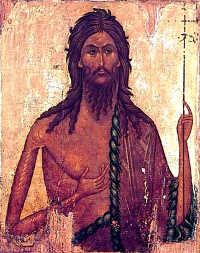
Early Christian monasticism drew its inspiration from the examples of the Prophet Elijah and John the Baptist, who both lived alone in the desert, and above all from the story of Jesus’ time in solitary struggle with Satan in the desert, before his public ministry. Beginning with the Exodus and all through the Old Testament times, the desert was regarded as a place of spiritual renewal and a return to God.  Although there were ascetics, especially women ascetics, among the first generations of Christians, they generally lived in the towns and cities.

St John the Baptist

St John the Baptist

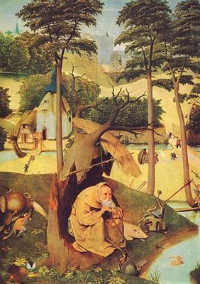
St. Anthony the Great (ca. 251-356) was the first well-known Christian to withdraw to the desert. According to the Life of Anthony written by St Athanasius in the mid fourth century, Anthony retreated to the wastelands of Egypt to lead an intensely ascetic life with the sole purpose of pursuing God in solitary prayer.  He remained alone until his holiness and evident wholesomeness attracted a growing circle of followers. So deep was his influence that he is considered the father, not only of the movement of Desert Fathers and Mothers of fourth – fifth century Egypt, but also the father of the entire Christian monastic family.

St Anthony

St Anthony
While the earliest Desert Fathers lived as hermits, they were rarely completely isolated, but often lived in proximity to one another, and soon loose-knit communities began to form in such places as the Desert of Nitria and the Desert of Skete.  The progression from hermit (“anchorite”) to monk (“cenobite”) living in community under one abbot, came quickly, when in 346 St Pachomius established in Egypt the first cenobitic Christian monastery.

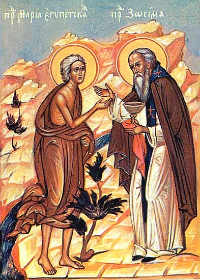
Mary of Egypt

Mary of Egypt

The Eastern monastic teachings were brought to the western church by Saint John Cassian (ca. 360 – ca. 435).  As a young adult, he and his friend Germanus entered a monastery in Palestine but then journeyed to Egypt to visit the eremitic groups in Nitria. Many years later, Cassian founded a monastery of monks and probably also one of nuns near Marseilles, and partly to counter what he felt were the abuses he found in Western monasticism, he wrote two long works, the Institutes and Conferences. In these books he not only transmitted his Egyptian experience (they are perhaps the oldest written record of the thought of the Desert Fathers), but he also gave Christian monasticism a profound evangelical and theological basis.

Cassian’s influence was enormous and lasted for centuries – even the smallest monastic library in Europe’s Dark Ages would have its copy of Cassian. Furthermore, St. Benedict incorporated Cassian’s thought into his monastic Rule, and recommended that his monks read Cassian’s works. Since the Rule of St Benedict is still used by Benedictine, Cistercian, and Trappist monastics, the thought of John Cassian, and the desert tradition behind him, still guides the spiritual lives of thousands of men and women in the Catholic Church.

The fear of the Lord is our cross. Just as someone who is crucified no longer has the power of moving or turning his limbs in any direction as he pleases, so we also ought to fasten our wishes and desires, not in accordance with what is pleasant and delightful to us now, but in accordance with the law of the Lord, where it hems us in. Being fastened to the wood of the cross means: no longer considering things present; not thinking about one’s preferences; not being disturbed by anxiety and care for the future; not being aroused by any desire to possess, nor inflamed by any pride or strife or rivalry; not grieving at present injuries, and not calling past injuries to mind; and while still breathing and in the present body, considering oneself dead to all earthly things, and sending the thoughts of one’s heart on ahead to that place where, one does not doubt, one will soon arrive… 

John Cassian, Institutes, Book IV ch.35
https://ocso.org

Forgotten Souls in Purgatory

One person on earth for one forgotten soul in purgatory!

Lets remember!

O merciful God, take pity on those souls who have no particular friends and intercessors to recommend them to Thee, who, either through the negligence of those that are alive, or through length of time are forgotten by their friends and by all. 

Spare them, O Lord, and remember Thine own mercy, when others forget to appeal to it. Let not the souls which Thou has created be parted from Thee, their Creator. They are Thy work, and though they  have sinned, they have been redeemed by Thee. 

Vouchsafe, therefore, to look upon them  and to deliver them from the intolerable pain of absence from Thee; the light and love of all Thy creatures. Oh! place them in the number of Thy blessed Saints and citizens through Jesus Christ their Savior. Amen.

Feast of The Immaculate Conception

“The most Blessed Virgin Mary was, from the first moment of her conception, by a singular grace and privilege of almighty God and by virtue of the merits of Jesus Christ, Savior of the human race, preserved immune from all stain of original sin.” 

In 1854, Pope Pius IX’s solemn declaration, “Ineffabilis Deus,” clarified with finality the long-held belief of the Church that Mary was conceived free from original sin. Mary was granted this extraordinary privilege because of Her unique role in history as the Mother of God. That is, she received the gift of salvation in Christ from the very moment of her conception. 

Even though Mary is unique in all humanity for being born without sin, she is held up by the Church as a model for all humanity in Her holiness and Her purity in her willingness to accept the Plan of God for her. 

Every person is called to recognize and respond to God’s call to their own vocation in order to carry out God’s plan for their life and fulfill the mission prepared for them since before the beginning of time. Mary’s “Let it be done to me according to Thy Word,” in response of the Angel Gabriel’s greeting, is the response required of all Christians to God’s Plan. 

The Solemnity of the Immaculate Conception is a time to celebrate the great joy of God’s gift to humanity in Mary, and to recognize with greater clarity, the truth that each and every human being has been created by God to fulfill a particular mission that he and only he can fulfill. 

“The word of the Lord came to me thus: “Before I formed you in the womb I knew you, before you were born I dedicated you, a prophet to the nations I appointed you.” (Jeremiah 1:5-6)