Like Elizabeth Ann Seton, Rita of Cascia was a wife, mother, widow, and member of a religious community. Her holiness was reflected in each phase of her life.
Born at Roccaporena in central Italy, Rita wanted to become a nun but was pressured at a young age into marrying a harsh and cruel man. During her 18-year marriage, she bore and raised two sons. After her husband was killed in a brawl and her sons had died, Rita tried to join the Augustinian nuns in Cascia. Unsuccessful at first because she was a widow, Rita eventually succeeded.
Over the years, her austerity, prayerfulness, and charity became legendary. When she developed wounds on her forehead, people quickly associated them with the wounds from Christ’s crown of thorns. She meditated frequently on Christ’s passion. Her care for the sick nuns was especially loving. She also counseled lay people who came to her monastery.
Beatified in 1626, Rita was not canonized until 1900. She has acquired the reputation, together with Saint Jude, as a saint of impossible cases. Many people visit her tomb each year.
Like Elizabeth Ann Seton, Rita of Cascia was a wife, mother, widow, and member of a religious community. Her holiness was reflected in each phase of her life.
Born at Roccaporena in central Italy, Rita wanted to become a nun but was pressured at a young age into marrying a harsh and cruel man. During her 18-year marriage, she bore and raised two sons. After her husband was killed in a brawl and her sons had died, Rita tried to join the Augustinian nuns in Cascia. Unsuccessful at first because she was a widow, Rita eventually succeeded.
Over the years, her austerity, prayerfulness, and charity became legendary. When she developed wounds on her forehead, people quickly associated them with the wounds from Christ’s crown of thorns. She meditated frequently on Christ’s passion. Her care for the sick nuns was especially loving. She also counseled lay people who came to her monastery.
Beatified in 1626, Rita was not canonized until 1900. She has acquired the reputation, together with Saint Jude, as a saint of impossible cases. Many people visit her tomb each year.
Reflection
Although we can easily imagine an ideal world in which to live out our baptismal vocation, such a world does not exist. An “If only ….” approach to holiness never quite gets underway, never produces the fruit that God has a right to expect.
Rita became holy because she made choices that reflected her baptism and her growth as a disciple of Jesus. Her overarching, lifelong choice was to cooperate generously with God’s grace, but many small choices were needed to make that happen. Few of those choices were made in ideal circumstances—not even when Rita became an Augustinian nun.
Pope Francis passed away on April 21, 2025, at age 88, and the Jesuit Conference joins people around the world in mourning. May he rest in the peace of Christ.
Born in Buenos Aires, Argentina, on December 17, 1936, Jorge Mario Bergoglio entered the Society of Jesus on March 11, 1958, and was ordained a priest on December 13, 1969. As a Jesuit, he served as novice master, a theology professor and provincial of the Jesuits in Argentina (1973-1979).
Undated photo of Fr. Jorge Mario Bergoglio , SJ (Jesuit Curia)
He was named auxiliary bishop of Buenos Aires in 1992 and archbishop in 1998. Pope Saint John Paul II elevated him to the College of Cardinals in 2001. On March 13, 2013, Jorge Mario Bergoglio was elected pope, making him the first Jesuit pope and the first pope from the Americas and the Southern Hemisphere. Read his full obituary at America magazine.
Below, read a statement from Fr. Brian Paulson, SJ, president of the Jesuit Conference of Canada and the United States, on Pope Francis’ passing:
I join the countless people around the world who are mourning the death of the Holy Father Pope Francis at this hour. I pray for the repose of his soul and for the consolation of his family, friends and brother Jesuits. While more thorough reflections and examinations of Pope Francis’ legacy will be published in the coming weeks and months, I wanted to offer this brief expression of gratitude for the Holy Father’s extraordinary life of service to God’s people, energized by the love of Christ.
First and foremost, Pope Francis was a pastor. He consistently encouraged bishops, priests and all church ministers to meet people wherever they are in their life journeys, in messiness and complexity and ambiguity, and to help them grow in holiness. The Holy Father’s witness as a shepherd “with the smell of the sheep” from closeness to those on the peripheries of the church and society always inspired and challenged me in my own priestly ministry.
Pope Francis met refugees at Centro Astalli’s soup kitchen in Rome in 2013. (Jesuit Refugee Service)
And Pope Francis indeed went to the peripheries time after time: His first official trip outside of Rome as pope was to visit the Mediterranean island of Lampedusa, a common entry point to Europe for migrants, to pray and advocate for those who had left their homes and risked their lives in pursuit of a better future. He washed the feet of prisoners at Holy Thursday liturgies. He directed the construction of showers for the homeless in St. Peter’s Square. And he appointed cardinals from regions on the planet that had never seen a cardinal named there before — the Amazon, the Philippines, South Sudan, Myanmar and more. These decisions and hundreds of similar ones made headlines so often during Francis’ papacy that it’s easy for us to take them for granted, but let us not forget how much his boldness surprised us. I believe Pope Francis will always be remembered for how he brought marginalized individuals and communities to the heart of the church.
Pope Francis with Father General Arturo Sosa, SJ (Jesuit Curia)
I also believe future appreciations of Pope Francis’ leadership will reflect the ways his reforms in church governance, the roles of the laity, and the social engagement of the church in service to the world were rooted in the teachings of Vatican II. The “Francis Project,” as it has sometimes been called, was not his own personal vision alone, but one formed by his experiences as a leader in the Latin American church in the decades following the Council.
The distinctly Ignatian influence on Pope Francis’ ministry was also unmistakable. In listening to Pope Francis and reading his writings, it is clear to me how much his thought was marked by the Spiritual Exercises of St. Ignatius. The Spiritual Exercises are a “school of the heart” that help a retreatant to grow in self-knowledge of their gifts, weaknesses and sinfulness while meditating on the life, death and resurrection of Jesus. Ignatian spirituality is extraordinarily practical; it engages our own hopes, desires, dreams, struggles, joys and sorrows. In works like “Evangelii Gaudium” and “Laudato Si’,” just to name two, Pope Francis offered his own “school of the heart” meditations, inviting all believers to find the joy of the Gospel within their everyday lives and to commit to responding to “the cry of the Earth and the cry of the poor” as an integral, concrete part of discipleship.
Fr. Brian Paulson, SJ, with Pope Francis
In recent years, the Synod on Synodality emerged as a signature moment of Pope Francis’ outreach toward the peripheries, calling the universal Catholic Church to live a deeper and more inclusive process of listening that includes the voices of all stakeholders. I pray this new mode of dialogue and decision-making continues to develop and take root in the church in the years to come.
Before all else, the Gospel invites us to respond to the God of love who saves us, to see God in others and to go forth from ourselves to seek the good of others. -Pope Francis
I will close this brief reflection with a quote from “Evangelii Gaudium,” the richness of which will continue to make the document a gift to the church for generations. In the quote, as in the exhortation as a whole, we get a sense of what Pope Francis saw as the heart of the spiritual life. “Before all else,” Pope Francis writes, “the Gospel invites us to respond to the God of love who saves us, to see God in others and to go forth from ourselves to seek the good of others.” Let us honor Pope Francis by trying to follow that advice every day.
May the Holy Father Pope Francis rest in the peace of Christ, his brother and Lord.
It requires a bit of detective work—pulling a few threads here, a few more there, and so on throughout the Gospels—to form a viewable tapestry of the holy Galilean women. However, by taking the time to delve into the verses on these women, this lovely group slowly comes into focus, and we can better learn to appreciate them for who they were and all they did for Jesus. St. Mary Magdalene, Blessed Joanna, Susanna, St. Salome, St. Mary of Clopas, and many others unnamed are indeed a special collection of women to know.
It is Luke who gives a formal introduction to these women. At the start of his eighth chapter, he presents them as a unique cluster from the region of Galilee who ministered to Jesus from “their resources.” Luke also lets us know that at least some of these women had suffered terribly and found healing.
We can only imagine the day-to-day lives of these women while they traveled with and assisted Jesus and the Twelve Apostles. Obviously, they had “resources” to spare. Perhaps it was strictly financial assistance that they gave. However, it seems possible that they helped with other things too—maybe they did some cooking, helped with laundry and mending, or nursed anyone who got sick. With a bit of imagination, it is easy to envision them helping in a variety of ways. These women most certainly gleaned some significant insights and understandings during their time of accompanying Christ. It would be nice to have more biblical elaboration on their roles, but we don’t.
After pondering their time going from town to town with Jesus and the apostles, Bible readers pretty much have to wait until the Passion narratives in each Gospel to read anything more about these women (a short narrative on St. Salome is one exception).
Their Home of Galilee
The region of Galilee was the site of many wonderful New Testament events: the Sermon on the Mount, the miracle of the wine at Cana, the healing of the centurion’s servant, and the Transfiguration—just to name a few. And, of course, Jesus’ childhood home in Nazareth was in Galilee as well. This collection of women is another star for this region west of the Sea of Galilee.
St. Mary Magdalene
Poor Mary Magdalene has been stuck for centuries now with the reputation of having been a prostitute. In reality, though, all we know for sure about her past is that she had been burdened with seven demons that had left her—under the authority of Jesus (Lk. 8:2 & Mk. 16:9).
During the early medieval days, Pope Gregory the Great once connected Mary Magdalene to a passage shortly before Luke’s formal introduction to the Galilean women (Lk 7:36-39). In it, a sinful woman who washed Jesus’ feet with her tears and then anointed them with a flask of ointment is presented.
Evidently, the pope had a hunch that the sin of this woman was prostitution and that she was likely the same as Mary Magdalene, who is mentioned just 12 verses later. Pope Gregory the Great (who we must remember really did do many “great” things) also linked Mary Magdalene with Mary of Bethany. These well-intentioned ideas stuck for a long time.
You still don’t have to go far to find someone who thinks Mary Magdalene was undoubtedly a prostitute and the same as Mary of Bethany. Many now assert that seven demons may actually represent mental illness—not prostitution. And most conclude that Mary Magdalene, Mary of Bethany, and the woman who washed Jesus’ feet with her tears are most likely three separate women.
Of all the holy Galilean women, Mary Magdalene is the most prominent. Three evangelists name her specifically as being at the Crucifixion, two at the burial, and all four Gospel writers put Mary Magdalene at the empty tomb. Matthew, Mark, and John also assert that she saw and spoke to the risen Christ.
Blessed Joanna
Joanna is the next Galilean woman Luke introduces. Little is said about Joanna, but the brief mention that Luke presents offers an intriguing clue. He included the fact that Joanna had a close connection to Herod Antipas the Tetrarch, who had John the Baptist beheaded. Joanna was the wife of Herod’s steward, Chuza.
Being a steward, Chuza likely had the responsibility of overseeing Herod’s estate, a job that surely demanded a certain loyalty to this ruler. One can only guess how Joanna managed to support her husband and follow Jesus without any conflict. Perhaps Joanna and her husband were present at the ill-fated birthday banquet. Maybe they heard Herod’s order for the beheading of John the Baptist and perhaps even saw the gruesome platter. We can only wonder.
Joanna is mentioned by name only one other time in the Bible—Luke lists her as one of the women who went to the tomb on the day of the Resurrection.
According to Luke, Joanna—along with other women of Galilee—saw two men in dazzling clothes at Jesus’ empty tomb, learned of Christ’s resurrection, and shared the great news with the apostles—who did not believe them! Although Joanna’s name is never mentioned again, it is reasonable to consider that she was likely a part of the group whenever there is a general reference to the Galilean women.
In the current Roman Martyrology, Joanna is listed as a blessed, rather than a saint. This is hard to discern; in the earliest days of the Church, the words blessed, holy, and saint were often used interchangeably. So you might see Joanna listed as a saint in some resources and as a blessed in others, similar to the way we call Mary the Blessed Virgin Mary or St. Mary.
It’s impossible to know with certainty what exactly was meant. Was Joanna considered an official saint in heaven or just a really good and pious person (perhaps not martyred)? Either way, she gave much and is an inspiration to all.
Blessed/St. Joanna’s memorial is May 24.
St. Salome
It is Mark and Matthew who let us know that Salome is another holy woman of Galilee. Mark provides us with her name—within his Crucifixion and Resurrection narratives. Matthew, who calls her “the mother of the sons of Zebedee,” gives an additional, somewhat amusing account of St. Salome. In his 20th chapter, he relates how this mother of two apostles—James the Greater and John the Evangelist—had big ideas for her sons and boldly requested: “Command that these two sons of mine sit, one at your right and the other at your left, in your kingdom” (Mt 20:21).
Of course, Jesus took the opportunity to preach on the importance of humility and that serving others would count for more than grand places of honor.
St. Salome is listed on the April 24 page of the Roman Martyrology.
Susanna
Susanna is mentioned one time only—in Luke’s introduction to the Galilean women. So we can only glean that she, like Mary Magdalene and Joanna, had been cured of some demon or malady, traveled with Jesus and the apostles, and offered assistance in whatever way she could. Susanna was credibly present at the Crucifixion, burial, and empty tomb. It would be nice to know more, but we just don’t.
Susanna is not listed in the current Roman Martyrology; however, that does not exclude her from sainthood. Actually, if you were to attend Mass at a Byzantine Catholic church two Sundays after Easter, you would notice that Susanna is given special notice and is commemorated as a part of a group called the Holy Myrrhbearers.
St. Mary of Clopas
St. Mary of Clopas is especially hard to pin down in the Gospels, for she is referred to by a variety of titles:
Mary, the Mother of James and Joseph;
The Other Mary;
Mary, the Mother of the Younger James and of Joses;
Mary, the Mother of Joses;
Mary, the Mother of James;
Mary, the Wife of Clopas.
It is through John’s labeling, “Mary, the wife of Clopas” (19:25), that she has received her name: St. Mary of Clopas. Although she doesn’t stand out like Mary Magdalene, one variation or another of her titles appears at the death, burial, and empty tomb scenes repeatedly. Matthew’s Gospel asserts that both Mary Magdalene and Mary of Clopas saw and heard Jesus that first Easter morning.
Some propose that Mary of Clopas’ husband was the Cleopas who traveled to Emmaus with a friend and met up with Jesus in Luke’s 24th chapter. Many even suggest that it was St. Mary of Clopas who was the unidentified traveling partner. This is not known for sure, but it is an intriguing thought to consider.
St. Mary of Clopas shares a memorial day with St. Salome: April 24.
The Unnamed Other Galilean Women
Although we don’t know their names, it is only fair to also remember the unnamed women of Galilee—many others, according to St. Luke. Perhaps these nameless women were shy or had other responsibilities that took them away from Jesus and the apostles from time to time.
Whatever the reason, the Gospels give plenty of assertions that there were others. And they deserve our notice—especially if we have ever experienced being overlooked or not named. When we get to heaven, we can meet these women, learn their names, and thank them for their rich contributions to the mission of Jesus, for bringing comfort to his crucifixion and love to his burial.
Honoring the Holy Galilean Women
Even though the Gospel writers vary somewhat in their placement of the holy Galilean women, we can still get the general idea. They were there, they were helpful, they were devout, they were fearless (braver than most of the apostles at the Crucifixion!), and they loved Jesus dearly and showed it. And at least Mary Magdalene and Mary of Clopas were highly blessed by being the first to see Jesus resurrected. Though not specifically mentioned, it seems highly probable that at least some of the holy Galilean women were present during the nine days in the upper room in Jerusalem, praying and awaiting the Holy Spirit.
The holy Galilean women were generous in many ways and great adorers of God; their good works are an example to all Christians. They fully and very bravely lived out Christ’s command to deny oneself and follow him.
Restoring St. Mary Magdalene’s Reputation
Hopefully St. Mary Magdalene’s mistaken reputation as a prostitute will continue to steadily diminish. It seems reasonable to offset this unfortunate label by putting a special emphasis on a far better one—a label given to St. Mary Magdalene by St. Thomas Aquinas: “The Apostle to the Apostles.”
This 13th-century Italian doctor of the Church wrote a commentary on the Gospel of St. John, a Gospel that offers particularly poignant highlights on Mary Magdalene’s role on that first Easter morning. John’s 20th chapter presents Mary Magdalene arriving at the empty tomb alone. His unique and rich portrayal of this special woman asserts that she tearfully glanced toward the empty tomb, was visited by two angels, mistook Jesus for a gardener, and then was overcome with emotion as she recognized her Lord. Then, Mary Magdalene—without hesitation—followed Jesus’ charge to share the news of his resurrection: “Mary of Magdala went and announced to the disciples, ‘I have seen the Lord’” (Jn 20:18a), and shared what he told her.
It was Mary Magdalene carrying out Jesus’ wish to announce his resurrection with eager confidence that prompted St. Thomas Aquinas to call Mary Magdalene the Apostle to the Apostles within his commentary.
It is compelling to note that St. Thomas Aquinas also pointed out Matthew’s inclusion of another holy Galilean woman—”the other Mary” (St. Mary of Clopas)—during the first appearance of Jesus. Certainly, her role was profound as well, and more elaboration on her story would be welcome. However, St. Thomas Aquinas couldn’t help but notice Mary Magdalene’s overall prominence, especially in John’s Gospel, and felt inspired to highlight her apostle-like role.
Evidently, Pope Francis has read this commentary of St. Thomas Aquinas and agrees. In June 2016, the pope expressed a great appreciation for this title bestowed upon St. Mary Magdalene and felt it was time to elevate her day of remembrance (July 22) from a memorial to a feast. (The rank of Church celebrations are: optional memorial, obligatory memorial, feast, and solemnity.)
This seems a perfect counteraction: to start referring to St. Mary Magdalene as the Apostle to the Apostles in order to help restore her due reputation and highlight her holiness; to focus on her great love and devotion to Christ; and to recognize her rich contribution of proclaiming Christ’s triumph over the cross.
Sidebar: A Retreat with the Holy Galilean Women
Perhaps you would like a two-week, at-home retreat with these special women. If so, take some time each day for 14 days to read a biblical passage on them. Take in one or two surrounding verses and read the footnotes, if desired, and ponder their impact. Try to imagine yourself at the various scenes; maybe jot down your thoughts in a journal. Note which of these women each Gospel writer chose to highlight for the death, burial, and Resurrection accounts.
“The most Blessed Virgin Mary was, from the first moment of her conception, by a singular grace and privilege of almighty God and by virtue of the merits of Jesus Christ, Savior of the human race, preserved immune from all stain of original sin.”
In 1854, Pope Pius IX’s solemn declaration, “Ineffabilis Deus,” clarified with finality the long-held belief of the Church that Mary was conceived free from original sin. Mary was granted this extraordinary privilege because of Her unique role in history as the Mother of God. That is, she received the gift of salvation in Christ from the very moment of her conception.
Even though Mary is unique in all humanity for being born without sin, she is held up by the Church as a model for all humanity in Her holiness and Her purity in her willingness to accept the Plan of God for her.
Every person is called to recognize and respond to God’s call to their own vocation in order to carry out God’s plan for their life and fulfill the mission prepared for them since before the beginning of time. Mary’s “Let it be done to me according to Thy Word,” in response of the Angel Gabriel’s greeting, is the response required of all Christians to God’s Plan.
The Solemnity of the Immaculate Conception is a time to celebrate the great joy of God’s gift to humanity in Mary, and to recognize with greater clarity, the truth that each and every human being has been created by God to fulfill a particular mission that he and only he can fulfill.
“The word of the Lord came to me thus: “Before I formed you in the womb I knew you, before you were born I dedicated you, a prophet to the nations I appointed you.” (Jeremiah 1:5-6)
Our book is now available as an ebook on amazon https://www.amazon.com/dp/B0D4WQLFRXyou can buy or read free if you subscribe to kindle reading.
This book celebrates the meaningful recitation of novenas, a traditional nine day prayer to a particular saint, angel or Madonna for help in solving a problem.
It was our objective to create a book that would be assessable to all, Catholic and non-Catholics alike.
You will learn about The Saints, Angels and The Madonna. The history of The Saints who lived with us on earth. The many visions of The Madonna as she appeared on earth. And more…
“I know by experience that the glorious Saint Joseph assists us generally in all necessities. I never asked him for anything which he did not obtain for me.” —Saint Teresa of Avila
Patron of: Fathers
A righteous man who never shirked his responsibilities as protector of his family, Saint Joseph offers a perfect example for fathers everywhere. He is invoked by families for all matters of support needed to sustain a household, both material and spiritual.
A descendant of the House of David, there is very little written about Joseph in the gospels. He was said to be betrothed to Mary when she became pregnant with Jesus. Instead of leaving her in scandal, he accepted the word of the angel Gabriel who told him that the child was divinely given and Joseph and Mary were chosen by God to be his earthly parents. It was Joseph who protected Mary on the journey to Bethlehem when Jesus was born. He also suffered the frustrations of a man who could not find proper shelter for his family as his wife was about to give birth. Upon returning to their native city of Nazareth, Joseph was once again visited by an angel warning him of the impending slaughter of the innocents. On faith alone, he dispensed with his business and personal effects, taking Jesus and Mary to Egypt where they stayed for seven years until Herod’s death. It fell upon Saint Joseph to support his young family in this foreign country.
The last mention of Joseph comes when Jesus is twelve years old and strayed from his family while on a pilgrimage to Jerusalem. It is thought that he died well before Jesus began his mission with Jesus and Mary at his deathbed. For this reason, more than any other saint, he is invoked for a happy death, one where a person is older and has their family at their side.
Though of noble lineage, Joseph was a carpenter and it was from him whom Jesus learned his trade. Because he worked with his hands and frequently put his family ahead of any personal ambitions, workers everywhere who live similar lives call on him as a patron. It is no mystery that the cult of Saint Joseph became more popular in modern times with the advent of the Industrial Revolution. Many saints throughout the ages have declared him to be a powerful advocate as well, since it is thought that Jesus obeyed him in his earthly life, he is inclined to listen to Joseph in his heavenly life. Teresa of Avila always buried medals with his image when she needed land for a new convent. This tradition has extended itself to realtors of all faiths who bury statues of Saint Joseph on properties they wish to sell.
It is assumed that since Joseph respected his wife’s virginity that he was an older man when he married. He is depicted in art with a staff, which he led his family ( precursor to the bishop’s staff) a lily for purity, and with carpenter tools or holding the baby Jesus.
Hail, Guardian of the Redeemer, Spouse of the Blessed Virgin Mary. To you God entrusted his only Son; in you Mary placed her trust with you Christ became man. Blessed Joseph, to us too, show yourself a father and guide us in the path of life. Obtain for us grace, mercy and courage, and defend us from every evil. Amen.
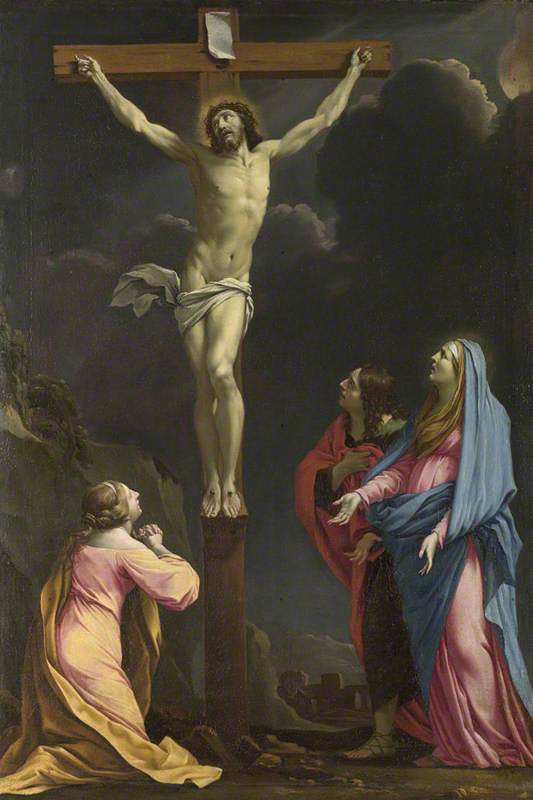
All four Gospels make note that Mary was present at the crucifixion and death of Jesus on Good Friday. Matthew, Mark, and Luke note that Mary and other women, in particular Mary Magdalene, “watched from a distance.” Only Luke writes that “some of Jesus’ disciples” were with Mary. Notably, the Twelve were not there, but hiding out of fear for their lives.
John, however, says very clearly that Mary—with Mary Magdalene and the disciple whom Jesus loved—witnessed Jesus’ death “from the foot of the cross,” not from a distance. At the same time, the distinction made between John and the other three evangelists may provide us with significant teaching moments.
On the one hand, Matthew, Mark, and Luke may be understood as historical descriptions since family and relatives, especially women, would not have been permitted up close to the actual place of execution. Executions were “men’s work.” Those executed were stripped of all clothing and died naked. Artists have added loincloths for the sake of Jesus’ dignity. And executioners would not have wanted hysterical family members getting in the way. If you’ve seen The Passion of the Christ, you will remember the shocking brutality of the crucifixion. But the point is that, even at a distance, the fact is that Mary and others saw Jesus crucified and die.
Universal Truths
John’s description has Mary, Magdalene, and “the disciple whom Jesus loved” close enough so that they could hear his words. John’s account is not for the purpose of describing the actual historical scene. Rather, it is to give the early Church a powerful instruction in the relationship of Mary not only to the disciple standing near her, but also to the whole Church. Jesus showed us that his mother was, indeed, the mother to all of God’s children.
In looking at this scene of Jesus’ crucifixion and noting the distinctions between Matthew, Mark, and Luke’s description—and that of John’s—we see an important point in reflecting on Scripture. Sometime people want to put great emphasis on those things that they see and understand as historical. It is essential to understand that God reveals his truth in various ways.
The writer, John, already knew of the other Gospels as they described Mary and the others watching the death of Jesus, showing their dedication and faithfulness to him even in death. The best conclusion to draw is that everything in the Gospels (and all of Scripture) is significant since it is the revealed word of God. Whether it is a fact of history or a manner of teaching that might not be historical, both contain the truth of God’s teaching for us.
Both the devotion of Mary and the women witnessing Jesus’ death—and the gift of Mary as mother to us—are truths we cannot be without.
“Behold the heart which has so much loved men that it has spared nothing, even exhausting and consuming itself in testimony of its love….” Patron of: family peace, anything Feast Day: June 8
The iconography of the Sacred Heart speaks to us on such a basic level that its image can be found everywhere in everyday life – from tattoos on bikers to stained glass windows in cathedrals. Traditionally, many Catholic homes display the Sacred Heart of Jesus to insure domestic peace and a loving atmosphere. This ancient concept depicting Christ’s heart in flames was first meditated on in privacy by the 4th century hermits in the desert and taken up by mystics in religious communities in the 11th and 12th centuries; it did not become a popular devotion until the 17th century.
On December 27, 1673, a young Visitation nun in Burgundy, France, named Margaret Mary Alacoque was praying in the convent chapel when she heard a strong inner voice identifying itself as Jesus Christ. In later visits the voice requested that she begin a devotion to an image of Christ’s heart in flames, bleeding and encircled by thorns. The flames were for His ardent love for mankind, the thorns were to remind us of His sacrifice on the cross and the blood was because He was God made man. There is no indication that Margaret Mary Alacoque had ever seen this image before. Indeed, she was puzzled by it and greatly mistrusted herself as being qualified to relay any spiritual messages no matter who they purportedly came from. When she reported her communications to her Mother Superior she was scoffed at as delusional and forbidden to perform any of the devotions she was instructed to carry out. It was only after her Confessor, Claude de La Columbiere heard her describe her visions that she was taken seriously.
Unlike the Mother Superior or Margaret Mary, he was well aware of the private devotions of Bernard of Clairvaux and Mechtilde of Helfta, religious mystics who lived centuries before, inspired by same image. La Columbiere did much to publicize devotion to the Sacred Heart based on the messages Christ gave to Margaret Mary. According to her, Christ was greatly troubled by the indifference and sacrilege He was being treated with by the average person.
As a reward for contemplating this image He promised:1. I will give them all the graces necessary for their state of life. 2. I will give peace in their families. 3. I will console them in all their troubles. 4. I will be their refuge in life and especially in death. 5. I will abundantly bless all their undertakings. 6. Sinners shall find in my Heart the source and infinite ocean of mercy. 7. Tepid souls shall become fervent. 8. Fervent souls shall rise speedily to great perfection. 9. I will bless those places wherein the image of My Sacred Heart shall be exposed and venerated. 10. I will give to priests the power to touch the most hardened hearts. 11. Persons who propagate this devotion shall have their names eternally written in my Heart. 12. In the excess of the mercy of my Heart, I promise you that my all powerful love will grant to all those who will receive Communion on the First Fridays, for nine consecutive months, the grace of final repentance: they will not die in my displeasure, nor without receiving the sacraments; and my Heart will be their secure refuge in that last hour.
Since there is no way to physically depict the soul, it is thought that the image of the Sacred Heart comes closest. The heart is the seat of love in the body and the wounded heart represents Christ’s sacrifice at the crucifixion as well as His ongoing pain at the state of mankind.
Novena:
O Lord, Jesus Christ, to your most Sacred Heart I confide this intention. Only look upon me, then do what your love inspires. Let your Sacred Heart decide. I count on you. I trust in you. I throw myself on your mercy. Lord Jesus, you will not fail me. (Mention your request.)
Sacred Heart of Jesus I trust in you. Sacred Heart of Jesus I believe in your love for me. Sacred Heart of Jesus, your kingdom come. Sacred Heart of Jesus, I have asked you for many favors, but I earnestly implore this one. Take it, place it in your open heart. When the Eternal Father looks upon it, he will see it covered with your Precious Blood. It will no longer be my prayer, but yours, Jesus. Sacred Heart of Jesus, I place all my trust in you. Let me not be disappointed. Amen.
Luke refers to a number of people accompanying Jesus and the twelve. From among them he names three women: “Mary, called Magdalene, … and Joanna the wife of Herod’s steward Chuza, and Susanna, and many others, who provided for them out of their resources” (Luke 8:2-3).
SAINT MARY MAGDALENE
Apostle to the Apostles
First Century
Feast Day: July 22
Patron of: Provence, contemplatives, converts, gardeners, glove makers, hairdressers, penitents, perfumers, pharmacists, prisoners, reformed prostitutes
Invoked against: sexual temptation
Symbols: alabaster jar, long hair, skull
“Touch me not; for I am not yet ascended to My Father; but go to my brethren, and say unto them, I ascend unto My Father, and your Father; and to My God, and your God.”
Christ to Mary Magdalene according to John 20:17
Though the subject of Mary Magdalene’s true identity may be fodder for a heated debate, there is one aspect of her life that all ecclesiastical writers agree upon: She never left Christ during His crucifixion, and she was the first person to see Him after His resurrection. Because Jesus chose her as His first witness and because He told her to go and tell the others what she saw, she is known as the “Apostle to the Apostles.” This title aside, it is the example she sets as a penitent and reformed sinner that she is most well known and honored.
According to ancient Jewish texts, the seaside town of Magdala was known as a place of loose morals. This town was Mary’s home, and she took its name as her own, signifying her unmarried state. It was said that Mary had wealth and took great pride in her appearance, enjoying luxuries and lapsing into promiscuity. Many shunned her because of her reputation for lewdness and it is as this sinner that we are first introduced to her.
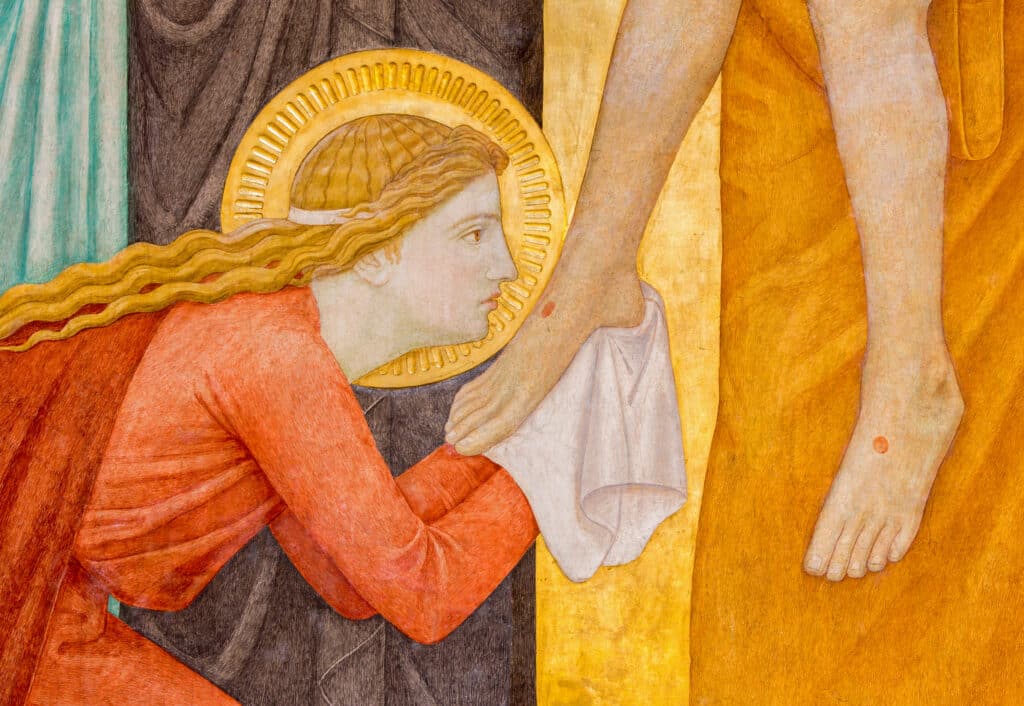
After Jesus had raised the son of a widow from the dead, a man named Simon invited him to be guest of honor at a dinner. While they were seated, a certain notorious woman walked into the room carrying an alabaster box. Weeping, she threw herself down and wiped Jesus’ feet with her hair and then anointed them with the oil. Simon was outraged that Jesus would accept such tribute from someone so disgraceful. But instead of judging the woman Jesus rebuked Simon, “Does thou see this woman? I entered into thy house–thou gave me no water for my feet. But she with tears has washed my feet, and with her hair has wiped them. Thou gave me no kiss. But she, since she came in, has not ceased to kiss my feet. My head with oil thou did not anoint but she with ointment has anointed my feet. Wherefore I say to thee: Many sins are forgiven her, because she has loved much. But to whom less is forgiven, he loves less.” He then told the penitent woman to go in peace, all her sins were forgiven.
In the next chapter of Luke he mentions the travels of Christ and his followers in Galilee, among them is “Mary called Magdalene, out of whom went seven devils.” Luke also tells us that the day before Christ’s entry into Jerusalem he dined with Lazarus and his sisters Martha and Mary. When Judas objects to the use of such expensive oil he is rebuked by Christ, like Simon, for being so self-righteous. “. . . For the poor you have always with you . . . but me you have not always. . .” Because in this story, Mary too wipes Jesus’ feet with her hair and anoints them with oil in the same manner as the penitent woman, Catholics believe both women to be Mary Magdalene, whom after being exorcized by Christ became one of his greatest and most loyal followers.
Indeed, her loyalty to Jesus was unsurpassed even at His death. Unlike His other disciples, Mary never renounced Jesus or ran from Him. She stood with His mother until He was dead, helped take Him down from the cross and wept outside of His tomb. On Easter morning it was Mary Magdalene who returned at dawn to keep a vigil. When she found the great stone covering the tomb rolled away, she ran back to tell Peter and the others that someone had taken Jesus’ body. They ran ahead of her, saw the open tomb, and left.
But it was Mary Magdalene who stayed behind, searching the tomb and weeping. Two angels dressed in white appeared to her and asked why she was weeping. “They have taken my Lord, and I know not where they have laid him,” she responded. A gardener asked her the same question and she begged the man to tell her where Christ’s body might be found. “Mary,” said the man, and she suddenly knew this man was not a gardener. She was talking to the risen Christ. When she went to embrace him he told her, “Touch me not!” (The phrase Noli me tangere in the Latin bible). Mary spread the good news to the disciples–the last action the gospels recorded of Mary Magdalene.
The rest of her life story was written in the early Middle Ages. It is said that after the resurrection of Christ, political leaders in Israel tried to quash the cult that was rapidly growing around Him. These leaders placed Mary Magdalene, her sister Martha, their brother Lazarus, and other followers in a rudderless boat, in hopes that they would perish at sea. Divine Providence brought them to the coast of Marseilles, France. There they had much success converting the local people to Christianity. Mary took her apostolic mission to Provence and was greeted with equal enthusiasm. After converting the king and helping to install a bishop, she retired to a cave to live out the last thirty years of her life as a penitent. Her hair grew long enough to cover her naked body, and she repented for her previous deeds as a sinner. Once a day angels would carry her to heaven, where she received her “daily sustenance,” which took the place of earthly food. Eventually her death drew near, and she sent for Maximinus, the bishop she had installed years earlier. She received the eucharist and died in tears.
Early French ecclesiastical writers claimed Mary Magdalene and her family as their evangelists. Since they were favorites of Christ, this divine favoritism then extended to France and the French people. Miraculous discoveries of her relics abounded from Provence to Burgundy. The Cathedral at Vézelay was dedicated to her in the twelfth century and became the center of her cult and an important stop on the pilgrimage to Campostela. Her feast, falling in the heart of summer was happily celebrated throughout France.
To the people of the Middle Ages, Mary Magdalene was a wildly glamorous figure, a beautiful woman with long, red hair. She presented an alternative to the image of an ever pious saint. Here was a woman who had enjoyed luxuries, made mistakes, and tried to redeem herself. As towns grew into cities, they began to face an onslaught of urban problems such as prostitution. Though there is no mention in the Bible of Mary Magdalene ever being a prostitute, preachers invented lurid tales of her youthful sexual indiscretions. That God could extend forgiveness to such a willful, wayward creature gave hope to everyone for their own forgiveness. Homes for reformed prostitutes took her as their patron, and the word magdalene became a description for a fallen woman. It was not until the twentieth century that Mary Magdalene’s role as a penitent and devoted follower of Christ was stressed.
Always a popular subject for artists, Mary Magdalene is always depicted as a beautiful, sorrowful woman with long hair. In some images she carries the alabaster unguent jar and in others a skull is present, the symbol of the penitent to remind us of how we are all going to end up. The English word maudlin is a derivative of Magdalene. Oxford University has a famous college named for her. Because she loved luxury before her conversion, and bought expensive unguents after it, she is the patron of such trades as glove makers, hairdressers, and perfumers. Since devils were cast out of her, she is the patron of prisoners who cast off their chains. Because Christ appeared to her as a gardener she is the patron of the profession. Her knowledge and use of unguents also makes her the patron of pharmacists.
Prayer to Saint Mary Magdalene
Saint Mary Magdalene, woman of many sins,
Who by conversion became the beloved of Jesus,
Thank you for your witness that Jesus forgives
through the miracle of love.
The Feast of the Infant of Prague is the same day as The Holy Name of Jesus, January 14.
Appeal to the Infant of Prague in times of desperation, to stop an epidemic or for abundance
Few novenas promise the instantaneous results of those to the Infant of Prague. It necessitates a suspension of all doubt as it is completed in one day over a nine—hour time span. Perhaps the most invoked aspect of Christ in the world, this novena promises that anything is possible for those who believe. Christ is presented as both a kindly child and a king. The Infant of Prague is a statue of the child Jesus dressed in actual clothing. Instead of the modest garments of a poor child, he is wearing the sumptuous gown of royalty. Because the Infant of Prague looks like a little doll, we are welcome to approach him with the open faith of a child. Reflecting the faith of Jesus, the novena requires an intensity of devotion.
Many people have a version of this statue in their homes, as it is said to guarantee abundance. This novena, frequently utilized by those in financial difficulties, can be said during any desperate situation. The Divine Child, a nineteen—inch wax sculpture, was brought to Prague, Czechoslovakia, by a Spanish princess who received it from her mother as a wedding gift. She in turn, bequeathed it to her daughter, Princess Polyxena. On becoming a widow in 1623, Polyxena decided to devote the rest of her life to doing charitable works. The extremely poor order of Carmelite monks of Prague were her favorite beneficiaries. Bringing the statue, she promised, “As long as you will venerate this image, you will not lack anything.” The statue of the Divine Child was installed in the chapel, and the monks became aware of an immediate change in their material and spiritual fortunes. In 1631 the monks had to flee their monastery because of an invasion by Sweden. In the ensuing confusion the statue was left behind, only to be thrown on a trash heap by the invading army. Miraculously, it was found seven years later by a priest named Father Cyril, who had been particularly devoted to the Divine Infant. Though it was made of wax, the only damage sustained by the statue was its missing hands.
Devotions to the Divine Infant, returned to its altar in the chapel as the once again poverty—stricken Carmelites began to rebuild their monastery, were revived with great fervor. While Father Cyril was praying before the statue, he heard the words: “Have pity on me and I will have pity on you. Give me my hands and I will give you peace.” Though money came to the order, it was felt that it should be put to use for more important causes than the repair of a statue. Again Father Cyril heard a voice while in prayer: “Place me near the entrance of the sacristy and you will receive aid.” A passing stranger, seeing the broken statue, offered to have it repaired. When the Divine Infant seemed to be responsible for several cures during an epidemic, the priests moved the statue to the main church so that the public could also benefit from its graces. In 1642 Baroness Benigna von Lopkowitz had a beautiful chapel built for the Divine Infant, where it remains to this day. Many make pilgrimages to Prague to see the original little statue that has inspired so many copies around the world.
Powerful Novena in Times of Distress to the Infant of Prague
Divine Infant of Prague, dearest Jesus, you who so lovingly said, “Ask and it shall be given you; seek and you shall find; knock and it shall be opened to you,” have mercy on me now, and through the intercession of our most holy Mother, I humbly ask you to grant me the grace I need. Mention your request Divine Infant of Prague, dearest Jesus, you who so compassionately taught, “If you can believe, all things are possible to him who believes,” have pity on me now. I do believe; help me. Increase my weak faith through the Blessed Mother’s intercession.
I humbly ask you to answer my request. Mention your request Divine Infant of Prague, dearest Jesus, you who once said to the Apostles: “If you have faith like a mustard seed, you will say to the mulberry tree, ‘Be uprooted and be planted in the sea,’ and it will obey you.” Hear my prayer, I humbly ask.
Through the intercession of Mary most holy, I feel certain that my prayer will be answered. Mention your request.
Because this novena is said for those in great distress or emergency situations, it is completed in one day.
Say this novena nine times in a row at the same time every hour for nine consecutive hours.






 novena.com