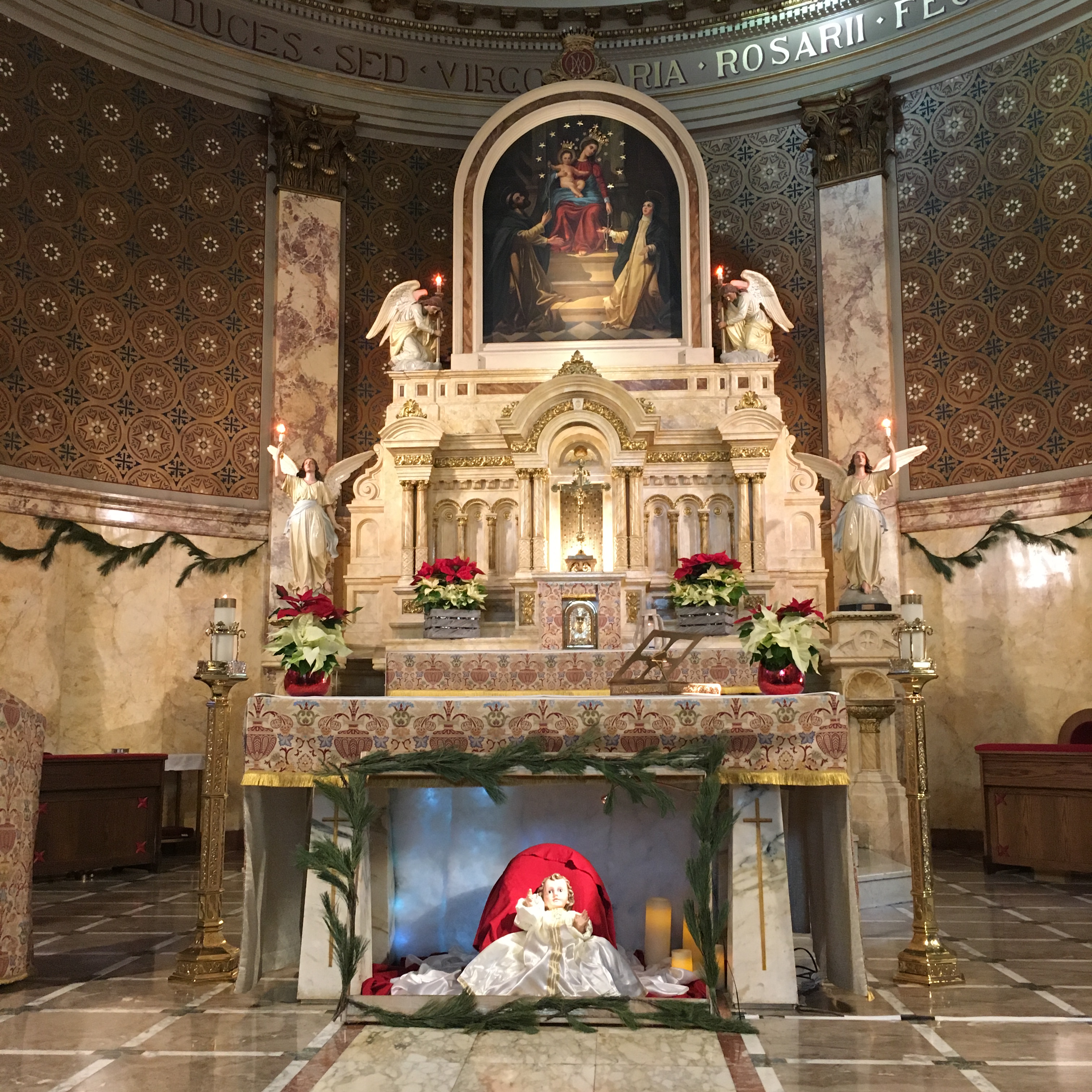
Our Lady of Pompeii began in 1892 as the chapel of St. Raphael Society for the Protection of Italian Immigrants, which was located in a townhouse that is still standing at 113 Waverly Place. In 1895, Pompeii rented the former Bethel Methodist Colored Church at 214 Sullivan St., no longer standing. In 1898 it purchased a church that stood at 210 Bleecker Street, across from the southern end of Minietta Street nearby on the eastern side of Sixth Avenue. The church, which looked like a Greek Temple, was erected in 1836 for the Unitarian Universalists. In 1888 the Unitarians sold the church to the African American Roman Catholic congregation of St. Benedict the Moor. When the city condemned the church to extend Sixth Avenue, Pompeii erected this building, formally opening it October 7, 1928.The church’s architect was Mathew Del Gaudio, an Italian American graduate of Cooper Union active in his profession from 1905 to his death in 1960. Del Gaudio created a Romanesque building that would have reminded the earliest parishioners of Italy, with its shallow front steps and flat façade close to the street, its domed sanctuary, and its campanile, or bell tower. The figure on the roof is St. Charles Borromeo, patron saint of the order of priests that founded and staff Pompeii.Step in, look up, and you’ll see paintings celebrating the Rosary, the work of Professore Antonio D’Ambrosio, who was born in Italy and trained as an artist there. He opened his ecclesiastical arts company in 1928, specializing in creating artwork for churches, trained his children in the field, and passed the business along to them. D’Ambrosio’s descendants have returned to do restoration work on Pompeii’s art several times.The right wall’s images depict the Joyful Mysteries: the Annunciation, Visitation, Nativity, Presentation, and Finding Jesus in the Temple. Those on the left wall depict the Sorrowful Mysteries: Jesus’ Agony in the Garden, His Scourging, His Crowing with Thorn, His Carrying of the Cross, and His Crucifixion. On the ceiling are the Glorious Mysteries: the Resurrection, Ascension, Pentecost, Assumption, and the Crowning of the Blessed Virgin in Heaven.Above the altar is a complex construction. On the left and right of the mural, respectively, are images of the Church Suffering, the souls in Purgatory awaiting redemption, and the Church Triumphant, the saints in Heaven.
The centerpiece is dedicated to the Church Militant, or the Church on Earth. Above the center is an image of Our Lady of the Rosary of Pompeii, with Jesus on her lap, both of them handing rosaries to St. Dominic and St. Catherine of Siena, early promoters of the rosary. Angels fly about them. Across the bottom are images associated with Pompeii parish, such as the building’s campanile. The figure in red on the right is St. Charles Borromeo. The bishop in white is Blessed John Baptist Scalabrini, founder of the priests who serve at Pompeii. The figure with the basket of roses is St. Martin de Porres, a tribute to the African American community whose church Pompeii purchased. To the left is a Franciscan friar, acknowledging that the Franciscans were the first ministers to New York’s Italians, at St. Anthony of Padua parish on Sullivan Street, a few blocks south of Pompeii. On the right is a galleon, a reminder that the Spanish credited their victory in the 1571 Battle of Lepanto to praying the rosary. The Latin phrase at the mural’s base translates as “Not Arms, Not Leaders, but the Virgin Mary of the Rosary Made us Victors.” Professore D’Ambrosio worked on this commission from 1934 to 1937, finishing with the painting of Jesus revealing His Sacred Heart to Saint Margaret Mary that is to the left as you come further into the church.Just behind you, near the entrance on the left, are statues indicative of the diversity of Pompei’s congregation.
The centerpiece is a shrine to Mother Frances Cabrini, patroness of immigrants. Before her is a statue of Jesus Nazareno, an image revered among the Filipino immigrants who also worship at Pompeii. The statue of San Gaetano is a long ago gift from his devotees that cannot be dated. The statue of Saint Jude is a 1955 bequest from parishioner Catherine Brignole; Jude, patron of hopeless causes, was a popular saint in the mid twentieth century. The bust of Bishop Scalabrini also dates from 1955, and Scalabrini’s coat of arms on the column near the bust, from soon thereafter, but these represent the beginnings of devotion to someone who may yet be declared a saint.At the beginning of the wall on the left, or southwest, side of the church, are statues of two saints popular among Italians, St. Rose of Lima and St. Lucy. Then come the stained glass windows, work on which commenced in 1928, with the Stations of the Cross between them. (The Stations and windows actually “begin” at end of the wall nearer the altar if you want to skip ahead and walk back.) The stained glass window at the back of the church is important not only for its illustrations of four of the Beatitudes but for the donors associated with it. Carolina Perazzo, whose name appears on the window, was the daughter of funeral home director Carlo Baciagalupo. She married Giovanni Battista Perazzo, who learned the undertaking business from his wife and father-in-law, and opened his own funeral home at 199 Bleecker St. in Greenwich Village. The business is no longer in the family, but is still at 199 Bleecker St.Most of the topics of the stained glass windows are easily recognizable, but some require some insider knowledge of Pompeii. For example, see the window on the southwest wall given in honor of A. Agostino Gazzolo. The bishop in the window is Scalabrini, the two clergy are a Scalabrinian priest and brother, and the two nuns represent two orders Blessed Scalabrini encouraged:
Mother Cabrini’s Missionaries of the Sacred Heart and the Apostles of the Sacred Heart, whose members taught in Pompeii’s school. The Gospel quotation references the Scalabrinians’ mission to help migrants preserve their faith in their new homes.Before turning to the altar, step into the room to the left, where there is a striking stained glass window and several more statues. St. Gerard’s statue came from the maternity ward on the 5thfloor of the Seton Building of St. Vincent de Paul; Greenwich Village’s hospital from 1849 to 2010; it is a gift from the hospital’s founders, the Sisters of Charity.The altar wall of the church consists of three parts. The mosaics of Assumption and of Jesus in Purgatory date from the tenure of Father Mario Albanese, pastor from 1952 to 1964. While you are at the Assumption altar, look at the wall to the left to see the fine mosaic of the Holy Family. In front of the image of the Assumption is one of Pompeii’s newest statues, that of Padre Pio, a Franciscan priest who was declared a saint in 2002. There is also an image of Our Lady of Guadalupe. Normally, that would indicate the presence of Mexican devotees, but during Pompeii’s earliest years, women from Chiavari, south of Genoa, practiced the devotion.
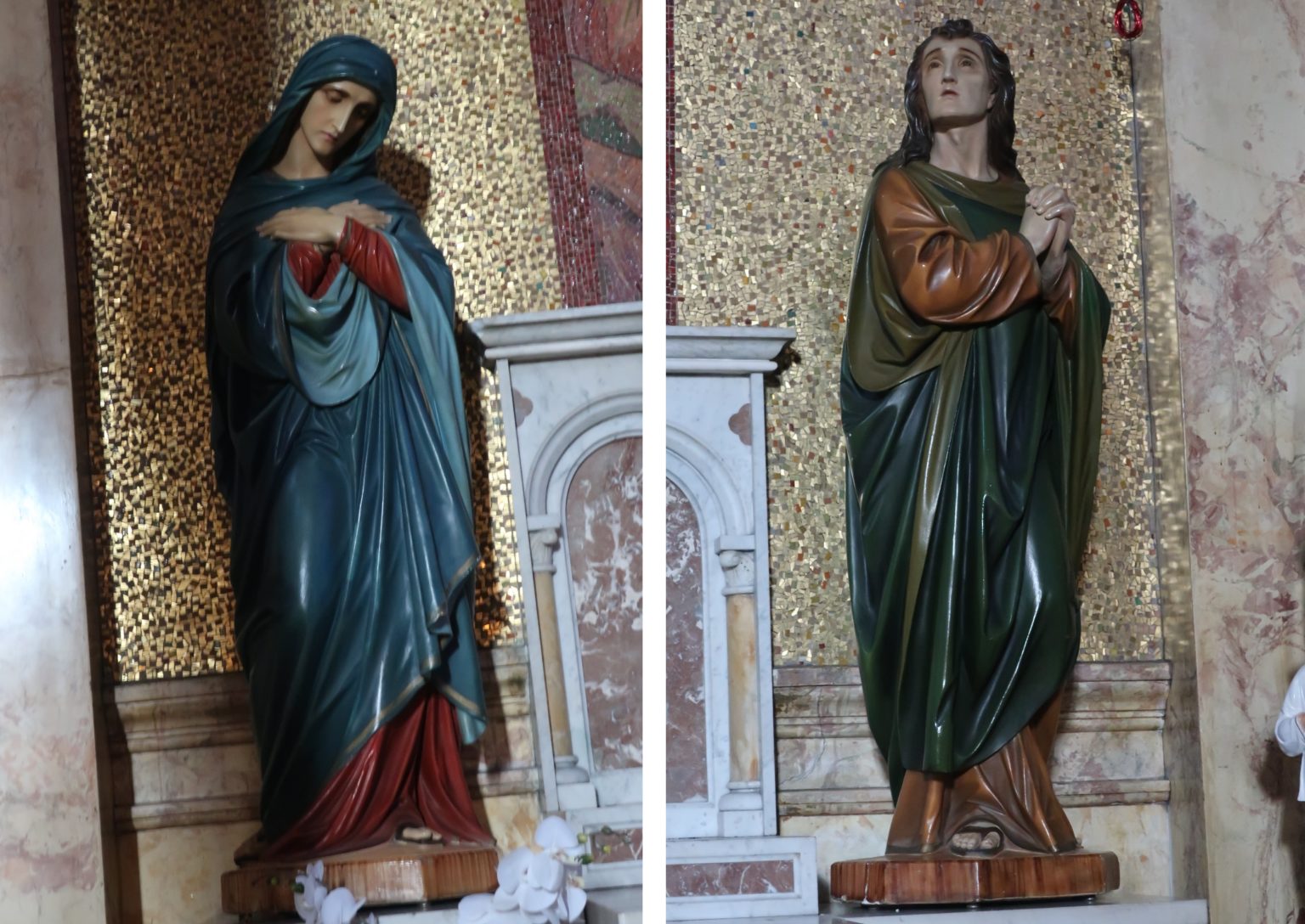
Embedded in the marble pre-Vatican II altar is a painting of Our Lady of the Rosary that is an exact replica of the one at the shrine to Our Lady of the Rosary in Pompeii, Italy. The painting was an 1895 gift of heiress Annie Leary. Shortly after its installation, this parish received permission from the Italian shrine’s founder, Bartolomeo Longo, to promote itself as the American shrine. The painting first hung over the altar at the 210 Bleecker Street church mentioned earlier; it was cut to its present shape to fit the altar here.Pompei’s oldest statues cluster around the Purgatory image. Those of the Blessed Mother and St. John the Evangelist date from the 1880s and are part of a set that, together with the crucifix in the donor’s shrine near the church entrance, were fixtures at St. Benedict the Moor. The statues of the Sacred Heart and St. Joseph appear in a 1909 photograph of Pompeii.The stained glass windows to the right of the altar, Pompeii’s northeast wall, also reflect parish history. Note the windows depicting marriage vows and Pope Leo sending Mother Cabrini to the Americas, all given by relatives of Italian-American lawyer Edward Bergonzi, who, along with pioneer Italian immigrant Luigi Fugazy, was on Pompeii’s first board of trustees. The image of the priest in the window depicting marriage is that of Father Antonio Demo, who served at Pompeii from 1898 to 1936, most of the time as pastor; he led Pompeii in building this church. Perhaps after you have completed your visit here you can see the park named for him, diagonally across the street from the church.
At the end of the row of Stations and windows is the donor’s shrine, and a plaque noting that Pompeii’s campanile was restored in honor of Vincent Gigante by his parents. He is better known as “Chin” Gigante, and was a leader in one of New York City’s organized crime families. His own family, though, included many other members who were part of the parish; before this plaque went up, another plaque, at the beginning of the Stations of the Cross, notes the Stations were refurbished in honor of Pietro Gigante.On your way out, look up. Above Pompeii’s doors are three stained glass windows. The one of Columbus giving thanks for having reached land in the Americas is a tribute to Pompeii’s Italian roots. The depiction of Ellis Island is a reminder of Pompeii’s commitment to immigrants. In the center is an image of the Holy Family on the Flight into Egypt, a reminder that Jesus, Mary and Joseph were once counted among the world’s migrants and refugees. Dr. Mary Elizabeth Brown, PhD.
In 1927, in order to extend Sixth Avenue south to Canal Street, the city tore down the 210 Bleecker Street building that Saint Benedict’s and Pompeii had occupied, and Pompeii moved to its present church. In 1979, St. Benedict’s contacted Pompeii regarding the other two statues in the original Crucifixion scene. The late Brother Michael La Mantia, c.s., oversaw the statues’ transfer to the present Pompeii church. The pastor at the time, the late Father Edward Marino, c.s., was using the Crucifix as the centerpiece for a niche honoring donors to the church, so instead of reuniting the set he placed the statues of the Blessed Mother and Saint John in their present positions, before the mosaic of the Crucified Christ and the Souls in Purgatory.
The Order of Cistercians of the Strict Observance (also known as “Trappists”) is a Roman Catholic contemplative religious order, consisting of monasteries of monks and monasteries of nuns. We are part of the larger Cistercian family which traces its origin to 1098. As Cistercians we follow the Rule of St Benedict, and so are part of the Benedictine family as well. Our lives are dedicated to seeking union with God, through Jesus Christ, in a community of sisters or brothers.
Early Monasticism
Jesus in the desert
The concept of monasticism is ancient and is found in many religions and philosophies. In the centuries immediately before Christ, Hinduism, Buddhism, and Judaism all developed alternative styles of life which involved renouncing the world in some ways, in order to seek liberation or purification or union with God, sometimes as a solitary ascetic, sometimes in community.
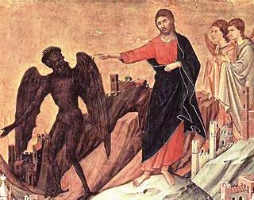
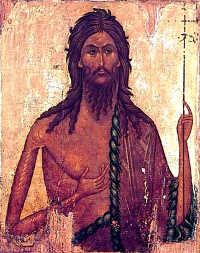
Early Christian monasticism drew its inspiration from the examples of the Prophet Elijah and John the Baptist, who both lived alone in the desert, and above all from the story of Jesus’ time in solitary struggle with Satan in the desert, before his public ministry. Beginning with the Exodus and all through the Old Testament times, the desert was regarded as a place of spiritual renewal and a return to God. Although there were ascetics, especially women ascetics, among the first generations of Christians, they generally lived in the towns and cities.
St John the Baptist
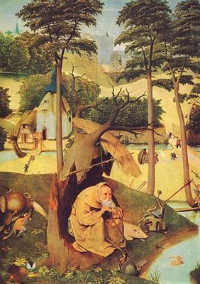
St. Anthony the Great (ca. 251-356) was the first well-known Christian to withdraw to the desert. According to the Life of Anthony written by St Athanasius in the mid fourth century, Anthony retreated to the wastelands of Egypt to lead an intensely ascetic life with the sole purpose of pursuing God in solitary prayer. He remained alone until his holiness and evident wholesomeness attracted a growing circle of followers. So deep was his influence that he is considered the father, not only of the movement of Desert Fathers and Mothers of fourth – fifth century Egypt, but also the father of the entire Christian monastic family.
St Anthony While the earliest Desert Fathers lived as hermits, they were rarely completely isolated, but often lived in proximity to one another, and soon loose-knit communities began to form in such places as the Desert of Nitria and the Desert of Skete. The progression from hermit (“anchorite”) to monk (“cenobite”) living in community under one abbot, came quickly, when in 346 St Pachomius established in Egypt the first cenobitic Christian monastery.
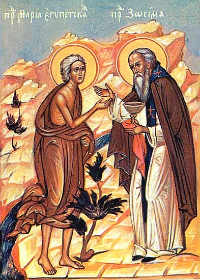
Mary of Egypt
The Eastern monastic teachings were brought to the western church by Saint John Cassian (ca. 360 – ca. 435). As a young adult, he and his friend Germanus entered a monastery in Palestine but then journeyed to Egypt to visit the eremitic groups in Nitria. Many years later, Cassian founded a monastery of monks and probably also one of nuns near Marseilles, and partly to counter what he felt were the abuses he found in Western monasticism, he wrote two long works, the Institutes and Conferences. In these books he not only transmitted his Egyptian experience (they are perhaps the oldest written record of the thought of the Desert Fathers), but he also gave Christian monasticism a profound evangelical and theological basis.
Cassian’s influence was enormous and lasted for centuries – even the smallest monastic library in Europe’s Dark Ages would have its copy of Cassian. Furthermore, St. Benedict incorporated Cassian’s thought into his monastic Rule, and recommended that his monks read Cassian’s works. Since the Rule of St Benedict is still used by Benedictine, Cistercian, and Trappist monastics, the thought of John Cassian, and the desert tradition behind him, still guides the spiritual lives of thousands of men and women in the Catholic Church.
The fear of the Lord is our cross. Just as someone who is crucified no longer has the power of moving or turning his limbs in any direction as he pleases, so we also ought to fasten our wishes and desires, not in accordance with what is pleasant and delightful to us now, but in accordance with the law of the Lord, where it hems us in. Being fastened to the wood of the cross means: no longer considering things present; not thinking about one’s preferences; not being disturbed by anxiety and care for the future; not being aroused by any desire to possess, nor inflamed by any pride or strife or rivalry; not grieving at present injuries, and not calling past injuries to mind; and while still breathing and in the present body, considering oneself dead to all earthly things, and sending the thoughts of one’s heart on ahead to that place where, one does not doubt, one will soon arrive…
Traditionally, AD 529 is considered to be the year in which St Benedict founded the monastery at Montecassino. He died and was buried there around 547. Some decades later, the monastery was destroyed and not rebuilt for a long time. The monastic community and the living tradition of Benedict seemed to have disappeared.
The Spreading of the Rule
However, copies of his Rule survived in Roman libraries. Around 594 Pope St Gregory the Great praised this Rule and its author, increasing the popularity of both. Next, the Rule is found in some monasteries in Southern Gaul (modern France) and elsewhere, normally used by the abbot together with rules written by other monastic fathers to help him to guide the community. In the early 8th century, monks from England proudly proclaim that they follow only the Rule of Benedict – the first genuine „Benedictines“. They popularize this rule further through their mission in continental Europe and eventually in 816/17 an important synod declares Benedict’s Rule binding for all monks. Throughout the Carolingian empire which covers modern France, Belgium, Holland Switzerland, Germany, parts of Italy and Austria, hundreds of monasteries of monks and nuns come now under the Rule of Benedict. Simultaneously, the observance of these monasteries is unified, even in areas where the Rule left details to the discretion of the abbot. In the Latin West, religious life is now mostly Benedictine. The monasteries become important centers of religious life, but also of political administration, of economic development and of learning, both theological and secular. Books are written and copied in the scriptoria (writing rooms) of the monasteries, and abbey schools train the clergy and the ruling elite. The monks dedicate themselves mainly to liturgical prayer, whose amount gradually increases. The monasteries own farms and sometimes whole villages, whose peasants sustain the monks with part of their produce. In the ninth century the papacy starts to protect some monasteries from the interference of noblemen and local bishops. Cluny in Burgundy, founded in 910, eventually establishes a huge family of monasteries under one abbot. In the 12th century several hundred houses belonged to it.
Decays and Reforms
The wealth and social role of the monasteries attracts also criticism, and several reform movements try to return to simpler ways of life and a more original understanding of Benedict’s rule. The Cistercians have the greatest impact. Within a short period several hundred monasteries of „white monks“ are founded, established as a clearly defined order with an efficient organization that balances unifying elements like the general chapter of all abbots and clear common principles with local autonomy and supervision through visitations.
In 1215 and in 1336 the papacy attempts to give a similar structure to the remaining „black“ Benedictines, initially with little success. Meanwhile, life in Europe has shifted from the countryside to cities. Newer orders like the Franciscans and the Dominicans respond to the spiritual and intellectual desires of city dwellers. While Benedictines continue to be found all over Europe, they are no longer the main protagonists of religious life.
From the 15th century onwards, monasteries try to protect themselves from the interference of secular or ecclesiastical lords by forming congregations. The most influential of these is the Congregation of Saint Justina in Italy, later called the Cassinese Congregation. It remains for many centuries a model which other Congregations copy. New forms of personal prayer and meditation are now introduced to the life of the monks, to complement the divine office and lectio. A new emphasis on the personal needs of the individual monk also leads to the introduction of cells, replacing the dormitories in use until then.
Turbulences and Rebirth
The so-called reformation in the 16th century turns against religious and monastic life of any kind. Protestant sovereigns use theological justifications to suppress the monasteries and confiscate their property. Some abbots and monks are killed, others simply retire from monastic life, return to their families or accept parishes. In England, Northern Germany, the Netherlands and Scandinavia monastic life disappears.
In Catholic countries, however, Benedictine monasticism begins to flourish again. Benedictine abbeys are being rebuilt in the splendid baroque style, and many monasteries become centres of scholarship, culture and education. And for the first time Benedictine life goes beyond Europe when the first abbeys of the New World are established in Brazil.
In the 18th century, new philosophical and political trends threaten monasticism. Faith comes under attack, and monasteries are seen as useless places of superstition and backwardness. In the decades after 1760, more than 95% of the monasteries in Europe are suppressed by governments or destroyed in the course of revolutions and wars. Churches are turned into factories, buildings are used as quarries, land and treasures or confiscated, books destroyed or sent to new national libraries.
But monasticism refuses to die. In the mid-19th century, a romantic rediscovery of medieval Christianity and monastic life takes place. In several countries old monasteries are re-founded or new communities created. Monastic life changes: the communities can no longer depend on rich endowments. The monks now work for their upkeep. The abbots have ceased to be lords and live much closer with their brothers. These monasteries fulfil important roles in the church, running major seminaries and schools, sometimes parishes or foreign missions. Because the Benedictines are still without any central organization, Pope Leo XIII establishes a study house in Rome, and in 1893 creates the Benedictine Confederation with an Abbot Primate at its head. Benedictine scholars rediscover the liturgical life of the early church. They influence the Liturgical Movement which prepares the reforms of the Second Vatican Council:
Most communities start singing in the vernacular, no longer in Latin. And the distinction between priests and brothers disappears. Most monasteries continue to attract Christians who want to spend a quiet time in prayer, who seek spiritual advice or who simply want to live alongside the monks for a few days.
A Worldwide Family
In 2018 the Benedictine Confederation numbers around 7500 monks in 400 monasteries, belonging to 19 different Congregations, with regional differences, particular missions or specific spiritual traditions. Some 13000 nuns and sisters also belong to the order. The Benedictines work closely with the Cistercians and the Trappists, orders which also follow St Benedict’s Rule. This rule has proved to be a guide for countless souls during 15 centuries.
OSB.ORG OSB DOT ORG Piazza dei Cavalieri di Malta 5 00153 Rome Italy EDITOR Br. Richard Oliver OSB
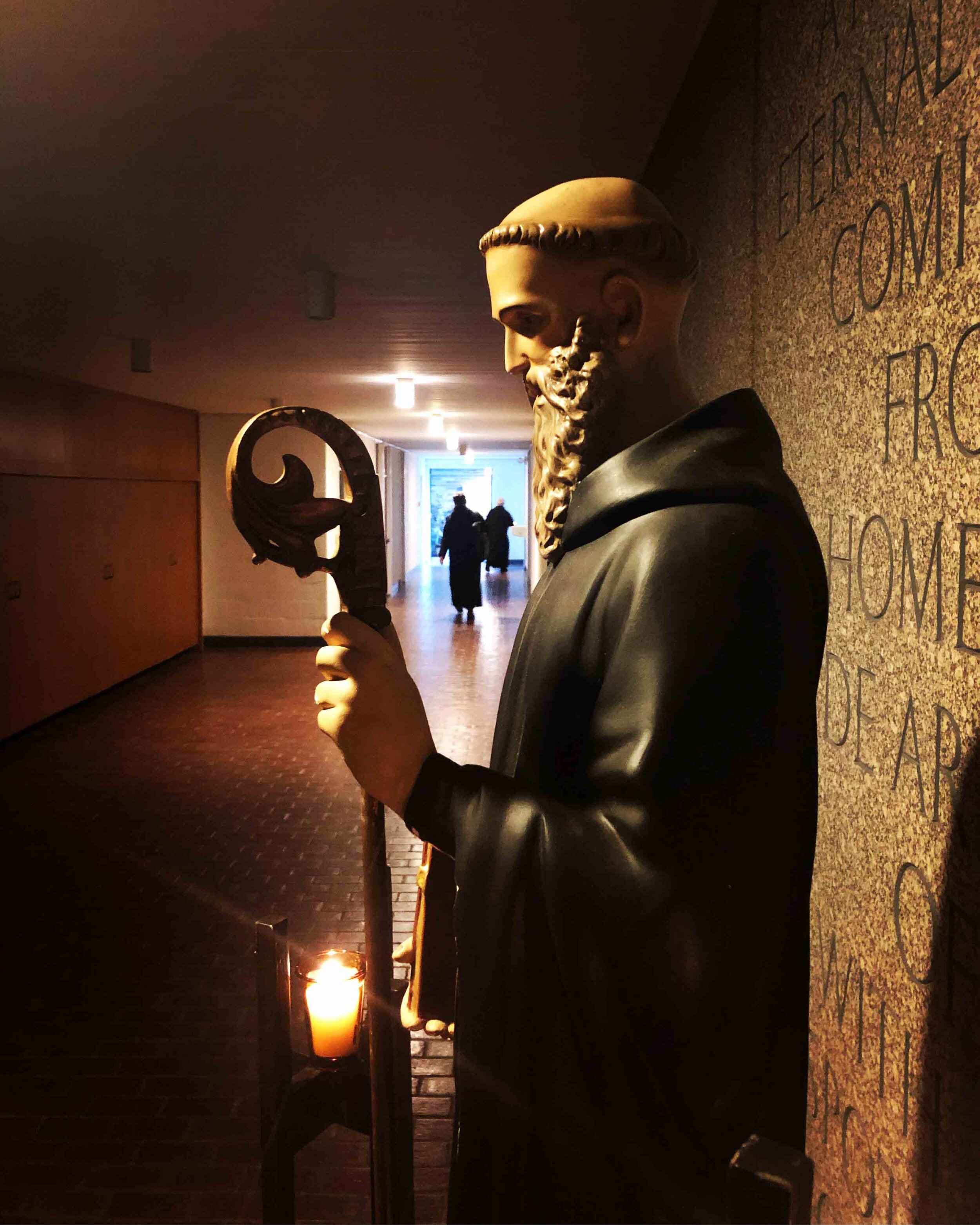
Saint Benedict
Shortly after the western Roman Empire ended in AD 476 with the capture, forced abdication, and death of the teen-aged Emperor Romulus, another Italian teenager was about to give birth to a different sort of “realm” – a spiritual one.
A youngster named Benedict, born in the city of Nursia in Umbria around AD 480, was sent to Rome for a classical education. He found little in that chaotic place to nurture his growing hunger to know God more intimately, for, in addition to the Empire’s recent ruin, even the Church was divided with various men claiming to be the legitimate Pope.
Benedict shook the dust of Rome off his sandals and headed, like many other seekers of God, into a wilderness place to seek God’s will. Three years of prayerful solitude in a rough cave at Subiaco, southeast of Rome, under the wise guidance of a spiritual father prepared him for his call. The boy had become a hermit.
God’s call often grows and unfolds in our lives, and not always as we would anticipate. Discovered by local shepherds in that desert place, the young hermit interrupted his solitude to answer their request that he teach them the basics of the Christian faith. The hermit had become a teacher.
Other seekers soon flocked to Benedict, asking him to teach them not merely Christian doctrine, but how to live out their Christian lives well. Again, Benedict responded to their request as though it were God’s own voice.
He left his beloved cave and solitude to establish twelve small communities of men wishing to share his life, not as solitary hermits, but as monks living together under his direction and guidance. The shy hermit had himself become a spiritual father (an “Abba” or Abbot).
From that cave, like a spiritual womb, Benedict’s spiritual family grew and spread. First, when Benedict and several of his disciples left Subiaco to establish a single, large community on the mountainous heights overlooking the main Roman highway between Rome and Naples – the famous Abbey of Montecassino.
In the West, the oldest reference to the cult of Saint Joseph (Ioseph sponsus Mariae) connected with 19 March appears around the year 800 in the north of France. Thereafter, reference to Joseph, the spouse of Mary, becomes more and more frequent from the 9th to the 14th centuries. In the 12th century, the crusaders built a church in his honor at Nazareth. But it was in the 15th century that the cult of Saint Joseph spread due to the influence of Saint Bernadine of Siena, and especially of Jean Gerson (+ 1420), Chancellor of Notre Dame in Paris, who promoted the cause that a feast to Saint Joseph be officially established. There were already some celebrations in Milan in Augustinian circles, and in many places in Germany. It was in 1480, with Pope Sixtus IV’s approval that the feast began to be celebrated on 19 March. It then became obligatory with Pope Gregory XV in 1621. In 1870, Pope Pius IX declared Saint Joseph the Patron of the Universal Church, and Pope Saint John XXIII inserted his name into the Roman Canon of Holy Mass in 1962. More recently, Pope Francis approved seven new invocations in the Litany to Saint Joseph: Guardian of the Redeemer, Servant of Christ, Minister of Salvation, Support in difficulties, Patron of exiles, Patron of the afflicted, and Patron of the poor.
Prayer
Hail, Guardian of the Redeemer, Spouse of the Blessed Virgin Mary. To you God entrusted his only Son; in you Mary placed her trust with you Christ became man. Blessed Joseph, to us too, show yourself a father and guide us in the path of life. Obtain for us grace, mercy and courage, and defend us from every evil. Amen.
Please leave message if you would like a copy of our novena app for iPhone or iPad. History and prayers of 36 saints.
Designed and revealed by Mary, the Medal is unique among all medals.
It was almost midnight when St. Catherine Labouré was awakened by a soft voice, whispering, “Sister, sister, sister.” Mysterious events led her to the chapel where the Blessed Mother appeared and sat down near the altar. St. Catherine knelt at her feet, rested her hands in Mary’s lap, looked into her eyes, and had a heart-to-heart conversation with her. Later, St. Catherine would refer to that night as “the sweetest moment of my life.”
Four months later, in November of 1830, Mary again appeared to St. Catherine at the Rue de Bac Chapel. This time, our Blessed Mother was standing on a globe, with dazzling rays of light streaming from her outstretched hands. Framing the apparition was an inscription: “O Mary, conceived without sin, pray for us who have recourse to thee.” When Mary spoke to St. Catherine, she said “Have a medal struck upon this model. Those who wear it will receive great graces, especially if they wear it around the neck. Those who repeat this prayer with devotion will be, in a special manner, under the protection of the Mother of God. Graces will be abundantly bestowed upon those who have confidence.”
With approval of the Catholic Church, the first medals were made in 1832 and distributed in Paris. Only ten of the original medals are known to exist, and one of them is housed at the Miraculous Medal Shrine.
Almost immediately, the blessings that Mary promised showered down on those who wore her medal, and soon all of France was clamoring for what the people referred to as the “Miraculous Medal.” Use of the Medal spread from country to country, and, at the time of St. Catherine’s death in 1876, more than a billion medals had been made. Today, the Medal is still drawing down from God blessings for body and soul.
Wearing The Miraculous Medal
Here are some rules for wearing a Miraculous Medal:
Wear it around the neck: According to Our Lady, the medal should be worn around the neck.
Have it blessed: It’s best to wear a medal that has been blessed by a priest. A priest or delegated lay person can invest the wearer in the medal using the approved rite.
Wear it with confidence: According to Our Lady, those who wear the medal with confidence will receive great graces.
Wear it as a sign of devotion: The medal is a visible sign of devotion to Mary and Jesus.
Wear it as a reminder of faith: The medal can be a daily reminder of faith.
The Miraculous Medal is a popular piece of jewelry for Catholics, but anyone can wear it. The medal originated from apparitions to French nun Saint Catherine Laboure.The medal’s front and back are full of symbolism.
THE MEANING OF THE MIRACULOUS MEDAL.pdfDuring Our Lady’s visit to Catherine on November 27, 1830, rays of light flowed from rings on her fingers that were made of precio…St Joseph Church | Chehalis, WA
The Hidden Symbolism in the Miraculous Medal – EWTNNov 27, 2023 — The History of the Miraculous Medal During one of many apparitions to French nun Saint Catherine Laboure, Our Lady gav…EWTN
Investiture of the Miraculous Medal – SS. Cyril and Methodius ParishNov 13, 2024 — A person becomes a member by wearing a Miraculous Medal that has been blessed by a priest. It is fitting that the pers…saintcyrils.church
Some form of cloister is present in all types of religious life, even the convents of sisters who engage in active apostolates. In such communities, one area of the convent is “cloistered,” reserved for the sisters alone. This type of cloister is called common cloister.
In the contemplative life, the concept of a cloister, a place reserved for the nuns alone, is expanded and deepened. Often the entire monastery is cloistered, and may even be surrounded by a cloister wall. The choir where the nuns sit in the chapel is sometimes hidden from the public who come to pray. And, depending on what form of cloister each monastery professes, some institutes of nuns even make enclosure the object of a fourth vow.
Papal cloister is the strictest form of enclosure, in which a nun does not leave the boundaries of the monastery except for serious reasons. The norms defining papal enclosure are given by Rome. The most recent instruction on papal cloister is the 2018 document Cor Orans, which implements what Pope Francis outlined in his 2016 Apostolic Constitution Vultum Dei Quaerere.Cor Orans states: “The law of papal cloister extends to the dwelling and to all the interior and exterior spaces of the monastery reserved exclusively for the nuns in which the presence of strangers can be admitted only in case of necessity. It must be a space of silence and recollection, facilitated by the absence of external works, where the permanent search for the face of God can develop more easily, according to the Institute’s charism.”
Constitutional cloister is a form of cloister defined by the norms in the Rule and Constitutions of the individual order. It is generally less strict than papal cloister. This type of cloister is practiced if the community’s charism joins to their life of contemplation some kind of apostolic or charitable work. They are still cloistered nuns, but they may have an apostolate attached to the monastery–such as a retreat house–which would be impossible to carry out if they practiced papal enclosure. Cor Orans says of constitutional cloister: “It must be a space of silence and recollection, where the permanent search for the face of God can develop, according to the charism of the Institute, in consideration of the works of apostolate or charity exercised by the nuns” (n. 205).



 St Joseph Church | Chehalis, WA
 EWTN
EWTN saintcyrils.church
 novena.com