Invoked for: finding a husband, finding lost articles
Invoked against: debt, shipwreck, starvation
Symbols: baby Jesus, book of Gospels, lily
Wonder and miracles are infused with every story of Saint Anthony. Though he has been dead for almost 800 years, he is still the most popular saint in the world and his statue is found in every Catholic Church. Saint Anthony is best known as the patron saint of lost articles but he is invoked for help in all life situations. In his own day he was called the “Wonder Worker’ and credited with the ability to stop the rain, raise the dead and reattach severed limbs. He was such a charismatic preacher that when a crowd of heretics in Rimini refused to listen to his preaching, the fish raised themselves out of the water to hear him.
Born Fernando de Bulhes in Lisbon, Portugal, he disappointed his noble family by rejecting his luxurious life and joining the Augustinian religious order. A scholar by nature, he read every book in the monastery, devoting his time to contemplative prayer. Eventually, he befriended a group of itinerant Franciscan monks and became fascinated with this new religious order. Much impressed by their dedication to simplicity, poverty and their belief in returning to the original words of Christ, he joined their ranks, changing his name to Anthony in honor of Saint Anthony of the Desert, the patron of their little church. Returning home from a failed missionary venture in Morocco, his ship was blown off course and he wound up in Messina, Sicily. A group of Franciscan friars insisted he go north with them for a great gathering of all Franciscans, with their founder Francis of Assisi.
Anthony remained in Italy and discovered his great gift of preaching when a superior ordered him to speak at an ordination, telling him to say whatever the holy spirit had infused into him. He astonished his audience, not only by his skills as an orator but by the depth of his knowledge. He was sent throughout northern Italy and southern France on evangelical preaching missions which gathered crowds in the tens of thousands. His popularity among the people increased as he used his position to get real changes enacted for their protection. While based in Padua, he observed the crushing power of debt upon the common people. At Anthony’s insistence, the local municipality enacted a law protecting those who could not pay their debts that is still enforced today.
Anthony exhausted himself preaching out in fields and in piazzas as there was not cathedral large enough to hold all who came to hear him. At the age of thirty six, his health began to fail him and a local Count donated a woodland retreat for his recovery. One morning the Count heard the sounds of a baby giggling and he looked out to see Anthony surrounded in light, playing with the baby Jesus. That Christ would choose to appear to one of his saints in such a vulnerable state is a testament to the loving and kind nature of Saint Anthony. Because he is depicted holding a baby, women having trouble conceiving invoke his aid. Being of Portuguese descent, Anthony’s feast day is very auspicious for marriages in Portugal and Brazil and in those cultures, he is known to assist women seeking a husband.
According to legend, Saint Anthony earned the title patron saint of lost articles when a novice borrowed his psalter and failed to return it. Saint Anthony prayed to get it back and the novice was visited by terrifying visions that sent him running back to Anthony with the book. In iconography, Anthony always holds the baby Jesus and a lily for purity. Many times the returned book of the gospels is included.
Novena to Saint Anthony of Padua
Holy Saint Anthony, gentle and powerful in your help, Your love for God and charity for His creatures, made you worthy when on earth, to possess miraculous powers. Miracles waited on your word, which you were always ready to request for those in trouble or anxiety. Encouraged by this thought, I implore you to obtain for me (mention your request here). The answer to my prayer may require a miracle. Even so, you are the saint of miracles. Gentle and loving Saint Anthony, whose heart is ever full of human sympathy, take my petition to the Infant Savior for whom you have such a great love, and the gratitude of my heart will be ever yours.
Amen
It is customary to donate to Saint Anthony’s Bread, a charity started in Saint Anthony’s lifetime, in gratitude to answered novena prayers.
Visit St. Francis of Assisi Church in New York City, it has a breadline every morning and a shrine to St. Anthony. 135-139 West 31st Street, New York, NY 10001.
Mass Schedule: Features daily masses (7:30 am, 12:00 pm, 5:30 pm) and weekend masses (Sat Vigil 4 pm; Sun 8 am, 9:15 am Korean, 10 am Spanish, 11 am, 5 pm).
Ministries: Includes a Migrant Center, LGBTQ+ ministry, adult education, counseling, and a daily breadline for the hungry.
Significance: Known for its Franciscan, peaceful atmosphere in a busy area, a piece of World Trade Center steel, and wood sculptures of St. Jude and St. Anthony.
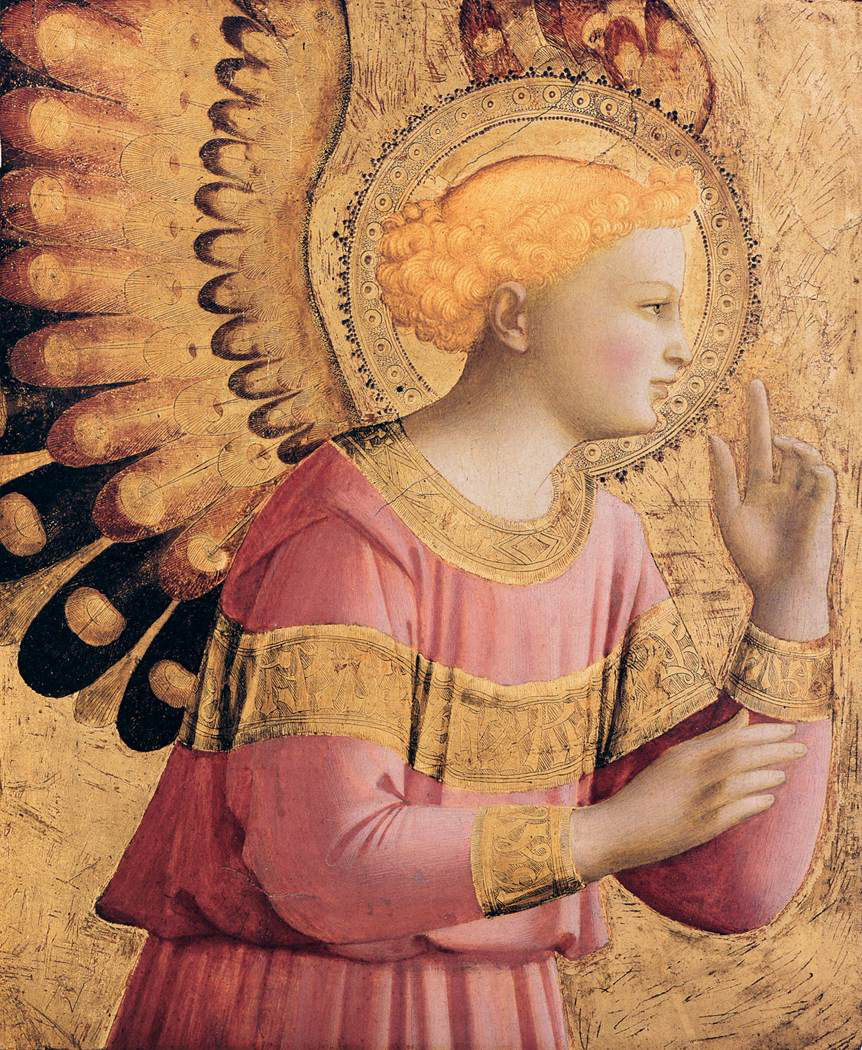
Angels—messengers from God—appear frequently in Scripture, but only Michael, Gabriel and Raphael are named.
Michael appears in Daniel’s vision as “the great prince” who defends Israel against its enemies; in the Book of Revelation, he leads God’s armies to final victory over the forces of evil. Devotion to Michael is the oldest angelic devotion, rising in the East in the fourth century. The Church in the West began to observe a feast honoring Michael and the angels in the fifth century.
Gabriel also makes an appearance in Daniel’s visions, announcing Michael’s role in God’s plan. His best-known appearance is an encounter with a young Jewish girl named Mary, who consents to bear the Messiah.
Raphael’s activity is confined to the Old Testament story of Tobit. There he appears to guide Tobit’s son Tobiah through a series of fantastic adventures which lead to a threefold happy ending: Tobiah’s marriage to Sarah, the healing of Tobit’s blindness, and the restoration of the family fortune.
The memorials of Gabriel and Raphael were added to the Roman calendar in 1921. The 1970 revision of the calendar joined their individual feasts to Michael’s.
Reflection
Each of the archangels performs a different mission in Scripture: Michael protects; Gabriel announces; Raphael guides. Earlier belief that inexplicable events were due to the actions of spiritual beings has given way to a scientific world-view and a different sense of cause and effect. Yet believers still experience God’s protection, communication, and guidance in ways which defy description. We cannot dismiss angels too lightly.
Saints Michael, Gabriel, and Raphael are the Patron Saints of:
Death Germany Grocers Police Officers/First Responders Radiologists
Saint Gabriel is the Patron Saint of:
Broadcasters/Communicators
Saint Raphael is the Patron Saint of:
The Blind Travelers
From Franciscan Media
The Archangels in the Jesuit church in Venice
In the heart of Cannaregio in Venice, there is a beautiful 18th century church, built by the Jesuits in 1729 and dedicated to the Assumption. Inside there are many works of art (including a fantastic painting by Tiziano Vecellio), but it is also one of the few churches in the world where the six archangels are represented.
Usually the archangels are Gabriele, Michele and Raffaele, but here there are the statues another three. On either side of the high altar there are Uriel (the guardian of the gates of Heaven) and Barachiele (the archangel of divine goodness) to the four corners of the transept there are four other statues (like the previous work of Giuseppe Torretto): Michele (Prince of the heavenly hosts), Raffaele (the heavenly messenger), Gabriele (the patron of travellers) and Sealtiele (the archangel of temperance).
The other 4 archangels (missing here is Jehudiele, the praise of God) are not explicitly mentioned in the Bible but are found in the Apocalypse and in the book of Tobia. The Jesuits, the great scholars of the Holy Scriptures who were in close contact with the rabbis of the nearby Ghetto, wanted to put all the Archangels to guard and protect their Church.
Today “the other Archangels” are analysed by all those involved in the study of the Kabbalah and esoteric sciences.
Daily Word Of God—jesuit.org.sg
John 1:47-51
When Jesus saw Nathanael coming he said of him, ‘There is an Israelite in who deserves the name, incapable of deceit.’ ‘How do you know me?’ said Nathanael. ‘Before Philip came to call you’, said Jesus, ‘I saw you under the fig tree.’ Nathanael answered, ‘Rabbi, you are the Son of God, you are the King of Israel.’
Jesus replied, ‘You believe that just because I said: I saw you under the fig tree. You will see greater things than that.’ And then he added, ‘I tell you most solemnly, you will see heaven laid open and, above the Son of Man, the angels of God ascending and descending.’
Today’s Pointers on God’s Word
As you read the passage what words, phases or meanings caught your attention?
Archangel Michael, Gabriel and Raphael were created by God to “protect, communicate and heal” us. These are God’s ways of loving and caring for us at all times.
We should be grateful to God at all times for His constant and caring ways that continue to attend to our needs and desires of life.
As God is so caring toward us we, in turn, are called to care for the needs of others especially the aged, the weak, and the marginalized of our family, neighbours and the world.
Saint Michael: Luca Giordano, The Fall of the Rebel Angels ( c. 1666), Kunsthistorisches Museum, Vienna
Fr. David Convertino, OFM Executive Director of Development
Every 4th of July, I reflect on the spirit of the Day and reflect on our freedoms, what it took to secure them, and what it takes to defend them. When I do this, I often think about the blood of innocent people who endure wars and conflicts, the friars who provide help in war-torn countries and never leave the people there, and our Nation’s military heroes, who time and again protect our freedom to gather in protest or in celebration, in worship, and in pursuing the great “American Dream” of freedom and prosperity that so many strive to have.
Many women and men have sacrificed on the battlefield, in factories, offices, schools, and in their homes, living difficult lives of sacrifice so that they can have this great dream for themselves or for their children.
As a friar, my faith defines much of who I am. Besides the 4th of this month, July is also a time when the Church dedicates the entire month to the Precious Blood of Jesus.
The Precious Blood of Jesus is the ultimate expression of God’s love and mercy.
Just as so many have shed their blood to secure liberty, Jesus shed His Precious Blood to free us from sin and death. One offers civic freedom—the other freedom from death.
My friends, as fireworks light up the sky this week, may they remind us of both the freedoms that belong to us in this democratic nation and the brilliance of Christ’s precious love.
We honor those who gave and still give their lives for our country, and we give thanks to the Savior who gave His life for ours.
But as we celebrate this July, we cannot forget those who still struggle for freedom from fear, poverty, a lack of healthcare, and other forms of suffering that many continue to fight for every day. Precious blood is still being shed every day.
Wishing you a blessed Feast of the Precious Blood and a joyful 4th of July.
Many Blessings,
Fr. David, OFM
The month of July is dedicated to the Most Precious Blood of the Redeemer. Supreme homage is given to the Sacred Blood. As we adore the Sacred Heart, because it is the Heart of Jesus, who is God, so we adore the Most Precious Blood.
The Blood of Jesus is the fountain of salvation. Each drop that flowed from the wounds of the Savior is a pledge of man’s eternal salvation. All races of the earth have been ransomed, and all individuals, who will allow the saving power of the Sacred Blood to be applied to their soul, are heirs of heaven. St. John Chrysostom calls the Precious Blood “the savior of souls”; St. Thomas Aquinas, “the key to heaven’s treasures”; St. Ambrose, “pure gold of ineffable worth”; St. Mary Magdalene de Pazzi, “a magnet of souls and pledge of eternal life”. The sins of mankind, in their number, in their offense to the Supreme Being, in the effects on transgressors, are immense; yet, the Precious Blood of Jesus is not frightened by numbers, it has in Itself the power to appease an angered God and to heal wounded creatures.
The Precious Blood is a cleansing bath. Unlike all other blood, which stains, the Blood of Jesus washes clean and white. According to the words of St. John, in the Apocalypse, the Angels wonder, and the question is asked: “These that are clothed in white robes, who are they?” The Lord answers: “These are they that have washed their robes, and have made them white in the Blood of the Lamb.” For no other reason did the Precious Blood flow but to regain for the souls of men the beautiful dress of innocence, and, once regained, to preserve it throughout life and into eternity.
The Blood of the Savior is a well of consolation for troubled hearts. Can anyone, confidingly, look at the Sacred Blood trickling down from the Cross without taking courage to carry on, in spite of the difficulties which are the common lot of all? One glance at the Cross must be able to drive away fear. And, another, must be able to instill trust in Him who did not rest until the last drop, mingled with water, flowed out of an opened Heart. He, who was willing to do so much for men, must be willing to overlook and forget the frailties which they deeply regret; He must be willing to come to their assistance when harassed, to defend them when tempted, to comfort them when afflicted. The Blood of Jesus must be for Christians what the north-star is to sailors.
Would that men on earth honored the Precious Blood in the manner in which they who are in heaven give honor and praise and thanksgiving! They proclaim that It purchased the glory which they enjoy. Without It, they would have remained slaves of Satan and outcasts from the eternal mansions of God. Let us profess that we owe to the Sacred Blood of Jesus all that we have in this life, and that to It we shall owe all that we shall enjoy in a better and eternal life! PASSIONIST NUNS, 8564 CRISP ROAD, WHITESVILLE, KY 42378
The call which comes from this important feast day is first of all a call to Eucharistic adoration, because in the Sacred Host the Lord Jesus is truly present and He offers each of us His Heart, His Merciful Love. To spend time in the Presence of the Eucharistic Lord, to adore Him, is the best expression of devotion to the Sacred Heart of Jesus which, as we know, spread all over the world thanks to Jesus’ revelations to Saint Margaret Mary Alacoque in the 17th century: “Behold the Heart which so loved mankind”!
As a prolongation and accomplishment of this message, the Lord appeared to another Sister in the 20th century revealing the abyss of His unfathomable mercy; she was Saint Faustina Kowalska who wrote in her Diary, now world famous, these words of Jesus: “I have opened my Heart as a living source of Mercy, from it all souls draw life, all approach with deep confidence this sea of Mercy. Sinners will obtain justification and the just will be strengthened in goodness. I will fill the souls of those who put their trust in My Mercy with My divine peace at the hour of their death. My daughter, continue to spread devotion to My Mercy, in doing so you will refresh My Heart which burns with the fire of compassion for sinners. Tell my priests that hardened sinners will be softened by their words if they speak of my boundless Mercy and of the compassion which My Heart feels for them. I will give priests who proclaim and exalt My Mercy wondrous power, unction to their words and I will move all the hearts to which they speak” (Book 5, 21 January 1938).
The deepest longing of Christ’s Heart is that we discover how much he loves us, the extent of his tender love for creatures who, cooled by their selfishness, look only inwards at themselves, as if they were afraid to let themselves be loved unconditionally by their Creator, who asks nothing and gives all!
Close to the Heart of the Son is the Heart of the Mother whom the Church celebrates the day after the solemnity of the Sacred Heart of Jesus. Let it again be the Holy Father who illuminates us with regard to this mystery: “The heart that resembles that of Christ more than any other is without a doubt the Heart of Mary, his Immaculate Mother, and for this very reason the liturgy holds them up together for our veneration. Responding to the Virgin’s invitation at Fatima, let us entrust the whole world to her Immaculate Heart, which we contemplated yesterday in a special way, so that it may experience the merciful love of God and know true peace” (Benedict XVI, Angelus 5 June 2005).
The Order of Cistercians of the Strict Observance (also known as “Trappists”) is a Roman Catholic contemplative religious order, consisting of monasteries of monks and monasteries of nuns. We are part of the larger Cistercian family which traces its origin to 1098. As Cistercians we follow the Rule of St Benedict, and so are part of the Benedictine family as well. Our lives are dedicated to seeking union with God, through Jesus Christ, in a community of sisters or brothers.
Early Monasticism
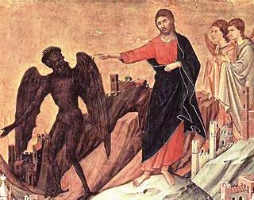
Jesus in the desert
The concept of monasticism is ancient and is found in many religions and philosophies. In the centuries immediately before Christ, Hinduism, Buddhism, and Judaism all developed alternative styles of life which involved renouncing the world in some ways, in order to seek liberation or purification or union with God, sometimes as a solitary ascetic, sometimes in community.
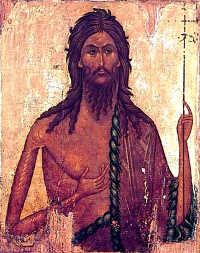
Early Christian monasticism drew its inspiration from the examples of the Prophet Elijah and John the Baptist, who both lived alone in the desert, and above all from the story of Jesus’ time in solitary struggle with Satan in the desert, before his public ministry. Beginning with the Exodus and all through the Old Testament times, the desert was regarded as a place of spiritual renewal and a return to God. Although there were ascetics, especially women ascetics, among the first generations of Christians, they generally lived in the towns and cities.
St John the Baptist
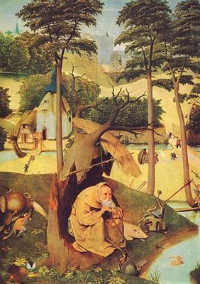
St. Anthony the Great (ca. 251-356) was the first well-known Christian to withdraw to the desert. According to the Life of Anthony written by St Athanasius in the mid fourth century, Anthony retreated to the wastelands of Egypt to lead an intensely ascetic life with the sole purpose of pursuing God in solitary prayer. He remained alone until his holiness and evident wholesomeness attracted a growing circle of followers. So deep was his influence that he is considered the father, not only of the movement of Desert Fathers and Mothers of fourth – fifth century Egypt, but also the father of the entire Christian monastic family.
St Anthony While the earliest Desert Fathers lived as hermits, they were rarely completely isolated, but often lived in proximity to one another, and soon loose-knit communities began to form in such places as the Desert of Nitria and the Desert of Skete. The progression from hermit (“anchorite”) to monk (“cenobite”) living in community under one abbot, came quickly, when in 346 St Pachomius established in Egypt the first cenobitic Christian monastery.
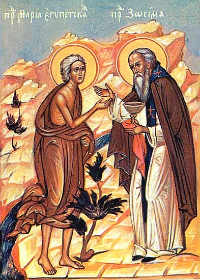
Mary of Egypt
The Eastern monastic teachings were brought to the western church by Saint John Cassian (ca. 360 – ca. 435). As a young adult, he and his friend Germanus entered a monastery in Palestine but then journeyed to Egypt to visit the eremitic groups in Nitria. Many years later, Cassian founded a monastery of monks and probably also one of nuns near Marseilles, and partly to counter what he felt were the abuses he found in Western monasticism, he wrote two long works, the Institutes and Conferences. In these books he not only transmitted his Egyptian experience (they are perhaps the oldest written record of the thought of the Desert Fathers), but he also gave Christian monasticism a profound evangelical and theological basis.
Cassian’s influence was enormous and lasted for centuries – even the smallest monastic library in Europe’s Dark Ages would have its copy of Cassian. Furthermore, St. Benedict incorporated Cassian’s thought into his monastic Rule, and recommended that his monks read Cassian’s works. Since the Rule of St Benedict is still used by Benedictine, Cistercian, and Trappist monastics, the thought of John Cassian, and the desert tradition behind him, still guides the spiritual lives of thousands of men and women in the Catholic Church.
The fear of the Lord is our cross. Just as someone who is crucified no longer has the power of moving or turning his limbs in any direction as he pleases, so we also ought to fasten our wishes and desires, not in accordance with what is pleasant and delightful to us now, but in accordance with the law of the Lord, where it hems us in. Being fastened to the wood of the cross means: no longer considering things present; not thinking about one’s preferences; not being disturbed by anxiety and care for the future; not being aroused by any desire to possess, nor inflamed by any pride or strife or rivalry; not grieving at present injuries, and not calling past injuries to mind; and while still breathing and in the present body, considering oneself dead to all earthly things, and sending the thoughts of one’s heart on ahead to that place where, one does not doubt, one will soon arrive…
It requires a bit of detective work—pulling a few threads here, a few more there, and so on throughout the Gospels—to form a viewable tapestry of the holy Galilean women. However, by taking the time to delve into the verses on these women, this lovely group slowly comes into focus, and we can better learn to appreciate them for who they were and all they did for Jesus. St. Mary Magdalene, Blessed Joanna, Susanna, St. Salome, St. Mary of Clopas, and many others unnamed are indeed a special collection of women to know.
It is Luke who gives a formal introduction to these women. At the start of his eighth chapter, he presents them as a unique cluster from the region of Galilee who ministered to Jesus from “their resources.” Luke also lets us know that at least some of these women had suffered terribly and found healing.
We can only imagine the day-to-day lives of these women while they traveled with and assisted Jesus and the Twelve Apostles. Obviously, they had “resources” to spare. Perhaps it was strictly financial assistance that they gave. However, it seems possible that they helped with other things too—maybe they did some cooking, helped with laundry and mending, or nursed anyone who got sick. With a bit of imagination, it is easy to envision them helping in a variety of ways. These women most certainly gleaned some significant insights and understandings during their time of accompanying Christ. It would be nice to have more biblical elaboration on their roles, but we don’t.
After pondering their time going from town to town with Jesus and the apostles, Bible readers pretty much have to wait until the Passion narratives in each Gospel to read anything more about these women (a short narrative on St. Salome is one exception).
Their Home of Galilee
The region of Galilee was the site of many wonderful New Testament events: the Sermon on the Mount, the miracle of the wine at Cana, the healing of the centurion’s servant, and the Transfiguration—just to name a few. And, of course, Jesus’ childhood home in Nazareth was in Galilee as well. This collection of women is another star for this region west of the Sea of Galilee.
St. Mary Magdalene
Poor Mary Magdalene has been stuck for centuries now with the reputation of having been a prostitute. In reality, though, all we know for sure about her past is that she had been burdened with seven demons that had left her—under the authority of Jesus (Lk. 8:2 & Mk. 16:9).
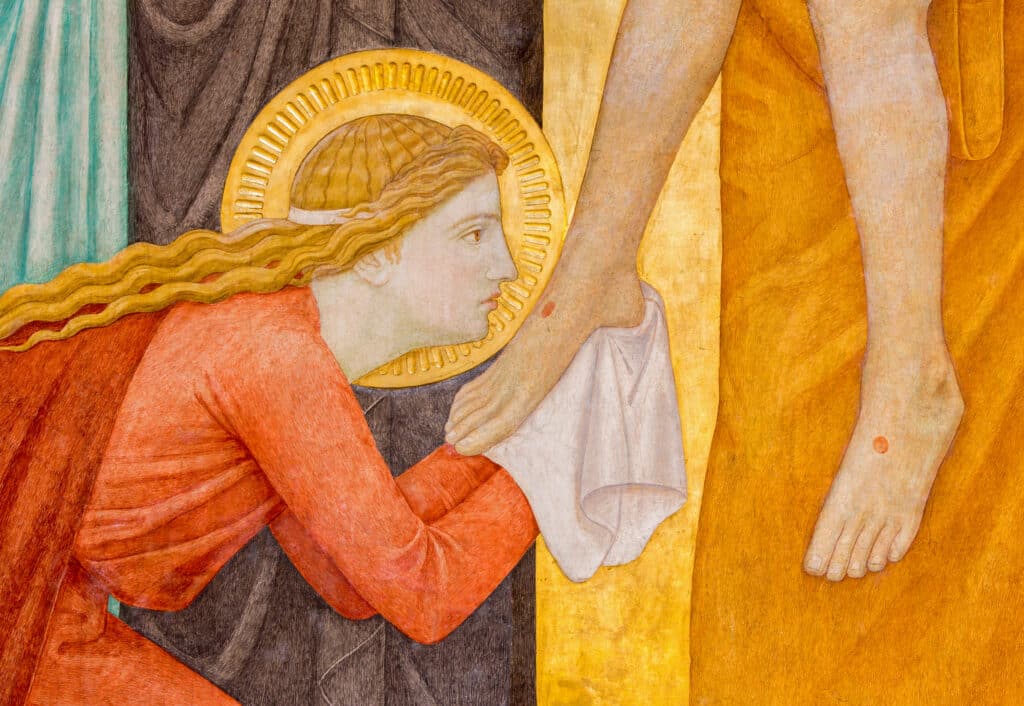
During the early medieval days, Pope Gregory the Great once connected Mary Magdalene to a passage shortly before Luke’s formal introduction to the Galilean women (Lk 7:36-39). In it, a sinful woman who washed Jesus’ feet with her tears and then anointed them with a flask of ointment is presented.
Evidently, the pope had a hunch that the sin of this woman was prostitution and that she was likely the same as Mary Magdalene, who is mentioned just 12 verses later. Pope Gregory the Great (who we must remember really did do many “great” things) also linked Mary Magdalene with Mary of Bethany. These well-intentioned ideas stuck for a long time.
You still don’t have to go far to find someone who thinks Mary Magdalene was undoubtedly a prostitute and the same as Mary of Bethany. Many now assert that seven demons may actually represent mental illness—not prostitution. And most conclude that Mary Magdalene, Mary of Bethany, and the woman who washed Jesus’ feet with her tears are most likely three separate women.
Of all the holy Galilean women, Mary Magdalene is the most prominent. Three evangelists name her specifically as being at the Crucifixion, two at the burial, and all four Gospel writers put Mary Magdalene at the empty tomb. Matthew, Mark, and John also assert that she saw and spoke to the risen Christ.
Blessed Joanna
Joanna is the next Galilean woman Luke introduces. Little is said about Joanna, but the brief mention that Luke presents offers an intriguing clue. He included the fact that Joanna had a close connection to Herod Antipas the Tetrarch, who had John the Baptist beheaded. Joanna was the wife of Herod’s steward, Chuza.
Being a steward, Chuza likely had the responsibility of overseeing Herod’s estate, a job that surely demanded a certain loyalty to this ruler. One can only guess how Joanna managed to support her husband and follow Jesus without any conflict. Perhaps Joanna and her husband were present at the ill-fated birthday banquet. Maybe they heard Herod’s order for the beheading of John the Baptist and perhaps even saw the gruesome platter. We can only wonder.
Joanna is mentioned by name only one other time in the Bible—Luke lists her as one of the women who went to the tomb on the day of the Resurrection.
According to Luke, Joanna—along with other women of Galilee—saw two men in dazzling clothes at Jesus’ empty tomb, learned of Christ’s resurrection, and shared the great news with the apostles—who did not believe them! Although Joanna’s name is never mentioned again, it is reasonable to consider that she was likely a part of the group whenever there is a general reference to the Galilean women.
In the current Roman Martyrology, Joanna is listed as a blessed, rather than a saint. This is hard to discern; in the earliest days of the Church, the words blessed, holy, and saint were often used interchangeably. So you might see Joanna listed as a saint in some resources and as a blessed in others, similar to the way we call Mary the Blessed Virgin Mary or St. Mary.
It’s impossible to know with certainty what exactly was meant. Was Joanna considered an official saint in heaven or just a really good and pious person (perhaps not martyred)? Either way, she gave much and is an inspiration to all.
Blessed/St. Joanna’s memorial is May 24.
St. Salome
It is Mark and Matthew who let us know that Salome is another holy woman of Galilee. Mark provides us with her name—within his Crucifixion and Resurrection narratives. Matthew, who calls her “the mother of the sons of Zebedee,” gives an additional, somewhat amusing account of St. Salome. In his 20th chapter, he relates how this mother of two apostles—James the Greater and John the Evangelist—had big ideas for her sons and boldly requested: “Command that these two sons of mine sit, one at your right and the other at your left, in your kingdom” (Mt 20:21).
Of course, Jesus took the opportunity to preach on the importance of humility and that serving others would count for more than grand places of honor.
St. Salome is listed on the April 24 page of the Roman Martyrology.
Susanna
Susanna is mentioned one time only—in Luke’s introduction to the Galilean women. So we can only glean that she, like Mary Magdalene and Joanna, had been cured of some demon or malady, traveled with Jesus and the apostles, and offered assistance in whatever way she could. Susanna was credibly present at the Crucifixion, burial, and empty tomb. It would be nice to know more, but we just don’t.
Susanna is not listed in the current Roman Martyrology; however, that does not exclude her from sainthood. Actually, if you were to attend Mass at a Byzantine Catholic church two Sundays after Easter, you would notice that Susanna is given special notice and is commemorated as a part of a group called the Holy Myrrhbearers.
St. Mary of Clopas
St. Mary of Clopas is especially hard to pin down in the Gospels, for she is referred to by a variety of titles:
Mary, the Mother of James and Joseph;
The Other Mary;
Mary, the Mother of the Younger James and of Joses;
Mary, the Mother of Joses;
Mary, the Mother of James;
Mary, the Wife of Clopas.
It is through John’s labeling, “Mary, the wife of Clopas” (19:25), that she has received her name: St. Mary of Clopas. Although she doesn’t stand out like Mary Magdalene, one variation or another of her titles appears at the death, burial, and empty tomb scenes repeatedly. Matthew’s Gospel asserts that both Mary Magdalene and Mary of Clopas saw and heard Jesus that first Easter morning.
Some propose that Mary of Clopas’ husband was the Cleopas who traveled to Emmaus with a friend and met up with Jesus in Luke’s 24th chapter. Many even suggest that it was St. Mary of Clopas who was the unidentified traveling partner. This is not known for sure, but it is an intriguing thought to consider.
St. Mary of Clopas shares a memorial day with St. Salome: April 24.
The Unnamed Other Galilean Women
Although we don’t know their names, it is only fair to also remember the unnamed women of Galilee—many others, according to St. Luke. Perhaps these nameless women were shy or had other responsibilities that took them away from Jesus and the apostles from time to time.
Whatever the reason, the Gospels give plenty of assertions that there were others. And they deserve our notice—especially if we have ever experienced being overlooked or not named. When we get to heaven, we can meet these women, learn their names, and thank them for their rich contributions to the mission of Jesus, for bringing comfort to his crucifixion and love to his burial.
Honoring the Holy Galilean Women
Even though the Gospel writers vary somewhat in their placement of the holy Galilean women, we can still get the general idea. They were there, they were helpful, they were devout, they were fearless (braver than most of the apostles at the Crucifixion!), and they loved Jesus dearly and showed it. And at least Mary Magdalene and Mary of Clopas were highly blessed by being the first to see Jesus resurrected. Though not specifically mentioned, it seems highly probable that at least some of the holy Galilean women were present during the nine days in the upper room in Jerusalem, praying and awaiting the Holy Spirit.
The holy Galilean women were generous in many ways and great adorers of God; their good works are an example to all Christians. They fully and very bravely lived out Christ’s command to deny oneself and follow him.
Restoring St. Mary Magdalene’s Reputation
Hopefully St. Mary Magdalene’s mistaken reputation as a prostitute will continue to steadily diminish. It seems reasonable to offset this unfortunate label by putting a special emphasis on a far better one—a label given to St. Mary Magdalene by St. Thomas Aquinas: “The Apostle to the Apostles.”
This 13th-century Italian doctor of the Church wrote a commentary on the Gospel of St. John, a Gospel that offers particularly poignant highlights on Mary Magdalene’s role on that first Easter morning. John’s 20th chapter presents Mary Magdalene arriving at the empty tomb alone. His unique and rich portrayal of this special woman asserts that she tearfully glanced toward the empty tomb, was visited by two angels, mistook Jesus for a gardener, and then was overcome with emotion as she recognized her Lord. Then, Mary Magdalene—without hesitation—followed Jesus’ charge to share the news of his resurrection: “Mary of Magdala went and announced to the disciples, ‘I have seen the Lord’” (Jn 20:18a), and shared what he told her.
It was Mary Magdalene carrying out Jesus’ wish to announce his resurrection with eager confidence that prompted St. Thomas Aquinas to call Mary Magdalene the Apostle to the Apostles within his commentary.
It is compelling to note that St. Thomas Aquinas also pointed out Matthew’s inclusion of another holy Galilean woman—”the other Mary” (St. Mary of Clopas)—during the first appearance of Jesus. Certainly, her role was profound as well, and more elaboration on her story would be welcome. However, St. Thomas Aquinas couldn’t help but notice Mary Magdalene’s overall prominence, especially in John’s Gospel, and felt inspired to highlight her apostle-like role.
Evidently, Pope Francis has read this commentary of St. Thomas Aquinas and agrees. In June 2016, the pope expressed a great appreciation for this title bestowed upon St. Mary Magdalene and felt it was time to elevate her day of remembrance (July 22) from a memorial to a feast. (The rank of Church celebrations are: optional memorial, obligatory memorial, feast, and solemnity.)
This seems a perfect counteraction: to start referring to St. Mary Magdalene as the Apostle to the Apostles in order to help restore her due reputation and highlight her holiness; to focus on her great love and devotion to Christ; and to recognize her rich contribution of proclaiming Christ’s triumph over the cross.
Sidebar: A Retreat with the Holy Galilean Women
Perhaps you would like a two-week, at-home retreat with these special women. If so, take some time each day for 14 days to read a biblical passage on them. Take in one or two surrounding verses and read the footnotes, if desired, and ponder their impact. Try to imagine yourself at the various scenes; maybe jot down your thoughts in a journal. Note which of these women each Gospel writer chose to highlight for the death, burial, and Resurrection accounts.
In the West, the oldest reference to the cult of Saint Joseph (Ioseph sponsus Mariae) connected with 19 March appears around the year 800 in the north of France. Thereafter, reference to Joseph, the spouse of Mary, becomes more and more frequent from the 9th to the 14th centuries. In the 12th century, the crusaders built a church in his honor at Nazareth. But it was in the 15th century that the cult of Saint Joseph spread due to the influence of Saint Bernadine of Siena, and especially of Jean Gerson (+ 1420), Chancellor of Notre Dame in Paris, who promoted the cause that a feast to Saint Joseph be officially established. There were already some celebrations in Milan in Augustinian circles, and in many places in Germany. It was in 1480, with Pope Sixtus IV’s approval that the feast began to be celebrated on 19 March. It then became obligatory with Pope Gregory XV in 1621. In 1870, Pope Pius IX declared Saint Joseph the Patron of the Universal Church, and Pope Saint John XXIII inserted his name into the Roman Canon of Holy Mass in 1962. More recently, Pope Francis approved seven new invocations in the Litany to Saint Joseph: Guardian of the Redeemer, Servant of Christ, Minister of Salvation, Support in difficulties, Patron of exiles, Patron of the afflicted, and Patron of the poor.
Prayer
Hail, Guardian of the Redeemer, Spouse of the Blessed Virgin Mary. To you God entrusted his only Son; in you Mary placed her trust with you Christ became man. Blessed Joseph, to us too, show yourself a father and guide us in the path of life. Obtain for us grace, mercy and courage, and defend us from every evil. Amen.
Please leave message if you would like a copy of our novena app for iPhone or iPad. History and prayers of 36 saints.
“The most Blessed Virgin Mary was, from the first moment of her conception, by a singular grace and privilege of almighty God and by virtue of the merits of Jesus Christ, Savior of the human race, preserved immune from all stain of original sin.”
In 1854, Pope Pius IX’s solemn declaration, “Ineffabilis Deus,” clarified with finality the long-held belief of the Church that Mary was conceived free from original sin. Mary was granted this extraordinary privilege because of Her unique role in history as the Mother of God. That is, she received the gift of salvation in Christ from the very moment of her conception.
Even though Mary is unique in all humanity for being born without sin, she is held up by the Church as a model for all humanity in Her holiness and Her purity in her willingness to accept the Plan of God for her.
Every person is called to recognize and respond to God’s call to their own vocation in order to carry out God’s plan for their life and fulfill the mission prepared for them since before the beginning of time. Mary’s “Let it be done to me according to Thy Word,” in response of the Angel Gabriel’s greeting, is the response required of all Christians to God’s Plan.
The Solemnity of the Immaculate Conception is a time to celebrate the great joy of God’s gift to humanity in Mary, and to recognize with greater clarity, the truth that each and every human being has been created by God to fulfill a particular mission that he and only he can fulfill.
“The word of the Lord came to me thus: “Before I formed you in the womb I knew you, before you were born I dedicated you, a prophet to the nations I appointed you.” (Jeremiah 1:5-6)
St. Ignatius Loyola included in his Spiritual Exercises a prayer called “the Examen,” which derives from the Latin word for examination. It is a meditation with roots not only in Ignatian spirituality, but also in the spiritual practices of the ancient Stoics. There are many versions of the Examen today, but all have five steps. Here is a simple rendering of some key elements:
Place yourself in God’s presence. Give thanks for God’s great love for you.
Pray for the grace to understand how God is acting in your life.
Review your day — recall specific moments and your feelings at the time.
Reflect on what you did, said, or thought in those instances. Were you drawing closer to God, or further away?
Look toward tomorrow — think of how you might collaborate more effectively with God’s plan. Be specific, and conclude with the “Our Father.”
Some versions of the Examen place a special emphasis on gratitude and feelings. A detailed example of such a meditation is offered by IgnatianSprituality.com.
“God is in it”
The heart of the Examen is the third part: reviewing your day.
“Think of it as a movie playing in your head,” writes James Martin, S.J., in The Jesuit Guide to (Almost) Everything. “Push the play button and run through your day, from start to finish, from your rising in the morning to preparing to go to bed at night. Notice what made you happy, what made you stressed, what confused you, what helped you be more loving. Recall everything: sights, sounds, feelings, tastes, textures, conversations. Thoughts, words, and deeds, as Ignatius says. Each moment offers a window to where God has been in your day.”
And remember that no experience is too trivial for spiritual investigation.
“Nothing in our lives is so insignificant that it doesn’t deserve God’s attention,” notes Jim Manney in A Simple Life-Changing Prayer, a book about the Examen. “In fact, the mundane and the humdrum parts of our lives give depth and texture to our relationships with God. Washing the windows and cooking dinner are as much a part of the relationship as graduation day. If it’s part of our human experience, God is in it.”
Ignatius was emphatic about the Examen. He told the early Jesuits that if they for some reason did no other spiritual exercises, they should do this one. Then as now, the Examen is a spiritual tool for sizing up your days — and planting the seeds for a more purposeful life.
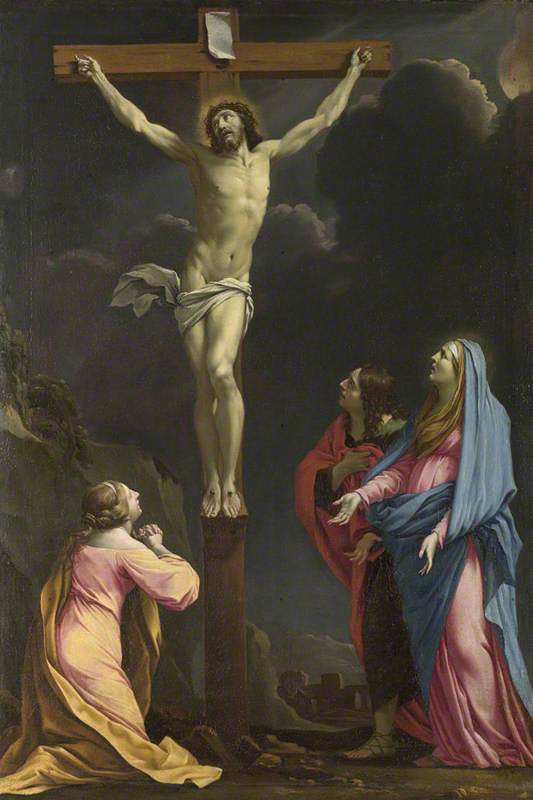
All four Gospels make note that Mary was present at the crucifixion and death of Jesus on Good Friday. Matthew, Mark, and Luke note that Mary and other women, in particular Mary Magdalene, “watched from a distance.” Only Luke writes that “some of Jesus’ disciples” were with Mary. Notably, the Twelve were not there, but hiding out of fear for their lives.
John, however, says very clearly that Mary—with Mary Magdalene and the disciple whom Jesus loved—witnessed Jesus’ death “from the foot of the cross,” not from a distance. At the same time, the distinction made between John and the other three evangelists may provide us with significant teaching moments.
On the one hand, Matthew, Mark, and Luke may be understood as historical descriptions since family and relatives, especially women, would not have been permitted up close to the actual place of execution. Executions were “men’s work.” Those executed were stripped of all clothing and died naked. Artists have added loincloths for the sake of Jesus’ dignity. And executioners would not have wanted hysterical family members getting in the way. If you’ve seen The Passion of the Christ, you will remember the shocking brutality of the crucifixion. But the point is that, even at a distance, the fact is that Mary and others saw Jesus crucified and die.
Universal Truths
John’s description has Mary, Magdalene, and “the disciple whom Jesus loved” close enough so that they could hear his words. John’s account is not for the purpose of describing the actual historical scene. Rather, it is to give the early Church a powerful instruction in the relationship of Mary not only to the disciple standing near her, but also to the whole Church. Jesus showed us that his mother was, indeed, the mother to all of God’s children.
In looking at this scene of Jesus’ crucifixion and noting the distinctions between Matthew, Mark, and Luke’s description—and that of John’s—we see an important point in reflecting on Scripture. Sometime people want to put great emphasis on those things that they see and understand as historical. It is essential to understand that God reveals his truth in various ways.
The writer, John, already knew of the other Gospels as they described Mary and the others watching the death of Jesus, showing their dedication and faithfulness to him even in death. The best conclusion to draw is that everything in the Gospels (and all of Scripture) is significant since it is the revealed word of God. Whether it is a fact of history or a manner of teaching that might not be historical, both contain the truth of God’s teaching for us.
Both the devotion of Mary and the women witnessing Jesus’ death—and the gift of Mary as mother to us—are truths we cannot be without.






 novena.com