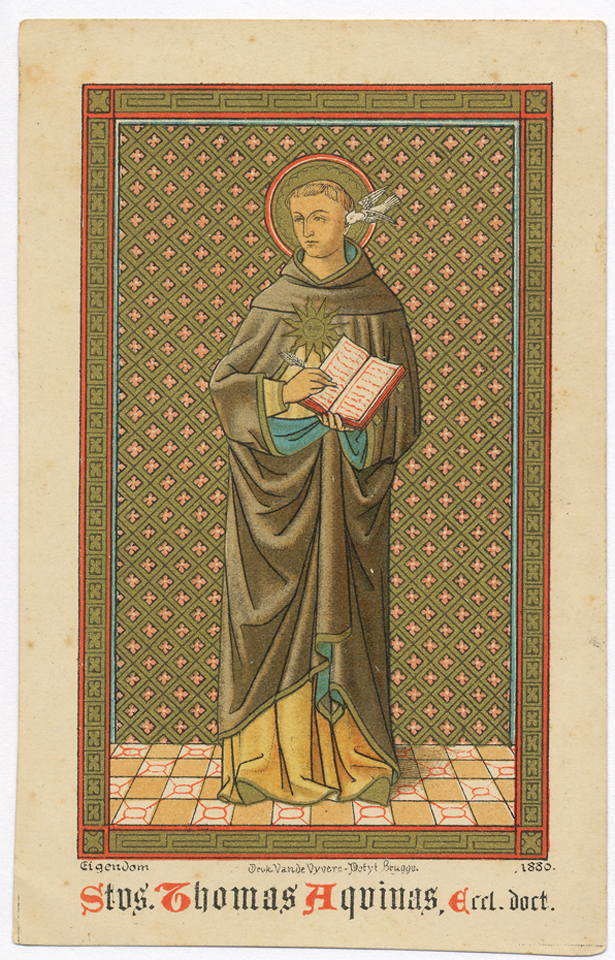
Feast of St. Thomas Aquinas, January 28

FullSizeCard_1@2“There must be must be a first mover existing above all – and this we call God.”

Patron of: Students

As one of the greatest philosophers of the Middle Ages. Yet on his deathbed, this intensely popular teacher and lecturer, who had lived in the cosmopolitan environments of Paris, Cologne and Naples, was said to give the innocent final confession of a child. Known in his lifetime as “The Angelic Doctor”, Thomas lived through his higher mind, taking intense pleasure in intellectual pursuits. Because he was an excellent teacher, able to clarify the most complicated points of learning, Thomas Aquinas is invoked by students whenever they are presented with a challenging test, a demanding course of studies or difficulty in passing an entrance exam.

Thomas was born in his noble family’s castle just outside of Naples, the youngest of four brothers and two sisters. As a child, one of his sisters was killed by lightning while sleeping in the same room as Thomas. He was forever fearful of thunderstorms, he is invoked by those with the same fears for protection against lightning strikes and sudden death. At the age of five Thomas was sent to study to the legendary Monastery of Monte Cassino. Considered the seat of Western Civilization through the dark ages, all manners of the arts and sciences were taught there. By the time Thomas left at the age of thirteen to attend the University of Naples, he was already tutoring his elders in their studies. While a student in Naples he horrified his noble family by joining the new order of mendicant Friars known as the Dominicans. Instead of begging in the streets with the Dominicans, his parents wanted to see Thomas using his great intellectual gifts to earn a higher ecclesiastical office. His brothers kidnapped him and locked him up in another family home, tempting him with every worldly thing they could think of. When they presented him with a prostitute, Thomas chased her out with a burning brand from the fireplace. After two years of confinement, his family relented and freed him The Dominicans sent Thomas to Cologne, Germany to study with Albert the Great, the most famous teacher of his times. Because of his quiet, kindly manner and his large size, his fellow students labeled him “the dumb ox”. Thomas quietly surpassed every student he ever had and Albert insisted he go to the University of Paris where he was made a teacher and received a doctor’s chair. His writings attracted both the Pope and the King of France who consulted him on matters of state. In 1272, the Dominicans sent him to Naples to run their school there. It was during the following year that experienced an ecstasy that caused him to suddenly stopped writing his greatest work , Summa Theologica, a tome that consisted of over two million words and he had spent the last seven years on. Compared to his vision, he declared, “all that I have written seems like so much straw.”

Novena:

Saint Thomas Aquinas, patron of students and schools, I thank God for the gifts of light and knowledge God bestowed on you, which you used to build up the church in love. I thank God, too, for the wealth and richness of theological teaching you left in your writings. Not only were you a great teacher, you lived a life of virtue and you made holiness the desire of your heart. If I cannot imitate you in the brilliance of your academic pursuits, I can follow you in the humility and charity that marked your life. As Saint Paul said, charity is the greatest gift, and is open to all. Pray for me that I may grow in holiness hand charity. Pray also for Catholic schools and for all students. In particular, please obtain the favor I ask during this novena.

(Mention your request).

Amen.

St. Francis of Assisi, feast day October 4

St.Francis“Lord make me an instrument of they peace, where there is hatred let me sow love.”
St. Francis of Assisi 1182 – 1226
Patron of: Ecologists

Love for God and everything in creation so consumed St. Francis of Assisi, that he was able to commune with the natural world on a divine level. Taming wolves, quieting flocks of birds and infusing peace and contentment to the humanity he interacted with, we call on Francis of Assisi to bring us into the harmonious rhythms of the universe, where all of nature and mankind are at one with the divine force of creation.

An unlikely mystic, Francis was born Giovanni Bernadone in the town of Assisi. His father, a proud member of the upper classes was a wealthy cloth merchant married to a woman from Provence. Because he frequently conversed in French with his mother, Giovanni was soon known as “Francesco” or “the Frenchman” by his friends and neighbors. Confident that his son would follow in his footsteps, the elder Bernadone indulged and catered to Francesco’s every whim and the youth enjoyed a pleasure filled existence in the company of others in his social caste. On a lark he set off with friends to take part in a war with Perugia. Much to his shock, he was taken prisoner and it took his family a year to ransom him back. Upon his return, he was bedridden and seriously ill. But in recovering his health, Francesco seems to have lost his identity. He suffered a great spiritual crisis as all interest in his old life and his father’s business waned and disappeared. While wandering the countryside he stopped into the deserted church of San Damiano and heard the crucifix say to him, “Francis, go and repair my house, which you see is falling down.” Happy to have some direction in his life, he took the request literally and began rebuilding the structure with his bare hands. Ultimately, his father disowned him and when Francis, renouncing his inheritance threw his clothing in the street, he donned the simple brown garment given him by the Bishop of Assisi.

Begging for supplies, Francis continued his work on San Damiano. Eventually he was joined by other disenchanted young men looking for a higher meaning in life. By simply following the exact tenets of Christ, this little band of friars, never owning anything, bartering labor for food and shelter began a movement of religious seekers that revolutionized the Church by the simple and loving way they spread the gospel. Instead of writing in church Latin he used colloquial Italian and in an effort to explain the story of Christ’s birth, he created a living tableau of animals and people – the first Christmas crèche.

A great poet and mystic, Francis was the first saint to receive the stigmata while in a meditative rapture. Filled with humility and though he founded one of the world’s greatest religious orders, Francis of Assisi was never ordained a priest. Upon his death he requested to be buried in the cemetery for criminals, but the people of Assisi so loved him that they took his body and interred it under the altar of their great cathedral.

Just as popular with nonCatholics as Catholics, Francis has inspired great artists, composers and writers. Assisi, Italy remains a great pilgrimage site for those wishing to pay him tribute.

Novena

O Beloved Saint Francis, gentle and poor, your obedience to God, and your simple, deep love for all God’s creatures led you to the heights of heavenly perfection and turned many hearts to follow God’s will. Now in our day, in our ministry to the many who come here searching for peace and intercede for us we come before the Lord with our special requests…

(Mention your special intentions here.)

O Blessed Saint of God, from your throne among the hosts of heaven, present our petitions before our faithful Lord. May your prayers on our behalf be heard and may God grant us the grace to lead good and faithful lives. Amen

Saint Francis of Assisi, pray for us.

Feast of St. Theresa of Lisieux

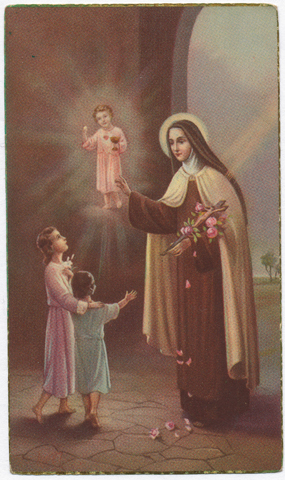
STTHofLSaint Therese of Lisieux, 1873-1897
Patron of: France, Russia, Vietnam, AIDS patients, Children, Florists, Foreign Missions, Love, Pilots, Tuberculosis Patients

Love, roses and children are keywords for Saint Therese of Lisieux. A young Carmelite novice, Therese lived a cloistered existence in a convent only miles away from where she was raised. She died in obscurity at the age of 24, never realizing her dream of working in the foreign missions, yet she is considered to be one of the greatest saints of modern times and a Doctor of the Church.

Therese Martin was the youngest of five daughters born to a very religious couple. At the age of four she lost her mother to breast cancer and the family moved from Normandy, France to the city of Lisieux to be among other relatives. Therese was spoiled by her older sisters and when the eldest joined the convent, she vowed to not only follow her, but to become a saint. She was admitted to the Carmelite cloister at the unusually young age of fifteen. Her sentimental fantasy of convent life was replaced by the reality of menial chores and constant prayer. She came face-to-face with her own doubts and weaknesses when she became ill with tuberculosis and her dream of doing missionary work in Hanoi was shattered Along with her diminished health, Therese had to accept the fact that she would never have the opportunity to travel the world and do great things. Feeling small and ineffectual, Therese went through a period of spiritual dryness where she doubted that her prayers were even heard.

By embracing her powerlessness, she was able to transform her life and develop her “Little Way”. A personal philosophy devoted to performing small, loving acts scattered throughout her day like so many flowers. Gradually, Therese realized that there were no actions that could be considered insignificant, no matter how small. If they were performed with love, they would have great force.

In 1896, while she was bedridden, Therese was ordered to write her autobiography. This self examination is part of the Carmelite spiritual regime. After her death, the book called “The Story of A Soul” was published in a small printing. It soon became spectacularly successful, as ordinary men and women were able to easily identify with its author’s struggle to accept living a hidden, mundane life. It has been translated in at least 50 languages and Saint Therese has a very active and enthusiastic following all over the world.

The international influence of her book realized Therese’s dream to be a foreign missionary. Her Little Way is greatly influenced by the simplicity of children, so the concerns of children are one of her patronages. On her deathbed she vowed that “I will spend my heaven doing good on earth. After my death I will let fall a shower of roses.”

A sign that your novena to Saint Therese is being answered is the sight and smell of roses.

Novena to Saint Therese of the Child Jesus

O little Therese of the Child Jesus, Please pick for me a rose from the heavenly gardens and send it to me as a message of love. O little flower of Jesus, ask God today to grant favors I now place with confidence in your hands.

(Mention your request here).

Saint Therese, help me to always believe as you did, in God’s great love for me, So that I might imitate your “Little Way” each day.

Amen.

Feast of Padre Pio, September 23

PadrePio

Padre Pio 1887-1968
Patron of: Forgiveness, Healing, Miracles, Reconciliation.
Denounced by Vatican officials as a fraud, and his mystical gifts frequently viewed with suspicion by his immediate superiors, Pio of Pietracelina was sequestered away in the remote monastery of San Giovanni Rotondo where it was expected that he would labor as a monk in obscurity. His adeptness in both physical and spiritual healing and his ability to read hearts and minds while in confession made him wildly popular among the common people of that impoverished region of Italy. Today, the town of San Giovanni Rotondo is the second most visited place by religious pilgrims who venture there to pay homage to one of the most popular saints of the twentieth century, Padre Pio. Made a saint in 2002, Padre Pio has no official patronage. Because of his devotion to the powers of the Sacred Heart of Jesus and his own suffering due to the mistrust of his superiors, he is frequently invoked to bring the grace of forgiveness to a situation.

Born Francesco Forlione in Pietracelina, a town north of Naples, he was named for his patron saint, Francis of Assisi. Coming from a religious family, he said he had spiritual visions of Christ and the Virgin Mary from a very young age. He never mentioned them to anyone as he assumed all people had such gifts. He was ordained as a Capuchin friar in 1910 taking the name Pio (meaning “Pious”) but was sent home due to a diagnosis of tuberculosis. While convalescing he offered himself as a conduit of suffering in exchange for the salvation of others. Eventually, in 1916 he was conscripted into the army where he contracted such a high fever that he was sent home to die. Upon his miraculous recovery from this illness, the Capuchin order sent him to the very remote monastery of Our Lady of Grace in San Giovanni Rotondo in Puglia, a province of Southern Italy. On September 20, 1918, while praying in the stillness of the church, Pio went into a trancelike state where he saw Christ standing before him bleeding from the wounds of the crucifixion. Pio’s heart almost burst in sympathy before coming out of the state in intense pain. Upon regaining consciousness he found himself to be afflicted with the same wounds of the crucifixion. It was this condition which only ended at his death in 1968, which would bring him under intense scrutiny by church officials for the rest of his life.

Pio’s talents for deciphering what people meant to tell him during confession but were too embarrassed or ashamed to bring up, became immediate apparent to the local townspeople and he developed a great following among them. They credited him with an incredible capacity of healing, mending physical ills, familial squabbles, and curing spiritual desolation. When Vatican Officials severely limited his official duties, the one mass he was allowed to say at 5 AM, had thousands lining up the night before so that they may be with him. Without ever leaving the monastery, he was known as “the living saint” as he sighted in hospitals and at sickbeds hundreds of miles away. The onset of World War Two spread his cult on an international level as soldiers from Australia, other parts of Europe, and the United States witnessed his miraculous abilities. By the late 1940’s he was receiving hundreds of international prayer requests per day. He eventually founded a hospital for the hopelessly ill, the internationally acclaimed House for the Relief of Suffering, which treats tens of thousands of people each year and survives solely on charitable donations.

The animosity that many Vatican officials had against Padre Pio was dissolved in 2002 when Pope John Paul II declared him a saint. This pope knew Pio’s powers firsthand as he had visited him fifty years before as a young seminarian in the hopes of obtaining a cure for a friend. Not only did his friend’s cancer go into remission, but Pio’s strange prediction of this obscure Polish priest’s rise to pope also came true.

Novena

(It is important to note that Padre Pio himself recited the Novena to the Sacred Heart of Jesus for the intentions of those who requested his prayers every day.)

Dear God, Thou hast generously blessed Thy servant, St. Pio of Pietrelcina, with the gifts of the Spirit. Thou hast marked his body with the five wounds of Christ Crucified, as a powerful witness to the saving Passion and Death of Thy Son. Endowed with the gift of discernment, St. Pio labored endlessly in the confessional for the salvation of souls. With reverence and intense devotion in the celebration of Mass, he invited countless men and women to a greater union with Jesus Christ in the Sacrament of the Holy Eucharist.
Through the intercession of St. Pio of Pietrelcina, I confidently beseech Thee to grant me the grace of (mention your intentions here). Amen.

Recite three Glorias.

(Excerpted from the App: “Novena: Praying with the Saints” by Barbara Calamari and Sandra DiPasqua).

Mother of Sorrows

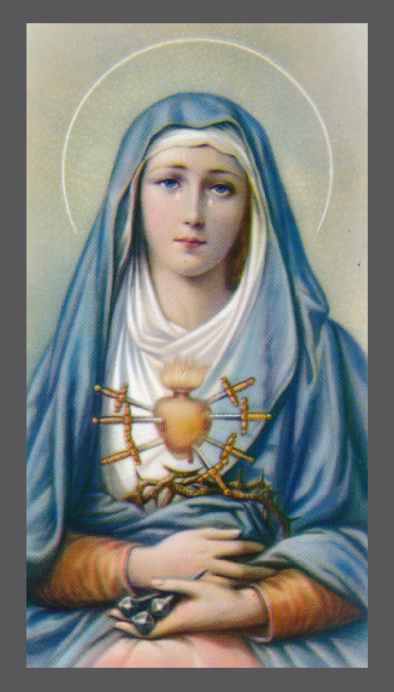
Sorrows_Small_Image

Mother of Sorrows
Patron of: Grief

When we are overwhelmed with grief, we turn to Mary, Mother of Jesus for help in our suffering. Throughout her life she endured much pain and sorrow and is fully able to empathize with anyone’s personal anguish. She endured the shame of being pregnant and unmarried, being poor, homelessness and having her only son unjustly imprisoned and executed. Most astonishing, Mary knew what was to befall her son yet had to see these events from God’s point of view and have faith that this was all for the good of mankind.

By meditating on the Seven Sorrows of Mary, a devotion from the Middle Ages, which uses scenes from the life of the Virgin Mother as a meditation on accepting the sorrowful part of life with grace.

The Seven Sorrows of Mary are:

1) The Prophecy of Simeon. As a young child, when his parents presented him in the temple, Jesus was met by the holy man Simeon who predicted everything that would happen to him in his address to Mary: “Behold, this child is destined for the fall and rise of many in Israel, and to be a sign that will be contradicted – and you yourself a sword will pierce so that thoughts of many hearts will be revealed.” (Luke 2:34-35).

2) The Flight into Egypt. In Bethlehem, after the birth of Christ, Joseph had a vision of an angel warning him of the impending slaughter of any male child under the age of two by King Herod in order to prevent the coming Messiah. The Holy Family had to travel a secretive route to Egypt and remain in that country until Herod died. Mary not only worried for the welfare of her own son but mourn for the murdered children left behind.

3) The Loss of the Child Jesus in the Temple. While on a pilgrimage to Jerusalem, the 12 year old Jesus vanished from his family. His heartsick parents finally found him three days later, arguing with elders in the temple.

4) The Meeting of Jesus with His Cross. Mary watched helplessly as her son was ridiculed and mocked as he stumbled, carrying the cross he was to be executed on.

5) The Crucifixion. As he was nailed to the cross, most of his disciples ran away. Mary never wavered as she stood at the foot of the cross, witnessing her son’s agony and death.

6) Jesus Taken Down from the Cross. Mary held her dead son’s wound covered body. This, her greatest sorrow is known as the “Pieta”.

7) The Burial of Jesus. As the stone was rolled, closing up his tomb, Mary had to say her final goodbye to her earthly son. Her faith had to be sincerely tested as there was no hint of the resurrection to come.
Prayer

Most holy and afflicted Virgin, Queen of Martyrs, you stood beneath the cross, witnessing the agony of your dying son. Look with a mother’s tenderness and pity on me, who kneel before you. I venerate your sorrows and I place my requests with filial confidence in the sanctuary of your wounded heart. Present them, I beseech you, on my behalf to Jesus Christ, through the merits of his own most sacred passion and death, together with your sufferings at the foot of the cross. Through the united efficacy of both, obtain the granting of my petition. To whom shall I have recourse in my wants and miseries if not to you, Mother of Mercy? You have drunk so deeply of the chalice of your son, you can compassionate our sorrows. Holy Mary, your soul was pierced by a sword of sorrow at the sight of the passion of your divine son. Intercede for me and obtain from Jesus (mention your request) if it be for his honor and glory and for my good. Amen.

Feast of St. Monica, August 28

St.Monica copy
St. Monica 331-387
Patron of: Wayward Children, Abuse Victims, Adultery Victims, Alcoholics, Housewives, Married Women, Mothers, Patience.

Though she was greatly hurt and disappointed by her firstborn son, St. Monica never gave up the idea that he would change his way of living. After 17 years of what seemed like fruitless prayers, her son turned his life around, converted to her faith and became one of the world’s greatest philosophers and Catholic saints, St. Augustine of Hippo. We invoke St. Monica to help us when our own children disappoint us. She serves as a reminder that there are no lost causes in this world and that absolutely anyone can reform and change their life.

Born into a Berber tribe in North Africa, Monica was brought up a Christian. Her parents arranged her in marriage with a prominent pagan Roman citizen of Carthage by the name of Patricius. Monica had a hard time in her early married years as she had to put up with a cantankerous mother-in-law as well as a dissolute husband. There are some accounts which say that she turned to alcohol and was herself an alcoholic who recovered her sobriety through faith and prayer. She had three children who she raised as Christians. The eldest, Augustine, was the most brilliant and his parents had high hopes for his career. Both Patricius and Monica worked hard to get the best education for their son and it was the greatest sorrow of Monica’s life when Augustine turned out to live a lazy, pleasure-filled life. It hurt her even more when he threw out his Christian beliefs to embrace the Manichean heresy – a popular cult believing in the natural good and evil of every soul. In order to keep his blasphemous beliefs from misleading her younger children, Monica forbade Augustine to come back to their home. Inconsolable in her grief, Monica had a vision of a radiant being pointing to Augustine in a beam of light next to her, saying, “Your son is with you.” When she related this vision to Augustine he laughingly said it would all be true if she would only give up her religious piety. “He did not say that I was with you,” she answered him. “He said you were with me.”

When Augustine openly took a mistress and further humiliated his mother by having an illegitimate son, Monica turned to her Bishop for help. He advised her to pray and be patient saying, “It is not possible that the son of so many tears should perish.” After the death of his father, Augustine decided to move to Rome to increase his worldly success, Monica vowed to follow him. In his own great treatise “Confessions”, Augustine relates how as his mother spent the night in prayer before their voyage, he tricked her and slipped away on an earlier ship. Devastated, she traveled to Rome anyway. By the time she arrived Augustine, had already left that city for Milan. By the time Monica tracked him down, she was overjoyed to find that Augustine was no longer a Manichean. He had met Ambrose, the bishop of Milan and was studying with him. Eventually, after several more years, Monica lived to see Augustine baptized a Christian. While waiting for a ship at Ostia to take mother and son back to Africa, Monica told her son that she had accomplished everything that she had set out to do in this life and did not need to live any longer. She died in Ostia, never returning to her native land. It is interesting to note that there are many great saints from Africa, especially the earliest ones and they are rarely depicted as anything but European in visage.

Novena

Dear Saint Monica, once the sorrowing mother of a wayward son, be pleased to present our petition to the Lord God of heaven and earth. (Your intention here.) Look down upon our anxieties and needs, and intercede for us, as you did so fervently for Augustine, your firstborn.

We have full confidence that your prayers will gain favorable hearing in heaven. Mother of a sinner-turned saint; obtain for us patience, perseverance, and total trust in God’s perfect timing. In His appointed hour, in His merciful way, may He respond to your prayer and ours, which we offer through you.

Amen

Saint Clare of Assisi Feast Day: August 11

stclareassisi

1193-1254


Abbess and Founder of the Poor Clares

Patron of: Television Workers

Quote: “Totally love Him, Who gave Himself totally for your love.”

Keywords: clarity, blindness, embroiderers, eye diseases, gilders, goldsmiths, laundry workers, telephones, telegraphs, television

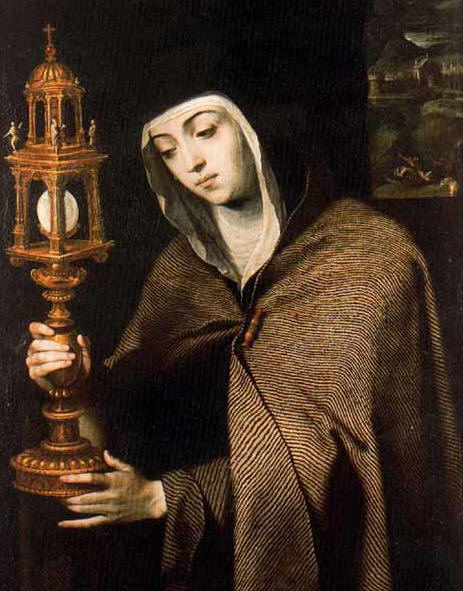
Symbols: monstrance, lamp, lily

Together with her mentor and friend, Francis of Assisi, St. Clare shook the foundations of Medieval society by revolutionizing religious expression. Her given name, Chiara means clarity and we call on St. Clare whenever we need to shine a light on a situation or to find a way to communicate more clearly. She is also invoked to protect the blind and to help those with eye trouble.

Chiara Offreduccio, as the beautiful daughter of minor royalty was offered every worldly advantage available to one in her social class. When she heard St. Francis preach the Lenten service at her church in 1212, his simple message of living with complete trust in God inspired her to abandon going through with her arranged marriage in order to join the Franciscan movement. The first followers of Saint Francis were the wealthy sons of his town of Assisi. Their act of turning their backs on the material world to live at the mercy of the elements and on whatever alms they could beg was disturbing and controversial to both their families as well as to the church authorities. Attracted by the joyous way in which they comported themselves, as well as the enthusiasm they brought to religious worship, Clare was the first woman to join their order.

Fervently believing in a life devoted to the precepts of the gospel, the Franciscans did not believe in personal property. When Clare escaped her family to join them on Palm Sunday, Francis himself cut off her long blond hair and handed her the simple woolen robe worn by his followers. He then left her in the local Benedictine convent as there were no facilities in his order for women. It was not long before her entire family attempted an intervention type rescue of the girl. Revealing her shorn hair to her horrified father made them realize that she would never return to their world. Her younger sister, as well as other wellborn young women from the town soon followed her. In 1215, Saint Francis installed Clare as the Abbess of the Order of Poor Ladies. True to the Rule of St. Francis, they accepted no dowries from their families as other religious orders did. When they were left inheritances, the money was distributed to the poor. Highly intelligent, and known for the efficacy of her prayers, popes, cardinals, royalty and St. Francis himself came to her for spiritual advice. Her own correspondence shows her to be a clever, happy person.

Devoted to the eucharist and frequently immersed in prayer, the stories of miraculous occurrences around Clare abound. The most famous is that while she was ill, her convent which was outside of the walls of Assisi was attacked by the Saracen mercenaries of Frederick II . As the invaders stormed the walls with ladders, Clare calmly held up a monstrance containing the host. A child’s voice emanated from inside the monstrance, “I will always guard and defend you.” A feeling of dread overtook the invaders and they ran away from the town.

Clare was named the patron saint of television writers and workers due to a vision she had while too ill to attend Christmas Eve mass. She was able to view and hear the entire mass on the wall of her room. She spent much time embroidering linens for use in mass, so she is the patron of embroiderers. Because that trade is hard on the eyes and because of her name, she is the patron of those with eye problems and the blind.

Explanation:

Monstrance: Devoted to the Eucharist, Clare protected her convent by holding up a monstrance, which holds the host. Sometimes in art, this monstrance is re-interpreted as a lamp. Since Chiara means clarity, it is Clare shining the light of clarity.


NOVENA TO SAINT CLARE


O Glorious St. Clare! God has given you the power of working miracles continually, and the favor of answering the prayers of those who invoke your assistance in misfortune, anxiety, and distress. We beseech you, obtain from Jesus through Mary His Blessed Mother, what we beg of you so fervently and hopefully, (mention your petition) if it be for the greater honor and glory of God and for the good of our souls.   Amen.

(Excerpted from the Novena App by Barbara Calamari and Sandra DiPasqua)

Novena for June: St. Anthony, June 13

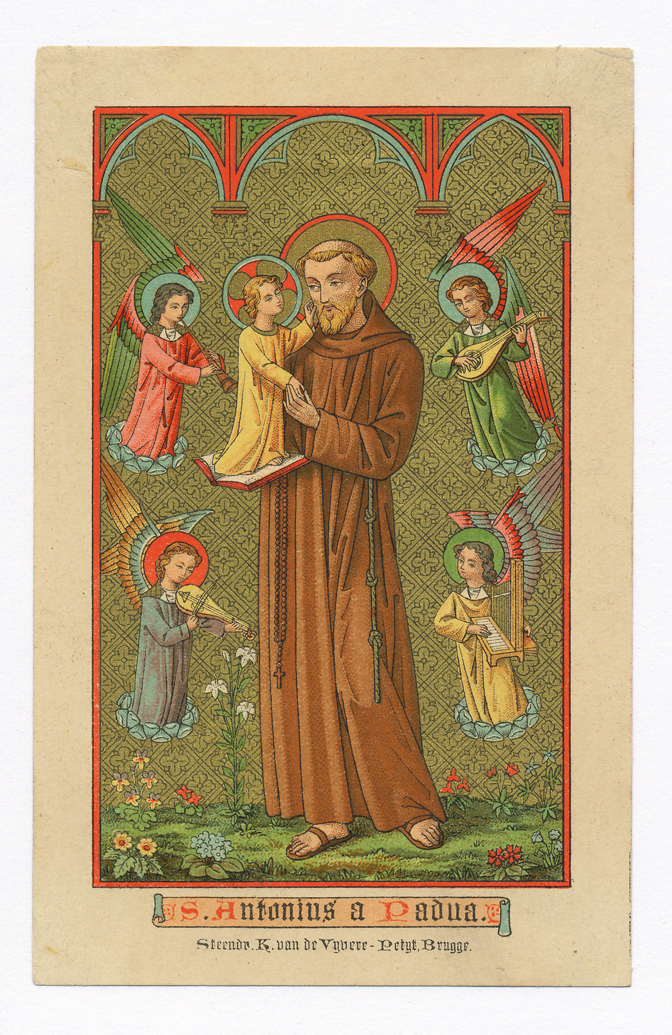
St. Antonius a PaduasmallSt. Anthony, June 13

Wonder and miracles are infused with every story of Saint Anthony. Though he has been dead for almost 800 years, he is still the most popular saint in the world and his statue is found in every Catholic Church. Saint Anthony is best known as the patron saint of lost articles but he is invoked for help in all life situations. In his own day he was called the “Wonder Worker’ and credited with the ability to stop the rain, raise the dead and reattach severed limbs. He was such a charismatic preacher that when a crowd of heretics in Rimini refused to listen to his preaching, the fish raised themselves out of the water to hear him.

Born Fernando de Bulhes in Lisbon, Portugal, he disappointed his noble family by rejecting his luxurious life and joining the Augustinian religious order. A scholar by nature, he read every book in the monastery, devoting his time to contemplative prayer. Eventually, he befriended a group of itinerant Franciscan monks and became fascinated with this new religious order. Much impressed by their dedication to simplicity, poverty and their belief in returning to the original words of Christ, he joined their ranks, changing his name to Anthony in honor of Saint Anthony of the Desert, the patron of their little church. Returning home from a failed missionary venture in Morocco, his ship was blown off course and he wound up in Messina, Sicily. A group of Franciscan friars insisted he go north with them for a great gathering of all Franciscans, with their founder Francis of Assisi. Anthony remained in Italy and discovered his great gift of preaching when a superior ordered him to speak at an ordination, telling him to say whatever the holy spirit had infused into him. He astonished his audience, not only by his skills as an orator but by the depth of his knowledge. He was sent throughout northern Italy and southern France on evangelical preaching missions which gathered crowds in the tens of thousands. His popularity among the people increased as he used his position to get real changes enacted for their protection. While based in Padua, he observed the crushing power of debt upon the common people. At Anthony’s insistence, the local municipality enacted a law protecting those who could not pay their debts that is still enforced today.

Anthony exhausted himself preaching out in fields and in piazzas as there was not cathedral large enough to hold all who came to hear him. At the age of thirty six, his health began to fail him and a local Count donated a woodland retreat for his recovery. One morning the Count heard the sounds of a baby giggling and he looked out to see Anthony surrounded in light, playing with the baby Jesus. That Christ would choose to appear to one of his saints in such a vulnerable state is a testament to the loving and kind nature of Saint Anthony. Because he is depicted holding a baby, women having trouble conceiving invoke his aid. Being of Portuguese descent, Anthony’s feast day is very auspicious for marriages in Portugal and Brazil and in those cultures, he is known to assist women seeking a husband.

According to legend, Saint Anthony earned the title patron saint of lost articles when a novice borrowed his psalter and failed to return it. Saint Anthony prayed to get it back and the novice was visited by terrifying visions that sent him running back to Anthony with the book. In iconography, Anthony always holds the baby Jesus and a lily for purity. Many times the returned book of the gospels is included.

Patron of: Lisbon, Portugal, Padua, amputees, barren women, domestic animals, draftees, oppressed people, orphans, paupers, the poor, pregnant women, prisoners, sailors

Novena

Holy Saint Anthony, gentle and powerful in your help, Your love for God and charity for His creatures, made you worthy when on earth, to possess miraculous powers. Miracles waited on your word, which you were always ready to request for those in trouble or anxiety. Encouraged by this thought, I implore you to obtain for me (mention your request here). The answer to my prayer may require a miracle. Even so, you are the saint of miracles. Gentle and loving Saint Anthony, whose heart is ever full of human sympathy, take my petition to the Infant Savior for whom you have such a great love, and the gratitude of my heart will be ever yours. Amen

It is customary to donate to Saint Anthony’s Bread, a charity started in Saint Anthony’s lifetime, in gratitude to answered novena prayers.

Everyday Miracles

CALL_FOR_EVERYDAY_M

Go back

Your message has been sent

Warning
Warning
Warning
Warning

Warning.

Novena’s for The Month of May

St. Peregrine May 1 – Cancer
St. Dymphna May 15 – Mental Illness, Incest, Runaways
St. Rita of Cascia May 22 – Impossible Causes, Bad marriages, Spousal abuse


St.Rita

St. Rita of Cascia 1386-1457

Patron of: Impossible Causes

An abused wife, a mother who’s children died, a widow of a murdered husband, and finally, a nun, Saint Rita experienced many lives in her time on earth. Knowing the powerlessness and despair of those in bad marriages she is invoked for help in desperate times. In her own lifetime she was famous for the power of her prayers to change any situation and it was said that she could accomplish the impossible. Canonized almost 500 years after her birth, she is the first declared female saint of the 20th Century. Margarita Lotti was born to an older farming couple in Roccaporena, Italy. She was called Rita because of a vision of an angel her mother had who named the baby while declaring, “You will give birth to a daughter marked with the seal of sanctity, gifted with every virtue, a helper to the helpless and an advocate of the afflicted.” As proof of this prophecy, bees, a sign of divine presence, always hovered over her crib as she slept, never harming or waking her. Though she had always wanted to be a nun, Rita’s parents feared for her future security as there was a schism in the church and many religious orders were closing their doors. Instead, she had to accept a marriage they contracted for her with a man named Paolo Mancini. Though he was a good provider, he soon proved to be an abusive, promiscuous husband. Settling his personal disputes with violence, Mancini created a tense family environment for Rita and the two sons she had with him. Never wavering in her devotion to God, Rita prayed that her husband would change his ways. After 18 years of marriage, Paolo had a vision of himself as others saw him and begged for his wife’s forgiveness. A lifetime of enemies caught up with Paolo and he was murdered, his mutilated body dumped on his family’s doorstep. Rita begged her two teenaged sons not to pursue a vendetta against his killers, but they refused. She prayed to God to prevent her sons from murdering anyone. Both of them came down with serious illnesses and died before they could act on their vendetta. Alone in the world, Rita petitioned to join the Augustinian convent. Because several of the nuns there had family members who were involved in Paolo’s murder, the convent refused her, not wanting tensions to carry over from the outside world. Rita prayed and entreated Paolo’s family to forgive his killers. Much to everyone’s surprise, they acquiesced and Rita was admitted to the convent on her third try. While there she spent her days nursing the older nuns and concentrating on Christ’s suffering. When she begged to feel what Christ felt on the cross, a thorn from the crown of thorns on a crucifix struck her on the head and became embedded there. It left a deep wound that never healed. Because this wound became infected and foul smelling Rita was shunned by the other nuns and remained in her cell praying and meditating. The January before she died, a cousin asked her if there was anything she needed and she asked for a rose from her childhood garden. The cousin was shocked to see that there was indeed two roses growing in that garden in the middle of January. Upon her death, her cell was filled with the smell of roses. Rita is always depicted with the thorn in her head, in her Augustinian habit, meditating on the crucified Christ. Thorns: she took on the suffering of Christ Wound in the head: Divine light, grace and spiritual power. Roses: love. Also proof of Rita’s miraculous powers as her roses grew in the winter.

Novena to Saint Rita

O holy protectress of those who art in greatest need, O you who shine as a star of hope in the midst of darkness, blessed Saint Rita, bright mirror of God’s grace, in patience and fortitude you are a model of all states in life. I unite my will with the will of God through the merits of my Savior, Jesus Christ, and in particular through his patient wearing of the crown of thorns, which with tender devotion you daily contemplated. Through the merits of the holy Virgin Mary and your own graces and virtues, I ask you to obtain my earnest petition, provided it be for the greater glory of God and my own sanctification. Guide and purify my intention, O holy protectress and advocate, so that I may obtain the pardon of all my sins and the grace to persevere daily, as you did in walking with courage, generosity, and fidelity down the path of life.

(Mention your request).

Saint Rita, advocate for the impossible, pray for us. Saint Rita, advocate of the helpless, pray for us.

(Recite Our Father, Hail Mary and the Glory Be three times each).

Amen.