St. Michael the Archangel, Feast date September 29

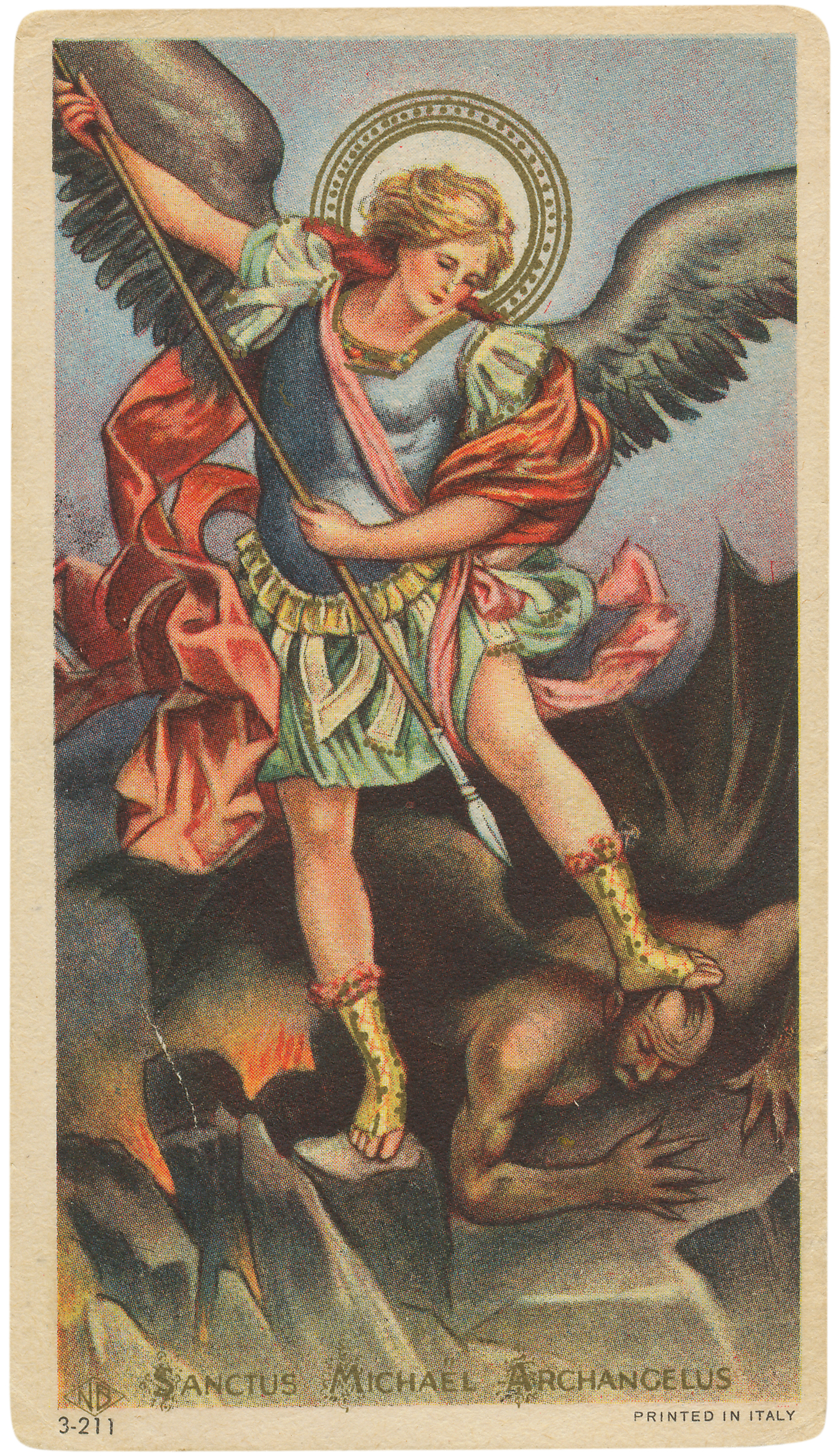
St.Michael
St. Michael the Archangel
Patron of: Policemen, Firemen, Grocers, Health, Knights, Mariners, Soldiers, Health, Holy Death, Physical Protection, Court Cases, Justice, Defense, Strength, Lawsuits.
Ever vigilant against evil, Michael the Archangel is most invoked for protection and justice. His novena is said by those in need of protection as well as those who are in need of justice.

According to the Book of Revelations, Michael was the angel who rose to God’s defense when Lucifer, God’s favorite and most beautiful angel decided that he was God’s equal. Leading a band of renegade angels he made an attempt to take over the throne of heaven. One outraged angel shouted, “Who is like God?” (mi-cha-el) and struck down Lucifer and his group, casting them into hell for their vanity. This angel took the name Michael as a reminder of his loyalty. A popular figure to the ancient Jews, early, Christians and Muslims, he is closely tied to the history of mankind and serves as its guardian.

Michael’s role in the world is firmly mandated: 1) He is to fight against Lucifer, no matter where he might be. 2) He is to rescue the souls of the faithful from the power of evil, especially at the time of death. 3) He is the champion of God and the protector of the Church. 4) He brings souls to justice, weighing the souls of the dead and deciding on who gets into heaven and who gets into hell.

Since Michael was the one who threw Lucifer into hell, Lucifer and the denizens of hell have no power over him. Catholics believe that Michael and the Virgin Mary are the only beings besides Jesus who can go into hell and release souls who are suffering there. Because of their actions in the great battle of heaven, it is Lucifer’s fate to reside in the lowest netherworld and it is Michael’s to dwell nearest to heaven. His shrines are the most ancient and natural in Christendom and tend to be on high, inaccessible cliffs that only a celestial being could reach. The Gargano caves in Apulia, Italy are said to be the first earthly dwelling place for the archangel. They have been an immensely popular pilgrimage site since the year 490 AD.

Saint Michael the Archangel is considered the most powerful of all angels. Christians in the East see him as a great healer, crediting him with the creation of many healing springs. In the sixth century, as Rome was being devastated by a plague, Pope Gregory I saw the archangel hovering over the tomb of the Emperor Hadrian, brandishing his sword. He interpreted this to mean that Rome was under the archangel’s protection and the plague would soon cease. A church was built over the tomb still bearing the title Castel San Angelo in honor of Michael.

Immensely popular throughout the world, Michael is always shown brandishing a sword while standing on the neck of the devil (sometimes interpreted as a giant serpent). In many images he holds the scales that will weigh the souls of the dead, because of this he is the patron saint of greengrocers who use these scales.

Prayer:

Saint Michael the Archangel, loyal champion of God and his people, I turn to you with confidence and seek your powerful intercession. For the love of God, who made you so glorious in grace and power, and for the love of the Mother of Jesus, the Queen of the Angels, be pleased to hear my prayer. You know the value of my soul in the eyes of God. May no stain of evil ever disfigure its beauty. Help me to conquer the evil spirit who tempts me. I desire to imitate your loyalty to God and Holy Mother Church and your great love for God and men. And since you are God’s messenger for the care of his people, I entrust to you this special request (your request here).

Saint Michael, since you are, by the will of the Creator, the powerful intercessor of Christians, I have great confidence in your prayers. I earnestly trust that if it is God’s holy will, my petition will be granted.

Pray for me, Saint Michael, and also for those I love. Protect us in all dangers of body and soul. Help us in our daily needs. Through your powerful intercession, may we live a holy life, die a happy death, and reach heaven, where we may praise and love God with you forever. Amen.

(Recite one Our Father, one Hail Mary, one Glory Be).

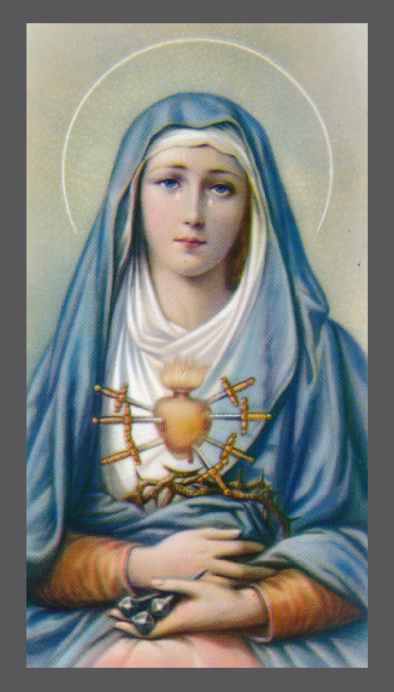
Mother of Sorrows

Sorrows_Small_Image

Mother of Sorrows
Patron of: Grief

When we are overwhelmed with grief, we turn to Mary, Mother of Jesus for help in our suffering. Throughout her life she endured much pain and sorrow and is fully able to empathize with anyone’s personal anguish. She endured the shame of being pregnant and unmarried, being poor, homelessness and having her only son unjustly imprisoned and executed. Most astonishing, Mary knew what was to befall her son yet had to see these events from God’s point of view and have faith that this was all for the good of mankind.

By meditating on the Seven Sorrows of Mary, a devotion from the Middle Ages, which uses scenes from the life of the Virgin Mother as a meditation on accepting the sorrowful part of life with grace.

The Seven Sorrows of Mary are:

1) The Prophecy of Simeon. As a young child, when his parents presented him in the temple, Jesus was met by the holy man Simeon who predicted everything that would happen to him in his address to Mary: “Behold, this child is destined for the fall and rise of many in Israel, and to be a sign that will be contradicted – and you yourself a sword will pierce so that thoughts of many hearts will be revealed.” (Luke 2:34-35).

2) The Flight into Egypt. In Bethlehem, after the birth of Christ, Joseph had a vision of an angel warning him of the impending slaughter of any male child under the age of two by King Herod in order to prevent the coming Messiah. The Holy Family had to travel a secretive route to Egypt and remain in that country until Herod died. Mary not only worried for the welfare of her own son but mourn for the murdered children left behind.

3) The Loss of the Child Jesus in the Temple. While on a pilgrimage to Jerusalem, the 12 year old Jesus vanished from his family. His heartsick parents finally found him three days later, arguing with elders in the temple.

4) The Meeting of Jesus with His Cross. Mary watched helplessly as her son was ridiculed and mocked as he stumbled, carrying the cross he was to be executed on.

5) The Crucifixion. As he was nailed to the cross, most of his disciples ran away. Mary never wavered as she stood at the foot of the cross, witnessing her son’s agony and death.

6) Jesus Taken Down from the Cross. Mary held her dead son’s wound covered body. This, her greatest sorrow is known as the “Pieta”.

7) The Burial of Jesus. As the stone was rolled, closing up his tomb, Mary had to say her final goodbye to her earthly son. Her faith had to be sincerely tested as there was no hint of the resurrection to come.
Prayer

Most holy and afflicted Virgin, Queen of Martyrs, you stood beneath the cross, witnessing the agony of your dying son. Look with a mother’s tenderness and pity on me, who kneel before you. I venerate your sorrows and I place my requests with filial confidence in the sanctuary of your wounded heart. Present them, I beseech you, on my behalf to Jesus Christ, through the merits of his own most sacred passion and death, together with your sufferings at the foot of the cross. Through the united efficacy of both, obtain the granting of my petition. To whom shall I have recourse in my wants and miseries if not to you, Mother of Mercy? You have drunk so deeply of the chalice of your son, you can compassionate our sorrows. Holy Mary, your soul was pierced by a sword of sorrow at the sight of the passion of your divine son. Intercede for me and obtain from Jesus (mention your request) if it be for his honor and glory and for my good. Amen.

Feast of St. Raymond Nonnatus, August 31

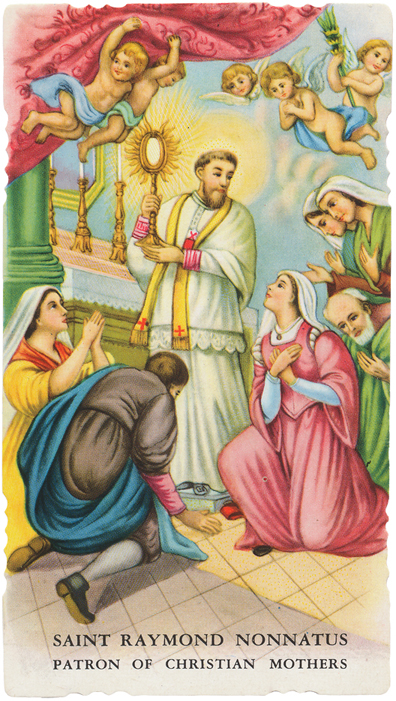
St.Raymond copySt. Raymond Nonnatus 1204-1240
Newborns, Midwives, Obstetricians, Expectant Mothers, Women In Labor, Falsely Accused, Secrets, Fever.

‘Non natus’ is Latin for “never born” and Saint Raymond was given his surname because his mother had died in labor two days before he was delivered by cesarean section. The fact that he did not die in his mother’s womb was considered an extraordinary event in the early thirteenth century, when a good number of mothers and infants were lost during childbirth. Because of the extraordinary circumstances of his birth, he always felt an affinity for the precarious state of women in labor and their infants. For this reason, midwives, obstetricians and expectant mothers call on him for help in the safe delivery of healthy newborns.

Hailing from Catalonia in Spain, Raymond’s family were from a noble class. His father attempted to train him to take over the family farms but because of his great devotion to the Virgin Mary, he chose instead to join the Mercedarians, a religious order dedicated to ransoming Christian slaves from the Moors, who occupied much of Spain. The Mercedarians also spiritually administered to Christian slaves in Moorish regions. As the Spanish territory was recaptured, and the Moors driven into North Africa, Raymond Nonnatus followed Christian slaves into Algeria. It was said he spent his entire inheritance ransoming slaves and when he ran out of money he substituted himself for another man’s freedom. He was soon imprisoned for his religious proselytizing and when he succeeded in converting several of his jailers, the Moors bored holes in his lips and sealed his mouth shut with an iron padlock to keep him from preaching. Though he was sentenced to death, the Mercedarians managed to ransom him home to Spain. As he was en route to Rome to receive the hat of a cardinal, he was struck down by a fever and died in Cardona, 60 miles from Barcelona. It was said that angels fed and administered communion to Raymond on his deathbed and he is frequently depicted in the company of angels.

Because of the padlock put on his lips, Raymond Nonnatus is invoked against gossip and the temptation to gossip. He is also invoked for help in keeping secrets as well as by priests for protection of keeping the sacred silence of the confessional. On the feast of Saint Raymond Nonnatus, it is customary for those who are victims of slander and gossip to put locks on the saint’s altar to silence their persecutors. In many images Saint Raymond Nonnatus carries the palm of martyrs signifying life defeating death, his palm has three crowns, for chastity, eloquence, and martyrdom.


Glorious St. Raymond, filled with compassion for those who invoke thee and with love for those who suffer heavily leaden with the weight of my troubles, I cast myself at thy feet and humbly beg of thee to take the present affair which I recommend to thee under thy special protection. ( your request here.)

Vouchsafe to recommend it to the Blessed Virgin Mary and lay it before the Throne of Jesus, so that He may bring it to a happy issue. Cease not to intercede for me until my request is granted. Above all obtain for me the grace of one day beholding my God face to Face, and with thee and Mary and the saints praising and blessing to all eternity. Amen.

Good St. Raymond, pray for us and obtain our request. Good St. Raymond, pray for us and obtain our request. Good St. Raymond, pray for us and obtain our request.
Say one Our Father, Hail Mary and Glory be.

Feast of St. Monica, August 28

St.Monica copy
St. Monica 331-387
Patron of: Wayward Children, Abuse Victims, Adultery Victims, Alcoholics, Housewives, Married Women, Mothers, Patience.

Though she was greatly hurt and disappointed by her firstborn son, St. Monica never gave up the idea that he would change his way of living. After 17 years of what seemed like fruitless prayers, her son turned his life around, converted to her faith and became one of the world’s greatest philosophers and Catholic saints, St. Augustine of Hippo. We invoke St. Monica to help us when our own children disappoint us. She serves as a reminder that there are no lost causes in this world and that absolutely anyone can reform and change their life.

Born into a Berber tribe in North Africa, Monica was brought up a Christian. Her parents arranged her in marriage with a prominent pagan Roman citizen of Carthage by the name of Patricius. Monica had a hard time in her early married years as she had to put up with a cantankerous mother-in-law as well as a dissolute husband. There are some accounts which say that she turned to alcohol and was herself an alcoholic who recovered her sobriety through faith and prayer. She had three children who she raised as Christians. The eldest, Augustine, was the most brilliant and his parents had high hopes for his career. Both Patricius and Monica worked hard to get the best education for their son and it was the greatest sorrow of Monica’s life when Augustine turned out to live a lazy, pleasure-filled life. It hurt her even more when he threw out his Christian beliefs to embrace the Manichean heresy – a popular cult believing in the natural good and evil of every soul. In order to keep his blasphemous beliefs from misleading her younger children, Monica forbade Augustine to come back to their home. Inconsolable in her grief, Monica had a vision of a radiant being pointing to Augustine in a beam of light next to her, saying, “Your son is with you.” When she related this vision to Augustine he laughingly said it would all be true if she would only give up her religious piety. “He did not say that I was with you,” she answered him. “He said you were with me.”

When Augustine openly took a mistress and further humiliated his mother by having an illegitimate son, Monica turned to her Bishop for help. He advised her to pray and be patient saying, “It is not possible that the son of so many tears should perish.” After the death of his father, Augustine decided to move to Rome to increase his worldly success, Monica vowed to follow him. In his own great treatise “Confessions”, Augustine relates how as his mother spent the night in prayer before their voyage, he tricked her and slipped away on an earlier ship. Devastated, she traveled to Rome anyway. By the time she arrived Augustine, had already left that city for Milan. By the time Monica tracked him down, she was overjoyed to find that Augustine was no longer a Manichean. He had met Ambrose, the bishop of Milan and was studying with him. Eventually, after several more years, Monica lived to see Augustine baptized a Christian. While waiting for a ship at Ostia to take mother and son back to Africa, Monica told her son that she had accomplished everything that she had set out to do in this life and did not need to live any longer. She died in Ostia, never returning to her native land. It is interesting to note that there are many great saints from Africa, especially the earliest ones and they are rarely depicted as anything but European in visage.

Novena

Dear Saint Monica, once the sorrowing mother of a wayward son, be pleased to present our petition to the Lord God of heaven and earth. (Your intention here.) Look down upon our anxieties and needs, and intercede for us, as you did so fervently for Augustine, your firstborn.

We have full confidence that your prayers will gain favorable hearing in heaven. Mother of a sinner-turned saint; obtain for us patience, perseverance, and total trust in God’s perfect timing. In His appointed hour, in His merciful way, may He respond to your prayer and ours, which we offer through you.

Amen

Novena for June: St. Anthony, June 13

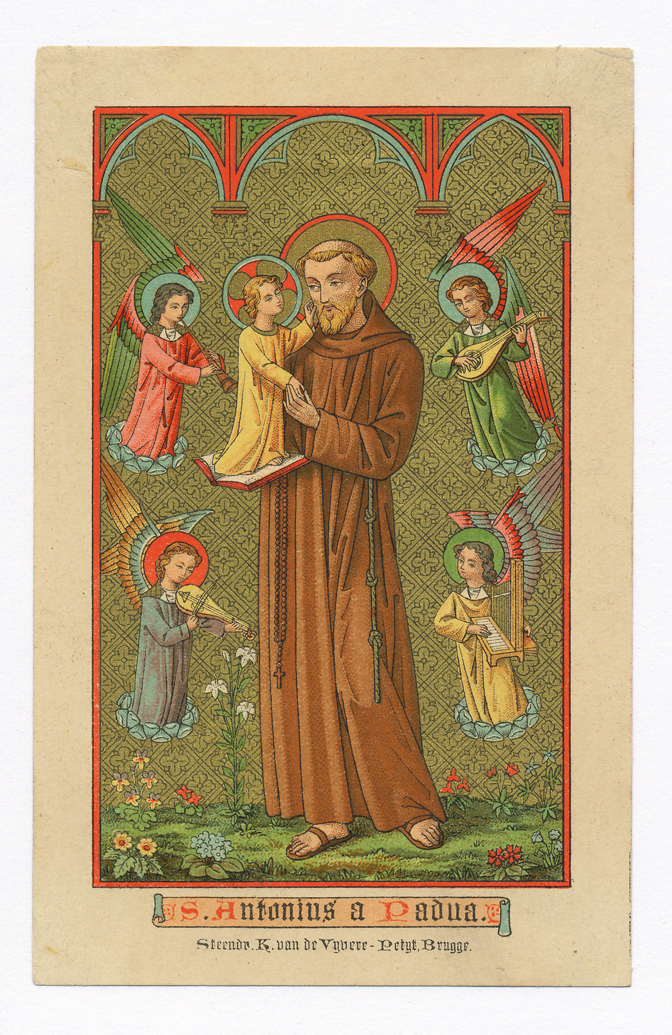
St. Antonius a PaduasmallSt. Anthony, June 13

Wonder and miracles are infused with every story of Saint Anthony. Though he has been dead for almost 800 years, he is still the most popular saint in the world and his statue is found in every Catholic Church. Saint Anthony is best known as the patron saint of lost articles but he is invoked for help in all life situations. In his own day he was called the “Wonder Worker’ and credited with the ability to stop the rain, raise the dead and reattach severed limbs. He was such a charismatic preacher that when a crowd of heretics in Rimini refused to listen to his preaching, the fish raised themselves out of the water to hear him.

Born Fernando de Bulhes in Lisbon, Portugal, he disappointed his noble family by rejecting his luxurious life and joining the Augustinian religious order. A scholar by nature, he read every book in the monastery, devoting his time to contemplative prayer. Eventually, he befriended a group of itinerant Franciscan monks and became fascinated with this new religious order. Much impressed by their dedication to simplicity, poverty and their belief in returning to the original words of Christ, he joined their ranks, changing his name to Anthony in honor of Saint Anthony of the Desert, the patron of their little church. Returning home from a failed missionary venture in Morocco, his ship was blown off course and he wound up in Messina, Sicily. A group of Franciscan friars insisted he go north with them for a great gathering of all Franciscans, with their founder Francis of Assisi. Anthony remained in Italy and discovered his great gift of preaching when a superior ordered him to speak at an ordination, telling him to say whatever the holy spirit had infused into him. He astonished his audience, not only by his skills as an orator but by the depth of his knowledge. He was sent throughout northern Italy and southern France on evangelical preaching missions which gathered crowds in the tens of thousands. His popularity among the people increased as he used his position to get real changes enacted for their protection. While based in Padua, he observed the crushing power of debt upon the common people. At Anthony’s insistence, the local municipality enacted a law protecting those who could not pay their debts that is still enforced today.

Anthony exhausted himself preaching out in fields and in piazzas as there was not cathedral large enough to hold all who came to hear him. At the age of thirty six, his health began to fail him and a local Count donated a woodland retreat for his recovery. One morning the Count heard the sounds of a baby giggling and he looked out to see Anthony surrounded in light, playing with the baby Jesus. That Christ would choose to appear to one of his saints in such a vulnerable state is a testament to the loving and kind nature of Saint Anthony. Because he is depicted holding a baby, women having trouble conceiving invoke his aid. Being of Portuguese descent, Anthony’s feast day is very auspicious for marriages in Portugal and Brazil and in those cultures, he is known to assist women seeking a husband.

According to legend, Saint Anthony earned the title patron saint of lost articles when a novice borrowed his psalter and failed to return it. Saint Anthony prayed to get it back and the novice was visited by terrifying visions that sent him running back to Anthony with the book. In iconography, Anthony always holds the baby Jesus and a lily for purity. Many times the returned book of the gospels is included.

Patron of: Lisbon, Portugal, Padua, amputees, barren women, domestic animals, draftees, oppressed people, orphans, paupers, the poor, pregnant women, prisoners, sailors

Novena

Holy Saint Anthony, gentle and powerful in your help, Your love for God and charity for His creatures, made you worthy when on earth, to possess miraculous powers. Miracles waited on your word, which you were always ready to request for those in trouble or anxiety. Encouraged by this thought, I implore you to obtain for me (mention your request here). The answer to my prayer may require a miracle. Even so, you are the saint of miracles. Gentle and loving Saint Anthony, whose heart is ever full of human sympathy, take my petition to the Infant Savior for whom you have such a great love, and the gratitude of my heart will be ever yours. Amen

It is customary to donate to Saint Anthony’s Bread, a charity started in Saint Anthony’s lifetime, in gratitude to answered novena prayers.

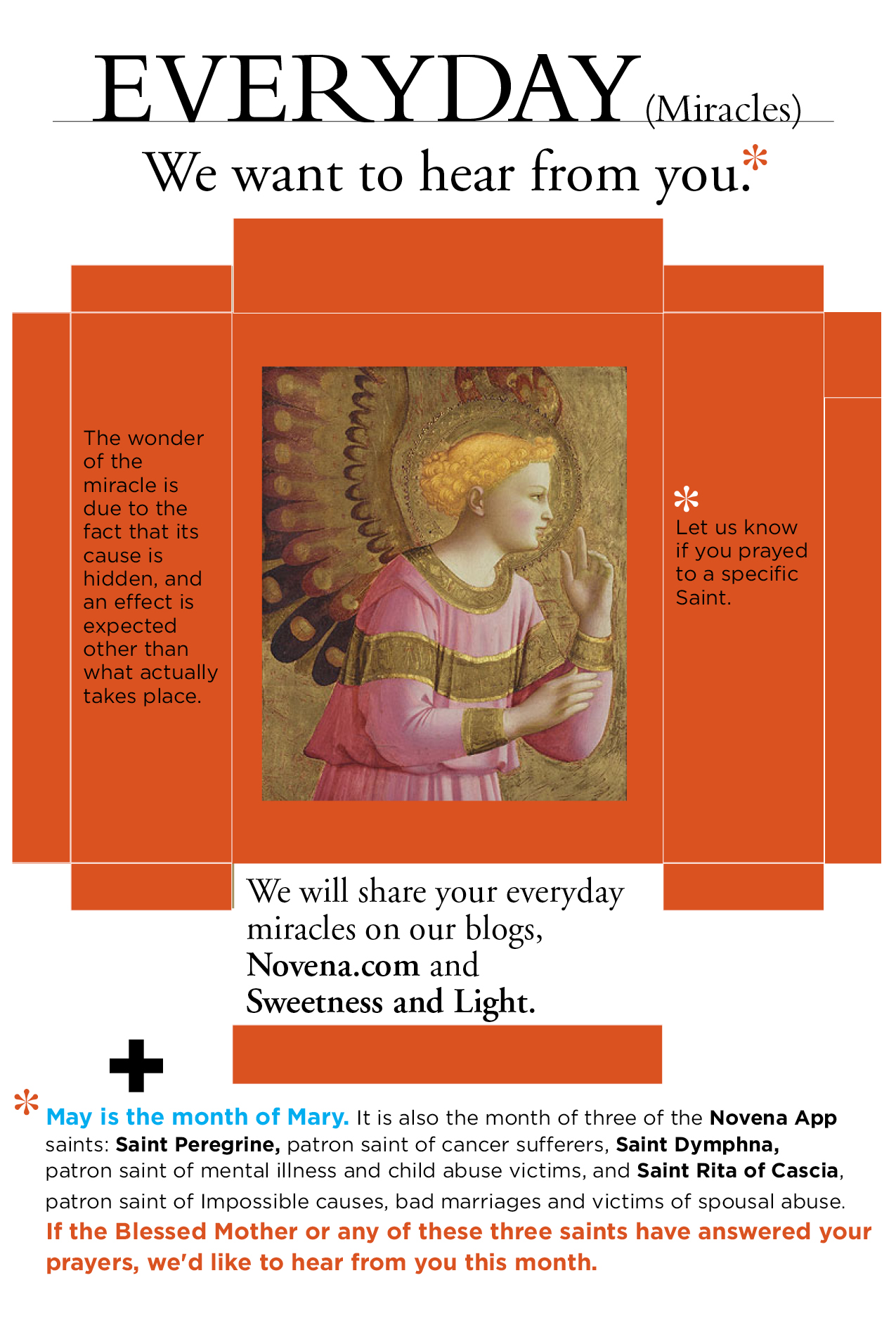
Everyday Miracles

CALL_FOR_EVERYDAY_M

Go back

Your message has been sent

Warning
Warning
Warning
Warning

Warning.

Novena’s for The Month of May

St. Peregrine May 1 – Cancer
St. Dymphna May 15 – Mental Illness, Incest, Runaways
St. Rita of Cascia May 22 – Impossible Causes, Bad marriages, Spousal abuse


St.Rita

St. Rita of Cascia 1386-1457

Patron of: Impossible Causes

An abused wife, a mother who’s children died, a widow of a murdered husband, and finally, a nun, Saint Rita experienced many lives in her time on earth. Knowing the powerlessness and despair of those in bad marriages she is invoked for help in desperate times. In her own lifetime she was famous for the power of her prayers to change any situation and it was said that she could accomplish the impossible. Canonized almost 500 years after her birth, she is the first declared female saint of the 20th Century. Margarita Lotti was born to an older farming couple in Roccaporena, Italy. She was called Rita because of a vision of an angel her mother had who named the baby while declaring, “You will give birth to a daughter marked with the seal of sanctity, gifted with every virtue, a helper to the helpless and an advocate of the afflicted.” As proof of this prophecy, bees, a sign of divine presence, always hovered over her crib as she slept, never harming or waking her. Though she had always wanted to be a nun, Rita’s parents feared for her future security as there was a schism in the church and many religious orders were closing their doors. Instead, she had to accept a marriage they contracted for her with a man named Paolo Mancini. Though he was a good provider, he soon proved to be an abusive, promiscuous husband. Settling his personal disputes with violence, Mancini created a tense family environment for Rita and the two sons she had with him. Never wavering in her devotion to God, Rita prayed that her husband would change his ways. After 18 years of marriage, Paolo had a vision of himself as others saw him and begged for his wife’s forgiveness. A lifetime of enemies caught up with Paolo and he was murdered, his mutilated body dumped on his family’s doorstep. Rita begged her two teenaged sons not to pursue a vendetta against his killers, but they refused. She prayed to God to prevent her sons from murdering anyone. Both of them came down with serious illnesses and died before they could act on their vendetta. Alone in the world, Rita petitioned to join the Augustinian convent. Because several of the nuns there had family members who were involved in Paolo’s murder, the convent refused her, not wanting tensions to carry over from the outside world. Rita prayed and entreated Paolo’s family to forgive his killers. Much to everyone’s surprise, they acquiesced and Rita was admitted to the convent on her third try. While there she spent her days nursing the older nuns and concentrating on Christ’s suffering. When she begged to feel what Christ felt on the cross, a thorn from the crown of thorns on a crucifix struck her on the head and became embedded there. It left a deep wound that never healed. Because this wound became infected and foul smelling Rita was shunned by the other nuns and remained in her cell praying and meditating. The January before she died, a cousin asked her if there was anything she needed and she asked for a rose from her childhood garden. The cousin was shocked to see that there was indeed two roses growing in that garden in the middle of January. Upon her death, her cell was filled with the smell of roses. Rita is always depicted with the thorn in her head, in her Augustinian habit, meditating on the crucified Christ. Thorns: she took on the suffering of Christ Wound in the head: Divine light, grace and spiritual power. Roses: love. Also proof of Rita’s miraculous powers as her roses grew in the winter.

Novena to Saint Rita

O holy protectress of those who art in greatest need, O you who shine as a star of hope in the midst of darkness, blessed Saint Rita, bright mirror of God’s grace, in patience and fortitude you are a model of all states in life. I unite my will with the will of God through the merits of my Savior, Jesus Christ, and in particular through his patient wearing of the crown of thorns, which with tender devotion you daily contemplated. Through the merits of the holy Virgin Mary and your own graces and virtues, I ask you to obtain my earnest petition, provided it be for the greater glory of God and my own sanctification. Guide and purify my intention, O holy protectress and advocate, so that I may obtain the pardon of all my sins and the grace to persevere daily, as you did in walking with courage, generosity, and fidelity down the path of life.

(Mention your request).

Saint Rita, advocate for the impossible, pray for us. Saint Rita, advocate of the helpless, pray for us.

(Recite Our Father, Hail Mary and the Glory Be three times each).

Amen.

Novena’s for The Month of May

St. Peregrine May 1 – Cancer
St. Dymphna May 15 – Mental Illness, Incest, Runaways
St. Rita of Cascia May 22 – Impossible Causes, Bad marriages, Spousal abuse

St. Dymphna

Saint Dymphna 605-620

Feast Day: May 15

Patron of: Mental Illness

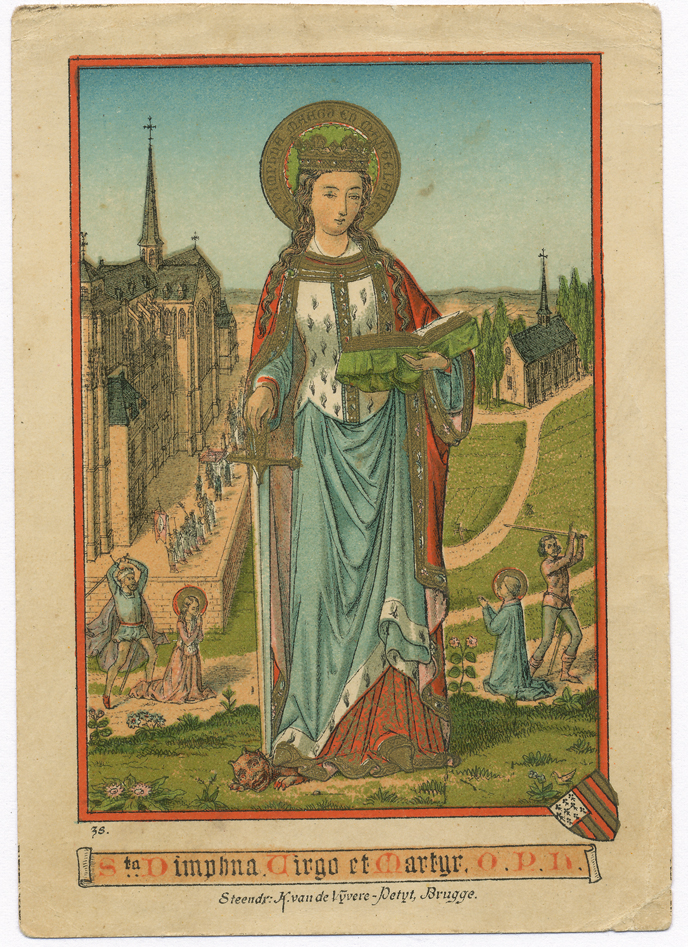
As a victim of a mentally ill father, Saint Dymphna offers much solace to those suffering from psychological problems as well as their families. She is invoked to bring peace to the unbalanced as well as create an aura of calm and consolation for those who live in the midst of instability. Having lived such a short life so long ago, there is very little factual information available about Saint Dymphna. According to a written report commissioned by the Bishop of Cambrai seven hundred years after her death, Dymphna was born an Irish princess. Her mother was a devout Christian married to Damon, a pagan king. Dymphna’s mother made sure her daughter was brought up as a Christian, having installed her own confessor, Gerebran into her household. At the age of fourteen Dymphna lost her mother and her father went mad with grief. After a period of mourning, he searched all of Ireland for a new companion but could not find a woman who even remotely resembled his first wife. Because Dymphna was almost the exact image of her mother, Damon decided to marry her and make her his queen, disregarding the fact that she was his own daughter. In order to thwart this plan, Gerebran and Dymphna escaped the castle and went abroad to Antwerp. Eventually settling in Gheel in Belgium, they lived as religious hermits. Dymphna studied to be an anchoress which was a woman who lived in a room connected to a church with a window open to the street. Towns in the middle ages usually supported these people who offered their knowledge to those in need of advice. It took Damon and his men a year to find Dymphna and Gerebran. The priest was executed immediately and Dymphna was offered her father’s kingdom in exchange for returning home with him. When she refused, he decapitated her in a rage. Both bodies were immediately buried. Since epilepsy and mental illness were all thought to be caused by demonic possession, those suffering from mental afflictions were never welcomed to live in one place and were doomed to wander from town to town. Soon after Dymphna’s death, a group of five of these social pariahs slept at the site of her murder and were instantly healed by the blood in the earth. In the 13th century, the remains of an unknown man and woman were accidentally disinterred at Gheel. The name DYMPNA was written on a brick over the woman’s remains. As the remains were reinterred in a tomb, miraculous healings of the mentally ill and epileptics in the region were recorded. Gheel became a pilgrimage site for anyone suffering from any form of mental illness. By the end of the thirteenth century a major hospital and treatment center was built there for those suffering from nervous disorders. To this day, Gheel offers the most advanced and humane treatment for the mentally ill in the world. Saint Dymphna’s remains, in the church named for her there continues to be a place of pilgrimage.

Novena to Saint Dymphna

O God, we humbly beseech you through your servant Saint Dymphna, who sealed with her blood the love she bore you, to grant relief to those who suffer from mental afflictions and nervous disorders, especially (mention the afflicted person). Saint Dymphna, helper of the mentally afflicted, pray for us. Saint Dymphna, comforter of the despondent, pray for us. Saint Dymphna, renowned for many miracles, please hear my plea. Amen. (Recite one Glory Be).


Novena’s for The Month of May.

St. Peregrine May 1 – Cancer
St. Dymphna May 15 – Mental Illness, Incest, Runaways
St. Rita of Cascia May 22 – Impossible Causes, Bad marriages, Spousal abuse

St.PeregrineSt. Peregrine 

A victim of cancer himself, Saint Peregrine not only had to accept the reality of his illness, but also the instantaneous healing of that disease through the intercession of Christ. For this reason he is invoked for medical breakthroughs as well as for those suffering from cancer, running sores and other incurable diseases.

A wealthy young man from the town of Forli, Italy, Peregrine was a political leader of the local anti-Papist party. His rabble rousing against the power of the Pope and his early disdain for the Church makes him an unlikely saint. When a papal representative, Philip Benizi the prior general of the Servants of Mary journeyed to Forli to preach and to attempt a reconciliation between the rival political factions, Peregrine and his men broke up the crowds attending the speech. Peregrine himself slapped Benizi in the face. Instead of inciting Benizi to retaliate, he received a kindly look of forgiveness which so stunned Peregrine, that he collapsed in shame over his actions.
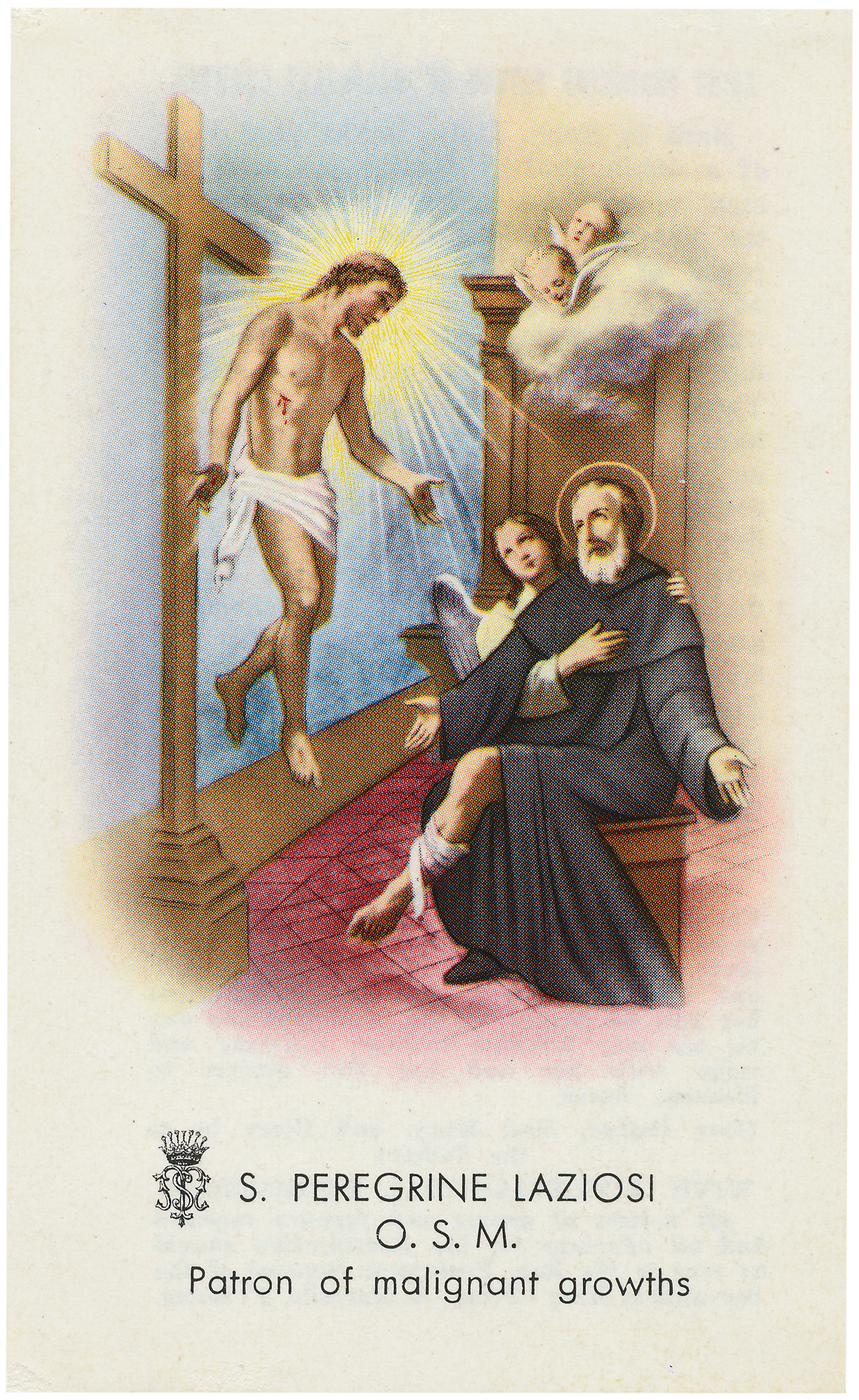
Since the Servants of Mary are devoted to the Blessed Mother, Benizi advised Peregrine to transform his life by cultivating a childlike devotion to Mary. While meditating in the cathedral at Forli, Peregrine had a vision of Mary instructing him to go to Siena and join the religious order of the Servants of Mary. Returning to Forli as a priest in that order, Peregrine devoted himself to the poor, the sick and the outcasts of society. Many reported being healed during his inspirational masses. Peregrine imposed a personal penance on himself of never sitting down unless he had to. He also slept on the ground, using a stone for a pillow. After 30 years of such deprivation he developed severe varicose veins and an incurable running sore down his leg. This led to a diagnosis of cancer, the only cure possible was amputation. Resigning himself to the same fate as those he had served, Peregrine reluctantly agreed to the surgery. Praying in the chapel on the eve of the operation he fell into a trancelike sleep where he experienced the figure of Christ getting off of the cross to touch his leg. When he awoke, there was no trace of illness in his leg and it was deemed to be completely healed. Because of this miracle, the incurably ill flocked to Forli for Peregrine’s healing prayers. Peregrine continued his mission for the next 20 years, dying at the age of 80. In modern times, many still make the pilgrimage to his tomb and there are thousands of healing societies bearing his name throughout the world.

Prayer

O great Saint Peregrine, you have been called “the Mighty” and the “Wonder Worker” because of the numerous miracles you have had recourse to, for so many years you bore in your own flesh this cancerous disease that destroys the very fiber of our being, and you had recourse to the source of all grace when the power of man could do no more. You were favored with the vision of Jesus coming down from his cross to heal your affliction. Ask of God, and our Lady the cure of these sick persons whom we entrust to you. Aided in this way by your powerful intercession, we shall sing to God, now and for all eternity, a song of gratitude for his great goodness and mercy.
(Mention your request.)
Saint Peregrine, pray for me and for all who invoke your aid.
Amen

These Saints are three of thirty six you will find on our Novena app: https://itunes.apple.com/us/app/novena/id631346670?mt=8

Offering a modern take on the ancient Catholic tradition of using novena prayers to call on saints to help in our earthly struggles, the app features biographies, prayers and iconographic explanations for 36 of the most popular saints from all over the world.

You might find out what you have in common with your favorite Saint.

Prayers to Two New Saints

One-euro sheet features two popes to be canonized

Prayer to St. John Paul II

Oh, St. John Paul, from the window of heaven, grant us your blessing! Bless the church that you loved and served and guided, courageously leading it along the paths of the world in order to bring Jesus to everyone and everyone to Jesus. Bless the young, who were your great passion. Help them dream again, help them look up high again to find the light that illuminates the paths of life here on earth.

May you bless families, bless each family! You warned of Satan’s assault against this precious and indispensable divine spark that God lit on earth. St. John Paul, with your prayer, may you protect the family and every life that blossoms from the family.

Pray for the whole world, which is still marked by tensions, wars and injustice. You tackled war by invoking dialogue and planting the seeds of love: pray for us so that we may be tireless sowers of peace.

Oh St. John Paul, from heaven’s window, where we see you next to Mary, send God’s blessing down upon us all. Amen.


Prayer to St. John XXIII

Dear Pope John,

Your simplicity and meekness carried the scent of God and sparked in people’s hearts the desire for goodness. You spoke often of the beauty of the family gathered around the table to share bread and faith: pray for us that once again true families would live in our homes.

With outstretched hands you sowed hope, and you taught us to listen for God’s footsteps as he prepares a new humanity: help us have a healthy optimism of defeating evil with good.

You loved the world with its light and darkness, and you believed that peace is possible: help us be instruments of peace at home and in our communities.

With paternal gentleness you gave all children a caress: you moved the world and reminded us that hands have been given to us not for striking, but for embracing and drying tears.

Pray for us so that we do not limit ourselves to cursing the darkness but that we bring the light, bringing Jesus everywhere and always praying to Mary. Amen.