A Day Within the Walls: Poor Clares

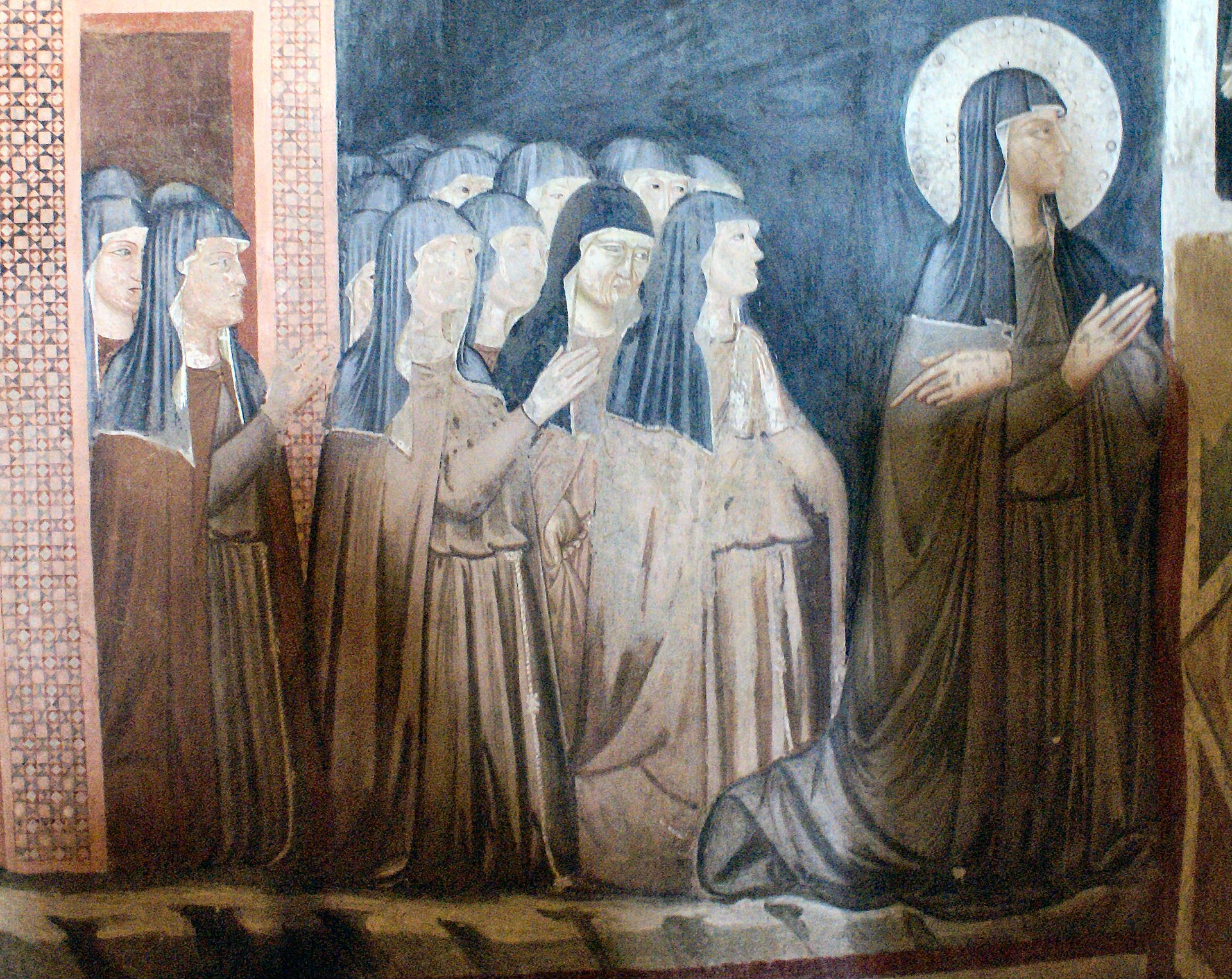
Fresco of Saint Clare and nuns of her order, Chapel of San Damiano, Assisi

Summoned to A New Day

The day of the Poor Clare nun begins at 12:30 a.m. when the Sister designated as “Caller” knocks on each cell door to summon her sisters to prayer. The nuns, clothed in the religious habit adapted for the night, rise in silence like the wise Virgins always ready and waiting for the call: “The Bridegroom is here, come out to meet Him!” At 12:45 a.m. the Sisters assemble in Office Choir (the Sister’s chapel) for the Hour of Matins (Office of Readings). It is an unbroken tradition for the Poor Clare Nuns to rise in the middle of the night after a few hours of sleep in order to pray for a needy world at a time when, under cover of darkness, so many sins are committed. At 1:45 a.m. the Divine Office and a period of meditation come to a close and the Sisters retire to their cells for about three more hours of sleep.

Five O’Clock Duty

At 5:00 a.m. the silence of the early hours of the morning is broken when the bell sounds for rising. The nuns rise promptly, wash in a simple basin in their cells and make their way to their five o’clock duty. These duties vary from dust-mopping the corridors or sweeping the refectory and stairs, to opening windows to air the house, dusting Choir or making preparations for breakfast. Then at 5:30 a.m. the Sisters gather promptly in Choir for the morning Angelus follows by Lauds (Morning Prayer). “With praise I will awake the dawn,” sings the Psalmist and the nuns likewise, by their wholehearted praise of the Creator, anticipate all of creation, which is just awakening from sleep. An hour of meditation in preparation for the Holy Sacrifice of the Mass follows and, at 7:00 a.m., the Rosary is recited communally during which the Sisters ponder the mysteries of Redemption and the role of the most Blessed Mother, making them a part of their own lives. “Nuns relive and perpetuate in the Church the presence and the work of Mary. Welcoming the Word in faith and adoring in silence, they put themselves at the service of the Mystery of the Incarnation, and united to Christ Jesus in His offering of Himself to the Father they become co-workers in the Mystery of Redemption” (Verbi Sponsa, no. 4).

The Mass — the Day’s Climax

The Holy Sacrifice of the Mass at 7:30 a.m. is the center and summit of the Poor Clare day around which everything else revolves. It is precisely from the Mass that the nuns draw their strength and the grace for the new day of prayer, sacrifice, and work for the love of God. The Sisters participate in this august mystery from their Mass Choir, which is separated from the main Chapel by an enclosure grille because of their hidden life of seclusion. “What return shall I make to the Lord for His goodness to me?” sings the Poor Clare in her heart as she spends the next quarter of an hour in thanksgiving for the greatest gift on earth: the Holy Eucharist to which she is united in a most intimate way. By now it is 8:30 a.m. and the Sisters go to the refectory to partake of a simple breakfast while standing, in keeping with the traditional fast. Although Great Silence has ended, a peaceful stillness continues to pervade the monastery as the nuns begin some work until 9:30 a.m. Answering benefactors’ letters and filling orders for spiritual bouquet cards to go out in the morning’s mail or beginning the day’s work in the kitchen are just a few examples. When Reverend Mother Abbess rings the bell, the Sisters assemble in the refectory for the Office announcements and a spiritual thought for the day, which are read aloud. Mother Abbess gives her blessing and the nuns process to the Choir for Exposition of the Blessed Sacrament and the first of the Daytime Hours: Terce(Midmorning Prayer). The Poor Clare nun’s entire day is punctuated by the different hours of the Divine Office in order constantly to return praise to the Blessed Trinity and to sanctify each passing moment. The Holy Sacrifice of the Mass is thus perpetuated throughout the whole of her day by the Liturgy of the Hours. It is in this way that the nun’s whole life becomes one great “Thanksgiving.” Pope John Paul II write of our Holy Mother Saint Clare: “her whole life was a Eucharist because … from her cloister she raised up a continual ‘thanksgiving’ to God in her prayer, praise, supplication, intercession, weeping, offering and sacrifice. She accepted everything from the Father in union with the infinite ‘thanks’ of the only begotten Son.”

A Virtuous Life and the Common Good

The remaining hours of the morning until 11:40 a.m. are spent in some manual work. “Let the Sisters to whom the Lord has given the grace of working work faithfully and devotedly after the hour of Terce at work that pertains to a virtuous life and the common good” (Holy Rule). It may vary greatly according to the day or the season. In the monastic tradition of the Poor Clares there has never been a distinction between Choir Nuns and Lay Sisters; rather, all help with the humble tasks and give themselves with generosity wherever help is needed. Our Extern Sisters, however, are the special guardians of the enclosure. They care for the external services of the monastery but observe the same form of life as the cloistered nuns in all things except the vow of enclosure. Whether hanging the laundry on wash day, answering the phone or the door bells, cooking, sweeping, sewing, gardening or painting, the Poor Clare Nun is motivated by love and therefore no task is too burdensome nor any sacrifice too great. “All for Love,” “All for Jesus” are the frequent aspirations that fill her mind while at work. Although she cannot spend the entire day with Our Lord in Choir, she finds He is present and at her side at every moment and in all the designs of Divine Providence as the day unfolds. Our Holy Mother Saint Clare urges her daughters to always work “in such a way that, while banishing all idleness, the enemy of the soul, they do not extinguish the spirit of holy prayer and devotion to which all other earthly things must contribute.”

Bell Calls to Midday Prayer

At 11:40 the bell calls the Sisters to the hour of Sext (Midday Prayer). “Let the Sisters, immediately ceasing their labors, come without delay” (Saint Colette). The monastic bell summoning the Sisters to work and prayer is understood as the voice of the Beloved calling to them and each Sister makes haste in order not to keep Him waiting. Midday Prayer is followed by the particular examen and the Angelus is said at noon. The community then processes to the refectory while reciting the Veni Creator. A full meal referred to as “dinner” is served at noon. The Poor Clare Colettine nuns observe a perpetual abstinence from meat, but fish is served twice a week and on special feast days. The meal typically consists of a carbohydrate (rice, noodles, or potatoes), a vegetable, salad and a simple dessert. As the Sisters take nourishment for their bodies to renew their physical strength, they are constantly reminded that “man does not live on bread alone but on every word that comes from the mouth of God.” The meals at Corpus Christi Monastery are taken in silence as the Sisters listen to some spiritual reading to nourish their souls. One of the nuns is appointed as “reader” and reads aloud from the biography of some saint, a reflection on the day’s Gospel or perhaps some other text of a religious or edifying nature.

Fruit and Potatoes

After dinner there is a half-hour period of general work. The Sisters help with dishes or prepare the vegetables, fruit or potatoes, which need peeling and slicing for the next day’s meal. At 1:30 p.m. “quiet time” begins. This is a special time of silence during which the Sisters may rest, do some quiet hobby or spend time in private devotions. Daily meditation on the Stations of the Cross is a Franciscan tradition and some may choose to take their quiet time in Choir for this purpose. As Pope John Paul II reminds us: “It is in the contemplation of the Crucified Christ that all vocations find their inspiration” (Vita Consecrata, no. 23). Other nuns may choose to spend time alone with God in their cells. “The solitary cell, the closed cloister, are the place where the nun, bride of the Incarnate Word, lives wholly concentrated with Christ in God” (Verbi Sponsa, no. 3). At 2:00 p.m. the nuns again repair to the Choir where they make ready to chant the hour of None (Midafternoon Prayer). The Blessed Sacrament is again exposed and “the Divine Service is carried out with the greatest possible devotion and the very greatest reverence… they should maintain there a humble and respectful attitude, and observe a profound silence…. Their bearing should be modest and such that it fulfills what is required in the presence of the God of Majesty,” counsels our Holy Mother Saint Colette. The cloistered nun stands before the Throne of Mercy representing the entire Body of Christ. She is entrusted with the divine service and carries it out in the name of the whole Church. This is the Poor Clare’s “greatest privilege and joy” and she remains fully aware of her awesome responsibility.

Weeding and Harvesting

The rest of the afternoon, until 4:30 p.m., is occupied with work. Again the Sisters spend themselves for the common good, each one seeing to her assigned duties or participating in some community task, such as loading a truck with brush to be hauled away, cleaning the monastery from top to bottom, printing holy cards, weeding the shrine, or harvesting rhubarb, apples, or squash and preparing them for freezing. “There is no time to get bored” as one postulant told her family when asked if she ever found the monastic life monotonous. Even if on some days the round of chores are similar to the preceding day, the Divine Bridegroom speaks to each soul in a new way with every passing day. Therefore the Sisters work in silence, communing with God alone, listening to Him and responding to His voice by the love with which they carry out their work, prayers and sacrifices. “In the monastery everything is directed to the search of the face of God, everything is reduced to the essential, because the only thing that matters is what leads to Him” (Pope John Paul II). The enclosure of Corpus Christi Monastery “is intended to create a space of separation, solitude and silence where God can be sought more freely in a life not only for Him and with Him but also in Him alone” (Verbi Sponsa, no. 5).

Interceding for a Troubled World

Vespers (Evening Prayer) is chanted at 4:30 p.m. The Poor Clare Nun leaves the concerns of her daily duties and stands before God interceding for a troubled world. Men, women and children of every land and nation are the subjects of her most sincere prayers. To this end she has renounced the world, only to be more united to it in a supernatural way. She has come apart, making of her life a continual sacrifice of praise for the needs of all. And she understands clearly that “those who become the property of God become God’s gift to all” (Verbi Sponsa, no. 7). This canonical hour is followed by fifteen minutes of Scripture meditation during which the Poor Clare ponders the Word of God in the presence of the Most Blessed Sacrament. In addition to this, at some point during the day, depending on her work, each Sister takes one hour of time reserved for private prayer and adoration of the Blessed Sacrament. This is an essential part of the Poor Clare’s day, for she knows well that “the call to holiness is accepted and can be cultivated only in the silence of adoration before the infinite transcendence of God” (Vita Consecrata, no. 38). At 5:30 p.m. the Sisters gather in Choir for the evening recitation of the Angelus and process to the refectory for collation. “The Sisters shall fast at all times.” This fast which our Holy Rule prescribes consists of refraining from taking any food between meals and “Lenten fare” which traditionally means that breakfast and the evening refection together do not equal the main meal at noon. Two slices of bread, cheese, a fruit and a cup of barley tea constitute a typical collation. Sometimes an egg or cereal, for example, is served in place of the cheese. The Sisters keep their eyes modestly cast down at all times, but especially in Choir and in the refectory. Our Holy Mother Saint Colette exhorts her daughters “that they may have a soul uplifted to God and attentive to what is said there, let them have their eyes cast downward.”

Recreation and a Family Spirit

At 6:30 p.m. the bell summons the nuns to an hour of recreation. This is a special time of joyful fellowship and relaxation for the Sisters. As silence is observed outside of this one hour per day, the recreation period is all the more enjoyable. The nuns speak on a variety of different topics ranging from the work of the day to the edifying examples of the lives of the saints. The Sisters occupy their hands with some needlepoint, artwork, cutting out stamps for the missions, making rosaries, or sewing copes for the Infant of Prague statues while good humor and a family spirit reign. According to the season this time of recreation may be spent outdoors pruning the trees, picking Job’s tears to be used as rosary beads, or planting flowers in the Lourdes grotto to honor the Blessed Mother. The Hour of Compline (Night Prayer) is said at 7:30 p.m. followed by the General Examen during a few moments of silent reflection and then Great Silence descends upon Corpus Christi Monastery. “Let the Sisters keep silence from the hour of Compline until Terce, let them also continually keep silence in the Church, the dormitory and the refectory while they are eating,” says our Holy Rule. The nuns then retire to their cells and are to be in bed by 9:00 p.m. They may read or do some quiet work before they lie down on their straw mattresses or thin rug mats for a few hours of peaceful slumber only to rise again at 12:30 a.m. for a new day of Poor Clare life in Corpus Christi Monastery.

Fresco of Saint Clare and nuns of her order, Chapel of San Damiano, Assisi

Novena, The Power of Prayer

Our book is now available as an ebook on amazon https://www.amazon.com/dp/B0D4WQLFRXyou can buy or read free if you subscribe to kindle reading.

This book celebrates the meaningful recitation of novenas, a traditional nine day prayer to a particular saint, angel or Madonna for help in solving a problem.

It was our objective to create a book that would be assessable to all, Catholic and non-Catholics alike.

You will learn about The Saints, Angels and The Madonna. The history of The Saints who lived with us on earth. The many visions of The Madonna as she appeared on earth. And more…

Barbara and Sandy

St. Joseph, First Century

“I know by experience that the glorious Saint Joseph assists us generally in all necessities. I never asked him for anything which he did not obtain for me.”
—Saint Teresa of Avila

Patron of: Fathers

A righteous man who never shirked his responsibilities as protector of his family, Saint Joseph offers a perfect example for fathers everywhere. He is invoked by families for all matters of support needed to sustain a household, both material and spiritual.

A descendant of the House of David, there is very little written about Joseph in the gospels. He was said to be betrothed to Mary when she became pregnant with Jesus. Instead of leaving her in scandal, he accepted the word of the angel Gabriel who told him that the child was divinely given and Joseph and Mary were chosen by God to be his earthly parents. It was Joseph who protected Mary on the journey to Bethlehem when Jesus was born. He also suffered the frustrations of a man who could not find proper shelter for his family as his wife was about to give birth. Upon returning to their native city of Nazareth, Joseph was once again visited by an angel warning him of the impending slaughter of the innocents. On faith alone, he dispensed with his business and personal effects, taking Jesus and Mary to Egypt where they stayed for seven years until Herod’s death. It fell upon Saint Joseph to support his young family in this foreign country.

The last mention of Joseph comes when Jesus is twelve years old and strayed from his family while on a pilgrimage to Jerusalem. It is thought that he died well before Jesus began his mission with Jesus and Mary at his deathbed. For this reason, more than any other saint, he is invoked for a happy death, one where a person is older and has their family at their side.

Though of noble lineage, Joseph was a carpenter and it was from him whom Jesus learned his trade. Because he worked with his hands and frequently put his family ahead of any personal ambitions, workers everywhere who live similar lives call on him as a patron. It is no mystery that the cult of Saint Joseph became more popular in modern times with the advent of the Industrial Revolution. Many saints throughout the ages have declared him to be a powerful advocate as well, since it is thought that Jesus obeyed him in his earthly life, he is inclined to listen to Joseph in his heavenly life. Teresa of Avila always buried medals with his image when she needed land for a new convent. This tradition has extended itself to realtors of all faiths who bury statues of Saint Joseph on properties they wish to sell.

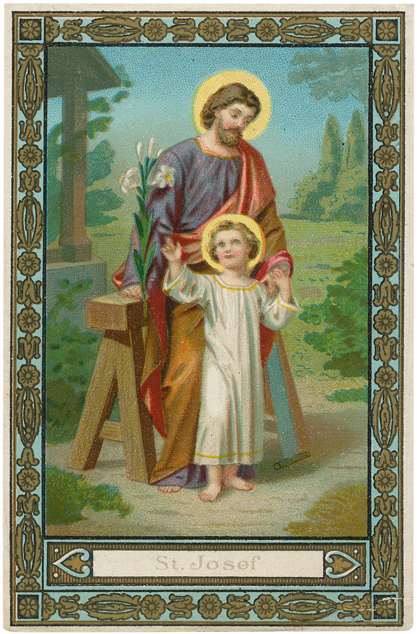
It is assumed that since Joseph respected his wife’s virginity that he was an older man when he married. He is depicted in art with a staff, which he led his family ( precursor to the bishop’s staff) a lily for purity, and with carpenter tools or holding the baby Jesus.

Hail, Guardian of the Redeemer,
Spouse of the Blessed Virgin Mary.
To you God entrusted his only Son;
in you Mary placed her trust
with you Christ became man.
Blessed Joseph, to us too,
show yourself a father
and guide us in the path of life.
Obtain for us grace, mercy and courage,
and defend us from every evil. Amen.

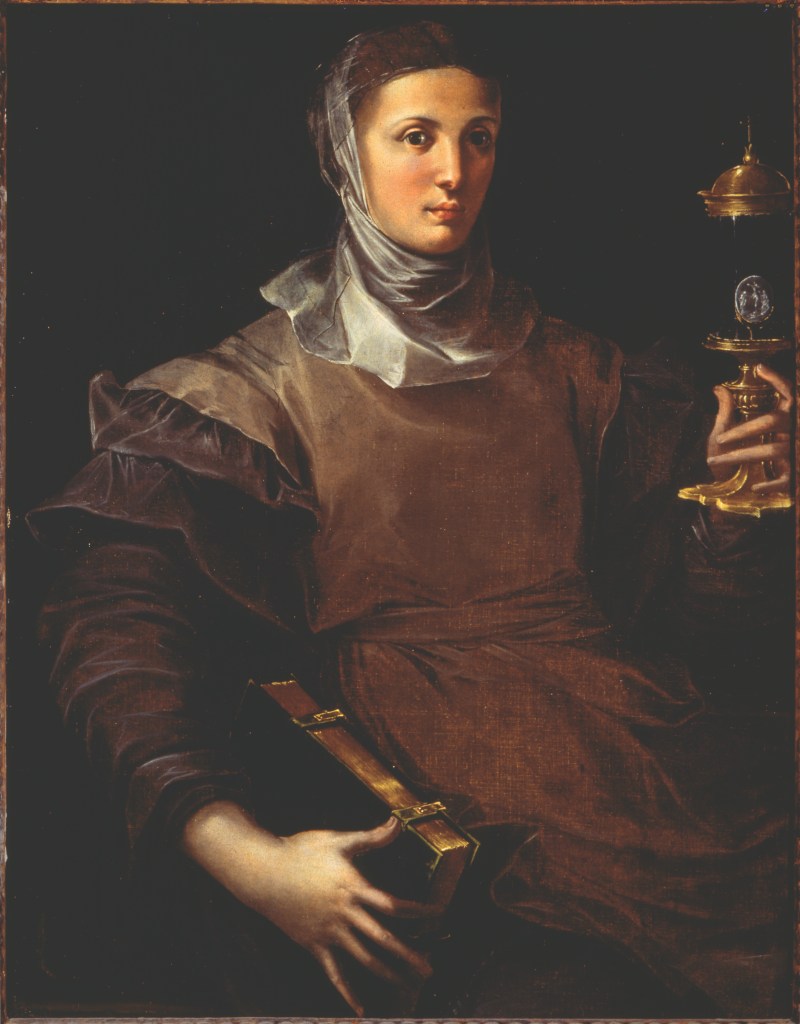
Saint Clare of Assisi

Alinari / Art Resource

Saint Clare of Assisi’s Story

One of the more sugary movies made about Francis of Assisi pictures Clare as a golden-haired beauty floating through sun-drenched fields, a sort of one-woman counterpart to the new Franciscan Order.

The beginning of her religious life was indeed movie material. Having refused to marry at 15, Clare was moved by the dynamic preaching of Francis. He became her lifelong friend and spiritual guide.

At 18, Clare escaped from her father’s home one night, was met on the road by friars carrying torches, and in the poor little chapel called the Portiuncula received a rough woolen habit, exchanged her jeweled belt for a common rope with knots in it, and sacrificed her long tresses to Francis’ scissors. He placed her in a Benedictine convent, which her father and uncles immediately stormed in rage. Clare clung to the altar of the church, threw aside her veil to show her cropped hair, and remained adamant.

Sixteen days later her sister Agnes joined her. Others came. They lived a simple life of great poverty, austerity, and complete seclusion from the world, according to a Rule which Francis gave them as a Second Order. At age 21, Francis obliged Clare under obedience to accept the office of abbess, one she exercised until her death.


The Poor Ladies went barefoot, slept on the ground, ate no meat, and observed almost complete silence. Later Clare, like Francis, persuaded her sisters to moderate this rigor: “Our bodies are not made of brass.” The greatest emphasis, of course, was on gospel poverty. They possessed no property, even in common, subsisting on daily contributions. When even the pope tried to persuade Clare to mitigate this practice, she showed her characteristic firmness: “I need to be absolved from my sins, but I do not wish to be absolved from the obligation of following Jesus Christ.”

Contemporary accounts glow with admiration of Clare’s life in the convent of San Damiano in Assisi. She served the sick and washed the feet of the begging nuns. She came from prayer, it was said, with her face so shining it dazzled those about her. She suffered serious illness for the last 27 years of her life. Her influence was such that popes, cardinals, and bishops often came to consult her—Clare herself never left the walls of San Damiano.

Francis always remained her great friend and inspiration. Clare was always obedient to his will and to the great ideal of gospel life which he was making real.

A well-known story concerns her prayer and trust. Clare had the Blessed Sacrament placed on the walls of the convent when it faced attack by invading Saracens. “Does it please you, O God, to deliver into the hands of these beasts the defenseless children I have nourished with your love? I beseech you, dear Lord, protect these whom I am now unable to protect.” To her sisters she said, “Don’t be afraid. Trust in Jesus.” The Saracens fled.


Reflection

The 41 years of Clare’s religious life are scenarios of sanctity: an indomitable resolve to lead the simple, literal gospel life as Francis taught her; courageous resistance to the ever-present pressure to dilute the ideal; a passion for poverty and humility; an ardent life of prayer; and a generous concern for her sisters.


Saint Clare is the Patron Saint of:

Eye disorders
Television


Click here for our novena to Saint Clare of Assisi!


Saint Clare of Assisi

Subscribe

Email*Franciscan Media is committed to protecting and respecting your privacy, and we’ll only use your personal information to administer your account and to provide the products and services you requested from us. From time to time, we would like to contact you about our products and services, as well as other content that may be of interest to you. If you consent to us contacting you for this purpose, please tick below to say how you would like us to contact you:

More From Franciscan Media

St. Joseph, First Century

St.Joseph copysmall
“I know by experience that the glorious Saint Joseph assists us generally in all necessities. I never asked him for anything which he did not obtain for me.

—Saint Teresa of Avila
Patron of: Fathers

A righteous man who never shirked his responsibilities as protector of his family, Saint Joseph offers a perfect example for fathers everywhere. He is invoked by families for all matters of support needed to sustain a household, both material and spiritual.

A descendant of the House of David, there is very little written about Joseph in the gospels. He was said to be betrothed to Mary when she became pregnant with Jesus. Instead of leaving her in scandal, he accepted the word of the angel Gabriel who told him that the child was divinely given and Joseph and Mary were chosen by God to be his earthly parents. It was Joseph who protected Mary on the journey to Bethlehem when Jesus was born. He also suffered the frustrations of a man who could not find proper shelter for his family as his wife was about to give birth. Upon returning to their native city of Nazareth, Joseph was once again visited by an angel warning him of the impending slaughter of the innocents. On faith alone, he dispensed with his business and personal effects, taking Jesus and Mary to Egypt where they stayed for seven years until Herod’s death. It fell upon Saint Joseph to support his young family in this foreign country.

The last mention of Joseph comes when Jesus is twelve years old and strayed from his family while on a pilgrimage to Jerusalem. It is thought that he died well before Jesus began his mission with Jesus and Mary at his deathbed. For this reason, more than any other saint, he is invoked for a happy death, one where a person is older and has their family at their side.

Though of noble lineage, Joseph was a carpenter and it was from him whom Jesus learned his trade. Because he worked with his hands and frequently put his family ahead of any personal ambitions, workers everywhere who live similar lives call on him as a patron. It is no mystery that the cult of Saint Joseph became more popular in modern times with the advent of the Industrial Revolution. Many saints throughout the ages have declared him to be a powerful advocate as well, since it is thought that Jesus obeyed him in his earthly life, he is inclined to listen to Joseph in his heavenly life. Teresa of Avila always buried medals with his image when she needed land for a new convent. This tradition has extended itself to realtors of all faiths who bury statues of Saint Joseph on properties they wish to sell. It is assumed that since Joseph respected his wife’s virginity that he was an older man when he married. He is depicted in art with a staff, which he led his family ( precursor to the bishop’s staff) a lily for purity, and with carpenter tools or holding the baby Jesus

Novena to Saint Joseph

O glorious Saint Joseph, faithful follower of Jesus Christ, to you we raise our hearts and hands to ask your powerful intercession in obtaining from the compassionate heart of Jesus all the helps and graces necessary for our spiritual and temporal welfare, particularly the grace of a happy death, and the spiritual grace for which we now ask.

(Mention your request.)

O guardian of the Word Incarnate, we feel animated with confidence that your prayers for us will be graciously heard at the throne of God.

(The following is to be said seven times in honor of the seven joys and seven sorrows of Saint Joseph.)

O glorious Saint Joseph, through the love you bear for Jesus Christ, and for the glory of his name, hear our prayers and grant our petitions.


St. Vincent Ferrer

Religious_Cards-00100web

 “Christ, master of humility, manifests his truth only to the humble and hides himself from the proud.”
Patron of: Builders, construction workers, brick makers, epilepsy, fields, headaches, inn keepers, lightning strikes, penance, plumbers, preachers, tile makers, reconciliation, roofers, vineyards
Feast Day: April 5
Symbols: Dominican habit, flame overhead, trumpets, banner

Born in Valencia, Spain to an English father and Spanish mother, Vincent Ferrer’s time on earth was spent during an extremely tumultuous period in history. The Black Death had ravaged Europe, decimating the population and the church was divided in a Great Schism, with three men claiming the papacy at one time. Because of his work in healing this rupture and his untiring labors in revitalizing the faithful, as well as his charismatic ability to convert thousands, he is the patron of builders and those in all of the construction trades.

With encouragement from his parents, Vincent realized his dream of becoming a Dominican friar at an early age. His intellectual gifts were immediately apparent and he soon became an expert on theology and scripture. His advice was much sought after by bishops and cardinals, and eventually, Vincent was summoned to Avignon to advise the schismatic pope Benedict XIII. In 1398 he suffered from a near fatal fever where he had a vision of Christ, Saint Dominic de Guzman (founder of the Dominicans), and Saint Francis of Assisi advising him to unite the world by evangelizing throughout it. Always a popular and skillful preacher, Vincent’s talents were said to have become supernatural after this vision. He left his political duties and took it upon himself to travel throughout Western Europe preaching about the Final Judgment, earning him the title “Angel of the Apocalypse.” Though he could only converse in his native Catalan, he was clearly understood by the tens of thousands who thronged to hear him preach. The Moslem-controlled city of Granada invited him to speak there resulting in 8,000 conversions. At a time when many were left reeling and faithless by the plague which had killed off one fourth of the population, Vincent Ferrer’s message of hope in the face of despair was wildly popular in cities and towns in England, France, Italy the Netherlands, Switzerland, Germany and Spain. Throngs of religious pilgrims drawn from every level of society devoted themselves to a life of penance, following him wherever he went. Along with his spectacular success as an evangelist, he also had the ability to heal the sick and hours were put aside every day for his prayers and cures. Because many of his miracles took place where thousands could gather in fields, one of his patronages is the protection of fields. Because lightning was such a threat to crops, he is also invoked against lightning strikes.

Vincent Ferrer is credited with helping to heal the great schism in the church when he realized that his friend and benefactor Benedict XIII should relinquish his claims on the papacy when he refused to submit himself to a vote among cardinals. Vincent withdrew his support and recognition of him and Benedict XIII was deposed in favor of Gregory XII in Rome.

Prayer

O Saint Vincent Ferrer, our guardian, because God, our eternal Father, has blessed you with and inexhaustible fountain of grace and blessing, we beg you to hear our prayers and to assist us with your powerful intercession which is even more effective now that you are in heaven than it was when you were on earth. Full of confidence in your mercy and compassion, we kneel in prayer before you, and commend to your powerful intercession all our needs, those of our families, our friends, relatives, and especially (your request here).

Glorious Saint Vincent Ferrer, let not our hope and confidence in your protection be deceived. Intercede for us before the throne of God. Watch over our eternal welfare. If our trials and tribulations in this world multiply, may they serve to give us spiritual joy and happiness. If God will only grant us the grace of ever increasing patience to the end that we may save our souls. Amen.

40 Days of Lent, 40 Novena apps

Image

lent_novena appclick here to receive a free novena app

Saint Joan of Arc

joan

Feast Day: May 30

Patron of: France, Orleans, Rouen, captives, opposition of Church authorities, radio workers, rape victims, shepherds, wireless telegraph workers, women in the military

Invoked for: strength in the face of opposition

Invoked against: fires in woodpiles

Symbols: armor, standard, sword

Saint Joan of Arc (or Jeanne d’Arc ) is both a secular heroine and a Roman Catholic saint. Known as La Pucelle, or “The Maid” to her countrymen, she is credited with being the galvanizing force that returned French rule to France.

Joan of Arc was from a comfortable peasant family of five children. Already known in the village as a pious child, the adolescent Joan was at work in a garden when she heard a disembodied voice in a blaze of light. The voice gave her a simple task: Pray often and attend church. After a time this voice revealed itself to be Michael the Archangel. The angel told her that she would soon be visited by Saint Margaret of Antioch and Saint Catherine of Alexandria, two ancient martyrs whose statues were ensconced in her village church. In her later testimony, Joan said the martyr’s voices began visiting her frequently, and she was eventually allowed to gaze upon them as well. Fearing disapproval from her father, Joan never told anyone about these visits. She also vowed to retain her virginity for as long as God wanted it.

After two years the three saints revealed Joan’s true task: She was to save her country by first taking Charles, the exiled heir to the throne, into Rheims to be crowned king, and then by driving the English out of France completely. She had no idea how an ignorant peasant girl was to accomplish this. But by the time she was sixteen, the voices grew more insistent and ordered Joan to travel to the next town to see the commander of Charles’s forces, Robert de Baudricourt, and tell him that she was appointed to lead the future king to his coronation.

Chaperoned by an uncle, she did as the voices instructed. The commander laughed and said, “Your father should give you a good whipping.” He also ignored Joan’s prediction that Orleans, the last remaining city in French hands on the Loire, would fall to the English if he did not listen to her. She returned home in defeat, the voices hounding her to complete her mission. She told them, “I am a mere girl who knows not even how to ride a horse.” They answered, “It is God who commands it.” She secretly returned to Baudricourt, who was unnerved by the fulfillment of her prediction. Orleans was ready to fall. Desperate for any help at all, and troubled by the girl’s otherworldly confidence, he recommended that the future king, known as the Dauphin, grant her an audience. Because the eleven-day journey to Chinon was through enemy territory, Joan was disguised in man’s clothing.

Tales of Joan’s seemingly supernatural abilities preceded her. As a test, Charles dressed a member of his entourage in royal robes while he stood among the throng of his courtiers. All were stunned when the girl walked in and immediately advanced toward the real Charles, saying, “Most illustrious Lord Dauphin, I have come and am sent in the name of God to bring aid to yourself and to the kingdom.” Privately, she related to him a secret prayer he had made the previous All Saints’ Day asking God to restore his kingdom if he was the true heir to the throne, and if not, to punish only him for his impudence and let his supporters live in peace. Unnerved, but not ready to accept this proof of her calling, Charles arranged for Joan to be interviewed by a group of theologians in Poitiers. They questioned her for three weeks before they granted their enthusiastic approval, amazed at how such an uneducated person could hold her own against learned scholars. They recommended that Charles recognize the girl’s divine gift and grant her
titular command of the army.

A small suit of armor was made for Joan, and she designed a banner for herself with the words Jesus Maria. Her voices told her to carry an ancient sword that would be found buried in the altar of the church of Saint Catherine-de-Fierbois. When it was easily found, Joan’s reputation as a messenger from God began to spread in the general population. Allegedly this sword was used by Charles Martel in the seventh century in his defense of France against the invading Saracens. Men enlisted who would normally not be inclined to join the army. Joan insisted that all soldiers go to confession and receive communion. She banished the prostitutes who routinely followed troops. There are many written accounts of men who served with Joan of Arc who declared that despite her physical beauty, they never “had the will to sin while in her company.”      

After unsuccessfully calling on the English to leave French soil, the military campaign to lift the siege of Orleans began on April 30. Charles’s commanders considered Joan a mere mascot and thus refused to take her strategic advice. After four days of witnessing their floundering efforts, Joan charged into
battle waving her banner. The vision of this fearless young girl on a mission from God turned the tide of the battle for the French army. By May 8 the English were forced to retreat and the siege of Orleans was lifted. Just as her voices had predicted, Joan endured a wound during the fighting. They also warned that she had very little time and had much to accomplish within the next year.

At her insistence, all English positions were cleared on the way to Reims. During these battles through one town and another, Joan took the lead, inspiring many common citizens to follow the troops. The English were routed completely, suffering a loss of 2,200 men, while the French army lost only three. With Joan organizing troop and artillery placement, the French army easily accomplished a feat that had seemed impossible to them–they drove the English out of Reims so that Charles VII could be crowned there, as all French kings had been before him. Joan held her banner as she stood next to Charles during his coronation on July 16, 1429.  Part of her mission was complete.

Though she was in a great hurry to accomplish the rest, Charles VII became cautious and followed his adviser’s recommendation to marginalize the seer. Against Joan’s wishes, he signed a truce with the Burgundians, which gave the British time to regroup. He refused to support his army in an assault on Paris, a fight in which Joan was wounded and forcibly removed from the battlefield. By the spring of 1430, Joan’s voices told her that she would be captured before the Feast of John the Baptist. This occurred in Burgundy on May 24. At that time, it was common practice to ransom off important captives. Charles VII could have offered to pay her ransom but instead ignored her plight. The inner circle of his court was discomfited by Joan’s strangeness. They convinced Charles that she had fallen out of favor with God. She was sold to the English, who imprisoned her in Rouen.

Since there were no rational explanations for her overwhelming successes, the English vowed revenge on Joan, considering her a witch with satanic powers. In order to destroy her reputation as a religious visionary sent by God, they wanted Joan tried in an Ecclesiastical court for witchcraft and heresy. Once this was proven, they could then charge that Charles VII was made king by diabolical means and reassert their claims on the French throne. Pierre Cauchon, the bishop of Beauvais, willingly adopted this plot in order to realize his own political ambitions.

Joan was illegally held in a secular prison guarded by men who repeatedly threatened her with rape. Since it was believed that a true witch was the lover of the devil, when her virginity was proven, she could not be charged with witchcraft. She was interrogated from February 21 to March 17, 1431, by a relentless panel of forty-seven judges, a majority of whom came from the pro-English University of Paris. After an attempted escape, Joan was imprisoned in a cage, chained by the neck, hands, and feet, and she was forbidden to partake of any of the sacraments. Despite their avid attempts to browbeat her and put words in her mouth, she calmly deflected the panel. These trial transcripts exist today, and are a remarkable testament to the brilliance of her simple answers. Many times, she instructed the judges to look up testimony she had previously given–exact to the day and hour. On March 1 she further infuriated the court by stating that “Within seven years’ space the English would have to forfeit a bigger prize than Orleans.” (Within six years and eight months the English would abandon French soil entirely.)

By May, the judges had written up their verdict: Forty-two of them agreeing that if Joan did not retract her statements, she would be handed over to the civil powers to be burned at the stake. Filled with fear, Joan signed a two-line retraction. A document detailing her acts as works of the devil was substituted in the official record. Because she had done as the judges ordered, they could not execute her and the British were furious. It is not known if Joan was so afraid of the threat of rape by her guards or if the dress she had been wearing during her trial was taken away and her male costume the only thing left to her, but when she appeared before the court on May 29 dressed as a man, she was declared a relapsed heretic. Her masculine attire served as proof of her crime, and she was burned at the stake in the town square the next day. On the morning of her execution she was visited by the judges. She solemnly warned Cauchon that he would be charged by God for the responsibility of her death. She insisted her voices came from God and had not deceived her. Her last word, as she was consumed by flames was “Jesus.” In order to discourage the collection of relics, her ashes were thrown into the Seine.

A reversal of her sentence was granted by the pope in 1456, twenty-five years after her death, citing of the unfairness of her judges and the fact that the court illegally denied her right to appeal to the Holy See. Joan of Arc remains one of the most illustrious historical figures in the world. Poets, painters, writers, and filmmakers have ensured her role in popular culture. While the image of her as a beautiful girl warrior is a romantic one, in fact she is the only person in written history, male or female, to command a nation’s army at the age of seventeen. Mocked as a pious lunatic by many intellectuals during the Enlightenment, her reputation as a French patriot was resuscitated when she became powerful propaganda figure during both world wars. She was finally declared a saint in 1920.

In art, Joan of Arc wears her suit of armor and carries her “Jesus Mary” banner. Because of her voices, she is the patron of radio and telegraph workers. She is patron of women in the military and shepherds because these were her occupations. She dressed in men’s clothing to avoid the threat of rape so she is the patron of rape victims. Most important, she is the patron of the nation she saved, France.

Novena to Saint Joan of Arc

Glorious Saint Joan of Arc, filled with compassion for those who
invoke you, with love for those who suffer,
heavily laden with the weight of my troubles,
I kneel at your feet and humbly beg you to take my present need
under your special protection [state intention here].
Vouchsafe to recommend it to the Blessed Virgin Mary,
and lay it before the throne of Jesus.
Cease not to intercede for me until my request is granted.
Above all, obtain for me the grace to one day meet God face to face
and with you and Mary and all the angels and saints praise Him
through all eternity.

O most powerful Saint Joan, do not let me lose my soul,
but obtain for me the grace of winning my way to heaven,
forever and ever.

Amen.

excerpted from the book, “Saints:Ancient and Modern”

Giveaway—40 Days of Lent— 40 novena app’s, 2018

NOVENA_APP_SPLASH_PAGE (2)To the first 40 people who send us their email, we will gift you novena app for the iPhone or iPad. Send email to dipasqua@nyc.rr.com.

36 Saints, prayer, history and artwork.

The saints, having been human, lived every type of earthly existence and it is in the details of their life stories that we find their patronages. By invoking the saints, we ask for guidance in overcoming our own earthly trials, much like one would ask advice of a family member or friend. Meditating on the lives of these remarkable people inspires us to conquer our own personal obstacles.

A novena is a nine day period of prayer. Usually the novena prayer is recited nine times in a row for nine consecutive days, the repetitive nature of the prayer serves to bring on a quiet and meditative state. When ones mind quiets down, it allows the solution to a problem to appear or even help in the acceptance of an unchangeable life challenge.

To help you find a saint that can aid you with your specific dilemma, we have divided this app of thirty-six saints into four categories: Health, Occupations, Situations and States of Life. You can find your saint by personally relating to their history, by being drawn to the illustrated depictions in their holy cards, or by searching the Glossary of extensive problems and life situations.

Our beautiful vintage holy cards depict the saints with the enigmatic attributes and symbols that are commonly used to represent them. Brief explanations of these symbols are given to help decipher the visual iconography in their images. The prayers in this app are universally known and have been used for centuries as tools in obtaining clarity and peace of mind. All are free to utilize them, regardless of one’s faith or religious belief.

Feast of Saint Adelaide, December 16

adIMG

Born 931

Patron Saint of Brides

Considered the most famous woman of her time. Adelaide was married twice. Her first marriage was arranged and ended with her husbands death three years later. Eventually she married Otto the Great with whom she had four children. Adelaide’s life was full of drama, including exile and raising her grandchildren.

She is one of the saints in Saints for All Occasions Notecards.

“These notecards are amazing – simply beautiful. They can be used for any occasion. We recently used these notecards for a retreat – they were so inspirational for those who received them.”—Rosie PS, Amazon review