HOLY THURSDAY is the most complex and profound of all religious observances, saving only the Easter Vigil. It celebrates both the institution by Christ himself of the Eucharist and of the institution of the sacerdotal priesthood (as distinct from the ‘priesthood of all believers’) for in this, His last supper with the disciples, a celebration of Passover, He is the self-offered Passover Victim, and every ordained priest to this day presents this same sacrifice, by Christ’s authority and command, in exactly the same way. The Last Supper was also Christ’s farewell to His assembled disciples, some of whom would betray, desert or deny Him before the sun rose again.
It requires a bit of detective work—pulling a few threads here, a few more there, and so on throughout the Gospels—to form a viewable tapestry of the holy Galilean women. However, by taking the time to delve into the verses on these women, this lovely group slowly comes into focus, and we can better learn to appreciate them for who they were and all they did for Jesus. St. Mary Magdalene, Blessed Joanna, Susanna, St. Salome, St. Mary of Clopas, and many others unnamed are indeed a special collection of women to know.
It is Luke who gives a formal introduction to these women. At the start of his eighth chapter, he presents them as a unique cluster from the region of Galilee who ministered to Jesus from “their resources.” Luke also lets us know that at least some of these women had suffered terribly and found healing.
We can only imagine the day-to-day lives of these women while they traveled with and assisted Jesus and the Twelve Apostles. Obviously, they had “resources” to spare. Perhaps it was strictly financial assistance that they gave. However, it seems possible that they helped with other things too—maybe they did some cooking, helped with laundry and mending, or nursed anyone who got sick. With a bit of imagination, it is easy to envision them helping in a variety of ways. These women most certainly gleaned some significant insights and understandings during their time of accompanying Christ. It would be nice to have more biblical elaboration on their roles, but we don’t.
After pondering their time going from town to town with Jesus and the apostles, Bible readers pretty much have to wait until the Passion narratives in each Gospel to read anything more about these women (a short narrative on St. Salome is one exception).
Their Home of Galilee
The region of Galilee was the site of many wonderful New Testament events: the Sermon on the Mount, the miracle of the wine at Cana, the healing of the centurion’s servant, and the Transfiguration—just to name a few. And, of course, Jesus’ childhood home in Nazareth was in Galilee as well. This collection of women is another star for this region west of the Sea of Galilee.
St. Mary Magdalene
Poor Mary Magdalene has been stuck for centuries now with the reputation of having been a prostitute. In reality, though, all we know for sure about her past is that she had been burdened with seven demons that had left her—under the authority of Jesus (Lk. 8:2 & Mk. 16:9).
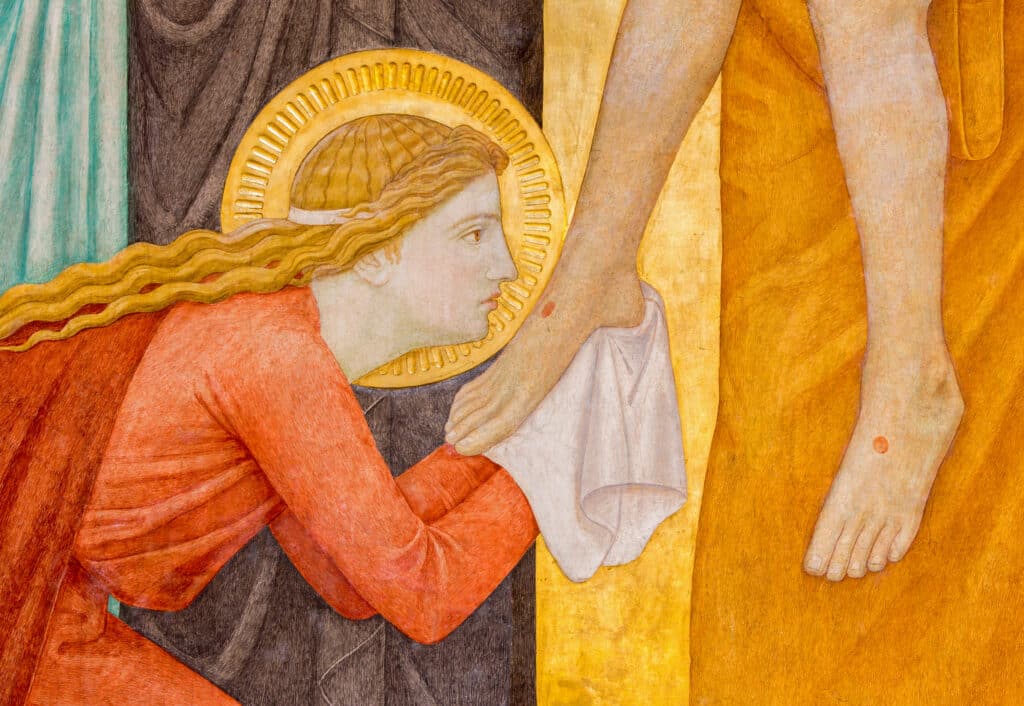
During the early medieval days, Pope Gregory the Great once connected Mary Magdalene to a passage shortly before Luke’s formal introduction to the Galilean women (Lk 7:36-39). In it, a sinful woman who washed Jesus’ feet with her tears and then anointed them with a flask of ointment is presented.
Evidently, the pope had a hunch that the sin of this woman was prostitution and that she was likely the same as Mary Magdalene, who is mentioned just 12 verses later. Pope Gregory the Great (who we must remember really did do many “great” things) also linked Mary Magdalene with Mary of Bethany. These well-intentioned ideas stuck for a long time.
You still don’t have to go far to find someone who thinks Mary Magdalene was undoubtedly a prostitute and the same as Mary of Bethany. Many now assert that seven demons may actually represent mental illness—not prostitution. And most conclude that Mary Magdalene, Mary of Bethany, and the woman who washed Jesus’ feet with her tears are most likely three separate women.
Of all the holy Galilean women, Mary Magdalene is the most prominent. Three evangelists name her specifically as being at the Crucifixion, two at the burial, and all four Gospel writers put Mary Magdalene at the empty tomb. Matthew, Mark, and John also assert that she saw and spoke to the risen Christ.
Blessed Joanna
Joanna is the next Galilean woman Luke introduces. Little is said about Joanna, but the brief mention that Luke presents offers an intriguing clue. He included the fact that Joanna had a close connection to Herod Antipas the Tetrarch, who had John the Baptist beheaded. Joanna was the wife of Herod’s steward, Chuza.
Being a steward, Chuza likely had the responsibility of overseeing Herod’s estate, a job that surely demanded a certain loyalty to this ruler. One can only guess how Joanna managed to support her husband and follow Jesus without any conflict. Perhaps Joanna and her husband were present at the ill-fated birthday banquet. Maybe they heard Herod’s order for the beheading of John the Baptist and perhaps even saw the gruesome platter. We can only wonder.
Joanna is mentioned by name only one other time in the Bible—Luke lists her as one of the women who went to the tomb on the day of the Resurrection.
According to Luke, Joanna—along with other women of Galilee—saw two men in dazzling clothes at Jesus’ empty tomb, learned of Christ’s resurrection, and shared the great news with the apostles—who did not believe them! Although Joanna’s name is never mentioned again, it is reasonable to consider that she was likely a part of the group whenever there is a general reference to the Galilean women.
In the current Roman Martyrology, Joanna is listed as a blessed, rather than a saint. This is hard to discern; in the earliest days of the Church, the words blessed, holy, and saint were often used interchangeably. So you might see Joanna listed as a saint in some resources and as a blessed in others, similar to the way we call Mary the Blessed Virgin Mary or St. Mary.
It’s impossible to know with certainty what exactly was meant. Was Joanna considered an official saint in heaven or just a really good and pious person (perhaps not martyred)? Either way, she gave much and is an inspiration to all.
Blessed/St. Joanna’s memorial is May 24.
St. Salome
It is Mark and Matthew who let us know that Salome is another holy woman of Galilee. Mark provides us with her name—within his Crucifixion and Resurrection narratives. Matthew, who calls her “the mother of the sons of Zebedee,” gives an additional, somewhat amusing account of St. Salome. In his 20th chapter, he relates how this mother of two apostles—James the Greater and John the Evangelist—had big ideas for her sons and boldly requested: “Command that these two sons of mine sit, one at your right and the other at your left, in your kingdom” (Mt 20:21).
Of course, Jesus took the opportunity to preach on the importance of humility and that serving others would count for more than grand places of honor.
St. Salome is listed on the April 24 page of the Roman Martyrology.
Susanna
Susanna is mentioned one time only—in Luke’s introduction to the Galilean women. So we can only glean that she, like Mary Magdalene and Joanna, had been cured of some demon or malady, traveled with Jesus and the apostles, and offered assistance in whatever way she could. Susanna was credibly present at the Crucifixion, burial, and empty tomb. It would be nice to know more, but we just don’t.
Susanna is not listed in the current Roman Martyrology; however, that does not exclude her from sainthood. Actually, if you were to attend Mass at a Byzantine Catholic church two Sundays after Easter, you would notice that Susanna is given special notice and is commemorated as a part of a group called the Holy Myrrhbearers.
St. Mary of Clopas
St. Mary of Clopas is especially hard to pin down in the Gospels, for she is referred to by a variety of titles:
Mary, the Mother of James and Joseph;
The Other Mary;
Mary, the Mother of the Younger James and of Joses;
Mary, the Mother of Joses;
Mary, the Mother of James;
Mary, the Wife of Clopas.
It is through John’s labeling, “Mary, the wife of Clopas” (19:25), that she has received her name: St. Mary of Clopas. Although she doesn’t stand out like Mary Magdalene, one variation or another of her titles appears at the death, burial, and empty tomb scenes repeatedly. Matthew’s Gospel asserts that both Mary Magdalene and Mary of Clopas saw and heard Jesus that first Easter morning.
Some propose that Mary of Clopas’ husband was the Cleopas who traveled to Emmaus with a friend and met up with Jesus in Luke’s 24th chapter. Many even suggest that it was St. Mary of Clopas who was the unidentified traveling partner. This is not known for sure, but it is an intriguing thought to consider.
St. Mary of Clopas shares a memorial day with St. Salome: April 24.
The Unnamed Other Galilean Women
Although we don’t know their names, it is only fair to also remember the unnamed women of Galilee—many others, according to St. Luke. Perhaps these nameless women were shy or had other responsibilities that took them away from Jesus and the apostles from time to time.
Whatever the reason, the Gospels give plenty of assertions that there were others. And they deserve our notice—especially if we have ever experienced being overlooked or not named. When we get to heaven, we can meet these women, learn their names, and thank them for their rich contributions to the mission of Jesus, for bringing comfort to his crucifixion and love to his burial.
Honoring the Holy Galilean Women
Even though the Gospel writers vary somewhat in their placement of the holy Galilean women, we can still get the general idea. They were there, they were helpful, they were devout, they were fearless (braver than most of the apostles at the Crucifixion!), and they loved Jesus dearly and showed it. And at least Mary Magdalene and Mary of Clopas were highly blessed by being the first to see Jesus resurrected. Though not specifically mentioned, it seems highly probable that at least some of the holy Galilean women were present during the nine days in the upper room in Jerusalem, praying and awaiting the Holy Spirit.
The holy Galilean women were generous in many ways and great adorers of God; their good works are an example to all Christians. They fully and very bravely lived out Christ’s command to deny oneself and follow him.
Restoring St. Mary Magdalene’s Reputation
Hopefully St. Mary Magdalene’s mistaken reputation as a prostitute will continue to steadily diminish. It seems reasonable to offset this unfortunate label by putting a special emphasis on a far better one—a label given to St. Mary Magdalene by St. Thomas Aquinas: “The Apostle to the Apostles.”
This 13th-century Italian doctor of the Church wrote a commentary on the Gospel of St. John, a Gospel that offers particularly poignant highlights on Mary Magdalene’s role on that first Easter morning. John’s 20th chapter presents Mary Magdalene arriving at the empty tomb alone. His unique and rich portrayal of this special woman asserts that she tearfully glanced toward the empty tomb, was visited by two angels, mistook Jesus for a gardener, and then was overcome with emotion as she recognized her Lord. Then, Mary Magdalene—without hesitation—followed Jesus’ charge to share the news of his resurrection: “Mary of Magdala went and announced to the disciples, ‘I have seen the Lord’” (Jn 20:18a), and shared what he told her.
It was Mary Magdalene carrying out Jesus’ wish to announce his resurrection with eager confidence that prompted St. Thomas Aquinas to call Mary Magdalene the Apostle to the Apostles within his commentary.
It is compelling to note that St. Thomas Aquinas also pointed out Matthew’s inclusion of another holy Galilean woman—”the other Mary” (St. Mary of Clopas)—during the first appearance of Jesus. Certainly, her role was profound as well, and more elaboration on her story would be welcome. However, St. Thomas Aquinas couldn’t help but notice Mary Magdalene’s overall prominence, especially in John’s Gospel, and felt inspired to highlight her apostle-like role.
Evidently, Pope Francis has read this commentary of St. Thomas Aquinas and agrees. In June 2016, the pope expressed a great appreciation for this title bestowed upon St. Mary Magdalene and felt it was time to elevate her day of remembrance (July 22) from a memorial to a feast. (The rank of Church celebrations are: optional memorial, obligatory memorial, feast, and solemnity.)
This seems a perfect counteraction: to start referring to St. Mary Magdalene as the Apostle to the Apostles in order to help restore her due reputation and highlight her holiness; to focus on her great love and devotion to Christ; and to recognize her rich contribution of proclaiming Christ’s triumph over the cross.
Sidebar: A Retreat with the Holy Galilean Women
Perhaps you would like a two-week, at-home retreat with these special women. If so, take some time each day for 14 days to read a biblical passage on them. Take in one or two surrounding verses and read the footnotes, if desired, and ponder their impact. Try to imagine yourself at the various scenes; maybe jot down your thoughts in a journal. Note which of these women each Gospel writer chose to highlight for the death, burial, and Resurrection accounts.
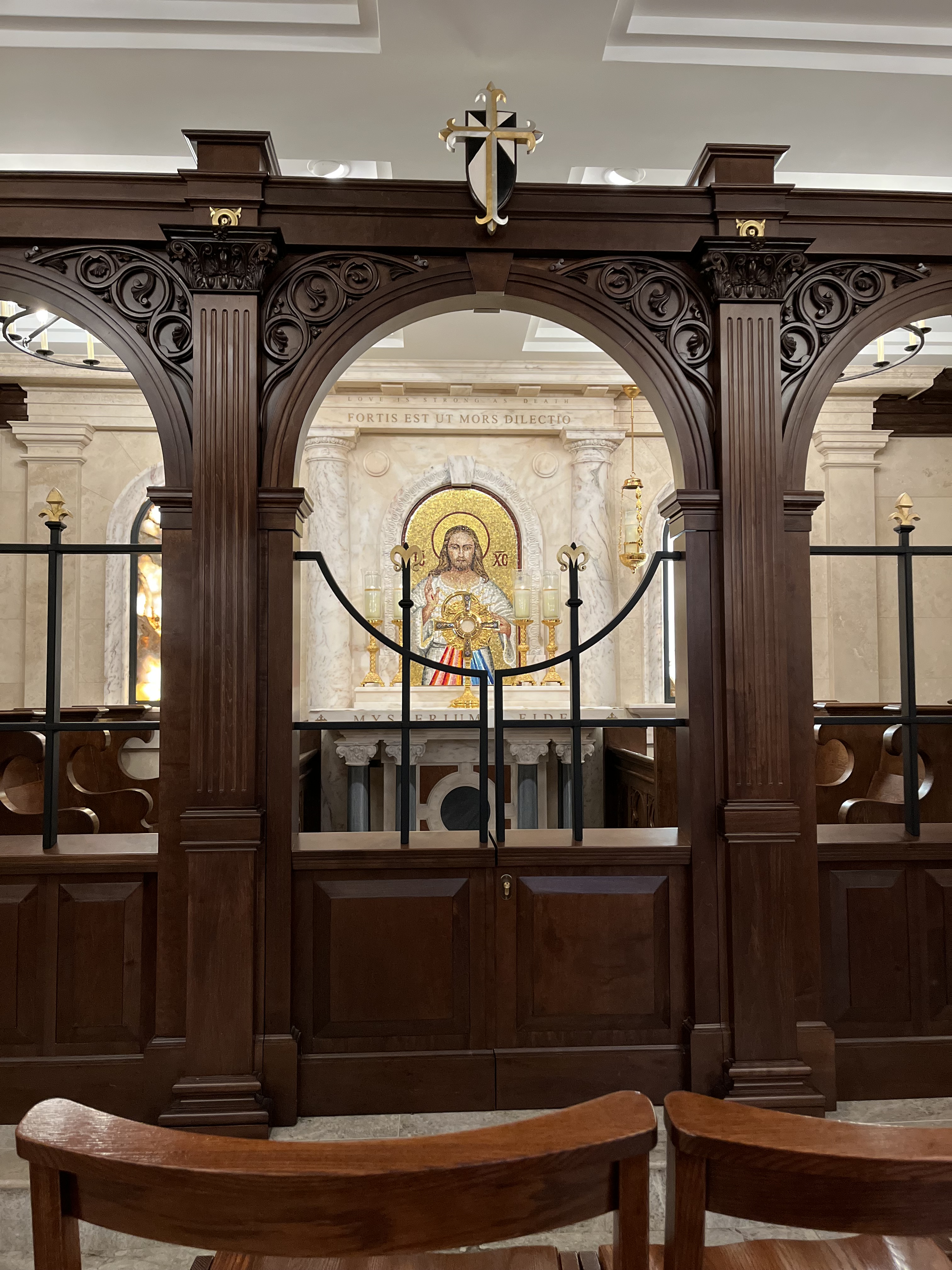
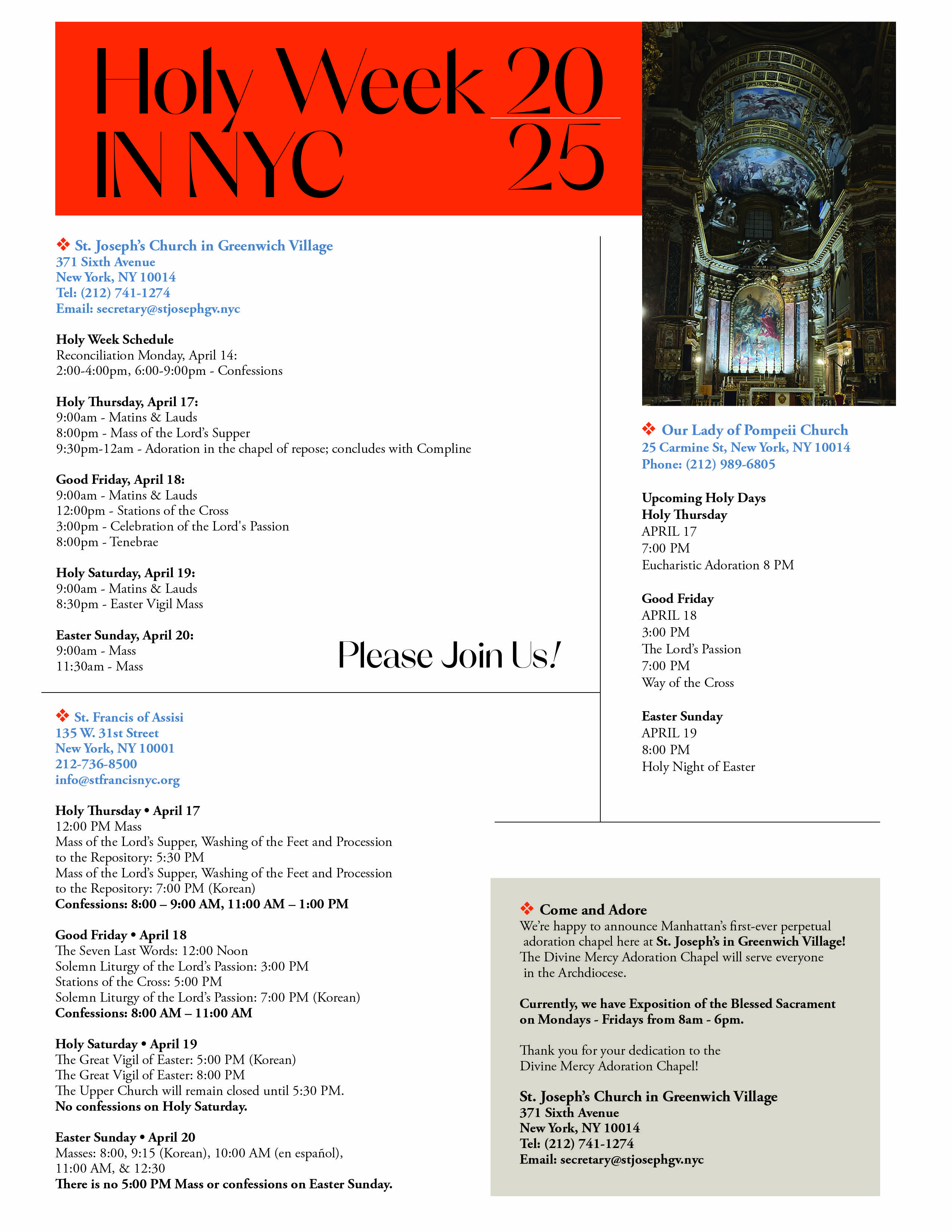
COME AND ADORE We’re happy to announce Manhattan’s first-ever perpetual adoration chapel here at St. Joseph’s in Greenwich Village! The Divine Mercy Adoration Chapel will serve everyone in the Archdiocese.
Currently, we have Exposition of the Blessed Sacrament on Mondays – Fridays from 8am – 6pm. Thank you for your dedication to the Divine Mercy Adoration Chapel!
God Bless, The Church of St. Joseph 371 Sixth Avenue New York, NY 10014 (212) 741-1274
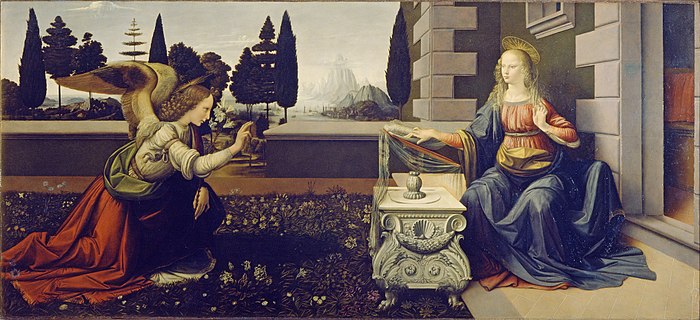
Luke’s account of the story of the Annunciation to Mary (see Luke 1:26–56) gives us a window through which to better appreciate this remarkable young woman. Through her interactions with Gabriel and Elisabeth, we see a young woman trying to grasp and understand her unique call from God. The magnitude of that call must have weighed heavily upon someone so young, and yet she readily submitted her will to that of the Father. Her story reminds us that God is aware of all of His children and that He calls ordinary men and women to participate in extraordinary ways to help build His kingdom. She became Jesus’s first disciple, and thus she is a model for all who choose to follow Him.
In the West, the oldest reference to the cult of Saint Joseph (Ioseph sponsus Mariae) connected with 19 March appears around the year 800 in the north of France. Thereafter, reference to Joseph, the spouse of Mary, becomes more and more frequent from the 9th to the 14th centuries. In the 12th century, the crusaders built a church in his honor at Nazareth. But it was in the 15th century that the cult of Saint Joseph spread due to the influence of Saint Bernadine of Siena, and especially of Jean Gerson (+ 1420), Chancellor of Notre Dame in Paris, who promoted the cause that a feast to Saint Joseph be officially established. There were already some celebrations in Milan in Augustinian circles, and in many places in Germany. It was in 1480, with Pope Sixtus IV’s approval that the feast began to be celebrated on 19 March. It then became obligatory with Pope Gregory XV in 1621. In 1870, Pope Pius IX declared Saint Joseph the Patron of the Universal Church, and Pope Saint John XXIII inserted his name into the Roman Canon of Holy Mass in 1962. More recently, Pope Francis approved seven new invocations in the Litany to Saint Joseph: Guardian of the Redeemer, Servant of Christ, Minister of Salvation, Support in difficulties, Patron of exiles, Patron of the afflicted, and Patron of the poor.
Prayer
Hail, Guardian of the Redeemer, Spouse of the Blessed Virgin Mary. To you God entrusted his only Son; in you Mary placed her trust with you Christ became man. Blessed Joseph, to us too, show yourself a father and guide us in the path of life. Obtain for us grace, mercy and courage, and defend us from every evil. Amen.
Please leave message if you would like a copy of our novena app for iPhone or iPad. History and prayers of 36 saints.






 novena.com