The Visit of Mary to Elizabeth (Philippe de Champaigne, 1602-1674)
Mary went to visit her cousin Elizabeth, who was also pregnant. When Mary entered the house and called a greeting, Elizabeth felt her baby move within her. Elizabeth was filled with the Holy Spirit and said “You are the most blessed of all women, and blessed is the child you will bear!” She went on to say that her baby jumped with gladness at the sound of Mary’s voice.
Understanding the text
Elizabeth is Mary’s cousin. She is now elderly and she and her husband, Zechariah, have never been able to have children. Now Elizabeth is pregnant as God has worked a miracle so they can conceive.
Their child will grow up to be John the Baptist, the person whose role in life is to prepare people for Jesus.
Mary goes to visit her cousin Elizabeth when both of them are expecting their babies. Elizabeth’s baby “leaped in her womb” when Mary entered the house and called a greeting.
This incident shows that even though they are not yet born, John acknowledges the superiority of Jesus and recognises that Jesus is God’s son.
Fr. David Convertino, OFM Executive Director of Development
Every 4th of July, I reflect on the spirit of the Day and reflect on our freedoms, what it took to secure them, and what it takes to defend them. When I do this, I often think about the blood of innocent people who endure wars and conflicts, the friars who provide help in war-torn countries and never leave the people there, and our Nation’s military heroes, who time and again protect our freedom to gather in protest or in celebration, in worship, and in pursuing the great “American Dream” of freedom and prosperity that so many strive to have.
Many women and men have sacrificed on the battlefield, in factories, offices, schools, and in their homes, living difficult lives of sacrifice so that they can have this great dream for themselves or for their children.
As a friar, my faith defines much of who I am. Besides the 4th of this month, July is also a time when the Church dedicates the entire month to the Precious Blood of Jesus.
The Precious Blood of Jesus is the ultimate expression of God’s love and mercy.
Just as so many have shed their blood to secure liberty, Jesus shed His Precious Blood to free us from sin and death. One offers civic freedom—the other freedom from death.
My friends, as fireworks light up the sky this week, may they remind us of both the freedoms that belong to us in this democratic nation and the brilliance of Christ’s precious love.
We honor those who gave and still give their lives for our country, and we give thanks to the Savior who gave His life for ours.
But as we celebrate this July, we cannot forget those who still struggle for freedom from fear, poverty, a lack of healthcare, and other forms of suffering that many continue to fight for every day. Precious blood is still being shed every day.
Wishing you a blessed Feast of the Precious Blood and a joyful 4th of July.
Many Blessings,
Fr. David, OFM
The month of July is dedicated to the Most Precious Blood of the Redeemer. Supreme homage is given to the Sacred Blood. As we adore the Sacred Heart, because it is the Heart of Jesus, who is God, so we adore the Most Precious Blood.
The Blood of Jesus is the fountain of salvation. Each drop that flowed from the wounds of the Savior is a pledge of man’s eternal salvation. All races of the earth have been ransomed, and all individuals, who will allow the saving power of the Sacred Blood to be applied to their soul, are heirs of heaven. St. John Chrysostom calls the Precious Blood “the savior of souls”; St. Thomas Aquinas, “the key to heaven’s treasures”; St. Ambrose, “pure gold of ineffable worth”; St. Mary Magdalene de Pazzi, “a magnet of souls and pledge of eternal life”. The sins of mankind, in their number, in their offense to the Supreme Being, in the effects on transgressors, are immense; yet, the Precious Blood of Jesus is not frightened by numbers, it has in Itself the power to appease an angered God and to heal wounded creatures.
The Precious Blood is a cleansing bath. Unlike all other blood, which stains, the Blood of Jesus washes clean and white. According to the words of St. John, in the Apocalypse, the Angels wonder, and the question is asked: “These that are clothed in white robes, who are they?” The Lord answers: “These are they that have washed their robes, and have made them white in the Blood of the Lamb.” For no other reason did the Precious Blood flow but to regain for the souls of men the beautiful dress of innocence, and, once regained, to preserve it throughout life and into eternity.
The Blood of the Savior is a well of consolation for troubled hearts. Can anyone, confidingly, look at the Sacred Blood trickling down from the Cross without taking courage to carry on, in spite of the difficulties which are the common lot of all? One glance at the Cross must be able to drive away fear. And, another, must be able to instill trust in Him who did not rest until the last drop, mingled with water, flowed out of an opened Heart. He, who was willing to do so much for men, must be willing to overlook and forget the frailties which they deeply regret; He must be willing to come to their assistance when harassed, to defend them when tempted, to comfort them when afflicted. The Blood of Jesus must be for Christians what the north-star is to sailors.
Would that men on earth honored the Precious Blood in the manner in which they who are in heaven give honor and praise and thanksgiving! They proclaim that It purchased the glory which they enjoy. Without It, they would have remained slaves of Satan and outcasts from the eternal mansions of God. Let us profess that we owe to the Sacred Blood of Jesus all that we have in this life, and that to It we shall owe all that we shall enjoy in a better and eternal life! PASSIONIST NUNS, 8564 CRISP ROAD, WHITESVILLE, KY 42378
St. Ignatius invites us to find God in all things. That means we have to pay careful attention to how the Spirit is moving in each moment of our daily lives. We have to take a magnifying glass to the seemingly ordinary, seeking to encounter the Divine.
That’s why the Examen is such a powerful prayer. In it, we’re invited to encounter God, express gratitude for the gift and gifts of each day, and to commit to make up for any mistakes we may have made.
The Examen is a flexible prayer, too, responding to the signs of the times. Below, you’ll find several variations to meet your need in this moment.
How to Pray the Examen
1. Place yourself in God’s presence. Give thanks for God’s great love for you.
2. Pray for the grace to understand how God is acting in your life.
3. Review your day — recall specific moments and your feelings at the time.
4. Reflect on what you did, said, or thought in those instances. Were you drawing closer to God, or further away?
5. Look toward tomorrow — think of how you might collaborate more effectively with God’s plan. Be specific, and conclude with the “Our Father.”
The call which comes from this important feast day is first of all a call to Eucharistic adoration, because in the Sacred Host the Lord Jesus is truly present and He offers each of us His Heart, His Merciful Love. To spend time in the Presence of the Eucharistic Lord, to adore Him, is the best expression of devotion to the Sacred Heart of Jesus which, as we know, spread all over the world thanks to Jesus’ revelations to Saint Margaret Mary Alacoque in the 17th century: “Behold the Heart which so loved mankind”!
As a prolongation and accomplishment of this message, the Lord appeared to another Sister in the 20th century revealing the abyss of His unfathomable mercy; she was Saint Faustina Kowalska who wrote in her Diary, now world famous, these words of Jesus: “I have opened my Heart as a living source of Mercy, from it all souls draw life, all approach with deep confidence this sea of Mercy. Sinners will obtain justification and the just will be strengthened in goodness. I will fill the souls of those who put their trust in My Mercy with My divine peace at the hour of their death. My daughter, continue to spread devotion to My Mercy, in doing so you will refresh My Heart which burns with the fire of compassion for sinners. Tell my priests that hardened sinners will be softened by their words if they speak of my boundless Mercy and of the compassion which My Heart feels for them. I will give priests who proclaim and exalt My Mercy wondrous power, unction to their words and I will move all the hearts to which they speak” (Book 5, 21 January 1938).
The deepest longing of Christ’s Heart is that we discover how much he loves us, the extent of his tender love for creatures who, cooled by their selfishness, look only inwards at themselves, as if they were afraid to let themselves be loved unconditionally by their Creator, who asks nothing and gives all!
Close to the Heart of the Son is the Heart of the Mother whom the Church celebrates the day after the solemnity of the Sacred Heart of Jesus. Let it again be the Holy Father who illuminates us with regard to this mystery: “The heart that resembles that of Christ more than any other is without a doubt the Heart of Mary, his Immaculate Mother, and for this very reason the liturgy holds them up together for our veneration. Responding to the Virgin’s invitation at Fatima, let us entrust the whole world to her Immaculate Heart, which we contemplated yesterday in a special way, so that it may experience the merciful love of God and know true peace” (Benedict XVI, Angelus 5 June 2005).
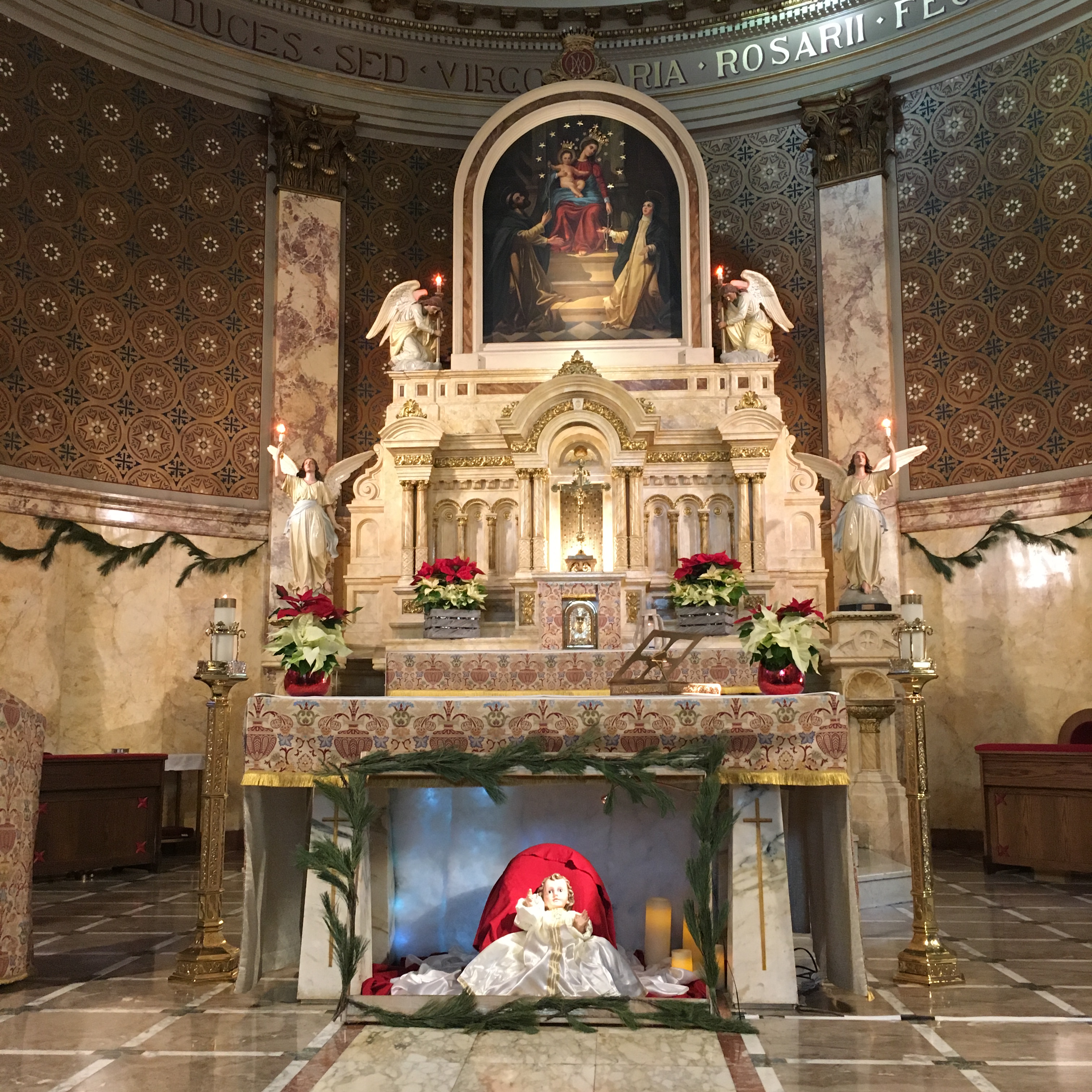
Our Lady of Pompeii began in 1892 as the chapel of St. Raphael Society for the Protection of Italian Immigrants, which was located in a townhouse that is still standing at 113 Waverly Place. In 1895, Pompeii rented the former Bethel Methodist Colored Church at 214 Sullivan St., no longer standing. In 1898 it purchased a church that stood at 210 Bleecker Street, across from the southern end of Minietta Street nearby on the eastern side of Sixth Avenue. The church, which looked like a Greek Temple, was erected in 1836 for the Unitarian Universalists. In 1888 the Unitarians sold the church to the African American Roman Catholic congregation of St. Benedict the Moor. When the city condemned the church to extend Sixth Avenue, Pompeii erected this building, formally opening it October 7, 1928.The church’s architect was Mathew Del Gaudio, an Italian American graduate of Cooper Union active in his profession from 1905 to his death in 1960. Del Gaudio created a Romanesque building that would have reminded the earliest parishioners of Italy, with its shallow front steps and flat façade close to the street, its domed sanctuary, and its campanile, or bell tower. The figure on the roof is St. Charles Borromeo, patron saint of the order of priests that founded and staff Pompeii.Step in, look up, and you’ll see paintings celebrating the Rosary, the work of Professore Antonio D’Ambrosio, who was born in Italy and trained as an artist there. He opened his ecclesiastical arts company in 1928, specializing in creating artwork for churches, trained his children in the field, and passed the business along to them. D’Ambrosio’s descendants have returned to do restoration work on Pompeii’s art several times.The right wall’s images depict the Joyful Mysteries: the Annunciation, Visitation, Nativity, Presentation, and Finding Jesus in the Temple. Those on the left wall depict the Sorrowful Mysteries: Jesus’ Agony in the Garden, His Scourging, His Crowing with Thorn, His Carrying of the Cross, and His Crucifixion. On the ceiling are the Glorious Mysteries: the Resurrection, Ascension, Pentecost, Assumption, and the Crowning of the Blessed Virgin in Heaven.Above the altar is a complex construction. On the left and right of the mural, respectively, are images of the Church Suffering, the souls in Purgatory awaiting redemption, and the Church Triumphant, the saints in Heaven.
The centerpiece is dedicated to the Church Militant, or the Church on Earth. Above the center is an image of Our Lady of the Rosary of Pompeii, with Jesus on her lap, both of them handing rosaries to St. Dominic and St. Catherine of Siena, early promoters of the rosary. Angels fly about them. Across the bottom are images associated with Pompeii parish, such as the building’s campanile. The figure in red on the right is St. Charles Borromeo. The bishop in white is Blessed John Baptist Scalabrini, founder of the priests who serve at Pompeii. The figure with the basket of roses is St. Martin de Porres, a tribute to the African American community whose church Pompeii purchased. To the left is a Franciscan friar, acknowledging that the Franciscans were the first ministers to New York’s Italians, at St. Anthony of Padua parish on Sullivan Street, a few blocks south of Pompeii. On the right is a galleon, a reminder that the Spanish credited their victory in the 1571 Battle of Lepanto to praying the rosary. The Latin phrase at the mural’s base translates as “Not Arms, Not Leaders, but the Virgin Mary of the Rosary Made us Victors.” Professore D’Ambrosio worked on this commission from 1934 to 1937, finishing with the painting of Jesus revealing His Sacred Heart to Saint Margaret Mary that is to the left as you come further into the church.Just behind you, near the entrance on the left, are statues indicative of the diversity of Pompei’s congregation.
The centerpiece is a shrine to Mother Frances Cabrini, patroness of immigrants. Before her is a statue of Jesus Nazareno, an image revered among the Filipino immigrants who also worship at Pompeii. The statue of San Gaetano is a long ago gift from his devotees that cannot be dated. The statue of Saint Jude is a 1955 bequest from parishioner Catherine Brignole; Jude, patron of hopeless causes, was a popular saint in the mid twentieth century. The bust of Bishop Scalabrini also dates from 1955, and Scalabrini’s coat of arms on the column near the bust, from soon thereafter, but these represent the beginnings of devotion to someone who may yet be declared a saint.At the beginning of the wall on the left, or southwest, side of the church, are statues of two saints popular among Italians, St. Rose of Lima and St. Lucy. Then come the stained glass windows, work on which commenced in 1928, with the Stations of the Cross between them. (The Stations and windows actually “begin” at end of the wall nearer the altar if you want to skip ahead and walk back.) The stained glass window at the back of the church is important not only for its illustrations of four of the Beatitudes but for the donors associated with it. Carolina Perazzo, whose name appears on the window, was the daughter of funeral home director Carlo Baciagalupo. She married Giovanni Battista Perazzo, who learned the undertaking business from his wife and father-in-law, and opened his own funeral home at 199 Bleecker St. in Greenwich Village. The business is no longer in the family, but is still at 199 Bleecker St.Most of the topics of the stained glass windows are easily recognizable, but some require some insider knowledge of Pompeii. For example, see the window on the southwest wall given in honor of A. Agostino Gazzolo. The bishop in the window is Scalabrini, the two clergy are a Scalabrinian priest and brother, and the two nuns represent two orders Blessed Scalabrini encouraged:
Mother Cabrini’s Missionaries of the Sacred Heart and the Apostles of the Sacred Heart, whose members taught in Pompeii’s school. The Gospel quotation references the Scalabrinians’ mission to help migrants preserve their faith in their new homes.Before turning to the altar, step into the room to the left, where there is a striking stained glass window and several more statues. St. Gerard’s statue came from the maternity ward on the 5thfloor of the Seton Building of St. Vincent de Paul; Greenwich Village’s hospital from 1849 to 2010; it is a gift from the hospital’s founders, the Sisters of Charity.The altar wall of the church consists of three parts. The mosaics of Assumption and of Jesus in Purgatory date from the tenure of Father Mario Albanese, pastor from 1952 to 1964. While you are at the Assumption altar, look at the wall to the left to see the fine mosaic of the Holy Family. In front of the image of the Assumption is one of Pompeii’s newest statues, that of Padre Pio, a Franciscan priest who was declared a saint in 2002. There is also an image of Our Lady of Guadalupe. Normally, that would indicate the presence of Mexican devotees, but during Pompeii’s earliest years, women from Chiavari, south of Genoa, practiced the devotion.
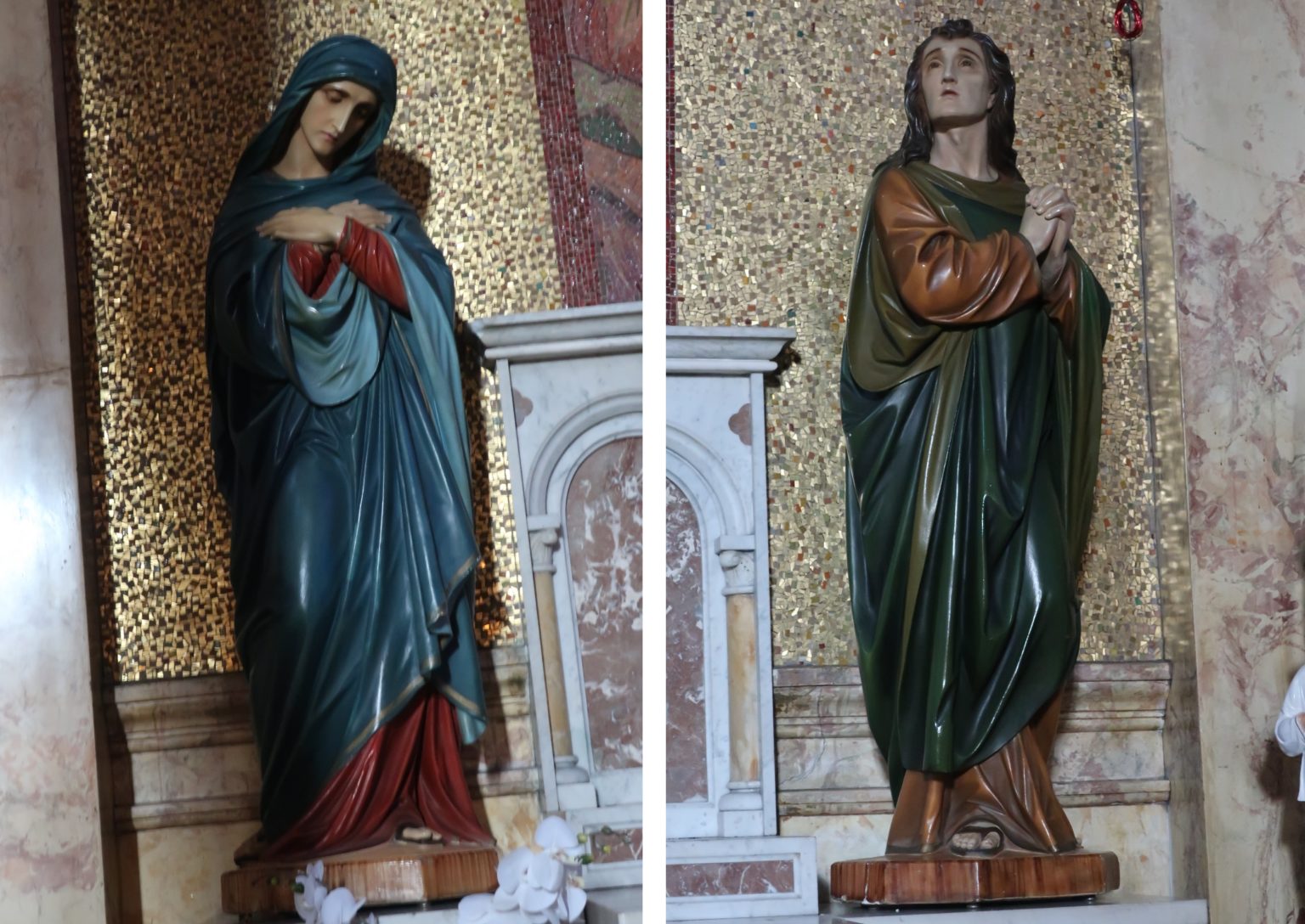
Embedded in the marble pre-Vatican II altar is a painting of Our Lady of the Rosary that is an exact replica of the one at the shrine to Our Lady of the Rosary in Pompeii, Italy. The painting was an 1895 gift of heiress Annie Leary. Shortly after its installation, this parish received permission from the Italian shrine’s founder, Bartolomeo Longo, to promote itself as the American shrine. The painting first hung over the altar at the 210 Bleecker Street church mentioned earlier; it was cut to its present shape to fit the altar here.Pompei’s oldest statues cluster around the Purgatory image. Those of the Blessed Mother and St. John the Evangelist date from the 1880s and are part of a set that, together with the crucifix in the donor’s shrine near the church entrance, were fixtures at St. Benedict the Moor. The statues of the Sacred Heart and St. Joseph appear in a 1909 photograph of Pompeii.The stained glass windows to the right of the altar, Pompeii’s northeast wall, also reflect parish history. Note the windows depicting marriage vows and Pope Leo sending Mother Cabrini to the Americas, all given by relatives of Italian-American lawyer Edward Bergonzi, who, along with pioneer Italian immigrant Luigi Fugazy, was on Pompeii’s first board of trustees. The image of the priest in the window depicting marriage is that of Father Antonio Demo, who served at Pompeii from 1898 to 1936, most of the time as pastor; he led Pompeii in building this church. Perhaps after you have completed your visit here you can see the park named for him, diagonally across the street from the church.
At the end of the row of Stations and windows is the donor’s shrine, and a plaque noting that Pompeii’s campanile was restored in honor of Vincent Gigante by his parents. He is better known as “Chin” Gigante, and was a leader in one of New York City’s organized crime families. His own family, though, included many other members who were part of the parish; before this plaque went up, another plaque, at the beginning of the Stations of the Cross, notes the Stations were refurbished in honor of Pietro Gigante.On your way out, look up. Above Pompeii’s doors are three stained glass windows. The one of Columbus giving thanks for having reached land in the Americas is a tribute to Pompeii’s Italian roots. The depiction of Ellis Island is a reminder of Pompeii’s commitment to immigrants. In the center is an image of the Holy Family on the Flight into Egypt, a reminder that Jesus, Mary and Joseph were once counted among the world’s migrants and refugees. Dr. Mary Elizabeth Brown, PhD.
In 1927, in order to extend Sixth Avenue south to Canal Street, the city tore down the 210 Bleecker Street building that Saint Benedict’s and Pompeii had occupied, and Pompeii moved to its present church. In 1979, St. Benedict’s contacted Pompeii regarding the other two statues in the original Crucifixion scene. The late Brother Michael La Mantia, c.s., oversaw the statues’ transfer to the present Pompeii church. The pastor at the time, the late Father Edward Marino, c.s., was using the Crucifix as the centerpiece for a niche honoring donors to the church, so instead of reuniting the set he placed the statues of the Blessed Mother and Saint John in their present positions, before the mosaic of the Crucified Christ and the Souls in Purgatory.
Faith in God, Father, Son and Holy Spirit (Trinity), is not a distant and unattainable experience. Instead, it is as near since it is perennially “broken” for us: This is my Body… This is my blood.” In 1207, a Belgian Augustinian nun, Giuliana di Cornillon, who had just turned fifteen, had a vision of a full moon with a dark spot sullying it. Contemporary experts interpreted it thus: the full moon symbolized the Church, the dark spot was the absence of a specific feast in honour of the Body of the Eucharistic Jesus. The following year, the same religious had an even clearer vision, but had to fight hard to get the feast instituted. She succeeded only at the diocesan level, when Robert de Thourette became bishop of Liège in 1247. In 1261, the former archdeacon of Liège, Jacques Panteléon, became Pope Urban IV. In 1264, impressed by a Eucharistic miracle that had taken place in Bolsena, near Orvieto in Italy where he was residing, he promulgated the bull Transiturusthrough which he instituted a new solemnity to be celebrated the Thursday after the Octave of Pentecost in honour of the Blessed Sacrament. Thomas Aquinas was given the task of composing the liturgical office. The last strophe of the hymns very famous hymn he wrote, Sacris Solemniis, which begins with the words Panis angelicus (Bread of angels), has often been set to different musical scores, apart from the rest of the hymn. Since Pope Urban IV died two months after having instituted the feast, the bull was never implemented, but Pope Clement V, the first Avignon Pope (1312), confirmed it later.
The now traditional procession of Corpus Christi was introduced by Pope John XXII in 1316. During his pastoral visit to Orvieto, Saint John Paul II said: “Even though the construction of this cathedral was not directly connected with the Solemnity of ‘Corpus Christi’, instituted by Pope Urban IV with the bull Transiturus, in 1264, nor with the miracle that took place in Bolsena the previous year, there is no doubt that the Eucharistic miracle is powerfully evidenced here due to the corporal of Bolsena for which the chapel was specifically built and which it now jealously guards. Since then, the city of Orvieto became known throughout the world due to that miraculous sign that reminds all of us of the merciful love of God who becomes the food and drink of salvation for humanity on its early pilgrimage. Because of the cult rendered to such a great mystery, your city preserves and nourishes the inextinguishable flame” (17 June 1990).
Lord Jesus, with your instructions to follow the man with the pitcher of water, you make me understand that I am to follow in the footsteps of those who seriously live their baptism: help me imitate those who aim high in life.
Lord Jesus, by inviting me to the upper room, you ask me to abandon a flat way of life: help me be carried away with the desires you place in my heart.
Lord Jesus, by giving me bread and wine, Your Body and Your Blood, you teach me that life is either a gift, or it is not life: nourished by You, help me to make my life an offering pleasing to the Father.
Lord Jesus, in gathering your disciples around the table, you teach me that there is no Eucharist without the community, and there is no community without service. Help me to make my life a Eucharistic life. (Prayer by Father Andrea Vena)
The Roman Catholic love and respect for the Virgin Mary divides it from other sects of Christianity. Mary is not only revered as the Mother of God but also as the Mother of all Humanity, and her image continually watches over every aspect in the daily life of Catholic countries. She is credited with working miracles through pictures, statues, and sacred earthly places. She is the inspiration of much of the world’s greatest music, art, and architectural works. Her spiritual gifts are recognized in the East and both Hindus and Buddhists refer to her as Mother Mary. Muslims revere her as the mother of a great prophet and she is the only woman with her own chapter in the Koran. As a human being Mary is able to relate directly to the major and minor sufferings of mankind. For this reason she is not prayed to as a goddess, but rather, called on by Catholics to aid them in their prayers. It is thought that she shares her constant flow of grace with those who ask, bringing them closer to God. Thomas Merton wrote, “Mary does not rule us from without, but from within. She does not change us by changing the world around us, but she changes the world around us by first changing our own inner lives.”
We are gifting the app, click on link below and take a look! Please leave your email in the comments box. 36 Saints to pray with, and learn their personal stories. All illustrated with vintage holy cards.