Feast of St. Joseph, March 19, First Century AD

St.Joseph copysmall“I know by experience that the glorious Saint Joseph assists us generally in all necessities. I never asked him for anything which he did not obtain for me.” —Saint Teresa of Avila

Patron of: Fathers, Carpenters, Catholic Church, Families, Homeless, Pregnant Women, Unborn Children, Workers, Family Protection, To Find Work, A Happy Death, To Sell A Home.

A righteous man who never shirked his responsibilities as protector of his family, Saint Joseph offers a perfect example for fathers everywhere. He is invoked by families for all matters of support needed to sustain a household, both material and spiritual.

A descendant of the House of David, there is very little written about Joseph in the gospels. He was said to be betrothed to Mary when she became pregnant with Jesus. Instead of leaving her in scandal, he accepted the word of the angel Gabriel who told him that the child was divinely given and Joseph and Mary were chosen by God to be his earthly parents. It was Joseph who protected Mary on the journey to Bethlehem when Jesus was born. He also suffered the frustrations of a man who could not find proper shelter for his family as his wife was about to give birth. Upon returning to their native city of Nazareth, Joseph was once again visited by an angel warning him of the impending slaughter of the innocents. On faith alone, he dispensed with his business and personal effects, taking Jesus and Mary to Egypt where they stayed for seven years until Herod’s death. It fell upon Saint Joseph to support his young family in this foreign country.

The last mention of Joseph comes when Jesus is twelve years old and strayed from his family while on a pilgrimage to Jerusalem. It is thought that he died well before Jesus began his mission with Jesus and Mary at his deathbed. For this reason, more than any other saint, he is invoked for a happy death, one where a person is older and has their family at their side.

Though of noble lineage, Joseph was a carpenter and it was from him whom Jesus learned his trade. Because he worked with his hands and frequently put his family ahead of any personal ambitions, workers everywhere who live similar lives call on him as a patron. It is no mystery that the cult of Saint Joseph became more popular in modern times with the advent of the Industrial Revolution. Many saints throughout the ages have declared him to be a powerful advocate as well, since it is thought that Jesus obeyed him in his earthly life, he is inclined to listen to Joseph in his heavenly life. Teresa of Avila always buried medals with his image when she needed land for a new convent. This tradition has extended itself to realtors of all faiths who bury statues of Saint Joseph on properties they wish to sell.

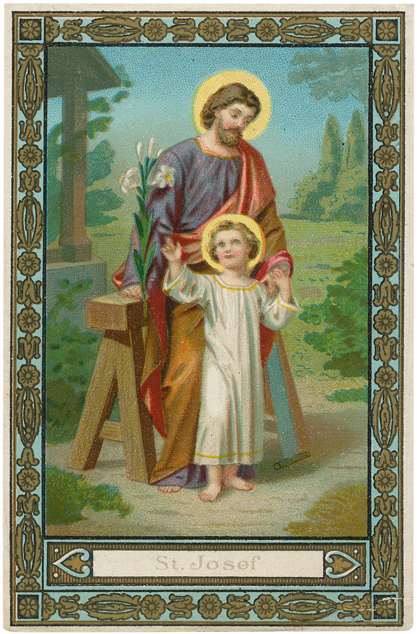
It is assumed that since Joseph respected his wife’s virginity that he was an older man when he married. He is depicted in art with a staff, which he led his family ( precursor to the bishop’s staff) a lily for purity, and with carpenter tools or holding the baby Jesus

Novena

O glorious Saint Joseph, faithful follower of Jesus Christ, to you we raise our hearts and hands to ask your powerful intercession in obtaining from the compassionate heart of Jesus all the helps and graces necessary for our spiritual and temporal welfare, particularly the grace of a happy death, and the spiritual grace for which we now ask.

(Mention your request.)

O guardian of the Word Incarnate, we feel animated with confidence that your prayers for us will be graciously heard at the throne of God. (The following is to be said seven times in honor of the seven joys and seven sorrows of Saint Joseph.)

O glorious Saint Joseph, through the love you bear for Jesus Christ, and for the glory of his name, hear our prayers and grant our petitions.

Feast of Our Lady of Lourdes

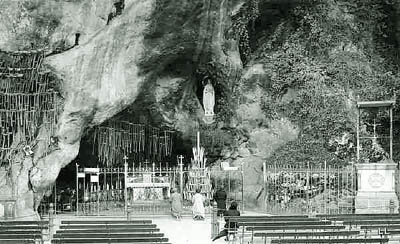
115_GrottoLourdes, an ancient village in the valley of the Pyrenees mountains, is in the extreme southwest of France near the Spanish border. It is the site of the most famous series of apparitions of the Virgin Mary and the most visited pilgrimage shrine in Christendom. Credited with exuding a powerful healing energy, it is inundated by those in need of physical and spiritual renewal. Attracting well over 200 million visitors since its discovery, Lourdes is a relatively modern holy site, having only been recognized by the Church as an official pilgrimage place since 1862. It became famous after a poor, illiterate local 14 year old girl, Bernadette Soubirous saw a vision of the Virgin Mary in a grotto near a great rock mound called Massabeille. Despite much ridicule and persecution inflicted on her by the local authorities, Bernadette could not be shaken from her story. While communing with the Virgin, Bernadette uncovered a trickle of muddy water in a place where water had never been. Today, that tiny spring gushes forth with thousands of gallons of water daily. Considered to contain inexplicable healing properties by the devout, many terminally ill people of all faiths flock to Lourdes as a last resort in curing their ailments. Catholics go to spiritually refresh themselves and to honor this visitation by the Mother of God.

Though officially ruled over by France, the villages of the Pyrenees had little to do with their country on any cultural or social level. Most spoke in patois, their own language, never learning French at all. They dressed in their own local costumes, disdained the central government and were known as the ‘Indians’ of France for the exotic way they lived. While the 19th century was celebrated as a great secular age, when France was finally freed of all political domination of the Catholic Church and science and logic replaced faith, the villagers of the Pyrenees defied all official teachings and held on to their religious beliefs. They were hostile to the French government and suspicious of any forms of official beauracracy. Living in a harsh, mountainous landscape, they held much of nature as sacred. They had little faith in modern medicine and combined ancient Celtic beliefs with their Catholic prayers. The love of the Virgin Mary was at the heart of their religious life. Since the 13th century shepherds and shepherdesses had reported direct contact with her, either through visions or the miraculous discovery of statues of her. Shrines to the Madonna were abundant and most towns had a special day of pilgrimage honoring her.

Bernadette Soubirous was a 14 year old girl who’s impoverished family lived in a dank former dungeon. Stricken with asthma, she was considered slow and held back from receiving her First Holy Communion because she had trouble learning her catechism. On February 11, 1858 her mother needed firewood for cooking and could not afford to buy any. She sent Bernadette, her younger sister and a friend out to look for some. So that they would not be accused of stealing, the girls had to go outside of town to public lands. There was an outcropping of rock facing the river with a grotto at its base known as Massabielle. The pigs of Lourdes grazed there and respectable residents did not go to that area because it was considered filthy. According to legend, the Massabeille had been sacred to the pagans in prehistoric times and those passing by it always crossed themselves to ward off the aura of evil that they felt emanated from it. Because of her illness, Bernadette stayed behind while the two younger girls waded across the river to get wood. She decided to join them and began taking off her stockings. It was at this point she heard the sound of a wind and then saw a soft light coming from the niche in the grotto. A beautiful, smiling girl in white seemed to beckon to her. Bernadette was startled and instinctively reached for her rosary. She was unable to pick it up until the young girl produced one herself. They made the sign of the cross together and as Bernadette prayed the rosary, the young girl passed her own beads through her fingers in silent prayer. When Bernadette finished, the young girl smiled and disappeared. Despite her mother’s opposition, Bernadette returned to the site that Sunday after mass. She was joined by a group of friends. The girl in white appeared and Bernadette said, “If you come from God, stay. If you don’t, go away.” She then sprinkled holy water at the girl to make sure she was not from the devil. Bernadette was relieved when the girl laughed and inclined her head to receive more water. Bernadette was the only one who could see or commune with the girl. Her friends were astounded by the physical change in her demeanor. She had fallen into a beautiful rapture and seemed totally relieved of her asthma. One threw a large stone in the direction of the niche and Bernadette did not flinch. Fearing she had had some sort of fit, they ran to get help. The towns residents who came were shocked at the beautiful transformation in Bernadette. Word of her visions started to spread.

Each time she returned to the grotto she was joined by a larger crowd. Many thought the apparition was either the ghost of a devout townswomen who had recently died or a soul who had wandered away from purgatory. Bernadette’s third vision was on the 18th of February and two important townswomen brought along a pen and paper. The girl in white laughed when Bernadette held out the writing instruments and for the first time spoke to her, addressing her with great politeness, “Boulet aoue ra gracia de bie aci penden quinze dias?” she asked in the patois dialect. (“Would you have the grace to come here for fifteen days?”) When Bernadette replied that she would ask her parents’ permission, the girl said, “I do not promise you happiness in this life, but in the next.” During these next two weeks news rapidly spread through Lourdes about the apparitions and the civil authorities felt obliged to take action. Bernadette was taken to the local police station for questioning. The authorities tried to make her admit that it was all a hoax. When she refused, they began to threaten her family. The Church was also skeptical and embarrassed by what they regarded as superstitious worship. The local pastor, Father Peyramale did not want to give the apparitions any credence. Even though the girl in the visions had not named herself, the belief that she might be the Virgin was growing among the townspeople.

For her part, Bernadette did not speculate on the mysterious girl’s identity, always referring to her as ‘Aquero’, the patois word for indescribable being. It was on February 25th, the ninth apparition of the girl that Bernadette was told to go drink at the spring and wash in it. Thinking the girl meant the river, she went towards the Gave. In her words, “…Aquero called me back and pointed to a spot beneath the rock. I found some moisture there but it was mud. Three times I threw it away even though the Lady said to drink it. Then I washed in it only to have my face besmeared with mud. When the Lady left, my Aunt Bernarde slapped my face. ‘Stop your nonsense,’ she said as she sent me home to the jeers of the people…” By the afternoon the muddy area was flowing with pure water and many in the laughing crowd were amazed.because they had never seen a spring there before. In subsequent apparitions the girl asked for penitence and the conversion of sinners. Bernadette said that she was afraid that the people climbing all over the grotto would disturb the rosebush where the girl stood. “I was afraid she might fall, but she kept on smiling at the people. She loved them, and she always seemed sorry to leave them.” At 13th visit Bernadette was told to tell the priests to come to the grotto on procession and to build a chapel. Father Peyramale was enraged and told her that if the girl in white wanted a chapel she should say who she was and she should make the wild rose bush in the niche blossom. It was after this 13th visit that the water in the spring was first accredited with healing properties. A pregnant woman with a paralyzed hand became totally cured and a stonecutter had his sight restored after he bathed his eyes in the water. Before this, there had been no physical proof of Bernadette’s visits.

The vast crowds that had started to accompany her did not see or hear the girl in white. They only believed in these visions because of Bernadette’s great physical transformation. Thursday, March 4th was the last of the 15 days. Over 8,000 people went to the grotto expecting to see something miraculous. At the end of her vision, 45 minutes, Bernadette put out her candle and went home. The rosebush did not bloom, the girl in white did not declare any message. Bernadette, unconcerned about the wild emotions she had aroused, went home content. For the next three weeks, Bernadette later wrote, “The people pestered me, the police watched me, and the public prosecutor almost crushed me…” Then, on the night of March 24th she awoke with the familiar urge to return. On March 25th,the day of the Annunciation, she returned to the grotto at 5AM. The girl in white appeared and Bernadette asked her four times to say who she was. “Aquero extended her hands towards the ground, swept them upwards to join them on her heart, raised her eyes, but not her head to Heaven, leaned tenderly towards me and said, ‘Que soy era Immaculada Concptiou.’ (‘I am the Immaculate Conception.’) She smiled at me. She disappeared. I was alone.” Father Peyramale was astounded at this announcement. This expression meant nothing to a simple peasant girl like Bernadette. The Catholic tradition that Mary had been conceived without original sin so that she might be worthy to be the Mother of God had only been formally defined as Church doctrine in 1854. Eventually, the parish priest would be Bernadette’s greatest defender as she was harassed and examined by government officials, psychologists and church hierarchy.

She never altered the account of her story to any of them, “I do not ask you to believe; I only told you what I had seen.” Three eminent Parisian doctors declared that she was mentally and emotionally sound but that she suffered from asthma. (“My mother could have told them that and saved them the trouble.”) Under increased pressure from the authorities, the grotto was closed off and anyone visiting it threatened with arrest. On the 16th of July, Bernadette saw the girl in white for the last time. She knelt in the meadow on the far side of the river. “…I began my rosary and my Lady stood in the Grotto smiling at me. It was the Feast of Our Lady of Mount Carmel. She looked more beautiful than I had ever seen her. This would be the last time I would see her on this earth….She left heaven in my heart and it has been there ever since.” While Lourdes developed into a world famous place of pilgrimage, Bernadette, disliking the attention her presence created, joined the Sisters of Nevers in 1866. Her novitiate was difficult and her health deteriorating. She never showed any interest in the miraculous healings promised by the water in the spring. Her insistence that the girl in white was no older than 12 was ignored and priestly experts stated that since Mary had to be between the age of 15 and 17 at the time of the Annunciation, the official image of the apparition should depict her at that age. Bernadette never liked the statue that was erected in the Grotto in 1864, declaring it “too big and too old”. She died of tuberculosis in 1879. When her body was exhumed in 1908, it was found to be uncorrupted. She was recognized as a Saint by the Catholic church in 1933. Gradually, the local officials had to relent and re-open the grotto to the public. The Bishop accepted the apparitions and approved the shrine in 1862. After the railroad line was finished in 1866, pilgrims began arriving in the tens of thousands. After 1873, when incidents of healing at the spring began to be reported, the shrine rapidly developed an international reputation for having healing powers. Bathing pools filled with cold water piped from Bernadette’s spring were created for visiting pilgrims. Much effort was put on the scientific community to repudiate the healings at Lourdes.

Many illnesses were declared to be hysterical in nature and therefore cured by the powers of suggestion. Studies of the water from the spring showed it had no special chemical properties In 1882 a medical bureau was established to test the validity of the cures. Before a cure can be officially considered, a patient’s medical records are studied by a commission of doctors and independent medical professionals. The alleged cure must be immediate and permanent to be regarded as a miracle. When an investigation does occur, the conclusion is placed in one of four possible categories: (1)There has been no cure. (2)A partial cure has taken place. (3)There has been a cure, but there are medical or psychological reasons for it. (4) There has been a cure for which there is not natural or scientific explanation. The pilgrim must then return after a year for further examination. Since March 1, 1858, the Church has recognized 65 miracles at Lourdes. There are countless undocumented healings and over 5,000 documented “inexplicable healings”. Father Peyramale completed the first basilica upon the rock of Massabielle in 1873. After the great “national” French pilgrimages were initiated where Catholics of all classes came to bathe the sick at Lourdes, a larger church had to be built. The Church of the Holy Rosary was consecrated in 1901.

Today, the Basilica rises in 3 tiers over the grotto. Across the stream is a cavernous underground church which seats 20,000. In the grotto the miraculous spring has been channeled into a long row of spigots where visitors may collect the “Lordais water” and take it home. A small hospital and a number of hostels serve the needs of the seriously ill There is a Rosary procession held by torchlight each evening and the entire shrine is active throughout the day and evening with various services, processions and blessings of the sick. At the heart of the Lourdes pilgrimage is service to the sick and the infirm. Many devotees do not go for themselves but to aid others and to commune with God in a holy atmosphere.

There are four traditional gifts imparted by Lourdes: 1) The gift of miraculous water 2) The gift of healing 3) The gift of reconciliation 4) The gift of strength and friendship.
Feast of St. Thomas Aquinas, January 28

FullSizeCard_1@2“There must be must be a first mover existing above all – and this we call God.”

Patron of: Students

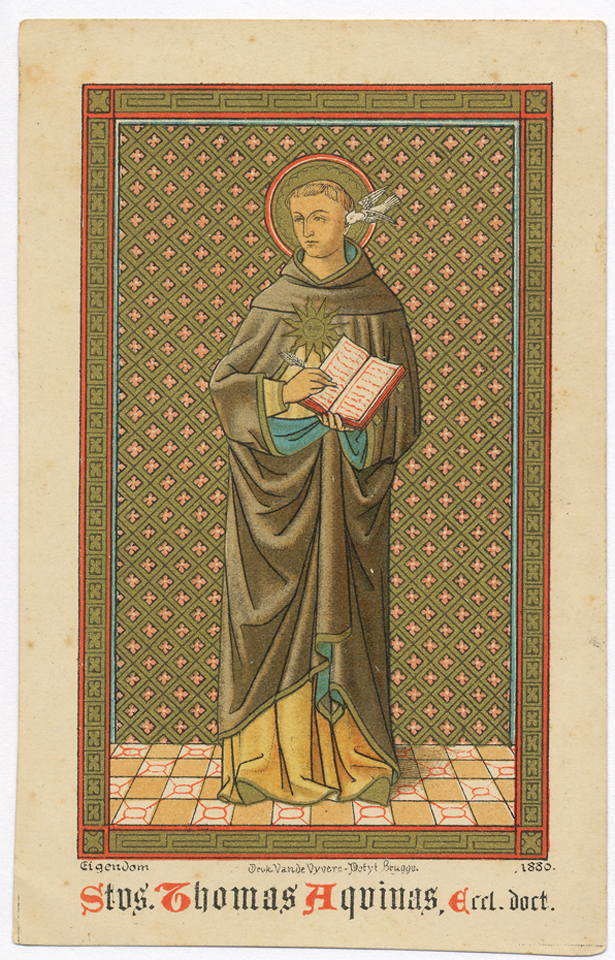
As one of the greatest philosophers of the Middle Ages. Yet on his deathbed, this intensely popular teacher and lecturer, who had lived in the cosmopolitan environments of Paris, Cologne and Naples, was said to give the innocent final confession of a child. Known in his lifetime as “The Angelic Doctor”, Thomas lived through his higher mind, taking intense pleasure in intellectual pursuits. Because he was an excellent teacher, able to clarify the most complicated points of learning, Thomas Aquinas is invoked by students whenever they are presented with a challenging test, a demanding course of studies or difficulty in passing an entrance exam.

Thomas was born in his noble family’s castle just outside of Naples, the youngest of four brothers and two sisters. As a child, one of his sisters was killed by lightning while sleeping in the same room as Thomas. He was forever fearful of thunderstorms, he is invoked by those with the same fears for protection against lightning strikes and sudden death. At the age of five Thomas was sent to study to the legendary Monastery of Monte Cassino. Considered the seat of Western Civilization through the dark ages, all manners of the arts and sciences were taught there. By the time Thomas left at the age of thirteen to attend the University of Naples, he was already tutoring his elders in their studies. While a student in Naples he horrified his noble family by joining the new order of mendicant Friars known as the Dominicans. Instead of begging in the streets with the Dominicans, his parents wanted to see Thomas using his great intellectual gifts to earn a higher ecclesiastical office. His brothers kidnapped him and locked him up in another family home, tempting him with every worldly thing they could think of. When they presented him with a prostitute, Thomas chased her out with a burning brand from the fireplace. After two years of confinement, his family relented and freed him The Dominicans sent Thomas to Cologne, Germany to study with Albert the Great, the most famous teacher of his times. Because of his quiet, kindly manner and his large size, his fellow students labeled him “the dumb ox”. Thomas quietly surpassed every student he ever had and Albert insisted he go to the University of Paris where he was made a teacher and received a doctor’s chair. His writings attracted both the Pope and the King of France who consulted him on matters of state. In 1272, the Dominicans sent him to Naples to run their school there. It was during the following year that experienced an ecstasy that caused him to suddenly stopped writing his greatest work , Summa Theologica, a tome that consisted of over two million words and he had spent the last seven years on. Compared to his vision, he declared, “all that I have written seems like so much straw.”

Novena:

Saint Thomas Aquinas, patron of students and schools, I thank God for the gifts of light and knowledge God bestowed on you, which you used to build up the church in love. I thank God, too, for the wealth and richness of theological teaching you left in your writings. Not only were you a great teacher, you lived a life of virtue and you made holiness the desire of your heart. If I cannot imitate you in the brilliance of your academic pursuits, I can follow you in the humility and charity that marked your life. As Saint Paul said, charity is the greatest gift, and is open to all. Pray for me that I may grow in holiness hand charity. Pray also for Catholic schools and for all students. In particular, please obtain the favor I ask during this novena.

(Mention your request).

Amen.

Feast of St. Theresa of Lisieux

STTHofLSaint Therese of Lisieux, 1873-1897
Patron of: France, Russia, Vietnam, AIDS patients, Children, Florists, Foreign Missions, Love, Pilots, Tuberculosis Patients

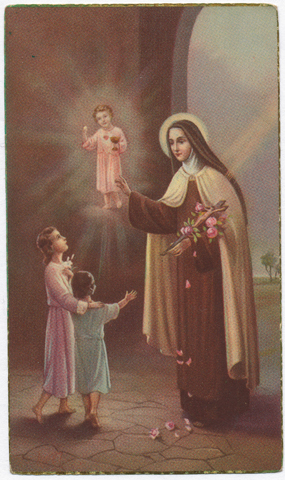
Love, roses and children are keywords for Saint Therese of Lisieux. A young Carmelite novice, Therese lived a cloistered existence in a convent only miles away from where she was raised. She died in obscurity at the age of 24, never realizing her dream of working in the foreign missions, yet she is considered to be one of the greatest saints of modern times and a Doctor of the Church.

Therese Martin was the youngest of five daughters born to a very religious couple. At the age of four she lost her mother to breast cancer and the family moved from Normandy, France to the city of Lisieux to be among other relatives. Therese was spoiled by her older sisters and when the eldest joined the convent, she vowed to not only follow her, but to become a saint. She was admitted to the Carmelite cloister at the unusually young age of fifteen. Her sentimental fantasy of convent life was replaced by the reality of menial chores and constant prayer. She came face-to-face with her own doubts and weaknesses when she became ill with tuberculosis and her dream of doing missionary work in Hanoi was shattered Along with her diminished health, Therese had to accept the fact that she would never have the opportunity to travel the world and do great things. Feeling small and ineffectual, Therese went through a period of spiritual dryness where she doubted that her prayers were even heard.

By embracing her powerlessness, she was able to transform her life and develop her “Little Way”. A personal philosophy devoted to performing small, loving acts scattered throughout her day like so many flowers. Gradually, Therese realized that there were no actions that could be considered insignificant, no matter how small. If they were performed with love, they would have great force.

In 1896, while she was bedridden, Therese was ordered to write her autobiography. This self examination is part of the Carmelite spiritual regime. After her death, the book called “The Story of A Soul” was published in a small printing. It soon became spectacularly successful, as ordinary men and women were able to easily identify with its author’s struggle to accept living a hidden, mundane life. It has been translated in at least 50 languages and Saint Therese has a very active and enthusiastic following all over the world.

The international influence of her book realized Therese’s dream to be a foreign missionary. Her Little Way is greatly influenced by the simplicity of children, so the concerns of children are one of her patronages. On her deathbed she vowed that “I will spend my heaven doing good on earth. After my death I will let fall a shower of roses.”

A sign that your novena to Saint Therese is being answered is the sight and smell of roses.

Novena to Saint Therese of the Child Jesus

O little Therese of the Child Jesus, Please pick for me a rose from the heavenly gardens and send it to me as a message of love. O little flower of Jesus, ask God today to grant favors I now place with confidence in your hands.

(Mention your request here).

Saint Therese, help me to always believe as you did, in God’s great love for me, So that I might imitate your “Little Way” each day.

Amen.

Feast of Padre Pio, September 23

PadrePio

Padre Pio 1887-1968
Patron of: Forgiveness, Healing, Miracles, Reconciliation.
Denounced by Vatican officials as a fraud, and his mystical gifts frequently viewed with suspicion by his immediate superiors, Pio of Pietracelina was sequestered away in the remote monastery of San Giovanni Rotondo where it was expected that he would labor as a monk in obscurity. His adeptness in both physical and spiritual healing and his ability to read hearts and minds while in confession made him wildly popular among the common people of that impoverished region of Italy. Today, the town of San Giovanni Rotondo is the second most visited place by religious pilgrims who venture there to pay homage to one of the most popular saints of the twentieth century, Padre Pio. Made a saint in 2002, Padre Pio has no official patronage. Because of his devotion to the powers of the Sacred Heart of Jesus and his own suffering due to the mistrust of his superiors, he is frequently invoked to bring the grace of forgiveness to a situation.

Born Francesco Forlione in Pietracelina, a town north of Naples, he was named for his patron saint, Francis of Assisi. Coming from a religious family, he said he had spiritual visions of Christ and the Virgin Mary from a very young age. He never mentioned them to anyone as he assumed all people had such gifts. He was ordained as a Capuchin friar in 1910 taking the name Pio (meaning “Pious”) but was sent home due to a diagnosis of tuberculosis. While convalescing he offered himself as a conduit of suffering in exchange for the salvation of others. Eventually, in 1916 he was conscripted into the army where he contracted such a high fever that he was sent home to die. Upon his miraculous recovery from this illness, the Capuchin order sent him to the very remote monastery of Our Lady of Grace in San Giovanni Rotondo in Puglia, a province of Southern Italy. On September 20, 1918, while praying in the stillness of the church, Pio went into a trancelike state where he saw Christ standing before him bleeding from the wounds of the crucifixion. Pio’s heart almost burst in sympathy before coming out of the state in intense pain. Upon regaining consciousness he found himself to be afflicted with the same wounds of the crucifixion. It was this condition which only ended at his death in 1968, which would bring him under intense scrutiny by church officials for the rest of his life.

Pio’s talents for deciphering what people meant to tell him during confession but were too embarrassed or ashamed to bring up, became immediate apparent to the local townspeople and he developed a great following among them. They credited him with an incredible capacity of healing, mending physical ills, familial squabbles, and curing spiritual desolation. When Vatican Officials severely limited his official duties, the one mass he was allowed to say at 5 AM, had thousands lining up the night before so that they may be with him. Without ever leaving the monastery, he was known as “the living saint” as he sighted in hospitals and at sickbeds hundreds of miles away. The onset of World War Two spread his cult on an international level as soldiers from Australia, other parts of Europe, and the United States witnessed his miraculous abilities. By the late 1940’s he was receiving hundreds of international prayer requests per day. He eventually founded a hospital for the hopelessly ill, the internationally acclaimed House for the Relief of Suffering, which treats tens of thousands of people each year and survives solely on charitable donations.

The animosity that many Vatican officials had against Padre Pio was dissolved in 2002 when Pope John Paul II declared him a saint. This pope knew Pio’s powers firsthand as he had visited him fifty years before as a young seminarian in the hopes of obtaining a cure for a friend. Not only did his friend’s cancer go into remission, but Pio’s strange prediction of this obscure Polish priest’s rise to pope also came true.

Novena

(It is important to note that Padre Pio himself recited the Novena to the Sacred Heart of Jesus for the intentions of those who requested his prayers every day.)

Dear God, Thou hast generously blessed Thy servant, St. Pio of Pietrelcina, with the gifts of the Spirit. Thou hast marked his body with the five wounds of Christ Crucified, as a powerful witness to the saving Passion and Death of Thy Son. Endowed with the gift of discernment, St. Pio labored endlessly in the confessional for the salvation of souls. With reverence and intense devotion in the celebration of Mass, he invited countless men and women to a greater union with Jesus Christ in the Sacrament of the Holy Eucharist.
Through the intercession of St. Pio of Pietrelcina, I confidently beseech Thee to grant me the grace of (mention your intentions here). Amen.

Recite three Glorias.

(Excerpted from the App: “Novena: Praying with the Saints” by Barbara Calamari and Sandra DiPasqua).

St. Michael the Archangel, Feast date September 29

St.Michael
St. Michael the Archangel
Patron of: Policemen, Firemen, Grocers, Health, Knights, Mariners, Soldiers, Health, Holy Death, Physical Protection, Court Cases, Justice, Defense, Strength, Lawsuits.
Ever vigilant against evil, Michael the Archangel is most invoked for protection and justice. His novena is said by those in need of protection as well as those who are in need of justice.

According to the Book of Revelations, Michael was the angel who rose to God’s defense when Lucifer, God’s favorite and most beautiful angel decided that he was God’s equal. Leading a band of renegade angels he made an attempt to take over the throne of heaven. One outraged angel shouted, “Who is like God?” (mi-cha-el) and struck down Lucifer and his group, casting them into hell for their vanity. This angel took the name Michael as a reminder of his loyalty. A popular figure to the ancient Jews, early, Christians and Muslims, he is closely tied to the history of mankind and serves as its guardian.

Michael’s role in the world is firmly mandated: 1) He is to fight against Lucifer, no matter where he might be. 2) He is to rescue the souls of the faithful from the power of evil, especially at the time of death. 3) He is the champion of God and the protector of the Church. 4) He brings souls to justice, weighing the souls of the dead and deciding on who gets into heaven and who gets into hell.

Since Michael was the one who threw Lucifer into hell, Lucifer and the denizens of hell have no power over him. Catholics believe that Michael and the Virgin Mary are the only beings besides Jesus who can go into hell and release souls who are suffering there. Because of their actions in the great battle of heaven, it is Lucifer’s fate to reside in the lowest netherworld and it is Michael’s to dwell nearest to heaven. His shrines are the most ancient and natural in Christendom and tend to be on high, inaccessible cliffs that only a celestial being could reach. The Gargano caves in Apulia, Italy are said to be the first earthly dwelling place for the archangel. They have been an immensely popular pilgrimage site since the year 490 AD.

Saint Michael the Archangel is considered the most powerful of all angels. Christians in the East see him as a great healer, crediting him with the creation of many healing springs. In the sixth century, as Rome was being devastated by a plague, Pope Gregory I saw the archangel hovering over the tomb of the Emperor Hadrian, brandishing his sword. He interpreted this to mean that Rome was under the archangel’s protection and the plague would soon cease. A church was built over the tomb still bearing the title Castel San Angelo in honor of Michael.

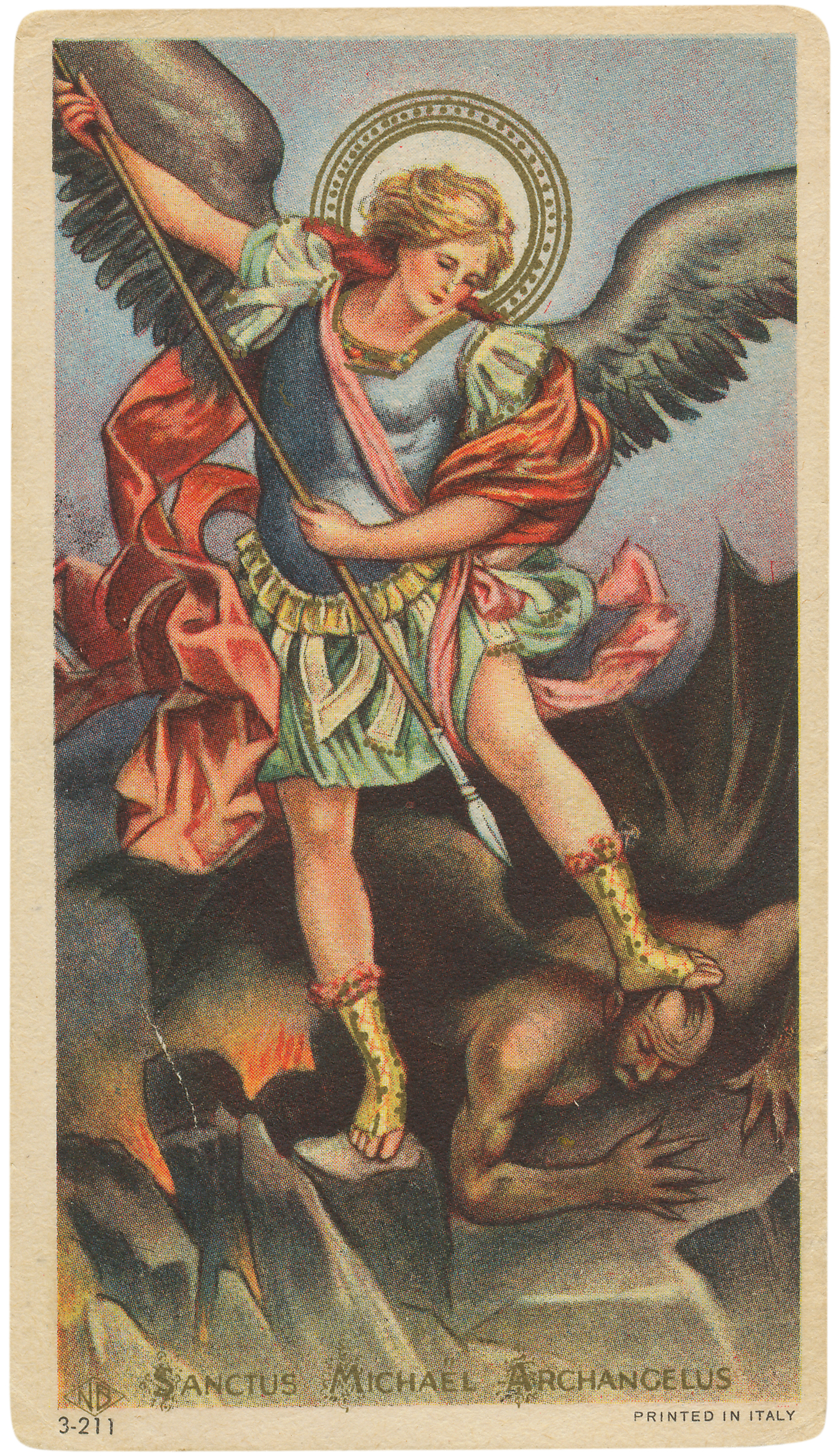
Immensely popular throughout the world, Michael is always shown brandishing a sword while standing on the neck of the devil (sometimes interpreted as a giant serpent). In many images he holds the scales that will weigh the souls of the dead, because of this he is the patron saint of greengrocers who use these scales.

Prayer:

Saint Michael the Archangel, loyal champion of God and his people, I turn to you with confidence and seek your powerful intercession. For the love of God, who made you so glorious in grace and power, and for the love of the Mother of Jesus, the Queen of the Angels, be pleased to hear my prayer. You know the value of my soul in the eyes of God. May no stain of evil ever disfigure its beauty. Help me to conquer the evil spirit who tempts me. I desire to imitate your loyalty to God and Holy Mother Church and your great love for God and men. And since you are God’s messenger for the care of his people, I entrust to you this special request (your request here).

Saint Michael, since you are, by the will of the Creator, the powerful intercessor of Christians, I have great confidence in your prayers. I earnestly trust that if it is God’s holy will, my petition will be granted.

Pray for me, Saint Michael, and also for those I love. Protect us in all dangers of body and soul. Help us in our daily needs. Through your powerful intercession, may we live a holy life, die a happy death, and reach heaven, where we may praise and love God with you forever. Amen.

(Recite one Our Father, one Hail Mary, one Glory Be).

Feast of St. Monica, August 28

St.Monica copy
St. Monica 331-387
Patron of: Wayward Children, Abuse Victims, Adultery Victims, Alcoholics, Housewives, Married Women, Mothers, Patience.

Though she was greatly hurt and disappointed by her firstborn son, St. Monica never gave up the idea that he would change his way of living. After 17 years of what seemed like fruitless prayers, her son turned his life around, converted to her faith and became one of the world’s greatest philosophers and Catholic saints, St. Augustine of Hippo. We invoke St. Monica to help us when our own children disappoint us. She serves as a reminder that there are no lost causes in this world and that absolutely anyone can reform and change their life.

Born into a Berber tribe in North Africa, Monica was brought up a Christian. Her parents arranged her in marriage with a prominent pagan Roman citizen of Carthage by the name of Patricius. Monica had a hard time in her early married years as she had to put up with a cantankerous mother-in-law as well as a dissolute husband. There are some accounts which say that she turned to alcohol and was herself an alcoholic who recovered her sobriety through faith and prayer. She had three children who she raised as Christians. The eldest, Augustine, was the most brilliant and his parents had high hopes for his career. Both Patricius and Monica worked hard to get the best education for their son and it was the greatest sorrow of Monica’s life when Augustine turned out to live a lazy, pleasure-filled life. It hurt her even more when he threw out his Christian beliefs to embrace the Manichean heresy – a popular cult believing in the natural good and evil of every soul. In order to keep his blasphemous beliefs from misleading her younger children, Monica forbade Augustine to come back to their home. Inconsolable in her grief, Monica had a vision of a radiant being pointing to Augustine in a beam of light next to her, saying, “Your son is with you.” When she related this vision to Augustine he laughingly said it would all be true if she would only give up her religious piety. “He did not say that I was with you,” she answered him. “He said you were with me.”

When Augustine openly took a mistress and further humiliated his mother by having an illegitimate son, Monica turned to her Bishop for help. He advised her to pray and be patient saying, “It is not possible that the son of so many tears should perish.” After the death of his father, Augustine decided to move to Rome to increase his worldly success, Monica vowed to follow him. In his own great treatise “Confessions”, Augustine relates how as his mother spent the night in prayer before their voyage, he tricked her and slipped away on an earlier ship. Devastated, she traveled to Rome anyway. By the time she arrived Augustine, had already left that city for Milan. By the time Monica tracked him down, she was overjoyed to find that Augustine was no longer a Manichean. He had met Ambrose, the bishop of Milan and was studying with him. Eventually, after several more years, Monica lived to see Augustine baptized a Christian. While waiting for a ship at Ostia to take mother and son back to Africa, Monica told her son that she had accomplished everything that she had set out to do in this life and did not need to live any longer. She died in Ostia, never returning to her native land. It is interesting to note that there are many great saints from Africa, especially the earliest ones and they are rarely depicted as anything but European in visage.

Novena

Dear Saint Monica, once the sorrowing mother of a wayward son, be pleased to present our petition to the Lord God of heaven and earth. (Your intention here.) Look down upon our anxieties and needs, and intercede for us, as you did so fervently for Augustine, your firstborn.

We have full confidence that your prayers will gain favorable hearing in heaven. Mother of a sinner-turned saint; obtain for us patience, perseverance, and total trust in God’s perfect timing. In His appointed hour, in His merciful way, may He respond to your prayer and ours, which we offer through you.

Amen

Everyday Miracles

CALL_FOR_EVERYDAY_M

← Back

Thank you for your response. ✨

Novena’s for The Month of May

St. Peregrine May 1 – Cancer
St. Dymphna May 15 – Mental Illness, Incest, Runaways
St. Rita of Cascia May 22 – Impossible Causes, Bad marriages, Spousal abuse


St.Rita

St. Rita of Cascia 1386-1457

Patron of: Impossible Causes

An abused wife, a mother who’s children died, a widow of a murdered husband, and finally, a nun, Saint Rita experienced many lives in her time on earth. Knowing the powerlessness and despair of those in bad marriages she is invoked for help in desperate times. In her own lifetime she was famous for the power of her prayers to change any situation and it was said that she could accomplish the impossible. Canonized almost 500 years after her birth, she is the first declared female saint of the 20th Century. Margarita Lotti was born to an older farming couple in Roccaporena, Italy. She was called Rita because of a vision of an angel her mother had who named the baby while declaring, “You will give birth to a daughter marked with the seal of sanctity, gifted with every virtue, a helper to the helpless and an advocate of the afflicted.” As proof of this prophecy, bees, a sign of divine presence, always hovered over her crib as she slept, never harming or waking her. Though she had always wanted to be a nun, Rita’s parents feared for her future security as there was a schism in the church and many religious orders were closing their doors. Instead, she had to accept a marriage they contracted for her with a man named Paolo Mancini. Though he was a good provider, he soon proved to be an abusive, promiscuous husband. Settling his personal disputes with violence, Mancini created a tense family environment for Rita and the two sons she had with him. Never wavering in her devotion to God, Rita prayed that her husband would change his ways. After 18 years of marriage, Paolo had a vision of himself as others saw him and begged for his wife’s forgiveness. A lifetime of enemies caught up with Paolo and he was murdered, his mutilated body dumped on his family’s doorstep. Rita begged her two teenaged sons not to pursue a vendetta against his killers, but they refused. She prayed to God to prevent her sons from murdering anyone. Both of them came down with serious illnesses and died before they could act on their vendetta. Alone in the world, Rita petitioned to join the Augustinian convent. Because several of the nuns there had family members who were involved in Paolo’s murder, the convent refused her, not wanting tensions to carry over from the outside world. Rita prayed and entreated Paolo’s family to forgive his killers. Much to everyone’s surprise, they acquiesced and Rita was admitted to the convent on her third try. While there she spent her days nursing the older nuns and concentrating on Christ’s suffering. When she begged to feel what Christ felt on the cross, a thorn from the crown of thorns on a crucifix struck her on the head and became embedded there. It left a deep wound that never healed. Because this wound became infected and foul smelling Rita was shunned by the other nuns and remained in her cell praying and meditating. The January before she died, a cousin asked her if there was anything she needed and she asked for a rose from her childhood garden. The cousin was shocked to see that there was indeed two roses growing in that garden in the middle of January. Upon her death, her cell was filled with the smell of roses. Rita is always depicted with the thorn in her head, in her Augustinian habit, meditating on the crucified Christ. Thorns: she took on the suffering of Christ Wound in the head: Divine light, grace and spiritual power. Roses: love. Also proof of Rita’s miraculous powers as her roses grew in the winter.

Novena to Saint Rita

O holy protectress of those who art in greatest need, O you who shine as a star of hope in the midst of darkness, blessed Saint Rita, bright mirror of God’s grace, in patience and fortitude you are a model of all states in life. I unite my will with the will of God through the merits of my Savior, Jesus Christ, and in particular through his patient wearing of the crown of thorns, which with tender devotion you daily contemplated. Through the merits of the holy Virgin Mary and your own graces and virtues, I ask you to obtain my earnest petition, provided it be for the greater glory of God and my own sanctification. Guide and purify my intention, O holy protectress and advocate, so that I may obtain the pardon of all my sins and the grace to persevere daily, as you did in walking with courage, generosity, and fidelity down the path of life.

(Mention your request).

Saint Rita, advocate for the impossible, pray for us. Saint Rita, advocate of the helpless, pray for us.

(Recite Our Father, Hail Mary and the Glory Be three times each).

Amen.

Novena’s for The Month of May

St. Peregrine May 1 – Cancer
St. Dymphna May 15 – Mental Illness, Incest, Runaways
St. Rita of Cascia May 22 – Impossible Causes, Bad marriages, Spousal abuse

St. Dymphna

Saint Dymphna 605-620

Feast Day: May 15

Patron of: Mental Illness

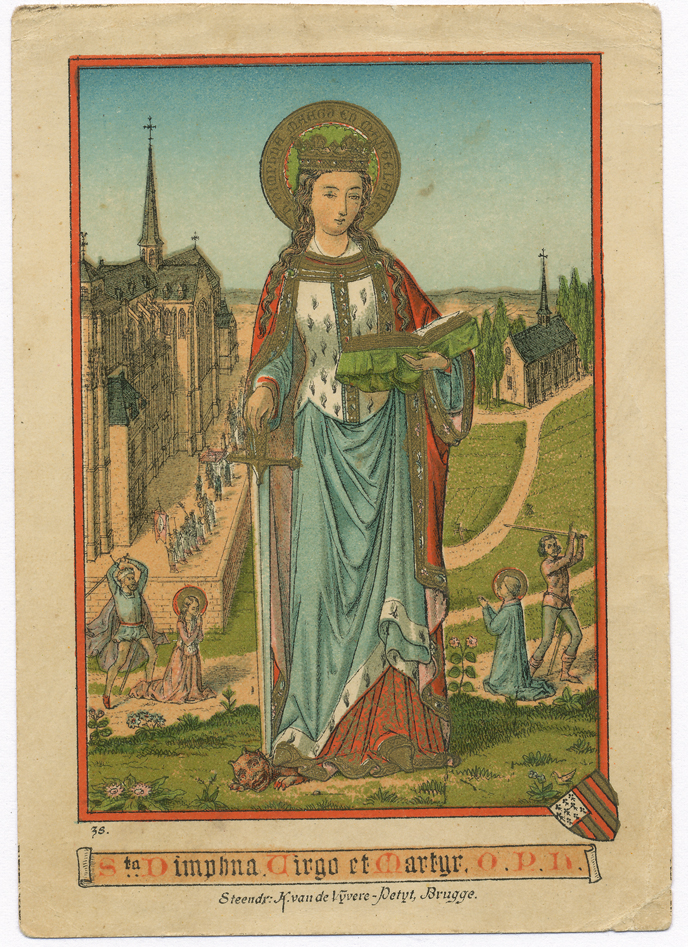
As a victim of a mentally ill father, Saint Dymphna offers much solace to those suffering from psychological problems as well as their families. She is invoked to bring peace to the unbalanced as well as create an aura of calm and consolation for those who live in the midst of instability. Having lived such a short life so long ago, there is very little factual information available about Saint Dymphna. According to a written report commissioned by the Bishop of Cambrai seven hundred years after her death, Dymphna was born an Irish princess. Her mother was a devout Christian married to Damon, a pagan king. Dymphna’s mother made sure her daughter was brought up as a Christian, having installed her own confessor, Gerebran into her household. At the age of fourteen Dymphna lost her mother and her father went mad with grief. After a period of mourning, he searched all of Ireland for a new companion but could not find a woman who even remotely resembled his first wife. Because Dymphna was almost the exact image of her mother, Damon decided to marry her and make her his queen, disregarding the fact that she was his own daughter. In order to thwart this plan, Gerebran and Dymphna escaped the castle and went abroad to Antwerp. Eventually settling in Gheel in Belgium, they lived as religious hermits. Dymphna studied to be an anchoress which was a woman who lived in a room connected to a church with a window open to the street. Towns in the middle ages usually supported these people who offered their knowledge to those in need of advice. It took Damon and his men a year to find Dymphna and Gerebran. The priest was executed immediately and Dymphna was offered her father’s kingdom in exchange for returning home with him. When she refused, he decapitated her in a rage. Both bodies were immediately buried. Since epilepsy and mental illness were all thought to be caused by demonic possession, those suffering from mental afflictions were never welcomed to live in one place and were doomed to wander from town to town. Soon after Dymphna’s death, a group of five of these social pariahs slept at the site of her murder and were instantly healed by the blood in the earth. In the 13th century, the remains of an unknown man and woman were accidentally disinterred at Gheel. The name DYMPNA was written on a brick over the woman’s remains. As the remains were reinterred in a tomb, miraculous healings of the mentally ill and epileptics in the region were recorded. Gheel became a pilgrimage site for anyone suffering from any form of mental illness. By the end of the thirteenth century a major hospital and treatment center was built there for those suffering from nervous disorders. To this day, Gheel offers the most advanced and humane treatment for the mentally ill in the world. Saint Dymphna’s remains, in the church named for her there continues to be a place of pilgrimage.

Novena to Saint Dymphna

O God, we humbly beseech you through your servant Saint Dymphna, who sealed with her blood the love she bore you, to grant relief to those who suffer from mental afflictions and nervous disorders, especially (mention the afflicted person). Saint Dymphna, helper of the mentally afflicted, pray for us. Saint Dymphna, comforter of the despondent, pray for us. Saint Dymphna, renowned for many miracles, please hear my plea. Amen. (Recite one Glory Be).