Day 1: 14 Days of Meditation On The Stations Of The Cross

christ-carrying-the-cross.jpg!Blog

Station 1

V. We adore Thee, O Christ, and praise Thee:
R. Because by Thy holy Cross Thou hast redeemed the world!
O INNOCENT Jesus! Having sinned, I am guilty of eternal death, Thou willingly dost accept the unjust sentence of death, that I might live. For whom, then, shall I henceforth live, if not for Thee, my Lord? Should I desire to please men, I could not be Thy servant. Let me, therefore, rather displease men and all the world than not please Thee, O Jesus.

Our Father, etc.; Hail Mary, etc.
V. Lord Jesus, crucified:
R. Have mercy on us!

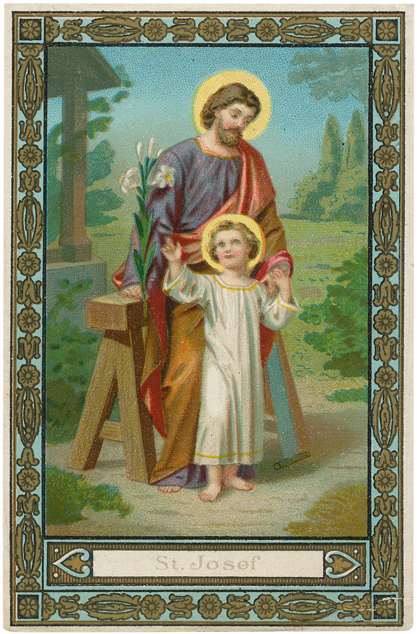
Feast of St. Joseph


Image

Feast Day: March 19

Patron of: Fathers

Quote: “I know by experience that the glorious Saint Joseph assists us generally in all necessities. I never asked him for anything which he did not obtain for me.” Saint Teresa of Avila

Symbols: flowering staff, carpenter tools, the child Jesus, lily 

A righteous man who never shirked his responsibilities as protector of his family, Saint Joseph offers a perfect example for fathers everywhere. He is invoked by families for all matters of support needed to sustain a household, both material and spiritual. 

A descendant of the House of David, there is very little written about Joseph in the gospels. He was said to be betrothed to Mary when she became pregnant with Jesus. Instead of leaving her in scandal, he accepted the word of the angel Gabriel who told him that the child was divinely given and Joseph and Mary were chosen by God to be his earthly parents. It was Joseph who protected Mary on the journey to Bethlehem when Jesus was born. He also suffered the frustrations of a man who could not find proper shelter for his family as his wife was about to give birth. Upon returning to their native city of Nazareth, Joseph was once again visited by an angel warning him of the impending slaughter of the innocents. On faith alone, he dispensed with his business and personal effects, taking Jesus and Mary to Egypt where they stayed for seven years until Herod’s death. It fell upon Saint Joseph to support his young family in this foreign country.

The last mention of Joseph comes when Jesus is twelve years old and strayed from his family while on a pilgrimage to Jerusalem.  It is thought that he died well before Jesus began his mission with Jesus and Mary at his deathbed. For this reason, more than any other saint, he is invoked for a happy death, one where a person is older and has their family at their side.  

Though of noble lineage, Joseph was a carpenter and it was from him whom Jesus learned his trade. Because he worked with his hands and frequently put his family ahead of any personal ambitions, workers everywhere who live similar lives call on him as a patron. It is no mystery that the cult of Saint Joseph became more popular in modern times with the advent of the Industrial Revolution. Many saints throughout the ages have declared him to be a powerful advocate as well, since it is thought that  Jesus obeyed him in his earthly life, he is inclined to listen to Joseph in his heavenly life. Teresa of Avila always buried medals with his image when she needed land for a new convent. This tradition has extended itself to realtors of all faiths who bury statues of Saint Joseph on properties they wish to sell.

 It is assumed that since Joseph respected his wife’s virginity that he was an older man when he married. He is depicted in art with a staff, which he led his family ( precursor to the bishop’s staff) a lily for purity, and with carpenter tools or holding the baby Jesus.

Explanation of symbols:

Child Jesus: Jesus learned carpentry from his earthly father, Joseph

Carpenter’s bench: Joseph was a carpenter

Lily: Joseph respected the purity of Mary

Novena to Saint Joseph

O glorious Saint Joseph, faithful follower of Jesus Christ, to you we raise our hearts and hands to ask your powerful intercession in obtaining from the compassionate heart of Jesus all the helps and graces necessary for our spiritual and temporal welfare, particularly the grace of a happy death, and the spiritual grace for which we now ask.

 (Mention your request.)

 O guardian of the Word Incarnate, we feel animated with confidence that your prayers for us will be graciously heard at the throne of God.

 (The following is to be said seven times in honor of the seven joys and seven sorrows of Saint Joseph.)

 O glorious Saint Joseph, through the love you bear for Jesus Christ, and for the glowy of his name, hear our prayers and grant our petitions.

A Gift for Lent

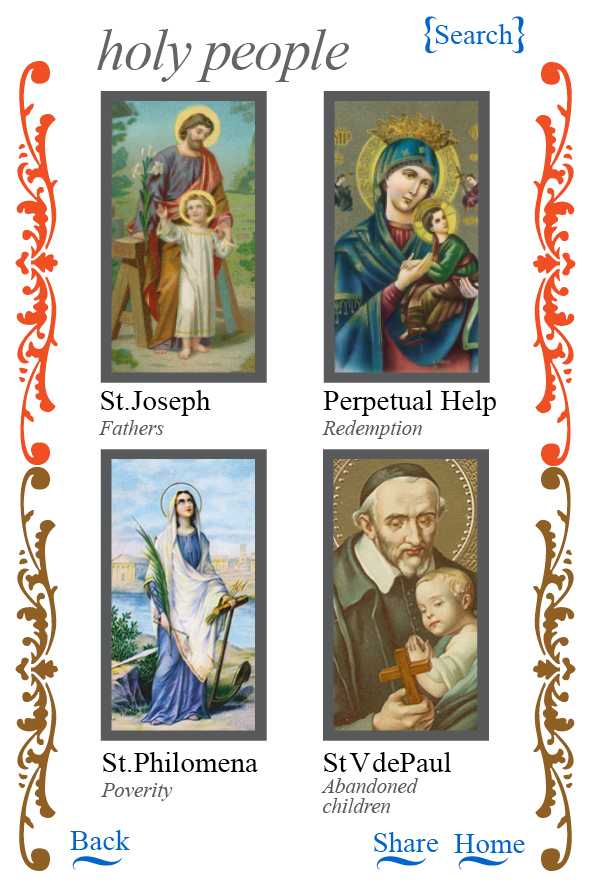
Novena_SPLASH SCREENHoly_PeopleTurn your cell phone into a prayer book for Lent! Starting today, and for all the 40 days of Lent, our beautiful App: “Novena: Praying With the Saints” will be reduced in price to 99 cents. 

Offering a modern take on the ancient Catholic tradition of using novena prayers to call on saints to help in earthly struggles, the app features visually striking vintage holy cards, prayers and histories for 36 of the most popular saints from all over the world:

Saint Agatha: Breast cancer
Saint Aloysius Gonzaga: AIDS sufferers
Saint Alphonse Liguoris: Arthritis sufferers
Saint Anthony of Padua: Lost Objects 
Saint Blaise: Throat ailments
Saint Catherine of Alexandria: Philosophers
Saint Claire of Assisi: Television workers
Saint Dymphna: Mental illness
Mother Cabrini: Immigrants
Saint Francis of Assisi: Ecologists
Saint Gabriel, Archangel: Teachers
Saint Gerard Majella: Infertility
Infant of Prague: Desperation
Saints Joachim and Ann: Grandparents
Saint John of God: Heart ailments
Saint Joseph: Fathers
Saint Jude: Impossible causes
Saint Lucy: Blindness
Saint Martin de Porres: Racial harmony
Saint Michael, Archangel: Policemen
Mother of Sorrows: Grief
Saint Monica: Wayward children
Our Lady of Guadalupe: Motherly comfort
Our Lady of Perpetual Help: All causes
Saint Philomena: The poor
Padre Pio: Forgiveness
Saint Peregrine: Cancer
Saint Raphael, Archangel: Travelers
Saint Raymond Nonnatus: Newborns
Saint Rita of Cascia: Impossible causes
Sacred Heart of Jesus: Family peace
Saint Therese of Lisieux: To create a loving atmosphere
Saint Thomas Aquinas: Students
Saint Vincent de Paul: Abandoned children
Saint Vincent Ferrer: Builders

https://itunes.apple.com/us/app/novena/id631346670?mt=8

February Saint of Health: Breast Cancer

St.Agatha

Saint Agatha 

D. 251

Feast Day: February 5

Patron of: Breast Cancer

Quote: “Do not offend Agatha’s nation, because she will avenge all insults”. – Inscription on the façade of the Cathedral of St. Agatha in Catania, Sicily

Keywords; breast cancer, burns, pulmonary diseases, bell ringers, bell makers, brass workers, cloth makers, glass workers, wet nurses, nursing mothers, nurses, fires, volcanic eruptions

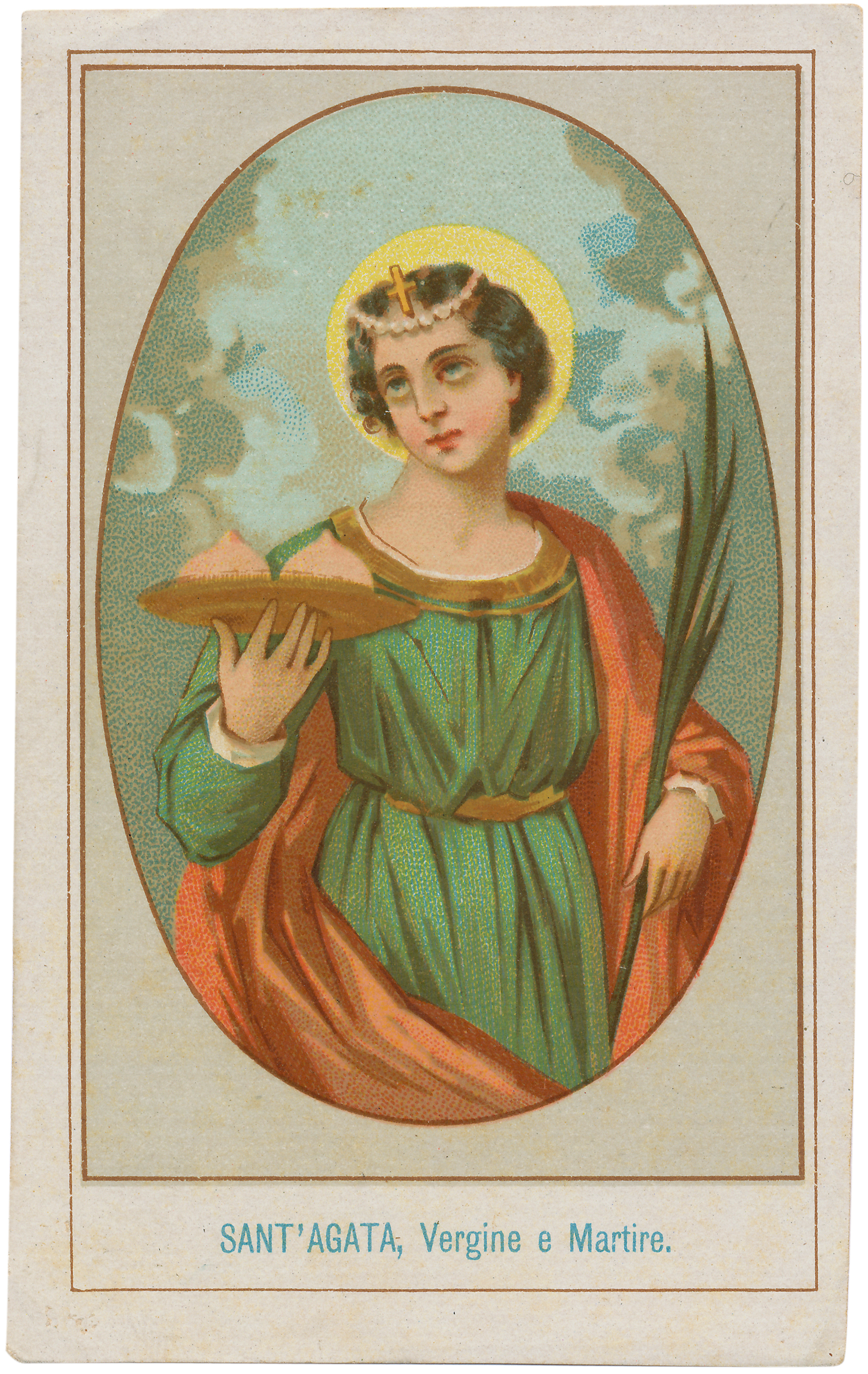
Symbols: breasts on a dish, palms

A national heroine to Sicilians, a great figure in art and one of the few saints mentioned in the Catholic mass, St. Agatha is a fierce and fearless role model for anyone who lives in modern times. A martyr, she is most often invoked by those suffering from diseases of the breast. Her tomb has been a place of miraculous healing since her death. Because of her courage in standing up to the Roman authorities, anyone persecuted by them, Pagans, Jews and Christians all made pilgrimages in her honor. In modern times, her feast day is an important holiday, attracting hundreds of thousands of devotees who process through the streets of Catania.

An orphaned daughter of wealthy Christians, Agatha was considered an attractive marriage prospect by  Quintianus, the ruling Roman consul of Sicily. Taking advantage of  the recent Roman decree outlawing Christianity, Quintianus assumed Agatha would renounce her religion and acquiesce to his proposal of marriage. She refused him on both counts, telling him that she had dedicated her virginity to Jesus Christ. Refusing to marry and bear children was considered an act of political defiance in those times. Agatha’s rejection of him so enraged Quintianus that he had Agatha taken to a brothel and forced her to live as a prostitute for thirty days. When she was brought back before him, he ordered her to sacrifice to the Roman gods. She pointed out that no Roman wife would dare live like Venus and no Roman husband could legally do the things that Jupiter was known for, why would she follow such gods? Christ lived what he preached, love and forgiveness; she would follow him instead. Agatha was then tortured by having her breasts slowly rushed and cut off. Thrown back in prison and left to die, an elderly man and a young boy came into her cell. Revealing himself as St. Peter, Agatha was miraculously healed. The next day, Quintianus ordered her to be rolled in broken pottery and hot coals. As this torture was being inflicted, an earthquake leveled Catania. The citizens of that city, declaring that this was God’s vengeance for what was happening to Agatha, chased Quintianus out of town and the terrified consul drowned in the river. Agatha offered her soul up to Christ and died.

The year after her death Mount Etna erupted and a lava flow threatened Catania. Agatha’s death shroud was taken out and held aloft which immediately stopped the lava. This same shroud has been used many times over the years to protect the city. Because of her tortures Agatha is the patron of those suffering from breast disease as well as those suffering from burns. Trades that use burning coals also claim her. Bells, which are signals for fire alarms and also resemble breasts are closely identified with this saint. Saint Agatha’s bread, shaped like breasts or bells are a specialty served around the time of her feast.

Explanation of symbols:

Mt. Etna in the background: Agatha protects Sicilians against its eruptions. She is the patron and protector of Sicily.

Offering breasts on a dish: Agatha suffered the gruesome torture of having her breasts cut off. Because of her faith, she easily endured this torture and offered it up to God.

Palms: a sign of martyrdom. Christ was showered in palms the Sunday before he was executed.

Novena to Saint Agatha

O Saint Agatha, who withstood the unwelcome advances from unwanted suitors, and suffered pain and torture for your devotion to our Lord, we celebrate your faith, dignity, and martyrdom.

Protect us against rape and other violations, guard us against breast cancer and other afflictions of women, and inspire us to overcome adversity.

O Saint Agatha, virgin and martyr, mercifully grant that we who venerate your sacrifice may receive your intercession.

(Mention your request).

Amen.

(Excerpted from the app: Novena:Praying With the Saints by Barbara Calamari and Sandra DiPasqua).

The Infant of Prague

Feast Day: January 14

Patron of: Financial Distress

Keywords: abundance, children, desperation, emergencies, epidemics, family life, financial distress, trust

Quote: “The more you honor me the more I shall bless you.”

Symbols: raised right hand, globe, crown

Surrendering oneself to this doll-like image of Christ as a child requires one to cast off the world of adult preoccupations to live in a state of faith and pure belief.  Honoring the Infant of Prague is a tradition that is kept in many homes throughout the world as some believe that it guarantees financial stability and abundance.  There are several novenas to the Infant of Prague, one reflecting the intensity of an emergency situation, is to be done in one day’s time, the prayer said once every hour for nine hours in a row.

Devotion to Christ as a young child dressed as a king has its roots in the Carmelite order of Spain. According to tradition, in 1555, Saint Teresa of Avila gave a statue of the Christ child, dressed in actual royal robes to a noblewoman who was marrying into an aristocratic family in Bohemia. Taking it with her to what is now the city of Prague, her daughter, the Princess Polysena inherited it.  In 1623, Princess Polysenia was widowed and chose to devote the rest of her life to charitable causes. When she saw the need that the poverty stricken Carmelite order had, she donated the statue to them, saying, “I give you my dearest possession. As long as you venerate this image, you will not lack anything.” The monks credited this image with the immediate upturn of their fortunes. When they were forced out of their monastery due to a war in 1631, they left the statue behind and the invading army threw it in a rubbish heap. Within seven years the Carmelites were back in their monastery in Prague, desperately attempting to rebuild it. One monk, Father Cyril, who had a particularly strong devotion to the Divine Infant found the little wax statue among the rubble. The only damage done to the statue was its crushed hands.

It was decided that the scarce funds the community had should go to more practical things than the repair of a statue. As the monks struggled to rebuild their former home and church, Father Cyril heard the words: “Have pity on me and I will have pity on you. Give me my hands and I shall give you peace.” After the statue was repaired, the monks again displayed it in the main church. As the city of Prague suffered an epidemic, parishioners began invoking the little statue for aid. The quick answer to their prayers brought many in the surrounding region to seek help. Gradually, the devotion spread to many other countries. Today, the church in Prague built to hold the statue, Our Lady of Victory, is a site of pilgrimage with visitors from all over the world paying their respects to the Divine Infant.

Invoked against: Financial Distress

Explanation of imagery:

Crown: Jesus is King of the World

Raised right hand: blessing

Imperial Orb: The entire world is in his hand.

Nine Day  Novena to the Infant of Prague

O Infant Jesus, I run to You, begging You through Your Holy Mother to save me in this need       (you may name it here), for I truly and firmly believe that Your Divinity can defend me.  Full of trust I hope in You to obtain Your holy grace. I love You with all my heart, I am painfully sorry for my sins  and on my knees I beg You, o Little Jesus, to free me from them. My resolution is to improve and never more to offend You. Therefore, I offer myself to You, ready to suffer everything for You and to serve You faithfully.  I will love my neighbour as myself from my heart for the love of You.  O Little Jesus, I adore You, o Mighty Child, I implore You, save me in this need (you can mention it here), that I may enjoy You eternally, with Mary and Joseph see You and with all the angels adore You.

Amen

Nine Hour Devotion to the Infant of Prague

 O Jesus, Who has said, ask and you shall receive, seek and you shall find, knock and it shall be opened to you, through the intercession of Mary, Your Most Holy Mother, I knock,I seek, I ask that my prayer be granted.

(Make your request)

O Jesus, Who has said, all that you ask of the Father in My Name, He will grant you through the intercession of Mary. Your Most Holy Mother. I humbly and urgently ask Your Father in Your Name that my prayer be granted.

(Make your request)

O Jesus, Who has said, “Heaven and earth shall pass away but My word shall not pass”,

through the intercession of Mary, Your Most Holy Mother, I feel confident that my prayer will be granted.

(Make your request)

(Excerpted from the app: “Novena: Praying with the Saints”).
Saint Jude Patron Saint of Impossible Causes

FullSizeCard_1@2x

Saint Jude Thaddeus

First Century

Patron of: Impossible Causes

Feast Day: October 28

Invoked: for help in Desperate Times

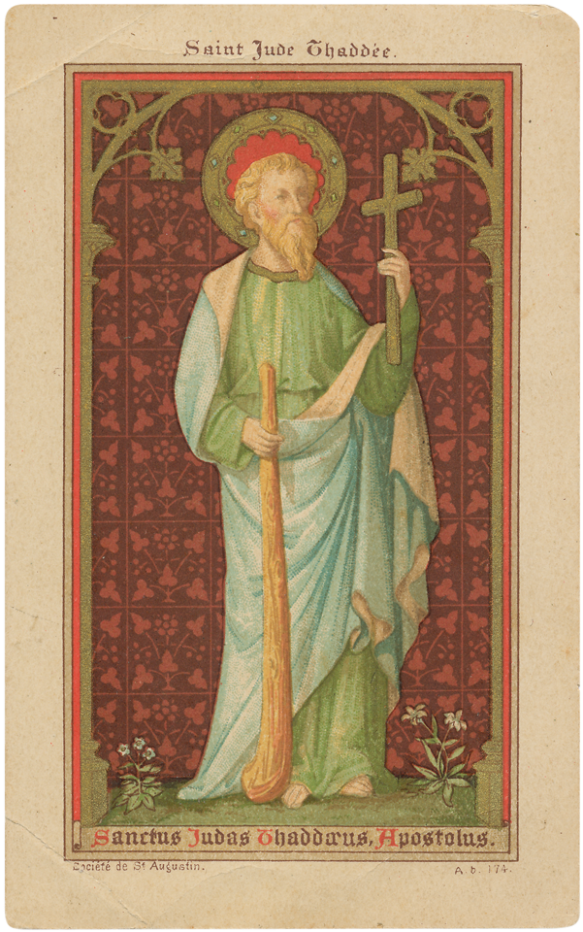
Attributes: Club, Cloth with image of Jesus, Flame over head

When all else fails, when we are in the most difficult of situations, we turn to Saint Jude, “Helper of the Helpless” and Saint of the Impossible.

One of the original 12 apostles, Jude is depicted with the flame of knowledge received from the Holy Spirit at the Pentecost burning above his head. Brother of James the Lesser and cousin of Jesus, Jude was one of Christ’s earliest followers.  He earned his title of Patron Saint of Impossible Causes because of a letter he wrote in 60AD to persecuted Christian converts in the East, exhorting them to stay strong in the face of all difficulties.

The name Jude means giver of joy and the name Thaddeus means great hearted one and  this saint was said to live up to his name, attracting immense crowds by preaching in an entertaining way, outwitting magicians and local priests.   Abgar, the King of Edessa was quite impressed with Jude and appealed to Jesus cure his leprosy. He sent an artist to draw Christ’s image. The artist was so shaken by the glow in Christ’s eyes, he could not draw. Christ wiped his face with a cloth and the image of his face was transferred to it. Jude brought the cloth back to Abgar and the king rubbed the cloth over his body, curing himself of leprosy. Many depictions and statues of Saint Jude include this cloth with Christ’s image on it. Jude was martyred along with Saint Simon in the city of Samir by being beaten with a club. This club, as well as the palms of martyrdom are also part of his iconography

The cult of Saint Jude all but died out after the Middle Ages because people confused him with Judas Iscariot, the apostle who betrayed Christ. Despite being cited as a great influence by the mystics Saint Bernard of Clairvaux and Saint Bridget of Sweden, Jude was rarely invoked by the faithful for anything. It is said that because of this, he became the saint to call on in the most impossible of situations. So anxious was he to be of help, he would turn heaven and earth to rectify a desperate situation. By the nineteenth century, it became customary to thank the saint for help with answered prayers by taking an ad in the newspaper. This helped to resurrect his popularity and these small “Thank you Saint Jude” ads can be found in many weekly and daily periodicals in present day.

Unfailing Prayer to Saint Jude

Glorious apostle, Saint Jude Thaddeus, I salute you through the Sacred Heart of Jesus. Through his heart I praise and thank God for all the graces he has bestowed upon you. I implore you, through his love, to look upon me with compassion. Do not despise my poor prayer. Do not let my trust be confounded! God has granted to you the privilege of aiding mankind in the most desperate cases. Oh, come to my aid that I may praise the mercies of God! All my life I will be your grateful client until I can thank you in heaven.

(Mention your request here).

Saint Jude, pray for us, and for all who invoke your aid.

(Excerpted from the App, “Novena: Praying With the Saints”).

Feast of St. Gerald Majella

St.GeraldSt. Gerard Majella

1726 – 1755

Feast Day: October 16

Patron of: Infertility

Keywords: expectant mothers, infertility, lay brothers, mothers, pregnancy

Quote: “Who except God can give you peace? Has the world ever been able to satisfy the heart?”

Symbols: skull, lily crucifix, psalter

A quiet and humble lay brother in the newly found Redemptorist order, St. Gerard Majella did not display his great mystical gifts until the last three years of his life. Before his early death at the age of twenty-nine, he was known as “The Wonderworker of the Eighteenth Century”, for his ability to read consciences, predict the future, be in two places at once, heal the dying and infuse his surroundings with serenity. He is most invoked by women who want to conceive a child and though there are many different novenas to him, The Prayer for Motherhood is particularly popular throughout the world.

Born in a town south of Naples to a tailor and his wife, Gerard was a sickly child, contemplative by nature. At the age of twelve, his father died, plunging his family into poverty. Gerard was apprenticed to a tailor in order to support his mother and three sisters.  He suffered brutally at the hands of this abusive man and eventually got a job as a servant for the local bishop. His hopes of entering the Capuchin order were dashed due to his poor health. Upon returning home, his devout nature and his kindness, especially to children, was noticed by St. Alphonsus Liguori, the founder of the Redemptorist order. He invited Gerard to join as a lay brother and work in the slums among the poor. It was while he was serving on this mission that Gerard faced the greatest challenge of his life. A young woman accused him of fathering her unborn child. When Gerard refused to comment on these charges or defend himself, the Redemptorists had no choice but to deprive him of the privilege of working with them. Months later when the woman admitted that she had lied, a bewildered Alphonse Liguori asked Gerard why he had remained silent. He answered that he had complete faith in God and that silence was the only answer to unjust accusations.

Raised as the only male in a household of women, St. Gerard was particularly sensitive to the problems women had in conceiving and giving birth. While visiting family friends, he dropped his handkerchief while leaving. The young woman of the family ran to give it to him and he refused to take it saying, “Keep it. One day it will be of service to you.” Though puzzled, she did as he said. Years later, while dying in childbirth she remembered his words and had the handkerchief brought to her and placed on her womb. All deadly complications stopped and she gave birth to a healthy baby. The handkerchief of St. Gerard’s was passed from mother to mother until his canonization in 1904. The remaining shred is still used to bless relics for those seeking to conceive a child or have a safe delivery.

Explanation of symbols:

Lily: purity

Skull: contemplative, the sign of one who knows that this life is temporary.

Psalter: book of devotional texts

Crucifix: devotion to Christ and willing to suffer

Novena Prayer for to St. Gerard Majella for Motherhood

O good St Gerard, powerful intercessor before God and wonder worker of our day, confidently I call upon you and seek your aid.  On Earth you always fulfilled God’s designs, help me now to do the holy will of God.  Implore the Master of Life, from whom all paternity proceeds, to render me fruitful in offspring, that I may raise up children to God in this life, and in the world to come, heirs to the Kingdom of His Glory. Amen.

Feast of St. Francis of Assisi

Saint Francis of AssisiSt. Francis of Assisi

 1182 – 1226

Feast Day: October 4

Founder of the Franciscan Order: Friars Minor, the Poor Clares, the Third Order of Saint Francis

Patron of: Ecologists

Key words: animals, ecology, grace, green technology, light, love, merchants, nature, peace, pets, tapestry workers, harmony, dying alone

Quote: “Lord make me an instrument of they peace, where there is hatred let me sow love.”

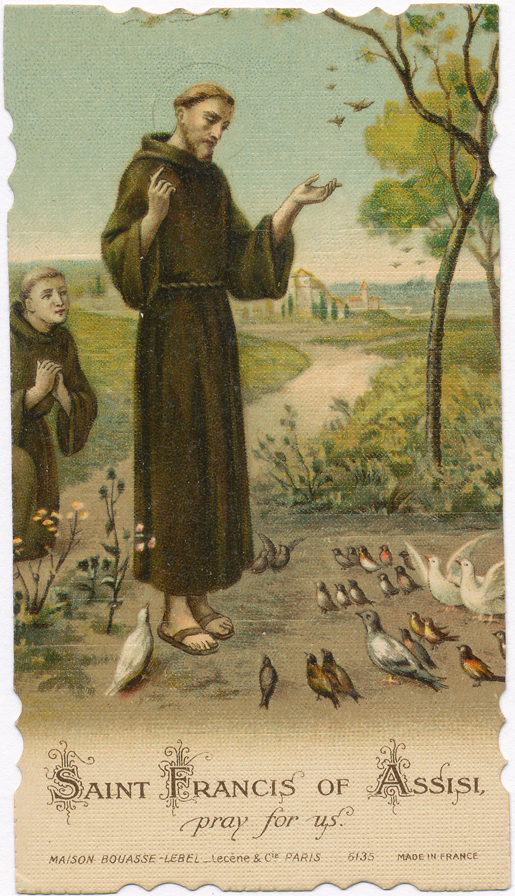
Symbols: communing with crucifix, preaching to birds, taming a wolf, receiving the stigmata

Love for God and everything in creation so consumed Saint Francis of Assisi, that he was able to commune with the natural world on a divine level. Taming wolves, quieting  flocks of  birds and infusing peace and contentment to the humanity he interacted with, we call on Francis of Assisi to bring us into the harmonious rhythms of the universe, where all of nature and mankind are at one with the divine force of creation.

An unlikely mystic, Francis was born Giovanni Bernadone in the town of Assisi. His father, a proud member of the upper classes was a wealthy cloth merchant married to a woman from Provence. Because he frequently conversed in French with his mother, Giovanni was soon known as “Francesco” or “the Frenchman” by his friends and neighbors. Confident that his son would follow in his footsteps, the elder Bernadone indulged and catered to Francesco’s every whim and the youth enjoyed a pleasure filled existence in the company of others in his social caste. On a lark he set off with friends to take part in a war with Perugia. Much to his shock, he was taken prisoner and it took his family a year to ransom him back. Upon his return, he was bedridden and seriously ill. But in recovering his health, Francesco seems to have lost his identity. He suffered a great spiritual crisis as all interest in his old life and his father’s business waned and disappeared. While wandering the countryside he stopped into the deserted church of San Damiano and  heard the crucifix say to him, “Francis, go and repair my house, which you see is falling down.” Happy to have some direction in his life, he took the request literally and began rebuilding the structure with his bare hands. Ultimately, his father disowned him and when Francis, renouncing his inheritance threw his clothing in the street, he donned the simple brown garment given him by the Bishop of Assisi.

Begging for supplies, Francis continued his work on San Damiano. Eventually he was joined by other disenchanted young men looking for a higher meaning in life. By simply following the exact tenets of Christ, this little band of friars, never owning anything, bartering labor for food and shelter began a movement of religious seekers that revolutionized the Church by the simple and loving way they spread the gospel.  Instead of writing in church Latin he used colloquial Italian and in an effort to explain the story of Christ’s birth, he created a living tableau of animals and people – the first Christmas crèche.

A great poet and mystic, Francis was the first saint to receive the stigmata while in a meditative rapture. Filled with humility and though he founded one of the world’s greatest religious orders, Francis of Assisi was never ordained a priest. Upon his death he requested to be buried in the cemetery for criminals, but the people of Assisi so loved him that they took his body and interred it under the altar of their great cathedral.

Just as popular with nonCatholics as Catholics, Francis has inspired great artists, composers and writers. Assisi, Italy remains a great pilgrimage site for those wishing to pay him tribute.

Explanation

Crucifix: Francis received messages from God when he meditated on the crucifix.

Stigmata: Francis was the first saint in history to receive the stigmata, or wounds of Christ while in meditation.

Novena to St. Francis of Assisi

O Beloved Saint Francis, gentle and poor, your obedience to God, and your simple, 
deep love for all God's creatures led you to the heights of heavenly perfection 
and turned many hearts to follow God's will. Now in our day, 
in our ministry to the many who come here searching for peace
and intercede for us we come before the Lord with our special requests...

(Mention your special intentions here.)

O Blessed Saint of God, from your throne among the hosts of heaven, 
present our petitions before our faithful Lord. May your prayers on our behalf 
be heard and may God grant us the grace to lead good and faithful lives.

Amen

Saint Francis of Assisi, pray for us.

Feast of Padre Pio

PadrePioSaint Pio (Padre Pio)
1887-1968
Feast Day: September 23

Patron of: Forgiveness
Keywords: healing, miracles
“Pray, hope, and don’t worry.”
Symbols: crucifix, stigmata

Denounced by Vatican officials as a fraud, and his mystical gifts frequently viewed with suspicion by his immediate superiors, Pio of Pietracelina was sequestered away in the remote monastery of San Giovanni Rotondo where it was expected that he would labor as a monk in obscurity. His adeptness in both physical and spiritual healing and his ability to read hearts and minds while in confession made him wildly popular among the common people of that impoverished region of Italy. Today, the town of San Giovanni Rotondo is the second most visited place by religious pilgrims who venture there to pay homage to one of the most popular saints of the twentieth century, Padre Pio. Made a saint in 2002, Padre Pio has no official patronage. Because of his devotion to the powers of the Sacred Heart of Jesus and his own suffering due to the mistrust of his superiors, he is frequently invoked to bring the grace of forgiveness to a situation.

Born Francesco Forlione in Pietracelina, a town north of Naples, he was named for his patron saint, Francis of Assisi. Coming from a religious family, he said he had spiritual visions of Christ and the Virgin Mary from a very young age. He never mentioned them to anyone as he assumed all people had such gifts. He was ordained as a Capuchin friar in 1910 taking the name Pio (meaning “Pious”) but was sent home due to a diagnosis of tuberculosis. While convalescing he offered himself as a conduit of suffering in exchange for the salvation of others. Eventually, in 1916 he was conscripted into the army where he contracted such a high fever that he was sent home to die. Upon his miraculous recovery from this illness, the Capuchin order sent him to the very remote monastery of Our Lady of Grace in San Giovanni Rotondo in Puglia, a province of Southern Italy. On September 20, 1918, while praying in the stillness of the church, Pio went into a trancelike state where he saw Christ standing before him bleeding from the wounds of the crucifixion. Pio’s heart almost burst in sympathy before coming out of the state in intense pain. Upon regaining consciousness he found himself to be afflicted with the same wounds of the crucifixion. It was this condition which only ended at his death in 1968, which would bring him under intense scrutiny by church officials for the rest of his life.

Pio’s talents for deciphering what people meant to tell him during confession but were too embarrassed or ashamed to bring up, became immediate apparent to the local townspeople and he developed a great following among them. They credited him with an incredible capacity of healing, mending physical ills, familial squabbles, and curing spiritual desolation. When Vatican Officials severely limited his official duties, the one mass he was allowed to say at 5 AM, had thousands lining up the night before so that they may be with him. Without ever leaving the monastery, he was known as “the living saint” as he sighted in hospitals and at sickbeds hundreds of miles away. The onset of World War Two spread his cult on an international level as soldiers from Australia, other parts of Europe, and the United States witnessed his miraculous abilities. By the late 1940’s he was receiving hundreds of international prayer requests per day. He eventually founded a hospital for the hopelessly ill, the internationally acclaimed House for the Relief of Suffering, which treats tens of thousands of people each year and survives solely on charitable donations.

The animosity that many Vatican officials had against Padre Pio was dissolved in 2002 when Pope John Paul II declared him a saint. This pope knew Pio’s powers firsthand as he had visited him fifty years before as a young seminarian in the hopes of obtaining a cure for a friend. Not only did his friend’s cancer go into remission, but Pio’s strange prediction of this obscure Polish priest’s rise to pope also came true.

Novena to Padre Pio

(It is important to note that Padre Pio himself recited the Novena to the Sacred Heart of Jesus for the intentions of those who requested his prayers every day.)

Dear God, Thou hast generously blessed Thy servant, St. Pio of Pietrelcina, with the gifts of the Spirit. Thou hast marked his body with the five wounds of Christ Crucified, as a powerful witness to the saving Passion and Death of Thy Son. Endowed with the gift of discernment, St. Pio labored endlessly in the confessional for the salvation of souls. With reverence and intense devotion in the celebration of Mass, he invited countless men and women to a greater union with Jesus Christ in the Sacrament of the Holy Eucharist.

Through the intercession of St. Pio of Pietrelcina, I confidently beseech Thee to grant me the grace of (mention your intentions here). Amen.

Recite three Glorias.

Feast of Mother of Sorrows, September 15

Mother of Sorrows
Feast Day: September 15
Patron of: Grief

Sorrows_Small_Image
Quote: “…And you yourself shall be pierced with a sword – so that the thoughts of many hearts may be laid bare.” Luke 2:34-35

Keywords: grief, solace, mourning

When we are overwhelmed with grief, we turn to Mary, Mother of Jesus for help in our suffering. Throughout her life she endured much pain and sorrow and is fully able to empathize with anyone’s personal anguish. She endured the shame of being pregnant and unmarried, being poor, homelessness and having her only son unjustly imprisoned and executed. Most astonishing, Mary knew what was to befall her son yet had to see these events from God’s point of view and have faith that this was all for the good of mankind.

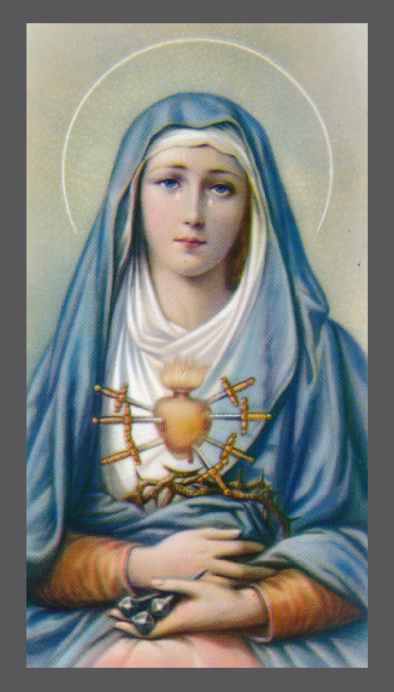
By meditating on the Seven Sorrows of Mary, a devotion from the Middle Ages, which uses scenes from the life of the Virgin Mother as a meditation on accepting the sorrowful part of life with grace.

The Seven Sorrows of Mary are:

1) The Prophecy of Simeon. As a young child, when his parents presented him in the temple, Jesus was met by the holy man Simeon who predicted everything that would happen to him in his address to Mary: “Behold, this child is destined for the fall and rise of many in Israel, and to be a sign that will be contradicted – and you yourself a sword will pierce so that thoughts of many hearts will be revealed.” (Luke 2:34-35).

2) The Flight into Egypt. In Bethlehem, after the birth of Christ, Joseph had a vision of an angel warning him of the impending slaughter of any male child under the age of two by King Herod in order to prevent the coming Messiah. The Holy Family had to travel a secretive route to Egypt and remain in that country until Herod died. Mary not only worried for the welfare of her own son but mourn for the murdered children left behind.

3) The Loss of the Child Jesus in the Temple. While on a pilgrimage to Jerusalem, the 12 year old Jesus vanished from his family. His heartsick parents finally found him three days later, arguing with elders in the temple.

4) The Meeting of Jesus with His Cross. Mary watched helplessly as her son was ridiculed and mocked as he stumbled, carrying the cross he was to be executed on.

5) The Crucifixion. As he was nailed to the cross, most of his disciples ran away. Mary never wavered as she stood at the foot of the cross, witnessing her son’s agony and death.

6) Jesus Taken Down from the Cross. Mary held her dead son’s wound covered body. This, her greatest sorrow is known as the “Pieta”.

7) The Burial of Jesus. As the stone was rolled, closing up his tomb, Mary had to say her final goodbye to her earthly son. Her faith had to be sincerely tested as there was no hint of the resurrection to come.

Symbols: Knives pricking Mary’s heart. Symbols of the crucifixion: crown of thorns, nails.

Novena to the Mother of Sorrows

Most holy and afflicted Virgin, Queen of Martyrs, you stood beneath the cross, witnessing the agony of your dying son. Look with a mother’s tenderness and pity on me, who kneel before you. I venerate your sorrows and I place my requests with filial confidence in the sanctuary of your wounded heart.

Present them, I beseech you, on my behalf to Jesus Christ, through the merits of his own most sacred passion and death, together with your sufferings at the foot of the cross. Through the united efficacy of both, obtain the granting of my petition. To whom shall I have recourse in my wants and miseries if not to you, Mother of Mercy? You have drunk so deeply of the chalice of your son, you can compassionate our sorrows.

Holy Mary, your soul was pierced by a sword of sorrow at the sight of the passion of your divine son. Intercede for me and obtain from Jesus (mention your request) if it be for his honor and glory and for my good. Amen.