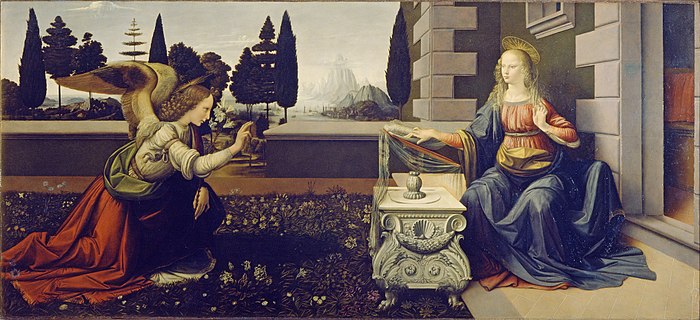
Luke’s account of the story of the Annunciation to Mary (see Luke 1:26–56) gives us a window through which to better appreciate this remarkable young woman. Through her interactions with Gabriel and Elisabeth, we see a young woman trying to grasp and understand her unique call from God. The magnitude of that call must have weighed heavily upon someone so young, and yet she readily submitted her will to that of the Father. Her story reminds us that God is aware of all of His children and that He calls ordinary men and women to participate in extraordinary ways to help build His kingdom. She became Jesus’s first disciple, and thus she is a model for all who choose to follow Him.
In the West, the oldest reference to the cult of Saint Joseph (Ioseph sponsus Mariae) connected with 19 March appears around the year 800 in the north of France. Thereafter, reference to Joseph, the spouse of Mary, becomes more and more frequent from the 9th to the 14th centuries. In the 12th century, the crusaders built a church in his honor at Nazareth. But it was in the 15th century that the cult of Saint Joseph spread due to the influence of Saint Bernadine of Siena, and especially of Jean Gerson (+ 1420), Chancellor of Notre Dame in Paris, who promoted the cause that a feast to Saint Joseph be officially established. There were already some celebrations in Milan in Augustinian circles, and in many places in Germany. It was in 1480, with Pope Sixtus IV’s approval that the feast began to be celebrated on 19 March. It then became obligatory with Pope Gregory XV in 1621. In 1870, Pope Pius IX declared Saint Joseph the Patron of the Universal Church, and Pope Saint John XXIII inserted his name into the Roman Canon of Holy Mass in 1962. More recently, Pope Francis approved seven new invocations in the Litany to Saint Joseph: Guardian of the Redeemer, Servant of Christ, Minister of Salvation, Support in difficulties, Patron of exiles, Patron of the afflicted, and Patron of the poor.
Prayer
Hail, Guardian of the Redeemer, Spouse of the Blessed Virgin Mary. To you God entrusted his only Son; in you Mary placed her trust with you Christ became man. Blessed Joseph, to us too, show yourself a father and guide us in the path of life. Obtain for us grace, mercy and courage, and defend us from every evil. Amen.
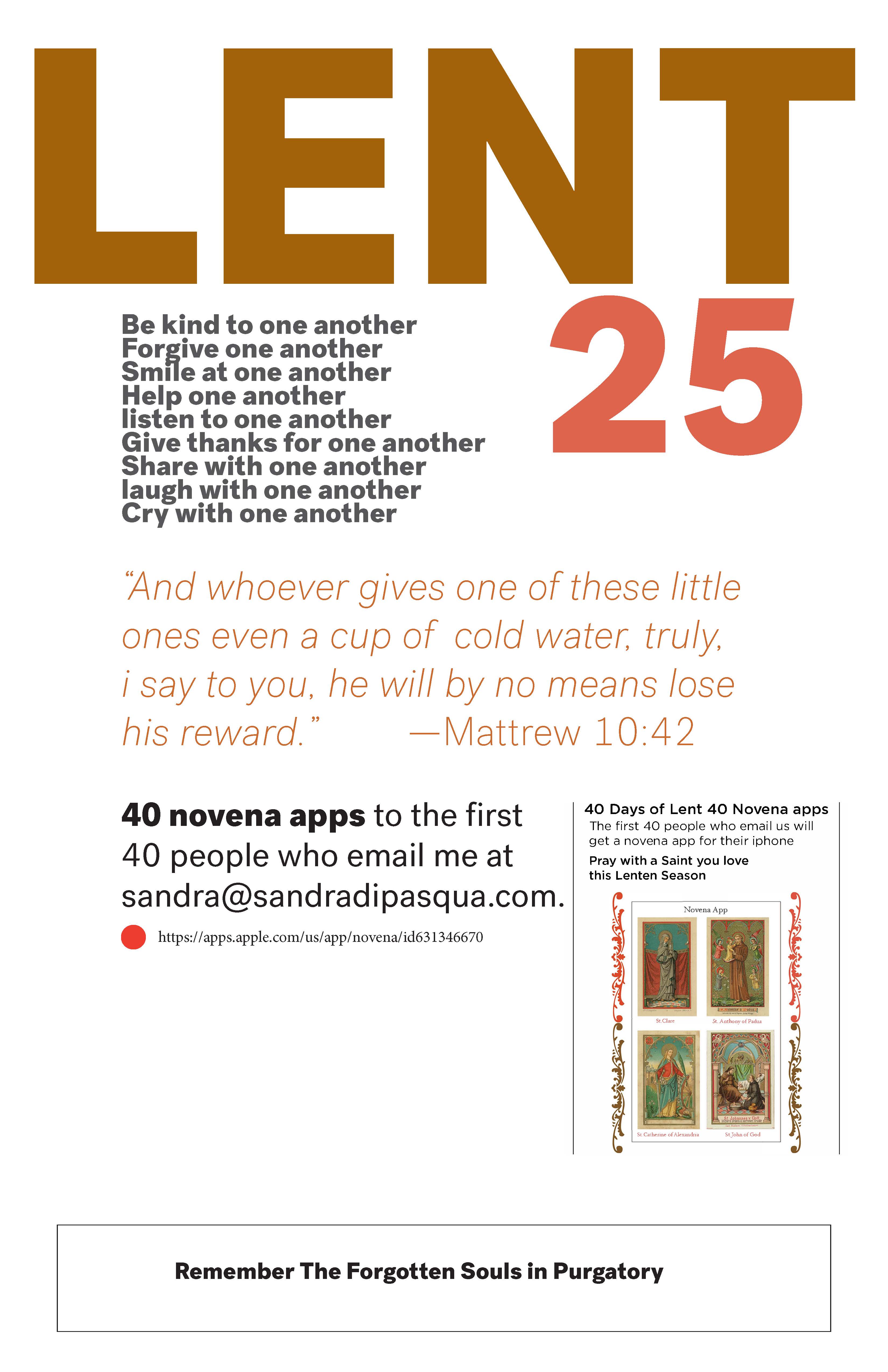
Please leave message if you would like a copy of our novena app for iPhone or iPad. History and prayers of 36 saints.
“The most Blessed Virgin Mary was, from the first moment of her conception, by a singular grace and privilege of almighty God and by virtue of the merits of Jesus Christ, Savior of the human race, preserved immune from all stain of original sin.”
In 1854, Pope Pius IX’s solemn declaration, “Ineffabilis Deus,” clarified with finality the long-held belief of the Church that Mary was conceived free from original sin. Mary was granted this extraordinary privilege because of Her unique role in history as the Mother of God. That is, she received the gift of salvation in Christ from the very moment of her conception.
Even though Mary is unique in all humanity for being born without sin, she is held up by the Church as a model for all humanity in Her holiness and Her purity in her willingness to accept the Plan of God for her.
Every person is called to recognize and respond to God’s call to their own vocation in order to carry out God’s plan for their life and fulfill the mission prepared for them since before the beginning of time. Mary’s “Let it be done to me according to Thy Word,” in response of the Angel Gabriel’s greeting, is the response required of all Christians to God’s Plan.
The Solemnity of the Immaculate Conception is a time to celebrate the great joy of God’s gift to humanity in Mary, and to recognize with greater clarity, the truth that each and every human being has been created by God to fulfill a particular mission that he and only he can fulfill.
“The word of the Lord came to me thus: “Before I formed you in the womb I knew you, before you were born I dedicated you, a prophet to the nations I appointed you.” (Jeremiah 1:5-6)
Designed and revealed by Mary, the Medal is unique among all medals.
It was almost midnight when St. Catherine Labouré was awakened by a soft voice, whispering, “Sister, sister, sister.” Mysterious events led her to the chapel where the Blessed Mother appeared and sat down near the altar. St. Catherine knelt at her feet, rested her hands in Mary’s lap, looked into her eyes, and had a heart-to-heart conversation with her. Later, St. Catherine would refer to that night as “the sweetest moment of my life.”
Four months later, in November of 1830, Mary again appeared to St. Catherine at the Rue de Bac Chapel. This time, our Blessed Mother was standing on a globe, with dazzling rays of light streaming from her outstretched hands. Framing the apparition was an inscription: “O Mary, conceived without sin, pray for us who have recourse to thee.” When Mary spoke to St. Catherine, she said “Have a medal struck upon this model. Those who wear it will receive great graces, especially if they wear it around the neck. Those who repeat this prayer with devotion will be, in a special manner, under the protection of the Mother of God. Graces will be abundantly bestowed upon those who have confidence.”
With approval of the Catholic Church, the first medals were made in 1832 and distributed in Paris. Only ten of the original medals are known to exist, and one of them is housed at the Miraculous Medal Shrine.
Almost immediately, the blessings that Mary promised showered down on those who wore her medal, and soon all of France was clamoring for what the people referred to as the “Miraculous Medal.” Use of the Medal spread from country to country, and, at the time of St. Catherine’s death in 1876, more than a billion medals had been made. Today, the Medal is still drawing down from God blessings for body and soul.
Wearing The Miraculous Medal
Here are some rules for wearing a Miraculous Medal:
Wear it around the neck: According to Our Lady, the medal should be worn around the neck.
Have it blessed: It’s best to wear a medal that has been blessed by a priest. A priest or delegated lay person can invest the wearer in the medal using the approved rite.
Wear it with confidence: According to Our Lady, those who wear the medal with confidence will receive great graces.
Wear it as a sign of devotion: The medal is a visible sign of devotion to Mary and Jesus.
Wear it as a reminder of faith: The medal can be a daily reminder of faith.
The Miraculous Medal is a popular piece of jewelry for Catholics, but anyone can wear it. The medal originated from apparitions to French nun Saint Catherine Laboure.The medal’s front and back are full of symbolism.
THE MEANING OF THE MIRACULOUS MEDAL.pdfDuring Our Lady’s visit to Catherine on November 27, 1830, rays of light flowed from rings on her fingers that were made of precio…St Joseph Church | Chehalis, WA
The Hidden Symbolism in the Miraculous Medal – EWTNNov 27, 2023 — The History of the Miraculous Medal During one of many apparitions to French nun Saint Catherine Laboure, Our Lady gav…EWTN
Investiture of the Miraculous Medal – SS. Cyril and Methodius ParishNov 13, 2024 — A person becomes a member by wearing a Miraculous Medal that has been blessed by a priest. It is fitting that the pers…saintcyrils.church
People celebrate All Souls Day through various practices, including participating in Mass, lighting candles in prayer, visiting cemeteries to decorate the graves of loved ones, and offering prayers for the dead. Many Catholics pray the All Souls Day prayer, which expresses the hope that the souls in purgatory will soon be freed from purgatory and welcomed into heaven.





 St Joseph Church | Chehalis, WA
 EWTN
EWTN saintcyrils.church

