Novena’s for The Month of May

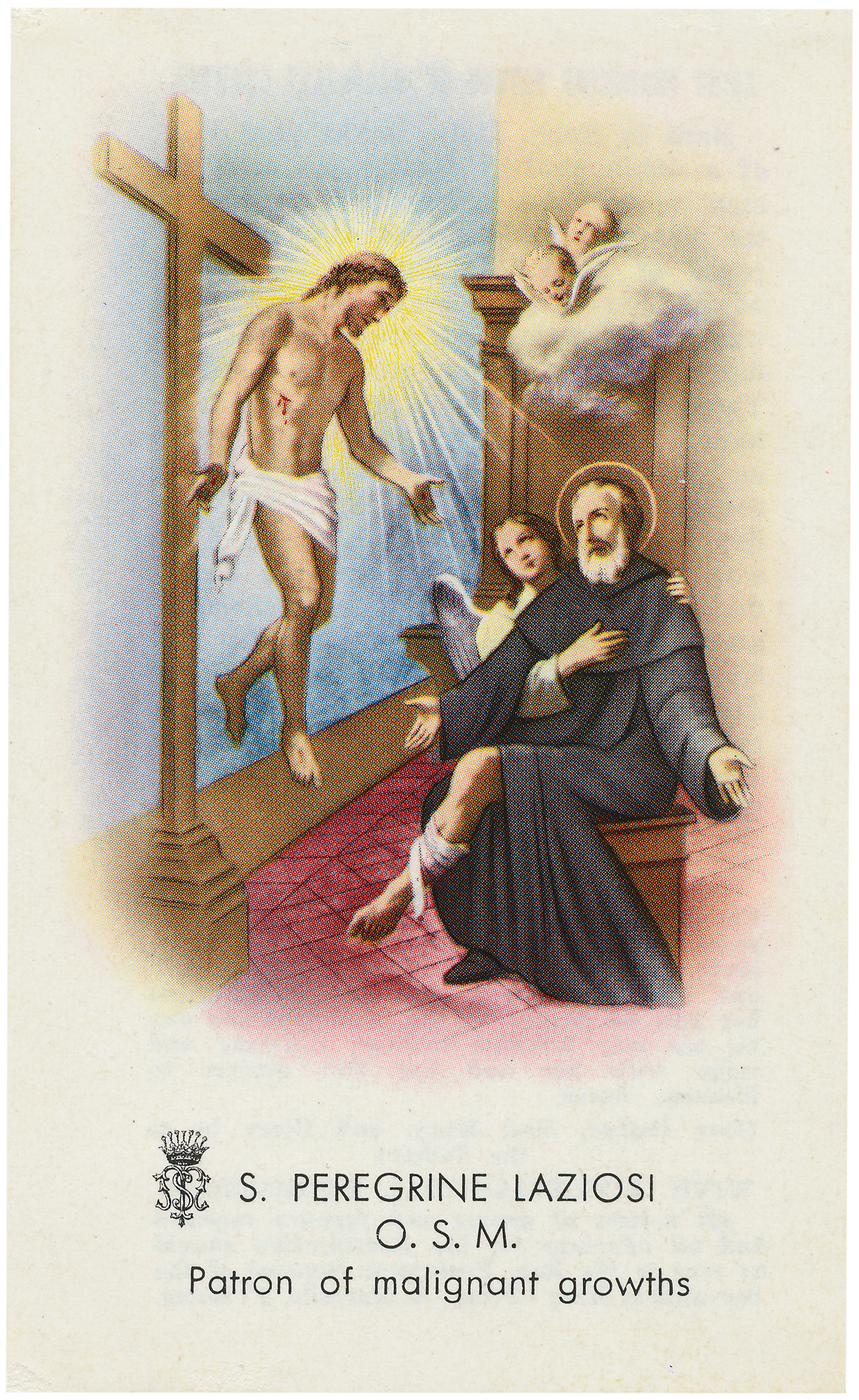
St. Peregrine May 1 – Cancer
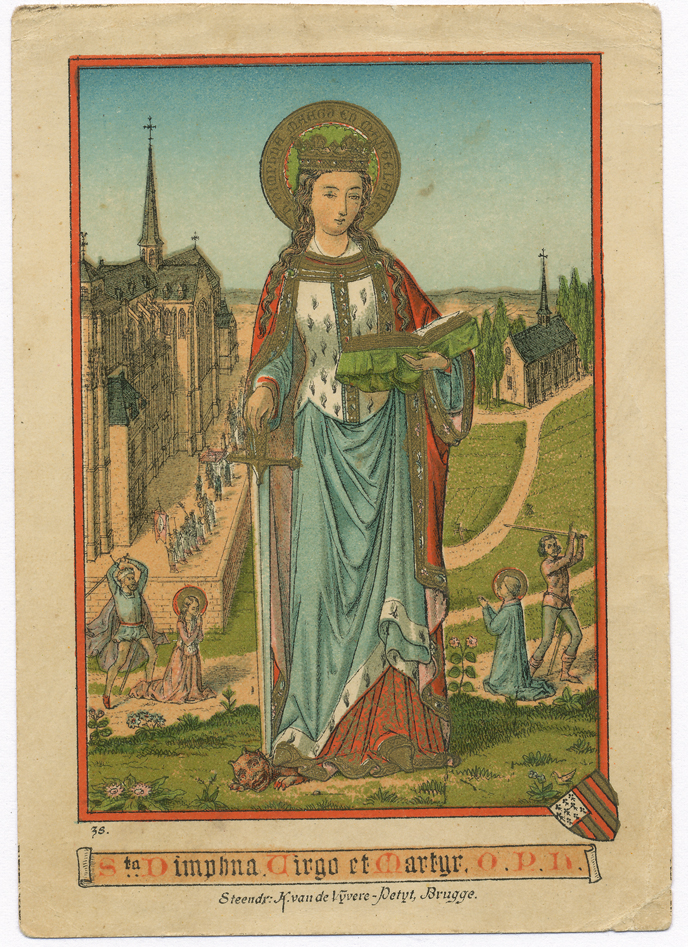
St. Dymphna May 15 – Mental Illness, Incest, Runaways
St. Rita of Cascia May 22 – Impossible Causes, Bad marriages, Spousal abuse

St. Dymphna

Saint Dymphna 605-620

Feast Day: May 15

Patron of: Mental Illness

As a victim of a mentally ill father, Saint Dymphna offers much solace to those suffering from psychological problems as well as their families. She is invoked to bring peace to the unbalanced as well as create an aura of calm and consolation for those who live in the midst of instability. Having lived such a short life so long ago, there is very little factual information available about Saint Dymphna. According to a written report commissioned by the Bishop of Cambrai seven hundred years after her death, Dymphna was born an Irish princess. Her mother was a devout Christian married to Damon, a pagan king. Dymphna’s mother made sure her daughter was brought up as a Christian, having installed her own confessor, Gerebran into her household. At the age of fourteen Dymphna lost her mother and her father went mad with grief. After a period of mourning, he searched all of Ireland for a new companion but could not find a woman who even remotely resembled his first wife. Because Dymphna was almost the exact image of her mother, Damon decided to marry her and make her his queen, disregarding the fact that she was his own daughter. In order to thwart this plan, Gerebran and Dymphna escaped the castle and went abroad to Antwerp. Eventually settling in Gheel in Belgium, they lived as religious hermits. Dymphna studied to be an anchoress which was a woman who lived in a room connected to a church with a window open to the street. Towns in the middle ages usually supported these people who offered their knowledge to those in need of advice. It took Damon and his men a year to find Dymphna and Gerebran. The priest was executed immediately and Dymphna was offered her father’s kingdom in exchange for returning home with him. When she refused, he decapitated her in a rage. Both bodies were immediately buried. Since epilepsy and mental illness were all thought to be caused by demonic possession, those suffering from mental afflictions were never welcomed to live in one place and were doomed to wander from town to town. Soon after Dymphna’s death, a group of five of these social pariahs slept at the site of her murder and were instantly healed by the blood in the earth. In the 13th century, the remains of an unknown man and woman were accidentally disinterred at Gheel. The name DYMPNA was written on a brick over the woman’s remains. As the remains were reinterred in a tomb, miraculous healings of the mentally ill and epileptics in the region were recorded. Gheel became a pilgrimage site for anyone suffering from any form of mental illness. By the end of the thirteenth century a major hospital and treatment center was built there for those suffering from nervous disorders. To this day, Gheel offers the most advanced and humane treatment for the mentally ill in the world. Saint Dymphna’s remains, in the church named for her there continues to be a place of pilgrimage.

Novena to Saint Dymphna

O God, we humbly beseech you through your servant Saint Dymphna, who sealed with her blood the love she bore you, to grant relief to those who suffer from mental afflictions and nervous disorders, especially (mention the afflicted person). Saint Dymphna, helper of the mentally afflicted, pray for us. Saint Dymphna, comforter of the despondent, pray for us. Saint Dymphna, renowned for many miracles, please hear my plea. Amen. (Recite one Glory Be).


Novena’s for The Month of May.

St. Peregrine May 1 – Cancer
St. Dymphna May 15 – Mental Illness, Incest, Runaways
St. Rita of Cascia May 22 – Impossible Causes, Bad marriages, Spousal abuse

St.PeregrineSt. Peregrine 

A victim of cancer himself, Saint Peregrine not only had to accept the reality of his illness, but also the instantaneous healing of that disease through the intercession of Christ. For this reason he is invoked for medical breakthroughs as well as for those suffering from cancer, running sores and other incurable diseases.

A wealthy young man from the town of Forli, Italy, Peregrine was a political leader of the local anti-Papist party. His rabble rousing against the power of the Pope and his early disdain for the Church makes him an unlikely saint. When a papal representative, Philip Benizi the prior general of the Servants of Mary journeyed to Forli to preach and to attempt a reconciliation between the rival political factions, Peregrine and his men broke up the crowds attending the speech. Peregrine himself slapped Benizi in the face. Instead of inciting Benizi to retaliate, he received a kindly look of forgiveness which so stunned Peregrine, that he collapsed in shame over his actions.
Since the Servants of Mary are devoted to the Blessed Mother, Benizi advised Peregrine to transform his life by cultivating a childlike devotion to Mary. While meditating in the cathedral at Forli, Peregrine had a vision of Mary instructing him to go to Siena and join the religious order of the Servants of Mary. Returning to Forli as a priest in that order, Peregrine devoted himself to the poor, the sick and the outcasts of society. Many reported being healed during his inspirational masses. Peregrine imposed a personal penance on himself of never sitting down unless he had to. He also slept on the ground, using a stone for a pillow. After 30 years of such deprivation he developed severe varicose veins and an incurable running sore down his leg. This led to a diagnosis of cancer, the only cure possible was amputation. Resigning himself to the same fate as those he had served, Peregrine reluctantly agreed to the surgery. Praying in the chapel on the eve of the operation he fell into a trancelike sleep where he experienced the figure of Christ getting off of the cross to touch his leg. When he awoke, there was no trace of illness in his leg and it was deemed to be completely healed. Because of this miracle, the incurably ill flocked to Forli for Peregrine’s healing prayers. Peregrine continued his mission for the next 20 years, dying at the age of 80. In modern times, many still make the pilgrimage to his tomb and there are thousands of healing societies bearing his name throughout the world.

Prayer

O great Saint Peregrine, you have been called “the Mighty” and the “Wonder Worker” because of the numerous miracles you have had recourse to, for so many years you bore in your own flesh this cancerous disease that destroys the very fiber of our being, and you had recourse to the source of all grace when the power of man could do no more. You were favored with the vision of Jesus coming down from his cross to heal your affliction. Ask of God, and our Lady the cure of these sick persons whom we entrust to you. Aided in this way by your powerful intercession, we shall sing to God, now and for all eternity, a song of gratitude for his great goodness and mercy.
(Mention your request.)
Saint Peregrine, pray for me and for all who invoke your aid.
Amen

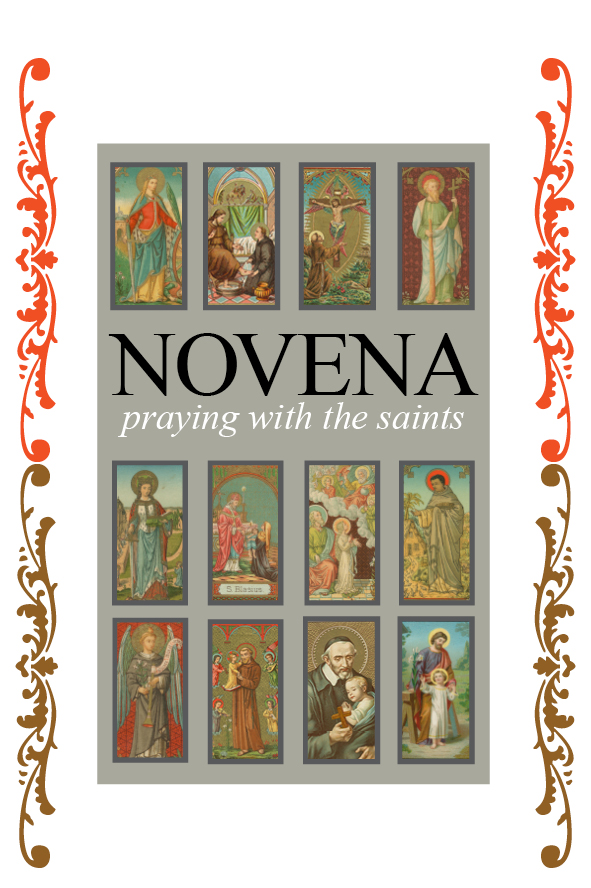
These Saints are three of thirty six you will find on our Novena app: https://itunes.apple.com/us/app/novena/id631346670?mt=8

Offering a modern take on the ancient Catholic tradition of using novena prayers to call on saints to help in our earthly struggles, the app features biographies, prayers and iconographic explanations for 36 of the most popular saints from all over the world.

You might find out what you have in common with your favorite Saint.

A Gift for Lent

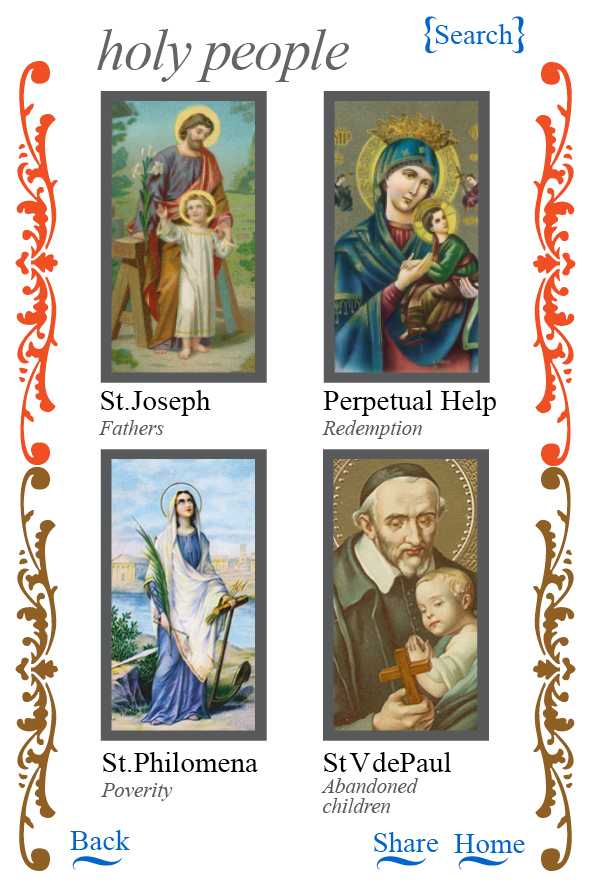
Novena_SPLASH SCREENHoly_PeopleTurn your cell phone into a prayer book for Lent! Starting today, and for all the 40 days of Lent, our beautiful App: “Novena: Praying With the Saints” will be reduced in price to 99 cents. 

Offering a modern take on the ancient Catholic tradition of using novena prayers to call on saints to help in earthly struggles, the app features visually striking vintage holy cards, prayers and histories for 36 of the most popular saints from all over the world:

Saint Agatha: Breast cancer
Saint Aloysius Gonzaga: AIDS sufferers
Saint Alphonse Liguoris: Arthritis sufferers
Saint Anthony of Padua: Lost Objects 
Saint Blaise: Throat ailments
Saint Catherine of Alexandria: Philosophers
Saint Claire of Assisi: Television workers
Saint Dymphna: Mental illness
Mother Cabrini: Immigrants
Saint Francis of Assisi: Ecologists
Saint Gabriel, Archangel: Teachers
Saint Gerard Majella: Infertility
Infant of Prague: Desperation
Saints Joachim and Ann: Grandparents
Saint John of God: Heart ailments
Saint Joseph: Fathers
Saint Jude: Impossible causes
Saint Lucy: Blindness
Saint Martin de Porres: Racial harmony
Saint Michael, Archangel: Policemen
Mother of Sorrows: Grief
Saint Monica: Wayward children
Our Lady of Guadalupe: Motherly comfort
Our Lady of Perpetual Help: All causes
Saint Philomena: The poor
Padre Pio: Forgiveness
Saint Peregrine: Cancer
Saint Raphael, Archangel: Travelers
Saint Raymond Nonnatus: Newborns
Saint Rita of Cascia: Impossible causes
Sacred Heart of Jesus: Family peace
Saint Therese of Lisieux: To create a loving atmosphere
Saint Thomas Aquinas: Students
Saint Vincent de Paul: Abandoned children
Saint Vincent Ferrer: Builders

https://itunes.apple.com/us/app/novena/id631346670?mt=8

February Saint of Health: Breast Cancer

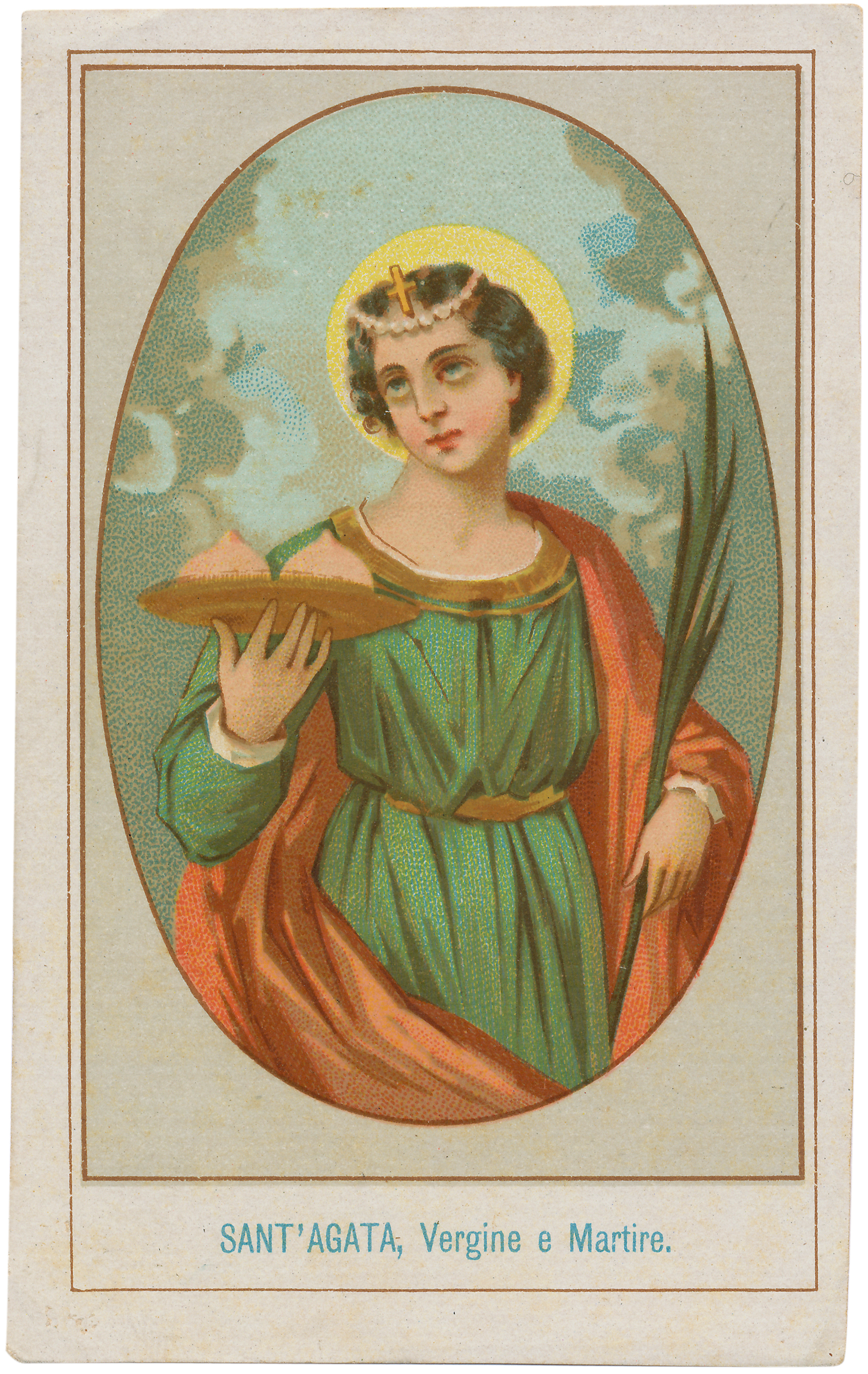
St.Agatha

Saint Agatha 

D. 251

Feast Day: February 5

Patron of: Breast Cancer

Quote: “Do not offend Agatha’s nation, because she will avenge all insults”. – Inscription on the façade of the Cathedral of St. Agatha in Catania, Sicily

Keywords; breast cancer, burns, pulmonary diseases, bell ringers, bell makers, brass workers, cloth makers, glass workers, wet nurses, nursing mothers, nurses, fires, volcanic eruptions

Symbols: breasts on a dish, palms

A national heroine to Sicilians, a great figure in art and one of the few saints mentioned in the Catholic mass, St. Agatha is a fierce and fearless role model for anyone who lives in modern times. A martyr, she is most often invoked by those suffering from diseases of the breast. Her tomb has been a place of miraculous healing since her death. Because of her courage in standing up to the Roman authorities, anyone persecuted by them, Pagans, Jews and Christians all made pilgrimages in her honor. In modern times, her feast day is an important holiday, attracting hundreds of thousands of devotees who process through the streets of Catania.

An orphaned daughter of wealthy Christians, Agatha was considered an attractive marriage prospect by  Quintianus, the ruling Roman consul of Sicily. Taking advantage of  the recent Roman decree outlawing Christianity, Quintianus assumed Agatha would renounce her religion and acquiesce to his proposal of marriage. She refused him on both counts, telling him that she had dedicated her virginity to Jesus Christ. Refusing to marry and bear children was considered an act of political defiance in those times. Agatha’s rejection of him so enraged Quintianus that he had Agatha taken to a brothel and forced her to live as a prostitute for thirty days. When she was brought back before him, he ordered her to sacrifice to the Roman gods. She pointed out that no Roman wife would dare live like Venus and no Roman husband could legally do the things that Jupiter was known for, why would she follow such gods? Christ lived what he preached, love and forgiveness; she would follow him instead. Agatha was then tortured by having her breasts slowly rushed and cut off. Thrown back in prison and left to die, an elderly man and a young boy came into her cell. Revealing himself as St. Peter, Agatha was miraculously healed. The next day, Quintianus ordered her to be rolled in broken pottery and hot coals. As this torture was being inflicted, an earthquake leveled Catania. The citizens of that city, declaring that this was God’s vengeance for what was happening to Agatha, chased Quintianus out of town and the terrified consul drowned in the river. Agatha offered her soul up to Christ and died.

The year after her death Mount Etna erupted and a lava flow threatened Catania. Agatha’s death shroud was taken out and held aloft which immediately stopped the lava. This same shroud has been used many times over the years to protect the city. Because of her tortures Agatha is the patron of those suffering from breast disease as well as those suffering from burns. Trades that use burning coals also claim her. Bells, which are signals for fire alarms and also resemble breasts are closely identified with this saint. Saint Agatha’s bread, shaped like breasts or bells are a specialty served around the time of her feast.

Explanation of symbols:

Mt. Etna in the background: Agatha protects Sicilians against its eruptions. She is the patron and protector of Sicily.

Offering breasts on a dish: Agatha suffered the gruesome torture of having her breasts cut off. Because of her faith, she easily endured this torture and offered it up to God.

Palms: a sign of martyrdom. Christ was showered in palms the Sunday before he was executed.

Novena to Saint Agatha

O Saint Agatha, who withstood the unwelcome advances from unwanted suitors, and suffered pain and torture for your devotion to our Lord, we celebrate your faith, dignity, and martyrdom.

Protect us against rape and other violations, guard us against breast cancer and other afflictions of women, and inspire us to overcome adversity.

O Saint Agatha, virgin and martyr, mercifully grant that we who venerate your sacrifice may receive your intercession.

(Mention your request).

Amen.

(Excerpted from the app: Novena:Praying With the Saints by Barbara Calamari and Sandra DiPasqua).

Saint Lucy

Saint Lucy

283 – 304

Feast Day: December 13

Patron of: the blind

Keywords: light, clarity, the blind, eye disease, dysentery, epidemics, cutlers, electricians, glaziers, gondoliers, oculists, peasants, writers, vision

Quote:  “Those whose hearts are pure are the temples of the Holy Spirit.”

Symbols: holding her eyes on a dish, martyrs palms, sword, oxen

Willing to give up the comforts of her privileged life in order to obtain a state of enlightenment, Saint Lucy is one of the early virgin martyrs who challenged the authority of the Roman state. Her very name means ‘light’ and as light is direct and clear, shining in the most filthy of environments, we invoke her for clarity of vision in the spiritual as well as the physical realm.

Born in Syracuse, Sicily to a wealthy family of Greek descent, Lucy’s father died when she was very young.  Following the traditions of their society, Lucy had a large dowry and was affianced in an arranged marriage to a pagan nobleman. Lucy was a Christian and believed that she could best be a conduit of the Holy Spirit by remaining a virgin unfettered by husband and children. At this time Christianity was a great threat to the Roman Empire and the emperor Diocletian vowed to stamp it out wherever it arose. Lucy kept her vow a secret as Christians were considered revolutionaries against the state.  Since her mother suffered from constant bleeding from a uterine hemorrhage, Lucy took her to the tomb of Saint Agatha in Catania, a place where many miracles were reported, for a healing. While spending the night there, Lucy dreamt of Saint Agatha who told her, “You have no need to invoke me, for your faith has already cured your mother. One day you will be known as the patron of your own city.”  Upon awakening and finding her mother completely healed, Lucy confessed to her desire to remain a virgin and distribute her dowry among the poor. Impressed by her faith, her mother acquiesced to her daughter’s wishes.

When her fiancé heard of the broken engagement he went to the governor to denounce Lucy as a Christian. In an attempt to change her mind, she was brought before the authorities. When she asked why was it so important that this man need to marry her, she was told because she had the loveliest eyes. Whereupon Lucy ripped out her eyeballs and told the governor to send them to her former fiancé. The next day her eyesight was miraculously restored and Lucy was once again brought before the authorities. An attempt was made to have her taken to a brothel to be repeatedly raped, but a phalanx of soldiers could not move her. A team of oxen was brought in to no avail. Burning pitch was poured on her head, but she stood fast, predicting the downfall of the emperor. This last declaration proved to be too much and Lucy was fatally stabbed in the throat. True to her prophecy Diocletian the emperor abdicated his throne within the year.

It is said that “the longest of nights and shortest of days belong to Saint Lucy.” Because her feast day, December 13 used to be the winter solstice before the change to the Gregorian calendar, Lucy enjoys great patronage in Scandanavia as the saint who brings the coming of the light. Her relics were moved to Venice where she is celebrated in song by gondoliers. In Sicily she is credited with ending an epidemic of children’s deaths in the 14th century, today she is synonymous with Santa Claus, where children receive gifts on her feast day. When there was a famine in her native land during the 16th century, ships laden with raw wheat turned up on her feast day. The starving inhabitants cooked the wheat whole, and today it is customary to cook with raw wheat on her feast day.

Explanation of symbols:

Eyes on a dish: Lucy ripped out her own eyes and offered them to her fiancée when she was told he loved her for her beautiful eyes. She was not in need of her mortal eyes as she was filled with light.

Palms: Symbol of martyrdom.

Novena to Saint Lucy

Saint Lucy, your beautiful name signifies light. By the light of faith which God bestowed upon you, increase and preserve this light in my soul so that I may avoid evil, be zealous in the performance of good works, and abhor nothing as much as the blindness and darkness of evil and sin. By your intercession with God, obtain for me perfect vision for my bodily eyes and the grace to use them for God’s great honor and glory and the salvation of all men. Saint Lucy, virgin and martyr, hear my prayers and obtain my petitions. (Mention your request here.)

Amen

(Excerpted from the app: “Novena:Praying with the Saints” by Barbara Calamari and Sandra DiPasqua).

Feast of St.Monica

St.MonicaSt. Monica
331 – 387
Feast Day: August 27

Patron of: Wayward Children

Quote: “Nothing is far from God.”

Keywords: abuse victims, adultery victims, alcoholics, housewives, married women, mothers, patience, wayward children

Symbols: tears, girdle

Though she was greatly hurt and disappointed by her firstborn son, St. Monica never gave up the idea that he would change his way of living. After 17 years of what seemed like fruitless prayers, her son turned his life around, converted to her faith and became one of the world’s greatest philosophers and Catholic saints, St. Augustine of Hippo. We invoke St. Monica to help us when our own children disappoint us. She serves as a reminder that there are no lost causes in this world and that absolutely anyone can reform and change their life.

Born into a Berber tribe in North Africa, Monica was brought up a Christian. Her parents arranged her in marriage with a prominent pagan Roman citizen of Carthage by the name of Patricius. Monica had a hard time in her early married years as she had to put up with a cantankerous mother-in-law as well as a dissolute husband. There are some accounts which say that she turned to alcohol and was herself an alcoholic who recovered her sobriety through faith and prayer. She had three children who she raised as Christians. The eldest, Augustine, was the most brilliant and his parents had high hopes for his career. Both Patricius and Monica worked hard to get the best education for their son and it was the greatest sorrow of Monica’s life when Augustine turned out to live a lazy, pleasure-filled life. It hurt her even more when he threw out his Christian beliefs to embrace the Manichean heresy – a popular cult believing in the natural good and evil of every soul. In order to keep his blasphemous beliefs from misleading her younger children, Monica forbade Augustine to come back to their home. Inconsolable in her grief, Monica had a vision of a radiant being pointing to Augustine in a beam of light next to her, saying, “Your son is with you.” When she related this vision to Augustine he laughingly said it would all be true if she would only give up her religious piety. “He did not say that I was with you,” she answered him. “He said you were with me.”

When Augustine openly took a mistress and further humiliated his mother by having an illegitimate son, Monica turned to her Bishop for help. He advised her to pray and be patient saying, “It is not possible that the son of so many tears should perish.” After the death of his father, Augustine decided to move to Rome to increase his worldly success, Monica vowed to follow him. In his own great treatise “Confessions”, Augustine relates how as his mother spent the night in prayer before their voyage, he tricked her and slipped away on an earlier ship. Devastated, she traveled to Rome anyway. By the time she arrived Augustine, had already left that city for Milan. By the time Monica tracked him down, she was overjoyed to find that Augustine was no longer a Manichean. He had met Ambrose, the bishop of Milan and was studying with him. Eventually, after several more years, Monica lived to see Augustine baptized a Christian. While waiting for a ship at Ostia to take mother and son back to Africa, Monica told her son that she had accomplished everything that she had set out to do in this life and did not need to live any longer. She died in Ostia, never returning to her native land.

It is interesting to note that there are many great saints from Africa, especially the earliest ones and they are rarely depicted as anything but European in visage.

Explanation:
Light from sky: Grace. Through prayer, Monica channeled grace to convert her son.
Outstretched arms: pointing to Africa, her homeland.
Palm tree: the shore of Ostia Antica, where Monica’s earthly life ended.

Novena Prayer to Saint Monica

Dear Saint Monica, once the sorrowing mother of a wayward son, be pleased to present our petition to the Lord God of heaven and earth. (Your intention here.) Look down upon our anxieties and needs, and intercede for us, as you did so fervently for Augustine, your firstborn.

We have full confidence that your prayers will gain favorable hearing in heaven. Mother of a sinner-turned saint; obtain for us patience, perseverance, and total trust in God’s perfect timing. In His appointed hour, in His merciful way, may He respond to your prayer and ours, which we offer through you. Amen

Feast of St. Clare of Assisi, August 11

St.ClareSt. Clare of Assisi
1193-1254
Abbess and Founder of the Poor Clares
Patron of: Television Workers
Quote: “Totally love Him, Who gave Himself totally for your love.”
Keywords: clarity, blindness, embroiderers, eye diseases, gilders, goldsmiths, laundry workers, telephones, telegraphs, television
Symbols: monstrance, lamp, lily

Together with her mentor and friend, Francis of Assisi, St. Clare shook the foundations of Medieval society by revolutionizing religious expression. Her given name, Chiara means clarity and we call on St. Clare whenever we need to shine a light on a situation or to find a way to communicate more clearly. She is also invoked to protect the blind and to help those with eye trouble.
Chiara Offreduccio, as the beautiful daughter of minor royalty was offered every worldly advantage available to one in her social class. When she heard St. Francis preach the Lenten service at her church in 1212, his simple message of living with complete trust in God inspired her to abandon going through with her arranged marriage in order to join the Franciscan movement. The first followers of Saint Francis were the wealthy sons of his town of Assisi. Their act of turning their backs on the material world to live at the mercy of the elements and on whatever alms they could beg was disturbing and controversial to both their families as well as to the church authorities. Attracted by the joyous way in which they comported themselves, as well as the enthusiasm they brought to religious worship, Clare was the first woman to join their order.
Fervently believing in a life devoted to the precepts of the gospel, the Franciscans did not believe in personal property. When Clare escaped her family to join them on Palm Sunday, Francis himself cut off her long blond hair and handed her the simple woolen robe worn by his followers. He then left her in the local Benedictine convent as there were no facilities in his order for women. It was not long before her entire family attempted an intervention type rescue of the girl. Revealing her shorn hair to her horrified father made them realize that she would never return to their world. Her younger sister, as well as other wellborn young women from the town soon followed her. In 1215, Saint Francis installed Clare as the Abbess of the Order of Poor Ladies. True to the Rule of St. Francis, they accepted no dowries from their families as other religious orders did. When they were left inheritances, the money was distributed to the poor. Highly intelligent, and known for the efficacy of her prayers, popes, cardinals, royalty and St. Francis himself came to her for spiritual advice. Her own correspondence shows her to be a clever, happy person.
Devoted to the eucharist and frequently immersed in prayer, the stories of miraculous occurrences around Clare abound. The most famous is that while she was ill, her convent which was outside of the walls of Assisi was attacked by the Saracen mercenaries of Frederick II . As the invaders stormed the walls with ladders, Clare calmly held up a monstrance containing the host. A child’s voice emanated from inside the monstrance, “I will always guard and defend you.” A feeling of dread overtook the invaders and they ran away from the town.
St. Clare was named the patron saint of television writers and workers due to a vision she had while too ill to attend Christmas Eve mass. She was able to view and hear the entire mass on the wall of her room. She spent much time embroidering linens for use in mass, so she is the patron of embroiderers. Because that trade is hard on the eyes and because of her name, she is the patron of those with eye problems and the blind.
CARD SYMBOLS
Monstrance: Devoted to the Eucharist, Clare protected her convent by holding up a monstrance, which holds the host. Sometimes in art, this monstrance is re-interpreted as a lamp. Since Chiara means clarity, it is Clare shining the light of clarity.

NOVENA TO SAINT CLARE
O Glorious St. Clare! God has given you the power of working miracles continually, and the favor of answering the prayers of those who invoke your assistance in misfortune, anxiety, and distress. We beseech you, obtain from Jesus through Mary His Blessed Mother, what we beg of you so fervently and hopefully, (mention your petition) if it be for the greater honor and glory of God and for the good of our souls. Amen.

Novena Saint for August: Health

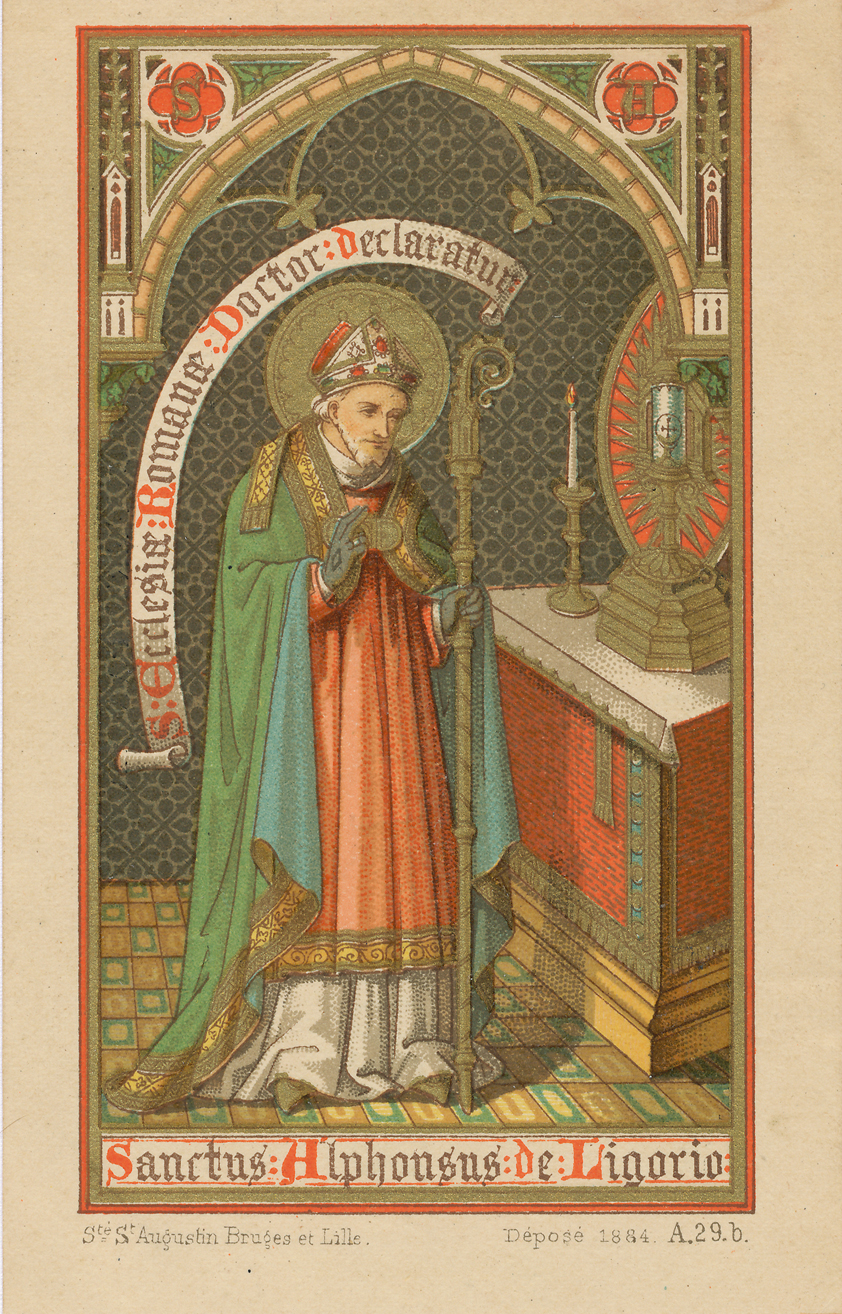
Sanctus Alphonsus de Ligorio

St. Alphonsus Liguori

 1696 – 1787

Feast Day: August 1 

Doctor of the Church

 Patron: Arthritis sufferers

 Keywords: Confessors, Moral Theologians, Lawyers, Scruples

 Quote: “Your God is ever beside you, indeed He is even within you.”

 Symbols: chin in chest, writing pen, book, bishops’ hat and staff


So crippled with arthritis that he could not lift his head off of his chest, St. Alphonsus Liguori looked on his illness as a grace since it made him use his earthly time in the most productive manner possible. In chronic pain and expecting to die at any moment, he went on to publish over 60 books dealing with theological studies, as well as music and poetry. He is invoked by those suffering with arthritis for a cure as well as those seeking a way to live a productive life while stricken with illness.

 Born into a noble but poor family near Naples in 1696, Alphonsus Liguori was the eldest of seven children.  Though he was physically small with poor eyesight, he was incredibly intelligent and musically talented. Because of his poor eyesight he could not follow in his father’s military footsteps, but his intellectual brilliance made him the hope of his family, as he received his law degree at the early age of sixteen.  He quickly became famous in the Neapolitan courts for never losing a case. A devout Catholic, he credited his success with his daily mass going. After eight years of constant triumph, Alphonsus was stunned to lose an extremely important and public case due to his own oversight regarding a signed document. Humiliated, he looked on this personal disaster as sign from God and fasted and prayed for three days. While doing charitable work in the Hospital for the Incurables, he had a vision commanding him to quit the world and give himself to God. His father was outraged when left the law for the priesthood.

 Devoting his work to those on the outskirts of society, he founded the Redemptorist Fathers, an order devoted to doing missionary work among the poor. Though gifted with the ability to argue the most finite facts of law or theology Alphonsus Liguori always preached in the simplest terms, writing many books and pamphlets in the vernacular of the common person. Because of his great popularity as a preacher, his religious order began to attract many young people. Living at a time of great political and religious upheaval and plagued with deteriorating health, Alphonsus Liguori never enjoyed much peace in his life. Instead, he welcomed these obstacles as an opportunity to perfect his soul.

 Explanation of symbols:

Banner: declaring him Doctor of the Church because of the incredible range and amount of his writings.

Bishop hat and staff: he was a Bishop and leader of his order.

Crucifix: Total devotion to Christ and His teachings.


Novena to St. Alphonsus Liguori

 Glorius Saint Alphonsus, loving fathr of the poor and sick, all your life you devoted yourself with a charity really heroic to lightening their spiritual and bodily miseries. Full of confidence in your tender pity for the sick, since you yourself have patiently borne the cross of illness, I come to you for help in my present need.

 (Mention your request).

 Loving father of the suffering, Saint Alphonsus, whom I invoke as the Arthritic Saint, since you suffered from the disease in your lifetime, look with compassion upon me in my suffering. Beg God to give me good health. If it is not God’s will to cure me, then give me strength to bear my cross patiently and to offer my sufferings in union with my crucified Savior and His Mother of Sorrows, for the glory of God and the salvation of souls, in reparation for my sins and those of others, for the needs of this troubled world, and for the souls in purgatory.

 (Recite one Our Father, one Hail Mary, one Glory Be.)

 Saint Alphonsus, patron of the sick, pray for me. Amen

Excerpted from our new App under Saints of Health.
Click Here: https://itunes.apple.com/us/app/novena/id631346670?mt=8

Feast of Saint Ann and Saint Joachim

FullSizeCard_1
Saint Ann and Saint Joachim
First Century B.C.
Feast Day: July 26

Patron of : Grandparents

Keywords: child rearing, childless people, fathers, family crisis, infertility, mothers, pregnancy

Quote: “O blessed couple, all the world is indebted to you, for it is by your means that it can offer to its Creator the most excellent gift possible, her who is worthy to be Mother of His only Son.” – St. John Damascene

Symbols: two white doves, meeting at the golden gate, teaching the Virgin Mary

Grandparents are the foundation of a family and we invoke Saints Joachim and Ann for strength in every sort of family crisis. As parents of the Virgin Mary and the grandparents of Jesus Christ, they offer a vast array of earthly experiences relatable to every human being. Infertility, late parenthood, an unmarried pregnant daughter, a grandson who was imprisoned and executed, are all parts of their life together which they accepted with grace and dignity.

Joachim and Ann are important as moral examples rather than truthful historical figures. According to legend, Joachim and Ann were married twenty years and still had not conceived a child. Living in Nazareth they were upstanding citizens, always tithing one third of their income to the temple. After many years, their barrenness was considered a form of divine judgment and eventually their contribution to the temple was refused and they were ostracized by their community. In shame, Joachim went off to live with his shepherds. There he was visited by an angel who told him, that Ann was pregnant with a child named Mary who was to be dedicated to the Lord. He was to return home and find his wife, who would be waiting at the golden gate, the entrance to the city. Doing as he was told, his joyful reunion with Ann at the golden gate has become a famous image in art history.

Mary was raised according to the instructions of the angel, she was consecrated to the Lord at infancy and sent off to live in the temple, away from the world, at the age of three. Accepting this great sacrifice of giving up what is most cherished to God, Joachim and Ann acted out an almost impossible act of faith. Though Saint Ann was younger and lived much longer than her husband, she and Joachim are inseparable in sharing the important patronage of grandparents.

Explanation:
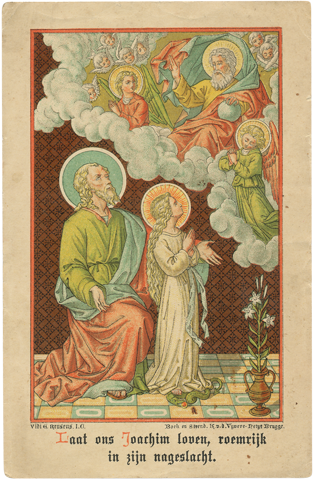
A rare image of Joachim as an older father, and his wife, Ann, instructing the Virgin Mary. They are divinely inspired by the wisdom of the Holy Spirit.

Novena to Saints Joachim and Ann

Saints Joachim and Ann, grandparents of Jesus and parents of Mary, we seek your intercession. We beg you to direct all our actions to the greater glory of God and the salvation of souls. Strengthen us when we are tempted, console us during our trials, help us when we are in need, be with us in life and in death.

O divine savior, we thank you for having chosen saint Joachim and Ann to be the parents of our Blessed Mother Mary and so to be your beloved grandparents. We place ourselves under their patronage this day. We recommend to them our families, our children, and our grandchildren. Keep them from all spiritual and physical harm. Grant that they may ever grow in greater love of God and others.

Saints Joachim and Ann, we have many great needs. We beg you to intercede for us before the throne of your divine grandson. All of us here have our special intentions, our own special needs, and we pray that through your intercession our prayers may be granted. Amen.

(Mention your request here)

Saint Anthony of Padua, 1195 – 1231

St. Antonius a Paduasmall“Saint Anthony, please come around, there’s something lost that must be found.” Doctor of the Church Feast Day: June 13 Patron of: Lisbon, Portugal, Padua, amputees, barren women, domestic animals, draftees, oppressed people, orphans, paupers, the poor, pregnant women, prisoners, sailors Invoked for: finding a husband, finding lost articles Invoked against: debt, shipwreck, starvation Symbols: baby Jesus, book of Gospels, lily Wonder and miracles are infused with every story of Saint Anthony. Though he has been dead for almost 800 years, he is still the most popular saint in the world and his statue is found in every Catholic Church. Saint Anthony is best known as the patron saint of lost articles but he is invoked for help in all life situations. In his own day he was called the “Wonder Worker’ and credited with the ability to stop the rain, raise the dead and reattach severed limbs. He was such a charismatic preacher that when a crowd of heretics in Rimini refused to listen to his preaching, the fish raised themselves out of the water to hear him. Born Fernando de Bulhes in Lisbon, Portugal, he disappointed his noble family by rejecting his luxurious life and joining the Augustinian religious order. A scholar by nature, he read every book in the monastery, devoting his time to contemplative prayer. Eventually, he befriended a group of itinerant Franciscan monks and became fascinated with this new religious order. Much impressed by their dedication to simplicity, poverty and their belief in returning to the original words of Christ, he joined their ranks, changing his name to Anthony in honor of Saint Anthony of the Desert, the patron of their little church. Returning home from a failed missionary venture in Morocco, his ship was blown off course and he wound up in Messina, Sicily. A group of Franciscan friars insisted he go north with them for a great gathering of all Franciscans, with their founder Francis of Assisi. Anthony remained in Italy and discovered his great gift of preaching when a superior ordered him to speak at an ordination, telling him to say whatever the holy spirit had infused into him. He astonished his audience, not only by his skills as an orator but by the depth of his knowledge. He was sent throughout northern Italy and southern France on evangelical preaching missions which gathered crowds in the tens of thousands. His popularity among the people increased as he used his position to get real changes enacted for their protection. While based in Padua, he observed the crushing power of debt upon the common people. At Anthony’s insistence, the local municipality enacted a law protecting those who could not pay their debts that is still enforced today. Anthony exhausted himself preaching out in fields and in piazzas as there was not cathedral large enough to hold all who came to hear him. At the age of thirty six, his health began to fail him and a local Count donated a woodland retreat for his recovery. One morning the Count heard the sounds of a baby giggling and he looked out to see Anthony surrounded in light, playing with the baby Jesus. That Christ would choose to appear to one of his saints in such a vulnerable state is a testament to the loving and kind nature of Saint Anthony. Because he is depicted holding a baby, women having trouble conceiving invoke his aid. Being of Portuguese descent, Anthony’s feast day is very auspicious for marriages in Portugal and Brazil and in those cultures, he is known to assist women seeking a husband. According to legend, Saint Anthony earned the title patron saint of lost articles when a novice borrowed his psalter and failed to return it. Saint Anthony prayed to get it back and the novice was visited by terrifying visions that sent him running back to Anthony with the book. In iconography, Anthony always holds the baby Jesus and a lily for purity. Many times the returned book of the gospels is included. Novena to Saint Anthony of Padua Holy Saint Anthony, gentle and powerful in your help, Your love for God and charity for His creatures, made you worthy when on earth, to possess miraculous powers. Miracles waited on your word, which you were always ready to request for those in trouble or anxiety. Encouraged by this thought, I implore you to obtain for me (mention your request here). The answer to my prayer may require a miracle. Even so, you are the saint of miracles. Gentle and loving Saint Anthony, whose heart is ever full of human sympathy, take my petition to the Infant Savior for whom you have such a great love, and the gratitude of my heart will be ever yours. Amen It is customary to donate to Saint Anthony’s Bread, a charity started in Saint Anthony’s lifetime, in gratitude to answered novena prayers.