Unknown's avatar

About sandra dipasqua

graphic designer

Hail / Barnabas the Apostle, d. 61, Feast Day: June 11

Originally from Cyprus, Barnabas was said to have been present at the Pentecost when the Holy Spirit descended on the original followers of Christ. He introduced Saint Paul to the other apostles and became his disciple. He was stoned in Cyprus when he attempted to preach there, and this is why he is invoked against hail. He was burned alive, and when his remains were discovered in 458, the Gospel of Matthew was with them.

Other patronages: Antioch, Cyprus

Invoked: for peace

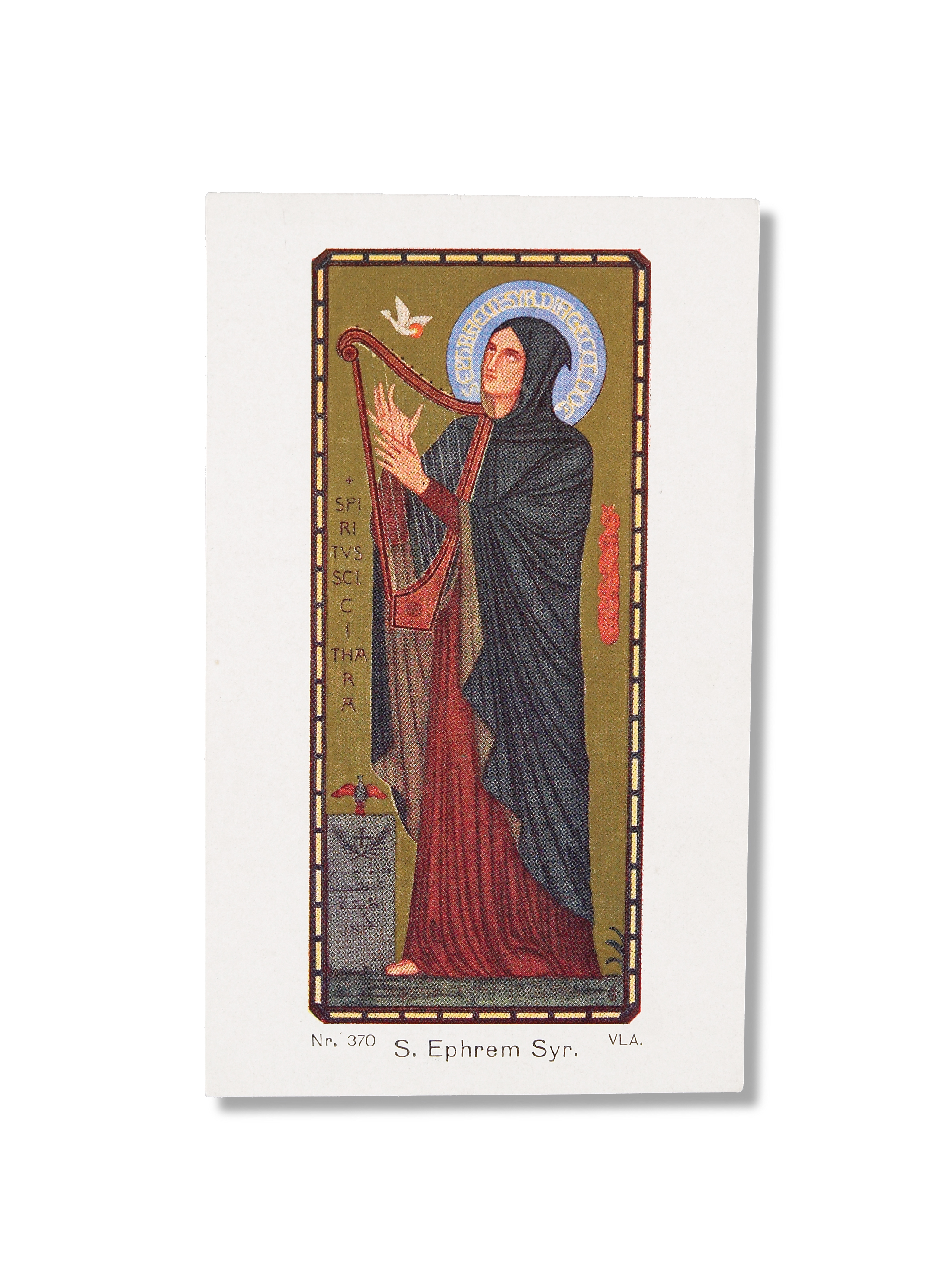
Syria / Ephrem of Syria, 306–373, Feast Day: June 9

Born into an early Christian community, Ephrem’s great body of writing—his homilies, poems, hymns, and dissertations on Christian philosophy—make him a pillar of both the Syrian and Roman Catholic churches. Driven out of his home in Syria, he found refuge in Edessa, where he lived in a cave and did much of his writing. His work, written in his native language, represents the Church before the influence of Europe.

Other patronages: spiritual directors, spiritual leaders

Peace / Norbert, 1080–1134, Feast Day: June 6

A German noble devoted to pleasure, Norbert took holy orders as a career move. When the horse he was riding was hit by lightning, Norbert awoke in a ditch a changed man. He became a traveling preacher, donated his wealth to the poor, and founded a movement of laypeople dedicated to reforming monasteries throughout Europe. He tried to settle a schism in the Church between Pope Innocent II and the antipope Anacletus.

Other patronages: Bohemia, Magdeburg (Germany)

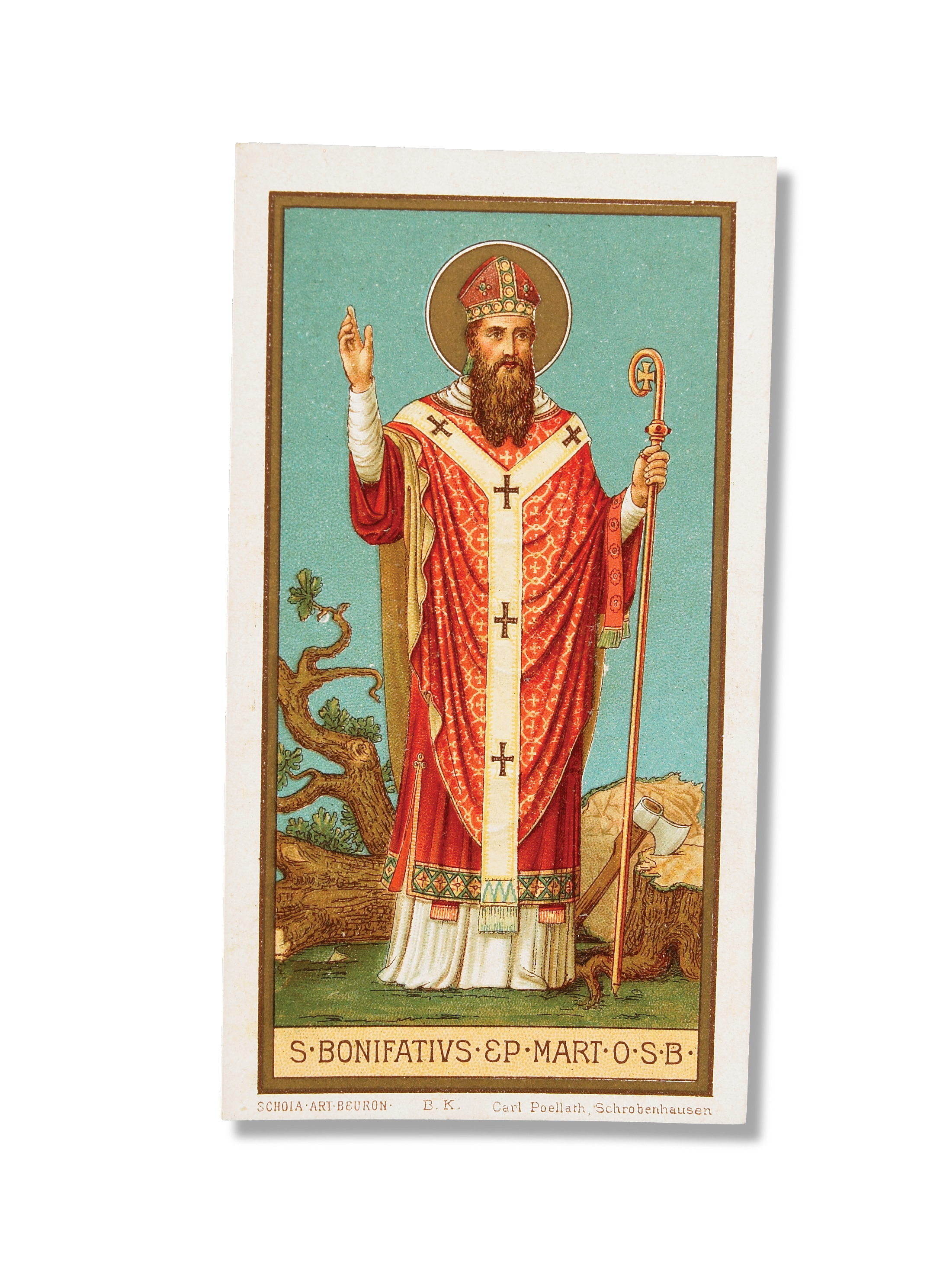
Germany / Boniface 680–754 Feast Day: June 5

An English monk, his interest in his Saxon roots took him to Germany, where he changed his name to Boniface and successfully evangelized the tribes that lived there. He chopped down the oak tree sacred to Thor, and when the crowds saw there was no retribution paid for this act, they began to follow him. A happy and popular man, he attracted many English priests and nuns to join him. He was murdered in the Netherlands while reading in his tent.

Other patronages: World Youth Day; brewers, file cutters, tailors

Adopted Children / Clotilde 475–545 Feast Day: June 3

A Christian princess from Burgundy, Clotilde married the king of the Franks and converted him to Christianity. After his death, her three sons fought amongst themselves and her daughter was forced into a terrible marriage. She adopted her three grandsons after the murder of their father. Two of these children were murdered by their uncles; the third, she safely hid in a monastery. She retired to Toulouse to escape these events and worked among the poor for the rest of her life.

Other patronages: queens; brides, death of children, disappointing children, the exiled, widows


Falsely Accused / Blandina d. 177 Feast Day: June 2

A slave girl converted by the Christian family she worked for, Blandina was imprisoned during a persecution in Lyons, France. Under torture, she refused to agree with charges accusing Christians of committing incest and cannibalism. Condemned to die in the arena, the lions and bears did not touch her as she comforted her dying compatriots. She was then tied in a net and gored to death by a wild bull, her body burned and her ashes thrown in the river.

Other patronages: girls, torture victims

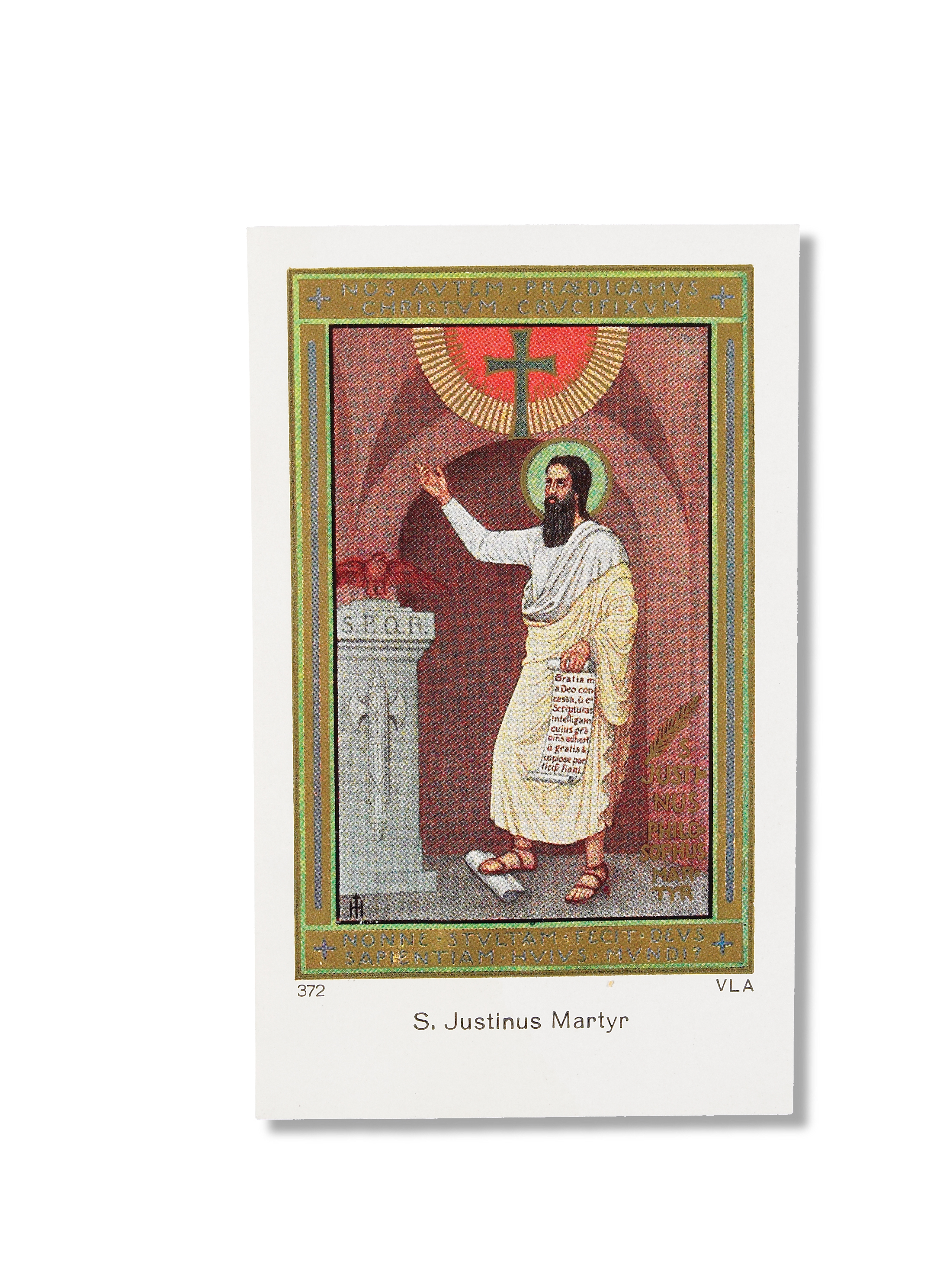
Philosophers / Justin Martyr 100–165 Feast Day: June 1

Born in Palestine to Greek parents, Justin was the first Christian philosopher. As a young man, he studied the Stoics, the Pythagoreans, and the Platonists, and he was introduced to Christianity at the age of thirty-three. Seeing no conflict between Faith and Reason, he traveled widely, debating those of different faiths and philosophies. When he won and argument against a Cynic in Rome, he was arrested and beheaded.

Other patronages: apologists, lecturers, orators

The above patron saints have been excerpted from the book: “Patron Saints: A Feast of Holy Cards” by Barbara Calamari and Sandra DiPasqua.
All images are from the collection of Father Eugene Carrella.

Novenas for June

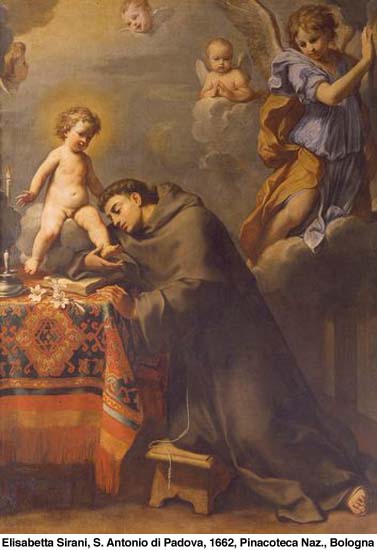
Saint Anthony of Padua

1195-1231

Always depicted with the baby Jesus, Saint Anthony of Padua is the most popular saint in the world. The unconditional love and kindness that are the essence of Saint Anthony’s nature are best represented by this story. While walking through his garden, an older relative heard the giggling and laughing of a baby. He looked up to see Anthony with the baby Jesus in his arms, happily carrying him and talking to him. The baby kissed Anthony and disappeared. In his novena, we beg Saint Anthony to whisper our request to the infant. Since babies are not judgmental, this incarnation of Christ will surely grant our petitions. Because of this special relationship, Saint Anthony is approachable by all, for large and small favors alike.

Born in Lisbon, Portugal, to noble parents, he was baptized Fernando. He took the name Anthony upon entering the Franciscan order. He intended to preach in Morocco and, if necessary die a martyr for his faith. Instead, after arriving there, he became very ill and was sent home. His ship was blown off course and he ended up in Messina, Sicily. He then attended the great meeting of all Franciscans, where he was very moved to be seated next to the order’s founder, Saint Francis of Assisi.

Saint Anthony was magnetic and charismatic. Sent by the Franciscans to be a traveling preacher around Lombardy and southern France, and with only prayer as preparation, he gave powerful speeches, overwhelming his audiences with his love for a more spiritual life. Saint Anthony was based in Padua, Italy, but he attracted huge crowds wherever he went. Many swore he radiated a holy aura.

Saint Anthony spent the last few years of his life working to help relieve the burden of debt from the poor of Padua. Saint Anthony’s Bread, devoted to feeding the hungry, is a charity that he started that is still in existence. After their novena prayers are answered, many people make donations to this organization in thanks.

Worn out by his travels, Saint Anthony died at the age of thirty-six. His reputation for compassion was so legendary, that even a few weeks after his death, when a child drowned in the river and his mother cried out to Saint Anthony in anguish, the child miraculously came back to life. Due to the many other miracles and answered prayers that followed his death, his consecration as a saint is the quickest on record, taking only one year.

Saint Anthony, credited with an extraordinary range of intercessionary powers and known as “The Wonder Worker”, is most famous as the saint of lost articles. After a novice borrowed his psalter and failed to return it, Saint Anthony prayed to get the book back. The novice then had a terrifying heavenly vision that forced him to return it. In 1263, when Saint Anthony’s tomb was reopened, it was found that his tongue had never decomposed. His tongue, jawbones, and vocal chords are on display in the cathedral at Padua. He is the patron saint of lost articles, the patron saint of the poor, and the patron saint of Portugal. Saint Anthony is usually depicted with the Infant Jesus, his returned psalter, and lilies to represent his purity.

Feast Day: June 13

Patron Saint of: Lost Articles, the Poor, Portugal

Invoked: against debt, to find what is lost

Novena to Saint Anthony of Padua

O holy Saint Anthony, gentlest of saints, your love for God and charity for his creatures made you worthy, when on earth, to possess miraculous powers. Miracles waited on your word, which were ever ready to speak for those in trouble or anxiety. Encouraged by this thought, I implore of you to obtain for me (mention your request here). The answer to my prayer may require a miracle; even so, you are the saint of miracles. O gentle and loving Saint Anthony, whose heart was ever filled with human sympathy. whisper my petition into the ears of the sweet infant Jesus, who loved to be folded in your arms, and the gratitude of my heart will be ever yours.

(Recite one Our Father, one Hail Mary and one Glory Be).

This novena can be said nine times in a row for nine days in a row.

It can also be said every Tuesday in church. Say this novena nine times in a row in front of a lit votive candle to Saint Anthony, for nine weeks in a row.

Excerpted from the book: “Novena: The Power of Prayer” by Barbara Calamari and Sandra DiPasqua.

The Sacred Heart of Jesus

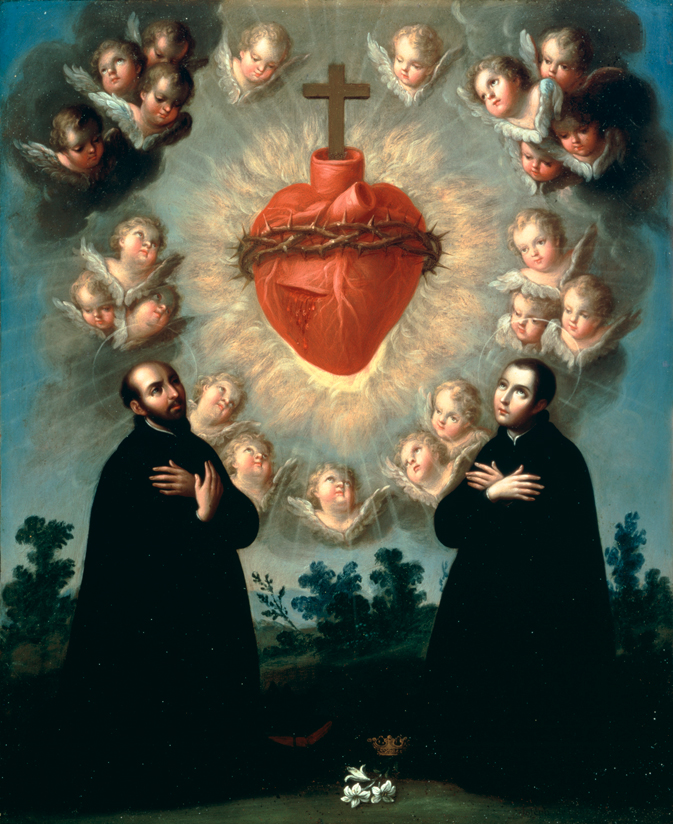
Devotions to the Sacred Heart of Jesus began in the seventeenth century.  Completely changing all perceptions of Christ as an image, Saint Margaret Mary’s vision of Jesus with his heart in flames, exposed and surrounded by thorns, became the predominant visual metaphor of his sacrifice and ardent love.  Devotion to the Sacred Heart promised to bring peace in the family, blessings on all undertakings, and a refuge at the hour of death. The heart is the seat of love in the body.  The wounded heart not only represents what Jesus took on for humanity at the crucifixion, but also his ongoing pain as he watches over the world. Jesus exposes his heart to all of mankind, leaving it in a vulnerable state. He asks all to call on him in a similar state of total trust.

On December 27, 1673, a young Visitation nun in Burgundy, France, named Margaret Mary Alacoque was praying in the convent chapel when she heard a strong inner voice that identified itself as Jesus Christ. Not fully trusting herself to receive a message from Christ, she began to believe in it as this voice spoke more clearly.  In subsequent visits,  Jesus explained to her that he wanted his heart honored in the form of human flesh, as it is represented in the now familiar depiction of the Sacred Heart. Christ also requested a specific devotion for honoring this aspect of his love for mankind.  Those who follow the devotion were to attend mass and take communion on the first Friday of each month for nine months in succession. In addition, one hour was to be spent on the Thursday night before the first Friday in meditation on the image of the Sacred Heart.  this was to serve as a reminder of the night Christ spent in the Garden of Gethesmane, as he contemplated his final hours on earth. As she envisioned an image of the Sacred Heart, Saint Margaret Mary heard the words, “Behold the heart which has so much loved men that it has spared nothing, even exhausting and consuming itself in testimony of its love. Instead of gratitude I receive from most only indifference, by irreverance and sacrilege and the coldness and scorn that men have for me in the sacrament of love.”

A slow and clumsy woman, Saint Margaret Mary was scorned by her mother superior when she informed her of this visitation. She was judged as delusional and barred from carrying out any of the devotions she was instructed to perform. She fell ill and was near death. the mother superior told her that if her health improved, she would take it as a sign that these were truthful revelations. Saint Margaret Mary prayed and recovered within one day.  The mother superior kept her word and an understanding confessor, Claude de La Colombiere, became a great ally in getting church officials to recognize the importance of the devotion of the Sacred Heart of Jesus. Though Saint Margaret Mary’s visions were never officially sanctioned, the sacredness of the devotion was recognized on its own merit. Saint Margaret Mary Alacoque was canonized in 1920.

The image of the Sacred Heart of Jesus is displayed in many homes as it is believed to bring Harmony to the Family.

The Feast Day of the Sacred Heart of Jesus for 2010 is: June 11

Novena of Confidence to the Sacred Heart of Jesus

O Lord Jesus Christ, to your most Sacred Heart I confide this intention.

Only look upon me, then do what your love inspires.

Let your Sacred Heart decide, I count on you. I trust in you. I throw myself at your mercy.

Lord Jesus, you will not fail me.

(Mention your request).

Sacred Heart of Jesus, I trust in you.

Sacred Heart of Jesus, I believe in your love for me.

Sacred Heart of Jesus, your kingdom come.

Sacred Heart of Jesus, I have asked you for many favors, but I earnestly implore this one.

Take it, place it in your open heart.

When the Eternal Father looks upon it, he will see it covered with your Precious Blood.

It will no longer by my prayer, but yours, Jesus.

Sacred Heart of Jesus, I place all my trust in you.

Let me not be disappointed.

Amen

Say this novena nine times in a row for nine days in a row.

(Excerpted from the book: “Novena: The Power of Prayer” by Barbara Calamari and Sandra DuPasqua).

Image: “Sacred Heart of Jesus with Saint Ignatius Loyola and Saint Louis Gonzaga”  by Jose de Paez, Mexico, 1770

Novenas for May

SAINT JOAN OF ARC

 1412-1431

Feast Day: May 30

Patron of: France, Orleans, Rouen, captives, opposition of Church Authorities, radio workers, rape victims, shepherds, wireless telegraph workers, women in the military,

Invoked: against fires in woodpiles, for strength in face of opposition

Symbols: armor, standard, sword

 “I place trust in God, my creator, in all things; I love Him with all my heart.

            Joan of Arc

            Saint Joan of Arc (or Jehanne d’Arc ) is both a secular heroine and a Roman Catholic saint. Known as La Pucelle, or “The Maid” to her countrymen, she is credited with being the galvanizing force who returned French rule to France.

              Joan D’Arc was from a comfortable peasant family of five children. Already known in the village as a pious child, the adolescent Joan was at work in a garden when she heard a disembodied voice in a blaze of light. The voice gave her a simple task :pray often and attend church.  After time it revealed itself to be Michael the Archangel. The angel told her that she would soon be visited by Saint Margaret of Antioch and Saint Catherine of Alexandria, two ancient martyrs whose statues were ensconced in her village church. In her later testimony, she said the martyr’s voices began visiting her frequently, eventually allowing her to gaze upon them as well. Fearing disapproval from her father, Joan never told anyone about these visits. And she vowed to retain her virginity for as long as God wanted it.

            After two years the three saints revealed Joan’s true task: she was to save her countryby first taking Charles to Rheims to be crowned king and then by driving the English out of France completely. She had no idea how an ignorant peasant girl was to accomplish this. By the time she was 16, the voices grew more insistent and ordered Joan to travel to the next town to see the commander of Charles’ forces, Robert de Baudricourt and tell him that she was appointed to lead the future king to his coronation.

            Chaperoned by an uncle, she did as she was told. The commander laughed, Your father should give you a good whipping.” He also ignored Joan’s prediction that Orleans, the last remaining city in French hands on the Loire, would fall to the English if he did not listen to her. She returned home in  defeat, her voices  hounding her to complete her mission. When she told them,  “I am a mere girl who knows not even how to ride a horse.” They answered, “It is God who commands it.” She secretly returned to Baudricourt who was unnerved by the fulfillment of her prediction. Orleans was ready to fall. Desperate for any help at all, and troubled by the girl’s otherworldly confidence, he recommended that the future king, known as the Dauphin, grant her an audience. Because the eleven day journey to Chinon was through enemy territory, Joan was disguised in man’s clothing.

            Tales of Joan’s seemingly supernatural abilities preceded her. As a test, Charles dressed a member of his entourage in royal robes while he stood among the throng of his courtiers. All were stunned when the girl walked in and immediately advanced towards the real Charles saying, “Most illustrious lord Dauphin I have come and am sent in the name of God to bring aid to yourself and to the kingdom.” Privately, she related to him a secret prayer he had made the previous All Saints Day asking God to restore his kingdom if he was the true heir to the throne and if not, to punish only him for his impudence and let his supporters live in peace. Unnerved, but not ready to accept this proof of her calling, Charles arranged for Joan to be interviewed by a group of theologians in Poitiers. They questioned her for three weeks before they granted their enthusiastic approval, amazed at how such an uneducated person could hold her own against learned scholars. They recommended that Charles recognize the girl’s divine gift and grant her titular command of the army.

            A small suit of armor was made for Joan and she designed a banner for herself with the  words “Jesus Maria”. Her voices told her to carry an ancient sword that would be found buried in the altar of the church of Saint Catherine-de-Fierbois. When it was easily found, Joan’s reputation as a messenger from God began to spread in the general population. Allegedly this sword was used by Charles Martel in the 7th century in his defense of France against the invading Saracens. Men who would normally not be inclined to join the army, enlisted. Joan insisted that all soldiers go to confession and receive communion. She banished the prostitutes that routinely followed troops. There are many written accounts of men who served with Joan of Arc who declared that despite her physical beauty, they never “had the will to sin while in her company”.            

 After unsuccessfully calling on the English to leave French soil, the military campaign to lift the siege of Orleans began on April 30. Charles’ commanders considered Joan a mere mascot and thus refused to take her strategic advice. After four days of witnessing their floundering efforts, Joan charged into battle waving her banner. The vision of this fearless young girl on a mission from God turned the tide of the battle turned for the French army. By May 8th the English were forced to retreat and the siege of Orleans was lifted. Just as her voices had predicted, Joan endured a wound during the fighting. They also warned that she had very little time and had much to accomplish within the next year.

            At her insistence, all English positions were cleared on the way to Reims. During these battles through one town and another, Joan took the lead inspiring many common citizens to follow the troops. The English were routed completely suffering a loss of 2200 men, while the French army lost only three.   With Joan organizing troop and artillery placement, the French army easily accomplished a feat which had seemed impossible to them – they drove the English out of Reims so that Charles VII could be crowned there, as all French kings had been before him. Joan held her banner as she stood next to Charles during his coronation on July 16, 1429.   Part of her mission was complete.

            Though she was in a great hurry to accomplish the rest, Charles VII became cautious and followed his advisor’s recommendation to marginalize the seer. Against Joan’s wishes he signed a truce with the Burgundians, which gave the British time to regroup. He refused to support his army in an assault on Paris, a fight in which Joan was wounded and forcibly removed from the battlefield.  By the Spring of 1430 Joan’s voices told her that she would be captured before the Feast of John the Baptist. This occurred in Burgundy on May 24th . At that time, it was common practice to ransom off important captives. Charles VII could have offered to pay her ransom but instead  ignored her plight. The inner circle of his court were discomfited by Joan’s strangeness. They convinced Charles that she had fallen out of favor with God. She was sold to the English who imprisoned her in Rouen.

            Since there were no rational explanations for her overwhelming successes, the English vowed revenge on Joan, considering her a witch with satanic powers. In order to destroy her reputation as a religious visionary sent by God, they wanted Joan tried in an Ecclesiastical Court for witchcraft and heresy. Once this was proven, they could then charge that Charles VII was made king by diabolical means and reassert their claims on the French throne. Pierre Cauchon, the Bishop of Beauvais willingly adopted this plot in order to realize his own political ambitions.

            Joan was illegally held in a secular prison guarded by men who repeatedly threatened her with rape. When her virginity was proven, she could not be charged with witchcraft. She was  interrogated from February 21 to March 17 by a relentless  panel of 47 judges, a majority of whom came from the pro-English University of Paris. After an attempted escape, Joan was imprisoned in a cage, chained by the neck, hands and feet and she was forbidden to partake in any of the sacraments. Despite their avid attempts to brow beat her and put words in her mouth, she calmly deflected the panel. These trial transcripts exist today, and are a remarkable testament to the  brilliance of her simple answers. Many times, she instructed the judges to look up testimony she had previously given – exact to the day and hour. On March1 she further infuriated the court by stating that “Within seven years’ space the English would have to forfeit a bigger prize than Orleans.” (Within six years and eight months the English would abandon French soil entirely).

            By May, the judges had written up their verdict, 42 of them agreeing that if Joan did not retract her statements, she would be handed over to the civil powers to be burnt at the stake. Filled with fear, Joan signed a two line retraction. A document detailing her acts as works of the devil was substituted in the official record. Because she had done as they ordered, they could not execute her and the British were furious. It is not known if Joan was so afraid of the threat of rape by her guards or if the dress she had been wearing during her trial was taken away and her male costume the only thing left to her, but when she appeared before the court on May 29th dressed as a man, she was declared a relapsed heretic. Her masculine attire served as proof of her crime and she was burned at the stake in the town square the next day. On the morning of her execution she was visited by the judges. She solemnly warned Cauchon that he would be charged by God for the responsibility of her death. She insisted her voices came from God and had not deceived her. Her last word, as she was consumed by flames was, “Jesus”. In order to discourage the collection of relics, her ashes were thrown into the Seine.

            A reversal of her sentence was granted by the Pope in 1456, twenty five years after her death citing of the unfairness of her judges and the fact that the court illegally denied her right to appeal to the Holy See. 

             Joan D’Arc remains one of the most popular historical figures in the world. Poets, Painters, Writers and Filmmakers have ensured her role in popular culture. She is the only person in written history, male or female,  to command a nation’s army at the age of 17. As a French patriot, she was a propaganda figure in both World Wars. She was finally declared a saint in 1920.      

                       In art, Joan D’Arc wears her suit of armor and carries her “Jesus Mary” banner. Because of her voices she is the patron of radio and telegraph workers. She is patron of  women in the military and shepherds because these were her occupations. She dressed in men’s clothing to avoid the threat of rape so she is the patron of rape victims. Most importantly she is the patron of the nation she saved, France.

                         Novena to Saint Joan of Arc

             Glorious Saint Joan of Arc, filled with compassion for those who

            invoke you, with love for those who suffer,

            heavily laden with the weight of my troubles,

            I kneel at your feet and humbly beg you to take my present need

            under your special protection (intention here).

            Vouchsafe to recommend it to the Blessed Virgin Mary,

            and lay it before the throne of Jesus.

            Cease not to intercede for me until my request is granted.

            Above all, obtain for me the grace to one day meet God face to face

            and with you and Mary and all the angels and saints praise Him

            through all eternity.

            O most powerful Saint Joan, do not let me lose my soul,

            but obtain for me the grace of winning my way to heaven,

            forever and ever. Amen

Excerpted from the book: “Saints: Ancient and Modern” by Barbara Calamari and Sandra DiPasqua.