One person on earth for one forgotten soul in purgatory!
Lets remember!
O merciful God, take pity on those souls who have no particular friends and intercessors to recommend them to Thee, who, either through the negligence of those that are alive, or through length of time are forgotten by their friends and by all.
Spare them, O Lord, and remember Thine own mercy, when others forget to appeal to it. Let not the souls which Thou has created be parted from Thee, their Creator. They are Thy work, and though they have sinned, they have been redeemed by Thee.
Vouchsafe, therefore, to look upon them and to deliver them from the intolerable pain of absence from Thee; the light and love of all Thy creatures. Oh! place them in the number of Thy blessed Saints and citizens through Jesus Christ their Savior. Amen.
In this fascinating, candid interview, Sister Mary Catharine, OP, takes Regina Magazine on an intimate journey through the life of a thriving cloistered community of Dominican nuns.
Q. Where is your Order? How long has it been there?
Our Monastery of our Lady of the Rosary is in Summit, New Jersey, a bedroom community of New York City and a quick 52 minute train ride from the city.
Summit is a very Catholic city with a small town feel. We began our monastery 94 years ago in 1919. Summit was considered a healthy place to live away from New York. It was touted as the “Denver of the East” for its high altitude!
Q. Can you tell us a bit about its founding? About the Dominicans in general — brief history?
The Nuns of the Order of Preachers were founded by St. Dominic and his bishop, Bishop Diego in 1206, ten years before the friars. So, we are their elder sisters!
Actually, St. Dominic never planned to found anything. Stunned by the Albigensian heresy rampant in southern France he began preaching to bring the people back to the truth.
The Albigensian hersey was based on a dualist god: the god of spirit (the “good” god) and the god matter (the “evil” god). Because of their austere way of life the heretics attracted many people. Converting these people back to the Catholic Faith was not easy.
A group of women, used to living the austere life of the heretics, converted to the Faith through the preaching of St. Dominic. A man of great compassion, St. Dominic saw that he now needed to take care of their physical needs.
Many of these women were disowned by their heretic families and had no place to live. So, he gathered them together at a little abandoned church, Notre Dame du Prouilhe and gave them a habit, rule of life, etc. They were desperately poor and St. Dominic would beg for them.
From the very beginning these first moniales were associated with the Order through their prayer and penance. In fact, the first monastery itself was called “the Holy Preaching” which is a powerful testimony to the witness of monastic-cloistered life.
The early nuns were called the Sister Preacheresses although they were cloistered and never went out to preach! The vocation of a Nun of the Order of Preachers is unique because we are fully monastic and contemplative but part of an evangelical and apostolic Order. One has to have a deeply apostolic heart yet find its expression not in the apostolate but in a life of hidden prayer.
Q. Tell us about the famous St. Dominic
For the first 10 years St. Dominic preached almost entirely alone in southern France. He had companions for a while but then they left. I’m sure he received great comfort in having the monastery as his “home base.”
St. Dominic would preach all day and pray all night. We know from the testimonies of the early friars that he wasn’t a quiet person when he prayed! He would groan and shed copious tears. He would cry out, “O Lord, what will become of sinners!”
His life of prayer and preaching is lived out in the Order by the Friars and Nuns in a complementary way: the friars go out to preach while the nuns carry within the innermost sanctuary of their compassion all sinners, the downtrodden and the afflicted. Like Esther, they go before the King pleading for the salvation of all. Like Moses, they raise their arms in prayer while the battle rages below.
What is commonly not known is that the friars and the nuns are united not just spiritually but juridically through our profession of obedience to the Master of the Order. Together we form the Order of Preachers. We have distinct but complimentary ways of expressing the Order’s mission to “preach for the salvation of souls”.
Q. What is a contemplative’s life like?
To answer this question fully would take several books and at the same time it can’t really be expressed!
I think the first word that comes to mind is JOY. Not that there aren’t hardships as in any vocation but through it all there is a deep abiding joy because I am totally consecrated to God to love and praise Him. The contemplative vocation is a gift beyond words and one for which I will be thanking God for all eternity!
For Dominican contemplative nuns the Word of God is primary. Our constitutions state that the monastery is to be a place where “the Word of God can dwell abundantly in the monastery.”
So, first we ponder the word through lectio divina and through theological study, we sing Mass and the entire Divine Office; we listen to God’s Word as it is expressed through our sisters.
Q. How is your Order governed?
Our manner of government is ordered so that our fraternal life can be “one mind and heart in God”. This means we come together as a chapter to discuss things so we can make a decision that is truly centered in God and not just what I want. This isn’t always easy. It requires that we listen to our sisters and that we be willing to be changed. We have to allow grace to be operative in us. The goal is not majority rule but consensus.
Q. What is your work and daily life like?
Our life is intensely liturgical. Holy Mass and the Office shape our day. Everything else is fitted in around it. So, with liturgical prayer, private prayer and our privileged hours of the “adoring Rosary, which is praying the Rosary before the Blessed Sacrament exposed in the monstrance we have about 5 to 6 hours of prayer each day.
Our work is simple, like that of Our Lady at Nazareth. We do the cooking, cleaning, sacristy, laundry, answer the mail, pay the bills, the garden, soap department, etc. Young women are always surprised at how full our days are. You go to bed tired at night!
During recreation times we like to just be together to talk, play games, go for a walk. There is a lot of laughter. Someone once said that our recreations are “high energy!”
Q. Many people, if asked, would probably guess that living in a cloister is very limiting. Is this true?
The cloister frees us immensely! One of the biggest fears in those discerning a contemplative vocation is that the cloister is seen as squashing freedom but it is just the opposite.
The cloister broadens us. It frees us from so many cares and concerns, even something as simple as not minding a stain on my scapular! This freedom isn’t from things so much as for something, really for Someone!
The enclosure is the ‘Garden Enclosed’ of the Song of Songs. Our life is entirely centered on Christ our Spouse alone. Papal enclosure is a great gift of the Church that allows us to live our contemplative life well.
When I have to leave the enclosure for something necessary I am always so glad to be back. The world is so noisy, both audibly and visually. I really don’t understand how people stay sane!
Q. Your Order never gave up their habits. Do you think this has affected your stability, as compared to other orders that did?
I entered long after the upheavals of the 60’s but I have never heard either the nuns or the friars even question whether we should give up the habit. The habit is our Blessed Mother’s gift to us and we treasure it dearly.
Actually Dominicans consider only the scapular as the habit and is the only part blessed. Well, the cloistered nuns also have their veil blessed during a beautiful part of the Solemn Profession rite called the Blessing and Imposition of the Veil. The veil is blessed and then the prioress solemnly veils the newly professed. It’s very beautiful.
Every nun in the world wears the habit! There might be slight variations of hem height, sleeve width, veil style but we all wear the habit. Get a group of nuns together at a meeting and eventually we’ll be asking each other the important question: “Where do you get your fabric from?” The habit is a non-issue.
Q. So where does the stability come from?
I think our Order’s stability comes first from a tremendous gift of God. We are nearly 800 years old and we have never had a division. We’ve come close but it hasn’t happened. There is only one Order of Preachers. One constitution for the friars: one constitution for the nuns.
Do you realize what a gift of God’s love this is? In his address to the Poor Clare nuns at Assisi, Pope Francis emphasized that the devil wants to destroy a community by causing division. The Order of Preachers from the very beginning has had a great devotion to our Lady and I think it is her protection that has kept us united.
Although St. Dominic died just five years after the Order was founded he left us with such a remarkable charism and form of government that it has shaped the Order these 800 years. Our manner of government is crucial to our stability. And most of all the preaching mission of the Order is perennial for each generation and time. One of the wonderful things about being such an old Order is that we’ve made every mistake in the book but we trust in God’s mercy and that of our sisters and brothers.
Q. How are your vocations doing?
In the past eight years we’ve had twelve postulants enter and seven have persevered so far. This is such a blessing. Our young sisters come from several countries and all over the USA. Each sister is so different!
Q. Can you tell us some recent vocation stories?
Our Sr. Mary Magdalene of the Immaculate Conception, O.P. is a native of Kansas and in college was part of the party scene. One night she lay in bed and realized that if she continued along this path she would die. It was a moment of grace when she says she was given the opportunity to choose. Gradually, she began attending Mass at the Newman Center at college that had a holy and dynamic priest.
One day she told him she thought she had a religious vocation; an idea that terrified her. At his suggestion she visited a Carmelite monastery nearby to experience cloistered life which she didn’t even know existed. At the end of her weekend she said, “These nuns are crazy and I think I might be as crazy as they are!”
She began a 54 day rosary novena and made the total consecration to Our Lady according to St. Louis de Monfort which was a source of great grace as well. She wrote to many monasteries and became attracted to the Dominican charism. About the same time the Newman Center at college received the total 10 tickets for the state of Kansas for the Papal Mass of Pope Emeritus Benedict at Yankee Stadium, NYC. This was in 2008. Because this was considered the official Mass of the Holy Father’s visit to the United States every diocese in the country received a certain number of tickets. As you can imagine the further west, the fewer tickets!
She wrote to our monastery asking if she could visit and in her less than 24 hour visit and on the 57th Day of her Rosary Novena she knew that this was the place God was calling her. She is now preparing for Solemn Profession next year.
Q. How do you sustain your life, financially?
We are mendicant and dependent on Divine Providence. God always provides and we have many wonderful friends and benefactors. Whenever there is a needed repair the Lord provides with unexpected resources and it can be done! God is so good to His spouses!
We also have a small business selling the soaps, creams, lip balms, room sprays, candles, woodcraft we make and books we publish. Mostly this is through the internet and the monastery’s tiny gift shop although we have some wholesale customers as well, mostly Catholic gift shops, retreat centers, etc.
Q. How did the idea for a soap and candle business come about?
We have a guild of about 70 volunteers who help us by serving as receptionist, drivers, etc. and every year we make a little Christmas gift for them. For some reason, lost in time, it’s the novice mistress’s responsibility to take care of this and someone suggested soap to me. Seven years ago, one Sunday afternoon in August I spent time searching the internet about how to make soap and learned a lot!
At about the same time our daily offerings were really down—sometimes receiving no more than $5 a day—and we had just received 4 postulants so our healthcare insurance really went up! We began selling our soap in the gift shop. We were going to have only 5 varieties. That lasted about 6 weeks. We now make hand crème and lip balms using our own formula, room sprays and now candles.
We are a relatively young community. I think our average age is about 47, so that means we have a large healthcare insurance expense. Since, unlike the active sisters, we don’t teach or bring in a paycheck, the small income from our Seignadou Soaps has proved to be very helpful toward meeting those costs.
Q. Who is your chief soap-maker?
Right now the novitiate sisters are assigned the work of the soap room. When a postulant enters she gradually learns all aspects of it. Although there may be sisters who are more “expert” than others, tomorrow another may be given the assignment of learning the craft while the “expert” is assigned to another job in the monastery.
It works out well because the soap room is only busy at certain times of the year. The sisters in the novitiate have formation classes and that is the priority.
Q. What kind of people come to pray at your chapel?
People from all walks of life come to our chapel. The doors are open from 6AM, when we pray Lauds, until about 7PM at night and everyone is welcome. All day people come to be with our Lord. Some are regulars who come daily and spend hours. We have several “rosary groups” who use our chapel on certain days. For example, we have mother-daughter group that prays the Rosary every 1st Thursday of the month. Other groups schedule a time to visit our chapel.
Some people come to our monastery to purchase our Seignadou Soap products and find that we have a chapel open all day long. Amazed, they ask, “You mean I can come and pray here?” We never thought of soap as a means of evangelization!
Q. Why else do they come?
We’re not only a monastery but a shrine, the first shrine in the USA to our Lady of the Rosary. But we’re not a touristy type shrine. The focus is on spending time with Jesus in the Blessed Sacrament, which is exposed every day and three nights a week.
We also have a replica of the Shroud of Turin that dates back to 1624. It was commissioned by the Duchess Maria Magdalena, the wife of Cosmo di Medici. It was laid on the real Shroud and the story goes that the stain on our shroud copy appeared when it was lifted up from the Shroud.
In 1988 a team of scientists did a “dry run” on our shroud copy in preparation for their testing on the real Shroud and they did some tests of the side wound stain on our copy. They said that the DNA was the same on both. Our shroud copy in our chapel is the source of much devotion for many people who visit and that is even more important.
Q. I’ve heard that the beauty of your liturgy is quite a draw.
Our liturgy draws people to our monastery. It’s not unusual for someone to call up to ask the times for when “the nuns do the singing”. Often someone else has told them about the beauty of our chant.
We have a dear friend who is Jewish and an artist. One evening she was worried about some family problems. She decided to visit the chapel on the advice of a Catholic friend. She heard us singing Vespers behind the grille and was so taken by the beauty of the chanting that she contacted us and eventually did a trilogy of books featuring the monastery as seen through her artwork.
Often, at Rosary and Sext at 11:30 PM or Office of Readings and None at 3:00 PM, it’s not unusual to see 10-15 people in the extern chapel. We’re happy they join us for the Office as we believe that this is the most important gift we can give to people—the opportunity to simply BE with Jesus who is here for us 24/7!
Our monastery is situated on a hill in a city called Summit. Like our father, St. Dominic we are meant to radiate the light of Christ. Not in words but in with our life. Eight hundred years later, we are still Sister Preacheresses, still a Holy Preaching!
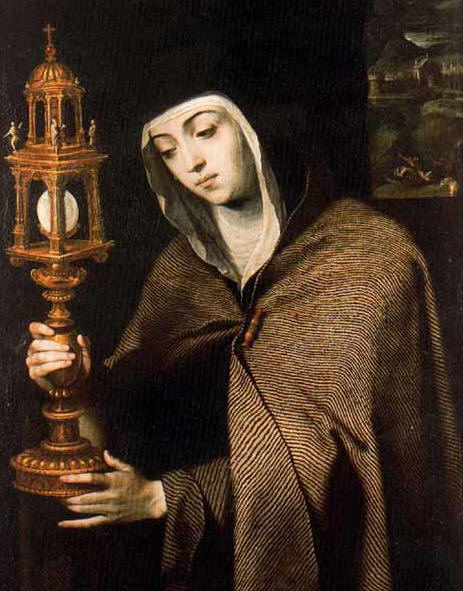
The mysterious world of being a Poor Clare. Contemplative nuns who live a life of prayer, community and joy.
The first thing you need to know is that a Poor Clare is a nun – meaning that she lives in one monastery (usually) for her whole life. She takes solemn vows that can only be dispensed by Rome. BUT the second thing you have to know – is that a Poor Clare Nun is not a Benedictine, Dominican, Visitation or Carmelite nun. She is a Poor Clare nun.There is a world of difference between these other beautiful orders and Poor Clares. NO, not all nuns are alike.
Each Poor Clare community is autonomous. Not all Poor Clares dress alike, work alike or keep the same daily schedule. If you go from monastery to monastery you will feel the spirit of Joy and Communal gifting of each other – you will experience the warm bond of Joy, Simplicity and happiness of being a Franciscan. BUT you will always notice a difference and know you are in a different monastery. Poor Clares Monasteries are individual and unique as is each sister in them. So please… in your journey of exploring the joyful world of Poor Clares – there is no “template” for what a Poor Clare should look like, sound like and be like. Because there are no two alike.. and that is how the Holy Spirit works.
The Poor Clare Sisters number over 20,000 sisters throughout the world in 16 federations and in over 70 countries. Most monasteries have from four to thirteen members. Some have larger communities but the Poor Clare charism is one of family and St. Clare guided us that small communites were much better to keep this family spirit than larger ones. So when a community gets to a certain number we usually start new ones rather than just keep getting bigger. Just one of the differences you will see as you walk with us.
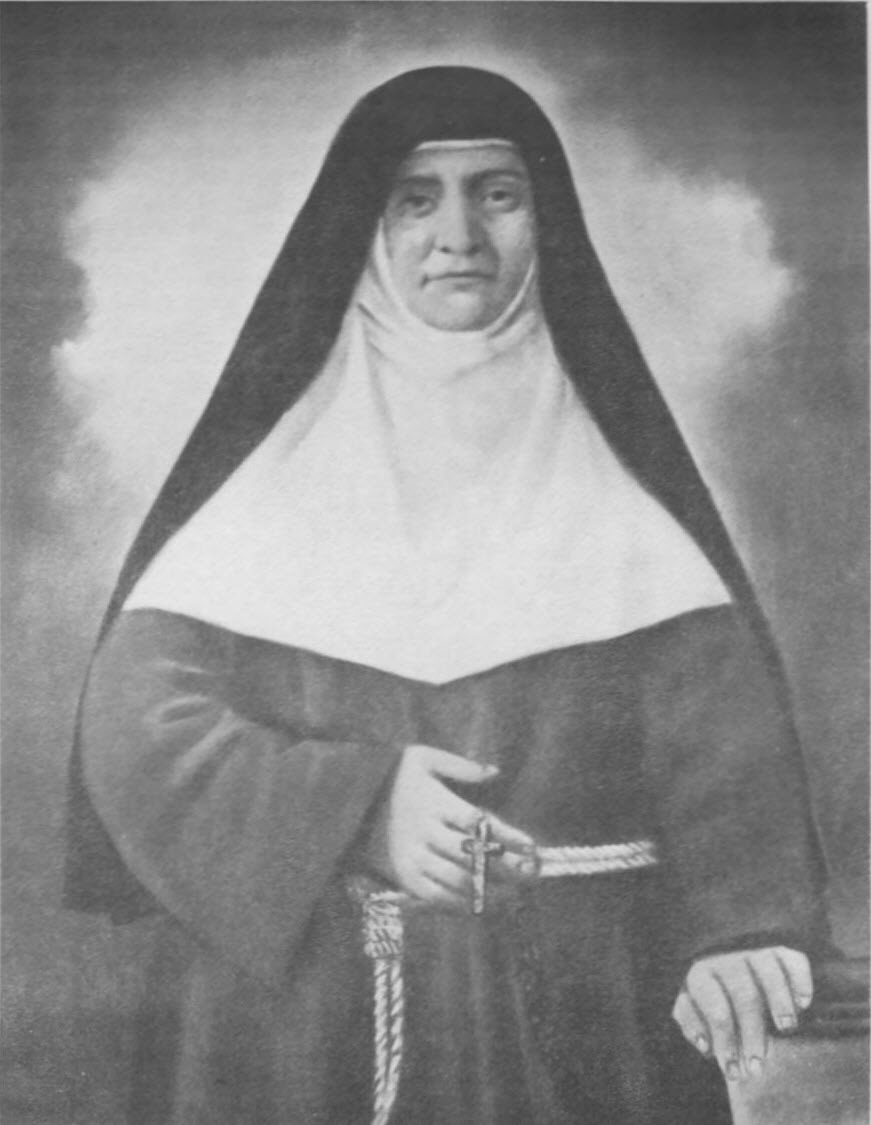
Mother Mary Maddelena Bentivoglio of the Sacred Heart of Jesus 1834-1905
Countess Anna Bentivoglio was a climber! From the age of five when she climbed onto a ledge in great St. Peter’s in Rome (to the horror of Count and Lady Bentivoglio!), to later life. This was the aim of her life – to climb – she would do so physically and spiritually.
Her yearning for religious life began when she followed her sister, Constance, into the Poor Clares. She longed for more austerity and asked for special penances. Then Pope Pius IX commissioned the two Bentivoglio sisters – Mother Magdalen and her sister Constance – to go to America. They first moved to Marseilles, France, were incorporated into the Poor Clares of the Primitive Rule, then on to the “New World”, arriving on Columbus Day, October 12, 1875. The first established monastery of the Order of Saint Clare was in Omaha, Nebraska, in 1878.
Following her example, today’s Poor Clares endeavor to follow this spiritual climber as they live out their daily life in simplicity and joy.
A Day in the Life
Our life is structured around an horarium, a rhythm of prayer throughout the day. The specific times of prayer are marked by the ringing of the bells, which symbolize the voice of God calling us to prayer. The Divine Office (also known as the Liturgy of the Hours), the Mass and the Eucharistic Adoration are the main framework around which our life of prayer revolves. It also includes manual labor, duties and community recreation which give balance to our times of prayer. In this rhythmic exchange of prayer, labor, and rest, we are liberated from the distractions of the world, free to dedicate our entire selves to living the Eucharistic Mystery.
We daily devote ourselves wholly to God alone:
by daily and personal conversion to the Gospel
by offering loving adoration, praise, and thanksgiving to God on behalf of all people
by our efforts to live and work contemplatively and to deepen our union with God in times of silence and solitude
by our intercessory prayer for the Church and all people,
by our efforts to love and serve our Sisters in true Community
by extending spiritual and material assistance to others in ways compatible with our contemplative life
by showing Sisterly hospitality and care to those who come to our monastery and in our relations with all persons
This is our cherished gift and call from our gracious God for which we are deeply grateful.
Horarium
5:15 AM Wake up—Rise and Shine!
6:00 AM Meditation
6:30 AM Morning Prayer followed by Mid-Morning Prayer Breakfast Work
9:00 AM The Holy Sacrifice of Mass—Prayer of Thanksgiving is made privately Office of Readings—On Sundays we move this to 11:30 and combine it with Mid-Day Prayer
10:15 AM Work for fully Professed Sisters Class and/or Work for Formation Sisters
11:45 AM Mid-Day Prayer
12:00 PM Dinner in Silence followed by dishes Recreation at table on Sundays and Thursdays Free time or Work
3:00 PM Mid-Afternoon Prayer followed by Divine Mercy Chaplet Work for fully Professed Sisters Class and/or Work for Formation Sisters
4:30 PM Evening Prayer followed by Communal Rosary—this becomes our Holy Hour for vocations for our Monastery on Fridays throughout the year and on Sundays in Lent and Advent
5:30-6:45 pm Supper in Silence followed by Dishes with Community Recreation on Mondays and Tuesdays Ongoing Formation for the solemnly Professed Sisters on Thursdays; Otherwise directly to Night Prayer
6:45 pm Night Prayer followed by personal time. On Sundays we have an optional movie recreation following this On Tuesdays and Thursdays we have our nocturnal adoration
9:30 pm Be in your rooms
10:00 pm Grand Silence and lights out—Good night sleepyheads!
*Each Sister is privileged to have one hour of adoration a day, an hour of nocturnal adoration twice a week, and adoration during a meal time each week.
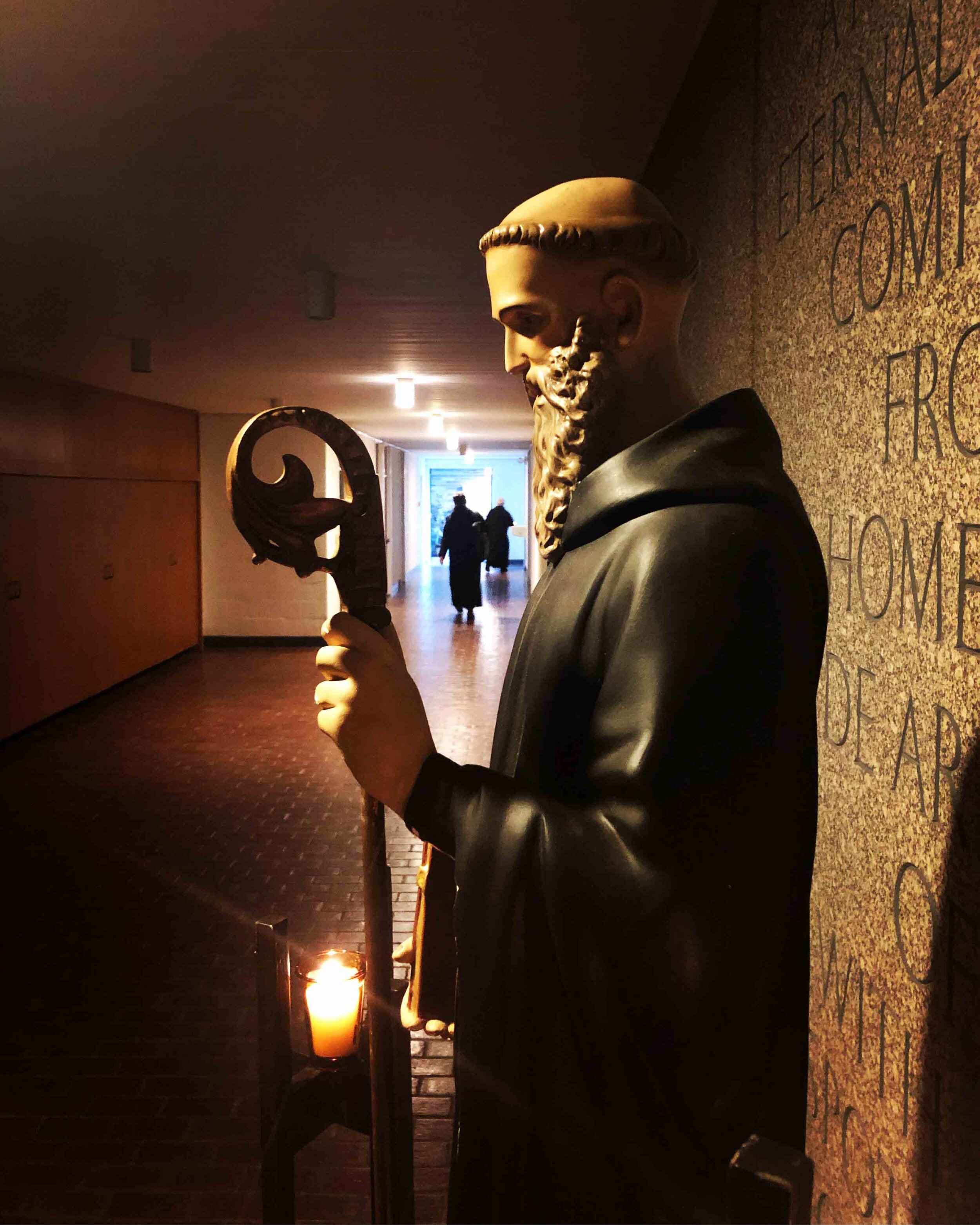
Traditionally, AD 529 is considered to be the year in which St Benedict founded the monastery at Montecassino. He died and was buried there around 547. Some decades later, the monastery was destroyed and not rebuilt for a long time. The monastic community and the living tradition of Benedict seemed to have disappeared.
The Spreading of the Rule
However, copies of his Rule survived in Roman libraries. Around 594 Pope St Gregory the Great praised this Rule and its author, increasing the popularity of both. Next, the Rule is found in some monasteries in Southern Gaul (modern France) and elsewhere, normally used by the abbot together with rules written by other monastic fathers to help him to guide the community. In the early 8th century, monks from England proudly proclaim that they follow only the Rule of Benedict – the first genuine „Benedictines“. They popularize this rule further through their mission in continental Europe and eventually in 816/17 an important synod declares Benedict’s Rule binding for all monks. Throughout the Carolingian empire which covers modern France, Belgium, Holland Switzerland, Germany, parts of Italy and Austria, hundreds of monasteries of monks and nuns come now under the Rule of Benedict. Simultaneously, the observance of these monasteries is unified, even in areas where the Rule left details to the discretion of the abbot. In the Latin West, religious life is now mostly Benedictine. The monasteries become important centers of religious life, but also of political administration, of economic development and of learning, both theological and secular. Books are written and copied in the scriptoria (writing rooms) of the monasteries, and abbey schools train the clergy and the ruling elite. The monks dedicate themselves mainly to liturgical prayer, whose amount gradually increases. The monasteries own farms and sometimes whole villages, whose peasants sustain the monks with part of their produce. In the ninth century the papacy starts to protect some monasteries from the interference of noblemen and local bishops. Cluny in Burgundy, founded in 910, eventually establishes a huge family of monasteries under one abbot. In the 12th century several hundred houses belonged to it.
Decays and Reforms
The wealth and social role of the monasteries attracts also criticism, and several reform movements try to return to simpler ways of life and a more original understanding of Benedict’s rule. The Cistercians have the greatest impact. Within a short period several hundred monasteries of „white monks“ are founded, established as a clearly defined order with an efficient organization that balances unifying elements like the general chapter of all abbots and clear common principles with local autonomy and supervision through visitations.
In 1215 and in 1336 the papacy attempts to give a similar structure to the remaining „black“ Benedictines, initially with little success. Meanwhile, life in Europe has shifted from the countryside to cities. Newer orders like the Franciscans and the Dominicans respond to the spiritual and intellectual desires of city dwellers. While Benedictines continue to be found all over Europe, they are no longer the main protagonists of religious life.
From the 15th century onwards, monasteries try to protect themselves from the interference of secular or ecclesiastical lords by forming congregations. The most influential of these is the Congregation of Saint Justina in Italy, later called the Cassinese Congregation. It remains for many centuries a model which other Congregations copy. New forms of personal prayer and meditation are now introduced to the life of the monks, to complement the divine office and lectio. A new emphasis on the personal needs of the individual monk also leads to the introduction of cells, replacing the dormitories in use until then.
Turbulences and Rebirth
The so-called reformation in the 16th century turns against religious and monastic life of any kind. Protestant sovereigns use theological justifications to suppress the monasteries and confiscate their property. Some abbots and monks are killed, others simply retire from monastic life, return to their families or accept parishes. In England, Northern Germany, the Netherlands and Scandinavia monastic life disappears.
In Catholic countries, however, Benedictine monasticism begins to flourish again. Benedictine abbeys are being rebuilt in the splendid baroque style, and many monasteries become centres of scholarship, culture and education. And for the first time Benedictine life goes beyond Europe when the first abbeys of the New World are established in Brazil.
In the 18th century, new philosophical and political trends threaten monasticism. Faith comes under attack, and monasteries are seen as useless places of superstition and backwardness. In the decades after 1760, more than 95% of the monasteries in Europe are suppressed by governments or destroyed in the course of revolutions and wars. Churches are turned into factories, buildings are used as quarries, land and treasures or confiscated, books destroyed or sent to new national libraries.
But monasticism refuses to die. In the mid-19th century, a romantic rediscovery of medieval Christianity and monastic life takes place. In several countries old monasteries are re-founded or new communities created. Monastic life changes: the communities can no longer depend on rich endowments. The monks now work for their upkeep. The abbots have ceased to be lords and live much closer with their brothers. These monasteries fulfil important roles in the church, running major seminaries and schools, sometimes parishes or foreign missions. Because the Benedictines are still without any central organization, Pope Leo XIII establishes a study house in Rome, and in 1893 creates the Benedictine Confederation with an Abbot Primate at its head. Benedictine scholars rediscover the liturgical life of the early church. They influence the Liturgical Movement which prepares the reforms of the Second Vatican Council:
Most communities start singing in the vernacular, no longer in Latin. And the distinction between priests and brothers disappears. Most monasteries continue to attract Christians who want to spend a quiet time in prayer, who seek spiritual advice or who simply want to live alongside the monks for a few days.
A Worldwide Family
In 2018 the Benedictine Confederation numbers around 7500 monks in 400 monasteries, belonging to 19 different Congregations, with regional differences, particular missions or specific spiritual traditions. Some 13000 nuns and sisters also belong to the order. The Benedictines work closely with the Cistercians and the Trappists, orders which also follow St Benedict’s Rule. This rule has proved to be a guide for countless souls during 15 centuries.
OSB.ORG OSB DOT ORG Piazza dei Cavalieri di Malta 5 00153 Rome Italy EDITOR Br. Richard Oliver OSB
Saint Benedict
Shortly after the western Roman Empire ended in AD 476 with the capture, forced abdication, and death of the teen-aged Emperor Romulus, another Italian teenager was about to give birth to a different sort of “realm” – a spiritual one.
A youngster named Benedict, born in the city of Nursia in Umbria around AD 480, was sent to Rome for a classical education. He found little in that chaotic place to nurture his growing hunger to know God more intimately, for, in addition to the Empire’s recent ruin, even the Church was divided with various men claiming to be the legitimate Pope.
Benedict shook the dust of Rome off his sandals and headed, like many other seekers of God, into a wilderness place to seek God’s will. Three years of prayerful solitude in a rough cave at Subiaco, southeast of Rome, under the wise guidance of a spiritual father prepared him for his call. The boy had become a hermit.
God’s call often grows and unfolds in our lives, and not always as we would anticipate. Discovered by local shepherds in that desert place, the young hermit interrupted his solitude to answer their request that he teach them the basics of the Christian faith. The hermit had become a teacher.
Other seekers soon flocked to Benedict, asking him to teach them not merely Christian doctrine, but how to live out their Christian lives well. Again, Benedict responded to their request as though it were God’s own voice.
He left his beloved cave and solitude to establish twelve small communities of men wishing to share his life, not as solitary hermits, but as monks living together under his direction and guidance. The shy hermit had himself become a spiritual father (an “Abba” or Abbot).
From that cave, like a spiritual womb, Benedict’s spiritual family grew and spread. First, when Benedict and several of his disciples left Subiaco to establish a single, large community on the mountainous heights overlooking the main Roman highway between Rome and Naples – the famous Abbey of Montecassino.
Like Elizabeth Ann Seton, Rita of Cascia was a wife, mother, widow, and member of a religious community. Her holiness was reflected in each phase of her life.
Born at Roccaporena in central Italy, Rita wanted to become a nun but was pressured at a young age into marrying a harsh and cruel man. During her 18-year marriage, she bore and raised two sons. After her husband was killed in a brawl and her sons had died, Rita tried to join the Augustinian nuns in Cascia. Unsuccessful at first because she was a widow, Rita eventually succeeded.
Over the years, her austerity, prayerfulness, and charity became legendary. When she developed wounds on her forehead, people quickly associated them with the wounds from Christ’s crown of thorns. She meditated frequently on Christ’s passion. Her care for the sick nuns was especially loving. She also counseled lay people who came to her monastery.
Beatified in 1626, Rita was not canonized until 1900. She has acquired the reputation, together with Saint Jude, as a saint of impossible cases. Many people visit her tomb each year.
Like Elizabeth Ann Seton, Rita of Cascia was a wife, mother, widow, and member of a religious community. Her holiness was reflected in each phase of her life.
Born at Roccaporena in central Italy, Rita wanted to become a nun but was pressured at a young age into marrying a harsh and cruel man. During her 18-year marriage, she bore and raised two sons. After her husband was killed in a brawl and her sons had died, Rita tried to join the Augustinian nuns in Cascia. Unsuccessful at first because she was a widow, Rita eventually succeeded.
Over the years, her austerity, prayerfulness, and charity became legendary. When she developed wounds on her forehead, people quickly associated them with the wounds from Christ’s crown of thorns. She meditated frequently on Christ’s passion. Her care for the sick nuns was especially loving. She also counseled lay people who came to her monastery.
Beatified in 1626, Rita was not canonized until 1900. She has acquired the reputation, together with Saint Jude, as a saint of impossible cases. Many people visit her tomb each year.
Reflection
Although we can easily imagine an ideal world in which to live out our baptismal vocation, such a world does not exist. An “If only ….” approach to holiness never quite gets underway, never produces the fruit that God has a right to expect.
Rita became holy because she made choices that reflected her baptism and her growth as a disciple of Jesus. Her overarching, lifelong choice was to cooperate generously with God’s grace, but many small choices were needed to make that happen. Few of those choices were made in ideal circumstances—not even when Rita became an Augustinian nun.
Pope Francis passed away on April 21, 2025, at age 88, and the Jesuit Conference joins people around the world in mourning. May he rest in the peace of Christ.
Born in Buenos Aires, Argentina, on December 17, 1936, Jorge Mario Bergoglio entered the Society of Jesus on March 11, 1958, and was ordained a priest on December 13, 1969. As a Jesuit, he served as novice master, a theology professor and provincial of the Jesuits in Argentina (1973-1979).
Undated photo of Fr. Jorge Mario Bergoglio , SJ (Jesuit Curia)
He was named auxiliary bishop of Buenos Aires in 1992 and archbishop in 1998. Pope Saint John Paul II elevated him to the College of Cardinals in 2001. On March 13, 2013, Jorge Mario Bergoglio was elected pope, making him the first Jesuit pope and the first pope from the Americas and the Southern Hemisphere. Read his full obituary at America magazine.
Below, read a statement from Fr. Brian Paulson, SJ, president of the Jesuit Conference of Canada and the United States, on Pope Francis’ passing:
I join the countless people around the world who are mourning the death of the Holy Father Pope Francis at this hour. I pray for the repose of his soul and for the consolation of his family, friends and brother Jesuits. While more thorough reflections and examinations of Pope Francis’ legacy will be published in the coming weeks and months, I wanted to offer this brief expression of gratitude for the Holy Father’s extraordinary life of service to God’s people, energized by the love of Christ.
First and foremost, Pope Francis was a pastor. He consistently encouraged bishops, priests and all church ministers to meet people wherever they are in their life journeys, in messiness and complexity and ambiguity, and to help them grow in holiness. The Holy Father’s witness as a shepherd “with the smell of the sheep” from closeness to those on the peripheries of the church and society always inspired and challenged me in my own priestly ministry.
Pope Francis met refugees at Centro Astalli’s soup kitchen in Rome in 2013. (Jesuit Refugee Service)
And Pope Francis indeed went to the peripheries time after time: His first official trip outside of Rome as pope was to visit the Mediterranean island of Lampedusa, a common entry point to Europe for migrants, to pray and advocate for those who had left their homes and risked their lives in pursuit of a better future. He washed the feet of prisoners at Holy Thursday liturgies. He directed the construction of showers for the homeless in St. Peter’s Square. And he appointed cardinals from regions on the planet that had never seen a cardinal named there before — the Amazon, the Philippines, South Sudan, Myanmar and more. These decisions and hundreds of similar ones made headlines so often during Francis’ papacy that it’s easy for us to take them for granted, but let us not forget how much his boldness surprised us. I believe Pope Francis will always be remembered for how he brought marginalized individuals and communities to the heart of the church.
Pope Francis with Father General Arturo Sosa, SJ (Jesuit Curia)
I also believe future appreciations of Pope Francis’ leadership will reflect the ways his reforms in church governance, the roles of the laity, and the social engagement of the church in service to the world were rooted in the teachings of Vatican II. The “Francis Project,” as it has sometimes been called, was not his own personal vision alone, but one formed by his experiences as a leader in the Latin American church in the decades following the Council.
The distinctly Ignatian influence on Pope Francis’ ministry was also unmistakable. In listening to Pope Francis and reading his writings, it is clear to me how much his thought was marked by the Spiritual Exercises of St. Ignatius. The Spiritual Exercises are a “school of the heart” that help a retreatant to grow in self-knowledge of their gifts, weaknesses and sinfulness while meditating on the life, death and resurrection of Jesus. Ignatian spirituality is extraordinarily practical; it engages our own hopes, desires, dreams, struggles, joys and sorrows. In works like “Evangelii Gaudium” and “Laudato Si’,” just to name two, Pope Francis offered his own “school of the heart” meditations, inviting all believers to find the joy of the Gospel within their everyday lives and to commit to responding to “the cry of the Earth and the cry of the poor” as an integral, concrete part of discipleship.
Fr. Brian Paulson, SJ, with Pope Francis
In recent years, the Synod on Synodality emerged as a signature moment of Pope Francis’ outreach toward the peripheries, calling the universal Catholic Church to live a deeper and more inclusive process of listening that includes the voices of all stakeholders. I pray this new mode of dialogue and decision-making continues to develop and take root in the church in the years to come.
Before all else, the Gospel invites us to respond to the God of love who saves us, to see God in others and to go forth from ourselves to seek the good of others. -Pope Francis
I will close this brief reflection with a quote from “Evangelii Gaudium,” the richness of which will continue to make the document a gift to the church for generations. In the quote, as in the exhortation as a whole, we get a sense of what Pope Francis saw as the heart of the spiritual life. “Before all else,” Pope Francis writes, “the Gospel invites us to respond to the God of love who saves us, to see God in others and to go forth from ourselves to seek the good of others.” Let us honor Pope Francis by trying to follow that advice every day.
May the Holy Father Pope Francis rest in the peace of Christ, his brother and Lord.
HOLY THURSDAY is the most complex and profound of all religious observances, saving only the Easter Vigil. It celebrates both the institution by Christ himself of the Eucharist and of the institution of the sacerdotal priesthood (as distinct from the ‘priesthood of all believers’) for in this, His last supper with the disciples, a celebration of Passover, He is the self-offered Passover Victim, and every ordained priest to this day presents this same sacrifice, by Christ’s authority and command, in exactly the same way. The Last Supper was also Christ’s farewell to His assembled disciples, some of whom would betray, desert or deny Him before the sun rose again.
It requires a bit of detective work—pulling a few threads here, a few more there, and so on throughout the Gospels—to form a viewable tapestry of the holy Galilean women. However, by taking the time to delve into the verses on these women, this lovely group slowly comes into focus, and we can better learn to appreciate them for who they were and all they did for Jesus. St. Mary Magdalene, Blessed Joanna, Susanna, St. Salome, St. Mary of Clopas, and many others unnamed are indeed a special collection of women to know.
It is Luke who gives a formal introduction to these women. At the start of his eighth chapter, he presents them as a unique cluster from the region of Galilee who ministered to Jesus from “their resources.” Luke also lets us know that at least some of these women had suffered terribly and found healing.
We can only imagine the day-to-day lives of these women while they traveled with and assisted Jesus and the Twelve Apostles. Obviously, they had “resources” to spare. Perhaps it was strictly financial assistance that they gave. However, it seems possible that they helped with other things too—maybe they did some cooking, helped with laundry and mending, or nursed anyone who got sick. With a bit of imagination, it is easy to envision them helping in a variety of ways. These women most certainly gleaned some significant insights and understandings during their time of accompanying Christ. It would be nice to have more biblical elaboration on their roles, but we don’t.
After pondering their time going from town to town with Jesus and the apostles, Bible readers pretty much have to wait until the Passion narratives in each Gospel to read anything more about these women (a short narrative on St. Salome is one exception).
Their Home of Galilee
The region of Galilee was the site of many wonderful New Testament events: the Sermon on the Mount, the miracle of the wine at Cana, the healing of the centurion’s servant, and the Transfiguration—just to name a few. And, of course, Jesus’ childhood home in Nazareth was in Galilee as well. This collection of women is another star for this region west of the Sea of Galilee.
St. Mary Magdalene
Poor Mary Magdalene has been stuck for centuries now with the reputation of having been a prostitute. In reality, though, all we know for sure about her past is that she had been burdened with seven demons that had left her—under the authority of Jesus (Lk. 8:2 & Mk. 16:9).
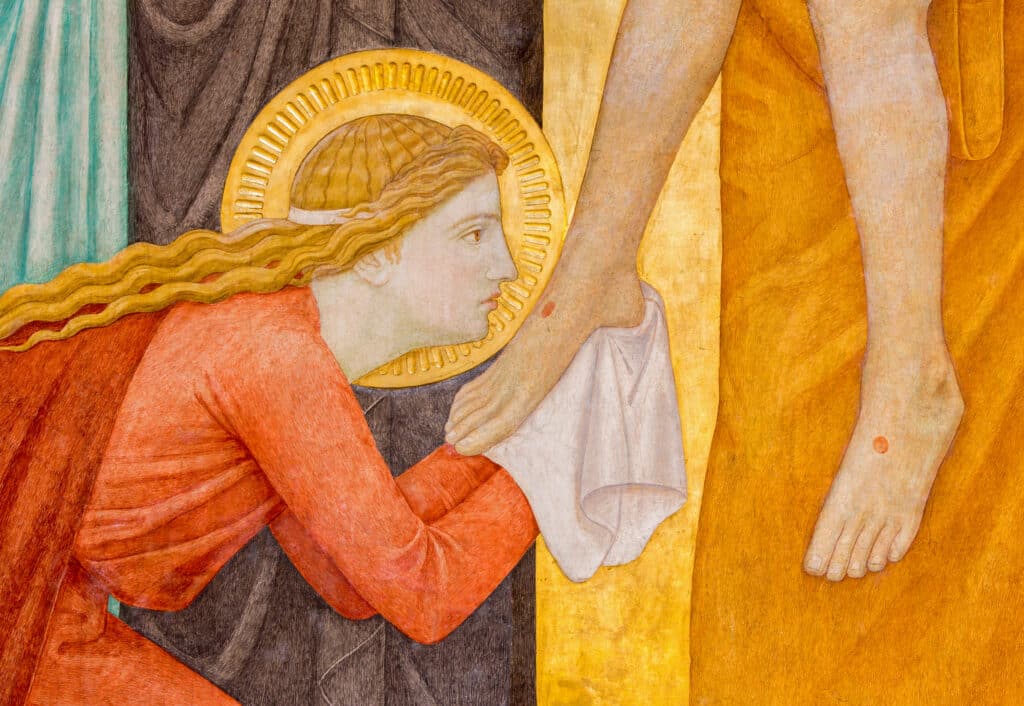
During the early medieval days, Pope Gregory the Great once connected Mary Magdalene to a passage shortly before Luke’s formal introduction to the Galilean women (Lk 7:36-39). In it, a sinful woman who washed Jesus’ feet with her tears and then anointed them with a flask of ointment is presented.
Evidently, the pope had a hunch that the sin of this woman was prostitution and that she was likely the same as Mary Magdalene, who is mentioned just 12 verses later. Pope Gregory the Great (who we must remember really did do many “great” things) also linked Mary Magdalene with Mary of Bethany. These well-intentioned ideas stuck for a long time.
You still don’t have to go far to find someone who thinks Mary Magdalene was undoubtedly a prostitute and the same as Mary of Bethany. Many now assert that seven demons may actually represent mental illness—not prostitution. And most conclude that Mary Magdalene, Mary of Bethany, and the woman who washed Jesus’ feet with her tears are most likely three separate women.
Of all the holy Galilean women, Mary Magdalene is the most prominent. Three evangelists name her specifically as being at the Crucifixion, two at the burial, and all four Gospel writers put Mary Magdalene at the empty tomb. Matthew, Mark, and John also assert that she saw and spoke to the risen Christ.
Blessed Joanna
Joanna is the next Galilean woman Luke introduces. Little is said about Joanna, but the brief mention that Luke presents offers an intriguing clue. He included the fact that Joanna had a close connection to Herod Antipas the Tetrarch, who had John the Baptist beheaded. Joanna was the wife of Herod’s steward, Chuza.
Being a steward, Chuza likely had the responsibility of overseeing Herod’s estate, a job that surely demanded a certain loyalty to this ruler. One can only guess how Joanna managed to support her husband and follow Jesus without any conflict. Perhaps Joanna and her husband were present at the ill-fated birthday banquet. Maybe they heard Herod’s order for the beheading of John the Baptist and perhaps even saw the gruesome platter. We can only wonder.
Joanna is mentioned by name only one other time in the Bible—Luke lists her as one of the women who went to the tomb on the day of the Resurrection.
According to Luke, Joanna—along with other women of Galilee—saw two men in dazzling clothes at Jesus’ empty tomb, learned of Christ’s resurrection, and shared the great news with the apostles—who did not believe them! Although Joanna’s name is never mentioned again, it is reasonable to consider that she was likely a part of the group whenever there is a general reference to the Galilean women.
In the current Roman Martyrology, Joanna is listed as a blessed, rather than a saint. This is hard to discern; in the earliest days of the Church, the words blessed, holy, and saint were often used interchangeably. So you might see Joanna listed as a saint in some resources and as a blessed in others, similar to the way we call Mary the Blessed Virgin Mary or St. Mary.
It’s impossible to know with certainty what exactly was meant. Was Joanna considered an official saint in heaven or just a really good and pious person (perhaps not martyred)? Either way, she gave much and is an inspiration to all.
Blessed/St. Joanna’s memorial is May 24.
St. Salome
It is Mark and Matthew who let us know that Salome is another holy woman of Galilee. Mark provides us with her name—within his Crucifixion and Resurrection narratives. Matthew, who calls her “the mother of the sons of Zebedee,” gives an additional, somewhat amusing account of St. Salome. In his 20th chapter, he relates how this mother of two apostles—James the Greater and John the Evangelist—had big ideas for her sons and boldly requested: “Command that these two sons of mine sit, one at your right and the other at your left, in your kingdom” (Mt 20:21).
Of course, Jesus took the opportunity to preach on the importance of humility and that serving others would count for more than grand places of honor.
St. Salome is listed on the April 24 page of the Roman Martyrology.
Susanna
Susanna is mentioned one time only—in Luke’s introduction to the Galilean women. So we can only glean that she, like Mary Magdalene and Joanna, had been cured of some demon or malady, traveled with Jesus and the apostles, and offered assistance in whatever way she could. Susanna was credibly present at the Crucifixion, burial, and empty tomb. It would be nice to know more, but we just don’t.
Susanna is not listed in the current Roman Martyrology; however, that does not exclude her from sainthood. Actually, if you were to attend Mass at a Byzantine Catholic church two Sundays after Easter, you would notice that Susanna is given special notice and is commemorated as a part of a group called the Holy Myrrhbearers.
St. Mary of Clopas
St. Mary of Clopas is especially hard to pin down in the Gospels, for she is referred to by a variety of titles:
Mary, the Mother of James and Joseph;
The Other Mary;
Mary, the Mother of the Younger James and of Joses;
Mary, the Mother of Joses;
Mary, the Mother of James;
Mary, the Wife of Clopas.
It is through John’s labeling, “Mary, the wife of Clopas” (19:25), that she has received her name: St. Mary of Clopas. Although she doesn’t stand out like Mary Magdalene, one variation or another of her titles appears at the death, burial, and empty tomb scenes repeatedly. Matthew’s Gospel asserts that both Mary Magdalene and Mary of Clopas saw and heard Jesus that first Easter morning.
Some propose that Mary of Clopas’ husband was the Cleopas who traveled to Emmaus with a friend and met up with Jesus in Luke’s 24th chapter. Many even suggest that it was St. Mary of Clopas who was the unidentified traveling partner. This is not known for sure, but it is an intriguing thought to consider.
St. Mary of Clopas shares a memorial day with St. Salome: April 24.
The Unnamed Other Galilean Women
Although we don’t know their names, it is only fair to also remember the unnamed women of Galilee—many others, according to St. Luke. Perhaps these nameless women were shy or had other responsibilities that took them away from Jesus and the apostles from time to time.
Whatever the reason, the Gospels give plenty of assertions that there were others. And they deserve our notice—especially if we have ever experienced being overlooked or not named. When we get to heaven, we can meet these women, learn their names, and thank them for their rich contributions to the mission of Jesus, for bringing comfort to his crucifixion and love to his burial.
Honoring the Holy Galilean Women
Even though the Gospel writers vary somewhat in their placement of the holy Galilean women, we can still get the general idea. They were there, they were helpful, they were devout, they were fearless (braver than most of the apostles at the Crucifixion!), and they loved Jesus dearly and showed it. And at least Mary Magdalene and Mary of Clopas were highly blessed by being the first to see Jesus resurrected. Though not specifically mentioned, it seems highly probable that at least some of the holy Galilean women were present during the nine days in the upper room in Jerusalem, praying and awaiting the Holy Spirit.
The holy Galilean women were generous in many ways and great adorers of God; their good works are an example to all Christians. They fully and very bravely lived out Christ’s command to deny oneself and follow him.
Restoring St. Mary Magdalene’s Reputation
Hopefully St. Mary Magdalene’s mistaken reputation as a prostitute will continue to steadily diminish. It seems reasonable to offset this unfortunate label by putting a special emphasis on a far better one—a label given to St. Mary Magdalene by St. Thomas Aquinas: “The Apostle to the Apostles.”
This 13th-century Italian doctor of the Church wrote a commentary on the Gospel of St. John, a Gospel that offers particularly poignant highlights on Mary Magdalene’s role on that first Easter morning. John’s 20th chapter presents Mary Magdalene arriving at the empty tomb alone. His unique and rich portrayal of this special woman asserts that she tearfully glanced toward the empty tomb, was visited by two angels, mistook Jesus for a gardener, and then was overcome with emotion as she recognized her Lord. Then, Mary Magdalene—without hesitation—followed Jesus’ charge to share the news of his resurrection: “Mary of Magdala went and announced to the disciples, ‘I have seen the Lord’” (Jn 20:18a), and shared what he told her.
It was Mary Magdalene carrying out Jesus’ wish to announce his resurrection with eager confidence that prompted St. Thomas Aquinas to call Mary Magdalene the Apostle to the Apostles within his commentary.
It is compelling to note that St. Thomas Aquinas also pointed out Matthew’s inclusion of another holy Galilean woman—”the other Mary” (St. Mary of Clopas)—during the first appearance of Jesus. Certainly, her role was profound as well, and more elaboration on her story would be welcome. However, St. Thomas Aquinas couldn’t help but notice Mary Magdalene’s overall prominence, especially in John’s Gospel, and felt inspired to highlight her apostle-like role.
Evidently, Pope Francis has read this commentary of St. Thomas Aquinas and agrees. In June 2016, the pope expressed a great appreciation for this title bestowed upon St. Mary Magdalene and felt it was time to elevate her day of remembrance (July 22) from a memorial to a feast. (The rank of Church celebrations are: optional memorial, obligatory memorial, feast, and solemnity.)
This seems a perfect counteraction: to start referring to St. Mary Magdalene as the Apostle to the Apostles in order to help restore her due reputation and highlight her holiness; to focus on her great love and devotion to Christ; and to recognize her rich contribution of proclaiming Christ’s triumph over the cross.
Sidebar: A Retreat with the Holy Galilean Women
Perhaps you would like a two-week, at-home retreat with these special women. If so, take some time each day for 14 days to read a biblical passage on them. Take in one or two surrounding verses and read the footnotes, if desired, and ponder their impact. Try to imagine yourself at the various scenes; maybe jot down your thoughts in a journal. Note which of these women each Gospel writer chose to highlight for the death, burial, and Resurrection accounts.




 novena.com