FRA ANGELICO

This fall, Florence will celebrate the work of Fra Angelico with a major retrospective—the city’s first in seventy years—at both the Palazzo Strozzi and the Museo di San Marco, opening on September 26. For the occasion, Ben Street writes about the resonance of Fra Angelico’s work in modern and contemporary art.

In September 1968, the Metropolitan Museum of Art, New York, staged its exhibition The Great Age of Fresco: Giotto to Pontormo. An Exhibition of Mural Paintings and Monumental Drawings. Two years before it opened, devastating floodwaters had surged through many Italian cities, causing extensive damage to historical sites and killing over 100 people. The wall paintings on show at the Met had been salvaged from ancient buildings whose structures were sodden with rising water. What this delicate process of removal and remounting had revealed were the underdrawings, or sinopias, that had been until then hidden beneath layers of plaster and pigment, ostensibly forever. The revelation of these huge drawings, and their display in New York, obliged a reappraisal of what Renaissance painting was—and what contemporary art could be. In a 2009 essay for October, “Why Would Anyone Want to Draw on the Wall?,” conceptual artist Mel Bochner looked back at his encounter with these works at the Met and answered his own question by declaring that large-scale wall work could “negate the gap between lived time and pictorial time.” The problem of painting in the late ’60s—its apparent inability to speak beyond itself, to rub up against the issues of its moment—found an unlikely solution in centuries-old works of art, for which that gap barely existed.

It was easy enough to pass by Fra Angelico’s work in the 1968 exhibition. Compared to the huge sinopias of his fellow Florentines Andrea del Castagno and Paolo Uccello, his contribution was small: three or four sinopias, saved from sites in and around Florence just after the floods. One of these, a Virgin and Child in rust-red pigment (the term “sinopia” refers to that material, almost always used in underdrawings), charms for its repeated attempts to nail the crook of the baby’s elbow. It has a tentativeness absent from the artist’s completed works. Yet Bochner’s claim that Renaissance wall painting could suggest “a new site, a new scale, a new sense of time” for contemporary art resounds in those of Angelico’s frescoes that remain in their original locations more strongly than in the work of any of his peers. You can see this for yourself: Step off the street in Florence and into the whitewashed cloister of the Dominican monastery of San Marco. Ascend the steep stairs to the top floor, where long corridors are punctuated by arched doorways. Within each of these is a monk’s cell containing a single fresco by Angelico. Each is an argument in paint for the interdependence of life and art. Each says: What gap?

Take this one. An angel with rainbow wings stands before a woman who, like her, is pale, thin, and haloed. Her arms folded in front of her, with right hand up and left hand down, the angel is silently communicating something, announcing something. The woman (a girl, really) echoes that arms-folded gesture, her right fingers holding open the book she’s been reading up to this moment. Those up-and-down gestures condense the subject of the painting: It’s a meeting of worlds, the up and the down, immortal and mortal, heaven and earth. Held still in front of the bellies of the two figures, the gesture also anticipates what’s coming next, namely the birth of a child, who’ll be held in a similar gesture, as babies tend to be. The painting’s subject is the annunciation of the birth of Jesus to Mary by the Archangel Gabriel, but none of Angelico’s presumed viewers would need that story spelled out. It’s entry-level Christian narrative, familiar to even a novice Dominican. Instead, Angelico leans into the implications of the story. That cloister you passed through on the way here, designed by the architect Michelozzo in the late 1430s—contemporary, that is, with Angelico’s fresco—is clearly the model for the painting’s plain architectural interior. The cool Tuscan light that picks out the folds of Gabriel’s garment is the same light illuminating you. And a robed figure behind Gabriel—a man with an alarming gash in his head, the blood dribbling down—is a modern figure, inserted into the ancient narrative: Saint Peter Martyr, a Dominican saint murdered a century before the painting was made. The complex temporality of the work makes demands on its viewers even now. What it means is that the painting is both about the interaction of heaven and earth and is that. Literally embedded in the walls of the monastery, the painting collapses real and painted space, lived and pictorial time: It extends art into life, and vice versa.

Even the name of Fra Angelico has something of the divine about it, yet it wasn’t a name he knew. He was born Guido di Pietro in the Mugello valley north of Florence, sometime toward the end of the fourteenth century. His first recorded paintings coincide with the beginning of his life as a monk; it’s impossible, then, to separate his artistic production from his spiritual life, as the posthumous name “Fra Angelico” (meaning “Angelic friar,” a name that emerged within a decade or so of his death) reflects. By the middle of the nineteenth century, critics such as John Ruskin were asserting (without evidence) that his “purity of life . . . and natural sweetness of disposition” accounted for the spiritual sincerity of his art. In 1982, he was beatified by Pope John Paul II—the only artist thus far to have received that honor, making him the default patron saint of artists. That status provided a framework, perhaps misleading, for understanding his art as a direct expression of spiritual purity. It also set him apart from his contemporaries, many of whom, such as Donatello and Piero di Cosimo, were quite happy to produce images of Roman gods and goddesses for private patrons, something it’s impossible to imagine Angelico doing.

This and other qualities make him an anachronistic figure, whose work never quite shook off the decorative Gothic elements and serene abstraction of his earliest work, from the 1420s. Well into his career he was making ethereal paintings with backgrounds of pure gold leaf while his peers had moved on to more naturalistic settings and anatomies. The 2025 exhibition at the Palazzo Strozzi and the Museo di San Marco, the first in Florence in seventy years, reiterates the case for Angelico’s place within the constellation of Renaissance household names, showing newly restored paintings and reuniting altarpieces dismantled in the nineteenth century. Yet Angelico resists such company. His work troubles the clean break between medieval and modern worlds. And that generative anachronism accounts for his reappraisal in the work of artists centuries after his death in Rome in 1455.

https://gagosian.com/quarterly/2025/08/20/essay-fra-angelico/
Feast of St. Anthony of Padua

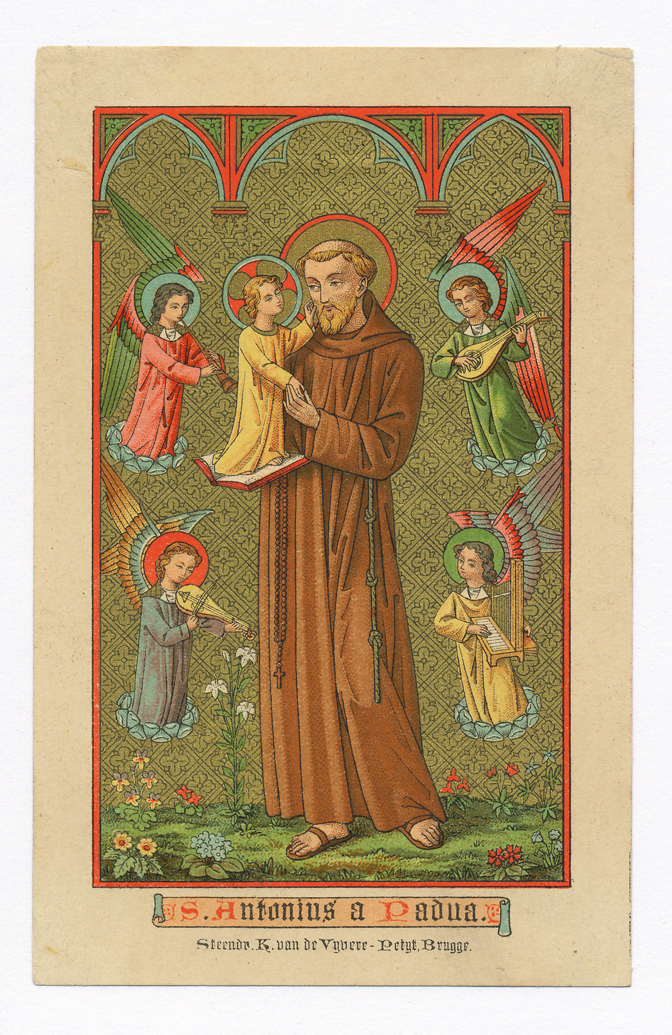
On June 13, Catholics honor the memory of the Franciscan priest St. Anthony of Padua. Although he is popularly invoked today by those who have trouble finding lost objects, he was known in his own day as the “Hammer of Heretics” due to the powerful witness of his life and preaching.

The saint known to the Church as Anthony of Padua was not born in the Italian city of Padua, nor was he originally named Anthony. He was born as Ferdinand in Lisbon, Portugal during 1195, the son of an army officer named Martin and a virtuous woman named Mary. They had Ferdinand educated by a group of priests, and the young man made his own decision to enter religious life at age 15. 

Ferdinand initially lived in a monastery of the Augustinian order outside of Lisbon. But he disliked the distraction of constant visits from his friends, and moved to a more remote house of the same order. There, he concentrated on reading the Bible and the Church Fathers, while living a life of asceticism and heartfelt devotion to God. 

Eight years later, in 1220, Ferdinand learned the news about five Franciscan friars who had recently died for their faith in Morocco. When their bodies were brought to Portugal for veneration, Ferdinand developed a passionate desire to imitate their commitment to the Gospel. When a group of Franciscans visited his monastery, Ferdinand told them he wanted to adopt their poor and humble way of life.

Some of the Augustinian monks criticized and mocked Ferdinand’s interest in the Franciscans, which had been established only recently, in 1209. But prayer confirmed his desire to follow the example of St. Francis, who was still living at the time. 

He eventually obtained permission to leave the Augustinians and join a small Franciscan monastery in 1221. At that time he took the name Anthony, after the fourth-century desert monk St. Anthony of Egypt. 

Anthony wanted to imitate the Franciscan martyrs who had died trying to convert the Muslims of Morocco. He traveled on a ship to Africa for this purpose, but became seriously ill and could not carry out his intention. The ship that was supposed to take him to Spain for treatment was blown off course, and ended up in Italy. 

Through this series of mishaps, Anthony ended up near Assisi, where St. Francis was holding a major meeting for the members of his order. Despite his poor health, Anthony resolved to stay in Italy in order to be closer to St. Francis himself. He deliberately concealed his deep knowledge of theology and Scripture, and offered to serve in the kitchen among the brothers. 

At the time, no one realized that the future “Hammer of Heretics” was anything other than a kitchen assistant and obedient Franciscan priest. Around 1224, however, Anthony was forced to deliver an improvised speech before an assembly of Dominicans and Franciscans, none of whom had prepared any remarks. 

His eloquence stunned the crowd, and St. Francis himself soon learned what kind of man the dishwashing priest really was. In 1224 he gave Anthony permission to teach theology in the Franciscan order –  “provided, however, that as the Rule prescribes, the spirit of prayer and devotion may not be extinguished.” 

Anthony taught theology in several French and Italian cities, while strictly following his Franciscan vows and preaching regularly to the people. Later, he dedicated himself entirely to the work of preaching as a missionary in France, Italy and Spain, teaching an authentic love for God to many people – whether peasants or princes – who had fallen away from Catholic faith and morality.

Known for his bold preaching and austere lifestyle, Anthony also had a reputation as a worker of miracles, which often came about in the course of his disputes with heretics. 

His biographers mention a horse, which refused to eat for three days, and accepted food only after it had placed itself in adoration before the Eucharist that Anthony brought in his hands. Another miracle involved a poisoned meal, which Anthony ate without any harm after making the sign of the Cross over it. And a final often recounted miracle of St. Anthony’s involved a group of fish, who rose out of the sea to hear his preaching when heretical residents of a city refused to listen.

After Lent in 1231, Anthony’s health was in decline. Following the example of his patron – the earlier St. Anthony, who had lived as a hermit – he retreated to a remote location, taking two companions to help him. When his worsening health forced him to be carried back to the Franciscan monastery in Padua, crowds of people converged on the group in hopes of paying their homage to the holy priest.

The commotion surrounding his transport forced his attendants to stop short of their destination. After receiving the last rites, Anthony prayed the Church’s seven traditional penitential psalms, sung a hymn to the Virgin Mary, and died on June 13 at the age of 36. 

St. Anthony’s well-established holiness, combined with the many miracles he had worked during his lifetime, moved Pope Gregory IX – who knew the saint personally – to canonize him one year after his death.

“St. Anthony, residing now in heaven, is honored on earth by many miracles daily seen at his tomb, of which we are certified by authentic writings,” proclaimed the 13th-century Pope.

A poem celebrating devotion to St. Anthony

a barefoot contessa walking down Mulberry Street

wearing the robe of Saint Anthony 

the brown of the robe, two shades darker then her brown sicilian skin

a white thick rope around her waist, knotted at the end, 

a rosary draped around her hands, the cross hanging at the end
she was one of many, in this sea of brown, 

lips moving with silent prayers

and how they formed me

she had green eyes, what visions were forming?

and how they formed me

in silence, not a word spoken

her stories were ancient, stone slabs and sand

celebrating with two lilies in a vase, a reminder

and how they formed me

she was unlike her sisters, they had voices, loud voices

my mother, my aunt, my other aunt

they had modern stories, cigarettes and cat-eye glasses

dresses made to order, nightclubs and frank sinatra

husbands that stayed out all night

and how they formed me

these are my memories along with my dreams

celebrating with two lilies 

lots of laughter 

and how they formed me

copyright:dipasqua

St. Francis of Assisi 1182 – 1226

Saint Francis of Assisi
“Lord make me an instrument of they peace, where there is hatred
let me sow love.”
Patron of: Ecologists

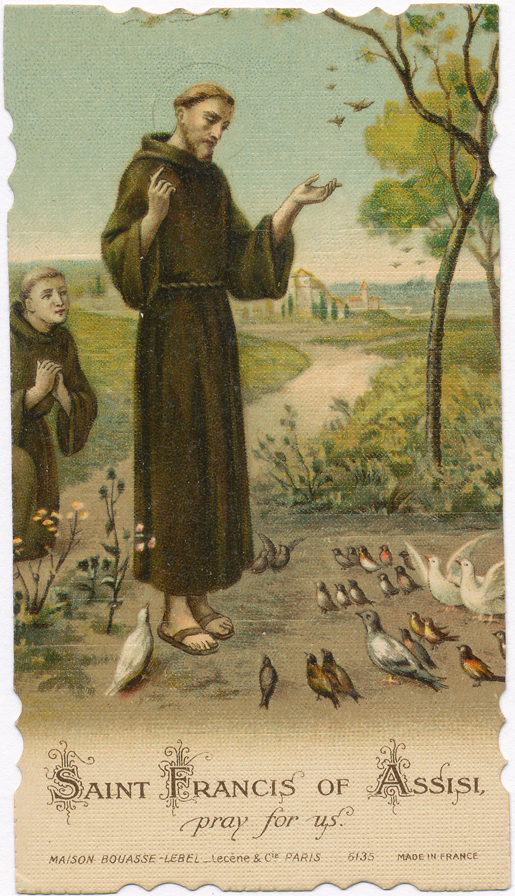
Love for God and everything in creation so consumed St. Francis of Assisi, that he was able to commune with the natural world on a divine level. Taming wolves, quieting flocks of birds and infusing peace and contentment to the humanity he interacted with, we call on Francis of Assisi to bring us into the harmonious rhythms of the universe, where all of nature and mankind are at one with the divine force of creation. An unlikely mystic, Francis was born Giovanni Bernadone in the town of Assisi. His father, a proud member of the upper classes was a wealthy cloth merchant married to a woman from Provence. Because he frequently conversed in French with his mother, Giovanni was soon known as “Francesco” or “the Frenchman” by his friends and neighbors. Confident that his son would follow in his footsteps, the elder Bernadone indulged and catered to Francesco’s every whim and the youth enjoyed a pleasure filled existence in the company of others in his social caste. On a lark he set off with friends to take part in a war with Perugia. Much to his shock, he was taken prisoner and it took his family a year to ransom him back. Upon his return, he was bedridden and seriously ill. But in recovering his health, Francesco seems to have lost his identity. He suffered a great spiritual crisis as all interest in his old life and his father’s business waned and disappeared. While wandering the countryside he stopped into the deserted church of San Damiano and heard the crucifix say to him, “Francis, go and repair my house, which you see is falling down.” Happy to have some direction in his life, he took the request literally and began rebuilding the structure with his bare hands. Ultimately, his father disowned him and when Francis, renouncing his inheritance threw his clothing in the street, he donned the simple brown garment given him by the Bishop of Assisi.

Begging for supplies, Francis continued his work on San Damiano. Eventually he was joined by other disenchanted young men looking for a higher meaning in life. By simply following the exact tenets of Christ, this little band of friars, never owning anything, bartering labor for food and shelter began a movement of religious seekers that revolutionized the Church by the simple and loving way they spread the gospel. Instead of writing in church Latin he used colloquial Italian and in an effort to explain the story of Christ’s birth, he created a living tableau of animals and people – the first Christmas crèche.

A great poet and mystic, Francis was the first saint to receive the stigmata while in a meditative rapture. Filled with humility and though he founded one of the world’s greatest religious orders, Francis of Assisi was never ordained a priest. Upon his death he requested to be buried in the cemetery for criminals, but the people of Assisi so loved him that they took his body and interred it under the altar of their great cathedral.

Just as popular with nonCatholics as Catholics, Francis has inspired great artists, composers and writers. Assisi, Italy remains a great pilgrimage site for those wishing to pay him tribute.

Prayer

O Beloved Saint Francis, gentle and poor, your obedience to God, and your simple, deep love for all God’s creatures led you to the heights of heavenly perfection and turned many hearts to follow God’s will. Now in our day, in our ministry to the many who come here searching for peace and intercede for us we come before the Lord with our special requests…

Mention your special intentions here.

O Blessed Saint of God, from your throne among the hosts of heaven, present our petitions before our faithful Lord. May your prayers on our behalf be heard and may God grant us the grace to lead good and faithful lives.
Amen
Saint Francis of Assisi, pray for us.