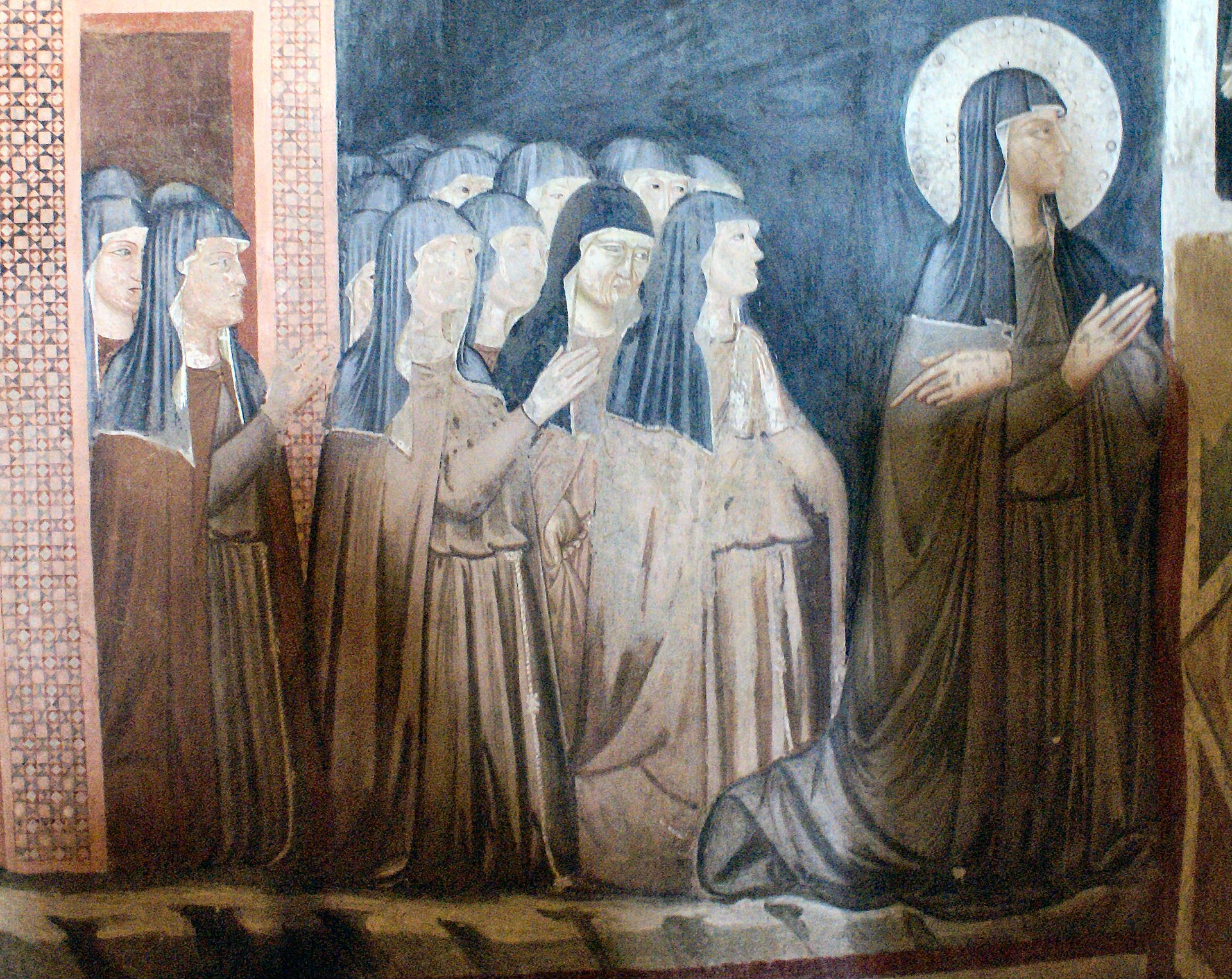
The mysterious world of being a Poor Clare. Contemplative nuns who live a life of prayer, community and joy.
The first thing you need to know is that a Poor Clare is a nun – meaning that she lives in one monastery (usually) for her whole life. She takes solemn vows that can only be dispensed by Rome. BUT the second thing you have to know – is that a Poor Clare Nun is not a Benedictine, Dominican, Visitation or Carmelite nun. She is a Poor Clare nun.There is a world of difference between these other beautiful orders and Poor Clares. NO, not all nuns are alike.
Each Poor Clare community is autonomous. Not all Poor Clares dress alike, work alike or keep the same daily schedule. If you go from monastery to monastery you will feel the spirit of Joy and Communal gifting of each other – you will experience the warm bond of Joy, Simplicity and happiness of being a Franciscan. BUT you will always notice a difference and know you are in a different monastery. Poor Clares Monasteries are individual and unique as is each sister in them. So please… in your journey of exploring the joyful world of Poor Clares – there is no “template” for what a Poor Clare should look like, sound like and be like. Because there are no two alike.. and that is how the Holy Spirit works.
The Poor Clare Sisters number over 20,000 sisters throughout the world in 16 federations and in over 70 countries. Most monasteries have from four to thirteen members. Some have larger communities but the Poor Clare charism is one of family and St. Clare guided us that small communites were much better to keep this family spirit than larger ones. So when a community gets to a certain number we usually start new ones rather than just keep getting bigger. Just one of the differences you will see as you walk with us.
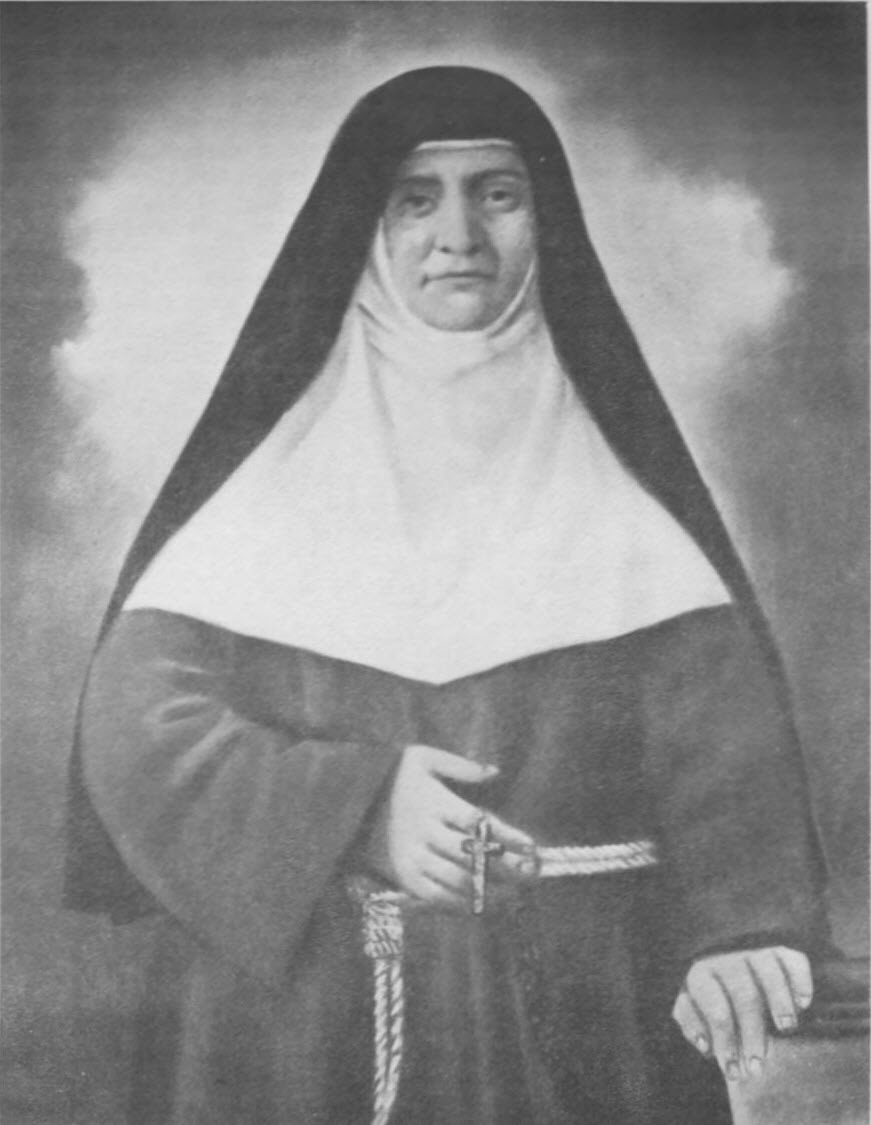
Mother Mary Maddelena Bentivoglio of the Sacred Heart of Jesus 1834-1905
Countess Anna Bentivoglio was a climber! From the age of five when she climbed onto a ledge in great St. Peter’s in Rome (to the horror of Count and Lady Bentivoglio!), to later life. This was the aim of her life – to climb – she would do so physically and spiritually.
Her yearning for religious life began when she followed her sister, Constance, into the Poor Clares. She longed for more austerity and asked for special penances. Then Pope Pius IX commissioned the two Bentivoglio sisters – Mother Magdalen and her sister Constance – to go to America. They first moved to Marseilles, France, were incorporated into the Poor Clares of the Primitive Rule, then on to the “New World”, arriving on Columbus Day, October 12, 1875. The first established monastery of the Order of Saint Clare was in Omaha, Nebraska, in 1878.
Following her example, today’s Poor Clares endeavor to follow this spiritual climber as they live out their daily life in simplicity and joy.
A Day in the Life
Our life is structured around an horarium, a rhythm of prayer throughout the day. The specific times of prayer are marked by the ringing of the bells, which symbolize the voice of God calling us to prayer. The Divine Office (also known as the Liturgy of the Hours), the Mass and the Eucharistic Adoration are the main framework around which our life of prayer revolves. It also includes manual labor, duties and community recreation which give balance to our times of prayer. In this rhythmic exchange of prayer, labor, and rest, we are liberated from the distractions of the world, free to dedicate our entire selves to living the Eucharistic Mystery.
We daily devote ourselves wholly to God alone:
by daily and personal conversion to the Gospel
by offering loving adoration, praise, and thanksgiving to God on behalf of all people
by our efforts to live and work contemplatively and to deepen our union with God in times of silence and solitude
by our intercessory prayer for the Church and all people,
by our efforts to love and serve our Sisters in true Community
by extending spiritual and material assistance to others in ways compatible with our contemplative life
by showing Sisterly hospitality and care to those who come to our monastery and in our relations with all persons
This is our cherished gift and call from our gracious God for which we are deeply grateful.
Horarium
5:15 AM Wake up—Rise and Shine!
6:00 AM Meditation
6:30 AM Morning Prayer followed by Mid-Morning Prayer Breakfast Work
9:00 AM The Holy Sacrifice of Mass—Prayer of Thanksgiving is made privately Office of Readings—On Sundays we move this to 11:30 and combine it with Mid-Day Prayer
10:15 AM Work for fully Professed Sisters Class and/or Work for Formation Sisters
11:45 AM Mid-Day Prayer
12:00 PM Dinner in Silence followed by dishes Recreation at table on Sundays and Thursdays Free time or Work
3:00 PM Mid-Afternoon Prayer followed by Divine Mercy Chaplet Work for fully Professed Sisters Class and/or Work for Formation Sisters
4:30 PM Evening Prayer followed by Communal Rosary—this becomes our Holy Hour for vocations for our Monastery on Fridays throughout the year and on Sundays in Lent and Advent
5:30-6:45 pm Supper in Silence followed by Dishes with Community Recreation on Mondays and Tuesdays Ongoing Formation for the solemnly Professed Sisters on Thursdays; Otherwise directly to Night Prayer
6:45 pm Night Prayer followed by personal time. On Sundays we have an optional movie recreation following this On Tuesdays and Thursdays we have our nocturnal adoration
9:30 pm Be in your rooms
10:00 pm Grand Silence and lights out—Good night sleepyheads!
*Each Sister is privileged to have one hour of adoration a day, an hour of nocturnal adoration twice a week, and adoration during a meal time each week.
Traditionally, AD 529 is considered to be the year in which St Benedict founded the monastery at Montecassino. He died and was buried there around 547. Some decades later, the monastery was destroyed and not rebuilt for a long time. The monastic community and the living tradition of Benedict seemed to have disappeared.
The Spreading of the Rule
However, copies of his Rule survived in Roman libraries. Around 594 Pope St Gregory the Great praised this Rule and its author, increasing the popularity of both. Next, the Rule is found in some monasteries in Southern Gaul (modern France) and elsewhere, normally used by the abbot together with rules written by other monastic fathers to help him to guide the community. In the early 8th century, monks from England proudly proclaim that they follow only the Rule of Benedict – the first genuine „Benedictines“. They popularize this rule further through their mission in continental Europe and eventually in 816/17 an important synod declares Benedict’s Rule binding for all monks. Throughout the Carolingian empire which covers modern France, Belgium, Holland Switzerland, Germany, parts of Italy and Austria, hundreds of monasteries of monks and nuns come now under the Rule of Benedict. Simultaneously, the observance of these monasteries is unified, even in areas where the Rule left details to the discretion of the abbot. In the Latin West, religious life is now mostly Benedictine. The monasteries become important centers of religious life, but also of political administration, of economic development and of learning, both theological and secular. Books are written and copied in the scriptoria (writing rooms) of the monasteries, and abbey schools train the clergy and the ruling elite. The monks dedicate themselves mainly to liturgical prayer, whose amount gradually increases. The monasteries own farms and sometimes whole villages, whose peasants sustain the monks with part of their produce. In the ninth century the papacy starts to protect some monasteries from the interference of noblemen and local bishops. Cluny in Burgundy, founded in 910, eventually establishes a huge family of monasteries under one abbot. In the 12th century several hundred houses belonged to it.
Decays and Reforms
The wealth and social role of the monasteries attracts also criticism, and several reform movements try to return to simpler ways of life and a more original understanding of Benedict’s rule. The Cistercians have the greatest impact. Within a short period several hundred monasteries of „white monks“ are founded, established as a clearly defined order with an efficient organization that balances unifying elements like the general chapter of all abbots and clear common principles with local autonomy and supervision through visitations.
In 1215 and in 1336 the papacy attempts to give a similar structure to the remaining „black“ Benedictines, initially with little success. Meanwhile, life in Europe has shifted from the countryside to cities. Newer orders like the Franciscans and the Dominicans respond to the spiritual and intellectual desires of city dwellers. While Benedictines continue to be found all over Europe, they are no longer the main protagonists of religious life.
From the 15th century onwards, monasteries try to protect themselves from the interference of secular or ecclesiastical lords by forming congregations. The most influential of these is the Congregation of Saint Justina in Italy, later called the Cassinese Congregation. It remains for many centuries a model which other Congregations copy. New forms of personal prayer and meditation are now introduced to the life of the monks, to complement the divine office and lectio. A new emphasis on the personal needs of the individual monk also leads to the introduction of cells, replacing the dormitories in use until then.
Turbulences and Rebirth
The so-called reformation in the 16th century turns against religious and monastic life of any kind. Protestant sovereigns use theological justifications to suppress the monasteries and confiscate their property. Some abbots and monks are killed, others simply retire from monastic life, return to their families or accept parishes. In England, Northern Germany, the Netherlands and Scandinavia monastic life disappears.
In Catholic countries, however, Benedictine monasticism begins to flourish again. Benedictine abbeys are being rebuilt in the splendid baroque style, and many monasteries become centres of scholarship, culture and education. And for the first time Benedictine life goes beyond Europe when the first abbeys of the New World are established in Brazil.
In the 18th century, new philosophical and political trends threaten monasticism. Faith comes under attack, and monasteries are seen as useless places of superstition and backwardness. In the decades after 1760, more than 95% of the monasteries in Europe are suppressed by governments or destroyed in the course of revolutions and wars. Churches are turned into factories, buildings are used as quarries, land and treasures or confiscated, books destroyed or sent to new national libraries.
But monasticism refuses to die. In the mid-19th century, a romantic rediscovery of medieval Christianity and monastic life takes place. In several countries old monasteries are re-founded or new communities created. Monastic life changes: the communities can no longer depend on rich endowments. The monks now work for their upkeep. The abbots have ceased to be lords and live much closer with their brothers. These monasteries fulfil important roles in the church, running major seminaries and schools, sometimes parishes or foreign missions. Because the Benedictines are still without any central organization, Pope Leo XIII establishes a study house in Rome, and in 1893 creates the Benedictine Confederation with an Abbot Primate at its head. Benedictine scholars rediscover the liturgical life of the early church. They influence the Liturgical Movement which prepares the reforms of the Second Vatican Council:
Most communities start singing in the vernacular, no longer in Latin. And the distinction between priests and brothers disappears. Most monasteries continue to attract Christians who want to spend a quiet time in prayer, who seek spiritual advice or who simply want to live alongside the monks for a few days.
A Worldwide Family
In 2018 the Benedictine Confederation numbers around 7500 monks in 400 monasteries, belonging to 19 different Congregations, with regional differences, particular missions or specific spiritual traditions. Some 13000 nuns and sisters also belong to the order. The Benedictines work closely with the Cistercians and the Trappists, orders which also follow St Benedict’s Rule. This rule has proved to be a guide for countless souls during 15 centuries.
OSB.ORG OSB DOT ORG Piazza dei Cavalieri di Malta 5 00153 Rome Italy EDITOR Br. Richard Oliver OSB
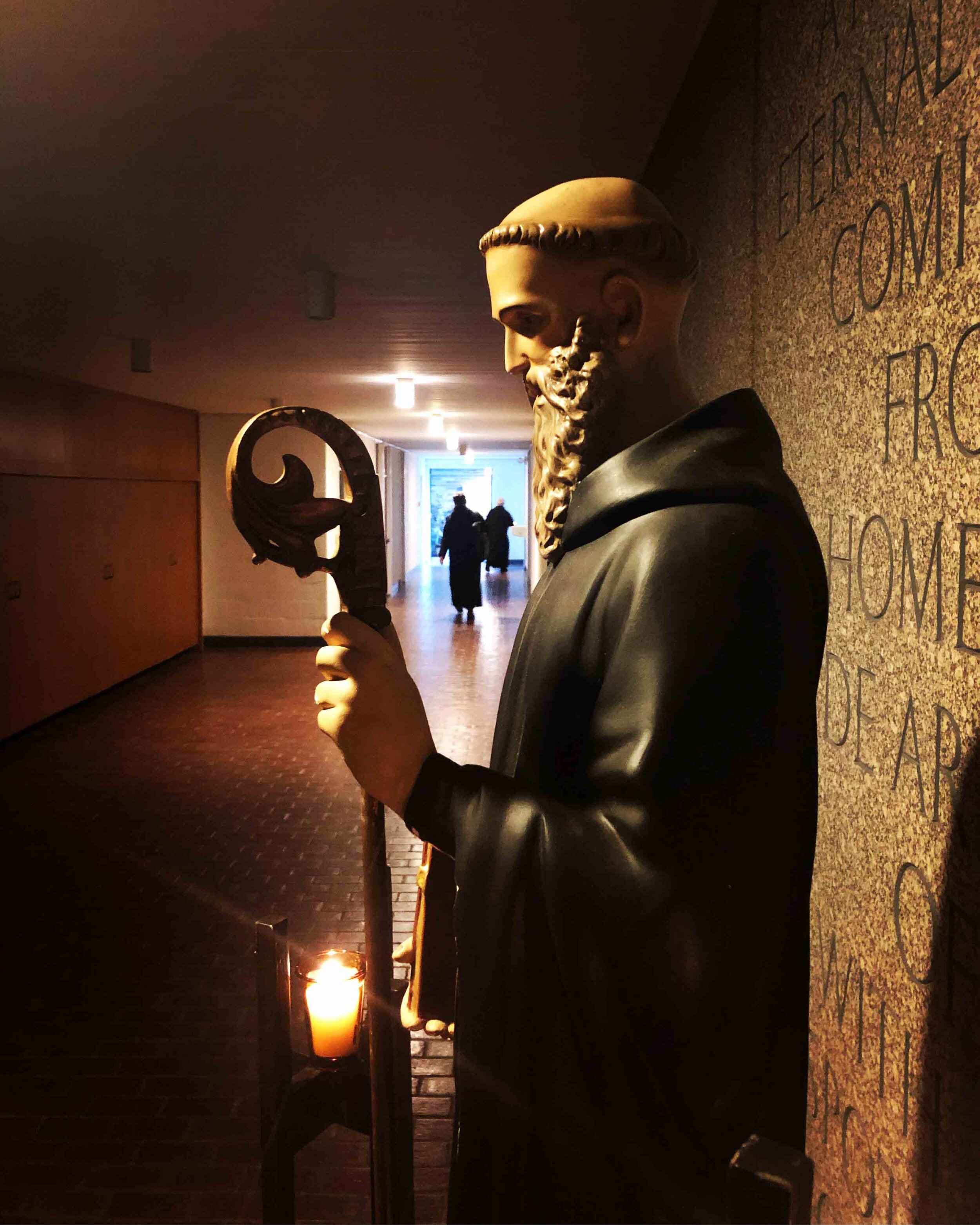
Saint Benedict
Shortly after the western Roman Empire ended in AD 476 with the capture, forced abdication, and death of the teen-aged Emperor Romulus, another Italian teenager was about to give birth to a different sort of “realm” – a spiritual one.
A youngster named Benedict, born in the city of Nursia in Umbria around AD 480, was sent to Rome for a classical education. He found little in that chaotic place to nurture his growing hunger to know God more intimately, for, in addition to the Empire’s recent ruin, even the Church was divided with various men claiming to be the legitimate Pope.
Benedict shook the dust of Rome off his sandals and headed, like many other seekers of God, into a wilderness place to seek God’s will. Three years of prayerful solitude in a rough cave at Subiaco, southeast of Rome, under the wise guidance of a spiritual father prepared him for his call. The boy had become a hermit.
God’s call often grows and unfolds in our lives, and not always as we would anticipate. Discovered by local shepherds in that desert place, the young hermit interrupted his solitude to answer their request that he teach them the basics of the Christian faith. The hermit had become a teacher.
Other seekers soon flocked to Benedict, asking him to teach them not merely Christian doctrine, but how to live out their Christian lives well. Again, Benedict responded to their request as though it were God’s own voice.
He left his beloved cave and solitude to establish twelve small communities of men wishing to share his life, not as solitary hermits, but as monks living together under his direction and guidance. The shy hermit had himself become a spiritual father (an “Abba” or Abbot).
From that cave, like a spiritual womb, Benedict’s spiritual family grew and spread. First, when Benedict and several of his disciples left Subiaco to establish a single, large community on the mountainous heights overlooking the main Roman highway between Rome and Naples – the famous Abbey of Montecassino.
Like Elizabeth Ann Seton, Rita of Cascia was a wife, mother, widow, and member of a religious community. Her holiness was reflected in each phase of her life.
Born at Roccaporena in central Italy, Rita wanted to become a nun but was pressured at a young age into marrying a harsh and cruel man. During her 18-year marriage, she bore and raised two sons. After her husband was killed in a brawl and her sons had died, Rita tried to join the Augustinian nuns in Cascia. Unsuccessful at first because she was a widow, Rita eventually succeeded.
Over the years, her austerity, prayerfulness, and charity became legendary. When she developed wounds on her forehead, people quickly associated them with the wounds from Christ’s crown of thorns. She meditated frequently on Christ’s passion. Her care for the sick nuns was especially loving. She also counseled lay people who came to her monastery.
Beatified in 1626, Rita was not canonized until 1900. She has acquired the reputation, together with Saint Jude, as a saint of impossible cases. Many people visit her tomb each year.
Like Elizabeth Ann Seton, Rita of Cascia was a wife, mother, widow, and member of a religious community. Her holiness was reflected in each phase of her life.
Born at Roccaporena in central Italy, Rita wanted to become a nun but was pressured at a young age into marrying a harsh and cruel man. During her 18-year marriage, she bore and raised two sons. After her husband was killed in a brawl and her sons had died, Rita tried to join the Augustinian nuns in Cascia. Unsuccessful at first because she was a widow, Rita eventually succeeded.
Over the years, her austerity, prayerfulness, and charity became legendary. When she developed wounds on her forehead, people quickly associated them with the wounds from Christ’s crown of thorns. She meditated frequently on Christ’s passion. Her care for the sick nuns was especially loving. She also counseled lay people who came to her monastery.
Beatified in 1626, Rita was not canonized until 1900. She has acquired the reputation, together with Saint Jude, as a saint of impossible cases. Many people visit her tomb each year.
Reflection
Although we can easily imagine an ideal world in which to live out our baptismal vocation, such a world does not exist. An “If only ….” approach to holiness never quite gets underway, never produces the fruit that God has a right to expect.
Rita became holy because she made choices that reflected her baptism and her growth as a disciple of Jesus. Her overarching, lifelong choice was to cooperate generously with God’s grace, but many small choices were needed to make that happen. Few of those choices were made in ideal circumstances—not even when Rita became an Augustinian nun.
It requires a bit of detective work—pulling a few threads here, a few more there, and so on throughout the Gospels—to form a viewable tapestry of the holy Galilean women. However, by taking the time to delve into the verses on these women, this lovely group slowly comes into focus, and we can better learn to appreciate them for who they were and all they did for Jesus. St. Mary Magdalene, Blessed Joanna, Susanna, St. Salome, St. Mary of Clopas, and many others unnamed are indeed a special collection of women to know.
It is Luke who gives a formal introduction to these women. At the start of his eighth chapter, he presents them as a unique cluster from the region of Galilee who ministered to Jesus from “their resources.” Luke also lets us know that at least some of these women had suffered terribly and found healing.
We can only imagine the day-to-day lives of these women while they traveled with and assisted Jesus and the Twelve Apostles. Obviously, they had “resources” to spare. Perhaps it was strictly financial assistance that they gave. However, it seems possible that they helped with other things too—maybe they did some cooking, helped with laundry and mending, or nursed anyone who got sick. With a bit of imagination, it is easy to envision them helping in a variety of ways. These women most certainly gleaned some significant insights and understandings during their time of accompanying Christ. It would be nice to have more biblical elaboration on their roles, but we don’t.
After pondering their time going from town to town with Jesus and the apostles, Bible readers pretty much have to wait until the Passion narratives in each Gospel to read anything more about these women (a short narrative on St. Salome is one exception).
Their Home of Galilee
The region of Galilee was the site of many wonderful New Testament events: the Sermon on the Mount, the miracle of the wine at Cana, the healing of the centurion’s servant, and the Transfiguration—just to name a few. And, of course, Jesus’ childhood home in Nazareth was in Galilee as well. This collection of women is another star for this region west of the Sea of Galilee.
St. Mary Magdalene
Poor Mary Magdalene has been stuck for centuries now with the reputation of having been a prostitute. In reality, though, all we know for sure about her past is that she had been burdened with seven demons that had left her—under the authority of Jesus (Lk. 8:2 & Mk. 16:9).
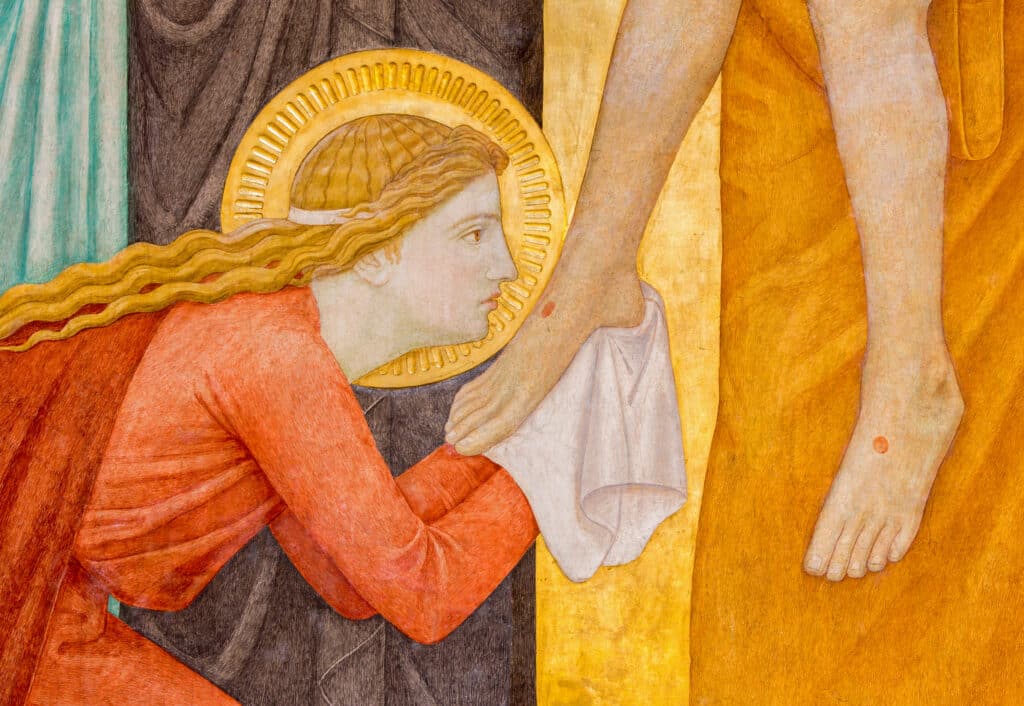
During the early medieval days, Pope Gregory the Great once connected Mary Magdalene to a passage shortly before Luke’s formal introduction to the Galilean women (Lk 7:36-39). In it, a sinful woman who washed Jesus’ feet with her tears and then anointed them with a flask of ointment is presented.
Evidently, the pope had a hunch that the sin of this woman was prostitution and that she was likely the same as Mary Magdalene, who is mentioned just 12 verses later. Pope Gregory the Great (who we must remember really did do many “great” things) also linked Mary Magdalene with Mary of Bethany. These well-intentioned ideas stuck for a long time.
You still don’t have to go far to find someone who thinks Mary Magdalene was undoubtedly a prostitute and the same as Mary of Bethany. Many now assert that seven demons may actually represent mental illness—not prostitution. And most conclude that Mary Magdalene, Mary of Bethany, and the woman who washed Jesus’ feet with her tears are most likely three separate women.
Of all the holy Galilean women, Mary Magdalene is the most prominent. Three evangelists name her specifically as being at the Crucifixion, two at the burial, and all four Gospel writers put Mary Magdalene at the empty tomb. Matthew, Mark, and John also assert that she saw and spoke to the risen Christ.
Blessed Joanna
Joanna is the next Galilean woman Luke introduces. Little is said about Joanna, but the brief mention that Luke presents offers an intriguing clue. He included the fact that Joanna had a close connection to Herod Antipas the Tetrarch, who had John the Baptist beheaded. Joanna was the wife of Herod’s steward, Chuza.
Being a steward, Chuza likely had the responsibility of overseeing Herod’s estate, a job that surely demanded a certain loyalty to this ruler. One can only guess how Joanna managed to support her husband and follow Jesus without any conflict. Perhaps Joanna and her husband were present at the ill-fated birthday banquet. Maybe they heard Herod’s order for the beheading of John the Baptist and perhaps even saw the gruesome platter. We can only wonder.
Joanna is mentioned by name only one other time in the Bible—Luke lists her as one of the women who went to the tomb on the day of the Resurrection.
According to Luke, Joanna—along with other women of Galilee—saw two men in dazzling clothes at Jesus’ empty tomb, learned of Christ’s resurrection, and shared the great news with the apostles—who did not believe them! Although Joanna’s name is never mentioned again, it is reasonable to consider that she was likely a part of the group whenever there is a general reference to the Galilean women.
In the current Roman Martyrology, Joanna is listed as a blessed, rather than a saint. This is hard to discern; in the earliest days of the Church, the words blessed, holy, and saint were often used interchangeably. So you might see Joanna listed as a saint in some resources and as a blessed in others, similar to the way we call Mary the Blessed Virgin Mary or St. Mary.
It’s impossible to know with certainty what exactly was meant. Was Joanna considered an official saint in heaven or just a really good and pious person (perhaps not martyred)? Either way, she gave much and is an inspiration to all.
Blessed/St. Joanna’s memorial is May 24.
St. Salome
It is Mark and Matthew who let us know that Salome is another holy woman of Galilee. Mark provides us with her name—within his Crucifixion and Resurrection narratives. Matthew, who calls her “the mother of the sons of Zebedee,” gives an additional, somewhat amusing account of St. Salome. In his 20th chapter, he relates how this mother of two apostles—James the Greater and John the Evangelist—had big ideas for her sons and boldly requested: “Command that these two sons of mine sit, one at your right and the other at your left, in your kingdom” (Mt 20:21).
Of course, Jesus took the opportunity to preach on the importance of humility and that serving others would count for more than grand places of honor.
St. Salome is listed on the April 24 page of the Roman Martyrology.
Susanna
Susanna is mentioned one time only—in Luke’s introduction to the Galilean women. So we can only glean that she, like Mary Magdalene and Joanna, had been cured of some demon or malady, traveled with Jesus and the apostles, and offered assistance in whatever way she could. Susanna was credibly present at the Crucifixion, burial, and empty tomb. It would be nice to know more, but we just don’t.
Susanna is not listed in the current Roman Martyrology; however, that does not exclude her from sainthood. Actually, if you were to attend Mass at a Byzantine Catholic church two Sundays after Easter, you would notice that Susanna is given special notice and is commemorated as a part of a group called the Holy Myrrhbearers.
St. Mary of Clopas
St. Mary of Clopas is especially hard to pin down in the Gospels, for she is referred to by a variety of titles:
Mary, the Mother of James and Joseph;
The Other Mary;
Mary, the Mother of the Younger James and of Joses;
Mary, the Mother of Joses;
Mary, the Mother of James;
Mary, the Wife of Clopas.
It is through John’s labeling, “Mary, the wife of Clopas” (19:25), that she has received her name: St. Mary of Clopas. Although she doesn’t stand out like Mary Magdalene, one variation or another of her titles appears at the death, burial, and empty tomb scenes repeatedly. Matthew’s Gospel asserts that both Mary Magdalene and Mary of Clopas saw and heard Jesus that first Easter morning.
Some propose that Mary of Clopas’ husband was the Cleopas who traveled to Emmaus with a friend and met up with Jesus in Luke’s 24th chapter. Many even suggest that it was St. Mary of Clopas who was the unidentified traveling partner. This is not known for sure, but it is an intriguing thought to consider.
St. Mary of Clopas shares a memorial day with St. Salome: April 24.
The Unnamed Other Galilean Women
Although we don’t know their names, it is only fair to also remember the unnamed women of Galilee—many others, according to St. Luke. Perhaps these nameless women were shy or had other responsibilities that took them away from Jesus and the apostles from time to time.
Whatever the reason, the Gospels give plenty of assertions that there were others. And they deserve our notice—especially if we have ever experienced being overlooked or not named. When we get to heaven, we can meet these women, learn their names, and thank them for their rich contributions to the mission of Jesus, for bringing comfort to his crucifixion and love to his burial.
Honoring the Holy Galilean Women
Even though the Gospel writers vary somewhat in their placement of the holy Galilean women, we can still get the general idea. They were there, they were helpful, they were devout, they were fearless (braver than most of the apostles at the Crucifixion!), and they loved Jesus dearly and showed it. And at least Mary Magdalene and Mary of Clopas were highly blessed by being the first to see Jesus resurrected. Though not specifically mentioned, it seems highly probable that at least some of the holy Galilean women were present during the nine days in the upper room in Jerusalem, praying and awaiting the Holy Spirit.
The holy Galilean women were generous in many ways and great adorers of God; their good works are an example to all Christians. They fully and very bravely lived out Christ’s command to deny oneself and follow him.
Restoring St. Mary Magdalene’s Reputation
Hopefully St. Mary Magdalene’s mistaken reputation as a prostitute will continue to steadily diminish. It seems reasonable to offset this unfortunate label by putting a special emphasis on a far better one—a label given to St. Mary Magdalene by St. Thomas Aquinas: “The Apostle to the Apostles.”
This 13th-century Italian doctor of the Church wrote a commentary on the Gospel of St. John, a Gospel that offers particularly poignant highlights on Mary Magdalene’s role on that first Easter morning. John’s 20th chapter presents Mary Magdalene arriving at the empty tomb alone. His unique and rich portrayal of this special woman asserts that she tearfully glanced toward the empty tomb, was visited by two angels, mistook Jesus for a gardener, and then was overcome with emotion as she recognized her Lord. Then, Mary Magdalene—without hesitation—followed Jesus’ charge to share the news of his resurrection: “Mary of Magdala went and announced to the disciples, ‘I have seen the Lord’” (Jn 20:18a), and shared what he told her.
It was Mary Magdalene carrying out Jesus’ wish to announce his resurrection with eager confidence that prompted St. Thomas Aquinas to call Mary Magdalene the Apostle to the Apostles within his commentary.
It is compelling to note that St. Thomas Aquinas also pointed out Matthew’s inclusion of another holy Galilean woman—”the other Mary” (St. Mary of Clopas)—during the first appearance of Jesus. Certainly, her role was profound as well, and more elaboration on her story would be welcome. However, St. Thomas Aquinas couldn’t help but notice Mary Magdalene’s overall prominence, especially in John’s Gospel, and felt inspired to highlight her apostle-like role.
Evidently, Pope Francis has read this commentary of St. Thomas Aquinas and agrees. In June 2016, the pope expressed a great appreciation for this title bestowed upon St. Mary Magdalene and felt it was time to elevate her day of remembrance (July 22) from a memorial to a feast. (The rank of Church celebrations are: optional memorial, obligatory memorial, feast, and solemnity.)
This seems a perfect counteraction: to start referring to St. Mary Magdalene as the Apostle to the Apostles in order to help restore her due reputation and highlight her holiness; to focus on her great love and devotion to Christ; and to recognize her rich contribution of proclaiming Christ’s triumph over the cross.
Sidebar: A Retreat with the Holy Galilean Women
Perhaps you would like a two-week, at-home retreat with these special women. If so, take some time each day for 14 days to read a biblical passage on them. Take in one or two surrounding verses and read the footnotes, if desired, and ponder their impact. Try to imagine yourself at the various scenes; maybe jot down your thoughts in a journal. Note which of these women each Gospel writer chose to highlight for the death, burial, and Resurrection accounts.
In the West, the oldest reference to the cult of Saint Joseph (Ioseph sponsus Mariae) connected with 19 March appears around the year 800 in the north of France. Thereafter, reference to Joseph, the spouse of Mary, becomes more and more frequent from the 9th to the 14th centuries. In the 12th century, the crusaders built a church in his honor at Nazareth. But it was in the 15th century that the cult of Saint Joseph spread due to the influence of Saint Bernadine of Siena, and especially of Jean Gerson (+ 1420), Chancellor of Notre Dame in Paris, who promoted the cause that a feast to Saint Joseph be officially established. There were already some celebrations in Milan in Augustinian circles, and in many places in Germany. It was in 1480, with Pope Sixtus IV’s approval that the feast began to be celebrated on 19 March. It then became obligatory with Pope Gregory XV in 1621. In 1870, Pope Pius IX declared Saint Joseph the Patron of the Universal Church, and Pope Saint John XXIII inserted his name into the Roman Canon of Holy Mass in 1962. More recently, Pope Francis approved seven new invocations in the Litany to Saint Joseph: Guardian of the Redeemer, Servant of Christ, Minister of Salvation, Support in difficulties, Patron of exiles, Patron of the afflicted, and Patron of the poor.
Prayer
Hail, Guardian of the Redeemer, Spouse of the Blessed Virgin Mary. To you God entrusted his only Son; in you Mary placed her trust with you Christ became man. Blessed Joseph, to us too, show yourself a father and guide us in the path of life. Obtain for us grace, mercy and courage, and defend us from every evil. Amen.
Please leave message if you would like a copy of our novena app for iPhone or iPad. History and prayers of 36 saints.
“The most Blessed Virgin Mary was, from the first moment of her conception, by a singular grace and privilege of almighty God and by virtue of the merits of Jesus Christ, Savior of the human race, preserved immune from all stain of original sin.”
In 1854, Pope Pius IX’s solemn declaration, “Ineffabilis Deus,” clarified with finality the long-held belief of the Church that Mary was conceived free from original sin. Mary was granted this extraordinary privilege because of Her unique role in history as the Mother of God. That is, she received the gift of salvation in Christ from the very moment of her conception.
Even though Mary is unique in all humanity for being born without sin, she is held up by the Church as a model for all humanity in Her holiness and Her purity in her willingness to accept the Plan of God for her.
Every person is called to recognize and respond to God’s call to their own vocation in order to carry out God’s plan for their life and fulfill the mission prepared for them since before the beginning of time. Mary’s “Let it be done to me according to Thy Word,” in response of the Angel Gabriel’s greeting, is the response required of all Christians to God’s Plan.
The Solemnity of the Immaculate Conception is a time to celebrate the great joy of God’s gift to humanity in Mary, and to recognize with greater clarity, the truth that each and every human being has been created by God to fulfill a particular mission that he and only he can fulfill.
“The word of the Lord came to me thus: “Before I formed you in the womb I knew you, before you were born I dedicated you, a prophet to the nations I appointed you.” (Jeremiah 1:5-6)
Designed and revealed by Mary, the Medal is unique among all medals.
It was almost midnight when St. Catherine Labouré was awakened by a soft voice, whispering, “Sister, sister, sister.” Mysterious events led her to the chapel where the Blessed Mother appeared and sat down near the altar. St. Catherine knelt at her feet, rested her hands in Mary’s lap, looked into her eyes, and had a heart-to-heart conversation with her. Later, St. Catherine would refer to that night as “the sweetest moment of my life.”
Four months later, in November of 1830, Mary again appeared to St. Catherine at the Rue de Bac Chapel. This time, our Blessed Mother was standing on a globe, with dazzling rays of light streaming from her outstretched hands. Framing the apparition was an inscription: “O Mary, conceived without sin, pray for us who have recourse to thee.” When Mary spoke to St. Catherine, she said “Have a medal struck upon this model. Those who wear it will receive great graces, especially if they wear it around the neck. Those who repeat this prayer with devotion will be, in a special manner, under the protection of the Mother of God. Graces will be abundantly bestowed upon those who have confidence.”
With approval of the Catholic Church, the first medals were made in 1832 and distributed in Paris. Only ten of the original medals are known to exist, and one of them is housed at the Miraculous Medal Shrine.
Almost immediately, the blessings that Mary promised showered down on those who wore her medal, and soon all of France was clamoring for what the people referred to as the “Miraculous Medal.” Use of the Medal spread from country to country, and, at the time of St. Catherine’s death in 1876, more than a billion medals had been made. Today, the Medal is still drawing down from God blessings for body and soul.
Wearing The Miraculous Medal
Here are some rules for wearing a Miraculous Medal:
Wear it around the neck: According to Our Lady, the medal should be worn around the neck.
Have it blessed: It’s best to wear a medal that has been blessed by a priest. A priest or delegated lay person can invest the wearer in the medal using the approved rite.
Wear it with confidence: According to Our Lady, those who wear the medal with confidence will receive great graces.
Wear it as a sign of devotion: The medal is a visible sign of devotion to Mary and Jesus.
Wear it as a reminder of faith: The medal can be a daily reminder of faith.
The Miraculous Medal is a popular piece of jewelry for Catholics, but anyone can wear it. The medal originated from apparitions to French nun Saint Catherine Laboure.The medal’s front and back are full of symbolism.
THE MEANING OF THE MIRACULOUS MEDAL.pdfDuring Our Lady’s visit to Catherine on November 27, 1830, rays of light flowed from rings on her fingers that were made of precio…St Joseph Church | Chehalis, WA
The Hidden Symbolism in the Miraculous Medal – EWTNNov 27, 2023 — The History of the Miraculous Medal During one of many apparitions to French nun Saint Catherine Laboure, Our Lady gav…EWTN
Investiture of the Miraculous Medal – SS. Cyril and Methodius ParishNov 13, 2024 — A person becomes a member by wearing a Miraculous Medal that has been blessed by a priest. It is fitting that the pers…saintcyrils.church
The day of the Poor Clare nun begins at 12:30 a.m. when the Sister designated as “Caller” knocks on each cell door to summon her sisters to prayer. The nuns, clothed in the religious habit adapted for the night, rise in silence like the wise Virgins always ready and waiting for the call: “The Bridegroom is here, come out to meet Him!” At 12:45 a.m. the Sisters assemble in Office Choir (the Sister’s chapel) for the Hour of Matins (Office of Readings). It is an unbroken tradition for the Poor Clare Nuns to rise in the middle of the night after a few hours of sleep in order to pray for a needy world at a time when, under cover of darkness, so many sins are committed. At 1:45 a.m. the Divine Office and a period of meditation come to a close and the Sisters retire to their cells for about three more hours of sleep.
Five O’Clock Duty
At 5:00 a.m. the silence of the early hours of the morning is broken when the bell sounds for rising. The nuns rise promptly, wash in a simple basin in their cells and make their way to their five o’clock duty. These duties vary from dust-mopping the corridors or sweeping the refectory and stairs, to opening windows to air the house, dusting Choir or making preparations for breakfast. Then at 5:30 a.m. the Sisters gather promptly in Choir for the morning Angelus follows by Lauds (Morning Prayer). “With praise I will awake the dawn,” sings the Psalmist and the nuns likewise, by their wholehearted praise of the Creator, anticipate all of creation, which is just awakening from sleep. An hour of meditation in preparation for the Holy Sacrifice of the Mass follows and, at 7:00 a.m., the Rosary is recited communally during which the Sisters ponder the mysteries of Redemption and the role of the most Blessed Mother, making them a part of their own lives. “Nuns relive and perpetuate in the Church the presence and the work of Mary. Welcoming the Word in faith and adoring in silence, they put themselves at the service of the Mystery of the Incarnation, and united to Christ Jesus in His offering of Himself to the Father they become co-workers in the Mystery of Redemption” (Verbi Sponsa, no. 4).
The Mass — the Day’s Climax
The Holy Sacrifice of the Mass at 7:30 a.m. is the center and summit of the Poor Clare day around which everything else revolves. It is precisely from the Mass that the nuns draw their strength and the grace for the new day of prayer, sacrifice, and work for the love of God. The Sisters participate in this august mystery from their Mass Choir, which is separated from the main Chapel by an enclosure grille because of their hidden life of seclusion. “What return shall I make to the Lord for His goodness to me?” sings the Poor Clare in her heart as she spends the next quarter of an hour in thanksgiving for the greatest gift on earth: the Holy Eucharist to which she is united in a most intimate way. By now it is 8:30 a.m. and the Sisters go to the refectory to partake of a simple breakfast while standing, in keeping with the traditional fast. Although Great Silence has ended, a peaceful stillness continues to pervade the monastery as the nuns begin some work until 9:30 a.m. Answering benefactors’ letters and filling orders for spiritual bouquet cards to go out in the morning’s mail or beginning the day’s work in the kitchen are just a few examples. When Reverend Mother Abbess rings the bell, the Sisters assemble in the refectory for the Office announcements and a spiritual thought for the day, which are read aloud. Mother Abbess gives her blessing and the nuns process to the Choir for Exposition of the Blessed Sacrament and the first of the Daytime Hours: Terce(Midmorning Prayer). The Poor Clare nun’s entire day is punctuated by the different hours of the Divine Office in order constantly to return praise to the Blessed Trinity and to sanctify each passing moment. The Holy Sacrifice of the Mass is thus perpetuated throughout the whole of her day by the Liturgy of the Hours. It is in this way that the nun’s whole life becomes one great “Thanksgiving.” Pope John Paul II write of our Holy Mother Saint Clare: “her whole life was a Eucharist because … from her cloister she raised up a continual ‘thanksgiving’ to God in her prayer, praise, supplication, intercession, weeping, offering and sacrifice. She accepted everything from the Father in union with the infinite ‘thanks’ of the only begotten Son.”
A Virtuous Life and the Common Good
The remaining hours of the morning until 11:40 a.m. are spent in some manual work. “Let the Sisters to whom the Lord has given the grace of working work faithfully and devotedly after the hour of Terce at work that pertains to a virtuous life and the common good” (Holy Rule). It may vary greatly according to the day or the season. In the monastic tradition of the Poor Clares there has never been a distinction between Choir Nuns and Lay Sisters; rather, all help with the humble tasks and give themselves with generosity wherever help is needed. Our Extern Sisters, however, are the special guardians of the enclosure. They care for the external services of the monastery but observe the same form of life as the cloistered nuns in all things except the vow of enclosure. Whether hanging the laundry on wash day, answering the phone or the door bells, cooking, sweeping, sewing, gardening or painting, the Poor Clare Nun is motivated by love and therefore no task is too burdensome nor any sacrifice too great. “All for Love,” “All for Jesus” are the frequent aspirations that fill her mind while at work. Although she cannot spend the entire day with Our Lord in Choir, she finds He is present and at her side at every moment and in all the designs of Divine Providence as the day unfolds. Our Holy Mother Saint Clare urges her daughters to always work “in such a way that, while banishing all idleness, the enemy of the soul, they do not extinguish the spirit of holy prayer and devotion to which all other earthly things must contribute.”
Bell Calls to Midday Prayer
At 11:40 the bell calls the Sisters to the hour of Sext (Midday Prayer). “Let the Sisters, immediately ceasing their labors, come without delay” (Saint Colette). The monastic bell summoning the Sisters to work and prayer is understood as the voice of the Beloved calling to them and each Sister makes haste in order not to keep Him waiting. Midday Prayer is followed by the particular examen and the Angelus is said at noon. The community then processes to the refectory while reciting the Veni Creator. A full meal referred to as “dinner” is served at noon. The Poor Clare Colettine nuns observe a perpetual abstinence from meat, but fish is served twice a week and on special feast days. The meal typically consists of a carbohydrate (rice, noodles, or potatoes), a vegetable, salad and a simple dessert. As the Sisters take nourishment for their bodies to renew their physical strength, they are constantly reminded that “man does not live on bread alone but on every word that comes from the mouth of God.” The meals at Corpus Christi Monastery are taken in silence as the Sisters listen to some spiritual reading to nourish their souls. One of the nuns is appointed as “reader” and reads aloud from the biography of some saint, a reflection on the day’s Gospel or perhaps some other text of a religious or edifying nature.
Fruit and Potatoes
After dinner there is a half-hour period of general work. The Sisters help with dishes or prepare the vegetables, fruit or potatoes, which need peeling and slicing for the next day’s meal. At 1:30 p.m. “quiet time” begins. This is a special time of silence during which the Sisters may rest, do some quiet hobby or spend time in private devotions. Daily meditation on the Stations of the Cross is a Franciscan tradition and some may choose to take their quiet time in Choir for this purpose. As Pope John Paul II reminds us: “It is in the contemplation of the Crucified Christ that all vocations find their inspiration” (Vita Consecrata, no. 23). Other nuns may choose to spend time alone with God in their cells. “The solitary cell, the closed cloister, are the place where the nun, bride of the Incarnate Word, lives wholly concentrated with Christ in God” (Verbi Sponsa, no. 3). At 2:00 p.m. the nuns again repair to the Choir where they make ready to chant the hour of None (Midafternoon Prayer). The Blessed Sacrament is again exposed and “the Divine Service is carried out with the greatest possible devotion and the very greatest reverence… they should maintain there a humble and respectful attitude, and observe a profound silence…. Their bearing should be modest and such that it fulfills what is required in the presence of the God of Majesty,” counsels our Holy Mother Saint Colette. The cloistered nun stands before the Throne of Mercy representing the entire Body of Christ. She is entrusted with the divine service and carries it out in the name of the whole Church. This is the Poor Clare’s “greatest privilege and joy” and she remains fully aware of her awesome responsibility.
Weeding and Harvesting
The rest of the afternoon, until 4:30 p.m., is occupied with work. Again the Sisters spend themselves for the common good, each one seeing to her assigned duties or participating in some community task, such as loading a truck with brush to be hauled away, cleaning the monastery from top to bottom, printing holy cards, weeding the shrine, or harvesting rhubarb, apples, or squash and preparing them for freezing. “There is no time to get bored” as one postulant told her family when asked if she ever found the monastic life monotonous. Even if on some days the round of chores are similar to the preceding day, the Divine Bridegroom speaks to each soul in a new way with every passing day. Therefore the Sisters work in silence, communing with God alone, listening to Him and responding to His voice by the love with which they carry out their work, prayers and sacrifices. “In the monastery everything is directed to the search of the face of God, everything is reduced to the essential, because the only thing that matters is what leads to Him” (Pope John Paul II). The enclosure of Corpus Christi Monastery “is intended to create a space of separation, solitude and silence where God can be sought more freely in a life not only for Him and with Him but also in Him alone” (Verbi Sponsa, no. 5).
Interceding for a Troubled World
Vespers (Evening Prayer) is chanted at 4:30 p.m. The Poor Clare Nun leaves the concerns of her daily duties and stands before God interceding for a troubled world. Men, women and children of every land and nation are the subjects of her most sincere prayers. To this end she has renounced the world, only to be more united to it in a supernatural way. She has come apart, making of her life a continual sacrifice of praise for the needs of all. And she understands clearly that “those who become the property of God become God’s gift to all” (Verbi Sponsa, no. 7). This canonical hour is followed by fifteen minutes of Scripture meditation during which the Poor Clare ponders the Word of God in the presence of the Most Blessed Sacrament. In addition to this, at some point during the day, depending on her work, each Sister takes one hour of time reserved for private prayer and adoration of the Blessed Sacrament. This is an essential part of the Poor Clare’s day, for she knows well that “the call to holiness is accepted and can be cultivated only in the silence of adoration before the infinite transcendence of God” (Vita Consecrata, no. 38). At 5:30 p.m. the Sisters gather in Choir for the evening recitation of the Angelus and process to the refectory for collation. “The Sisters shall fast at all times.” This fast which our Holy Rule prescribes consists of refraining from taking any food between meals and “Lenten fare” which traditionally means that breakfast and the evening refection together do not equal the main meal at noon. Two slices of bread, cheese, a fruit and a cup of barley tea constitute a typical collation. Sometimes an egg or cereal, for example, is served in place of the cheese. The Sisters keep their eyes modestly cast down at all times, but especially in Choir and in the refectory. Our Holy Mother Saint Colette exhorts her daughters “that they may have a soul uplifted to God and attentive to what is said there, let them have their eyes cast downward.”
Recreation and a Family Spirit
At 6:30 p.m. the bell summons the nuns to an hour of recreation. This is a special time of joyful fellowship and relaxation for the Sisters. As silence is observed outside of this one hour per day, the recreation period is all the more enjoyable. The nuns speak on a variety of different topics ranging from the work of the day to the edifying examples of the lives of the saints. The Sisters occupy their hands with some needlepoint, artwork, cutting out stamps for the missions, making rosaries, or sewing copes for the Infant of Prague statues while good humor and a family spirit reign. According to the season this time of recreation may be spent outdoors pruning the trees, picking Job’s tears to be used as rosary beads, or planting flowers in the Lourdes grotto to honor the Blessed Mother. The Hour of Compline (Night Prayer) is said at 7:30 p.m. followed by the General Examen during a few moments of silent reflection and then Great Silence descends upon Corpus Christi Monastery. “Let the Sisters keep silence from the hour of Compline until Terce, let them also continually keep silence in the Church, the dormitory and the refectory while they are eating,” says our Holy Rule. The nuns then retire to their cells and are to be in bed by 9:00 p.m. They may read or do some quiet work before they lie down on their straw mattresses or thin rug mats for a few hours of peaceful slumber only to rise again at 12:30 a.m. for a new day of Poor Clare life in Corpus Christi Monastery.
Some form of cloister is present in all types of religious life, even the convents of sisters who engage in active apostolates. In such communities, one area of the convent is “cloistered,” reserved for the sisters alone. This type of cloister is called common cloister.
In the contemplative life, the concept of a cloister, a place reserved for the nuns alone, is expanded and deepened. Often the entire monastery is cloistered, and may even be surrounded by a cloister wall. The choir where the nuns sit in the chapel is sometimes hidden from the public who come to pray. And, depending on what form of cloister each monastery professes, some institutes of nuns even make enclosure the object of a fourth vow.
Papal cloister is the strictest form of enclosure, in which a nun does not leave the boundaries of the monastery except for serious reasons. The norms defining papal enclosure are given by Rome. The most recent instruction on papal cloister is the 2018 document Cor Orans, which implements what Pope Francis outlined in his 2016 Apostolic Constitution Vultum Dei Quaerere.Cor Orans states: “The law of papal cloister extends to the dwelling and to all the interior and exterior spaces of the monastery reserved exclusively for the nuns in which the presence of strangers can be admitted only in case of necessity. It must be a space of silence and recollection, facilitated by the absence of external works, where the permanent search for the face of God can develop more easily, according to the Institute’s charism.”
Constitutional cloister is a form of cloister defined by the norms in the Rule and Constitutions of the individual order. It is generally less strict than papal cloister. This type of cloister is practiced if the community’s charism joins to their life of contemplation some kind of apostolic or charitable work. They are still cloistered nuns, but they may have an apostolate attached to the monastery–such as a retreat house–which would be impossible to carry out if they practiced papal enclosure. Cor Orans says of constitutional cloister: “It must be a space of silence and recollection, where the permanent search for the face of God can develop, according to the charism of the Institute, in consideration of the works of apostolate or charity exercised by the nuns” (n. 205).
St. Ignatius Loyola included in his Spiritual Exercises a prayer called “the Examen,” which derives from the Latin word for examination. It is a meditation with roots not only in Ignatian spirituality, but also in the spiritual practices of the ancient Stoics. There are many versions of the Examen today, but all have five steps. Here is a simple rendering of some key elements:
Place yourself in God’s presence. Give thanks for God’s great love for you.
Pray for the grace to understand how God is acting in your life.
Review your day — recall specific moments and your feelings at the time.
Reflect on what you did, said, or thought in those instances. Were you drawing closer to God, or further away?
Look toward tomorrow — think of how you might collaborate more effectively with God’s plan. Be specific, and conclude with the “Our Father.”
Some versions of the Examen place a special emphasis on gratitude and feelings. A detailed example of such a meditation is offered by IgnatianSprituality.com.
“God is in it”
The heart of the Examen is the third part: reviewing your day.
“Think of it as a movie playing in your head,” writes James Martin, S.J., in The Jesuit Guide to (Almost) Everything. “Push the play button and run through your day, from start to finish, from your rising in the morning to preparing to go to bed at night. Notice what made you happy, what made you stressed, what confused you, what helped you be more loving. Recall everything: sights, sounds, feelings, tastes, textures, conversations. Thoughts, words, and deeds, as Ignatius says. Each moment offers a window to where God has been in your day.”
And remember that no experience is too trivial for spiritual investigation.
“Nothing in our lives is so insignificant that it doesn’t deserve God’s attention,” notes Jim Manney in A Simple Life-Changing Prayer, a book about the Examen. “In fact, the mundane and the humdrum parts of our lives give depth and texture to our relationships with God. Washing the windows and cooking dinner are as much a part of the relationship as graduation day. If it’s part of our human experience, God is in it.”
Ignatius was emphatic about the Examen. He told the early Jesuits that if they for some reason did no other spiritual exercises, they should do this one. Then as now, the Examen is a spiritual tool for sizing up your days — and planting the seeds for a more purposeful life.




 St Joseph Church | Chehalis, WA
 EWTN
EWTN saintcyrils.church