“I know by experience that the glorious Saint Joseph assists us generally in all necessities. I never asked him for anything which he did not obtain for me.” —Saint Teresa of Avila
Patron of: Fathers
A righteous man who never shirked his responsibilities as protector of his family, Saint Joseph offers a perfect example for fathers everywhere. He is invoked by families for all matters of support needed to sustain a household, both material and spiritual.
A descendant of the House of David, there is very little written about Joseph in the gospels. He was said to be betrothed to Mary when she became pregnant with Jesus. Instead of leaving her in scandal, he accepted the word of the angel Gabriel who told him that the child was divinely given and Joseph and Mary were chosen by God to be his earthly parents. It was Joseph who protected Mary on the journey to Bethlehem when Jesus was born. He also suffered the frustrations of a man who could not find proper shelter for his family as his wife was about to give birth. Upon returning to their native city of Nazareth, Joseph was once again visited by an angel warning him of the impending slaughter of the innocents. On faith alone, he dispensed with his business and personal effects, taking Jesus and Mary to Egypt where they stayed for seven years until Herod’s death. It fell upon Saint Joseph to support his young family in this foreign country.
The last mention of Joseph comes when Jesus is twelve years old and strayed from his family while on a pilgrimage to Jerusalem. It is thought that he died well before Jesus began his mission with Jesus and Mary at his deathbed. For this reason, more than any other saint, he is invoked for a happy death, one where a person is older and has their family at their side.
Though of noble lineage, Joseph was a carpenter and it was from him whom Jesus learned his trade. Because he worked with his hands and frequently put his family ahead of any personal ambitions, workers everywhere who live similar lives call on him as a patron. It is no mystery that the cult of Saint Joseph became more popular in modern times with the advent of the Industrial Revolution. Many saints throughout the ages have declared him to be a powerful advocate as well, since it is thought that Jesus obeyed him in his earthly life, he is inclined to listen to Joseph in his heavenly life. Teresa of Avila always buried medals with his image when she needed land for a new convent. This tradition has extended itself to realtors of all faiths who bury statues of Saint Joseph on properties they wish to sell.
It is assumed that since Joseph respected his wife’s virginity that he was an older man when he married. He is depicted in art with a staff, which he led his family ( precursor to the bishop’s staff) a lily for purity, and with carpenter tools or holding the baby Jesus.
Hail, Guardian of the Redeemer, Spouse of the Blessed Virgin Mary. To you God entrusted his only Son; in you Mary placed her trust with you Christ became man. Blessed Joseph, to us too, show yourself a father and guide us in the path of life. Obtain for us grace, mercy and courage, and defend us from every evil. Amen.
During the Lenten season, Psalm 23 reminds us of God’s intent that we find times of refreshing: Beside restful waters he leads me; he refreshes my soul.
St. Ignatius of Loyola refers to these times of refreshing as consolations: a deep-seated sense of God’s presence leading to spiritual growth.
How are we being refreshed and consoled in our lives, in our Church, and in our work for justice?
There’s only one door out of purgatory for the Holy Souls there. It opens only into heaven. But here’s the catch: they can’t open it themselves. We have to open it for them. We have the key.
The question is, will we help unlock it for some of them during this month of November, which the Church dedicates to the Holy Souls?
Here’s the beautiful part: The Church hands us not just one key but a whole ring full of them. We can use any number of them to keep unlocking the door for the single-file lineup of souls who are suffering in purgatory.
They’re all waiting to join the saints in heaven on the other side of the door. They can get there a lot quicker if we unlock that door for them. Notice how the Church puts All Souls Day, Nov. 2, right next to Nov. 1, All Saints’ Day?
So, let’s start with some of the main keys the Church gives us to use. Some work every day, and some work only at a certain time or day, like the one that works from Nov. 1-8 specifically for the souls in purgatory. These are listed in the official Manual of Indulgences (Enchiridion Indulgenarium).
Key for Nov. 1-8
Every year on these eight days the Church grants a plenary indulgence that can be applied only to the souls in purgatory. The faithful can receive this indulgence each of the eight days to apply to a particular soul — a parent, spouse, relative, friend, or anyone even unknown.
How to use this key? On each day from Nov. 1-8 a person seeking the plenary indulgence for a soul must (1) “devoutly visit a cemetery and pray, if only mentally, for the departed; (2) on All Souls’ Day (or according to the ordinary, on the Sunday preceding it or following it…) devoutly visit a church or an oratory and recite an Our Father and the Creed.”
There are a couple of other requirements that have to be fulfilled, too, which apply to any plenary indulgence. More on this detail a bit later, since it will also apply to other keys.
Just in case, for these same dates, there is a key that is a partial indulgence (for example, maybe a person isn’t able to fulfill all the requirements for a plenary indulgence). Again, for these Nov. 1-8 days, it can be applied only to souls in purgatory and granted for (1) devoutly visiting a cemetery and at least mentally praying for the dead; (2) devoutly reciting lauds or vespers from the Office of the Dead or the prayer, “Eternal rest grant unto them, O Lord, and let perpetual light shine upon them. May they rest in peace. Amen.”
But don’t stop with only these eight days. You have all month to gain indulgences (more on requirements in a moment) to apply to the holy souls sending out their SOS’s (Stop Our Suffering). And you can help them every day of the year too, with other keys.
Mighty Keys for Every Day
These are most accessible, handy keys with a plenary indulgence attached (with the usual conditions) since they will readily open that door. These four can gain that plenary indulgence “each day of the year,” but “no more than once a day.”
Eucharistic Adoration. “Visit the Blessed Sacrament for adoration lasting at least a half hour.”
Praying the Rosary. “Devoutly recite the Marian Rosary in a church or oratory, or in a family, a religious community, or an association of the faithful, and in general when several of the faithful gather for some honest purpose…”
Reading or listening to Sacred Scriptures. “Read the Sacred Scriptures as spiritual reading, from a text approved by a competent authority, and with the reverence due to the divine word, for at least a half an hour; if the time is less, the indulgence will be partial.” Or listen to it being read.
Pious exercise of the Way of the Cross. Walk them in church or where legitimately erected.
You choose who the indulgence applies to: either yourself — you cannot give it to another living person — or to a holy soul in purgatory. Remember them this November, and throughout the rest of the year too.
Keys to the Indulgence
We went over the specific requirement for the Nov. 1-8 plenary indulgence, and then for a plenary indulgence that can be gained on any day of the year, one per day, though any of the main four listed.
Here’s a quick refresher of the standard requirements every plenary indulgence must fulfill to become plenary which wipes away all temporal punishment due to sin. Just think of the number of holy souls you help out of purgatory, and in turn what friends they will become helping you get to heaven.
To gain a plenary indulgence you must:
Be baptized and in the state of grace, at least at the time the indulgenced work is done.
Have “the interior disposition of complete detachment from sin, even venial sin.” Otherwise, the indulgence becomes partial, not plenary.
And fulfill these three conditions:
Sacramentally confess your sins
Receive Holy Communion. (“It is certainly better to receive it while participating in Holy Mass, but for the indulgence only Holy Communion is required”).
Pray for the intentions of the Holy Father. One Our Father and one Hail Mary fully satisfies this.
One sacramental confession suffices for gaining several plenary indulgences, but a separate Holy Communion and separate prayer for the intentions of the Holy Father are required for each plenary indulgence. According to the most recent Church guidelines on the subject, “it is sufficient that these sacred rites and prayers be carried out within several days (about 20) before or after the indulgenced act.”
Of course, you must also:
Perform the prescribed work to which the indulgence is attached.
Have at least a general intention to gain the indulgence. You can’t receive an indulgence unintentionally or by accident.
If any part of the requirements is missing, then the indulgence becomes partial. Heaven determines the degree of the partial indulgence.
Helps the Holy Souls and Ourselves
We’re on the receiving end, too, even when we give away the indulgence, plenary or partial, to the holy souls in purgatory. Here’s how.
When Blessed Pope Paul VI updated the enchiridion in 1967, he said that the “aim in granting them is both to help the faithful expiate the punishment due sins and to urge them to works of piety, penance, and charity.”
Then in a 1999 general audience concentrated on indulgences, St. John Paul II explained how the Church “dispenses and applies with authority the treasury of the satisfactions of Christ and the saints … as it were through indulgences.”
He said it is “the expression of the Church’s full confidence of being heard by the Father when — in view of Christ’s merits and, by his gift, those of Our Lady and the saints — she asks him to mitigate or cancel the painful aspect of punishment by fostering its medicinal aspect through other channels of grace. In the unfathomable mystery of divine wisdom, this gift of intercession can also benefit the faithful departed, who receive its fruits in a way appropriate to their condition.”
Even though we give the indulgence away to a holy soul, here’s how we’re helped as we aim for that plenary indulgence. St. John Paul II pointed to the requirement “that the spiritual condition for receiving a plenary indulgence is the exclusion ‘of all attachment to sin, even venial sin.’”
“Therefore, it would be a mistake to think that we can receive this gift by simply performing certain outward acts. On the contrary, they are required as the expression and support of our progress in conversion.”
So at the same time we’re helping the holy souls and getting that indulgence key to quickly open the door to heaven for them, we’re progressing in our spiritual life.
Two More Keys
Simply put, attend Mass for the Holy Souls. Have a Mass offered for a departed soul. What could be more exceptional help for them.
Then there is the St. Gertrude Prayer specifically to release souls from purgatory: “Eternal Father I offer you the most precious blood of your divine son Jesus, in union with all the Masses said throughout the world today, for all the holy souls in purgatory, for sinners everywhere, sinners in the Universal Church, those in my own home and within my family. Amen.”
Once you use these keys and help the holy souls to get through that door in purgatory, they will never forget you. They will become your friends praying for you from heaven — and we certainly can use lots of friends helping us from there.
This article originally appeared Nov. 2, 2017, at the Register.
Joseph Pronechen Joseph Pronechen is staff writer with the National Catholic Register since 2005 and before that a regular correspondent for the paper. His articles have appeared in a number of national publications including Columbiamagazine, Soul, Faith and Family, Catholic Digest, Catholic Exchange, and Marian Helper. His religion features have also appeared in Fairfield County Catholic and in major newspapers. He is the author of Fruits of Fatima — Century of Signs and Wonders. He holds a graduate degree and formerly taught English and courses in film study that he developed at a Catholic high school in Connecticut. Joseph and his wife Mary reside on the East Coast.Show Comments 14
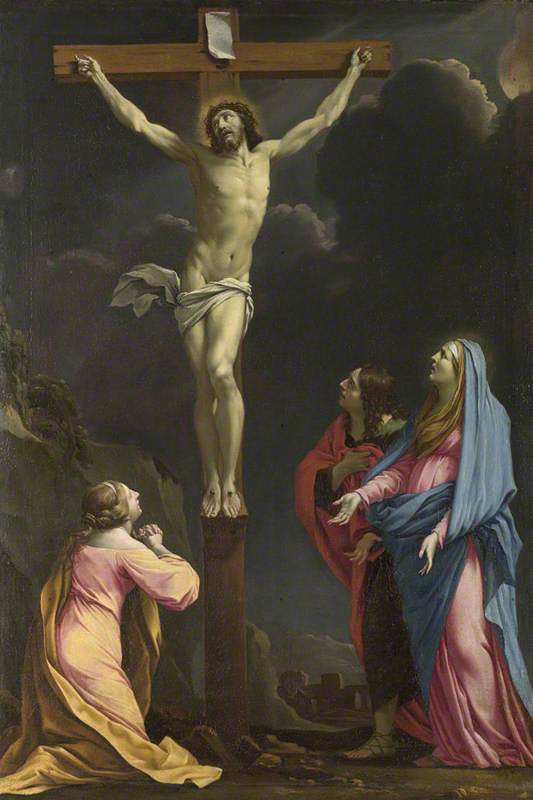
All four Gospels make note that Mary was present at the crucifixion and death of Jesus on Good Friday. Matthew, Mark, and Luke note that Mary and other women, in particular Mary Magdalene, “watched from a distance.” Only Luke writes that “some of Jesus’ disciples” were with Mary. Notably, the Twelve were not there, but hiding out of fear for their lives.
John, however, says very clearly that Mary—with Mary Magdalene and the disciple whom Jesus loved—witnessed Jesus’ death “from the foot of the cross,” not from a distance. At the same time, the distinction made between John and the other three evangelists may provide us with significant teaching moments.
On the one hand, Matthew, Mark, and Luke may be understood as historical descriptions since family and relatives, especially women, would not have been permitted up close to the actual place of execution. Executions were “men’s work.” Those executed were stripped of all clothing and died naked. Artists have added loincloths for the sake of Jesus’ dignity. And executioners would not have wanted hysterical family members getting in the way. If you’ve seen The Passion of the Christ, you will remember the shocking brutality of the crucifixion. But the point is that, even at a distance, the fact is that Mary and others saw Jesus crucified and die.
Universal Truths
John’s description has Mary, Magdalene, and “the disciple whom Jesus loved” close enough so that they could hear his words. John’s account is not for the purpose of describing the actual historical scene. Rather, it is to give the early Church a powerful instruction in the relationship of Mary not only to the disciple standing near her, but also to the whole Church. Jesus showed us that his mother was, indeed, the mother to all of God’s children.
In looking at this scene of Jesus’ crucifixion and noting the distinctions between Matthew, Mark, and Luke’s description—and that of John’s—we see an important point in reflecting on Scripture. Sometime people want to put great emphasis on those things that they see and understand as historical. It is essential to understand that God reveals his truth in various ways.
The writer, John, already knew of the other Gospels as they described Mary and the others watching the death of Jesus, showing their dedication and faithfulness to him even in death. The best conclusion to draw is that everything in the Gospels (and all of Scripture) is significant since it is the revealed word of God. Whether it is a fact of history or a manner of teaching that might not be historical, both contain the truth of God’s teaching for us.
Both the devotion of Mary and the women witnessing Jesus’ death—and the gift of Mary as mother to us—are truths we cannot be without.
“Whoever shall faithfully serve me by the recitation of the Rosary, shall receive powerful graces.”
“I promise my special protection and the greatest graces to all those who shall recite the Rosary.”
“The Rosary shall be a powerful armor against hell, it will destroy vice, decrease sin, and defeat heresies.”
“It will cause virtue and good works to flourish; it will obtain for souls the abundant mercy of God; it will withdraw the hearts of people from the love of the world and its vanities, and will lift them to the desire of eternal things. Oh, that souls would sanctify themselves by this means.”
“The soul which recommends itself to me by the recitation of the Rosary, shall not perish.”
“Whoever shall recite the Rosary devoutly, applying himself to the consideration of its Sacred Mysteries shall never be conquered by misfortune. God will not chastise him in His justice, he shall not perish by an unprovided death; if he be just, he shall remain in the grace of God, and become worthy of eternal life.”
“Whoever shall have a true devotion for the Rosary shall not die without the Sacraments of the Church.”
“Those who are faithful to recite the Rosary shall have during their life and at their death the light of God and the plenitude of His graces; at the moment of death they shall participate in the merits of the Saints in Paradise.”
“I shall deliver from purgatory those who have been devoted to the Rosary.”
“The faithful children of the Rosary shall merit a high degree of glory in Heaven.”
“You shall obtain all you ask of me by the recitation of the Rosary.”
“All those who propagate the Holy Rosary shall be aided by me in their necessities.”
“I have obtained from my Divine Son that all the advocates of the Rosary shall have for intercessors the entire celestial court during their life and at the hour of death.”
“All who recite the Rosary are my children, and brothers and sisters of my only Son, Jesus Christ.”
“Devotion of my Rosary is a great sign of predestination.”
Our Lady’s Rosary Makers was founded in 1949 by Brother Sylvan Mattingly, C.F.X. This Xaverian Brother taught people to make rosaries on the premise that they would make rosaries and distribute them freely to missionaries. Our Mission, set forth by our founder, Brother Sylvan, who envisioned a world in which all God’s children, possessing an instrument of peace and comfort, would work to fulfill Our Lady’s requests at Fatima, to pray the Rosary daily, is to provide those in need of a Rosary with one.
OLRM provides low cost materials, resources, and support in the spirit of Br. Sylvan’s mission and vision. We are a member driven, non-profit, Catholic lay apostolate within the Archdiocese of Louisville. Our diverse and active members spread devotion through the Immaculate Heart of Mary by making and sharing the Rosary with the world’s spiritually needy.
OLRM publishes FREE instructions for making rosaries. How to make a rosary instructions are available for cord and wire rosaries. In addition to these two there are some instructions for variations on these methods. Printable, online, and video instructions of making rosaries are offered directly on this site below.You may also order FREE copies in bulk, or a DVD for $8.50, through our Online Rosary Parts Catalog.
OUR HISTORY
Long haunted by the urgency of Mary’s words at Fatima, Brother Sylvan, C.F.X., decided in May 1949 to do something extra for Our Lady. He began to teach children how to make rosaries for the missions.
Inspired by Our Lady’s words, and having seen letters from missionaries around the world, he knew of the great need for rosaries in the mission fields.
He thought: The missionary can teach his people Christianity, he can offer the Mass for his people, but what happens when he’s off caring for others? With a few rosaries arriving he could now leave a symbol of the Faith to his people. Even though they could neither read nor write, they could pray the rosary.
Letters began pouring in from missions all over the world. The need was really greater than anyone had imagined.
Brother made a trip to Denver to teach ten people there. This group grew and spread the word to others as far away as a small town in Minnesota. Inspired people of Detroit started a group which today sends over 100,000 rosaries a year to the missions.
He set up a small office in a basement room at St. Xavier High School in Louisville, Kentucky and named his slow-forming club “Our Lady of Fatima Rosary Making Club.”. An elderly couple donated $25 for a typewriter to communicate with missionaries and club members.
In 1951 Brother asked Father Bertrand Rapp, newly ordained parish priest, to take over the duties as Chaplain to the Club. On a cold winter night in December, after working all day to build a fieldstone “Grotto for Mary”, Brother Sylvan died.
Father Rapp worked tirelessly to continue Brother’s work. Teaching here, arranging for volunteers somewhere else. He spent his vacations in Rosary Club endeavors, unselfishly working for Mary. By 1954 membership had grown to 2,500 adults and many children in schools across the nation.
With growth came the need for more capacity to serve our members. Brother Sylvan had a difficult time raising that first $25 for a typewriter, and with growth, there were more expenses. Thirty-four thousand dollars for a bead mold; twenty thousand for a die to mold the needed crucifixes and centers. Wire had to be bought in half ton lots for maximum economy. Where does all the money come from?
Our Blessed Mother inspires, but she doesn’t make it easy; yet the answer came simply enough. The deficit is made up by the Club making catalog sales to those rosary-makers who wish to make a nice gift rosary for a friend or relative. The profit from these catalog parts help make up the mission loss.
Annual members dues of $2 help pay for our newsletter, Our Lady’s Messenger, with the remainder going into the deficit fund. Invariably when there is need, someone helps with a small donation; sometimes a large one.
Today the club has grown from its humble origins to be the world’s leading mission Rosary apostolate. A new International Rosary Center was built in 1968. Today the center is more than double its original size. OLRM staff work diligently five days a week processing and filling orders for rosary supplies, as well as, connecting members with missionaries and missions in need of rosaries.
The International Rosary Center houses our operations, showroom, and Our Lady’s Chapel – in which we pray our morning rosary. The Blessed Sacrament is present and we have a monthly Mass on the First Saturday in honor of Brother Sylvan and all Club members
For more than two thousand years, the Christian saints have had great influence worldwide. Now, this new, inspiring collection of biographies reveals the legendary stories, little-known facts, and inspiring beliefs of some of the best loved saints. Full color throughout, each profile includes a biography with patronage and feast dates, along with prayers both to and about the saint.
Our book Ancient & Modern Saints below.part1 and part 2. Enjoy! Barbara and Sandy






 novena.com