Saints for October: Saint Therese of Lisieux, invoked for a loving and peacefilled atmosphere

Saint Therese of Lisieux

(also known as Therese of the Child Jesus and the Holy Face)

1873-1897

Doctor of the Church

Feast Day: October 1

Patron of: France, Russia, Vietnam, AIDS patients, Children, Florists, Foreign Missions, Love, Pilots, Tuberculosis Patients

Invoked for: a peaceful atmosphere

Attributes: Crucifix, Showering Roses

Love, roses and children are keywords for Saint Therese of Lisieux.  A young Carmelite novice, Therese lived a cloistered existence in a convent only miles away from where she was raised. She died in obscurity at the age of 24, never realizing her dream of working in the foreign missions, yet she is considered to be one of the greatest saints of modern times.

Therese Martin was the youngest of five daughters born to a very religious couple. At the age of four she lost her mother to breast cancer and the family moved from Normandy, France to the city of Lisieux to be among other relatives. Therese was spoiled by her older sisters and when the eldest joined the convent, she vowed to not only follow her, but to become a saint. She was admitted to the Carmelite cloister at the unusually young age of fifteen. Her sentimental fantasy of convent life was replaced by the reality of menial chores and constant prayer.  She came face-to-face with her own doubts and weaknesses when she became ill with tuberculosis and her dream of doing missionary work in Hanoi was shattered  Along with her diminished health, Therese had to accept the fact that she would never have the opportunity to travel the world and do great things. Feeling small and ineffectual, Therese went through a period of spiritual dryness where she doubted that her prayers were even heard.

By embracing her powerlessness, she was able to transform her life and develop her “Little Way”. A personal philosophy devoted to performing small, loving acts scattered throughout her day like so many flowers. Gradually, Therese realized that there were no actions that could be considered insignificant, no matter how small. If they were performed with love, they would have great force.

In 1896, while she was bedridden, Therese was ordered to write her autobiography. This self examination is part of the Carmelite spiritual regime. After her death, the book  called “The Story of A Soul” was published in a small printing. It soon became spectacularly successful, as ordinary men and women were able to easily identify with its author’s struggle to accept living a hidden, mundane life. It has been translated in at least 50 languages and Saint Therese has a very active and enthusiastic following all over the world.

The international influence of her book realized Therese’s dream to be a foreign missionary. Her Little Way is greatly influenced by the simplicity of children, so the concerns of children are one of her patronages. On her deathbed she vowed  that “I will spend my heaven doing good on earth. After my death I will let fall a shower of roses.”

A sign that your novena to Saint Therese is being answered is the sight and smell of roses.

Novena to Saint Therese of the Child Jesus

O little Therese of the Child Jesus, Please pick for me a rose from the heavenly gardens and send it to me as a message of love. O little flower of Jesus, ask God today to grant favors I now place with confidence in your hands. (Mention your request here). Saint Therese, help me to always believe as you did, in God’s great love for me, So that I might imitate your “Little Way” each day.

Amen.

(From the App: “Novena:Praying with the Saints”).
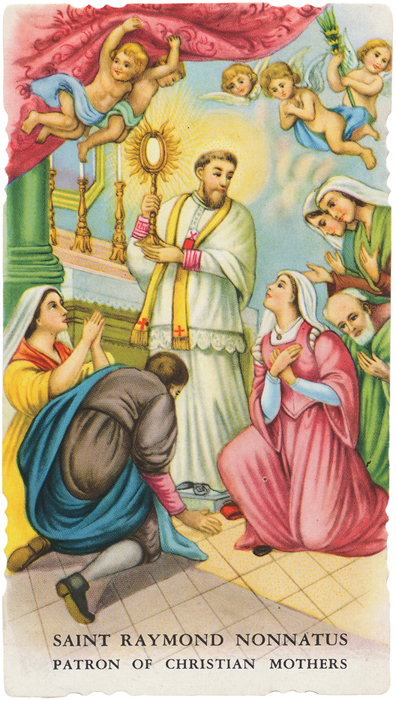
Feast of St.Raymond Nonnatus

St.Raymond copySt. Raymond Nonnatus 1204-1240
Feast Day: August 31
Patron of: Newborns, Midwives, Obstetricians, Expectant Mothers, Women In Labor, Falsely Accused, Secrets, Fever.

“For many hours you did not die in the womb of your dead mother and you were successfully delivered from her side to be the joy of the world.”

‘Non natus’ is Latin for “never born” and Saint Raymond was given his surname because his mother had died in labor two days before he was delivered by cesarean section. The fact that he did not die in his mother’s womb was considered an extraordinary event in the early thirteenth century, when a good number of mothers and infants were lost during childbirth. Because of the extraordinary circumstances of his birth, he always felt an affinity for the precarious state of women in labor and their infants. For this reason, midwives, obstetricians and expectant mothers call on him for help in the safe delivery of healthy newborns.
Hailing from Catalonia in Spain, Raymond’s family were from a noble class. His father attempted to train him to take over the family farms but because of his great devotion to the Virgin Mary, he chose instead to join the Mercedarians, a religious order dedicated to ransoming Christian slaves from the Moors, who occupied much of Spain. The Mercedarians also spiritually administered to Christian slaves in Moorish regions. As the Spanish territory was recaptured, and the Moors driven into North Africa, Raymond Nonnatus followed Christian slaves into Algeria. It was said he spent his entire inheritance ransoming slaves and when he ran out of money he substituted himself for another man’s freedom. He was soon imprisoned for his religious proselytizing and when he succeeded in converting several of his jailers, the Moors bored holes in his lips and sealed his mouth shut with an iron padlock to keep him from preaching. Though he was sentenced to death, the Mercedarians managed to ransom him home to Spain. As he was en route to Rome to receive the hat of a cardinal, he was struck down by a fever and died in Cardona, 60 miles from Barcelona. It was said that angels fed and administered communion to Raymond on his deathbed and he is frequently depicted in the company of angels.
Because of the padlock put on his lips, Raymond Nonnatus is invoked against gossip and the temptation to gossip. He is also invoked for help in keeping secrets as well as by priests for protection of keeping the sacred silence of the confessional. On the feast of Saint Raymond Nonnatus, it is customary for those who are victims of slander and gossip to put locks on the saint’s altar to silence their persecutors. In many images Saint Raymond Nonnatus carries the palm of martyrs signifying life defeating death, his palm has three crowns, for chastity, eloquence, and martyrdom.

Novena
Glorious St. Raymond, filled with compassion for those who invoke thee and with love for those who suffer heavily leaden with the weight of my troubles, I cast myself at thy feet and humbly beg of thee to take the present affair which I recommend to thee under thy special protection. ( your request here.)

Vouchsafe to recommend it to the Blessed Virgin Mary and lay it before the Throne of Jesus, so that He may bring it to a happy issue. Cease not to intercede for me until my request is granted. Above all obtain for me the grace of one day beholding my God face to Face, and with thee and Mary and the saints praising and blessing to all eternity. Amen.

Good St. Raymond, pray for us and obtain our request.

Say one Our Father, Hail Mary and Glory be.

Feast of St.Monica

St.MonicaSt. Monica
331 – 387
Feast Day: August 27

Patron of: Wayward Children

Quote: “Nothing is far from God.”

Keywords: abuse victims, adultery victims, alcoholics, housewives, married women, mothers, patience, wayward children

Symbols: tears, girdle

Though she was greatly hurt and disappointed by her firstborn son, St. Monica never gave up the idea that he would change his way of living. After 17 years of what seemed like fruitless prayers, her son turned his life around, converted to her faith and became one of the world’s greatest philosophers and Catholic saints, St. Augustine of Hippo. We invoke St. Monica to help us when our own children disappoint us. She serves as a reminder that there are no lost causes in this world and that absolutely anyone can reform and change their life.

Born into a Berber tribe in North Africa, Monica was brought up a Christian. Her parents arranged her in marriage with a prominent pagan Roman citizen of Carthage by the name of Patricius. Monica had a hard time in her early married years as she had to put up with a cantankerous mother-in-law as well as a dissolute husband. There are some accounts which say that she turned to alcohol and was herself an alcoholic who recovered her sobriety through faith and prayer. She had three children who she raised as Christians. The eldest, Augustine, was the most brilliant and his parents had high hopes for his career. Both Patricius and Monica worked hard to get the best education for their son and it was the greatest sorrow of Monica’s life when Augustine turned out to live a lazy, pleasure-filled life. It hurt her even more when he threw out his Christian beliefs to embrace the Manichean heresy – a popular cult believing in the natural good and evil of every soul. In order to keep his blasphemous beliefs from misleading her younger children, Monica forbade Augustine to come back to their home. Inconsolable in her grief, Monica had a vision of a radiant being pointing to Augustine in a beam of light next to her, saying, “Your son is with you.” When she related this vision to Augustine he laughingly said it would all be true if she would only give up her religious piety. “He did not say that I was with you,” she answered him. “He said you were with me.”

When Augustine openly took a mistress and further humiliated his mother by having an illegitimate son, Monica turned to her Bishop for help. He advised her to pray and be patient saying, “It is not possible that the son of so many tears should perish.” After the death of his father, Augustine decided to move to Rome to increase his worldly success, Monica vowed to follow him. In his own great treatise “Confessions”, Augustine relates how as his mother spent the night in prayer before their voyage, he tricked her and slipped away on an earlier ship. Devastated, she traveled to Rome anyway. By the time she arrived Augustine, had already left that city for Milan. By the time Monica tracked him down, she was overjoyed to find that Augustine was no longer a Manichean. He had met Ambrose, the bishop of Milan and was studying with him. Eventually, after several more years, Monica lived to see Augustine baptized a Christian. While waiting for a ship at Ostia to take mother and son back to Africa, Monica told her son that she had accomplished everything that she had set out to do in this life and did not need to live any longer. She died in Ostia, never returning to her native land.

It is interesting to note that there are many great saints from Africa, especially the earliest ones and they are rarely depicted as anything but European in visage.

Explanation:
Light from sky: Grace. Through prayer, Monica channeled grace to convert her son.
Outstretched arms: pointing to Africa, her homeland.
Palm tree: the shore of Ostia Antica, where Monica’s earthly life ended.

Novena Prayer to Saint Monica

Dear Saint Monica, once the sorrowing mother of a wayward son, be pleased to present our petition to the Lord God of heaven and earth. (Your intention here.) Look down upon our anxieties and needs, and intercede for us, as you did so fervently for Augustine, your firstborn.

We have full confidence that your prayers will gain favorable hearing in heaven. Mother of a sinner-turned saint; obtain for us patience, perseverance, and total trust in God’s perfect timing. In His appointed hour, in His merciful way, may He respond to your prayer and ours, which we offer through you. Amen

Novena to Saint Philomena

Aside

FullSizeCard_1


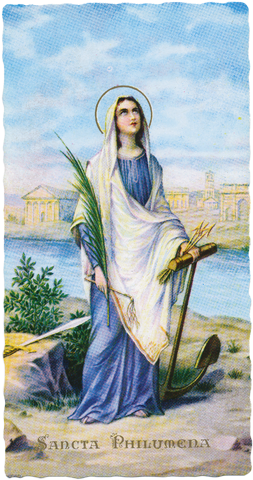
Saint Philomena

 291 – 304

 Feast Day: August 11

 Patron of: the Poor

 Keywords: the poor, children, babies, priests, lost causes, youth

 Symbols: palms, arrows, anchor, crown

 Quote:  “For the love of God!  It might well be that her name is not Philomena, but this Saint has performed many miracles and it is not the name that did them.”   Padre Pio

 Never official canonized, and listed in the local Calendar of Saints for only 130 years before being removed, Saint Philomena enjoys a unique and fervid following among common people, popes and saints. Her remains discovered seventeen centuries after her death, Saint Philomena is known as one of the great Wonder Workers of the nineteenth century and is the only person declared a saint based solely on their intercessionary powers. Recognized for her miraculous influence by six popes and ten different saints who have claimed personal experiences through her intervention, she is called upon when things look most hopeless. Discovered by a priest who hailed from a poverty-stricken parish near Naples, she is said to be particularly in tune with the needs of the poor.

 In 1802, the bones of a girl between the ages of 13 and 15 were discovered in the Catacombs of Priscilia in Rome, Italy. Three tiles closing off her space hollowed into the rock read, “Peace be with thee, Philomena”. Entombed with the girl was a vial thought to contain blood as well as drawings of a palm, two anchors and three arrows. Because these images were well known symbols used by early Christians to convey martyrdom, it was established that the girl was one of the many virgin martyrs in the early, underground church. In 1805 a young priest from the diocese of Nola (a district near Naples) requested the Vatican to allow him to obtain a relic for the new altar in the Church of Our Lady of Grace in Mugnano. Because he felt a spiritual affinity when he was near her remains, he was allowed to take the relics of the recently discovered virgin martyr back with him. Before her remains were translated to the church, they were put on display in Naples. Almost immediately, there were reports of miraculous healing. When her relics arrived in Mugnano on August 11, 1805, a cult rapidly grew, attributing many miracles to the intercession of the little martyr.

 In 1833 a Neapolitan nun, Sister Maria Luisa de Gesu, claimed to have a vision of Philomena who relayed her life story. According to her vision, Philomena was the daughter of the king of Corfu in Greece. When the Emperor Diocletian of Rome threatened her father’s kingdom with war, he traveled to Rome with his family in order to obtain peace. There Philomena discovered Christianity and vowed her virginity to Christ. When the Emperor saw how beautiful she was, he asked to marry her. When the young girl refused him, she was tortured and then drowned with an anchor tied around her neck. When two angels raised her up out of the sea, she was shot with arrows. After this failed to kill her, she was decapitated. According to the nun’s vision, Philomena declared that August 11th, the day her relics were installed in Mugnano, was also the anniversary of her death.

 In 1835, when Pauline Jaricot, the well-known and respected French reformer was gravely ill with heart disease, she made a pilgrimage to Mugnano and was completely cured by Philomena. News of this event spread throughout France and Spain and Philomena attracted such notable devotees as Saint Anthony Mary Claret from Spain and Saint John Vianney of France who built his own shrine to the little martyr. Several popes, while still cardinals paid visits to Philomena’s shrine. Pope Pius IX credits her with curing him of epilepsy. Saints such as Francis Xavier Cabrini, Padre Pio and Father Damian are numbered among her devotees. When the Calendar of Saints was reassessed to only list saints who had historical proof of their existence, Philomena lost her place. Her cult is still very strong and pilgrims from around the world visit her shrine in Mugnano.

 Symbols:

Crown – of royal birth

Anchor – early Christian symbol of being ‘anchored by Christ’

Palms – martyrdom

Arrows – method of martyrdom


NOVENA PRAYER TO SAINT PHILOMENA


 O Faithful Virgin and glorious martyr, St. Philomena, who works so many miracles on behalf of the poor and sorrowing, have pity on me. Thou knowest the multitude and diversity of my needs. Behold me at thy feet, full of misery, but full of hope. I entreat thy charity, O great Saint! Graciously hear me and obtain from God a favorable answer to the request which I now humbly lay before thee.. (mention your intention).

I am firmly convinced that through thy merits, through the scorn, the sufferings and the death thou didst endure, united to the merits of the Passion and death of Jesus, thy Spouse, I shall obtain what I ask of thee, and in the joy of my heart I will bless God, who is admirable in His Saints. Amen.

 End with:

Saint Philomena, powerful with God, pray for us!
Saint Philomena, powerful with God, hear our prayers!

(Excerpted from The Novena App on itunes: https://itunes.apple.com/us/app/novena/id631346670?mt=8)

Feast of Saint Ann and Saint Joachim

FullSizeCard_1
Saint Ann and Saint Joachim
First Century B.C.
Feast Day: July 26

Patron of : Grandparents

Keywords: child rearing, childless people, fathers, family crisis, infertility, mothers, pregnancy

Quote: “O blessed couple, all the world is indebted to you, for it is by your means that it can offer to its Creator the most excellent gift possible, her who is worthy to be Mother of His only Son.” – St. John Damascene

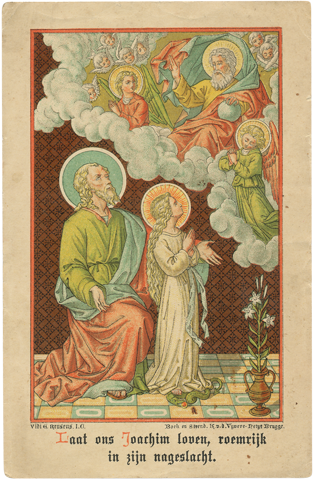
Symbols: two white doves, meeting at the golden gate, teaching the Virgin Mary

Grandparents are the foundation of a family and we invoke Saints Joachim and Ann for strength in every sort of family crisis. As parents of the Virgin Mary and the grandparents of Jesus Christ, they offer a vast array of earthly experiences relatable to every human being. Infertility, late parenthood, an unmarried pregnant daughter, a grandson who was imprisoned and executed, are all parts of their life together which they accepted with grace and dignity.

Joachim and Ann are important as moral examples rather than truthful historical figures. According to legend, Joachim and Ann were married twenty years and still had not conceived a child. Living in Nazareth they were upstanding citizens, always tithing one third of their income to the temple. After many years, their barrenness was considered a form of divine judgment and eventually their contribution to the temple was refused and they were ostracized by their community. In shame, Joachim went off to live with his shepherds. There he was visited by an angel who told him, that Ann was pregnant with a child named Mary who was to be dedicated to the Lord. He was to return home and find his wife, who would be waiting at the golden gate, the entrance to the city. Doing as he was told, his joyful reunion with Ann at the golden gate has become a famous image in art history.

Mary was raised according to the instructions of the angel, she was consecrated to the Lord at infancy and sent off to live in the temple, away from the world, at the age of three. Accepting this great sacrifice of giving up what is most cherished to God, Joachim and Ann acted out an almost impossible act of faith. Though Saint Ann was younger and lived much longer than her husband, she and Joachim are inseparable in sharing the important patronage of grandparents.

Explanation:
A rare image of Joachim as an older father, and his wife, Ann, instructing the Virgin Mary. They are divinely inspired by the wisdom of the Holy Spirit.

Novena to Saints Joachim and Ann

Saints Joachim and Ann, grandparents of Jesus and parents of Mary, we seek your intercession. We beg you to direct all our actions to the greater glory of God and the salvation of souls. Strengthen us when we are tempted, console us during our trials, help us when we are in need, be with us in life and in death.

O divine savior, we thank you for having chosen saint Joachim and Ann to be the parents of our Blessed Mother Mary and so to be your beloved grandparents. We place ourselves under their patronage this day. We recommend to them our families, our children, and our grandchildren. Keep them from all spiritual and physical harm. Grant that they may ever grow in greater love of God and others.

Saints Joachim and Ann, we have many great needs. We beg you to intercede for us before the throne of your divine grandson. All of us here have our special intentions, our own special needs, and we pray that through your intercession our prayers may be granted. Amen.

(Mention your request here)

Saint Anthony of Padua, 1195 – 1231

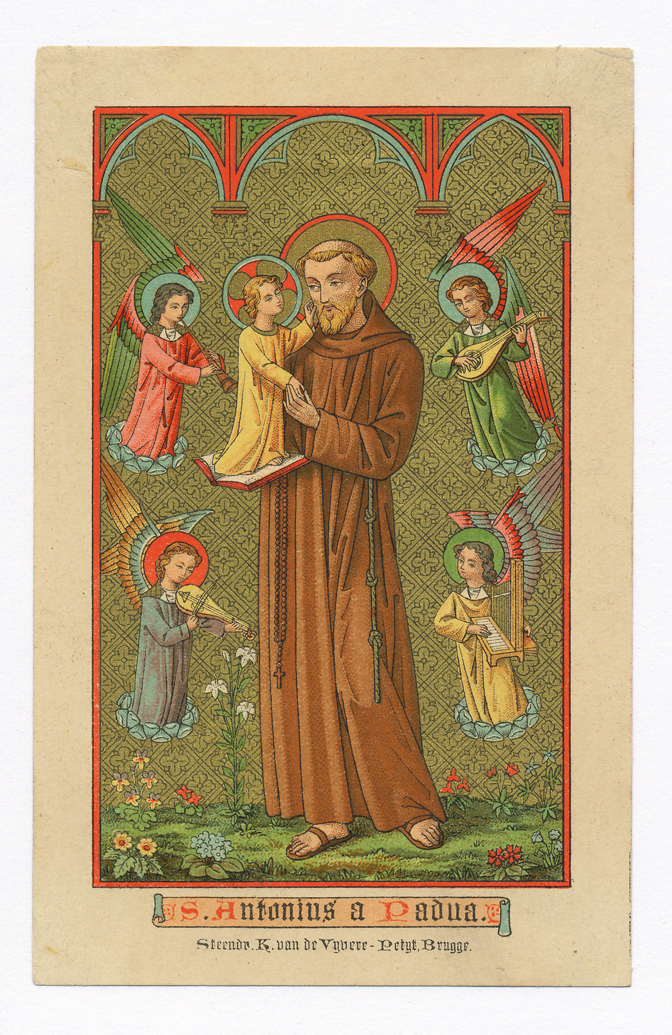
St. Antonius a Paduasmall“Saint Anthony, please come around, there’s something lost that must be found.” Doctor of the Church Feast Day: June 13 Patron of: Lisbon, Portugal, Padua, amputees, barren women, domestic animals, draftees, oppressed people, orphans, paupers, the poor, pregnant women, prisoners, sailors Invoked for: finding a husband, finding lost articles Invoked against: debt, shipwreck, starvation Symbols: baby Jesus, book of Gospels, lily Wonder and miracles are infused with every story of Saint Anthony. Though he has been dead for almost 800 years, he is still the most popular saint in the world and his statue is found in every Catholic Church. Saint Anthony is best known as the patron saint of lost articles but he is invoked for help in all life situations. In his own day he was called the “Wonder Worker’ and credited with the ability to stop the rain, raise the dead and reattach severed limbs. He was such a charismatic preacher that when a crowd of heretics in Rimini refused to listen to his preaching, the fish raised themselves out of the water to hear him. Born Fernando de Bulhes in Lisbon, Portugal, he disappointed his noble family by rejecting his luxurious life and joining the Augustinian religious order. A scholar by nature, he read every book in the monastery, devoting his time to contemplative prayer. Eventually, he befriended a group of itinerant Franciscan monks and became fascinated with this new religious order. Much impressed by their dedication to simplicity, poverty and their belief in returning to the original words of Christ, he joined their ranks, changing his name to Anthony in honor of Saint Anthony of the Desert, the patron of their little church. Returning home from a failed missionary venture in Morocco, his ship was blown off course and he wound up in Messina, Sicily. A group of Franciscan friars insisted he go north with them for a great gathering of all Franciscans, with their founder Francis of Assisi. Anthony remained in Italy and discovered his great gift of preaching when a superior ordered him to speak at an ordination, telling him to say whatever the holy spirit had infused into him. He astonished his audience, not only by his skills as an orator but by the depth of his knowledge. He was sent throughout northern Italy and southern France on evangelical preaching missions which gathered crowds in the tens of thousands. His popularity among the people increased as he used his position to get real changes enacted for their protection. While based in Padua, he observed the crushing power of debt upon the common people. At Anthony’s insistence, the local municipality enacted a law protecting those who could not pay their debts that is still enforced today. Anthony exhausted himself preaching out in fields and in piazzas as there was not cathedral large enough to hold all who came to hear him. At the age of thirty six, his health began to fail him and a local Count donated a woodland retreat for his recovery. One morning the Count heard the sounds of a baby giggling and he looked out to see Anthony surrounded in light, playing with the baby Jesus. That Christ would choose to appear to one of his saints in such a vulnerable state is a testament to the loving and kind nature of Saint Anthony. Because he is depicted holding a baby, women having trouble conceiving invoke his aid. Being of Portuguese descent, Anthony’s feast day is very auspicious for marriages in Portugal and Brazil and in those cultures, he is known to assist women seeking a husband. According to legend, Saint Anthony earned the title patron saint of lost articles when a novice borrowed his psalter and failed to return it. Saint Anthony prayed to get it back and the novice was visited by terrifying visions that sent him running back to Anthony with the book. In iconography, Anthony always holds the baby Jesus and a lily for purity. Many times the returned book of the gospels is included. Novena to Saint Anthony of Padua Holy Saint Anthony, gentle and powerful in your help, Your love for God and charity for His creatures, made you worthy when on earth, to possess miraculous powers. Miracles waited on your word, which you were always ready to request for those in trouble or anxiety. Encouraged by this thought, I implore you to obtain for me (mention your request here). The answer to my prayer may require a miracle. Even so, you are the saint of miracles. Gentle and loving Saint Anthony, whose heart is ever full of human sympathy, take my petition to the Infant Savior for whom you have such a great love, and the gratitude of my heart will be ever yours. Amen It is customary to donate to Saint Anthony’s Bread, a charity started in Saint Anthony’s lifetime, in gratitude to answered novena prayers.

Sacred Heart of Jesus

FullSizeCard_1Feast Day: June 7
Movable – the Friday after the Second Sunday after Pentecost

Patronage: Family Peace, Anything

Keywords: Love, Family Peace, Consolation, Mercy, Reparations

Quote: “Behold the heart which has so much loved men that it has spared nothing, even exhausting and consuming itself in testimony of its love….”

The iconography of the Sacred Heart speaks to us on such a basic level that its image can be found everywhere in everyday life – from tattoos on bikers to stained glass windows in cathedrals. Traditionally, many Catholic homes display the Sacred Heart of Jesus to insure domestic peace and a loving atmosphere. This ancient concept depicting Christ’s heart in flames was first meditated on in privacy by the 4th century hermits in the desert and taken up by mystics in religious communities in the 11th and 12th centuries; it did not become a popular devotion until the 17th century.

On December 27, 1673, a young Visitation nun in Burgundy, France, named Margaret Mary Alacoque was praying in the convent chapel when she heard a strong inner voice identifying itself as Jesus Christ. In later visits the voice requested that she begin a devotion to an image of Christ’s heart in flames, bleeding and encircled by thorns. The flames were for His ardent love for mankind, the thorns were to remind us of His sacrifice on the cross and the blood was because He was God made man. There is no indication that Margaret Mary Alacoque had ever seen this image before. Indeed, she was puzzled by it and greatly mistrusted herself as being qualified to relay any spiritual messages no matter who they purportedly came from. When she reported her communications to her Mother Superior she was scoffed at as delusional and forbidden to perform any of the devotions she was instructed to carry out. It was only after her Confessor, Claude de La Columbiere heard her describe her visions that she was taken seriously. Unlike the Mother Superior or Margaret Mary, he was well aware of the private devotions of Bernard of Clairvaux and Mechtilde of Helfta, religious mystics who lived centuries before, inspired by same image. La Columbiere did much to publicize devotion to the Sacred Heart based on the messages Christ gave to Margaret Mary. According to her, Christ was greatly troubled by the indifference and sacrilege He was being treated with by the average person. As a reward for contemplating this image He promised:
1. I will give them all the graces necessary for their state of life.
2. I will give peace in their families.
3. I will console them in all their troubles.
4. I will be their refuge in life and especially in death.
5. I will abundantly bless all their undertakings.
6. Sinners shall find in my Heart the source and infinite ocean of mercy.
7. Tepid souls shall become fervent.
8. Fervent souls shall rise speedily to great perfection.
9. I will bless those places wherein the image of My Sacred Heart shall be exposed and venerated.
10. I will give to priests the power to touch the most hardened hearts.
11. Persons who propagate this devotion shall have their names eternally written in my Heart.
12. In the excess of the mercy of my Heart, I promise you that my all powerful love will grant to all those who will receive Communion on the First Fridays, for nine consecutive months, the grace of final repentance: they will not die in my displeasure, nor without receiving the sacraments; and my Heart will be their secure refuge in that last hour.
Since there is no way to physically depict the soul, it is thought that the image of the Sacred Heart comes closest. The heart is the seat of love in the body and the wounded heart represents Christ’s sacrifice at the crucifixion as well as His ongoing pain at the state of mankind.

Novena to the Sacred Heart of Jesus
O Lord, Jesus Christ, to your most Sacred Heart I confide this intention. Only look upon me, then do what your love inspires. Let your Sacred Heart decide. I count on you. I trust in you. I throw myself on your mercy. Lord Jesus, you will not fail me.
(Mention your request.)
Sacred Heart of Jesus I trust in you.
Sacred Heart of Jesus I believe in your love for me.
Sacred Heart of Jesus, your kingdom come.
Sacred Heart of Jesus, I have asked you for many favors, but I earnestly implore this one. Take it, place it in your open heart. When the Eternal Father looks upon it, he will see it covered with your Precious Blood. It will no longer be my prayer, but yours, Jesus. Sacred Heart of Jesus, I place all my trust in you. Let me not be disappointed. Amen.

Feast of St. Dymphna

St. Dymphna
St. Dymphna
605 – 620
Feast Day: May 15
Patron of: Mental Illness
Invoked for: epilepsy, incest victims, runaways, demonic possession, schizophrenia, family peace, calm, consolation

“Saint Dymphna, renowned for many miracles, please hear my plea.”

As a victim of a mentally ill father, Saint Dymphna offers much solace to those suffering from psychological problems as well as their families. She is invoked to bring peace to the unbalanced as well as create an aura of calm and consolation for those who live in the midst of instability.

Having lived such a short life so long ago, there is very little factual information available about Saint Dymphna. According to a written report commissioned by the Bishop of Cambrai seven hundred years after her death, Dymphna was born an Irish princess. Her mother was a devout Christian married to Damon, a pagan king. Dymphna’s mother made sure her daughter was brought up as a Christian, having installed her own confessor, Gerebran into her household. At the age of fourteen Dymphna lost her mother and her father went mad with grief. After a period of mourning, he searched all of Ireland for a new companion but could not find a woman who even remotely resembled his first wife. Because Dymphna was almost the exact image of her mother, Damon decided to marry her and make her his queen, disregarding the fact that she was his own daughter. In order to thwart this plan, Gerebran and Dymphna escaped the castle and went abroad to Antwerp. Eventually settling in Gheel in Belgium, they lived as religious hermits. Dymphna studied to be an anchoress which was a woman who lived in a room connected to a church with a window open to the street. Towns in the middle ages usually supported these people who offered their knowledge to those in need of advice. It took Damon and his men a year to find Dymphna and Gerebran. The priest was executed immediately and Dymphna was offered her father’s kingdom in exchange for returning home with him. When she refused, he decapitated her in a rage. Both bodies were immediately buried. Since epilepsy and mental illness were all thought to be caused by demonic possession, those suffering from mental afflictions were never welcomed to live in one place and were doomed to wander from town to town. Soon after Dymphna’s death, a group of five of these social pariahs slept at the site of her murder and were instantly healed by the blood in the earth.

In the 13th century, the remains of an unknown man and woman were accidentally disinterred at Gheel. The name DYMPNA was written on a brick over the woman’s remains. As the remains were reinterred in a tomb, miraculous healings of the mentally ill and epileptics in the region were recorded. Gheel became a pilgrimage site for anyone suffering from any form of mental illness. By the end of the thirteenth century a major hospital and treatment center was built there for those suffering from nervous disorders. To this day, Gheel offers the most advanced and humane treatment for the mentally ill in the world. Saint Dymphna’s remains, in the church named for her there continues to be a place of pilgrimage.

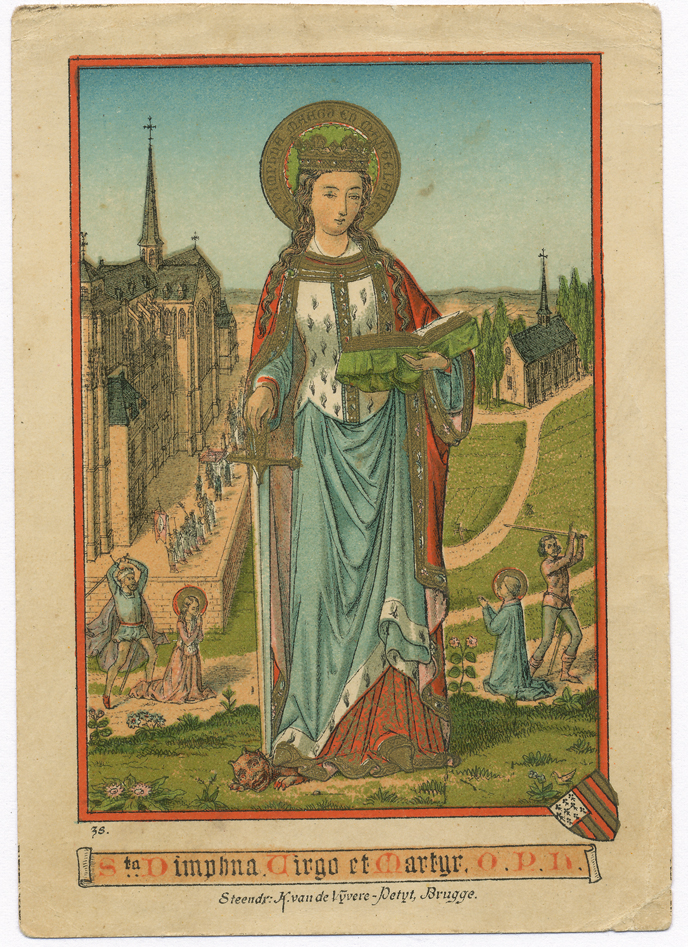
Symbols: crown because of royal birth, shackled serpent representing the devil who was thought to be responsible for the mentally ill due to demonic possession, book because she was an anchoress and religious scholar, lily for purity, martyrs palm

Novena to Saint Dymphna

O God, we humbly beseech you through your servant Saint Dymphna, who sealed with her blood the love she bore you, to grant relief to those who suffer from mental afflictions and nervous disorders, especially (mention the afflicted person).

Saint Dymphna, helper of the mentally afflicted, pray for us.

Saint Dymphna, comforter of the despondent, pray for us.

Saint Dymphna, renowned for many miracles, please hear my plea.

Amen.

(Recite one Glory Be).

Saint Rita of Cascia

St. Rita of Cascia
1386-1457
Patron of: Impossible Causes

Keywords: Impossible, Desperation, bad marriages, spousal abuse, widows, bodily ills, loneliness, smallpox, sterility

Symbols: roses, thorns, bees, wounded head

An abused wife, a mother who’s children died, a widow of a murdered husband, and finally, a nun, Saint Rita experienced many lives in her time on earth. Knowing the powerlessness and despair of those in bad marriages she is invoked for help in desperate times. In her own lifetime she was famous for the power of her prayers to change any situation and it was said that she could accomplish the impossible. Canonized almost 500 years after her birth, she is the first declared female saint of the 20th Century.

Margarita Lotti was born to an older farming couple in Roccaporena, Italy. She was called Rita because of a vision of an angel her mother had who named the baby while declaring, “You will give birth to a daughter marked with the seal of sanctity, gifted with every virtue, a helper to the helpless and an advocate of the afflicted.” As proof of this prophecy, bees, a sign of divine presence, always hovered over her crib as she slept, never harming or waking her.

Though she had always wanted to be a nun, Rita’s parents feared for her future security as there was a schism in the church and many religious orders were closing their doors. Instead, she had to accept a marriage they contracted for her with a man named Paolo Mancini. Though he was a good provider, he soon proved to be an abusive, promiscuous husband. Settling his personal disputes with violence, Mancini created a tense family environment for Rita and the two sons she had with him. Never wavering in her devotion to God, Rita prayed that her husband would change his ways. After 18 years of marriage, Paolo had a vision of himself as others saw him and begged for his wife’s forgiveness. A lifetime of enemies caught up with Paolo and he was murdered, his mutilated body dumped on his family’s doorstep. Rita begged her two teenaged sons not to pursue a vendetta against his killers, but they refused. She prayed to God to prevent her sons from murdering anyone. Both of them came down with serious illnesses and died before they could act on their vendetta.

Alone in the world, Rita petitioned to join the Augustinian convent. Because several of the nuns there had family members who were involved in Paolo’s murder, the convent refused her, not wanting tensions to carry over from the outside world. Rita prayed and entreated Paolo’s family to forgive his killers. Much to everyone’s surprise, they acquiesced and Rita was admitted to the convent on her third try. While there she spent her days nursing the older nuns and concentrating on Christ’s suffering. When she begged to feel what Christ felt on the cross, a thorn from the crown of thorns on a crucifix struck her on the head and became embedded there. It left a deep wound that never healed. Because this wound became infected and foul smelling Rita was shunned by the other nuns and remained in her cell praying and meditating. The January before she died, a cousin asked her if there was anything she needed and she asked for a rose from her childhood garden. The cousin was shocked to see that there was indeed two roses growing in that garden in the middle of January. Upon her death, her cell was filled with the smell of roses. Rita is always depicted with the thorn in her head, in her Augustinian habit, meditating on the crucified Christ.

Thorns: she took on the suffering of Christ
Wound in the head: Divine light, grace and spiritual power.
Roses: love. Also proof of Rita’s miraculous powers as her roses grew in the winter.

St. Rita
Novena to Saint Rita
O holy protectress of those who art in greatest need, O you who shine as a star of hope in the midst of darkness, blessed Saint Rita, bright mirror of God’s grace, in patience and fortitude you are a model of all states in life. I unite my will with the will of God through the merits of my Savior, Jesus Christ, and in particular through his patient wearing of the crown of thorns, which with tender devotion you daily contemplated. Through the merits of the holy Virgin Mary and your own graces and virtues, I ask you to obtain my earnest petition, provided it be for the greater glory of God and my own sanctification. Guide and purify my intention, O holy protectress and advocate, so that I may obtain the pardon of all my sins and the grace to persevere daily, as you did in walking with courage, generosity, and fidelity down the path of life.
(Mention your request).
Saint Rita, advocate for the impossible, pray for us.

Saint Rita, advocate of the helpless, pray for us.

(Recite Our Father, Hail Mary and the Glory Be three