Feast of Our Lady of Lourdes

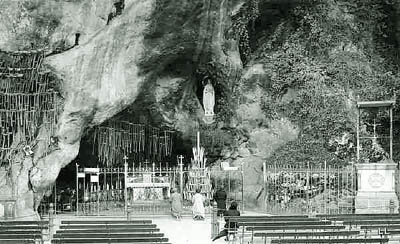
115_GrottoLourdes, an ancient village in the valley of the Pyrenees mountains, is in the extreme southwest of France near the Spanish border. It is the site of the most famous series of apparitions of the Virgin Mary and the most visited pilgrimage shrine in Christendom. Credited with exuding a powerful healing energy, it is inundated by those in need of physical and spiritual renewal. Attracting well over 200 million visitors since its discovery, Lourdes is a relatively modern holy site, having only been recognized by the Church as an official pilgrimage place since 1862. It became famous after a poor, illiterate local 14 year old girl, Bernadette Soubirous saw a vision of the Virgin Mary in a grotto near a great rock mound called Massabeille. Despite much ridicule and persecution inflicted on her by the local authorities, Bernadette could not be shaken from her story. While communing with the Virgin, Bernadette uncovered a trickle of muddy water in a place where water had never been. Today, that tiny spring gushes forth with thousands of gallons of water daily. Considered to contain inexplicable healing properties by the devout, many terminally ill people of all faiths flock to Lourdes as a last resort in curing their ailments. Catholics go to spiritually refresh themselves and to honor this visitation by the Mother of God.

Though officially ruled over by France, the villages of the Pyrenees had little to do with their country on any cultural or social level. Most spoke in patois, their own language, never learning French at all. They dressed in their own local costumes, disdained the central government and were known as the ‘Indians’ of France for the exotic way they lived. While the 19th century was celebrated as a great secular age, when France was finally freed of all political domination of the Catholic Church and science and logic replaced faith, the villagers of the Pyrenees defied all official teachings and held on to their religious beliefs. They were hostile to the French government and suspicious of any forms of official beauracracy. Living in a harsh, mountainous landscape, they held much of nature as sacred. They had little faith in modern medicine and combined ancient Celtic beliefs with their Catholic prayers. The love of the Virgin Mary was at the heart of their religious life. Since the 13th century shepherds and shepherdesses had reported direct contact with her, either through visions or the miraculous discovery of statues of her. Shrines to the Madonna were abundant and most towns had a special day of pilgrimage honoring her.

Bernadette Soubirous was a 14 year old girl who’s impoverished family lived in a dank former dungeon. Stricken with asthma, she was considered slow and held back from receiving her First Holy Communion because she had trouble learning her catechism. On February 11, 1858 her mother needed firewood for cooking and could not afford to buy any. She sent Bernadette, her younger sister and a friend out to look for some. So that they would not be accused of stealing, the girls had to go outside of town to public lands. There was an outcropping of rock facing the river with a grotto at its base known as Massabielle. The pigs of Lourdes grazed there and respectable residents did not go to that area because it was considered filthy. According to legend, the Massabeille had been sacred to the pagans in prehistoric times and those passing by it always crossed themselves to ward off the aura of evil that they felt emanated from it. Because of her illness, Bernadette stayed behind while the two younger girls waded across the river to get wood. She decided to join them and began taking off her stockings. It was at this point she heard the sound of a wind and then saw a soft light coming from the niche in the grotto. A beautiful, smiling girl in white seemed to beckon to her. Bernadette was startled and instinctively reached for her rosary. She was unable to pick it up until the young girl produced one herself. They made the sign of the cross together and as Bernadette prayed the rosary, the young girl passed her own beads through her fingers in silent prayer. When Bernadette finished, the young girl smiled and disappeared. Despite her mother’s opposition, Bernadette returned to the site that Sunday after mass. She was joined by a group of friends. The girl in white appeared and Bernadette said, “If you come from God, stay. If you don’t, go away.” She then sprinkled holy water at the girl to make sure she was not from the devil. Bernadette was relieved when the girl laughed and inclined her head to receive more water. Bernadette was the only one who could see or commune with the girl. Her friends were astounded by the physical change in her demeanor. She had fallen into a beautiful rapture and seemed totally relieved of her asthma. One threw a large stone in the direction of the niche and Bernadette did not flinch. Fearing she had had some sort of fit, they ran to get help. The towns residents who came were shocked at the beautiful transformation in Bernadette. Word of her visions started to spread.

Each time she returned to the grotto she was joined by a larger crowd. Many thought the apparition was either the ghost of a devout townswomen who had recently died or a soul who had wandered away from purgatory. Bernadette’s third vision was on the 18th of February and two important townswomen brought along a pen and paper. The girl in white laughed when Bernadette held out the writing instruments and for the first time spoke to her, addressing her with great politeness, “Boulet aoue ra gracia de bie aci penden quinze dias?” she asked in the patois dialect. (“Would you have the grace to come here for fifteen days?”) When Bernadette replied that she would ask her parents’ permission, the girl said, “I do not promise you happiness in this life, but in the next.” During these next two weeks news rapidly spread through Lourdes about the apparitions and the civil authorities felt obliged to take action. Bernadette was taken to the local police station for questioning. The authorities tried to make her admit that it was all a hoax. When she refused, they began to threaten her family. The Church was also skeptical and embarrassed by what they regarded as superstitious worship. The local pastor, Father Peyramale did not want to give the apparitions any credence. Even though the girl in the visions had not named herself, the belief that she might be the Virgin was growing among the townspeople.

For her part, Bernadette did not speculate on the mysterious girl’s identity, always referring to her as ‘Aquero’, the patois word for indescribable being. It was on February 25th, the ninth apparition of the girl that Bernadette was told to go drink at the spring and wash in it. Thinking the girl meant the river, she went towards the Gave. In her words, “…Aquero called me back and pointed to a spot beneath the rock. I found some moisture there but it was mud. Three times I threw it away even though the Lady said to drink it. Then I washed in it only to have my face besmeared with mud. When the Lady left, my Aunt Bernarde slapped my face. ‘Stop your nonsense,’ she said as she sent me home to the jeers of the people…” By the afternoon the muddy area was flowing with pure water and many in the laughing crowd were amazed.because they had never seen a spring there before. In subsequent apparitions the girl asked for penitence and the conversion of sinners. Bernadette said that she was afraid that the people climbing all over the grotto would disturb the rosebush where the girl stood. “I was afraid she might fall, but she kept on smiling at the people. She loved them, and she always seemed sorry to leave them.” At 13th visit Bernadette was told to tell the priests to come to the grotto on procession and to build a chapel. Father Peyramale was enraged and told her that if the girl in white wanted a chapel she should say who she was and she should make the wild rose bush in the niche blossom. It was after this 13th visit that the water in the spring was first accredited with healing properties. A pregnant woman with a paralyzed hand became totally cured and a stonecutter had his sight restored after he bathed his eyes in the water. Before this, there had been no physical proof of Bernadette’s visits.

The vast crowds that had started to accompany her did not see or hear the girl in white. They only believed in these visions because of Bernadette’s great physical transformation. Thursday, March 4th was the last of the 15 days. Over 8,000 people went to the grotto expecting to see something miraculous. At the end of her vision, 45 minutes, Bernadette put out her candle and went home. The rosebush did not bloom, the girl in white did not declare any message. Bernadette, unconcerned about the wild emotions she had aroused, went home content. For the next three weeks, Bernadette later wrote, “The people pestered me, the police watched me, and the public prosecutor almost crushed me…” Then, on the night of March 24th she awoke with the familiar urge to return. On March 25th,the day of the Annunciation, she returned to the grotto at 5AM. The girl in white appeared and Bernadette asked her four times to say who she was. “Aquero extended her hands towards the ground, swept them upwards to join them on her heart, raised her eyes, but not her head to Heaven, leaned tenderly towards me and said, ‘Que soy era Immaculada Concptiou.’ (‘I am the Immaculate Conception.’) She smiled at me. She disappeared. I was alone.” Father Peyramale was astounded at this announcement. This expression meant nothing to a simple peasant girl like Bernadette. The Catholic tradition that Mary had been conceived without original sin so that she might be worthy to be the Mother of God had only been formally defined as Church doctrine in 1854. Eventually, the parish priest would be Bernadette’s greatest defender as she was harassed and examined by government officials, psychologists and church hierarchy.

She never altered the account of her story to any of them, “I do not ask you to believe; I only told you what I had seen.” Three eminent Parisian doctors declared that she was mentally and emotionally sound but that she suffered from asthma. (“My mother could have told them that and saved them the trouble.”) Under increased pressure from the authorities, the grotto was closed off and anyone visiting it threatened with arrest. On the 16th of July, Bernadette saw the girl in white for the last time. She knelt in the meadow on the far side of the river. “…I began my rosary and my Lady stood in the Grotto smiling at me. It was the Feast of Our Lady of Mount Carmel. She looked more beautiful than I had ever seen her. This would be the last time I would see her on this earth….She left heaven in my heart and it has been there ever since.” While Lourdes developed into a world famous place of pilgrimage, Bernadette, disliking the attention her presence created, joined the Sisters of Nevers in 1866. Her novitiate was difficult and her health deteriorating. She never showed any interest in the miraculous healings promised by the water in the spring. Her insistence that the girl in white was no older than 12 was ignored and priestly experts stated that since Mary had to be between the age of 15 and 17 at the time of the Annunciation, the official image of the apparition should depict her at that age. Bernadette never liked the statue that was erected in the Grotto in 1864, declaring it “too big and too old”. She died of tuberculosis in 1879. When her body was exhumed in 1908, it was found to be uncorrupted. She was recognized as a Saint by the Catholic church in 1933. Gradually, the local officials had to relent and re-open the grotto to the public. The Bishop accepted the apparitions and approved the shrine in 1862. After the railroad line was finished in 1866, pilgrims began arriving in the tens of thousands. After 1873, when incidents of healing at the spring began to be reported, the shrine rapidly developed an international reputation for having healing powers. Bathing pools filled with cold water piped from Bernadette’s spring were created for visiting pilgrims. Much effort was put on the scientific community to repudiate the healings at Lourdes.

Many illnesses were declared to be hysterical in nature and therefore cured by the powers of suggestion. Studies of the water from the spring showed it had no special chemical properties In 1882 a medical bureau was established to test the validity of the cures. Before a cure can be officially considered, a patient’s medical records are studied by a commission of doctors and independent medical professionals. The alleged cure must be immediate and permanent to be regarded as a miracle. When an investigation does occur, the conclusion is placed in one of four possible categories: (1)There has been no cure. (2)A partial cure has taken place. (3)There has been a cure, but there are medical or psychological reasons for it. (4) There has been a cure for which there is not natural or scientific explanation. The pilgrim must then return after a year for further examination. Since March 1, 1858, the Church has recognized 65 miracles at Lourdes. There are countless undocumented healings and over 5,000 documented “inexplicable healings”. Father Peyramale completed the first basilica upon the rock of Massabielle in 1873. After the great “national” French pilgrimages were initiated where Catholics of all classes came to bathe the sick at Lourdes, a larger church had to be built. The Church of the Holy Rosary was consecrated in 1901.

Today, the Basilica rises in 3 tiers over the grotto. Across the stream is a cavernous underground church which seats 20,000. In the grotto the miraculous spring has been channeled into a long row of spigots where visitors may collect the “Lordais water” and take it home. A small hospital and a number of hostels serve the needs of the seriously ill There is a Rosary procession held by torchlight each evening and the entire shrine is active throughout the day and evening with various services, processions and blessings of the sick. At the heart of the Lourdes pilgrimage is service to the sick and the infirm. Many devotees do not go for themselves but to aid others and to commune with God in a holy atmosphere.

There are four traditional gifts imparted by Lourdes: 1) The gift of miraculous water 2) The gift of healing 3) The gift of reconciliation 4) The gift of strength and friendship.

Saint Mary Magdalene, First Century

Le Brun,Charles (1619-1690)Feast Day: July 22 Patron of: Provence, contemplatives, converts, gardeners, glove makers, hairdressers, penitents, perfumers, pharmacists, prisoners, reformed prostitutes

Invoked against: sexual temptation

Symbols: alabaster jar, long hair, skull

Though the subject of Mary Magdalene’s true identity may be fodder for a heated debate, there is one aspect of her life that all ecclesiastical writers agree upon: She never left Christ during His crucifixion, and she was the first person to see Him after His resurrection. Because Jesus chose her as His first witness and because He told her to go and tell the others what she saw, she is known as the “Apostle to the Apostles.” This title aside, it is the example she sets as a penitent and reformed sinner that she is most well known and honored. According to ancient Jewish texts, the seaside town of Magdala was known as a place of loose morals. This town was Mary’s home, and she took its name as her own, signifying her unmarried state. It was said that Mary had wealth and took great pride in her appearance, enjoying luxuries and lapsing into promiscuity. Many shunned her because of her reputation for lewdness, and it is as this sinner that we are first introduced to her. After Jesus had raised the son of a widow from the dead, a man named Simon invited him to be guest of honor at a dinner. While they were seated, a certain notorious woman walked into the room carrying an alabaster box. Weeping, she threw herself down and wiped Jesus’ feet with her hair and then anointed them with the oil. Simon was outraged that Jesus would accept such tribute from someone so disgraceful. But instead of judging the woman, Jesus rebuked Simon, “Does thou see this woman? I entered into thy house–thou gave me no water for my feet. But she with tears has washed my feet, and with her hair has wiped them. Thou gave me no kiss. But she, since she came in, has not ceased to kiss my feet. My head with oil thou did not anoint but she with ointment has anointed my feet. Wherefore I say to thee: Many sins are forgiven her, because she has loved much. But to whom less is forgiven, he loves less.” He then told the penitent woman to go in peace, all her sins were forgiven.

Excerpt from Saints, now an ebook on amazon.


SAINTS: Ancient & Modern

SAINTS_COVER_web
Announcing the Electronic Version of “Saints: Ancient and Modern”

Journey through time as Saints reveals the wonder and power of God through full color illustrations, images and inspirational prayers.

For more than two thousand years, the Christian saints have had great influence worldwide. They lived full, passionate lives and remain compelling examples of God’s work here on Earth. Now, this new, inspiring collection of biographies reveals the legendary stories, little-known facts, and inspiring beliefs of some of the best-loved saints.

Saints explores a select group of these individuals whose influence can be felt profoundly in the modern day. Each profile includes an extensive biography with patronage and feast dates throughout the world, along with prayers both to and about each saint. These saints inspired countless classic artworks and you’ll also learn the symbols used to identify each.

Saints included in this collection:

Ancient Saints

Saint Michael The Archangel
Saint Anne
Saint Joseph
Saint Mary Magdalene
Saint Jude
Saint Cecilia
Saint Valentine
Saint Christopher
Saint Lucy
Saint Nicholas
Saint Ursula
Saint Benedict
Modern Saints

Saint Francis of Assisi
Saint Clare of Assisi
Saint Anthony of Padua
Saint Rita of Cascia
Saint Joan of Arc
Saint Teresa of Avila
Saint Martin de Porres
Saint Therese of Lisieuex
Saint Teresa Benedicta of the Cross (Edith Stein)
Saint Pio (Padre Pio)

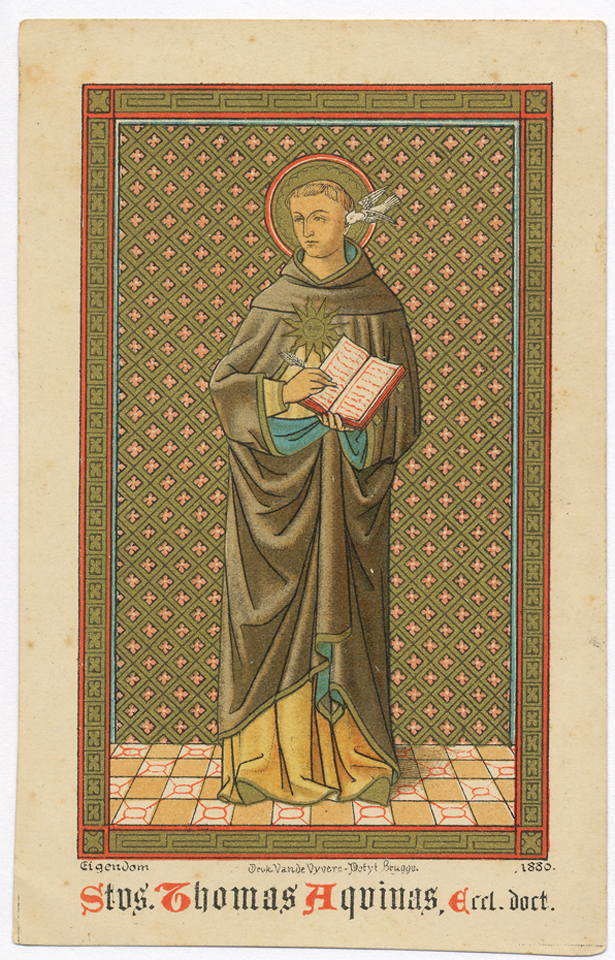
Feast of St. Thomas Aquinas, January 28

FullSizeCard_1@2“There must be must be a first mover existing above all – and this we call God.”

Patron of: Students

As one of the greatest philosophers of the Middle Ages. Yet on his deathbed, this intensely popular teacher and lecturer, who had lived in the cosmopolitan environments of Paris, Cologne and Naples, was said to give the innocent final confession of a child. Known in his lifetime as “The Angelic Doctor”, Thomas lived through his higher mind, taking intense pleasure in intellectual pursuits. Because he was an excellent teacher, able to clarify the most complicated points of learning, Thomas Aquinas is invoked by students whenever they are presented with a challenging test, a demanding course of studies or difficulty in passing an entrance exam.

Thomas was born in his noble family’s castle just outside of Naples, the youngest of four brothers and two sisters. As a child, one of his sisters was killed by lightning while sleeping in the same room as Thomas. He was forever fearful of thunderstorms, he is invoked by those with the same fears for protection against lightning strikes and sudden death. At the age of five Thomas was sent to study to the legendary Monastery of Monte Cassino. Considered the seat of Western Civilization through the dark ages, all manners of the arts and sciences were taught there. By the time Thomas left at the age of thirteen to attend the University of Naples, he was already tutoring his elders in their studies. While a student in Naples he horrified his noble family by joining the new order of mendicant Friars known as the Dominicans. Instead of begging in the streets with the Dominicans, his parents wanted to see Thomas using his great intellectual gifts to earn a higher ecclesiastical office. His brothers kidnapped him and locked him up in another family home, tempting him with every worldly thing they could think of. When they presented him with a prostitute, Thomas chased her out with a burning brand from the fireplace. After two years of confinement, his family relented and freed him The Dominicans sent Thomas to Cologne, Germany to study with Albert the Great, the most famous teacher of his times. Because of his quiet, kindly manner and his large size, his fellow students labeled him “the dumb ox”. Thomas quietly surpassed every student he ever had and Albert insisted he go to the University of Paris where he was made a teacher and received a doctor’s chair. His writings attracted both the Pope and the King of France who consulted him on matters of state. In 1272, the Dominicans sent him to Naples to run their school there. It was during the following year that experienced an ecstasy that caused him to suddenly stopped writing his greatest work , Summa Theologica, a tome that consisted of over two million words and he had spent the last seven years on. Compared to his vision, he declared, “all that I have written seems like so much straw.”

Novena:

Saint Thomas Aquinas, patron of students and schools, I thank God for the gifts of light and knowledge God bestowed on you, which you used to build up the church in love. I thank God, too, for the wealth and richness of theological teaching you left in your writings. Not only were you a great teacher, you lived a life of virtue and you made holiness the desire of your heart. If I cannot imitate you in the brilliance of your academic pursuits, I can follow you in the humility and charity that marked your life. As Saint Paul said, charity is the greatest gift, and is open to all. Pray for me that I may grow in holiness hand charity. Pray also for Catholic schools and for all students. In particular, please obtain the favor I ask during this novena.

(Mention your request).

Amen.

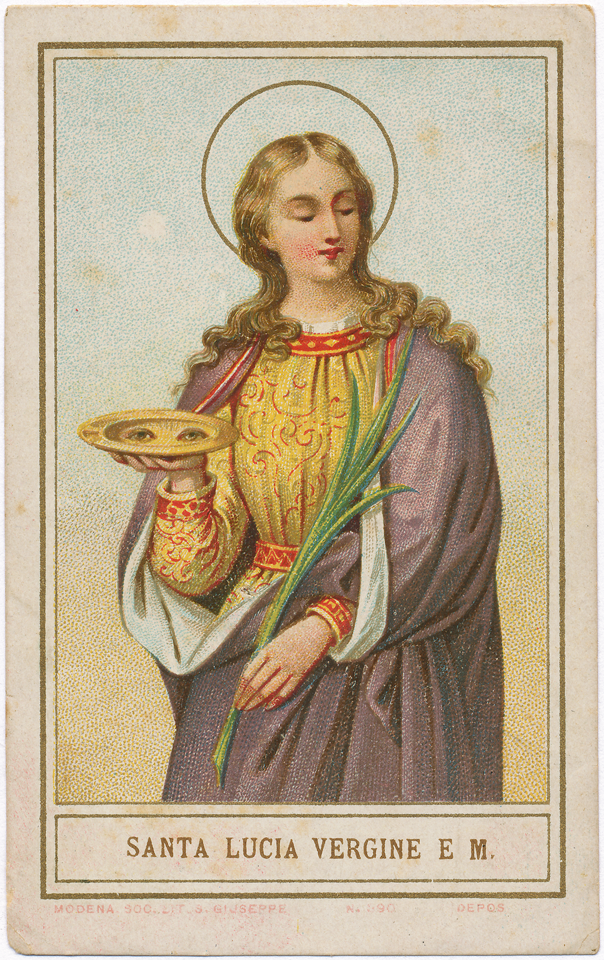
Feast of St. Lucy 283-304, December 13

St.Lucy“Those whose hearts are pure are the temples of the Holy Spirit.”

Patron of: Blindness, Light, Clarity, Eye Disease, Dysentery, Epidemics, Cutlers, Electricians, Glaziers, Gondoliers, Oculists, Peasants, Writers, Vision.
Willing to give up the comforts of her privileged life in order to obtain a state of enlightenment, Saint Lucy is one of the early virgin martyrs who challenged the authority of the Roman state. Her very name means ‘light’ and as light is direct and clear, shining in the most filthy of environments, we invoke her for clarity of vision in the spiritual as well as the physical realm.

Born in Syracuse, Sicily to a wealthy family of Greek descent, Lucy’s father died when she was very young. Following the traditions of their society, Lucy had a large dowry and was affianced in an arranged marriage to a pagan nobleman. Lucy was a Christian and believed that she could best be a conduit of the Holy Spirit by remaining a virgin unfettered by husband and children. At this time Christianity was a great threat to the Roman Empire and the emperor Diocletian vowed to stamp it out wherever it arose. Lucy kept her vow a secret as Christians were considered revolutionaries against the state. Since her mother suffered from constant bleeding from a uterine hemorrhage, Lucy took her to the tomb of Saint Agatha in Catania, a place where many miracles were reported, for a healing. While spending the night there, Lucy dreamt of Saint Agatha who told her, “You have no need to invoke me, for your faith has already cured your mother. One day you will be known as the patron of your own city.” Upon awakening and finding her mother completely healed, Lucy confessed to her desire to remain a virgin and distribute her dowry among the poor. Impressed by her faith, her mother acquiesced to her daughter’s wishes.

When her fiance heard of the broken engagement he went to the governor to denounce Lucy as a Christian. In an attempt to change her mind, she was brought before the authorities. When she asked why was it so important that this man need to marry her, she was told because she had the loveliest eyes. Whereupon Lucy ripped out her eyeballs and told the governor to send them to her former fiance. The next day her eyesight was miraculously restored and Lucy was once again brought before the authorities. An attempt was made to have her taken to a brothel to be repeatedly raped, but a phalanx of soldiers could not move her. A team of oxen was brought in to no avail. Burning pitch was poured on her head, but she stood fast, predicting the downfall of the emperor. This last declaration proved to be too much and Lucy was fatally stabbed in the throat. True to her prophecy Diocletian the emperor abdicated his throne within the year.

It is said that “the longest of nights and shortest of days belong to Saint Lucy.” Because her feast day, December 13 used to be the winter solstice before the change to the Gregorian calendar, Lucy enjoys great patronage in Scandinavia as the saint who brings the coming of the light. Her relics were moved to Venice where she is celebrated in song by gondoliers. In Sicily she is credited with ending an epidemic of children’s deaths in the 14th century, today she is synonymous with Santa Claus, where children receive gifts on her feast day. When there was a famine in her native land during the 16th century, ships laden with raw wheat turned up on her feast day. The starving inhabitants cooked the wheat whole, and today it is customary to cook with raw wheat on her feast day.

Novena:

Saint Lucy, your beautiful name signifies light. By the light of faith which God bestowed upon you, increase and preserve this light in my soul so that I may avoid evil, be zealous in the performance of good works, and abhor nothing as much as the blindness and darkness of evil and sin. By your intercession with God, obtain for me perfect vision for my bodily eyes and the grace to use them for God’s great honor and glory and the salvation of all men. Saint Lucy, virgin and martyr, hear my prayers and obtain my petitions.

(Mention your request here.)

Amen

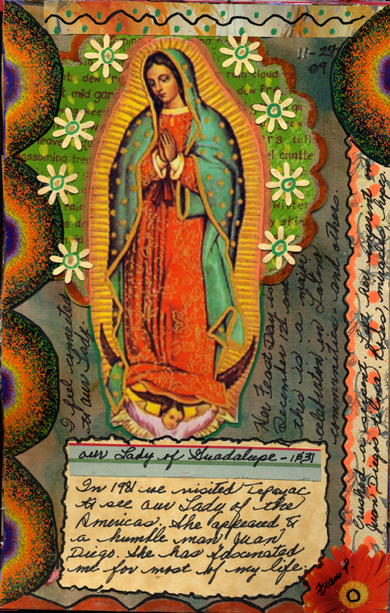
Feast of Our Lady of Guadalupe, December 12

guadalupe
“Am I not your mother?”

Patron of: Motherly Comfort, The Americas.

This image of Mary is the preeminent cultural icon of Mexico and the American Southwest, cherished by Catholics and non-Catholics alike. Unlike other apparitions of Mary, where she sometimes issues warnings to mankind, in her visitation to the Aztec people, she promised hope, love and comfort at a time when their own way of life had been destroyed. We invoke Our Lady of Guadalupe anytime we need the wisdom and comfort of a motherly force.

In December of 1531, the world of the once great Aztec civilization lay in ruins. The native inhabitants of what would become Mexico City were suffering brutally under the domination of Spanish Colonialists who had first invaded in 1519. Within two short years the forces of Hernan Cortes, with the help of native enemies of the Aztecs had completely overrun and destroyed a dual culture of light and dark, one of gracious cities and blood filled temples. Believing that their superiority and way of life depended on feeding their gods human sacrifices, the Aztecs routinely invaded neighboring tribes, sacrificing tens of thousands of captives a week. Gradually, the images of their own gods, particularly the female ones, took on more monstrous and grotesque features. The Spanish responded to these sacred sites by wreaking havoc and destruction upon them. Within ten years the remaining Aztec residents were heart-sick, depressed and dying off.

On December 9, 1531, and Aztec convert to Catholicism called Juan Diego, was on his way to mass. Distracted by the singing of birds on a hillside, he stopped. He then heard the kindly calling of his name in his native Nahuatl language. He approached the noble Aztec woman n the hill and was stunned at the heightened glow of her surroundings. She introduced herself as the perfect maiden Saint Mary, honorable mother of the true God. She asked him to go to the bishop and request a temple be built to her on the hill. She added, “I am the compassionate mother of you and your people, here in this land and of all the people who love me, search for me and confide in me…” After a long wait, the bishop told Juan Diego that he needed a sign proving that this was a true appearance of Mary. In subsequent days, when Juan Diego again saw the woman on the hill, he begged her to get someone who the bishop would respect more to deliver her request. She kindly replied that he was the perfect one for her message. The next day Juan Diego walked another way into town in order to avoid the woman as his uncle was sick and he did not want to waste any time doing her errands. Nonplussed, she came down from the other side of the hill to meet him. Flustered, he told her he had to tend to his uncle and had no time to wait for the bishop who did not believe him anyway. The woman assured him that his uncle was already well and then told him to gather roses among the rocks. This being winter he was amazed at how many roses were in full bloom. The woman arranged the roses in his cloak and again sent him off to the bishop. When he was finally granted this audience, it was the bishop’s turn to gasp in amazement. As Juan Diego unwrapped his cloak of roses, there imprinted on his cloak was the exact image of the lady on the hill. The bishop fell to his knees and begged Juan’s forgiveness. Today, tens of millions of pilgrims flock to Mexico City to see this original cloth which is in the cathedral named after this apparition of Mary, Our Lady of Guadalupe.

The Virgin Mary appears to each visionary as a member of their own culture. This image of a kindly, loving mother figure so impressed the native people of Mexico, that thousands of them came to be baptized within the first few months of the cloth being put on display.

Prayer

Our Lady of Guadalupe, according to your message in Mexico I venerate you as “the Virgin Mother Of the true God for whom we live, the Creator of all the world, maker of heaven and earth.” In spirit I kneel before your most holy image which you miraculously imprinted upon the cloak of the Indian Juan Diego. And with the faith of the countless numbers of pilgrims who visit your shrine, I beg you for this favor: (mention your request).
Remember, O Immaculate Virgin, the words you spoke to your devout client, “I am a merciful Mother to you and to all your people who love me and trust in me and invoke my help. I listen to their lamentations and solace all their sorrows and their sufferings.” I beg you to be a merciful Mother to me, because I sincerely love you and trust in you and invoke your help. I entreat you, Our Lady of Guadalupe, to grant my request, if this should be the will of God, in order that I may bear witness to your love, your compassion, your help and protection. Do not forsake me in my needs. Amen.

Our Lady of Guadalupe, pray for us.

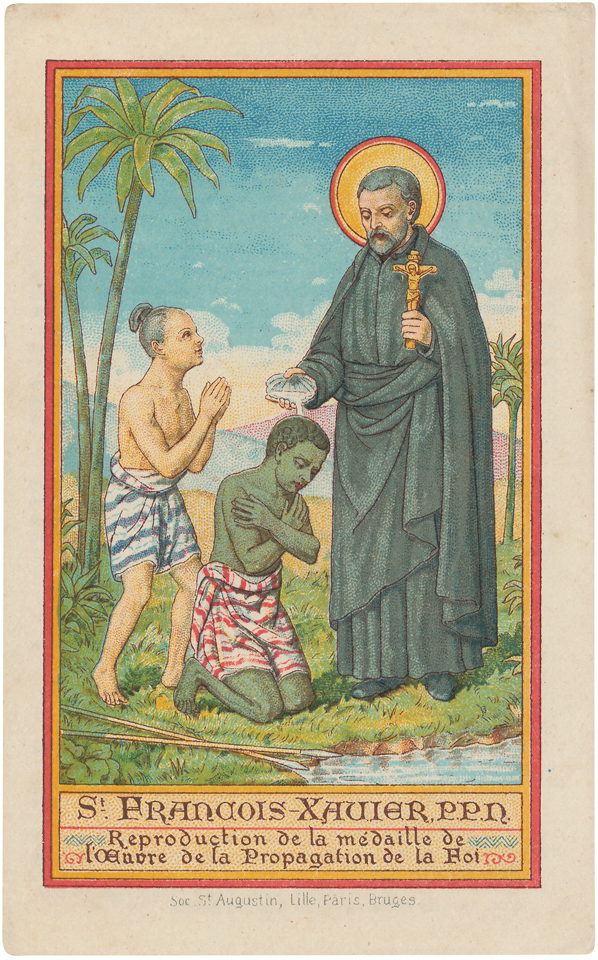
Feast of St. Francis Xavier 1506-1552, December 3

St.FrancisX “It is not the actual physical exertion that counts towards one’s progress, nor the nature of the task, but the spirit of faith with which it is undertaken.”
Patron of: Missionaries, Foreign Missions, Grace, Hurricanes, Plague, Sailors, Tourists.

Credited with converting hundreds of thousands of people, St. Francis Xavier is considered the most successful missionary since St. Paul. In his own life, he evolved from being a sheltered, wealthy intellectual to becoming a fearless explorer traveling to newly discovered lands, happily living among the lowest castes of people, improving their lives with love and grace. The novena in his honor, the Miraculous Novena of Grace is said to bring the force of grace into our lives, creating a more harmonious relationship with the world around us.

Born in the Kingdom of Navarre, the Basque region of Spain, Francis grew up in his family’s castle. Much admired for his intellectual gifts, he was sent to the University of Paris where it was thought that he would become one of its more gifted professors. His life changed drastically when he met an older student named Ignatius Loyola who had a small band of followers. Together with Loyola, St. Francis Xavier formed a new religious order, The Society of Jesus (now known as the Jesuits) with the intention of spreading Christ’s word to the farthest corners of the earth.

The King of Portugal sent Francis Xavier on his first mission to Goa in India where his country had a colony. He was concerned about the lack of religious practice available to his people and Francis’s mandate was to form a ministry for his Portuguese subjects. However, the European merchants and traders were more interested in gambling, drinking, slave trading and prostitution than in any religious preachings. When Francis Xavier attempted to meet with the Brahmin or wealthy local people, he was equally rebuffed. He then decided he would work with the lowest of the low, shocking both European and upper caste Indians by openly treating beggars, prostitutes, prisoners and the illegitimate as equals. The many eloquent letters he wrote about his life and work among society’s outcasts are still enlightening reading today. Gifted in languages, Francis Xavier had the ability to easily communicate in the various dialects spoken in the region. He is credited with saving the Paravas, an indigenous people who were pearl divers on the coastal islands from decimation and enslavement by the various Arab and European traders who plagued them.

Excited by his great success, Francis Xavier travelled throughout the Far East and he was the first missionary to travel to Japan. Not always met with the same respect and openness that he offered others, he endured his frustration with good spirits. He died on the island of Chang-Chuen-Shan, never realizing his dream of reaching mainland China. His body was put in quicklime and taken back to Goa, where it lies in a much visited shrine.

Novena

Most amiable and most loving Saint Francis Xavier, in union with you I reverently adore the Divine Majesty. I rejoice exceedingly on account of the marvelous gifts which God bestowed upon you. I thank God for the special graces he gave you during your life on earth and for the great glory that came to you after your death. I implore you to obtain for me, through your powerful intercession, the greatest of all blessings, that of living and dying in the state of grace. I also beg of you to secure for me the special favor I ask in this novena. In asking this favor, I am fully resigned to the Divine Will. I pray and desire only to obtain that which is most conducive to the greater glory of God and the greater good of my soul.

Amen.

(Here you may mention the grace, spiritual or temporal that you wish to obtain).

Recite one Our Father, one Hail Mary, one Glory Be.

There are two times a year when the Miraculous Novena of Grace is considered especially powerful: from March 4 to March 12 and from November 25 to December 3.

Feast of St. Catherine of Alexandria 290-305, November 25

St.CatherineofA“If you are ruled by the mind you are king, if by the body you are a slave.”

St. Catherine of Alexandria 290-305
Patron of: Philosophers, Librarians, Mechanics, Millers, Nurses, Potters, Scholars, Students, Wheels, Unmarried Women.
Brilliant and beautiful, Catherine of Alexandria was a force to be reckoned with. While still in her teens she had mastered philosophy, several languages and medicine. Because of her clarity of mind, she had great poise and self-confidence. One of the Fourteen Heavenly Helpers, the people of the Middle Ages believed she was one of the most powerful of early saints and invoked her for everything. Definite in her beliefs, we call on her for help in our studies or before we begin a major project, as she will clearly guide us.

The daughter of a governor, Catherine lived in a sumptuous palace among beautiful objects and scientific wonders. It is said she told her mother that she refused to marry anyone who was not as brilliant or beautiful as herself. Her mother readily agreed, not realizing that Catherine had discovered Christianity in her philosophical studies and had vowed herself to Christ. While working in her palace she heard the screams of a group of Christians who were being tortured . for refusing to give up their faith. Catherine went straight to the Emperor Maxentius and demanded he stop this persecution. Charmed by Catherine’s beauty, he invited her to debate the leading philosophers in the region to see if she could be persuaded to abandon Christianity by reasonable arguments. Instead of these fifty great scholars winning over the young girl with their scholarly knowledge, Catherine converted them to Christianity. Enraged, the Emperor had all fifty of these great men burned in the public square.

The Emperor then tried to charm Catherine with promises of great riches if she would become his concubine. Reminding him of her promise to Christ, she refused and was instantly imprisoned. While Maxentius was away on a trip, his wife visited Catherine in prison aand Catherine converted her to Christianity along with her prison guards and the Captain of the Emperor’s Legion. Upon his return to Alexandria, Maxentius was outraged at what he regarded to be the betrayal of his wife and legion. He ordered Catherine to be killed by being rolled on a spiked wheel. Catherine was fastened to the giant wheel and just as it was about to be rolled, her straps broke and she was released as the wheel shattered into hundreds of pieces killing many in the crowd. Catherine was then beheaded by sword. According to legend, angels then transported her body to the top of Mount Sinai, where a monastery and church devoted to Saint Catherine still exists.

St. Catherine is always depicted with a wheel and she is the patron of any occupation that requires a wheel. During the Middle Ages St. Catherine was viewed as an exemplary example for unmarried women. Therefore, in France and England St. Catherines’s Day is celebrated by unmarried women asking for husbands.

Novena:

Almighty and eternal God! With lively faith and reverently worshiping Thy divine Majesty, I prostrate myself before Thee and invoke with filial trust Thy supreme bounty and mercy. Illumine the darkness of my intellect with a ray of Thy heavenly light and inflame my heart with the fire of Thy divine love, that I may contemplate the great virtues and merits of Saint Catherine of Alexandria in whose honor I make this novena, and following her example imitate, like her, the life of Thy divine Son.

Moreover, I beseech Thee to grant graciously, through the merits and intercession of this powerful Helper, the petition which through him I humbly place before Thee, devoutly saying, “Thy will be done on earth as it is in heaven.” (Mention your request here.) Vouchsafe graciously to hear it, if it redounds to Thy greater glory and to the salvation of my soul.

Saint Catherine of Alexandria, pray for us!

Amen.

Feast of St. Frances Xavier Cabrini, 1850-1917

MotherCabrini “We must pray without tiring, for the salvation of mankind does not depend on material success; nor on sciences that cloud the intellect. Neither does it depend on arms and human industries, but on Jesus alone.”

Patron of: Immigrants, The Poor, Orphanages, Orphans, Displaced Persons, The Homeless, Hospital Administration, Business, Obedience, Meditation.

The first American citizen to be named a saint, St. Frances Xavier Cabrini never desired to travel to, much less spend her life in her adopted country of the United States of America. Born Maria Francesca Cabrini in northern Italy, she intended to use her schoolteacher’s degree to work as a missionary in China. Suffering through a smallpox epidemic which killed her parents, she was turned down by two convents she attempted to join. When she was finally accepted by one, she was sent to a small town to run an orphanage which was eventually closed. Enthralled by the works of Saint Francis Xavier, the Jesuit Missionary, she took his name and founded an order of nuns, the Missionary Sisters of the Sacred Heart. Many were shocked to see how quickly her new order was approved by the Pope. Instead of granting her wish to continue her namesake’s work in China, Pope Leo XIII told her, “Your China will be the United States.”

At that time 50,000 Italian immigrants lived crammed in a filthy ghetto in New York City. There was no one there to help or intercede for them. Arriving with six other nuns, Mother Cabrini was told to go home by the archbishop of New York. Instead, she moved her nuns into the Italian slums and immediately opened an orphanage. Through her personal tenacity as well as her willingness to live among the poor, Mother Cabrini set an impressive example for those trying to enact social reforms. Gifted with an innate business sense, and due to the great success her order had in caring for the destitute and displaced, Mother Cabrini was able to raise money from all levels of society. Within a few short years the Missionary Sisters of the Sacred Heart had opened orphanages, schools, hospitals and nurse’s homes throughout the United States, Central America, Argentina, Brazil, France, Spain, England and Italy. She became a United States citizen in 1909.
Though she was a tireless worker and an excellent administrator, Mother Cabrini felt the most important part of her day was the time she spent in mediation. Devoted to the Sacred Heart of Jesus, she felt great strength was to be found in humility, obedience and a quiet atmosphere. In her own case, by following the Pope’s orders at the expense of her personal dreams, she found more success in her mission than she could ever imagine was possible. At the time of her death, she had sixty seven foundations and over thirteen hundred missionaries carrying out her work.

Prayer

O loving Savior, infinitely generous, seeking only our interest, from your Sacred Heart, came these words of pleading love, “Come to me all you that labor and are burdened and I will refresh you.”
Relying on this promise of your infinite charity, we come to you and in the lowliness of our hearts earnestly beg you to grant us the favor we ask in this novena,

(mention your request here)

through the intercession of your faithful servant,

Saint Frances Xavier Cabrini.

Amen.

Feast of St. Martin de Porre, November 3

St.Martin dePatron of: Mixed Race People

Born in Peru, with a Spanish noble fatherand an African freed slave mother, St. Martin de Porres is one of the most popular saints in the New World. A great healer, he was so in tune with the innate rhythms of nature, he could read minds, heal any sickness, communicate with animals and even levitate. Being a person of mixed race he is called on to quell racial tensions, but his patronage extends to bringing harmony to all situations and he is invoked to heal both physical and spiritual wounds.

Martin and sister had a poor and difficult childhood, as people of mixed race were reviled. At the age of twelve Martin was apprenticed to a barber. 17th Century barbers did more than just cut hair, they also performed medical procedures, made medicines and prescribed treatments for every ailment. A naturally devout boy, Martin meditated on Christ’s passion as he mixed his herbs and it is said he healed as many people with his prayers as with his potions. By the time he was eighteen, Martin had a very successful practice. People from all walks of life sought his abilities. Instead of pursuing a lucrative career in town, Martin joined the local Dominican Convent as a Lay Brother, secretly wishing to become a foreign missionary.

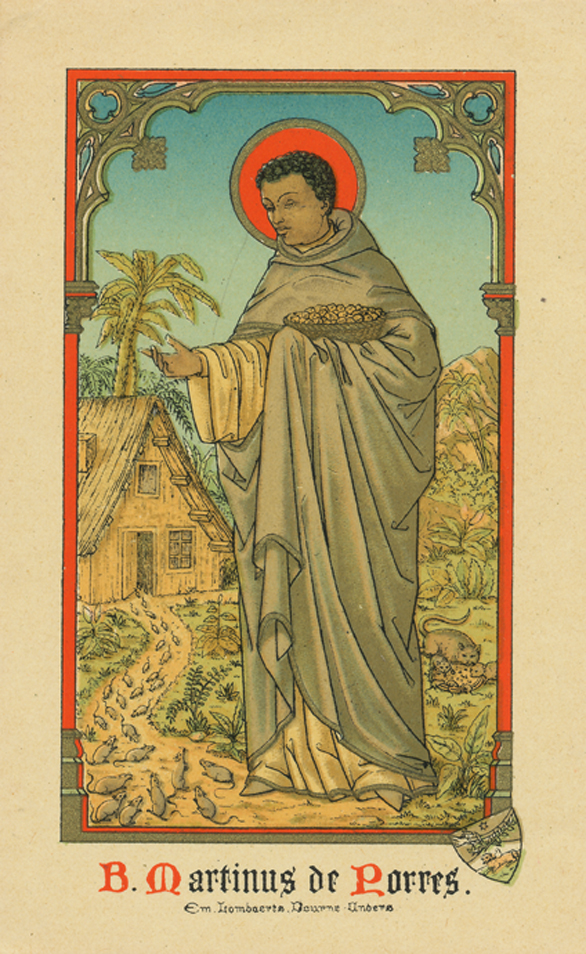
While the monastery was founded to tend to Spanish nationals working in Peru, Martin taught his European brethren the true meaning of Christian charity when helping out in the infirmary during a plague. He cared for nobility, slaves, soldiers, merchants and natives with the same respect. The incredible success of his treatments made his superiors install him as the head of the infirmary. Knowing Lima and its citizens as a native of that city made him a very effective fundraiser for the monastery. His superiors gave him full autonomy on dispersing whatever monies he raised to the poor. Every day at noon he opened the doors of the monastery distributing food to whoever needed it. To Martin all creatures in creation were equally loved and he inaugurated the first shelters for stray cats and dogs. When the monastery was overrun by rodents, his superiors ordered poison to be set out. Instead, Martin went out to the garden and called the rodents out their hiding places. He promised to feed them, if they promised to stay out of the building. Both sides kept to their agreement, and Martin has been invoked ever since, to prevent mice and rat infestation. Martin used menial labor as a time of prayer and communion with God. He developed deep wisdom from this form of mediation and Archbishops, city officials and students came to him for spiritual guidance. Because of this he is the patron of jurists.

Prayer

Saint Martin de Porres, your concern and charity embraced not only your needy brethren, but also the animals of the field. You are a splendid example of charity; we thank and praise you. From above, hear the requests of your needy brethren. (mention your request here). By modeling our lives after yours, and imitating your virtues, may we live content knowing that God has looked favorably upon us. Because this is so, we can accept our burdens with strength and courage in order to follow in the footsteps of our Lord and the Blessed Mother. May we reach the Kingdom of Heaven through the intercession of our Lord Jesus Christ. Amen.