Novena for January

SAINT THOMAS AQUINAS

1225 – 1274

Doctor of the Church


Considered more angelic than human, Saint Thomas Aquinas has the title of “Angelic Doctor”. His life is the story of someone who lived totally through his higher mind, rejecting all worldly temptations, ambitions, and pleasures in favor of intellectual pursuit. Honored in his own lifetime, he was continually invited by the Pope and the king of France to share his learning, but this never changed his disposition of the simple way he lived his life. He refused all offers of holy office in order to continue his vocation of studying, writing, and preaching. Because of this love of learning for its own sake, Saint Thomas Aquinas is the patron saint of students. He is invoked whenever there is a difficult situation regarding education, be it tackling a difficult subject or passing and entrance examination. Although this novena is written for the patronage of Catholic schools, all students should feel free to call on him.

Saint Thomas Aquinas is regarded by most historians as the greatest thinker and theologian of the Middle Ages. Yet the more knowledge he mastered, the more he realized how much he did not know. Born at Roccasecca, near Naples, he was the youngest child of the count of Aquino. At the age of five he was sent away to the Benedictines of Monte Cassino. There, at that young age, he displayed great intellectual acuity and easily surpassed all the other students in his class. His father, being a nobleman, assumed that he would be trained for a high ecclesiastical office. At the age of seventeen, Saint Thomas scandalized his family when they discovered that he had secretly joined the new order of Dominican friars. This order frequently resorted to begging in the streets to survive. His brothers then kidnapped him and locked him in the family house for the next year. Trying to get him to break his vows, they presented him with every temptation, including a beautiful prostitute. Saint Thomas chased her away with a flaming torch and from that day was freed from any sexual desires. His family finally relented and released him. In 1248 he went to the city of Cologne, where he studied under Saint Albert the Great, at that time the most brilliant professor in Europe. His lumbering presence and slow movements belied his genius, causing his fellow students to refer to Saint Thomas as “the Dumb Ox”. He began publishing his works at the age of twenty-two and then went to Paris, where he earned his doctorate in theology. He was in great demand as a university professor and became famous for his lucid writings. The great challenge of his life was to explain Christianity in Aristotelian terms.

In 1266 Saint Thomas began his greatest work, Summa Theologica. Seven years and two million years later, he quite suddenly stopped work on it, leaving it unfinished. While attending mass he had had an ecstatic vision, and afterward, he declared that compared with what he had just seen, “all that writing seemed like so much straw.” He died three months later, at the age of forty-nine. So simple, pure and ingenuos had Saint Thomas Aquinas remained in his life that his deathbed confessor declared his final confession to be akin to that of a five-year-old child.


Feast Day: January 28


Patron of: Students, Universities, Catholic Schools


Novena to Saint Thomas Aquinas


Saint Thomas Aquinas, patron of students and schools, I thank God for the gifts of light and knowledge God bestowed on you, which you used to build up the church in love. I thank God, too, for the wealth and richness of theological teachings you left in your writings. Not only were you a great teacher, you lived a life of virtue and you made holiness the desire of your heart. If I cannot imitate you in the brilliance of your academic pursuits, I can follow you in the humility and charity that marked your life. As Saint Paul said, charity is the greatest gift and is open to all. Pray for me that I may grow in holiness and charity. Pray also for Catholic schools and for all students. In particular, please obtain the favor I ask during this novena. Amen.

(Mention your request.)


Say this novena nine times in a row for nine days in a row.


Excerpted from the book, “Novena: The Power of Prayer” by Barbara Calamari and Sandra DiPasqua

Image: Detail from “The Triumph of Saint Thomas Aquinas” by Bennozzo Gozzoli 

Dining With the Saints

The Feast of Sant’ Antonio Abate


 Sant’Antonio Abate (Saint Anthony the Abbot, born 251 in Egypt) is the protector of domestic animals, so in Italy on his feast day, January 17, all kinds of pets and farm animals go to be blessed in church. Donkeys, geese, cats, monkeys, goats, parrots, all arrive at the door of the church carried or escorted by their owners and often decorated in ribbons, bells, and bows.

 As the protector of animals, Sant’Antonio Abate is usually depicted accompanied by a large domestic pig. This part of his iconography is said to stem from his success in healing inflammatory skin diseases. The traditional treatment for these ailments were pork fat. However, his feast day in Italy also serves as the bittersweet slaughter day for the family pig, one that has been fattened all year just for the occasion. It’s a huge ritual throughout rural Italy, and the pig provides food for an entire family for the whole year.

 January 17 is always celebrated with pork dishes. In Piemonte they prepare sausages with red wine and lentils, or a pork loin piccata. No part of the pig is wasted. The lungs, brains, and liver are made into a fritto misto. Fennel-flavored sausages are made in Tuscany, and in the South, in Puglia and Calabria, they always serve their famous coppa, a cured pork loin seasoned with either hot peppers or sweet spices. Pork ragú, served with pasta or polenta, is often another highlight of the huge pork-focused feast, as is sanguinaccio, a sweet blood pudding. Sanguinaccio sounds peculiar, but it’s quite delicious. It can be flavored, depending on the region, with cinnamon, chocolate, nutmeg, Marsala, raisins, pine nuts, pistachios, or red wine.

 Here’s a pork braciole recipe inspired by the cooking of the Abruzzi region. Try it if you’d like to celebrate your own feast of Saint Anthony.

Pork Braciole with Provolone, Parsley, and Capers


(Serves 4)

    1 garlic clove

    A large bunch of flat-leaf parsley, stemmed (about a cup of packed leaves), plus a small handful of whole leaves reserved for garnish

    A large handful of salt-packed capers, soaked for about 20 minutes in several changes of water and rinsed

    3/4 cup grated provolone cheese (try to find a imported Southern Italian cheese, not a domestic brand, which can be salty and lacking in finesse)

    Salt

    A few pinches of ground cayenne pepper

    Extra-virgin olive oil

    About 3 pounds of pork, cut for braciole (into thinly sliced rectangular pieces. The shoulder cut is best.

    3 medium shallots, cut into small dice

    2 cloves, ground to a powder in a mortar and pestle

    A bay leaf

    A wineglass of dry white wine

    A 35-ounce can of plum tomatoes, well chopped, with the juice

    Kitchen string for tieing the braciole

 Place the garlic, parsley, and capers in the bowl of a food processor and pulse briefly until roughly chopped (you don’t want a paste). Transfer the mixture into a small bowl and add the grated provolone, a pinch of salt (not much, since the cheese and capers will be slightly salty), the cayenne pepper, and a drizzle of olive oil. Mix everything together.

 Lay the pork slices out on a work surface. Spoon a heaping tablespoon of filling onto each slice and spread it out to about 1/4 inch from the end all around. Roll up the braciole lengthwise and tie each in about 3 or 4 places with string. They’ll look like they’re a lot of meat, but they’ll shrink down considerably during cooking.

 Choose a casserole fitted with a lid and big enough to hold all the braciole and the sauce. Heat a few tablespoons of olive oil in it over medium heat. Season the braciole with salt and a pinch of cayenne and place them in the casserole. Take your time to brown them well all over (the browning will add great flavor to the sauce). Scatter on the shallots and season the meat with the ground cloves. Sauté a few minutes longer, just until the shallots have softened and given off flavor.

 Add the white wine and let it boil for a couple of minutes, scraping up any cooked-on juices from the bottom of the casserole. Add the tomatoes and a pinch more salt. The braciole should be almost completely covered by the liquid (just poking out a little); if they’re not, add a bit of warm water. Cover the casserole, lower the heat, and simmer, turning the braciole occasionally, until they are very tender, about 2 hours. You’ll need to skim the surface once or twice during cooking. Uncover the casserole for the last half hour of cooking so the sauce can reduce.

 When you’re ready to serve the braciole, lift them from the casserole onto a cutting surface. The sauce should be reduced to a medium thickness (it is not meant to be a dense tomato sauce). If it seems a little too liquid, boil it over high heat for a few minutes. You also may need to give the surface a quick skim. Taste for seasoning, adding another little pinch of cayenne pepper if you like and a little salt if needed. Remove the string from the braciole, and cut them into approximately 1/4-inch slices on a slight angle. Place them on a warmed serving plate and spoon a little of the sauce over the top (you can pour the remaining sauce into a small serving bowl and bring it to the table). Garnish the plate with the whole parsley leaves.

 It’s customary to serve pasta dressed with the braciole sauce as a first course and then serve the meat second. You can certainly do this if you like, but I prefer to forgo the pasta and instead offer a dish of roasted potatoes or rice, bringing the extra sauce to the table so guests can use it to pour on the rice or to sop it up with bread.

 ‘Dining With the Saints’ is a monthly column written by Writer and Chef Erica DeMane. EricaDeMane.com

Images: Top, a poster for one of the thousands of local festivals celebrating Saint Anthony the Abbott from Italy.  Bottom: Italian Holy Card


Novenas for December

SAINT LUCY

 283 – 304

Feast Day: December 13

Patronage: Syracuse, the blind, cutlers, electricians, glaziers, gondoliers, oculists, peasants, writers

Invoked Against: dysentery, epidemics, eye disease, hemorrhages, throat ailments, for clarity

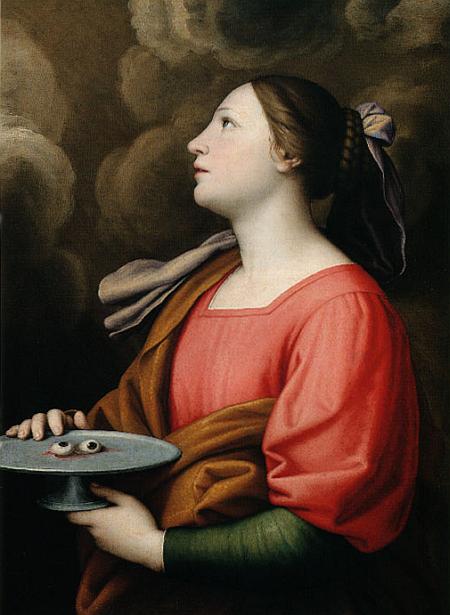
Symbols: holding her eyes on a dish, martyrs palms, sword, oxen, cord

 “Those who live chaste lives are temples of the holy spirit.”

            Saint Lucy 304AD

             Saint Lucy was a privileged young woman who chose a state of enlightenment over the prosperous, respectable life she was expected to lead in Roman society. One of the early virgin martyrs, her quiet but steadfast rebellion against the civil authorities earned her an excruciating death that became a triumphant example of everlasting life, hastening the overthrow of the Emperor and the legalization of Christianity.   

            Born in Siracusa, Sicily, Lucy was a young Christian  woman of Greek ancestry.  She held a deep spiritual belief that one must remain pure to be a true conduit of the Holy Spirit. Lucy secretly vowed to remain a virgin, even while her widowed mother arranged her marriage to a wealthy pagan nobleman. At this time in history, Christianity was looked upon as a threat by the Roman Emperor. So many soldiers in the Empire had converted, that officials feared they would follow the tenets of Christ over their military leaders. The state insisted that it was a man’s duty to serve his nation militarily and a woman’s duty to marry and bear children. When a girl refused to do this, she was considered a traitor to the empire. Therefore, consecrating one’s virginity to Christ, was more of a bold and revolutionary stance against the state than a  private act of devotion.

            Lucy’s mother suffered ceaseless bleeding from a uterine hemorrhage.  Her daughter insisted they make a healing pilgrimage to the tomb of the virgin martyr Saint Agatha in Catania some 50 miles away. Agatha had become the patron of Catania after her veil stopped the deadly flow of Mount Etna’s lava from entering the town. She was credited with so many miracles since her martyrdom 35 years prior, that Christians, Jews and pagans alike were drawn to her tomb to invoke her aid. Lucy and her mother spent the night in prayer outside of the tomb. Agatha visited Lucy in a dream, telling her, “You have no need to invoke me, for your faith has already cured your mother. One day you will be known as the patron of your own city.” As the day dawned, Lucy found her mother completely healed. When she confessed  her secret vow of virginity, her mother agreed not to force her into marriage.

             In 303 the Emperor Diocletian launched the most extensive and vicious anti-Christian campaign throughout the Roman Empire. This was the political atmosphere that Lucy and her mother returned home to. Since she was no longer in need of a dowry, Lucy encouraged her mother to divest herself of all the investments she had made for her daughter’s future and give the money to the poor. Lucy’s fiancé, outraged to learn that his engagement was broken, denounced her to the governor of Siracusa. Brought before this official, Lucy asked, “Why would that man want to marry me?” When the governor quipped, “Perhaps it is your lovely eyes,” Lucy ripped out her eyeballs and told him to send them to her former fiance. Her eyesight was miraculously restored the next day and the governor demanded why she so adamantly refused to marry. Lucy replied, “Those who live chaste lives are the temples of the Holy Spirit.”

            The governor then told her that he would have her taken to a brothel and repeatedly raped until she “lost the Holy Spirit.” Soldiers came to carry her off but could not move her. A thousand men were called in, to no avail. Lucy would not budge. Nor could a team of oxen drag her away.  Burning pitch was poured on her skin but nothing would break her will. Upon predicting the fall of the Emperor, Lucy was fatally stabbed in the throat.  True to her prophecy, the Emperor fell within the year and Christianity was legalized in Rome under Constantine nine years later.  

            Immediately after her death, public opinion was so swayed by Lucy’s fate that it was considered a great honor for other Christians to be buried in the catacombs of Siracusa near her. In the sixth century, the Acts of the Virgin Martyrs were given great recognition by ecclesiastical writers and Lucy’s name was entered in the Canon of the Mass. In art, she is sometimes portrayed in the company of Saints Agatha, Agnes of Rome, Barbara, Thecla and Catherine of Alexandria. All of them, legendary young girls defiant and fearless in the face of death.

            The people of her native city have always honored Lucy and been protective of her. In the ninth century when Siracusa fell into Muslim hands, they hid Lucy’s remains for hundreds of years until 1040 when the Byzantine army drove out the Saracens. In gratitude for their liberation, they sent their most precious possession, her body,  to Constantinople as a  gift for the Empress Theodora. Many of her relics were then distributed throughout Europe which greatly expanded the range of her cult.  In 1204, Venetian Crusaders conquered Constantinople and took Lucy’s remains back to Venice where they were installed in a church named for her. This original church was near the place where the gondolas were parked. The song “Santa Lucia” became famous among gondoliers looking forward to the end of their night’s work. When the church was torn down to make way for the new train station, the station was named for Saint Lucy and her remains were interred in the nearby Church of Saint Jeremiah.

            The name “Lucy” means light. According to the Julian calendar, her feast day, December 13 was considered the shortest day of the year. Celebrations combining Lucy’s feast day with the winter solstice began in Sicily and spread throughout Europe. It was said that the “longest of nights and the shortest of days belong to Saint Lucy”. Today, she is most celebrated in Sweden and other Scandinavian nations because when the Swedes converted to Christianity in the 11th Century, they could most easily relate to a Saint who would gradually bring more light each day as the sun changed its course.  Saint Lucy’s day is a major holiday in that part of the world, celebrated with torchlight processions of crowned girls in white dresses. With the change to the Gregorian calendar in the 1300’s, and the shifting of the solstice to ten days later, Lucy’s feast became synonymous with the start of the Christmas season. She is associated with gifts to children because of her part in curing an eye epidemic that was blinding children in the 13th century. When local families went on a barefoot pilgrimage to her tomb invoking her aid, she sent them home, curing the children and telling them that they would find gifts in their shoes. It became a common Christmas custom in many parts of Europe to celebrate the saint’s feast by putting  gifts in children’s shoes. In 1582 Saint Lucy was credited with ending a famine in Sicily by sending three grain loaded ships to its starving residents. The people were so hungry that they boiled and ate the grain without grinding it into flour.  To this day, Sicilians do not eat anything made with flour on Saint Lucy’s day and there are a host of traditional foods and desserts created specifically for her feast day.                  

            Lucy is a popular subject for artists, she is frequently depicted calmly holding her eyeballs on a dish, referencing her story. Because of this, she is the patron of the blind and all trades relating to the eyes. Eye strain is a common problem for writers, therefore she is their patron. Because of the success of her mother’s healing she is invoked against hemorrhage. Since she was stabbed in the throat she protects against throat ailments and cutlers because she was killed by a knife. As a true patron of her city, Syracuse, she was historically called upon to help in all epidemics, hence her aid against dysentery. Peasants claim her patronage because they depend on oxen who play a part in her story. Her final resting place is Venice so she is the patron of that city’s glassmakers and gondoliers.

Prayer to Saint Lucy of Syracuse

                                             Saint Lucy, your beautiful name signifies light.

                                        By the light of faith which God bestowed upon you,

                             Increase and preserve this light in my soul so that I may avoid evil,

                                           Be zealous in the performance of good works,

                        and abhor nothing as much as the blindness and darkness of evil and sin.

                                                       By your intercession with God,

                                           obtain for me perfect vision for my bodily eyes

                                 and the grace to use them for God’s greater honor and glory

                                                         and the salvation of all men.

                                                         Saint Lucy, virgin and martyr,

                                               Hear my prayers and obtain my petitions.

(mention your request here)

                                                                          Amen

Say this novena times in a row for nine days in a row.

Excerpted from the book, “Saints:Ancient and Modern” by Barbara Calamari and Sandra DiPasqua

 Painting of Saint Lucy by: Giovanni Battista Salvi da Sassoferrato  1609 – 1685

SAINT NICHOLAS OF MYRA AND OF BARI

270-345

Feast Day: December 6

“The West as the East acclaims and glorifies him. Wherever there are people, in the country and the town, in the villages, in the isles, in the furthest parts of the earth, his name is revered and churches are built in his honor. All Christians young and old, men and women, boys and girls, reverence his memory and call upon his protection. And his favors, which know no limit of time and continue from age to age, are poured out all over the earth; the Scythians know them, as do the Indians and the barbarians, the Africans as well as the Italians.” –Anonymous, Greece, tenth century A.D.

       In the East, Saint Nicholas of Myra is one of the most revered saints, so much so that he is invoked in the Eastern Orthodox Mass. In the West, he has come to symbolize the celebration of Christmas in the form of a character named Santa Claus, or St. Nick. The traditions of Christmas reflect his life of wonders. Nicholas was born in Patara on the Western coast of present day Turkey. His wealthy parents died when he was very young, leaving their shy, devout son a fortune. His compassion for the poor led him to anonymously distribute his wealth, as in the case of his neighbor who was so desperate that he was considering selling his three daughters into prostitution. Nicholas secretly went to the man’s house on three consecutive nights, throwing in a bag of gold coins to provide a dowry for each girl. It is said that the three bags of gold landed in stockings hung to dry over the fire.  We hang stockings on Christmas Eve to remind ourselves of this compassionate act.

            Compassion and care for others, regardless of their circumstances, were prevailing traits throughout Saint Nicholas’s life. On several occasions he raised people from the dead, including three young boys who had been kidnapped and murdered by a butcher. They had been dismembered and hidden in a barrel of brine.  When Nicholas learned of their fate through a dream, he miraculously raised three whole boys from the barrel and restored them to life. The butcher confessed and repented for his crime. Because of this Saint Nicholas is the patron of butchers, barrel makers and murderers. In another, a man swore on an altar of Saint Nicholas that he had repaid a debt owed to a moneylender. The court believed his oath, but on the man’s way home, he was killed in an accident on the road–the money he owed spilling out from his cane where he had hidden it. Instead of picking up the money which was rightfully his, the moneylender invoked Saint Nicholas to bring the man back to life. When the man miraculously got up from the road, the moneylender picked up his coins and became a Christian convert while the liar repented for trying to evade the payment of the loan.

            In his own lifetime Nicholas was revered as a Saint, and indeed, received the bishophric of Myra under supernatural circumstance. The city’s bishop had died suddenly, and a neighboring bishop was told in a dream to make the first man who entered the church the new bishop. As fate would have it, Nicholas was visiting the city and upon his entrance at dawn, he was welcomed and consecrated as bishop of Myra. He accepted his office with grace and humility, standing fast against the persecutions of Diocletian, the Roman Emperor. Nicholas was said to be present at the Council of Nicaea in 325 A.D., where he defended the teaching of the Holy Trinity against Arius, who argued against the divinity of Christ. For his holy stance, he was thrown into prison; however, Christ and the Virgin Mary appeared to him in the prison and restored his robes and holy office. Once free he single handedly brought down the great Temple of Diana. According to legend, screaming demons fled as the building fell. Today, the day once celebrated as Diana’s birthday, December 6th, is the feast day of Saint Nicholas.

            Since Myra is on the coast, there are many tales of Nicholas helping sailors at sea. He would appear to them in dreams, advising them how to steer through rough passages. “May Saint Nicholas hold the tiller,” became a common saying among sailors on the Aegean and Ionian seas. These sailors spread tales of his wonderworking in every port they entered and hundreds of seaport chapels sprung up in his name.

In these many countries customs were established to honor Saint Nicholas’s practice of anonymous generosity. The French would leave gifts and candy to poor children on December 5th, Saint Nicholas’ Eve, a practice that spread to all of Western Europe. The cult of Saint Nicholas was particularly embraced in the Netherlands. After the Reformation, when honoring saints became suspect, Martin Luther moved the customary celebration of Saint Nicholas’ Day to December 25th and changed it to a celebration of the birth of Christ. However, Saint Nicholas lived on in the common people in the guise of Sinta Klaus (Saint ‘Claus). The first Dutch settlers in New York brought their traditional celebration of Saint Nicholas with them. However, it was the German immigrants in Pennsylvania who were the first to make Christmas a major celebration. The image of Saint Nicholas driving a sled with reindeer was taken from the German myths of the gods. Odin was said to fly through the heavens the same way. In the early 1800s, visual depictions of Saint Nicholas evolved from the traditional Eastern bishop with a beard to the more modern jolly Dutch burgher. With the publication in 1823 of the poem “A Visit from St. Nicholas” (“The Night Before Christmas”) Saint Nicholas had completed his journey from the wonderworking Fourth Century saint to our present day popular figure of Santa Claus.        

Iconography:

            Since Saint Nicholas was a defender of the Holy Trinity, tales of his wonderworking frequently feature three individuals or three objects: rescuing his neighbor’s three daughters with three bags of gold (Christmas stockings, oranges or chocolate covered gold coins, the three gold balls of the pawnbroker symbolize the bags of gold). Candy canes are symbols of Saint Nicholas bishop’s staff. In art, Saint Nicholas is always depicted bearded with a bishop’s hat and staff, usually with three objects or three figures taken from the numerous tales of his wonderworking.

 Patron of: Russia, Greece, Bari, Italy, the Kingdom of Naples, Sicily, Apulia, Apothecaries, Bakers, Barrel makers, Boatmen, Children, Dock workers, Thieves, Murderers, Pawnbrokers, Wine Venders, Pharmacists, Butchers, Grain Venders, the wrongfully accused, Paupers

Invoked for: protection against judicial error, happy marriages blessed with children

Symbols: Miter, Bishop’s staff, 3 Gold Balls, 3 Bags of Money, Anchor, Ship

Eastern Orthodox Saint Nicholas Prayer

Almighty God, who in your love gave to your servant Nicholas of Myra a perpetual name for deeds of kindness on land and sea:

Grant, we pray, that your Church may never cease to

work for the happiness of children,

the safety of sailors,

the relief of the poor,

and the help of those tossed by tempests of doubt

or grief;

through Jesus Christ our Lord,

who lives and reigns with you and the Holy Spirit,

One God, for ever and ever.

Amen

Excerpted from the book: “Saints: Ancient and Modern” by Barbara Calamari and Sandra DiPasqua

Image: Ukrainian prayer card celebrating Saint Nicholas as the Patron Saint of Children


Miraculous Novena of Grace

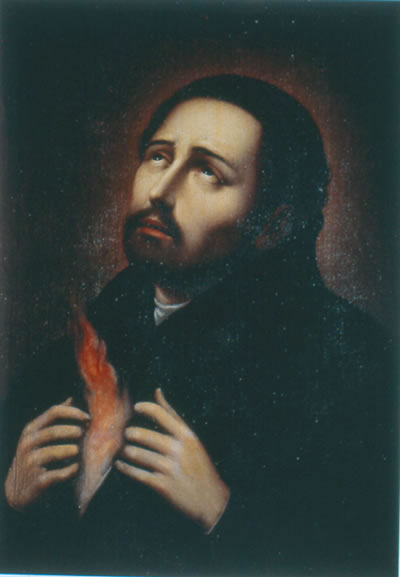
SAINT FRANCIS XAVIER

 1506 – 1552

            The life of Saint Francis Xavier, a brilliant intellectual who had to learn how to trust like a child, is an illustration of the power of grace. His special novena, The Miraculous Novena of Grace, is a tool for welcoming clarity and synchronicity into our lives. It helps us surrender control to a higher power. As he attained ever more grace through prayer, Saint Francis Xavier matured from being an earnest, sheltered college professor to becoming a man at home any place in the world, able to converse in any language, with people of all levels of society.

             Born into a noble family in Aragon, Spain, Francis Xavier grew up in a castle, the youngest of six children. He was doted upon by his family, and his father was delighted when he showed an early ability to write well. Francis Xavier was then set upon an intellectual path and sent to the University of Paris to complete his education. There he displayed a considerable aptitude for philosophy, and it was thought he might even become one of the world famous professors at the Sorbonne. His life changed course, however, when he met an older student named Ignatius Loyola. Though he took an instant dislike to Loyola, Francis Xavier eventually joined his new order of priests, the Society of Jesus, which was devoted to spreading Christ’s message abroad. Saint Francis Xavier became one of the six original Jesuits and was sent to Goa in India, where the Portuguese had a colony. When he arrived there he realized how horribly degrading the European influence was on the native culture. Slavery, prostitution, thievery, and gambling were practiced openly. His beautifully written and voluminous collection of letters detailing his life in Goa and the degradation of the local people are still studied today. Though Francis Xavier was of noble birth, he was still able to relate to and emphasize with the lowest-born individual. He was frequently seen chatting with prostitutes, members of the underworld, and beggars in the street. He had a miraculous ability with languages and spoke various dialects of Indian with relative ease. His theory was to teach the simplest people first. Children loved him, as did prisoners and the outcasts of society, among whom he lived. As he devoted himself fully to his mission, Francis Xavier’s gifts magnified. He is credited with the ability to speak in tongues, quiet stormy seas, heal the hopelessly ill and predict the future.

             Using Goa as a base, Francis Xavier went on to convert hundreds of thousands of people in the Far East. He was the first missionary to reach Japan, in 1544. It was his dream to go on to China, but he died, worn out from his ceaseless work, on the island of Chang-Chuen-Shan. He was forty-six years old. His body was put in quicklime and returned to Goa, where it is enshrined in an uncorrupt state. He is considered a protector by the Paravas, the indigenous people whom he saved from being decimated by both the Europeans and the higher-caste Indians. Not only is he the patron saint of foreign missions; but after his death, he often became the patron of newly discovered regions of the world.

 Feast Day: December 3

 Patron Saint of: Australia, Borneo, China, Japan, Pakistan, Foreign Missions, Sailors, Tourists

 Invoked Against: Hurricanes, Plague

(Painting by Jose de Alzibar                Mexico   18th Century)  


The Miraculous Novena of Grace


Most amiable and most loving Saint Francis Xavier, in union with you I reverently adore the Divine Majesty. I rejoice exceedingly on account of the marvelous gifts which God bestowed upon you. I thank God for the special graces he gave you during your life on earth and for the great glory that came to you after your death. I implore you to obtain for me, through your powerful intercession, the greatest of all blessings, that of living and dying in the state of grace. I also beg of you to secure for me the special favor I ask in this novena. In asking this favor, I am fully resigned to the Divine Will. I pray and desire only to obtain that which is most conducive to the greater glory of God and the greater good of my soul. 

Amen.

(Here you may mention the grace, spiritual or temporal that you wish to obtain).

 (Recite one Our Father, one Hail Mary, one Glory Be).

 There are two times a year when the Miraculous Novena of Grace is considered especially powerful: from March 4 to March 12 and from November 25 to December 3.


Say this novena nine times in a row for nine days in a row.


Excerpted from the book: “Novena: The Power of Prayer” by Barbara Calamari and Sandra DiPasqua.

Novenas for November

cecilia_reni

SAINT CECILIA

 Second Century or Third Century

Feast Day: November 22

Patron of: musicians, musical instrument makers, music, poets, singers, Rome Academy of Music

Symbols: lute, organ, roses, martyrs palms

Blessed Cecilia, appear in visions
To all musicians, appear and inspire:
Translated Daughter, come down and startle
Composing mortals with immortal fire.

      from “Anthem for St. Cecilia’s Day” by W. H. Auden


      As an inspirational subject she has inspired masterpieces in every artistic discipline, and the popularity of her cult spans from ancient to modern times. Yet,  little is known about Cecilia besides the fact that she was a rich young Roman girl martyred in her home in Trastevere.      

      Cecilia came from the senatorial family Coecilia, a family prominent in Rome’s ancient history. Her mother raised her as a Christian and she secretly took a vow of chastity. Her father, not taking his daughter’s faith seriously,  arranged a marriage for her to a nobleman named Valerian. As musicians played for the guests, Cecilia begged God to help her keep her vow.

      On their wedding night, Cecilia told Valerian, now her husband, that she had a guardian angel with her that only she could see and warned him that the angel would be upset if she were touched in an impure way. When he asked to see the angel she directed him to go out and be baptized. Valerian did as she asked and on his return he found Cecilia praying in her room next to an angel with flaming wings . In his hands the angel held two wreathes made of roses and lilies. After crowning the couple, the angel vanished.

      When Valerian’s brother Tibertius entered, he was astounded at the rare beauty and fragrance of the flowers and after he was told the story of Cecilia and her guardian, he too was baptized. Valerian and Tibertius then became active in the Christian community, making lavish gifts to the poor and burying martyrs slain for their faith. These actions came to the attention of the Roman Prefect who demanded that they sacrifice to the gods to prove their patriotism. When they refused, they were executed. Cecilia then had them buried together in the same tomb owned by her family.

         Since Christianity was illegal, Cecilia was put on trial and condemned to death for not renouncing her faith.Coming from an illustrious family, Cecilia could not be executed in public. She was shut up in her sudarium, the steam room of her bath house.  The vents were sealed and the furnaces were heated seven times higher than their normal  limit in order to suffocate her. Cecilia was discovered the next day, happily praying,  seemingly untouched by the hellish atmosphere of the room.                

          An executioner was dispatched to decapitate her. Hitting her three times with an axe, he was unable to kill her. Because Roman law decreed that three blows with the axe was the legal limit an executioner could use to kill a prisoner, Cecilia was left to bleed to death on the floor of her home. Crowds flocked to visit her as she prayed. She disbursed her worldly goods to the poor and she left her house to the Pope to be used as a church. When she finally died, three days later, she was buried in the Catacombs of Saint Callixtus.

         This story was recorded hundreds of years after her death, in the Fifth Century ‘Acts of Cecilia’ which detailed her suffering and served as an inspiration for early Christians. At that time, her home was one of the first churches in Rome and Cecilia was so well regarded that her feast day was widely celebrated and there were five different masses in her honor.

      In 821 Pope Paschal decided to repair the crumbling ruin of her church. Wanting to have a relic of the saint’s, he searched the catacombs. He could not find them, believing that they might have been looted by the Lombards. In a dream Cecilia encouraged him to continue his search, that in actuality, he had been very near her body. In the neighboring catacomb of Pratextarus, it was discovered that many bodies of the original martyrs had been moved to prevent thievery. One, perfectly preserved young woman, wrapped in gold, with bloody rags at her feet, was thought to be Cecilia. Among other martyrs with her were Valerianus and Tiburtius. These relics along with those of the ancient popes Urbanus and Lucius were installed in the altar of the Church of Saint Cecilia in Trastevere.

      During the early Renaissance when many ancient texts were being translated, the lines in her Acts that read, “Cantantibus organis illa in corde suo soi domino decantabat”, (“While musicians played at her nuptials, she sang only in her heart to God.”) were misconstrued to say that Cecilia herself played the organ at her own wedding. From this grew the legend that she not only could play every single musical instrument, but Cecilia even  invented the organ. When an early 16th Century Florentine Musical Academy named Cecilia as their patron saint, other musical organizations followed suit, including the Academy of Music in Rome. This is the beginning of Cecilia’s patronage of music and poetry. From the Renaissance on, all visual depictions of Cecilia feature musical instruments. In England it became a tradition to celebrate Saint Cecilia’s Day with musical concerts and many great composers have written compositions in her honor.

      It was in the spirit of this newfound respect for the Arts brought on by the Renaissance that a renovation of Saint Cecilia’s in Trastevere was undertaken in 1599. When the relics of Cecilia and the other martyrs were found beneath the altar, it became a major event in the cultural world. One of the official witnesses to the uncovering of the relics was the sculptor Stefano Maderno. According to those who were there, Cecilia was still incorrupt and his work , which resides in the church, is an uncanny physical likeness of the saint.  Though this was almost 1500 years after her death, the streets of Rome were thronged with thousands who came to honor her. On November 22, 1599 the Pope came to her basilica to celebrate a Solemn High Mass accompanied by 42 Cardinals. Cecilia’s remains were then re-interred beneath the high altar..

      Though the story of Cecilia has always been considered a pious legend, future restorations of her church in Trastevere unearthed the bathroom in a private Roman home from ancient times complete with a boiler and lead pipes two levels underneath the building, presenting the feasibility that there might be more truth in the story of her life than was first considered possible. What cannot be denied is that Cecilia had captured the public imagination, becoming a popular subject for painters such as Raphael, Delaroche and Poussin.  Handel, Gounod, Scarlatti and Benjamin Britten are just a few of the composers who have written musical celebrations of her while poets from Chaucer to Auden have written odes to her. Today, it is customary for musicians to invoke her aid for a good performance.

       In art Cecilia is represented holding or playing a musical instrument. Sometimes she is surrounded by angels. Martyrs palms, lilies for purity and roses for the wreath she and her husband were given by the angel on their wedding night.


Musician’s Prayer to Saint Cecilia


Heroic martyr who stayed faithful to Jesus your divine bridegroom,

Give us faith to rise above our persecutors and to see in them the

Image of our Lord.

We know that you were a musician and we are told that you

Heard angels sing.

Inspire musicians to gladden the hearts of people by filling the air

With God’s gift of music and reminding them of the Divine Musician

Who created all beauty.

Amen

Excerpted from the book: “Saints: Ancient and Modern” by Barbara Calamari and Sandra DiPasqua 


mother cabrini

Saint Frances Xavier Cabrini

“Mother Cabrini” 

1850-1917

            The miracles attributed to Mother Cabrini are ongoing. In the chapel that holds her remains in New York City, there is a constantly changing collection of plaques, gifts, thank-you cards, and written testimonials to answered prayers by those who have invoked her for help. She is the first American citizen ever to be named a saint, and there are three major shrines to her in the United States. Having lived among the world’s forgotten citizens and the working poor, she is especially known for her intercession in relieving the small everyday burdens and disappointments that can sometimes seem insurmountable.

             She was born Maria Francesca Cabrini in the Lombard region of Italy. She lived on a farm, the youngest of thirteen children, only four of whom survived adolescence. When she was twenty years old, both her parents died in a smallpox epidemic. Due to her own ill health, she was turned down by two convents that she tried to join. Qualified as a schoolteacher, in 1880 she was sent to Codogno to run a small orphanage. There she founded the Missionary Sisters of the Sacred Heart, the first group of missionary nuns. She took the name Frances Xavier after her idol, Saint Francis Xavier, patron of the missions. It was her dream to continue his work in Asia by opening up a mission in China. After her orphanage was closed, she went to Rome and surprised many by having the rule of the order she founded authorized by the Pope in so little time. When he learned of her desire to be sent to China, he pointed out the unmet need in America, particularly New York City, where more than fifty thousand newly emigrated Italians lived in the filthy slums. With six nuns, Mother Cabrini arrived in America in 1889, only to be told by the archbishop of New York to go home. Instead, they moved into the Italian ghetto and opened an orphanage.  Within a few short years, Mother Cabrini’s order opened a multitude of orphanages, schools, hospitals, and nurse’s homes throughout the United States, Central America, Argentina, Brazil, France, Spain, England, and Italy, all catering to the displaced and destitute.

            Mother Cabrini was gifted with an innate business sense which made her extremely successful at raising money. Thought of as a somewhat difficult personality, she was very tenacious. This is perhaps due to the nature of her ministry. She lived among the lost and abandoned and even administered to the most violent offenders in Sing-Sing prison. Her experiences with the diverse groups of people she came in contact with softened her nature. Her character mellowed and she became less narrow in her judgments. In 1909 she became an American citizen. Just as Mother Cabrini evolved as a person, she is evolving as a saint. Though she is the patroness of immigrants, orphans, displaced persons and hospital administrators, she is invoked for absolutely anything. Indeed, her popularity as an intercessionary force is growing. Mother Cabrini died of malaria on December 22, 1917, and was canonized by Pope Pius XII in 1946. Her body lies on view at the Saint Frances Cabrini Shrine in New York City.

 Her Feast Day is the anniversary of her Beatification: November 13

 Patron Saint of: Immigrants, Orphans, Displaced Persons, Hospital Administrators

Novena to Mother Cabrini

 O loving Savior, infinitely generous, seeking only our interest, from your Sacred Heart came these words of pleading love: “Come to me all you that labor and are burdened and I will refresh you.” Relying on this promise of your infinite charity, we come to you and in the lowliness of our hearts earnestly beg you to grant us the favor we ask in this novena, through the intercession of your faithful servant Saint Frances Xavier Cabrini, Amen.


Say this novena nine times in a row for nine days in a row.

Excerpted from the book, “Novena: The Power of Prayer” by Barbara Calamari and Sandra DiPasqua

saint martin de porres

SAINT MARTIN DE PORRES

 1579 – 1639

Feast Day: November 3

Patronage: Peru, barbers, black people, hairdressers, hotel-keepers, inter-racial justice, jurists, mixed race people, poor, public health, public schools, racial harmony

Invoked: against mice and rats

 “Compassion my dear brother is preferable to cleanliness. Reflect that with a little soap I can easily clean my bed covers but even with a torrent of tears I would never wash from my soul the stain that my harshness toward the unfortunate would create.”

                                             Martin de Porres


            As a mixed race man born in Peru, Saint Martin de Porres is a representative of three continents; his mother was of African descent, his father was from Spain and he himself was born in the New World. A highly esteemed healer and friend to all living creatures, Martin is one of the most popular saints in Latin America.

            Born in Lima, Peru, Martin was the illegitimate child of a  Spanish knight and a freed black woman from Panama, whose family had been African slaves. Dark complexioned like his mother, he was not legally recognized by his father until he was older. He and his sister shared a poor and neglectful childhood and at the age of 12 he was apprenticed to a barber so that he might have a trade. In those days, in addition to cutting hair, barbers performed surgery, mixed medicines and were much sought out for cures of every ailment.

            Deeply religious, it was Martin’s habit to pray as he mixed his herbal healing potions and it was said that he healed as many with his prayers as with his herbs. He met with great success in his new profession but in his desire to serve God with childlike humility, he routinely gave all his money to the poor. By the age of 15 he wanted to become a foreign missionary and decided to enter the Dominican Rosary Convent as a Third Order Tertiary or Lay Brother. He chose to perform the lowliest house chores, all the while meditating on the Passion of Christ, a subject of much fascination for him.  As a farm laborer and gardener, Martin developed a deep attunement to nature. Animals flocked to him and he in turn,  showed them a respect and kindness which bewildered his European brothers.

            Since the majority of the Dominican priests were from Spain, they had little experience with people from other cultures. Believing in the superiority of their own civilization, they were basically in the New World to administer to the newly arrived soldiers and merchants from their own country. During a plague Martin quietly taught them the true meaning of Christian charity when he volunteered to help out in the infirmary. He ceaselessly nursed African slaves, the native population and Spanish nobility with the same grace and ardor. Because of the spectacular success of his treatments,  he was installed as head of the infirmary, a job he claimed to be unworthy of. When the infirmary was overcrowded with the sick, Martin was told not to admit anyone else. He found an Indian bleeding to death from a knife wound, immediately took him in and treated him. Martin’s Superior chastised him for this open disobedience of his order and Martin replied, “Forgive my error, and please instruct me, for I did not know that the precept of obedience took precedence over that of charity.”  Martin was then given the liberty to follow his own decisions on treating patients. Martin proved to add such a valuable contribution to his religious community that at the insistence of his prior, racial stipulations were abolished so that he could be made a fully professed brother in the Dominican Order.

            As a priest, Martin put his missionary instincts to work, traveling through the city to tend the sick of Lima. He was particularly devoted to improving the lot of the poor and the racially oppressed. Having great practical instincts, he opened hospitals and orphanages, raising money from the newly wealthy Spanish elite. Because of his ability to budget and allocate the charitable donations he was given, Martin was promoted to almoner of the monastery at a time when it was floundering for financial support. He amassed steady donations totaling $2000 per week, an astounding sum at that time, to cover its operating expenses as well as the daily tradition of feeding the hungry that Martin began. Every afternoon at 12 he had the gates of the monastery opened so that he could distribute food to anyone who needed it. Regardless of the number of people waiting, no one was ever turned away.

            His charity extended to the animal kingdom and he inaugurated the first shelter for stray cats and dogs. It was his sincere belief that all creatures were equally loved by God so all were deserving of his compassion and servitude. When his prior ordered poison to be set out to end the innundation of rats and mice the monastery was suffering from, Martin went out to the garden and softly called the rodents out of their hiding places. He reprimanded them for invading the monastery and promised to feed them every day out in the garden  if they would stay away from the building. Thus both sides kept to this agreement and Saint Martin is still invoked to prevent infestations of these pests.

            If Martin’s great love for animals seemed inexplicable to his Spanish brethren, they grew to accept it as just another proof of his sanctity. He ceaselessly prayed and enjoyed menial tasks because they enabled him to keep his silent union with God. Martin’s wisdom which seemed to come from a source deep within him, was much sought after. Archbishops and students of religion came to him for spiritual guidance and direction. This was no doubt a difficult role for him, since he preferred a life of humility and anonymity. In the chapel, he would go so deeply into meditation that he would levitate off the ground. His intuitive abilities enabled him to read minds and slip through locked doors. Like other mystical saints, he was gifted with bi-location, the ability to be in two places at once, transcending all laws of time and space. Spanish traders who knew him from Lima reported meeting him in the Philippines and Japan. An African slave who Martin treated in Peru, told Martin that he was extremely happy to see him again and asked how his voyage was. When he was told by another brother that Martin never left Lima in his life, the slave vehemently disagreed. He insisted that Martin had come to the slaves in the hull of the boats as they were transported in irons, offering consolation and comfort.

            By the time of his death of a high fever, Martin de Porres was a great celebrity in Lima. The poor considered him a folk hero and called him “The Father of Charity” and he was honored by the upper classes for his good works and ability as a healer. His funeral was open to the entire city and was attended by the noblemen, ex-slaves and religious authorities who he had served and advised with equal respect in life. After his death, Martin maintained the love of the Peruvian people and his cult is particularly strong in South America.

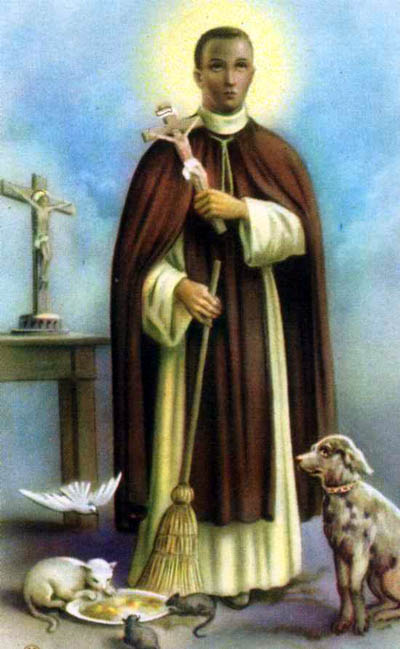
             In art, Saint Martin de Porres is depicted in a Dominican habit with a broom, little animals at his feet as a reminder of the life of humility he led, doing menial work and his love for all of God’s creatures. The dove of the Holy Spirit is also present stressing the divine wisdom Martin had.. He carries a cross because of his devotion to Christ’s Passion. Since Martin was of mixed race, he is the patron of racial harmony. Because he began his life as a barber, barbers and hairdressers claim him. He is the patron of jurists because so many important people came to him.


Prayer to Saint Martin de Porres

                                To you Saint Martin de Porres we prayerfully lift up our hearts

                                              filled with serene confidence and devotion.

                                            Mindful of your unbounded and helpful charity

                          to all levels of society and also of your meekness and humility of heart,

                                            we offer our petitions to you. (Request here)


            Pour out upon our families the precious gifts of your solicitous and generous intercession.

                     Show to the people of every race and color the paths of unity and of justice.

                               Implore from our Father in heaven the coming of His kingdom,

                                              so that through mutual benevolence in God

                        men may increase the fruits of grace and merit the rewards of eternal life.

                                                                          Amen


Excerpted from: “Saints:Ancient and Modern” by Barbara Calamari and Sandra DiPasqua.


Dining With The Saints

day of the dead

All Souls Day

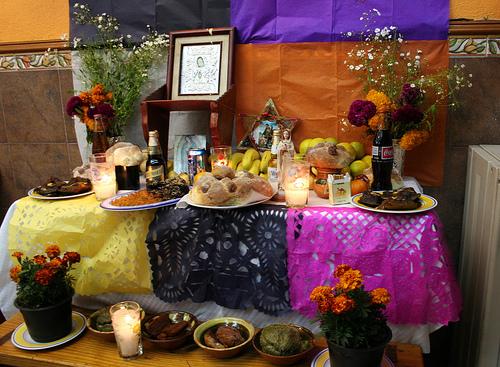
 November 2nd is All Souls Day, or Day of the Dead as it’s commonly called in Mexico, where it’s one of the most important religious events of the year. Mexicans travel miles to take food and flowers to the graves of their departed relatives. As morbid as this sounds, it’s usually a day of great celebration, as families reunite, catch up on gossip, and eat and drink together. Altars are set up in private homes, elaborately decorated with candles, photos of their dead relatives, skulls, crosses, huge bouquets of flowers, fresh fruit of all kinds, and Pan de Muertos, breads flavored with orange flower water and shaped into skulls and bones. Tomales, chicken mole, chunks of Mexican chocolate, even cans of soda, beer, and cigarettes are left at the altar in honor of the departed.


To celebrate your own All Souls Day, Mexican style, you might like to try this elegant chicken dish made with almonds, raisins, and hot and sweet spices. It’s a lot simpler than many of the Mexican mole sauces often cooked with chicken, but it’s hauntingly delicious with a great depth of flavor. I’ve adapted the recipe from one in The Art of Mexican Cooking, by Diana Kennedy.


Braised Chicken with Almonds, Raisins, and Jalapenos


(Serves four)


¼ cup extra virgin olive oil

1 large chicken (about 3 ½ pounds), cut into serving pieces

Salt

1 medium onion, diced

3 garlic cloves, thinly sliced

2 carrots, peeled and thinly sliced

A few large thyme sprigs, leaves chopped, plus extra leaves for garnish

A few large marjoram sprigs, leaves chopped, plus extra leaves for garnish

1 fresh bay leaf

3 cloves, ground to a powder

3 allspice, ground to a powder

½ cup white wine

1 tablespoon white wine vinegar

1 cup chicken broth

½ cup raisins

½ cup sliced almonds, lightly toasted

8 small new potatoes, peeled and cut in half

2 or 3 canned jalapeno chilies, sliced


Choose a large casserole, fitted with a lid. Pour in the olive oil and get it nice and hot over medium heat. Add the chicken pieces and brown them on both sides. Season with salt and add the onion, garlic, carrots, thyme, marjoram, cloves, and allspice. Sauté a minute or so longer, just to blend these flavors and soften the vegetables. Add the white wine and the vinegar and let it bubble for about a minute or so to burn off the alcohol. Add the chicken broth and bring it to a boil. Turn the heat to low, cover the casserole, and simmer for about 30 minutes. Now add the raisins, almonds, potatoes, and the sliced jalapenos. Continue simmering, covered, until the chicken and the vegetables are very tender, about 30 minutes longer. Garnish with the extra marjoram and thyme leaves. Serve hot.

by Erica De Mane

w.ericademane.com


all_saints_day

ALL SAINTS DAY

 When a Catholic is baptized, he or she is given a saint’s name, and that saint becomes his or her patron. Also, at confirmation, a saint’s name is selected as one’s confirmation name, preferably that of a saint one would wish to emulate.

 This is a general novena to invoke the intercession of your particular saint. Novenas to your patron saint can be done at any time, but they are most appreciated on your saint’s feast day. If that day is unknown to you, or you do not have a patron, November 1 has been set aside as the Day of All Saints. On this day patron saints are thanks for their protection and are asked to become more present in our lives.

 The Feast of All Saints was first observed in May 609 in order to rededicate the Pantheon in Rome from a pagan temple devoted to a myriad of gods to a church known as the Blessed Mother and the Martyrs (now called Santa Maria Rotonda). Even in these early times there were thousands of saints, too many for the official calendar, and it was felt that there should be a day dedicated to them. Attendance at the ceremony was so great that the food and wine for the festivities were depleted before the celebration began. The May feast was then moved to November 1, when food supplies were more ample after the harvest.

 It is said that when we honor the saints we honor ourselves. By sending them love and admiration, an amplified, magnified form of love and grace is received in return. On All Saints’ Day, the patrons can be prayed to individually or the saints can be universally invoked. Since the saints have had a human existence, meditating on and reflecting on their natures and lives offers the hope of improving or perfecting one’s own way of being. The saints intercede for us as a group, and with such powers, it would be impossible for prayers to go unanswered. So long as it is in accordance with God’s will, it is the desire of the saints to aid in the fulfillment of God’s wishes.

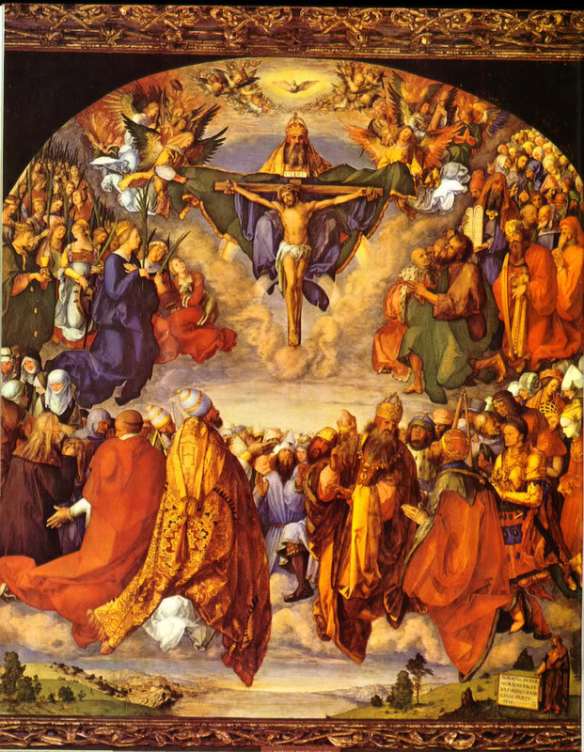
 Here the image used to illustrate the novena for All Saints represents a vision that the warden of the Church of Saint Peter was purported to have had one year after the first All Saints’ Day. After he went from altar to altar imploring the help of each saint, he sat down in rapt ecstasy. Then he saw an endless procession of saints, representing every race being led  by the angel before the throne of Christ and the Virgin Mary. They sang their thanks to God for the honor done them by those on earth and they prayed for the entire world. Then the angel instructed the warden to tell the Pope what he had seen and commanded him to establish the day after the Feast of All Saints as a day for the departed souls, so that those who had no one to pray for them would be remembered as a group. Thus, the Day of All Souls is on November 2.

 The Day of All Saints is November 1

Novena to Your Patron Saint


Glorious Saint ____, my beloved patron, you served God in humility and with confidence on earth. Now you enjoy his beatific vision in heaven. You preserved until death and gained the crown of eternal life. Remember now the dangers and confusion and anguish that surround me in my needs and troubles, especially (mention your request) Amen.

 Say this novena nine times in a row for nine days in a row.

Excerpted from the book “Novena: The Power of Prayer” by Barbara Calamari and Sandra DiPasqua