Novenas for May

SAINT JOAN OF ARC

 1412-1431

Feast Day: May 30

Patron of: France, Orleans, Rouen, captives, opposition of Church Authorities, radio workers, rape victims, shepherds, wireless telegraph workers, women in the military,

Invoked: against fires in woodpiles, for strength in face of opposition

Symbols: armor, standard, sword

 “I place trust in God, my creator, in all things; I love Him with all my heart.

            Joan of Arc

            Saint Joan of Arc (or Jehanne d’Arc ) is both a secular heroine and a Roman Catholic saint. Known as La Pucelle, or “The Maid” to her countrymen, she is credited with being the galvanizing force who returned French rule to France.

              Joan D’Arc was from a comfortable peasant family of five children. Already known in the village as a pious child, the adolescent Joan was at work in a garden when she heard a disembodied voice in a blaze of light. The voice gave her a simple task :pray often and attend church.  After time it revealed itself to be Michael the Archangel. The angel told her that she would soon be visited by Saint Margaret of Antioch and Saint Catherine of Alexandria, two ancient martyrs whose statues were ensconced in her village church. In her later testimony, she said the martyr’s voices began visiting her frequently, eventually allowing her to gaze upon them as well. Fearing disapproval from her father, Joan never told anyone about these visits. And she vowed to retain her virginity for as long as God wanted it.

            After two years the three saints revealed Joan’s true task: she was to save her countryby first taking Charles to Rheims to be crowned king and then by driving the English out of France completely. She had no idea how an ignorant peasant girl was to accomplish this. By the time she was 16, the voices grew more insistent and ordered Joan to travel to the next town to see the commander of Charles’ forces, Robert de Baudricourt and tell him that she was appointed to lead the future king to his coronation.

            Chaperoned by an uncle, she did as she was told. The commander laughed, Your father should give you a good whipping.” He also ignored Joan’s prediction that Orleans, the last remaining city in French hands on the Loire, would fall to the English if he did not listen to her. She returned home in  defeat, her voices  hounding her to complete her mission. When she told them,  “I am a mere girl who knows not even how to ride a horse.” They answered, “It is God who commands it.” She secretly returned to Baudricourt who was unnerved by the fulfillment of her prediction. Orleans was ready to fall. Desperate for any help at all, and troubled by the girl’s otherworldly confidence, he recommended that the future king, known as the Dauphin, grant her an audience. Because the eleven day journey to Chinon was through enemy territory, Joan was disguised in man’s clothing.

            Tales of Joan’s seemingly supernatural abilities preceded her. As a test, Charles dressed a member of his entourage in royal robes while he stood among the throng of his courtiers. All were stunned when the girl walked in and immediately advanced towards the real Charles saying, “Most illustrious lord Dauphin I have come and am sent in the name of God to bring aid to yourself and to the kingdom.” Privately, she related to him a secret prayer he had made the previous All Saints Day asking God to restore his kingdom if he was the true heir to the throne and if not, to punish only him for his impudence and let his supporters live in peace. Unnerved, but not ready to accept this proof of her calling, Charles arranged for Joan to be interviewed by a group of theologians in Poitiers. They questioned her for three weeks before they granted their enthusiastic approval, amazed at how such an uneducated person could hold her own against learned scholars. They recommended that Charles recognize the girl’s divine gift and grant her titular command of the army.

            A small suit of armor was made for Joan and she designed a banner for herself with the  words “Jesus Maria”. Her voices told her to carry an ancient sword that would be found buried in the altar of the church of Saint Catherine-de-Fierbois. When it was easily found, Joan’s reputation as a messenger from God began to spread in the general population. Allegedly this sword was used by Charles Martel in the 7th century in his defense of France against the invading Saracens. Men who would normally not be inclined to join the army, enlisted. Joan insisted that all soldiers go to confession and receive communion. She banished the prostitutes that routinely followed troops. There are many written accounts of men who served with Joan of Arc who declared that despite her physical beauty, they never “had the will to sin while in her company”.            

 After unsuccessfully calling on the English to leave French soil, the military campaign to lift the siege of Orleans began on April 30. Charles’ commanders considered Joan a mere mascot and thus refused to take her strategic advice. After four days of witnessing their floundering efforts, Joan charged into battle waving her banner. The vision of this fearless young girl on a mission from God turned the tide of the battle turned for the French army. By May 8th the English were forced to retreat and the siege of Orleans was lifted. Just as her voices had predicted, Joan endured a wound during the fighting. They also warned that she had very little time and had much to accomplish within the next year.

            At her insistence, all English positions were cleared on the way to Reims. During these battles through one town and another, Joan took the lead inspiring many common citizens to follow the troops. The English were routed completely suffering a loss of 2200 men, while the French army lost only three.   With Joan organizing troop and artillery placement, the French army easily accomplished a feat which had seemed impossible to them – they drove the English out of Reims so that Charles VII could be crowned there, as all French kings had been before him. Joan held her banner as she stood next to Charles during his coronation on July 16, 1429.   Part of her mission was complete.

            Though she was in a great hurry to accomplish the rest, Charles VII became cautious and followed his advisor’s recommendation to marginalize the seer. Against Joan’s wishes he signed a truce with the Burgundians, which gave the British time to regroup. He refused to support his army in an assault on Paris, a fight in which Joan was wounded and forcibly removed from the battlefield.  By the Spring of 1430 Joan’s voices told her that she would be captured before the Feast of John the Baptist. This occurred in Burgundy on May 24th . At that time, it was common practice to ransom off important captives. Charles VII could have offered to pay her ransom but instead  ignored her plight. The inner circle of his court were discomfited by Joan’s strangeness. They convinced Charles that she had fallen out of favor with God. She was sold to the English who imprisoned her in Rouen.

            Since there were no rational explanations for her overwhelming successes, the English vowed revenge on Joan, considering her a witch with satanic powers. In order to destroy her reputation as a religious visionary sent by God, they wanted Joan tried in an Ecclesiastical Court for witchcraft and heresy. Once this was proven, they could then charge that Charles VII was made king by diabolical means and reassert their claims on the French throne. Pierre Cauchon, the Bishop of Beauvais willingly adopted this plot in order to realize his own political ambitions.

            Joan was illegally held in a secular prison guarded by men who repeatedly threatened her with rape. When her virginity was proven, she could not be charged with witchcraft. She was  interrogated from February 21 to March 17 by a relentless  panel of 47 judges, a majority of whom came from the pro-English University of Paris. After an attempted escape, Joan was imprisoned in a cage, chained by the neck, hands and feet and she was forbidden to partake in any of the sacraments. Despite their avid attempts to brow beat her and put words in her mouth, she calmly deflected the panel. These trial transcripts exist today, and are a remarkable testament to the  brilliance of her simple answers. Many times, she instructed the judges to look up testimony she had previously given – exact to the day and hour. On March1 she further infuriated the court by stating that “Within seven years’ space the English would have to forfeit a bigger prize than Orleans.” (Within six years and eight months the English would abandon French soil entirely).

            By May, the judges had written up their verdict, 42 of them agreeing that if Joan did not retract her statements, she would be handed over to the civil powers to be burnt at the stake. Filled with fear, Joan signed a two line retraction. A document detailing her acts as works of the devil was substituted in the official record. Because she had done as they ordered, they could not execute her and the British were furious. It is not known if Joan was so afraid of the threat of rape by her guards or if the dress she had been wearing during her trial was taken away and her male costume the only thing left to her, but when she appeared before the court on May 29th dressed as a man, she was declared a relapsed heretic. Her masculine attire served as proof of her crime and she was burned at the stake in the town square the next day. On the morning of her execution she was visited by the judges. She solemnly warned Cauchon that he would be charged by God for the responsibility of her death. She insisted her voices came from God and had not deceived her. Her last word, as she was consumed by flames was, “Jesus”. In order to discourage the collection of relics, her ashes were thrown into the Seine.

            A reversal of her sentence was granted by the Pope in 1456, twenty five years after her death citing of the unfairness of her judges and the fact that the court illegally denied her right to appeal to the Holy See. 

             Joan D’Arc remains one of the most popular historical figures in the world. Poets, Painters, Writers and Filmmakers have ensured her role in popular culture. She is the only person in written history, male or female,  to command a nation’s army at the age of 17. As a French patriot, she was a propaganda figure in both World Wars. She was finally declared a saint in 1920.      

                       In art, Joan D’Arc wears her suit of armor and carries her “Jesus Mary” banner. Because of her voices she is the patron of radio and telegraph workers. She is patron of  women in the military and shepherds because these were her occupations. She dressed in men’s clothing to avoid the threat of rape so she is the patron of rape victims. Most importantly she is the patron of the nation she saved, France.

                         Novena to Saint Joan of Arc

             Glorious Saint Joan of Arc, filled with compassion for those who

            invoke you, with love for those who suffer,

            heavily laden with the weight of my troubles,

            I kneel at your feet and humbly beg you to take my present need

            under your special protection (intention here).

            Vouchsafe to recommend it to the Blessed Virgin Mary,

            and lay it before the throne of Jesus.

            Cease not to intercede for me until my request is granted.

            Above all, obtain for me the grace to one day meet God face to face

            and with you and Mary and all the angels and saints praise Him

            through all eternity.

            O most powerful Saint Joan, do not let me lose my soul,

            but obtain for me the grace of winning my way to heaven,

            forever and ever. Amen

Excerpted from the book: “Saints: Ancient and Modern” by Barbara Calamari and Sandra DiPasqua.
Saint Rita of Cascia

 1386-1457

Feast Day: May 22

Patronage: Impossible Causes, Bad Marriages, Victims of Spousal Abuse, Widows

Invoked Against: Sterility, Loneliness, Bodily ills, Smallpox

Symbols: Roses, Bees, Figs, Nun with cross receiving wound, Crown of thorns, Crucifix

       Margarita Lotti was the answer to the prayers of a devoutly Catholic older couple in Roccaporena, Italy. During the pregnancy, her mother had a vision of an angel telling her “You will give birth to a daughter marked with the seal of sanctity, gifted with every virtue, a helper to the helpless and an advocate of the afflicted.” Her father named the child Rita, as the Angel had called her.  After the baby’s baptism, bees would hover over her while she slept.  A symbol of divine presence, they never harmed nor woke her.

       Rita came of age at the time of a deep schism in the Church – the Pope had fled to Avignon and the future of many religious communities was uncertain. Her true wish was to become a nun but she obeyed her parents and married instead, to support them in their old age. The husband chosen for her, Paolo Mancini, was a good provider though gradually revealed a violent, volatile nature. He was unfaithful, abusive and domineering. Heavily involved in the factional infighting that gripped the Italian landscape, he made many enemies.

        Rita prayed fervently that her husband would have a change of heart and become a better husband and father to their twin sons.  Paolo experienced a conversion when he was sent a vision of himself as he was seen by others. He begged Rita’s forgiveness for the difficult life he had subjected her to and vowed to change. They had been married for 18 years when Paolo was ambushed on his way to work and murdered, his mutilated body dumped on the family’s doorstep. Their enraged teenaged sons vowed a vendetta. Entreaties by their mother to turn the other cheek were scoffed at.  Rita begged God to stop her boys before they also committed murder. Within that year, before they could act on their anger, both boys contracted an illness and died. Rita was distraught at the loss of her entire family, but took some comfort in the fact that her sons died in a state of grace.  

            Devoting herself to charity, Rita decided to pursue her early wishes of joining a convent. It is said that the local order of Augustinian nuns refused her on the grounds that she was not a virgin. A more probable reason for rejection, several of the nuns came from families of Paolo’s declared enemies and they did not want to inflame the convent with tensions brought in from the outside world. Rita implored her patron saints for help, Saint John the Baptist, Saint Augustine of Hippo and Saint Nicholas of Tolentino. Three times she requested admission to the convent and three times she was denied. One tale of how she was eventually accepted has Rita hearing a knock at her door during her prays to her three patrons. Though no one was there, a voice called to her, “Rita! Rita! Fear not, God will admit you into the cloister as His spouse.”  When she resumed praying, John the Baptist appeared to her and told her to follow him to the Convent of Mary Magdalene. Along the way, they were joined by Saints Augustine and Nicholas of Tolentino, radiant in light.  The saints blessed her at the convent door then disappeared. Rita was found the next day by the astonished nuns, inside their convent! After she recounted the story of her miraculous entrance, it was decided that she should remain with them. The other tale explains that through prayer and meditation Rita was able to create such an atmosphere of serenity about her that it enabled her to affect a signed truce between her husband’s family and the family of his enemies. Impressed by her dedication and sincerity, the prioress of the convent admitted her.

       As a nun, Rita tended the elderly and sick sisters and devoted much time to prayer, and meditation, allegedly sleeping only two hours a night. When she had lived in the convent for 25 years, she heard a sermon on the Passion and Death of Jesus Christ which focused on his crown of thorns. While later meditating on this in her cell she felt an intense pain in her head. A wound opened on her forehead.  Never healing, it grew foul smelling with infection and eventually filled with little worms.  Rita was shunned as repulsive by the rest of the nuns and remained isolated in her cell, praying and meditating with a mystical fervor. In 1450 the Pope declared a Jubilee Year and Rita requested permission to travel to Rome with the other nuns. She was told she could not leave until her wound healed. After a day of prayer all trace of the wound vanished and Rita made the pilgrimage. Upon walking over the convent’s threshold on her return, the festering wound instantly reappeared.

       Rita’s parents were known for their ability to make peace between the warring factions of Guelphs and Ghibellines, and she too had a gift for peacemaking. Citizens of Cascia sought her out to mediate arguments and disagreements that seemed impossible to settle. She gained a reputation for the powers of her prayers, healing those beyond the help of medical science. While Rita was dying of tuberculosis, a cousin came to visit her the winter before her death. When asked if there was anything at all that she wanted, she replied, “Bring me a rose from my childhood garden in Roccaporrena.”  The cousin assumed that being January, this request was impossible to fill.  Yet there in the garden she found two roses in bloom and brought them to Rita. “Would you like anything else?” asked the cousin.  Rita requested two figs from the same garden. There they were found, hanging from a tree in the dead of winter.

       Upon Rita’s death in May of 1457, the bells of every church in the surrounding villages began to ring of their own accord. Rita’s body exuded the odor of roses and her cell was filled with light. As the town gathered to pay their last respects, spontaneous healing occurred among the mourners. Many reported intense joy and feelings of love, the burdens of life lifted. Her body was preserved and is still on view at the Sanctuary of Saint Rita in Cascia. Because so many women identify with her difficult life, her cult quickly spread throughout Europe and is particularly strong in Italy, Spain and South America, where girls are frequently given the name of Rita. Her feast day brings thousands of pilgrims to Cascia as she is one of the most popular saints in the world.

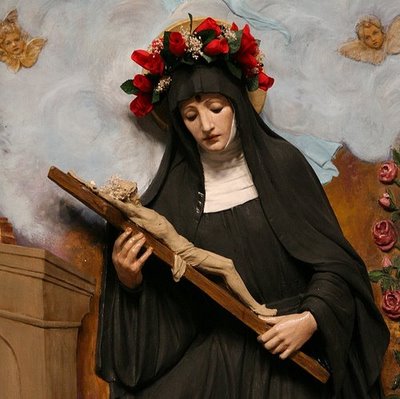
  Though she died in the mid 15th century, Saint Rita of Cascia was the first female saint of the 20th Century. By that time, devotion to this woman who had been an abused wife, a mother who lost her children, a widow of a murdered husband, and finally, a nun, had spread throughout the world. Roses are an important part of the imagery of Saint Rita and on her feast day there is a procession when roses are blessed and their petals distributed. Six centuries after her death a swarm of bees still live in the wall of her cell. Occasionally Rita is depicted with her twin sons, but generally, she is shown as a nun in a black habit with a crown of thorns, a crucifix and a wound in her head.

 Novena to Saint Rita

                        O glorious Saint Rita, your pleadings before the divine

                        crucifix have been known to grant favors

                        that many would call the impossible.

                        Lovely Saint Rita, so humble, so pure, so devoted in your

                        love for thy crucified Jesus,

                        Speak on my behalf for my petition which seems so impossible

                        from my humbled position. (Mention your request).

                        Be propitious, O glorious Saint Rita, to my petition,

                        showing thy power with God on behalf of thy supplicant.

                        Be lavish to me, as thou has been in so many wonderful cases

                        for the greater glory of God.

                        I promise, dear Saint Rita, if my petition is granted, to glorify thee,

                        by making known thy favor, to bless and sing thy praises forever.

                        Relying then upon thy merits and power before the Sacred Heart

                        of Jesus I pray. Amen

Excerpted from the book: “Saints: Ancient and Modern” ny Barbara Calamari and Sandra DiPasqua.

Novena for April

Our Lady of Good Counsel

Madonna of the Popes


(State your petitions)
Holy Virgin, moved by the painful uncertainty we experience in seeking and acquiring the true and the good,
we cast ourselves at thy feet and invoke thee under the sweet title of Mother of Good Counsel.
We beseech thee: come to our aid at this moment in our worldly sojourn when the twin darknesses of error and of evil
that plots our ruin by leading minds and hearts astray.

Seat of Wisdom and Star of the Sea,
enlighten the victims of doubt and of error so that they may not be seduced by evil masquerading as good;
strengthen them against the hostile and corrupting forces of passion and of sin.

Mother of Good Counsel, obtain for us from thy Divine Son the love of virtue and the strength to choose,
in doubtful and difficult situations, the course agreeable to our salvation.
Supported by thy hand we shall thus journey without harm along the paths taught us by the word and example of Jesus our Savior,
following the Sun of Truth and Justice in freedom and safety across the battlefield of life under the guidance of thy maternal Star,
until we come at length to the harbor of salvation to enjoy with thee unalloyed and everlasting peace. Amen.

(By Pope Pius XII, 23 January 1953)

Patron Saints for April

Italy / Catherine of Siena, 1347–1380,
Feast Day: April 29

As a young girl, she defied her parents and took up the religious life. A tertiary in the Order of St. Dominic, she tended the incurably ill. Catherine received the stigmata, and she developed a following of young people. Her series of dictated letters are classics of Italian literature. She convinced the Pope to return the Holy See from Avignon, France, to Rome, and this made her the patron of Italy.

Other patronages: Europe; fire prevention, nursing services; firefighters, laundresses; sick people

Invoked: against burns, miscarriage, temptation

Novena to Saint Catherine of Siena


Novena For March

SAINT JOSEPH

First Century

Feast Day: March 19

Patron of: Austria, Belgium, Bohemia, Canada, China, Croatia, Korea, Mexico, Peru, Vietnam,  carpenters,  Catholic Church, families, fathers, homeless, pregnant women, workers

Invoked: for family protection, to find work, for a happy death, to sell a home, against doubt, against hesitation, Symbols: Lily, Baby Jesus, Flowering branch, Carpenter’s tools

  “I know by experience that the glorious Saint Joseph assists us generally in all necessities. I never asked him for anything which he did not obtain for me.” 

            Saint Teresa of Avila

          A working man descended from royal lineage, Joseph is said to have been chosen by God to protect His greatest treasures, Jesus and Mary. In the few descriptions of him in the Gospels, Joseph never speaks. He displays the depth of his faith by listening and quietly doing what he is told. In the face of possible public scandal he marries Mary when she is pregnant with a child that is not his. When an angel tells him that the child she has conceived is of the Holy Spirit, he accepts it.

         When all citizens were required to register on the tax rolls Joseph dutifully takes a very pregnant Mary with him to Bethlehem. As the city is severely overcrowded, they cannot find a proper place to sleep and Mary is forced to give birth in a stable. The holy family settles back into Nazareth until an angel warns Joseph in a dream of the impending slaughter of the innocents, and instructs him to flee with Mary and Jesus to Egypt. Without hesitation Joseph relinquishes his business and home to take his wife and young son on a perilous journey to an unknown land. Following the angel’s order, they stay in Egypt for seven years, with Joseph caring for both the financial and spiritual needs of the holy family.

            The final mention of Joseph is in the story of the twelve year old Jesus straying from his family during a pilgrimage to Jerusalem. It is believed that Joseph died well before Jesus began his public life and his patronage for a good death stems from the probability that he was surrounded by Jesus and Mary as he lay on his death bed.

            While the gospels concern Joseph only in regard to his relationship to Jesus, other histories of Joseph passed down from the fifth century state that Joseph was a widower who had been married 49 years and had six children before his first wife died. When the priests announced that all unmarried men from the tribe of Juda were to be candidates to marry Mary, Joseph went to Jerusalem with great reluctance. He was elderly and did not think he should be seriously considered. While the other men presented themselves by putting their walking sticks on the altar, Joseph held back and did not participate.  To everyone’s amazement the tip of his staff burst into a bloom of flowers, a sign from God that he was to be named the fiancee of Mary.           This tale is where the early visual depictions of Joseph as an elderly man with a flowering branch come from.  It was also thought that since Joseph had to respect Mary’s virginity throughout their marriage, that in all probability he would have been older.

            During the beginnings of the church, only martyrs were recognized as saints. Despite the importance of Joseph in the life of Christ, his cult was only found in the East. It did not arrive in the West until the ninth century when he was honored in church as the Foster Father of Our Lord.  The Carmelite order brought his cult to Europe when they were driven out of Jerusalem during the Crusades and the first church dedicated to him was in 1129 in Bologna, Italy.             

European Evangelists recognized Joseph’s reputation as the perfect father figure as useful in gaining conversions.  Common people forced to put the needs of their family before personal ambition saw Joseph’s life mirror their own. Church mystics and scholars Bernard of Clairvaux, Thomas Aquinas and Bridget of Sweden all stressed the importance of Saint Joseph in their religious devotions. While reforming the Carmelite order in Spain, Teresa of Avila chose him to be the patron of her Discalced Carmelite order.  She did much to spread his public devotion spread throughout the Spanish Kingdom. During the Middle Ages when drought and famine struck Sicily, residents throughout that island prayed to Saint Joseph for help. At midnight on March 19th rain began pouring and good weather immediately followed. Sicilians have venerated Saint Joseph ever since, by setting up altars, cooking special food and sweets which are given to friends and to the poor. These festivities were adapted by the rest of Italy where Saint Joseph is greatly revered. It is said that Saint Joseph has the power to overturn natural law, because Jesus had to obey his earthly father while he was a boy, that he would still do whatever Saint Joseph asked of him.

            With the advent of the Industrial Revolution, and the new class of laborers it produced, patronage to Saint Joseph became universal. By the end of the 19th Century he was named patron of the Catholic Church out of gratitude for the care he took of Jesus. Because Joseph had to move on a moment’s notice with the flight into Egypt and was responsible for providing shelter for his family, he is invoked for buying or selling a home.  The tradition of burying a Saint Joseph’s statue on the grounds of a home to initiate a quick sale goes back to the 17th Century. When Teresa of Avila was in need of more land to set up her religious houses, she had her nuns bury their Saint Joseph’s medals in the ground. Gradually, these medals evolved into a statue of Saint Joseph that would be buried upside down until the house was sold, then dug up and taken to the new home. Today, even nonCatholics do this as a superstitious rite, buying Saint Joseph’s Home Sale Kits off the internet.

            In art, Saint Joseph is always depicted with the infant Jesus. He sometimes has carpenter tools and because of his chastity he carries a lily for purity. The flowering staff became a popular attribute for him because it is also the emblem of shepherd kings who forcefully defended their flock. This staff is also the ancestor of the Bishop’s crook. An additional feast day was declared for Saint Joseph as May 1st.  May Day to the rest of the world, the church in its attempt to combat Communism dedicated this day set aside for the working man to the Patron of Workers.

Prayer for Saint Joseph’s Intercession


                                     Remember, O most chaste spouse of the Virgin Mary,

                                That never was it known that anyone who implored your help

                                          and sought your intercession was left unassisted.

                                                     Full of confidence in your power,

                                                 I fly unto you and beg your protection.

                                            Despise not, O foster father of the Redeemer,

                                                 My humble supplication, (request here)

                                             but in your bounty, hear and answer me. 

            Amen

Excerpted from the book “Saints:Ancient and Modern” by Barbara Calamari and Sandra DiPasqua.
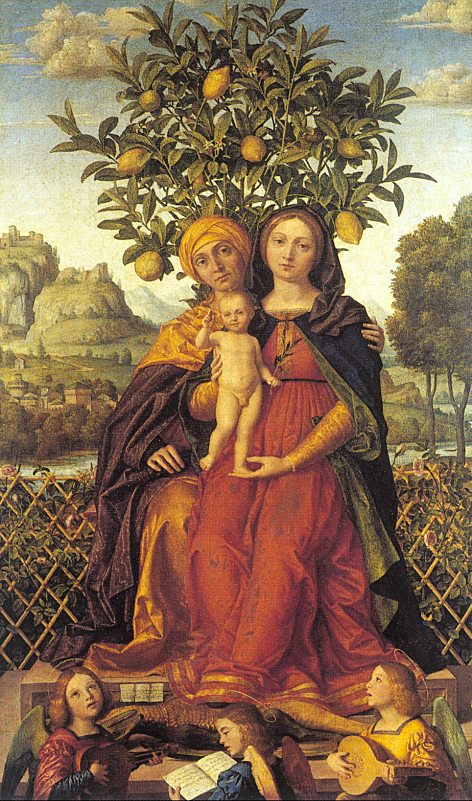
Dining with the Saints in Honor of Saint Joseph

More on Saint Joseph

Novena For February

Our Lady of Lourdes

First Apparition: February 11, 1858

Feast Day: February 11

Patron of France

Invoked for curing illnesses, reconciling differences

There are four traditional gifts imparted by a pilgrimage to Lourdes: (1) The gift of the miraculous water. (2) The gift of healing. (3) The gift of reconciliation. (4) The gift of friendship.

Novena to Our Lady of Lourdes

 O ever Immaculate Virgin,
Mother of Mercy,
Health of the Sick,
Refuge of Sinners,
Comfort to the Afflicted,
 you know my wants, my troubles, my sufferings.
Deign to cast upon me a look of mercy.
By appearing in the Grotto of Lourdes,
you were pleased to make it a privileged sanctuary,
whence you dispense your favors;
and already many sufferers
have obtained the cure of their infirmities,
both spiritual and corporal.
 I come, therefore, with the most unbounded confidence
to implore your maternal intercession.
Obtain, O loving Mother,
the granting of my requests.
 Through gratitude for favors,
I will endeavor to imitate your virtues
that I may one day share your glory.
 (mention your request here)
 Our Lady of Lourdes, pray for us.
 Amen
Recite one Our Father, One Hail Mary, One Glory Be
Pray this novena nine times in a row for nine days in a row.
Image: 

Breast Disorders: Agatha

D. 251     Feast Day: February 5

A virgin martyr from Catania, Sicily, Agatha is closely identified with the protection of her homeland. When she refused to renounce her Christian faith, Agatha was tortured by having her breasts cut off. While in prison, Saint Peter came and healed her. She was later killed by being rolled in burning coals. At the same time, a great earthquake shook Catania, destroying her persecutors. Her veil is still used to ward off the eruptions of nearby Mount Etna.

Other Patronages: Malta, Burns, Pulmonary Diseases, Bell Ringers, Bell Makers, Brass Workers, Cloth Makers, Glass Workers, Wet Nurses, Nursing Mothers

Invoked Against: Fires, Volcanic Eruptions

Novena to Saint Agatha

Novena for January

SAINT THOMAS AQUINAS

1225 – 1274

Doctor of the Church


Considered more angelic than human, Saint Thomas Aquinas has the title of “Angelic Doctor”. His life is the story of someone who lived totally through his higher mind, rejecting all worldly temptations, ambitions, and pleasures in favor of intellectual pursuit. Honored in his own lifetime, he was continually invited by the Pope and the king of France to share his learning, but this never changed his disposition of the simple way he lived his life. He refused all offers of holy office in order to continue his vocation of studying, writing, and preaching. Because of this love of learning for its own sake, Saint Thomas Aquinas is the patron saint of students. He is invoked whenever there is a difficult situation regarding education, be it tackling a difficult subject or passing and entrance examination. Although this novena is written for the patronage of Catholic schools, all students should feel free to call on him.

Saint Thomas Aquinas is regarded by most historians as the greatest thinker and theologian of the Middle Ages. Yet the more knowledge he mastered, the more he realized how much he did not know. Born at Roccasecca, near Naples, he was the youngest child of the count of Aquino. At the age of five he was sent away to the Benedictines of Monte Cassino. There, at that young age, he displayed great intellectual acuity and easily surpassed all the other students in his class. His father, being a nobleman, assumed that he would be trained for a high ecclesiastical office. At the age of seventeen, Saint Thomas scandalized his family when they discovered that he had secretly joined the new order of Dominican friars. This order frequently resorted to begging in the streets to survive. His brothers then kidnapped him and locked him in the family house for the next year. Trying to get him to break his vows, they presented him with every temptation, including a beautiful prostitute. Saint Thomas chased her away with a flaming torch and from that day was freed from any sexual desires. His family finally relented and released him. In 1248 he went to the city of Cologne, where he studied under Saint Albert the Great, at that time the most brilliant professor in Europe. His lumbering presence and slow movements belied his genius, causing his fellow students to refer to Saint Thomas as “the Dumb Ox”. He began publishing his works at the age of twenty-two and then went to Paris, where he earned his doctorate in theology. He was in great demand as a university professor and became famous for his lucid writings. The great challenge of his life was to explain Christianity in Aristotelian terms.

In 1266 Saint Thomas began his greatest work, Summa Theologica. Seven years and two million years later, he quite suddenly stopped work on it, leaving it unfinished. While attending mass he had had an ecstatic vision, and afterward, he declared that compared with what he had just seen, “all that writing seemed like so much straw.” He died three months later, at the age of forty-nine. So simple, pure and ingenuos had Saint Thomas Aquinas remained in his life that his deathbed confessor declared his final confession to be akin to that of a five-year-old child.


Feast Day: January 28


Patron of: Students, Universities, Catholic Schools


Novena to Saint Thomas Aquinas


Saint Thomas Aquinas, patron of students and schools, I thank God for the gifts of light and knowledge God bestowed on you, which you used to build up the church in love. I thank God, too, for the wealth and richness of theological teachings you left in your writings. Not only were you a great teacher, you lived a life of virtue and you made holiness the desire of your heart. If I cannot imitate you in the brilliance of your academic pursuits, I can follow you in the humility and charity that marked your life. As Saint Paul said, charity is the greatest gift and is open to all. Pray for me that I may grow in holiness and charity. Pray also for Catholic schools and for all students. In particular, please obtain the favor I ask during this novena. Amen.

(Mention your request.)


Say this novena nine times in a row for nine days in a row.


Excerpted from the book, “Novena: The Power of Prayer” by Barbara Calamari and Sandra DiPasqua

Image: Detail from “The Triumph of Saint Thomas Aquinas” by Bennozzo Gozzoli 

Novenas for December

SAINT LUCY

 283 – 304

Feast Day: December 13

Patronage: Syracuse, the blind, cutlers, electricians, glaziers, gondoliers, oculists, peasants, writers

Invoked Against: dysentery, epidemics, eye disease, hemorrhages, throat ailments, for clarity

Symbols: holding her eyes on a dish, martyrs palms, sword, oxen, cord

 “Those who live chaste lives are temples of the holy spirit.”

            Saint Lucy 304AD

             Saint Lucy was a privileged young woman who chose a state of enlightenment over the prosperous, respectable life she was expected to lead in Roman society. One of the early virgin martyrs, her quiet but steadfast rebellion against the civil authorities earned her an excruciating death that became a triumphant example of everlasting life, hastening the overthrow of the Emperor and the legalization of Christianity.   

            Born in Siracusa, Sicily, Lucy was a young Christian  woman of Greek ancestry.  She held a deep spiritual belief that one must remain pure to be a true conduit of the Holy Spirit. Lucy secretly vowed to remain a virgin, even while her widowed mother arranged her marriage to a wealthy pagan nobleman. At this time in history, Christianity was looked upon as a threat by the Roman Emperor. So many soldiers in the Empire had converted, that officials feared they would follow the tenets of Christ over their military leaders. The state insisted that it was a man’s duty to serve his nation militarily and a woman’s duty to marry and bear children. When a girl refused to do this, she was considered a traitor to the empire. Therefore, consecrating one’s virginity to Christ, was more of a bold and revolutionary stance against the state than a  private act of devotion.

            Lucy’s mother suffered ceaseless bleeding from a uterine hemorrhage.  Her daughter insisted they make a healing pilgrimage to the tomb of the virgin martyr Saint Agatha in Catania some 50 miles away. Agatha had become the patron of Catania after her veil stopped the deadly flow of Mount Etna’s lava from entering the town. She was credited with so many miracles since her martyrdom 35 years prior, that Christians, Jews and pagans alike were drawn to her tomb to invoke her aid. Lucy and her mother spent the night in prayer outside of the tomb. Agatha visited Lucy in a dream, telling her, “You have no need to invoke me, for your faith has already cured your mother. One day you will be known as the patron of your own city.” As the day dawned, Lucy found her mother completely healed. When she confessed  her secret vow of virginity, her mother agreed not to force her into marriage.

             In 303 the Emperor Diocletian launched the most extensive and vicious anti-Christian campaign throughout the Roman Empire. This was the political atmosphere that Lucy and her mother returned home to. Since she was no longer in need of a dowry, Lucy encouraged her mother to divest herself of all the investments she had made for her daughter’s future and give the money to the poor. Lucy’s fiancé, outraged to learn that his engagement was broken, denounced her to the governor of Siracusa. Brought before this official, Lucy asked, “Why would that man want to marry me?” When the governor quipped, “Perhaps it is your lovely eyes,” Lucy ripped out her eyeballs and told him to send them to her former fiance. Her eyesight was miraculously restored the next day and the governor demanded why she so adamantly refused to marry. Lucy replied, “Those who live chaste lives are the temples of the Holy Spirit.”

            The governor then told her that he would have her taken to a brothel and repeatedly raped until she “lost the Holy Spirit.” Soldiers came to carry her off but could not move her. A thousand men were called in, to no avail. Lucy would not budge. Nor could a team of oxen drag her away.  Burning pitch was poured on her skin but nothing would break her will. Upon predicting the fall of the Emperor, Lucy was fatally stabbed in the throat.  True to her prophecy, the Emperor fell within the year and Christianity was legalized in Rome under Constantine nine years later.  

            Immediately after her death, public opinion was so swayed by Lucy’s fate that it was considered a great honor for other Christians to be buried in the catacombs of Siracusa near her. In the sixth century, the Acts of the Virgin Martyrs were given great recognition by ecclesiastical writers and Lucy’s name was entered in the Canon of the Mass. In art, she is sometimes portrayed in the company of Saints Agatha, Agnes of Rome, Barbara, Thecla and Catherine of Alexandria. All of them, legendary young girls defiant and fearless in the face of death.

            The people of her native city have always honored Lucy and been protective of her. In the ninth century when Siracusa fell into Muslim hands, they hid Lucy’s remains for hundreds of years until 1040 when the Byzantine army drove out the Saracens. In gratitude for their liberation, they sent their most precious possession, her body,  to Constantinople as a  gift for the Empress Theodora. Many of her relics were then distributed throughout Europe which greatly expanded the range of her cult.  In 1204, Venetian Crusaders conquered Constantinople and took Lucy’s remains back to Venice where they were installed in a church named for her. This original church was near the place where the gondolas were parked. The song “Santa Lucia” became famous among gondoliers looking forward to the end of their night’s work. When the church was torn down to make way for the new train station, the station was named for Saint Lucy and her remains were interred in the nearby Church of Saint Jeremiah.

            The name “Lucy” means light. According to the Julian calendar, her feast day, December 13 was considered the shortest day of the year. Celebrations combining Lucy’s feast day with the winter solstice began in Sicily and spread throughout Europe. It was said that the “longest of nights and the shortest of days belong to Saint Lucy”. Today, she is most celebrated in Sweden and other Scandinavian nations because when the Swedes converted to Christianity in the 11th Century, they could most easily relate to a Saint who would gradually bring more light each day as the sun changed its course.  Saint Lucy’s day is a major holiday in that part of the world, celebrated with torchlight processions of crowned girls in white dresses. With the change to the Gregorian calendar in the 1300’s, and the shifting of the solstice to ten days later, Lucy’s feast became synonymous with the start of the Christmas season. She is associated with gifts to children because of her part in curing an eye epidemic that was blinding children in the 13th century. When local families went on a barefoot pilgrimage to her tomb invoking her aid, she sent them home, curing the children and telling them that they would find gifts in their shoes. It became a common Christmas custom in many parts of Europe to celebrate the saint’s feast by putting  gifts in children’s shoes. In 1582 Saint Lucy was credited with ending a famine in Sicily by sending three grain loaded ships to its starving residents. The people were so hungry that they boiled and ate the grain without grinding it into flour.  To this day, Sicilians do not eat anything made with flour on Saint Lucy’s day and there are a host of traditional foods and desserts created specifically for her feast day.                  

            Lucy is a popular subject for artists, she is frequently depicted calmly holding her eyeballs on a dish, referencing her story. Because of this, she is the patron of the blind and all trades relating to the eyes. Eye strain is a common problem for writers, therefore she is their patron. Because of the success of her mother’s healing she is invoked against hemorrhage. Since she was stabbed in the throat she protects against throat ailments and cutlers because she was killed by a knife. As a true patron of her city, Syracuse, she was historically called upon to help in all epidemics, hence her aid against dysentery. Peasants claim her patronage because they depend on oxen who play a part in her story. Her final resting place is Venice so she is the patron of that city’s glassmakers and gondoliers.

Prayer to Saint Lucy of Syracuse

                                             Saint Lucy, your beautiful name signifies light.

                                        By the light of faith which God bestowed upon you,

                             Increase and preserve this light in my soul so that I may avoid evil,

                                           Be zealous in the performance of good works,

                        and abhor nothing as much as the blindness and darkness of evil and sin.

                                                       By your intercession with God,

                                           obtain for me perfect vision for my bodily eyes

                                 and the grace to use them for God’s greater honor and glory

                                                         and the salvation of all men.

                                                         Saint Lucy, virgin and martyr,

                                               Hear my prayers and obtain my petitions.

(mention your request here)

                                                                          Amen

Say this novena times in a row for nine days in a row.

Excerpted from the book, “Saints:Ancient and Modern” by Barbara Calamari and Sandra DiPasqua

 Painting of Saint Lucy by: Giovanni Battista Salvi da Sassoferrato  1609 – 1685

OUR LADY OF GUADALUPE

             Our Lady of Guadalupe represents one of the most kindly and motherly aspects of Mary. In this novena she is begging us to appeal to her for comfort. Our Lady of Guadalupe should be invoked whenever we need a non-judgemental force of love in our lives. Just ten years after the Spanish conquest of Mexico, this apparition occurred on the hill where a temple to the Aztec corn and earth goddess, Tonantzin, once stood. The name Tonantzin means “Our Mother”, and this is exactly how Mary asks the people of Mexico to perceive her. It seems she did not appear to give warnings or dire predictions to humanity, but rather to show herself as a merciful mother figure, ready to assist in any request. The only visitation of Mary officially recognized by the Church on the North American continent, it is an example of how the Madonna changes her image to resemble the race and culture of the people to whom she appears.

             On December 9, 1531, a Mexican-Indian peasant named Juan Diego was walking through the countryside of what is now Mexico City. From the top of a hill a beautiful woman called out to him, asking, “Am I not your mother?” She then told him she was Mary, Mother of God, and that she would like a church to be built upon the ground where she stood. She sent him off to Bishop Zumarraga to make this request. The bishop, upon hearing Juan’s story, instructed him to obtain a sign to prove that this was truly an apparition of Mary. Juan, returning to the site, found the woman waiting for him. Again she told him that she urgently desired a church to be built to bear witness to her love, compassion, help and protection. She wanted the world to know that she was a merciful mother to all and desired everyone to trust in her and invoke her in times of need. She instructed Juan to gather roses among the nearby rocks for the bishop. Since it was winter, not a season when roses bloomed, he was surprised to find them growing where she told him to look. After gathering the roses in his peasant’s cloak, he presented them to Mary, who arranged them; then he took them back to the bishop. As Juan unwrapped his cloak, and the roses fell out, the bishop was stunned. The roses uncovered an elaborate portrait of the Virgin Mary imprinted on the cloak.

             This image still exists and is visited by hundreds of thousands of pilgrims each year. A basilica in Mexico City was erected to house it, thereby fulfilling the Virgin’s request for a church. This images offers a very different view of Mary; her features are Mexican-Indian, there are rays of light streaming out from her entire body, and the figure is set among the sun, moon and stars.

             Our Lady of Guadalupe is the patron of Mexico, and her feast is honored by the people of that country with an almost political fervor. In keeping with her own requests, all people of the world should feel free to invoke her for help in solving any types of problems, big or small.

 Feast Day: December 12

 Patron of: Mexico, The Americas

 Invoked for: Motherly Comfort

Novena to Our Lady of Guadalupe


Our lady of Guadalupe, according to your message in Mexico, I venerate you as the Virgin Mother of the true God for whom we live, the Creator of all the world, maker of heaven and earth. In spirit I kneel before your most holy image which you miraculously imprinted upon the cloak of the Indian Juan Diego, and with the faith of the countless numbers of pilgrims who visit your shrine, I beg you for this favor: (mention your request).

Remember, O immaculate Virgin, the words you spoke to your devout client: “I am a merciful mother to you and to all your people who love me and trust in me and invoke my help. I listen to their lamentations and solace all their sorrows and sufferings.” I beg you to be a merciful mother to me, because I sincerely love you and trust in you and invoke your help. I entreat you, our Lady of Guadalupe, to grant my request, if this be the will of God, in order that I may bear witness to your love, your compassion, your help and protection. Do not forsake me in my needs.

(Recite “Our Lady of Guadalupe, pray for us” and Hail Mary three times).

Say this novena nine times in a row for nine days in a row.

Excerpted from the book: “Novena: The Power of Prayer” by Barbara Calamari and Sandra DiPasqua