Feast of St. Joseph


Image

Feast Day: March 19

Patron of: Fathers

Quote: “I know by experience that the glorious Saint Joseph assists us generally in all necessities. I never asked him for anything which he did not obtain for me.” Saint Teresa of Avila

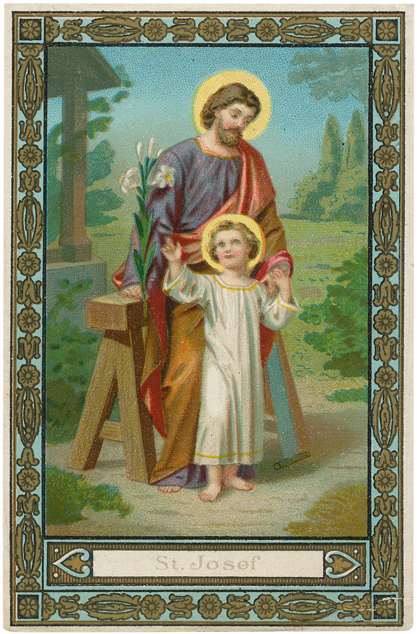
Symbols: flowering staff, carpenter tools, the child Jesus, lily 

A righteous man who never shirked his responsibilities as protector of his family, Saint Joseph offers a perfect example for fathers everywhere. He is invoked by families for all matters of support needed to sustain a household, both material and spiritual. 

A descendant of the House of David, there is very little written about Joseph in the gospels. He was said to be betrothed to Mary when she became pregnant with Jesus. Instead of leaving her in scandal, he accepted the word of the angel Gabriel who told him that the child was divinely given and Joseph and Mary were chosen by God to be his earthly parents. It was Joseph who protected Mary on the journey to Bethlehem when Jesus was born. He also suffered the frustrations of a man who could not find proper shelter for his family as his wife was about to give birth. Upon returning to their native city of Nazareth, Joseph was once again visited by an angel warning him of the impending slaughter of the innocents. On faith alone, he dispensed with his business and personal effects, taking Jesus and Mary to Egypt where they stayed for seven years until Herod’s death. It fell upon Saint Joseph to support his young family in this foreign country.

The last mention of Joseph comes when Jesus is twelve years old and strayed from his family while on a pilgrimage to Jerusalem.  It is thought that he died well before Jesus began his mission with Jesus and Mary at his deathbed. For this reason, more than any other saint, he is invoked for a happy death, one where a person is older and has their family at their side.  

Though of noble lineage, Joseph was a carpenter and it was from him whom Jesus learned his trade. Because he worked with his hands and frequently put his family ahead of any personal ambitions, workers everywhere who live similar lives call on him as a patron. It is no mystery that the cult of Saint Joseph became more popular in modern times with the advent of the Industrial Revolution. Many saints throughout the ages have declared him to be a powerful advocate as well, since it is thought that  Jesus obeyed him in his earthly life, he is inclined to listen to Joseph in his heavenly life. Teresa of Avila always buried medals with his image when she needed land for a new convent. This tradition has extended itself to realtors of all faiths who bury statues of Saint Joseph on properties they wish to sell.

 It is assumed that since Joseph respected his wife’s virginity that he was an older man when he married. He is depicted in art with a staff, which he led his family ( precursor to the bishop’s staff) a lily for purity, and with carpenter tools or holding the baby Jesus.

Explanation of symbols:

Child Jesus: Jesus learned carpentry from his earthly father, Joseph

Carpenter’s bench: Joseph was a carpenter

Lily: Joseph respected the purity of Mary

Novena to Saint Joseph

O glorious Saint Joseph, faithful follower of Jesus Christ, to you we raise our hearts and hands to ask your powerful intercession in obtaining from the compassionate heart of Jesus all the helps and graces necessary for our spiritual and temporal welfare, particularly the grace of a happy death, and the spiritual grace for which we now ask.

 (Mention your request.)

 O guardian of the Word Incarnate, we feel animated with confidence that your prayers for us will be graciously heard at the throne of God.

 (The following is to be said seven times in honor of the seven joys and seven sorrows of Saint Joseph.)

 O glorious Saint Joseph, through the love you bear for Jesus Christ, and for the glowy of his name, hear our prayers and grant our petitions.

A Gift for Lent

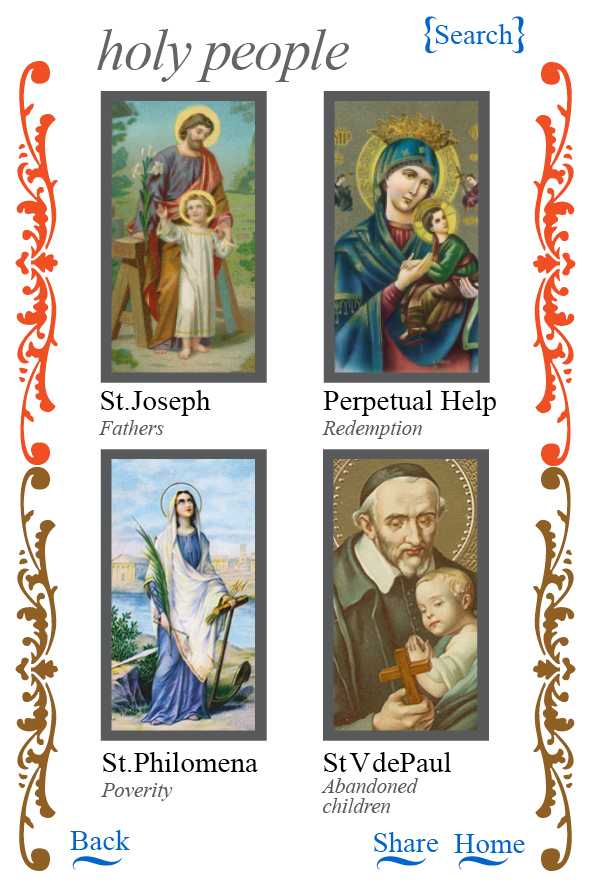
Novena_SPLASH SCREENHoly_PeopleTurn your cell phone into a prayer book for Lent! Starting today, and for all the 40 days of Lent, our beautiful App: “Novena: Praying With the Saints” will be reduced in price to 99 cents. 

Offering a modern take on the ancient Catholic tradition of using novena prayers to call on saints to help in earthly struggles, the app features visually striking vintage holy cards, prayers and histories for 36 of the most popular saints from all over the world:

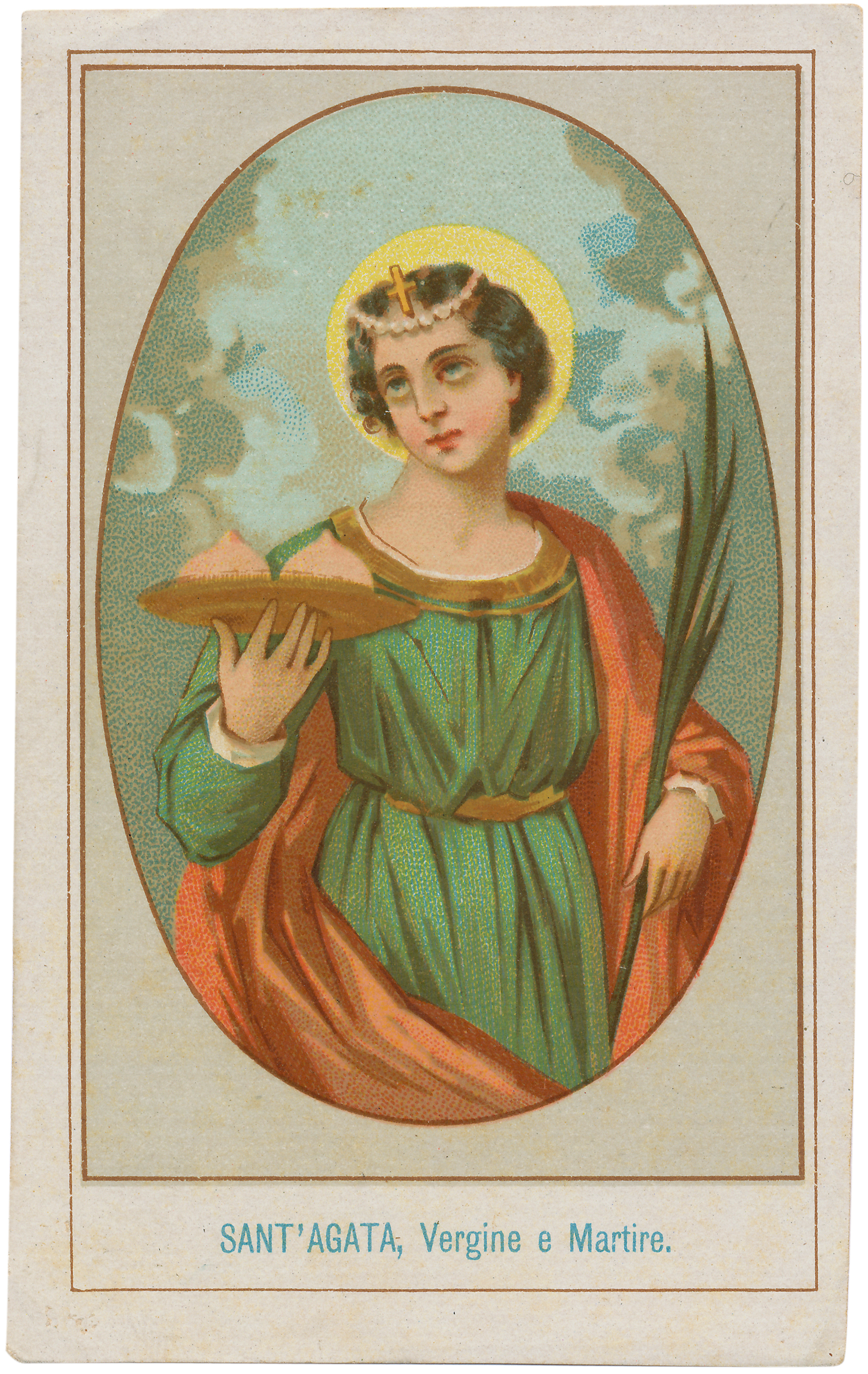
Saint Agatha: Breast cancer
Saint Aloysius Gonzaga: AIDS sufferers
Saint Alphonse Liguoris: Arthritis sufferers
Saint Anthony of Padua: Lost Objects 
Saint Blaise: Throat ailments
Saint Catherine of Alexandria: Philosophers
Saint Claire of Assisi: Television workers
Saint Dymphna: Mental illness
Mother Cabrini: Immigrants
Saint Francis of Assisi: Ecologists
Saint Gabriel, Archangel: Teachers
Saint Gerard Majella: Infertility
Infant of Prague: Desperation
Saints Joachim and Ann: Grandparents
Saint John of God: Heart ailments
Saint Joseph: Fathers
Saint Jude: Impossible causes
Saint Lucy: Blindness
Saint Martin de Porres: Racial harmony
Saint Michael, Archangel: Policemen
Mother of Sorrows: Grief
Saint Monica: Wayward children
Our Lady of Guadalupe: Motherly comfort
Our Lady of Perpetual Help: All causes
Saint Philomena: The poor
Padre Pio: Forgiveness
Saint Peregrine: Cancer
Saint Raphael, Archangel: Travelers
Saint Raymond Nonnatus: Newborns
Saint Rita of Cascia: Impossible causes
Sacred Heart of Jesus: Family peace
Saint Therese of Lisieux: To create a loving atmosphere
Saint Thomas Aquinas: Students
Saint Vincent de Paul: Abandoned children
Saint Vincent Ferrer: Builders

https://itunes.apple.com/us/app/novena/id631346670?mt=8

February Saint of Health: Breast Cancer

St.Agatha

Saint Agatha 

D. 251

Feast Day: February 5

Patron of: Breast Cancer

Quote: “Do not offend Agatha’s nation, because she will avenge all insults”. – Inscription on the façade of the Cathedral of St. Agatha in Catania, Sicily

Keywords; breast cancer, burns, pulmonary diseases, bell ringers, bell makers, brass workers, cloth makers, glass workers, wet nurses, nursing mothers, nurses, fires, volcanic eruptions

Symbols: breasts on a dish, palms

A national heroine to Sicilians, a great figure in art and one of the few saints mentioned in the Catholic mass, St. Agatha is a fierce and fearless role model for anyone who lives in modern times. A martyr, she is most often invoked by those suffering from diseases of the breast. Her tomb has been a place of miraculous healing since her death. Because of her courage in standing up to the Roman authorities, anyone persecuted by them, Pagans, Jews and Christians all made pilgrimages in her honor. In modern times, her feast day is an important holiday, attracting hundreds of thousands of devotees who process through the streets of Catania.

An orphaned daughter of wealthy Christians, Agatha was considered an attractive marriage prospect by  Quintianus, the ruling Roman consul of Sicily. Taking advantage of  the recent Roman decree outlawing Christianity, Quintianus assumed Agatha would renounce her religion and acquiesce to his proposal of marriage. She refused him on both counts, telling him that she had dedicated her virginity to Jesus Christ. Refusing to marry and bear children was considered an act of political defiance in those times. Agatha’s rejection of him so enraged Quintianus that he had Agatha taken to a brothel and forced her to live as a prostitute for thirty days. When she was brought back before him, he ordered her to sacrifice to the Roman gods. She pointed out that no Roman wife would dare live like Venus and no Roman husband could legally do the things that Jupiter was known for, why would she follow such gods? Christ lived what he preached, love and forgiveness; she would follow him instead. Agatha was then tortured by having her breasts slowly rushed and cut off. Thrown back in prison and left to die, an elderly man and a young boy came into her cell. Revealing himself as St. Peter, Agatha was miraculously healed. The next day, Quintianus ordered her to be rolled in broken pottery and hot coals. As this torture was being inflicted, an earthquake leveled Catania. The citizens of that city, declaring that this was God’s vengeance for what was happening to Agatha, chased Quintianus out of town and the terrified consul drowned in the river. Agatha offered her soul up to Christ and died.

The year after her death Mount Etna erupted and a lava flow threatened Catania. Agatha’s death shroud was taken out and held aloft which immediately stopped the lava. This same shroud has been used many times over the years to protect the city. Because of her tortures Agatha is the patron of those suffering from breast disease as well as those suffering from burns. Trades that use burning coals also claim her. Bells, which are signals for fire alarms and also resemble breasts are closely identified with this saint. Saint Agatha’s bread, shaped like breasts or bells are a specialty served around the time of her feast.

Explanation of symbols:

Mt. Etna in the background: Agatha protects Sicilians against its eruptions. She is the patron and protector of Sicily.

Offering breasts on a dish: Agatha suffered the gruesome torture of having her breasts cut off. Because of her faith, she easily endured this torture and offered it up to God.

Palms: a sign of martyrdom. Christ was showered in palms the Sunday before he was executed.

Novena to Saint Agatha

O Saint Agatha, who withstood the unwelcome advances from unwanted suitors, and suffered pain and torture for your devotion to our Lord, we celebrate your faith, dignity, and martyrdom.

Protect us against rape and other violations, guard us against breast cancer and other afflictions of women, and inspire us to overcome adversity.

O Saint Agatha, virgin and martyr, mercifully grant that we who venerate your sacrifice may receive your intercession.

(Mention your request).

Amen.

(Excerpted from the app: Novena:Praying With the Saints by Barbara Calamari and Sandra DiPasqua).

The Infant of Prague

Feast Day: January 14

Patron of: Financial Distress

Keywords: abundance, children, desperation, emergencies, epidemics, family life, financial distress, trust

Quote: “The more you honor me the more I shall bless you.”

Symbols: raised right hand, globe, crown

Surrendering oneself to this doll-like image of Christ as a child requires one to cast off the world of adult preoccupations to live in a state of faith and pure belief.  Honoring the Infant of Prague is a tradition that is kept in many homes throughout the world as some believe that it guarantees financial stability and abundance.  There are several novenas to the Infant of Prague, one reflecting the intensity of an emergency situation, is to be done in one day’s time, the prayer said once every hour for nine hours in a row.

Devotion to Christ as a young child dressed as a king has its roots in the Carmelite order of Spain. According to tradition, in 1555, Saint Teresa of Avila gave a statue of the Christ child, dressed in actual royal robes to a noblewoman who was marrying into an aristocratic family in Bohemia. Taking it with her to what is now the city of Prague, her daughter, the Princess Polysena inherited it.  In 1623, Princess Polysenia was widowed and chose to devote the rest of her life to charitable causes. When she saw the need that the poverty stricken Carmelite order had, she donated the statue to them, saying, “I give you my dearest possession. As long as you venerate this image, you will not lack anything.” The monks credited this image with the immediate upturn of their fortunes. When they were forced out of their monastery due to a war in 1631, they left the statue behind and the invading army threw it in a rubbish heap. Within seven years the Carmelites were back in their monastery in Prague, desperately attempting to rebuild it. One monk, Father Cyril, who had a particularly strong devotion to the Divine Infant found the little wax statue among the rubble. The only damage done to the statue was its crushed hands.

It was decided that the scarce funds the community had should go to more practical things than the repair of a statue. As the monks struggled to rebuild their former home and church, Father Cyril heard the words: “Have pity on me and I will have pity on you. Give me my hands and I shall give you peace.” After the statue was repaired, the monks again displayed it in the main church. As the city of Prague suffered an epidemic, parishioners began invoking the little statue for aid. The quick answer to their prayers brought many in the surrounding region to seek help. Gradually, the devotion spread to many other countries. Today, the church in Prague built to hold the statue, Our Lady of Victory, is a site of pilgrimage with visitors from all over the world paying their respects to the Divine Infant.

Invoked against: Financial Distress

Explanation of imagery:

Crown: Jesus is King of the World

Raised right hand: blessing

Imperial Orb: The entire world is in his hand.

Nine Day  Novena to the Infant of Prague

O Infant Jesus, I run to You, begging You through Your Holy Mother to save me in this need       (you may name it here), for I truly and firmly believe that Your Divinity can defend me.  Full of trust I hope in You to obtain Your holy grace. I love You with all my heart, I am painfully sorry for my sins  and on my knees I beg You, o Little Jesus, to free me from them. My resolution is to improve and never more to offend You. Therefore, I offer myself to You, ready to suffer everything for You and to serve You faithfully.  I will love my neighbour as myself from my heart for the love of You.  O Little Jesus, I adore You, o Mighty Child, I implore You, save me in this need (you can mention it here), that I may enjoy You eternally, with Mary and Joseph see You and with all the angels adore You.

Amen

Nine Hour Devotion to the Infant of Prague

 O Jesus, Who has said, ask and you shall receive, seek and you shall find, knock and it shall be opened to you, through the intercession of Mary, Your Most Holy Mother, I knock,I seek, I ask that my prayer be granted.

(Make your request)

O Jesus, Who has said, all that you ask of the Father in My Name, He will grant you through the intercession of Mary. Your Most Holy Mother. I humbly and urgently ask Your Father in Your Name that my prayer be granted.

(Make your request)

O Jesus, Who has said, “Heaven and earth shall pass away but My word shall not pass”,

through the intercession of Mary, Your Most Holy Mother, I feel confident that my prayer will be granted.

(Make your request)

(Excerpted from the app: “Novena: Praying with the Saints”).
2013 in review

The WordPress.com stats helper monkeys prepared a 2013 annual report for this blog.

Here’s an excerpt:

The concert hall at the Sydney Opera House holds 2,700 people. This blog was viewed about 48,000 times in 2013. If it were a concert at Sydney Opera House, it would take about 18 sold-out performances for that many people to see it.

Click here to see the complete report.

Merry Christmas from Novena.com!

Saint Lucy

Saint Lucy

283 – 304

Feast Day: December 13

Patron of: the blind

Keywords: light, clarity, the blind, eye disease, dysentery, epidemics, cutlers, electricians, glaziers, gondoliers, oculists, peasants, writers, vision

Quote:  “Those whose hearts are pure are the temples of the Holy Spirit.”

Symbols: holding her eyes on a dish, martyrs palms, sword, oxen

Willing to give up the comforts of her privileged life in order to obtain a state of enlightenment, Saint Lucy is one of the early virgin martyrs who challenged the authority of the Roman state. Her very name means ‘light’ and as light is direct and clear, shining in the most filthy of environments, we invoke her for clarity of vision in the spiritual as well as the physical realm.

Born in Syracuse, Sicily to a wealthy family of Greek descent, Lucy’s father died when she was very young.  Following the traditions of their society, Lucy had a large dowry and was affianced in an arranged marriage to a pagan nobleman. Lucy was a Christian and believed that she could best be a conduit of the Holy Spirit by remaining a virgin unfettered by husband and children. At this time Christianity was a great threat to the Roman Empire and the emperor Diocletian vowed to stamp it out wherever it arose. Lucy kept her vow a secret as Christians were considered revolutionaries against the state.  Since her mother suffered from constant bleeding from a uterine hemorrhage, Lucy took her to the tomb of Saint Agatha in Catania, a place where many miracles were reported, for a healing. While spending the night there, Lucy dreamt of Saint Agatha who told her, “You have no need to invoke me, for your faith has already cured your mother. One day you will be known as the patron of your own city.”  Upon awakening and finding her mother completely healed, Lucy confessed to her desire to remain a virgin and distribute her dowry among the poor. Impressed by her faith, her mother acquiesced to her daughter’s wishes.

When her fiancé heard of the broken engagement he went to the governor to denounce Lucy as a Christian. In an attempt to change her mind, she was brought before the authorities. When she asked why was it so important that this man need to marry her, she was told because she had the loveliest eyes. Whereupon Lucy ripped out her eyeballs and told the governor to send them to her former fiancé. The next day her eyesight was miraculously restored and Lucy was once again brought before the authorities. An attempt was made to have her taken to a brothel to be repeatedly raped, but a phalanx of soldiers could not move her. A team of oxen was brought in to no avail. Burning pitch was poured on her head, but she stood fast, predicting the downfall of the emperor. This last declaration proved to be too much and Lucy was fatally stabbed in the throat. True to her prophecy Diocletian the emperor abdicated his throne within the year.

It is said that “the longest of nights and shortest of days belong to Saint Lucy.” Because her feast day, December 13 used to be the winter solstice before the change to the Gregorian calendar, Lucy enjoys great patronage in Scandanavia as the saint who brings the coming of the light. Her relics were moved to Venice where she is celebrated in song by gondoliers. In Sicily she is credited with ending an epidemic of children’s deaths in the 14th century, today she is synonymous with Santa Claus, where children receive gifts on her feast day. When there was a famine in her native land during the 16th century, ships laden with raw wheat turned up on her feast day. The starving inhabitants cooked the wheat whole, and today it is customary to cook with raw wheat on her feast day.

Explanation of symbols:

Eyes on a dish: Lucy ripped out her own eyes and offered them to her fiancée when she was told he loved her for her beautiful eyes. She was not in need of her mortal eyes as she was filled with light.

Palms: Symbol of martyrdom.

Novena to Saint Lucy

Saint Lucy, your beautiful name signifies light. By the light of faith which God bestowed upon you, increase and preserve this light in my soul so that I may avoid evil, be zealous in the performance of good works, and abhor nothing as much as the blindness and darkness of evil and sin. By your intercession with God, obtain for me perfect vision for my bodily eyes and the grace to use them for God’s great honor and glory and the salvation of all men. Saint Lucy, virgin and martyr, hear my prayers and obtain my petitions. (Mention your request here.)

Amen

(Excerpted from the app: “Novena:Praying with the Saints” by Barbara Calamari and Sandra DiPasqua).

Our Lady of Guadalupe

Our Lady of Guadalupe


Feast Day: December 12

Patron of: Motherly Comfort

Quote: “Am I not your mother?”

Keywords: the Americas, compassion, love, forgiveness, mercy, motherly comfort, protection

 Symbols: mandorla (body halo), roses, stars, crescent moon, angel

This image of Mary is the preeminent cultural icon of Mexico and the American Southwest, cherished by Catholics and non-Catholics alike. Unlike other apparitions of Mary, where she sometimes issues warnings to mankind, in her visitation to the Aztec people, she promised hope, love and comfort at a time when their own way of life had been destroyed.   We invoke Our Lady of Guadalupe anytime we need the wisdom and comfort of a motherly force.

In December of 1531, the world of the once great Aztec civilization lay in ruins. The native inhabitants of what would become Mexico City were suffering brutally under the domination of Spanish Colonialists who had first invaded in 1519. Within two short years the forces of Hernan Cortes, with the help of native enemies of the Aztecs had completely overrun and destroyed a dual culture of light and dark, one of gracious cities and blood filled temples. Believing that their superiority and way of life depended on feeding their gods human sacrifices, the Aztecs routinely invaded neighboring tribes, sacrificing tens of thousands of captives a week. Gradually, the images of their own gods, particularly the female ones, took on more monstrous and grotesque features. The Spanish responded  to these sacred sites by wreaking havoc and destruction upon them. Within ten years the remaining Aztec residents were heart-sick, depressed and dying off.

 On December 9, 1531, and Aztec convert to Catholicism called Juan Diego, was on his way to mass. Distracted by the singing of birds on a hillside, he stopped. He then heard the kindly calling of his name in his native Nahuatl language. He approached the noble Aztec woman n the hill and was stunned at the heightened glow of her surroundings. She introduced herself as the perfect maiden Saint Mary, honorable mother of the true God. She asked him to go to the bishop and request a temple be built to her on the hill. She added, “I am the compassionate mother of you and your people, here in this land and of all the people who love me, search for me and confide in me…”  After a long wait, the bishop told Juan Diego that he needed a sign proving that this was a true appearance of Mary. In subsequent days, when Juan Diego again saw the woman on the hill, he begged her to get someone who the bishop would respect more to deliver her request. She kindly replied that he was the perfect one for her message. The next day Juan Diego walked another way into town in order to avoid the woman as his uncle was sick and he did not want to waste any time doing her errands. Nonplussed, she came down from the other side of the hill to meet him. Flustered, he told her he had to tend to his uncle and had no time to wait for the bishop who did not believe him anyway. The woman assured him that his uncle was already well and then told him to gather roses among the rocks.  This being winter he was amazed at how many roses were in full bloom. The woman arranged the roses in his cloak and again sent him off to the bishop. When he was finally granted this audience, it was the bishop’s turn to gasp in amazement. As Juan Diego unwrapped his cloak of roses, there imprinted on his cloak was the exact image of the lady on the hill. The bishop fell to his knees and begged Juan’s forgiveness. Today, tens of millions of pilgrims flock to Mexico City to see this original cloth which is in the cathedral named after this apparition of Mary, Our  Lady of Guadalupe.

The Virgin Mary appears to each visionary as a member of their own culture.  This image of a kindly, loving mother figure so impressed the native people of Mexico, that thousands of them came to be baptized within the first few months of the cloth being put on display.

 Explanation of images:

Mandorla: a body halo which signifies that Mary is wrapped in the grace of God.

Robe of stars: By wwearing the stars she is showing that her God is more powerful than the stars. Blue is the color of royalty and virginity.

Crescent Moon: to Christians, Mary’s virginity. To Indian’s Mary is stronger than the moon god, the god of darkness.

angel:  Carried there by heaven.


 Novena to Our Lady of Guadalupe 

Our Lady of Guadalupe, according to your message in Mexico I venerate you as “the Virgin Mother Of the true God for whom we live, the Creator of all the world, maker of heaven and earth.” In spirit I kneel before your most holy image which you miraculously imprinted upon the cloak of the Indian Juan Diego. And with the faith of the countless numbers of pilgrims who visit your shrine, I beg you for this favor: (mention your request). 

Remember, O Immaculate Virgin, the words you spoke to your devout client, “I am a merciful Mother to you and to all your people who love me and trust in me and invoke my help. I listen to their lamentations and solace all their sorrows and their sufferings.” I beg you to be a merciful Mother to me, because I sincerely love you and trust in you and invoke your help. I entreat you, Our Lady of Guadalupe, to grant my request, if this should be the will of God, in order that I may bear witness to your love, your compassion, your help and protection. Do not forsake me in my needs. Amen.

(Excerpted from the app: “Novena: Praying with the Saints” by Barbara Calamari and Sandra Di Pasqua).


Our Lady of Guadalupe, pray for us.


Saint Francis Xavier Miraculous Novena of Grace

Saint Francis Xavier

1506 – 1552

Patron of: Missionaries

Feast Day: December 3

Keywords: foreign missions, grace, hurricanes, missionaries, plague, sailors, tourists

Quote: “It is not the actual physical exertion that counts towards one’s progress, nor the nature of the task, but the spirit of faith with which it is undertaken.”

Symbols: crucifix, lily, flaming heart, torch

Credited with converting hundreds of thousands of people, St. Francis Xavier is considered the most successful missionary since St. Paul. In his own life, he evolved from being a sheltered, wealthy intellectual to becoming a fearless explorer travelling to newly discovered lands, happily living  among the lowest castes of people, improving their lives with love and grace. The novena in his honor, the Miraculous Novena of Grace is said to bring the force of grace into our lives, creating  a more harmonious relationship with the world around us.

Born in the Kingdom of Navarre, the Basque region of Spain, Francis grew up in his family’s castle. Much admired for his intellectual gifts, he was sent to the University of Paris where it was thought that he would become one of its more gifted professors. His life changed drastically when he met an older student named Ignatius Loyola who had a small band of followers. Together with Loyola, St. Francis Xavier formed a new religious order, The Society of Jesus (now known as the Jesuits) with the intention of spreading Christ’s word to the farthest corners of the earth. The King of Portugal sent Francis Xavier on his first mission to Goa in India where his country had a colony. He was concerned about the lack of religious practice available to his people and Francis’s mandate was to form a ministry for his Portuguese subjects. However, the European merchants and traders were more interested in gambling, drinking, slave trading and prostitution than in any religious preachings. When Francis Xavier attempted to meet with the Brahmin or wealthy local people, he was equally rebuffed. He then decided he would work with the lowest of the low, shocking both European and upper caste Indians by openly treating beggars, prostitutes, prisoners and the illegitimate as equals. The many eloquent letters he wrote about his life and work among society’s outcasts are still enlightening reading today. Gifted in languages, Francis Xavier had the ability to easily communicate in the various dialects spoken in the region. He is credited with saving the Paravas, an indigenous people who were pearl divers on the coastal islands from decimation and enslavement by the various Arab and European traders who plagued them.

Excited by his great success, Francis Xavier travelled throughout the Far East and he was the first missionary to travel to Japan. Not always met with the same respect and openness that he offered others, he endured his frustration with good spirits. He died on the island of Chang-Chuen-Shan, never realizing his dream of reaching mainland China. His body was put in quicklime and taken back to Goa, where it lies in a much visited shrine.


Miraculous Novena of Grace to St. Francis Xavier


Most amiable and most loving Saint Francis Xavier, in union with you I reverently adore the Divine Majesty. I rejoice exceedingly on account of the marvelous gifts which God bestowed upon you. I thank God for the special graces he gave you during your life on earth and for the great glory that came to you after your death. I implore you to obtain for me, through your powerful intercession, the greatest of all blessings, that of living and dying in the state of grace. I also beg of you to secure for me the special favor I ask in this novena. In asking this favor, I am fully resigned to the Divine Will. I pray and desire only to obtain that which is most conducive to the greater glory of God and the greater good of my soul. 

Amen.

(Here you may mention the grace, spiritual or temporal that you wish to obtain).

(Recite one Our Father, one Hail Mary, one Glory Be).

 There are two times a year when the Miraculous Novena of Grace is considered especially powerful: from March 4 to March 12 and from November 25 to December 3.

(Excerptef from the App, Novena:Praying With the Saints”).

Pray for the People of the Philippines!

Blessed Virgin Mary.jpg

Immaculate Heart of Mary, one of the Patrons of the Philippines

Please help the people of the Philippines by donating here: http://filipinopastoralministry.com/send-help-yolanda-typhoon-victims/