Unknown's avatar

About sandra dipasqua

graphic designer

Novena For February

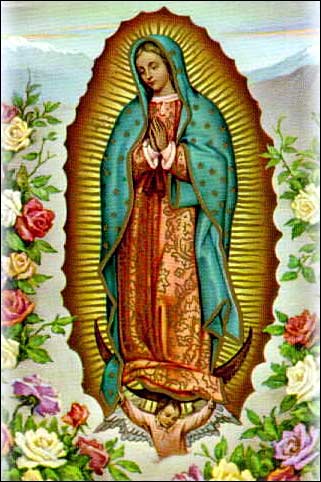
Our Lady of Lourdes

First Apparition: February 11, 1858

Feast Day: February 11

Patron of France

Invoked for curing illnesses, reconciling differences

There are four traditional gifts imparted by a pilgrimage to Lourdes: (1) The gift of the miraculous water. (2) The gift of healing. (3) The gift of reconciliation. (4) The gift of friendship.

Novena to Our Lady of Lourdes

 O ever Immaculate Virgin,
Mother of Mercy,
Health of the Sick,
Refuge of Sinners,
Comfort to the Afflicted,
 you know my wants, my troubles, my sufferings.
Deign to cast upon me a look of mercy.
By appearing in the Grotto of Lourdes,
you were pleased to make it a privileged sanctuary,
whence you dispense your favors;
and already many sufferers
have obtained the cure of their infirmities,
both spiritual and corporal.
 I come, therefore, with the most unbounded confidence
to implore your maternal intercession.
Obtain, O loving Mother,
the granting of my requests.
 Through gratitude for favors,
I will endeavor to imitate your virtues
that I may one day share your glory.
 (mention your request here)
 Our Lady of Lourdes, pray for us.
 Amen
Recite one Our Father, One Hail Mary, One Glory Be
Pray this novena nine times in a row for nine days in a row.
Image: 

FEBRUARY PATRON SAINTS OF HEALTH

Depression: Margaret of Cortona

1247-1297     Feast Day: February 22

A Franciscan tertiary, Margaret had lived with her lover until his murder. Upon her conversion, she struggled with the temptation to return to her former life. She suffered extreme bouts of self-hatred and had to be prevented from self-mutilation. Despite the ridicule and gossip that surrounded her, she was extremely spiritual, experiencing visions of Christ.

Other Patronages: Fallen Women, Falsely Accused People

Invoked Against: Temptation

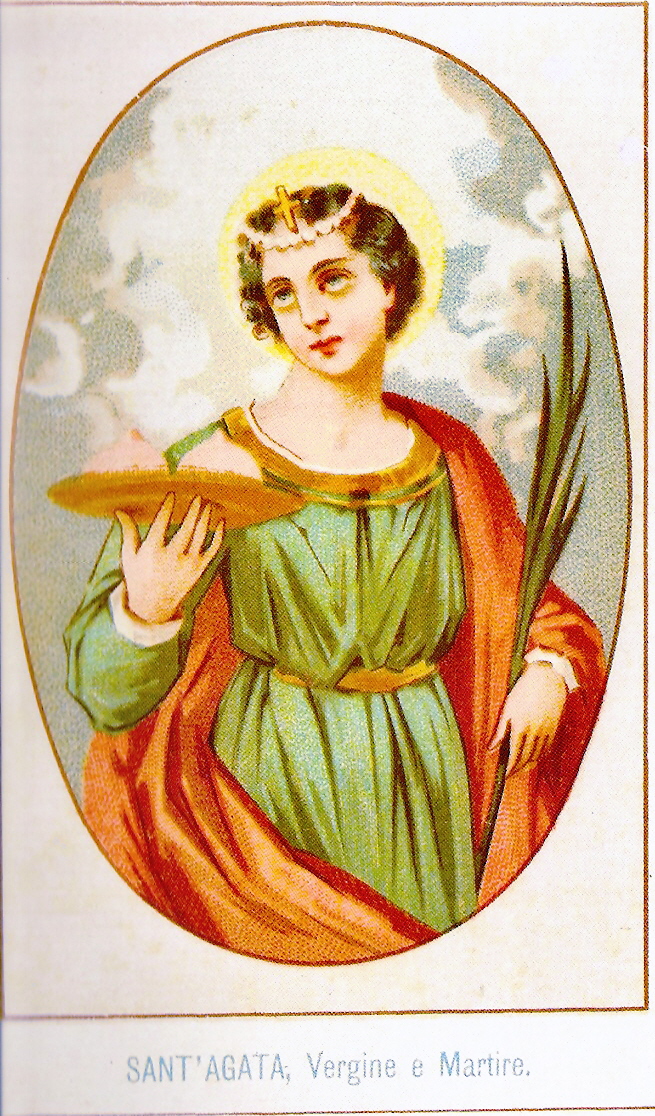
Breast Disorders: Agatha

D. 251     Feast Day: February 5

A virgin martyr from Catania, Sicily, Agatha is closely identified with the protection of her homeland. When she refused to renounce her Christian faith, Agatha was tortured by having her breasts cut off. While in prison, Saint Peter came and healed her. She was later killed by being rolled in burning coals. At the same time, a great earthquake shook Catania, destroying her persecutors. Her veil is still used to ward off the eruptions of nearby Mount Etna.

Other Patronages: Malta, Burns, Pulmonary Diseases, Bell Ringers, Bell Makers, Brass Workers, Cloth Makers, Glass Workers, Wet Nurses, Nursing Mothers

Invoked Against: Fires, Volcanic Eruptions

Novena to Saint Agatha

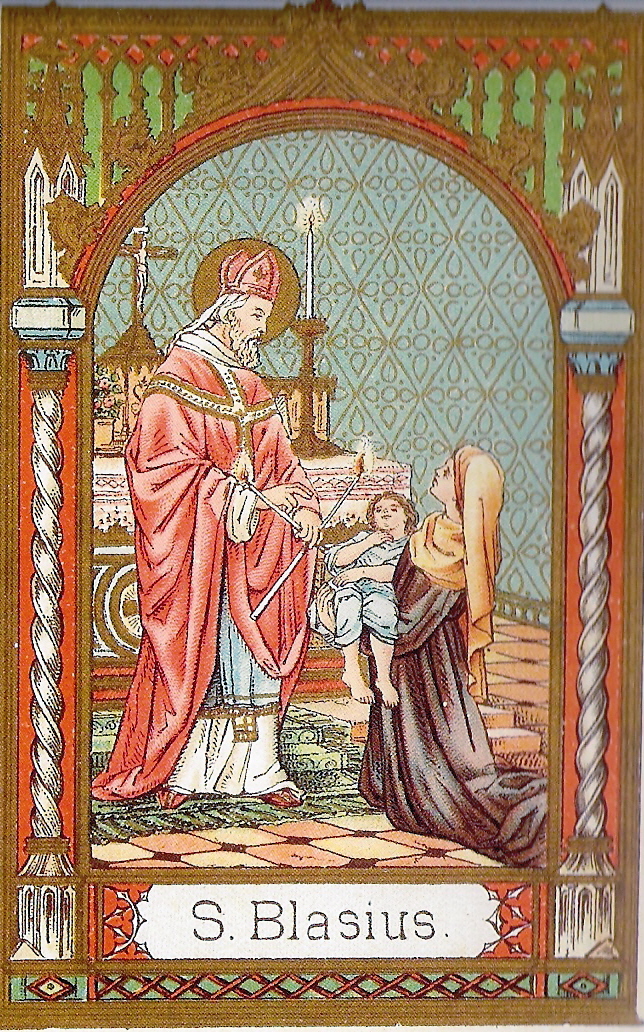
Coughing:   Saint Blaise

D. 316     Feast Day: February 3

An Armenian bishop known for his healing powers, Blaise took refuge in a forest during a time of persecution. When many animals stayed by his side, angry hunters reported him to the authorities. While in prison, he healed a boy choking on a fishbone by praying in his cell. Condemned to death, he then promised to protect all who brought a candle to church on his feast fay. He is commemorated on his feast during the “Blessing of the Throats.”

Other Patronages:  Croatia, sick cattle, wild animals, builders, carders, laryngologists, mattress makers, swineherds, wind musicians, wool workers

Invoked against: Goiter, Throat Disease

The above patron saints descriptions are excerpted from the book: “Patron Saints: A Feast of Holy Cards” by Barbara Calamari and Sandra DiPasqua. Unless otherwise notated, all images are fom the holy card collection of Father Eugene Carrella.

Novena for January

SAINT THOMAS AQUINAS

1225 – 1274

Doctor of the Church


Considered more angelic than human, Saint Thomas Aquinas has the title of “Angelic Doctor”. His life is the story of someone who lived totally through his higher mind, rejecting all worldly temptations, ambitions, and pleasures in favor of intellectual pursuit. Honored in his own lifetime, he was continually invited by the Pope and the king of France to share his learning, but this never changed his disposition of the simple way he lived his life. He refused all offers of holy office in order to continue his vocation of studying, writing, and preaching. Because of this love of learning for its own sake, Saint Thomas Aquinas is the patron saint of students. He is invoked whenever there is a difficult situation regarding education, be it tackling a difficult subject or passing and entrance examination. Although this novena is written for the patronage of Catholic schools, all students should feel free to call on him.

Saint Thomas Aquinas is regarded by most historians as the greatest thinker and theologian of the Middle Ages. Yet the more knowledge he mastered, the more he realized how much he did not know. Born at Roccasecca, near Naples, he was the youngest child of the count of Aquino. At the age of five he was sent away to the Benedictines of Monte Cassino. There, at that young age, he displayed great intellectual acuity and easily surpassed all the other students in his class. His father, being a nobleman, assumed that he would be trained for a high ecclesiastical office. At the age of seventeen, Saint Thomas scandalized his family when they discovered that he had secretly joined the new order of Dominican friars. This order frequently resorted to begging in the streets to survive. His brothers then kidnapped him and locked him in the family house for the next year. Trying to get him to break his vows, they presented him with every temptation, including a beautiful prostitute. Saint Thomas chased her away with a flaming torch and from that day was freed from any sexual desires. His family finally relented and released him. In 1248 he went to the city of Cologne, where he studied under Saint Albert the Great, at that time the most brilliant professor in Europe. His lumbering presence and slow movements belied his genius, causing his fellow students to refer to Saint Thomas as “the Dumb Ox”. He began publishing his works at the age of twenty-two and then went to Paris, where he earned his doctorate in theology. He was in great demand as a university professor and became famous for his lucid writings. The great challenge of his life was to explain Christianity in Aristotelian terms.

In 1266 Saint Thomas began his greatest work, Summa Theologica. Seven years and two million years later, he quite suddenly stopped work on it, leaving it unfinished. While attending mass he had had an ecstatic vision, and afterward, he declared that compared with what he had just seen, “all that writing seemed like so much straw.” He died three months later, at the age of forty-nine. So simple, pure and ingenuos had Saint Thomas Aquinas remained in his life that his deathbed confessor declared his final confession to be akin to that of a five-year-old child.


Feast Day: January 28


Patron of: Students, Universities, Catholic Schools


Novena to Saint Thomas Aquinas


Saint Thomas Aquinas, patron of students and schools, I thank God for the gifts of light and knowledge God bestowed on you, which you used to build up the church in love. I thank God, too, for the wealth and richness of theological teachings you left in your writings. Not only were you a great teacher, you lived a life of virtue and you made holiness the desire of your heart. If I cannot imitate you in the brilliance of your academic pursuits, I can follow you in the humility and charity that marked your life. As Saint Paul said, charity is the greatest gift and is open to all. Pray for me that I may grow in holiness and charity. Pray also for Catholic schools and for all students. In particular, please obtain the favor I ask during this novena. Amen.

(Mention your request.)


Say this novena nine times in a row for nine days in a row.


Excerpted from the book, “Novena: The Power of Prayer” by Barbara Calamari and Sandra DiPasqua

Image: Detail from “The Triumph of Saint Thomas Aquinas” by Bennozzo Gozzoli 

Pray for the Haitian People!

Patron of Haiti

Dining With the Saints

The Feast of Sant’ Antonio Abate


 Sant’Antonio Abate (Saint Anthony the Abbot, born 251 in Egypt) is the protector of domestic animals, so in Italy on his feast day, January 17, all kinds of pets and farm animals go to be blessed in church. Donkeys, geese, cats, monkeys, goats, parrots, all arrive at the door of the church carried or escorted by their owners and often decorated in ribbons, bells, and bows.

 As the protector of animals, Sant’Antonio Abate is usually depicted accompanied by a large domestic pig. This part of his iconography is said to stem from his success in healing inflammatory skin diseases. The traditional treatment for these ailments were pork fat. However, his feast day in Italy also serves as the bittersweet slaughter day for the family pig, one that has been fattened all year just for the occasion. It’s a huge ritual throughout rural Italy, and the pig provides food for an entire family for the whole year.

 January 17 is always celebrated with pork dishes. In Piemonte they prepare sausages with red wine and lentils, or a pork loin piccata. No part of the pig is wasted. The lungs, brains, and liver are made into a fritto misto. Fennel-flavored sausages are made in Tuscany, and in the South, in Puglia and Calabria, they always serve their famous coppa, a cured pork loin seasoned with either hot peppers or sweet spices. Pork ragú, served with pasta or polenta, is often another highlight of the huge pork-focused feast, as is sanguinaccio, a sweet blood pudding. Sanguinaccio sounds peculiar, but it’s quite delicious. It can be flavored, depending on the region, with cinnamon, chocolate, nutmeg, Marsala, raisins, pine nuts, pistachios, or red wine.

 Here’s a pork braciole recipe inspired by the cooking of the Abruzzi region. Try it if you’d like to celebrate your own feast of Saint Anthony.

Pork Braciole with Provolone, Parsley, and Capers


(Serves 4)

    1 garlic clove

    A large bunch of flat-leaf parsley, stemmed (about a cup of packed leaves), plus a small handful of whole leaves reserved for garnish

    A large handful of salt-packed capers, soaked for about 20 minutes in several changes of water and rinsed

    3/4 cup grated provolone cheese (try to find a imported Southern Italian cheese, not a domestic brand, which can be salty and lacking in finesse)

    Salt

    A few pinches of ground cayenne pepper

    Extra-virgin olive oil

    About 3 pounds of pork, cut for braciole (into thinly sliced rectangular pieces. The shoulder cut is best.

    3 medium shallots, cut into small dice

    2 cloves, ground to a powder in a mortar and pestle

    A bay leaf

    A wineglass of dry white wine

    A 35-ounce can of plum tomatoes, well chopped, with the juice

    Kitchen string for tieing the braciole

 Place the garlic, parsley, and capers in the bowl of a food processor and pulse briefly until roughly chopped (you don’t want a paste). Transfer the mixture into a small bowl and add the grated provolone, a pinch of salt (not much, since the cheese and capers will be slightly salty), the cayenne pepper, and a drizzle of olive oil. Mix everything together.

 Lay the pork slices out on a work surface. Spoon a heaping tablespoon of filling onto each slice and spread it out to about 1/4 inch from the end all around. Roll up the braciole lengthwise and tie each in about 3 or 4 places with string. They’ll look like they’re a lot of meat, but they’ll shrink down considerably during cooking.

 Choose a casserole fitted with a lid and big enough to hold all the braciole and the sauce. Heat a few tablespoons of olive oil in it over medium heat. Season the braciole with salt and a pinch of cayenne and place them in the casserole. Take your time to brown them well all over (the browning will add great flavor to the sauce). Scatter on the shallots and season the meat with the ground cloves. Sauté a few minutes longer, just until the shallots have softened and given off flavor.

 Add the white wine and let it boil for a couple of minutes, scraping up any cooked-on juices from the bottom of the casserole. Add the tomatoes and a pinch more salt. The braciole should be almost completely covered by the liquid (just poking out a little); if they’re not, add a bit of warm water. Cover the casserole, lower the heat, and simmer, turning the braciole occasionally, until they are very tender, about 2 hours. You’ll need to skim the surface once or twice during cooking. Uncover the casserole for the last half hour of cooking so the sauce can reduce.

 When you’re ready to serve the braciole, lift them from the casserole onto a cutting surface. The sauce should be reduced to a medium thickness (it is not meant to be a dense tomato sauce). If it seems a little too liquid, boil it over high heat for a few minutes. You also may need to give the surface a quick skim. Taste for seasoning, adding another little pinch of cayenne pepper if you like and a little salt if needed. Remove the string from the braciole, and cut them into approximately 1/4-inch slices on a slight angle. Place them on a warmed serving plate and spoon a little of the sauce over the top (you can pour the remaining sauce into a small serving bowl and bring it to the table). Garnish the plate with the whole parsley leaves.

 It’s customary to serve pasta dressed with the braciole sauce as a first course and then serve the meat second. You can certainly do this if you like, but I prefer to forgo the pasta and instead offer a dish of roasted potatoes or rice, bringing the extra sauce to the table so guests can use it to pour on the rice or to sop it up with bread.

 ‘Dining With the Saints’ is a monthly column written by Writer and Chef Erica DeMane. EricaDeMane.com

Images: Top, a poster for one of the thousands of local festivals celebrating Saint Anthony the Abbott from Italy.  Bottom: Italian Holy Card


Dining With the Saints


La Vigilia

 Christmas Eve, La Vigilia (the vigil), as it’s called in Italy, is traditionally a meatless meal, eaten late in the evening. But just because it lacks a big lamb or pork centerpiece doesn’t mean it skimps on quality or quantity. To the contrary. This is a meal of many fish dishes and usually takes hours to eat, each dish brought to the table separately, in ceremonial fashion. For Italian-Americans seven fish dishes are usually the amount prepared, but this seems to be more an American than a purely Italian tradition.  People debate what the number symbolizes, except that it most likely refers to the seven sacraments. In Italy, especially in the South, nine, eleven, or thirteen fish dishes are more the norm and they have specific religious symbolism. Nine represents the Holy Trinity times three. The number thirteen stands for the twelve Apostles plus Jesus, but the preparation of eleven seafood dishes seem to stand for the twelve Apostles minus Judas (very popular in Sicily for some reason).

 My New York Italian family usually prepared three, I believe because it was relatively easy to prepare and get them out to the table without too much kitchen hysteria. Usually we started off with some type of cold seafood salad that could include calamari or scungilli, then on to linguine with clam sauce, and after that often we’d eat a big platter of giant broiled shrimp with garlic and lemon. Other traditional dishes can involve octopus, sea urchin, oysters, baccala, eel, and whole sea bass.

 My mother’s father always prepared this beautiful pasta with lobster. I never tasted his version since he died young, but I’ve recreated it from my mother’s description. It’s really lovely.

 Merry Christmas to you.

Spaghetti with Lobster, Tomato, and Cognac


(Serves 4 as a main course)


3 small lobsters (about 1 1/2 pounds each)

 Extra-virgin olive oil

 2 tablespoons unsalted butter

 2 shallots, cut into small dice

 3 large thyme sprigs, the leaves chopped

 1 small inner celery stalk, cut into small dice, plus the leaves, chopped

 Salt

 A generous pinch of sugar

 About 8 big scrapings of nutmeg

 A generous pinch of Aleppo pepper (or a smaller pinch of cayenne)

 1/3 cup cognac or brandy

 1 35-ounce can high quality, Italian plum tomatoes, with the juice, well chopped

 1 pound spaghetti (Latini is the brand I always use)

 A dozen basil leaves, lightly chopped, plus a few whole sprigs for garnish

For the best flavor and texture, the lobster for this dish  should be sautéed raw. This means either hacking the things up alive (something I no longer have the stomach for) or, my new solution, having your fish seller kill them for you. You just have to make sure to cook them the same day. Once you get your lobsters home, you’ll need to cut them into pieces. Get a sharp, heavy knife or a cleaver and start by cutting the lobsters in half horizontally through the top of the shell. Remove the head sac, located on either side of the top of the shell. Now separate the tail sections from the head sections. Remove the claws and front legs in one piece, and give the claws a swift whack with the back of your knife or cleaver to crack them. You’ll notice a long, dark intestinal tract running along the top of one of the tail sections; pull that out. Remove the tomalley, and the roe if you find any, and place in a small bowl, mashing it up a bit.

 If you don’t want to bother with all this, just have your  fish seller cut up your lobsters for you.

 Set up a large pot of pasta cooking water over high heat.

 In a medium saucepan, heat 2 tablespoons of olive oil and the butter over medium heat. Add the shallots, celery and leaves, thyme, a pinch of sugar, salt, Aleppo or cayenne, and nutmeg,  and sauté until soft and fragrant, about 5 minutes. Add half of the cognac and let it bubble until almost dry. Add the tomatoes and a splash of water and simmer, uncovered, for about 8 minutes.

 In a very large sauté skillet (or two smaller ones), heat two tablespoons of olive oil over medium-high heat (a little more if you’re using two skillets). When hot, add the lobster pieces, shell side down, and sauté until they turn pink, about 4 minutes. Turn the pieces over and sauté for a minute on the other side. Now add the remaining cognac and let it bubble away. Add the tomato sauce and the tomalley and roe if you have it, and let everything simmer, uncovered, until the  lobster is just tender, about 5 minutes. The sauce will be a bit loose. Taste for seasoning, adding more salt and a pinch of Aleppo or cayenne, if desired (this is not meant to be a full-on Fra Diavolo hot sauce. You really want to a hint of heat). Add the basil.

 While the lobster is simmering, add a generous amount of salt to the boiling pasta water and drop the spaghetti into the pot. Cook until al dente. Drain the spaghetti, leaving a little water clinging to it, and pour it onto a very large serving platter. Drizzle with a generous amount of olive oil and give it a toss. Pour the lobster sauce over the top and garish with the basil sprigs. Serve right away.

Dining With the Saints is written by chef Erica DeMane.  EricaDeMane.com

Image: Detail from a fresco of The Nativity (1303-1305) by Giotto di Bondone located in the Scrovegni Chapel in Padua, Italy.

Novenas for December

SAINT LUCY

 283 – 304

Feast Day: December 13

Patronage: Syracuse, the blind, cutlers, electricians, glaziers, gondoliers, oculists, peasants, writers

Invoked Against: dysentery, epidemics, eye disease, hemorrhages, throat ailments, for clarity

Symbols: holding her eyes on a dish, martyrs palms, sword, oxen, cord

 “Those who live chaste lives are temples of the holy spirit.”

            Saint Lucy 304AD

             Saint Lucy was a privileged young woman who chose a state of enlightenment over the prosperous, respectable life she was expected to lead in Roman society. One of the early virgin martyrs, her quiet but steadfast rebellion against the civil authorities earned her an excruciating death that became a triumphant example of everlasting life, hastening the overthrow of the Emperor and the legalization of Christianity.   

            Born in Siracusa, Sicily, Lucy was a young Christian  woman of Greek ancestry.  She held a deep spiritual belief that one must remain pure to be a true conduit of the Holy Spirit. Lucy secretly vowed to remain a virgin, even while her widowed mother arranged her marriage to a wealthy pagan nobleman. At this time in history, Christianity was looked upon as a threat by the Roman Emperor. So many soldiers in the Empire had converted, that officials feared they would follow the tenets of Christ over their military leaders. The state insisted that it was a man’s duty to serve his nation militarily and a woman’s duty to marry and bear children. When a girl refused to do this, she was considered a traitor to the empire. Therefore, consecrating one’s virginity to Christ, was more of a bold and revolutionary stance against the state than a  private act of devotion.

            Lucy’s mother suffered ceaseless bleeding from a uterine hemorrhage.  Her daughter insisted they make a healing pilgrimage to the tomb of the virgin martyr Saint Agatha in Catania some 50 miles away. Agatha had become the patron of Catania after her veil stopped the deadly flow of Mount Etna’s lava from entering the town. She was credited with so many miracles since her martyrdom 35 years prior, that Christians, Jews and pagans alike were drawn to her tomb to invoke her aid. Lucy and her mother spent the night in prayer outside of the tomb. Agatha visited Lucy in a dream, telling her, “You have no need to invoke me, for your faith has already cured your mother. One day you will be known as the patron of your own city.” As the day dawned, Lucy found her mother completely healed. When she confessed  her secret vow of virginity, her mother agreed not to force her into marriage.

             In 303 the Emperor Diocletian launched the most extensive and vicious anti-Christian campaign throughout the Roman Empire. This was the political atmosphere that Lucy and her mother returned home to. Since she was no longer in need of a dowry, Lucy encouraged her mother to divest herself of all the investments she had made for her daughter’s future and give the money to the poor. Lucy’s fiancé, outraged to learn that his engagement was broken, denounced her to the governor of Siracusa. Brought before this official, Lucy asked, “Why would that man want to marry me?” When the governor quipped, “Perhaps it is your lovely eyes,” Lucy ripped out her eyeballs and told him to send them to her former fiance. Her eyesight was miraculously restored the next day and the governor demanded why she so adamantly refused to marry. Lucy replied, “Those who live chaste lives are the temples of the Holy Spirit.”

            The governor then told her that he would have her taken to a brothel and repeatedly raped until she “lost the Holy Spirit.” Soldiers came to carry her off but could not move her. A thousand men were called in, to no avail. Lucy would not budge. Nor could a team of oxen drag her away.  Burning pitch was poured on her skin but nothing would break her will. Upon predicting the fall of the Emperor, Lucy was fatally stabbed in the throat.  True to her prophecy, the Emperor fell within the year and Christianity was legalized in Rome under Constantine nine years later.  

            Immediately after her death, public opinion was so swayed by Lucy’s fate that it was considered a great honor for other Christians to be buried in the catacombs of Siracusa near her. In the sixth century, the Acts of the Virgin Martyrs were given great recognition by ecclesiastical writers and Lucy’s name was entered in the Canon of the Mass. In art, she is sometimes portrayed in the company of Saints Agatha, Agnes of Rome, Barbara, Thecla and Catherine of Alexandria. All of them, legendary young girls defiant and fearless in the face of death.

            The people of her native city have always honored Lucy and been protective of her. In the ninth century when Siracusa fell into Muslim hands, they hid Lucy’s remains for hundreds of years until 1040 when the Byzantine army drove out the Saracens. In gratitude for their liberation, they sent their most precious possession, her body,  to Constantinople as a  gift for the Empress Theodora. Many of her relics were then distributed throughout Europe which greatly expanded the range of her cult.  In 1204, Venetian Crusaders conquered Constantinople and took Lucy’s remains back to Venice where they were installed in a church named for her. This original church was near the place where the gondolas were parked. The song “Santa Lucia” became famous among gondoliers looking forward to the end of their night’s work. When the church was torn down to make way for the new train station, the station was named for Saint Lucy and her remains were interred in the nearby Church of Saint Jeremiah.

            The name “Lucy” means light. According to the Julian calendar, her feast day, December 13 was considered the shortest day of the year. Celebrations combining Lucy’s feast day with the winter solstice began in Sicily and spread throughout Europe. It was said that the “longest of nights and the shortest of days belong to Saint Lucy”. Today, she is most celebrated in Sweden and other Scandinavian nations because when the Swedes converted to Christianity in the 11th Century, they could most easily relate to a Saint who would gradually bring more light each day as the sun changed its course.  Saint Lucy’s day is a major holiday in that part of the world, celebrated with torchlight processions of crowned girls in white dresses. With the change to the Gregorian calendar in the 1300’s, and the shifting of the solstice to ten days later, Lucy’s feast became synonymous with the start of the Christmas season. She is associated with gifts to children because of her part in curing an eye epidemic that was blinding children in the 13th century. When local families went on a barefoot pilgrimage to her tomb invoking her aid, she sent them home, curing the children and telling them that they would find gifts in their shoes. It became a common Christmas custom in many parts of Europe to celebrate the saint’s feast by putting  gifts in children’s shoes. In 1582 Saint Lucy was credited with ending a famine in Sicily by sending three grain loaded ships to its starving residents. The people were so hungry that they boiled and ate the grain without grinding it into flour.  To this day, Sicilians do not eat anything made with flour on Saint Lucy’s day and there are a host of traditional foods and desserts created specifically for her feast day.                  

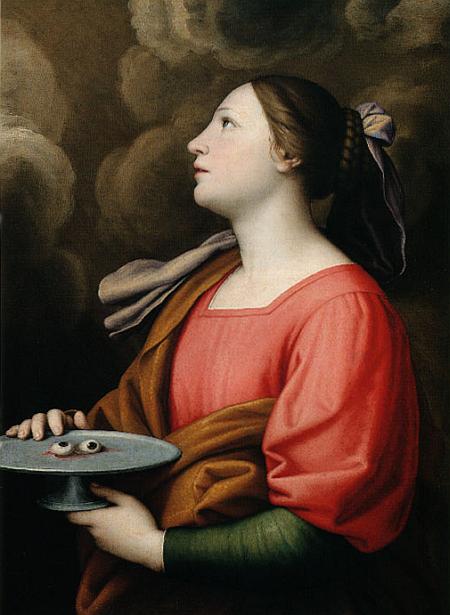
            Lucy is a popular subject for artists, she is frequently depicted calmly holding her eyeballs on a dish, referencing her story. Because of this, she is the patron of the blind and all trades relating to the eyes. Eye strain is a common problem for writers, therefore she is their patron. Because of the success of her mother’s healing she is invoked against hemorrhage. Since she was stabbed in the throat she protects against throat ailments and cutlers because she was killed by a knife. As a true patron of her city, Syracuse, she was historically called upon to help in all epidemics, hence her aid against dysentery. Peasants claim her patronage because they depend on oxen who play a part in her story. Her final resting place is Venice so she is the patron of that city’s glassmakers and gondoliers.

Prayer to Saint Lucy of Syracuse

                                             Saint Lucy, your beautiful name signifies light.

                                        By the light of faith which God bestowed upon you,

                             Increase and preserve this light in my soul so that I may avoid evil,

                                           Be zealous in the performance of good works,

                        and abhor nothing as much as the blindness and darkness of evil and sin.

                                                       By your intercession with God,

                                           obtain for me perfect vision for my bodily eyes

                                 and the grace to use them for God’s greater honor and glory

                                                         and the salvation of all men.

                                                         Saint Lucy, virgin and martyr,

                                               Hear my prayers and obtain my petitions.

(mention your request here)

                                                                          Amen

Say this novena times in a row for nine days in a row.

Excerpted from the book, “Saints:Ancient and Modern” by Barbara Calamari and Sandra DiPasqua

 Painting of Saint Lucy by: Giovanni Battista Salvi da Sassoferrato  1609 – 1685

OUR LADY OF GUADALUPE

             Our Lady of Guadalupe represents one of the most kindly and motherly aspects of Mary. In this novena she is begging us to appeal to her for comfort. Our Lady of Guadalupe should be invoked whenever we need a non-judgemental force of love in our lives. Just ten years after the Spanish conquest of Mexico, this apparition occurred on the hill where a temple to the Aztec corn and earth goddess, Tonantzin, once stood. The name Tonantzin means “Our Mother”, and this is exactly how Mary asks the people of Mexico to perceive her. It seems she did not appear to give warnings or dire predictions to humanity, but rather to show herself as a merciful mother figure, ready to assist in any request. The only visitation of Mary officially recognized by the Church on the North American continent, it is an example of how the Madonna changes her image to resemble the race and culture of the people to whom she appears.

             On December 9, 1531, a Mexican-Indian peasant named Juan Diego was walking through the countryside of what is now Mexico City. From the top of a hill a beautiful woman called out to him, asking, “Am I not your mother?” She then told him she was Mary, Mother of God, and that she would like a church to be built upon the ground where she stood. She sent him off to Bishop Zumarraga to make this request. The bishop, upon hearing Juan’s story, instructed him to obtain a sign to prove that this was truly an apparition of Mary. Juan, returning to the site, found the woman waiting for him. Again she told him that she urgently desired a church to be built to bear witness to her love, compassion, help and protection. She wanted the world to know that she was a merciful mother to all and desired everyone to trust in her and invoke her in times of need. She instructed Juan to gather roses among the nearby rocks for the bishop. Since it was winter, not a season when roses bloomed, he was surprised to find them growing where she told him to look. After gathering the roses in his peasant’s cloak, he presented them to Mary, who arranged them; then he took them back to the bishop. As Juan unwrapped his cloak, and the roses fell out, the bishop was stunned. The roses uncovered an elaborate portrait of the Virgin Mary imprinted on the cloak.

             This image still exists and is visited by hundreds of thousands of pilgrims each year. A basilica in Mexico City was erected to house it, thereby fulfilling the Virgin’s request for a church. This images offers a very different view of Mary; her features are Mexican-Indian, there are rays of light streaming out from her entire body, and the figure is set among the sun, moon and stars.

             Our Lady of Guadalupe is the patron of Mexico, and her feast is honored by the people of that country with an almost political fervor. In keeping with her own requests, all people of the world should feel free to invoke her for help in solving any types of problems, big or small.

 Feast Day: December 12

 Patron of: Mexico, The Americas

 Invoked for: Motherly Comfort

Novena to Our Lady of Guadalupe


Our lady of Guadalupe, according to your message in Mexico, I venerate you as the Virgin Mother of the true God for whom we live, the Creator of all the world, maker of heaven and earth. In spirit I kneel before your most holy image which you miraculously imprinted upon the cloak of the Indian Juan Diego, and with the faith of the countless numbers of pilgrims who visit your shrine, I beg you for this favor: (mention your request).

Remember, O immaculate Virgin, the words you spoke to your devout client: “I am a merciful mother to you and to all your people who love me and trust in me and invoke my help. I listen to their lamentations and solace all their sorrows and sufferings.” I beg you to be a merciful mother to me, because I sincerely love you and trust in you and invoke your help. I entreat you, our Lady of Guadalupe, to grant my request, if this be the will of God, in order that I may bear witness to your love, your compassion, your help and protection. Do not forsake me in my needs.

(Recite “Our Lady of Guadalupe, pray for us” and Hail Mary three times).

Say this novena nine times in a row for nine days in a row.

Excerpted from the book: “Novena: The Power of Prayer” by Barbara Calamari and Sandra DiPasqua