Unknown's avatar

About sandra dipasqua

graphic designer

Novena For March

SAINT JOSEPH

First Century

Feast Day: March 19

Patron of: Austria, Belgium, Bohemia, Canada, China, Croatia, Korea, Mexico, Peru, Vietnam,  carpenters,  Catholic Church, families, fathers, homeless, pregnant women, workers

Invoked: for family protection, to find work, for a happy death, to sell a home, against doubt, against hesitation, Symbols: Lily, Baby Jesus, Flowering branch, Carpenter’s tools

  “I know by experience that the glorious Saint Joseph assists us generally in all necessities. I never asked him for anything which he did not obtain for me.” 

            Saint Teresa of Avila

          A working man descended from royal lineage, Joseph is said to have been chosen by God to protect His greatest treasures, Jesus and Mary. In the few descriptions of him in the Gospels, Joseph never speaks. He displays the depth of his faith by listening and quietly doing what he is told. In the face of possible public scandal he marries Mary when she is pregnant with a child that is not his. When an angel tells him that the child she has conceived is of the Holy Spirit, he accepts it.

         When all citizens were required to register on the tax rolls Joseph dutifully takes a very pregnant Mary with him to Bethlehem. As the city is severely overcrowded, they cannot find a proper place to sleep and Mary is forced to give birth in a stable. The holy family settles back into Nazareth until an angel warns Joseph in a dream of the impending slaughter of the innocents, and instructs him to flee with Mary and Jesus to Egypt. Without hesitation Joseph relinquishes his business and home to take his wife and young son on a perilous journey to an unknown land. Following the angel’s order, they stay in Egypt for seven years, with Joseph caring for both the financial and spiritual needs of the holy family.

            The final mention of Joseph is in the story of the twelve year old Jesus straying from his family during a pilgrimage to Jerusalem. It is believed that Joseph died well before Jesus began his public life and his patronage for a good death stems from the probability that he was surrounded by Jesus and Mary as he lay on his death bed.

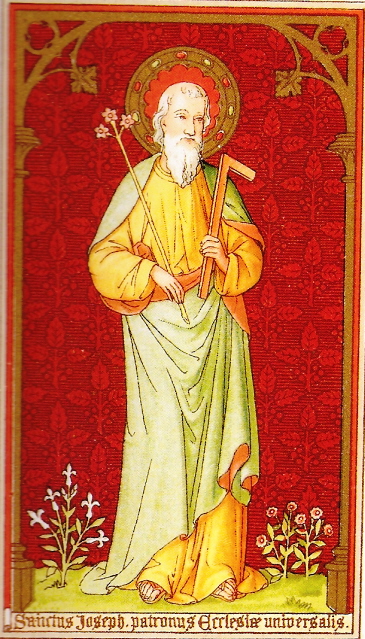
            While the gospels concern Joseph only in regard to his relationship to Jesus, other histories of Joseph passed down from the fifth century state that Joseph was a widower who had been married 49 years and had six children before his first wife died. When the priests announced that all unmarried men from the tribe of Juda were to be candidates to marry Mary, Joseph went to Jerusalem with great reluctance. He was elderly and did not think he should be seriously considered. While the other men presented themselves by putting their walking sticks on the altar, Joseph held back and did not participate.  To everyone’s amazement the tip of his staff burst into a bloom of flowers, a sign from God that he was to be named the fiancee of Mary.           This tale is where the early visual depictions of Joseph as an elderly man with a flowering branch come from.  It was also thought that since Joseph had to respect Mary’s virginity throughout their marriage, that in all probability he would have been older.

            During the beginnings of the church, only martyrs were recognized as saints. Despite the importance of Joseph in the life of Christ, his cult was only found in the East. It did not arrive in the West until the ninth century when he was honored in church as the Foster Father of Our Lord.  The Carmelite order brought his cult to Europe when they were driven out of Jerusalem during the Crusades and the first church dedicated to him was in 1129 in Bologna, Italy.             

European Evangelists recognized Joseph’s reputation as the perfect father figure as useful in gaining conversions.  Common people forced to put the needs of their family before personal ambition saw Joseph’s life mirror their own. Church mystics and scholars Bernard of Clairvaux, Thomas Aquinas and Bridget of Sweden all stressed the importance of Saint Joseph in their religious devotions. While reforming the Carmelite order in Spain, Teresa of Avila chose him to be the patron of her Discalced Carmelite order.  She did much to spread his public devotion spread throughout the Spanish Kingdom. During the Middle Ages when drought and famine struck Sicily, residents throughout that island prayed to Saint Joseph for help. At midnight on March 19th rain began pouring and good weather immediately followed. Sicilians have venerated Saint Joseph ever since, by setting up altars, cooking special food and sweets which are given to friends and to the poor. These festivities were adapted by the rest of Italy where Saint Joseph is greatly revered. It is said that Saint Joseph has the power to overturn natural law, because Jesus had to obey his earthly father while he was a boy, that he would still do whatever Saint Joseph asked of him.

            With the advent of the Industrial Revolution, and the new class of laborers it produced, patronage to Saint Joseph became universal. By the end of the 19th Century he was named patron of the Catholic Church out of gratitude for the care he took of Jesus. Because Joseph had to move on a moment’s notice with the flight into Egypt and was responsible for providing shelter for his family, he is invoked for buying or selling a home.  The tradition of burying a Saint Joseph’s statue on the grounds of a home to initiate a quick sale goes back to the 17th Century. When Teresa of Avila was in need of more land to set up her religious houses, she had her nuns bury their Saint Joseph’s medals in the ground. Gradually, these medals evolved into a statue of Saint Joseph that would be buried upside down until the house was sold, then dug up and taken to the new home. Today, even nonCatholics do this as a superstitious rite, buying Saint Joseph’s Home Sale Kits off the internet.

            In art, Saint Joseph is always depicted with the infant Jesus. He sometimes has carpenter tools and because of his chastity he carries a lily for purity. The flowering staff became a popular attribute for him because it is also the emblem of shepherd kings who forcefully defended their flock. This staff is also the ancestor of the Bishop’s crook. An additional feast day was declared for Saint Joseph as May 1st.  May Day to the rest of the world, the church in its attempt to combat Communism dedicated this day set aside for the working man to the Patron of Workers.

Prayer for Saint Joseph’s Intercession


                                     Remember, O most chaste spouse of the Virgin Mary,

                                That never was it known that anyone who implored your help

                                          and sought your intercession was left unassisted.

                                                     Full of confidence in your power,

                                                 I fly unto you and beg your protection.

                                            Despise not, O foster father of the Redeemer,

                                                 My humble supplication, (request here)

                                             but in your bounty, hear and answer me. 

            Amen

Excerpted from the book “Saints:Ancient and Modern” by Barbara Calamari and Sandra DiPasqua.
Dining with the Saints in Honor of Saint Joseph

More on Saint Joseph

Dining With The Saints

St. Patrick’s Day


The Irish have observed St. Patrick’s feast day of March 17th for over 1,000 years and even though it falls during lent, the church for this celebration has long waved the prohibitions against meat. This is a huge national holiday throughout the country and people traditionally celebrate with a meal of Irish bacon cooked with cabbage, lots of beer, and lots of dancing.
Fresh salmon, one of Ireland’s finest food offerings and a springtime treat, is fast becoming a contender for the centerpiece of the St. Patrick’s Day meal. Especially popular is salmon poached or baked and then finished with a cream sauce. Sounds rich, and it is. I’ve lightened this dish a bit by adding white wine, lemon zest, and capers to the cream. I think this salmon would be perfect with a side of steamed asparagus and boiled new potatoes tossed with butter and parsley.

Baked Salmon with White Wine, Cream, and Capers

(Serves four)
A 2 1/2 pound piece of wild salmon fillet (a thick center cut), skinned
Unsalted butter
½ cup dry white wine
1 large shallot, very thinly sliced
Salt
Freshly ground black pepper
A few big scrapings of freshly ground nutmeg
½ cup of heavy cream
The grated zest from 1 small lemon
A palmful of small capers, rinsed
A few large dill sprigs, chopped
Preheat the oven to 350 degrees.
Lightly butter the bottom of a large baking dish (one that gives the salmon a little room to breath, about 2 inches on all sides is perfect). Place the salmon in the dish and pour on the white wine. Season it with salt, black pepper, and the nutmeg. Scatter on the shallots and dot the top with small pieces of butter. Cover with foil and bake until the salmon is just tender and still a little pink at the center, about 15 minutes or so (it should flake at the thinner ends but still be a bit pink at the thickest point).
Take the salmon from the oven and gently, with a large, long spatula, transfer it to a warmed serving platter. Cover it with aluminum foil to keep it hot.
Place the baking dish with the salmon cooking juices over a high flame and boil the juices down until you have about 3 tablespoons. Add the cream and the lemon zest and boil that down until it’s reduced by about ½, adding a little salt and fresh black pepper. Strain the cream sauce and pour it over the salmon. Scatter on the capers and the dill. Serve right away.
 
Written by Erica De Mane, chef and food writer. Check out her blog at www.ericademane.com
 

Patron Saints for March

ONE-ARMED PEOPLE: JOHN DAMASCENE

 676 – 749                                FEAST DAY: MARCH 27

 A Syrian Christian who was the chief financial officer for the Muslim Caliph, John was extremely well educated. When the Patriarch of Constantinople ordered the destruction of icons as graven images, John wrote the treatise In Defense of Icons. Thisbrought the common people into the debate. In revenge, the Patriarch made false charges against him to the Caliph, and John’s writing hand was cut off as punishment. He spent the night praying before an icon of the Virgin Mary, and it was miraculously reattached. Because of the wisdom of his writings he is one of the Doctors of the Church.

 Other Patronage: Iconographers

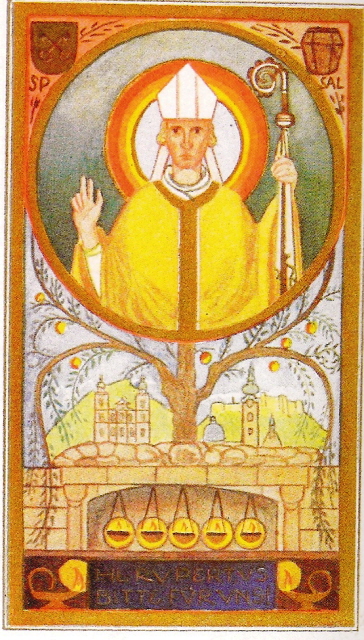
MINERS: RUPERT

 660 – 718                                FEAST DAY: MARCH 27

A missionary bishop sent to Bavaria, Rupert had great successes in gaining converts along the Danube River. He requested permission to settle in Juvavum, a dilapidated Roman outpost. There he started the industry of salt mining in the mountains. This led to the rejuvenation of the area and its being renamed Salzburg. The monastery he erected is still in use today.

 Other Patronage: Salzburg


DYING: JOSEPH

 FIRST CENTURY, B.C.       FEAST DAY: MARCH 19

 Joseph was the carpenter who served as Christ’s father on Earth. He never shirked his duties as the head of his family and stood by Mary, guarding her from ridicule and respecting her virgin state. It is thought that Joseph died well before Christ was crucified, hence he never had to suffer over the fate of his son. For this reason, he is invoked for a happy death.

 Other Patronages: Austria, Belgium, Canada, Mexico, Peru, Vietnam; Carpenters; Fathers 

Invoked Against: Doubt

Invoked For: the sale of a house, to find work


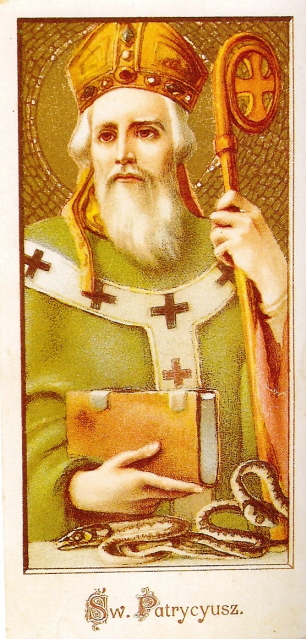
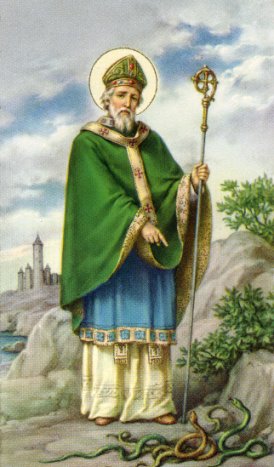
IRELAND: PATRICK

 390 – 461                    FEAST DAY: MARCH 17

A British subject of Rome, Patrick was kidnapped by pirates and taken to Ireland when he was sixteen. After six years of herding sheep and being exposed to the elements, he managed to escape. He studied to become a missionary to Ireland, and on his return devoted himself to evangelizing the tribes there. It was said he had more power over nature than the druidic priests. He rid the island of snakes and could control the weather. He was granted his request to God that the Irish be judged by him when they died. He is a national hero there and his cult has spread all over the world.

 Other Patronages: Nigeria

Invoked Against: Rabies, Serpents, the torments of hell


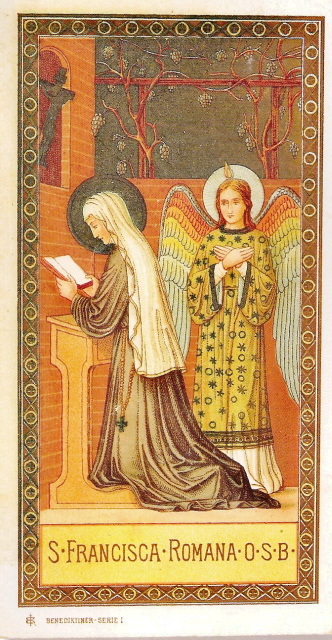
WIDOWS: FRANCES OF ROME

 1384 – 1440                FEAST DAY: MARCH 9

 A noble Roman woman, Frances had a happy forty-year marriage. Though she lived in a palazzo, she organized a group of laywomen to help tend the sick. The city was in great political turmoil, and her husband was exiled, leaving her to manage alone. The family lost much of its fortune, and on his return, he died a broken man. Through prayer and a cheerful disposition, Frances was granted the privilege of always seeing her guardian angel, whose glow functioned much like a headlight on a car. After her husband’s death, Frances entered religious life.

 Other Patronages: Motorists, Taxi Drivers; Death of Children

HEART AILMENTS: JOHN OF GOD

 1495-1550                                      FEAST DAY: MARCH 8

 A Portuguese mercenary who fought in several wars, sold slaves, and lived hard, John was known to “think with his heart” by acting impulsively. While a book dealer in Grenada, he heard a sermon that changed his life, driving him to temporary madness. Upon his recovery, he devoted the rest of his life to the sick and destitute. He leaped into a river to save a drowning man and died himself from an overexhausted heart.

 Other Patronages: Dying; Hospitals, Booksellers, Nurses, Printers

 Invoked against: Alcoholism


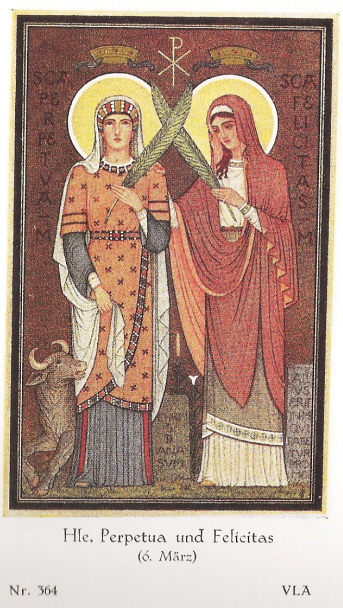
COWS: PERPETUA AND FELICITY

 D. 203                         FEAST DAY: MARCH 7

Pepetua was a married noblewoman in Africa and Felicity was a pregnant slave, both were imprisoned together. Perpetua left a detailed journal about their captivity and the persecution of Christians. Perpeuta’s greatest torment was being separated from her child. Felicity gave birth two days before they were killed in the arena by a herd of wild cattle.

 Other Patronage: Mothers

Above Patron Saints for March have been excerpted from the book: “Patron Saints: A Feast of Holy Cards” by Barbara Calamari and Sandra DiPasqua.

All images have been borrowed from the holy card collection of Father Eugene Carrella.


Dining With the Saints

A  SAINT VALENTINE’S DAY DINNER

Saint Valentine, the Saint associated with marriage and love, has a very special place in the hearts of the people of Roquemaure, and small town in the Vaucluse region of Provence, France. In 1868 the town welcomed the Saint’s relics into their town in an effort to cure their terribly blight infested vineyards. Every year since the arrival of the holy relics, the town holds a huge festival, starting on the Saint’s feast day of February 14 and lasting three days. Couples promenade through the town square in 19th century attire, and there is much period dancing and live music, all dedicated to the theme of love. Kids play traditional 19th century games, and basket makers set up their stalls to demonstrate their craft. Barrel organs are on every street corner, and horse drawn carriages carry residents and tourists,dressed head to toe in the fashions of St. Valentine’s Day, through the town. This area now produces some of Provence’s best red wine and much of it is consumed during this cold weather, outdoor festival.

The St. Valentine’s festival also coincides with the black truffle season in the Vaucluse, where truffle hunters spend hours in the chilly Provence woods with their truffle hunting pigs or dogs, searching for these expensive prized tubers. Truffles have always been a culinary symbol of romance and an offering of love.

Black truffles are prepared simply so their beautiful perfume is not masked by competing flavors. In the Vaucluse shaving truffles over boiled potatoes drizzled with olive oil is a standard treatment, so is shaving them onto creamy scrambled eggs. But my favorite is a dish of egg pasta, tossed simply with butter and fine Provencal olive oil and topped with thin shavings of the Vaucluse truffle. If you really want to woo your lover, Provence style, try this simple but extravagant recipe.

Tagliatelle with Black Truffles, Vaucluse Style

(Serves two)

½ pound fresh tagliatelle pasta

Salt

3 tablespoons unsalted butter

2 tablespoons extra virgin olive oil, from Provence, if possible

A few sprigs flat leaf parsley, leaves lightly chopped

1 ½ to 2 ounces fresh black truffle

Freshly ground black pepper

Put up a pot of pasta cooking water and bring it to a boil. Season it with a generous amount of salt.

Warm a pasta serving bowl and have it close at hand.

Drop the tagliatelle into the water and cook until just tender. The fresher the pasta the shorter the cooking time. Just made egg pasta can take as little as a minute. Store bought, fresh pasta tends to be slightly firmer and might take about 3 minutes. When tender, drain the pasta, leaving a little water clinging to it, and pour it into the serving bowl. Add the butter and olive oil, the parsley, a few big grindings of black pepper, and a pinch of salt, and toss until the pasta is well coated. With a vegetable scraper or a truffle shaver, shave the black truffle over the top. Serve right away.

By Erica De Mane, chef and cookbook writer

www.ericademane.com

More about Saint Valentine.