
SAINT FRANCIS OF ASSISI
1182-1226
Ardent love for everything in the universe so consumed Saint Francis of Assisi that he refused to have a full tonsure shaved into his head so that bugs and vermin, his “more simple brethren”, might still have a home in his hair. He called all animals brother and sister and exhorted every creature to honor its creator. It is said that birds became quiet when he preached and that when he walked through their flocks, they never moved unless he asked it of them. A great poet, Saint Francis himself wrote the first part of this novena. Because of the mystical way he experienced the world, in full possession of and living in divine light, he is invoked to change our view of the world and fill our lives with grace.
He was born Giovanni Bernadone in the town of Assisi in the year 1182. His father was a wealthy cloth merchant and an upstanding member of the local upper classes. Everyone called him Francesco instead of Giovanni because his mother was Provence and he was given to exclaiming in French. Francis lived a pleasure-filled life as a young man, and it was assumed he would inherit his father’s business and social position. When war broke out with neighboring Perugia, Francis went to fight, viewing it all as a great adventure. He was taken prisoner, however, and eventually returned to his family extremely ill. As he recovered, his old way of life seemed to bore him. It was in the neglected Church of San Damiano that he heard the crucifix speak to him: “go and repair my house, which you see is falling down.” He took these instructions literally, enraging his father. Ultimately, h renounced his inheritance, throwing his clothes into the street. The bishop of Assisi provided Francis with his new garments, the brown robe of a monk.
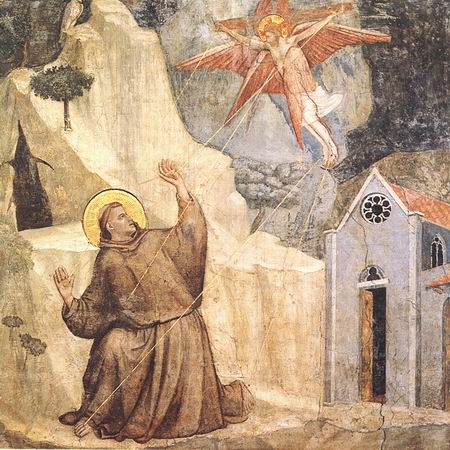
Living alone, Francis rebuilt San Damiano, sometimes begging for the money for supplies. He was eventually joined by a few other young men of his status, and in 1209 he wrote his first holy rule. He embraced poverty and was intent on living as the original apostles of Christ did, traveling, preaching and begging for alms. When he prayed, the bright light in his raptures caused him to cry, but he could not bear to stop. His followers, worried that he would ruin his eyesight, attempted to intervene, but he replied, “We are the same as the flies, attracted to light.” In 1224, while praying alone on the secluded mountain of La Verna, Francis became the first saint to know the suffering of the crucified Christ by receiving the stigmata. These wounds stayed with him for the remaining two years of his life.
Saint Francis of Assisi is one of the greatest saints of the Catholic Church and is the founder of the Franciscan friars. Yet, so true was his embrace of humility that he himself was never ordained a priest, only a deacon. He lived out his life in the order he founded as a humble member with no official status. He was canonized a saint in 1228. Because of his extensive travels in his native country and his love for its natural beauty, Saint Francis is the Patron Saint of Italy.
Feast Day: October 4
Patronage: Italy, Animals, Ecologists, Nature
Prayer by Saint Francis of Assisi with novena
Lord, make me an instrument of your peace.
Where there is hatred, let me sow love;
Where there is injury, pardon;
Where there is doubt, faith;
Where there is despair, hope;
Where there is darkness, light;
And where there is sadness, joy.
O divine master,
Grant that I may not so much seek
To be consoled as to console,
To be understood as to understand,
To be loved as to love.
For it is in giving that we receive,
In pardoning that we are pardoned, and in
Dying that we are born to Eternal Life.
Amen
Saint Francis of Assisi, reflection of Christ
Through your life of poverty and humility,
grant us through your intercession the
graces we so much need for soul and body.
Especially during this novena, we ask for
(mention your request).
We also ask your blessings on all those whom we love.
Amen
Say this novena nine times in a row for nine days in a row.
(Excerpted from the book: “Novena: The Power of Prayer” by Barbara Calamari and Sandra DiPasqua).