Unknown's avatar

About sandra dipasqua

graphic designer

Novenas for December


Saint Lucy

285 – 304

Clarity and light are the primary attributes of Saint Lucy. Often her name is invoked as a protection against temptation, since she is thought to enhance judgment and aid in discernment. The name Lucy means “light” and light is the nature of grace. Just as light shines in a direct, straight line, Saint Lucy’s belief in God never wavered. Light is also immaculate, no matter how filthy the place it shines in. Her affiliation with light also extends to vision. Thus, Saint Lucy is the patron saint of the blind: we also call on her to help those with eye troubles.

Born in Siracusa, Sicily, into a noble family, Saint Lucy was secretly a Christian, having been impressed early on by the stories of Saint Agatha’s martyrdom in nearby Catania. Lucy’s mother suffered from long-term health problems, and Lucy took her to Saint Agatha’s tomb to be healed. When her mother’s health was instantly restored, she also became a Christian. Although her family had arranged for her to marry, Lucy begged to be allowed to break the engagement, as she had promised her virginity to the Lord. She wanted her dowry to be distributed to the poor and to live a life devoted to prayer and chastity. This enraged Lucy’s betrothed, and he denounced her to the local authorities as a Christian and an enemy of the emperor. This being the time of the persecutions of Diocletian, the punishment for Christian beliefs was torture, then death. Lucy refused to sacrifice to the Roman idols when commanded by the local officials, saying, “The sacrifice that is pleasing to God is to visit the poor and help them in their need.” Paschasius, the Roman consul, ordered her to be put in a house of prostitution. When the soldiers came to carry Lucy away, they could not move her. A thousand soldiers and a thousand oxen were brought in and still she could not be budged. Magicians and wizards chanting incantations had no effect. Paschasius, at wits’ end, ordered a fire to be built around Lucy and boiling oil to be poured on her head. Still unfazed, Lucy said, “Ihave prayed for this prolongation of my martyrdom in order to free believers from the fear of suffering and to give unbelievers time to insult me.” At this point, a friend of the consul’s plunged a dagger into her throat and ended her earthly life. A church was raised at the site of her death a few years later. Saint Lucy is one of the oldest and most adored saints in the world.

There are two different stories as to why Saint Lucy is always shown holding her eyes on a dish. One is that they were torn from her head     under torture and were then miraculously restored. The other is that a persistent suitor asked for her hand  in marriage, citing her beautiful eyes as the reason she won his heart. Lucy, intent on keeping her virginity, ripped out her own eyes and sent them to him. Here again they were miraculously restored the next day. Saint Lucy is   also always depicted with the palms of martyrdom. Her remains are partially uncorrupt and were moved to a church in Venice. Because she died from having her throat cut, she is also invoked for throat ailments and hemorrhages.

Feast Day: December 13

Patron of: Blindness

Invoked for: Clarity

Invoked against: Eye Troubles, Throat Ailments, Hemorrhages

Saint Lucy Novena


By your steadfast faith, O glorious Saint Lucy, you firmly declared to the ruler that no one could take from you the Holy Spirit, who dwelt in your heart as in his temple. Obtain for me from God that I may always live in a holy and salutary fear of losing his grace and that I may flee everything that might cause so grievous a loss.

(Recite one Our Father, one Hail Mary, one Glory Be.)

By the great love which your immaculate spouse had for you, O glorious Saint Lucy, when by an unheard of miracle he rendered you immovable in spite of the attempts of your enemies to drag you into a place of shame and sin, I ask you to obtain for me the grace  never to consent to the temptations of the world, the flesh, and the devil, and to fight constantly against their assaults by the continuous mortification of all my senses.

(Recite one Our Father, one Hail Mary, one Glory Be.)

By the same ardent love you had for Jesus, O glorious Saint Lucy, after consecrating yourself to him by an irrevocable vow, you refused profitable offers of marriage. After distributing all your goods to aid the poor, you sacrificed your life by the blade that pierced your neck. Obtain for me the grace to be filled with holy charity, that I may be ready to renounce worldly goods and endure all evil rather than become, even in the least degree, unfaithful to Jesus.

(Recite one Our Father, one Hail Mary, one Glory Be.)

The purpose of this novena is to ward off temptation and to maintain clarity in confusing situations.

Say this novena nine times in a row for nine days in a row.

Excerpted from the book: “Novena: The Power of Prayer” by Barbara Calamari and Sandra DiPasqua.


Artwork: detail of altar piece by Francesco del Cossa (1473-1474)

 More on Saint Lucy

Novena to Our Lady of Guadalupe

Novena to Our Lady of the Miraculous Conception

Saint Barbara

Third to Fourth Century


Saint Barbara was a beautiful young girl brutally murdered by her father. Because she was avenged by God, she is invoked at times of injustice, when a fiery response is warranted or protection against violence is needed. Just as the heavenly retribution against her father was simple and direct, so is this novena to Saint Barbara. Though some doubt that she ever existed, Saint Barbara is one of the greatest saints of the Eastern Orthodox  Catholic Church, and her statue guards countless homes and businesses. She is the saint who in spirit is most like Michael the Archangel, assuring us   of universal protection and justice.

 Born in the city of Nicomedia, near the Persian border, her parents were wealthy and influential people who doted on their only child. It was, however, a time of considerable social upheaval. To protect his daughter from the rabble around them, Dioscurus, her father, committed her to live in a tower. From there she observed the world, entertained her friends, and was tutored by great teachers. She had much time for contemplation, and ultimately she concluded that worshipping a pantheon of gods was absurd and developed an interest in the Christian religion. While her father was away, she sent to Alexandria for the famous teacher Origen to give her further religious instruction. From him she learned about the Holy Trinity, and she was converted to Christianity. Meanwhile, her father was constructing a new bathhouse on the grounds near the tower as a present to Barbara. While visiting the site Barbara ordered the workmen to build a third window, thereby creating a symbolic trinity. She also removed any pagan statues and images in the structure, replacing them with a simple cross in the wall. When her father returned from his trip, he demanded to know who had changed the bathhouse design. Barbara admitted that she had had the offending third window installed, and declared, “Grace comes to us through three channels, the Father, the Son and the Holy Spirit.” Dioscurus, infuriated to discover that his daughter was now a Christian, had her dragged off to the authorities   and denounced her. Saint Barbara was then tortured for refusing to sacrifice to the pagan gods. Her own father asked to be her executioner and took out his sword and beheaded her. As he was leaving the site of her death, Dioscurus was struck by lightning and reduced to ashes. This is why Saint Barbara is invoked in the time of lightning storms, artillery bombardments, and explosions.

 Saint Barbara is also invoked against sudden death and is said to bring holy communion to the faithful at the time of death. Because of her work on the bathhouse, and her affiliation with the tower in which she lived, she is also the patroness of architects. In art she is shown with her tower, holding the palms of martyrdom and the sword that beheaded her. There is a church in Cairo Egypt, that houses  her remains and is named after her. Saint Barbara was a very popular saint in France during the Middle Ages. Besides being greatly honored in Greece and Egypt, she has enjoyed a great resurgence in popularity in the Caribbean and in South America.

 Feast Day: December 4

 Patron of:  Artillerymen, Architects

 Invoked against: Lightning strikes, Sudden Death

Novena to Saint Barbara


O Saint Barbara, I offer this prayer to you in the name of the Father, the Son, and the Holy Spirit. With a sword bearing your illustrious name, Saint Barbara, I make a sign of the cross over my heart. I pray that your spirit by my faith, that your protection and justice be my guide, and from all my heart I beg that you grant this petition. (Mention your request). I hope to obtain this help through your grace. Amen.


 Say this novena nine times in a row for nine days in a row.

 (Excerpted from the book, “Novena: The Power of Prayer” by Barbara Calamari and Sandra DiPaqua).

Dining With The Saints


The Feast of St. Andrew

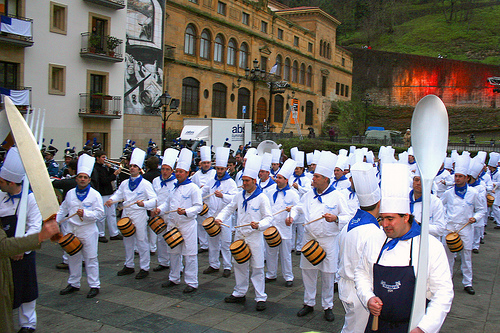
 St. Andrew is the patron Saint of Scotland. His feast day on November 30th is celebrated with a huge festival, not only in Scotland, but also by Scots who live abroad. There is, for instance, a St. Andrew’s Society in Boston that was set up in 1657 and it’s still very active in organizing his feast day activities.

 It was the custom for farm workers and laborers in Scotland to go ‘St. Andra’ing’, where they would go out and shoot rabbits, spend all day cleaning and preparing them, and then have a huge meal of roast rabbit and Scotch whisky. Eating a singed sheep’s head also used to be traditional. Today the occasion is more likely celebrated with an assortment of famous Scottish dishes such as Scotch broth, salted herring, beef in whisky sauce, finnan hadie, haggis, Dundee cake, Crannachan, a kind of sweet dumpling, Angus Toffee and, of course, lots of whisky.

 One of my favorite Scottish dishes and something that’s always present at any St. Andrew day feast is Scotch Eggs, hard cooked eggs that have been encased in herbed sausage and deep-fried. They’re very easy to make and are delicious. Great with Scotch whisky or beer.

Scotch Eggs

 (Serves four)


A mild vegetable oil for deep-frying

1 ¼ pounds country style sausage, removed from it’s casing (or buy bulk sausage)

6 fresh sage leaves, finely chopped

8 sprigs of fresh thyme, leaves chopped

Salt

A generous pinch of cayenne pepper

4 large, hard-boiled eggs

About ½ cup off all-purpose flour

2 raw eggs, lightly beaten

1 cup home-made, dry breadcrumbs


Over high heat about 4 inches of oil in a large pot.


In a large bowl combine the sausage, sage, thyme, a little salt, and the cayenne. Divide the mixture into four parts and flatten each portion out into a thin round. Wrap a sausage round around each hard-boiled egg, sealing it well with your fingers.

When the oil reaches approximately 360 degrees, it’s hot enough for frying.

 Dredge the sausage covered eggs in flour, then dip them in the raw egg, letting the excess drip off, and then coat them in the breadcrumbs.

 Fry the eggs, turning them gently a few times, until they’re golden all over, about 5 minutes. Lift them from the oil with a slotted spoon and let them drain on paper towels. Serve hot or warm.

Painting: “Saint Andrew and Saint Francis” by El Greco

Dining with the Saints is a monthly column written by chef and author Erica DeMane. Erica DeMane.com


Patron Saints for November

Greece / Andrew the Apostle, first century a.d.,
Feast Day: November 30

One of the original twelve apostles, Andrew was given Scythia, in what is now Russia, for his mission. It is doubtful whether he ever reached it. He was executed in Greece for converting the wife of the governor of Patras. He was tied to an X-shaped cross (known as a saltire cross), from which he preached for two days before dying. In the eleventh century, his remains were taken to Scotland, where his cross is on the national flag.

Other patronages: Amalfi (Italy), Burgundy (France), Russia, Scotland; fish dealers, golfers, sailors, singers; spinsters

Invoked: by women who wish to be mothers; against sore throat, gout, neck problems

Cyclists / Catherine of Alexandria, 287–305,
Feast Day: November 25

An Egyptian noblewoman, Catherine complained to the emperor about the persecution of the Christians in such a way that she converted his wife and the fifty philosophers who came to argue against her. When all except Catherine were executed, the emperor demanded to marry her. Because she refused, he ordered her to be broken on a spiked wheel, which crumbled to pieces at her touch. She was then beheaded. Because of the wheel, many careers that use wheels were put under her patronage.

Other patronages: University of Paris; knife grinders, librarians, mechanics, millers, nurses, philosophers, potters, spinners, students, wheelwrights; dying people, unmarried girls

Invoked: to find a husband; against diseases of the tongue

Musicians / Cecilia, d. 117, Feast Day: November 22

A girl from an illustrious Roman family, Cecilia was secretly a Christian. She had an arranged marriage with a pagan, and it is said that, on her wedding day, as the instruments were being played, Cecilia sang in her heart to God alone. After her marriage, she convinced her husband to follow her ways. He was found out and executed. When the Romans tried to behead her in her own home, she took three days to die. Her house became one of the first Christian churches. Some legends credit Cecilia with the invention of the organ.

Other patronages: composers, makers of musical instruments, poets

More on Saint Cecilia

Wolves / Edmund of East Anglia, 841–870,
Feast Day: November 20

Known as a fair and just ruler, Edmund was a king in eastern England. When the Danes invaded, he was captured and told to turn over his followers. When he refused, he was beaten, shot with arrows, and beheaded. When his followers came to claim his body, they could not find his head. They heard a voice in the woods calling and, following it, found a wolf cradling Edmund’s head between its paws.

Other patronages: kings; torture victims

Invoked: against epidemics, plague

Buisnesswomen / Hilda, 614–680, Feast Day: November 17

The daughter of English nobility, Hilda was an abbess. She founded the influential Abbey of Whitby, a double monastery that educated both men and women. Her order was devoted to the arts and sciences, and she was the patroness of the first English poet, Caedmon. Her management skills and wisdom were legendary; many important rulers and kings asked for her advice and guidance.

Earthquakes / Gregory Thaumaturgus, 213–270,
Feast Day: November 17

As a wealthy young law student in Beirut, Gregory converted to Christianity. Upon his return to his native city he was named the bishop of the seventeen Christians who lived there. By the time of his death, all but seventeen pagans had been converted by him. Known for his healing abilities, he could dry up streams and move great boulders with the commands of his word.

Other patronages: Armenia; desperate and forgotten causes

Invoked: against flooding

Hospital Workers / Elizabeth of Hungary, 1207–1231,
Feast Day: November 17

Daughter of the king of Hungary, Elizabeth had a happy marriage to the prince of Thuringia. Her
in-laws were at odds with her interest in caring for the poor and sick. When her husband died on his way to the Crusades, she and her children were turned out by his family. She became a Franciscan tertiary, donating whatever money she had left to building a hospital for the abandoned sick.

Other patronages: Germany; charitable associations, Franciscans, hospitals, Knights of the Teutonic Order, Sisters of Charity; bakers; beggars, orphans, unjustly persecuted people, widows

Invoked: against in-law problems, plague, ringworm, toothache