Unknown's avatar

About sandra dipasqua

graphic designer

Saint Dymphna


St. Dymphna3
605—620

Catholic tradition promotes saints for various devotions and in support of numerous causes. These include the feast of St. Dymphna, known for miracles involving mental health, anxieties and general mental wellness and well-being. Historically, St. Dymphna has been attributed to various miracles of healing for those suffering from mental illness.

In a world of stress and anxiety, St. Dymphna can be a source of inspiration and devotion. Many have invoked her name and intercession for friends and family in need of healing from mental illness, as well as the stresses and anxieties of day-to-day living.

Feast Day is May 15

Patron Saint of Epilepsy, Mental Illness, Incest Victims, Runaways

“O God, we humbly beseech you through your servant, Saint Dymphna, who sealed with blood the love she bore you, to grant relief to those who suffer from mental afflictions and nervous disorders.”

Because of her personal knowledge of the terror and misery caused by madness, Saint Dymphna offers great comfort and consolation to those afflicted with mental disorders and also to their families. Her burial site continues to be a place of miraculous healing, and Gheel, in Belgium, the town where it is located, leads the world as a center for the treatment of the mentally ill. Saint Dymphna lived for such a short time, so long ago, there is little to prove that she ever really existed.  Born the daughter of an Irish pagan King and Christian mother, Dymphna fled her home after her mother died to avoid the sexual advances of her grief mad father.

Saint Dymphna was born in Ireland. Her father, Damon, was a pagan king and her mother was a Christian. Dymphna was raised in her mother’s faith and was very devout. When Dymphna was fourteen, her mother died, and her father became so engulfed in grief, that he sank into mental illness. He sent messengers throughout the land to find a woman of noble birth who resembled his wife so he might marry her. None could be found. Dymphna, however, so resembled his dead wife that he decided to marry her, even though she was his daughter. In order to avoid this fate, Dymphna fled from the castle with her confessor, Saint Gerebran. They traveled abroad, first to Antwerp, then finally settling in Gheel. Within a year her father found them living as hermits. He had the priest beheaded and begged Dymphna to return home with him.

When she refused, he drew his sword and chopped off her head. Both bodies were buried immediately. She was fifteen years old at the time of her death. In those days, epileptics and the mentally ill were treated as pariahs and left to roam. Shortly after Saint Dymphna’s death, five such sufferers went to sleep at the site where she was killed and were instantly healed by the blood in the earth. The legend of Saint Dymphna became very popular in the early thirteenth century when the bodily remains of an unknown man and woman were dug up and the name Dymphna was written on a brick found in the coffin of the woman. As the remains were reinterred in a tomb, miraculous healings of those suffering from epilepsy and mental illness were reported in the immediate area.

The bishop of Cambrai commissioned a text of the life of Saint Dymphna which drew on oral reports for its information. The tomb became a pilgrimage site for those suffering from mental afflictions. By the end of the thirteenth century a hospital was built near Dymphna’s tomb for the treatment of nervous and mental illnesses.

Today, Gheel remains a world—renown hospital center, offering the most enlightened methods in treating the mentally ill, and the residents of that city are known for their kindness toward those so afflicted. As many as two thousand patients at a time live within the community with local families and work on everyday tasks until they are well. Because of the madness of her father, Dymphna is known as the patroness of mental and nervous afflictions. It is assumed she was sexually abused; thus she is also the patroness of incest victims and runaways. Saint Dymphna is traditionally pictured with the palms of martyrdom. In some images she is depicted with the sword that beheaded her, and the devil, representing mental illness, is shown in chains at her feet.

Novena

O God, we humbly beseech you through your servant Saint Dymphna, who sealed with her blood the love she bore you, to grant relief to those who suffer from mental afflictions and nervous disorders, especially

Name the afflicted person

Saint Dymphna, helper of the mentally afflicted, pray for us. Saint Dymphna, comforter of the despondent, pray for us. Saint Dymphna, renowned for many miracles, please hear my plea. Amen  

Recite one Glory Be  

Say this novena nine times in a row for nine days
in a row.

Feast of St. Peregrine 1265 – 1345, May 1

St.Peregrine
 “You had recourse to the source of all grace when the power of man could do no more”

St. Peregrine 1265 – 1345
Patron of: Cancer

A victim of cancer himself, Saint Peregrine not only had to accept the reality of his illness, but also the instantaneous healing of that disease through the intercession of Christ. For this reason he is invoked for medical breakthroughs as well as for those suffering from cancer, running sores and other incurable diseases.

A wealthy young man from the town of Forli, Italy, Peregrine was a political leader of the local anti-Papist party. His rabble rousing against the power of the Pope and his early disdain for the Church makes him an unlikely saint. When a papal representative, Philip Benizi the prior general of the Servants of Mary journeyed to Forli to preach and to attempt a reconciliation between the rival political factions, Peregrine and his men broke up the crowds attending the speech. Peregrine himself slapped Benizi in the face. Instead of inciting Benizi to retaliate, he received a kindly look of forgiveness which so stunned Peregrine, that he collapsed in shame over his actions.

Since the Servants of Mary are devoted to the Blessed Mother, Benizi advised Peregrine to transform his life by cultivating a childlike devotion to Mary. While meditating in the cathedral at Forli, Peregrine had a vision of Mary instructing him to go to Siena and join the religious order of the Servants of Mary. Returning to Forli as a priest in that order, Peregrine devoted himself to the poor, the sick and the outcasts of society.

Many reported being healed during his inspirational masses. Peregrine imposed a personal penance on himself of never sitting down unless he had to. He also slept on the ground, using a stone for a pillow. After 30 years of such deprivation he developed severe varicose veins and an incurable running sore down his leg. This led to a diagnosis of cancer, the only cure possible was amputation. Resigning himself to the same fate as those he had served, Peregrine reluctantly agreed to the surgery.

Praying in the chapel on the eve of the operation he fell into a trancelike sleep where he experienced the figure of Christ getting off of the cross to touch his leg. When he awoke, there was no trace of illness in his leg and it was deemed to be completely healed. Because of this miracle, the incurably ill flocked to Forli for Peregrine’s healing prayers. Peregrine continued his mission for the next 20 years, dying at the age of 80. In modern times, many still make the pilgrimage to his tomb and there are thousands of healing societies bearing his name throughout the world.

Novena

O great Saint Peregrine, you have been called “the Mighty” and the “Wonder Worker” because of the numerous miracles you have had recourse to, for so many years you bore in your own flesh this cancerous disease that destroys the very fiber of our being, and you had recourse to the source of all grace when the power of man could do no more.

You were favored with the vision of Jesus coming down from his cross to heal your affliction. Ask of God, and our Lady the cure of these sick persons whom we entrust to you. Aided in this way by your powerful intercession, we shall sing to God, now and for all eternity, a song of gratitude for his great goodness and mercy.

(Mention your request.)

Saint Peregrine, pray for me and for all who invoke your aid. Amen

Life is Beautiful! RCM Birthday Giveaway Extravaganza

Heather Renshaw's avatarReal Catholic Mom

Once upon a time, lo these many moons ago, a young college student and her boyfriend conceived a tiny little life one unusually warm summer eve.

Despite swirling emotions, harsh judgements, and unfulfilled expectations, the young woman resolved to carry her child to term, flying in the face of advice to the contrary and the law of the land which allowed termination through the ninth month of pregnancy.

On a Wednesday morning in the month of May, the young woman delivered her first-born child, a healthy baby girl with dark hair and lungs the size of Texas.

Mere hours later, knowing her painstaking choice was one made with greatly sacrificial love, the young woman gave her little girl away to her new forever family.

***

Every year, on this day, I reflect on the amazing collection of “yeses” that culminated in the precious gift of my life. I am keenly…

View original post 275 more words

Saint Catherine of Siena

1347—1380

Feast Day is April 29

S. Catharina Senensis* is the patron saint of Fire Protection, Italy, Nursing Services, Activism

Action and activism are the essence of Saint Catherine of Siena. Passionately devoted to the salvation of mankind, she left an astounding legacy of four hundred written letters and a devotional Dialogue that are considered great classics in literature. She is credited with influencing the return of the papacy to Rome from Avignon, and for this reason she is the patroness of Italy. Known for her incredible charm, she horrified her wealthy parents by her willingness to express her devotion to Christ through corporal humiliations and long periods of fasting. Counselor and advisor to those in power, it was said that she perfected the art of kissing the Pope’s feet while simultaneously twisting his arm. Saint Catherine struggled against great odds to keep the Catholic Church united. Her novena is a call to faith in troubled times. She is invoked to engender the strength and faith for action in times when action is needed, both political and spiritual.

Born Caterina Benincasa, the youngest of twenty—five children, Saint Catherine’s father was a wealthy dyer. At the age of six she had a mystical vision of Christ surrounded by saints. A beautiful and cheerful child, she alarmed her parents by spending much of her time in prayer and meditation. She grew devoted to Christ and, like him, wanted to take on the suffering of the entire world, secretly mortifying her flesh and fasting for days.

Saint Catherine is the patroness of fire protection because her sister saw her deep in prayer in the kitchen, engulfed in flames from the stove. When she was pulled out, there was no evidence of burn marks on her body. Her parents, wanting a normal daughter, were angry at her refusal to marry or to improve her personal appearance. They finally gave in to her religious cravings and allowed her to become a tertiary (lay person) in the Order of Saint Dominic. She lived at home and went out to work, caring for those with the most repulsive diseases when no one else would help them. For this reason, Saint Catherine is also known as the patron saint of nursing services. Because of her great spiritual insight and radiantly happy outlook, she attracted a following in Siena known as the Caterinati.

They did much to revitalize an interest in spirituality in Siena and its surrounding regions. On the Fourth Sunday of Lent in 1375, Saint Catherine received the stigmata; the wounds of Christ appeared on her body and then disappeared, visible only to her.

Illiterate, Saint Catherine dictated hundreds of letters and spiritual writings to her secretaries. It was her constant barrage of letters to Pope Gregory XI that influenced him to move the papacy back from Avignon to Rome. She later became the advisor to his successor, the arrogant and difficult Urban VI. When he caused a great schism in the church, the College of Cardinals having voted in a rival Pope to return to Avignon, Saint Catherine remained loyal to Urban. She lectured him in countless letters on how to best improve himself. At his invitation, she moved to Rome to work as a papal adviser. When she died there of a stroke at the age of thirty—three, the wounds of the stigmata reappeared on her body.

Novena to Saint Catherine

Heavenly Father, your glory is in your saints. We praise your glory in the life of the admirable Saint Catherine of Siena, virgin and doctor of the church. Her whole life was a noble sacrifice inspired by an ardent love of Jesus, your unblemished lamb. In troubled times she strenuously upheld the rights of his beloved spouse, the church. Father, honor her merits and hear her prayers for each of us. Help us to pass unscathed through the corruption of this world. Help us always to see in the Vicar of Christ an anchor in the storms of life and a beacon of light to the harbor of your love, in this dark night of your times and men’s souls. Grant also to each of us our special petition. We ask this through
Jesus, your Son, in the bond of the Holy Spirit. Amen.

Pause to pray for your intentions Saint Catherine of Siena, pray for us.

Say this novena nine times in a row for nine days in a row.

Saint Vincent Ferrer, Novena App Occupations: Builders

1350-1419

Patron of: Builders

Feast Day: April 5


Quote: “Christ, master of humility, manifests his truth only to the humble and hides himself from the proud.”

Keywords: construction workers, brick makers, epilepsy, fields, headaches, inn keepers, lightning strikes, penance, plumbers, preachers, tile makers, reconciliation, roofers, vineyards

Symbols: Dominican habit, flame overhead, trumpets, banner

Born in Valencia, Spain to an English father and Spanish mother, Vincent Ferrer’s time on earth was spent during an extremely tumultuous period in history. The Black Death had ravaged Europe, decimating the population and the church was divided in a Great Schism, with three men claiming the papacy at one time.  Because of his work in healing this rupture and his untiring labors in revitalizing the faithful, as well as his charismatic ability to convert thousands, he is the patron of builders and those in all of the construction trades.

With encouragement from his parents, Vincent realized his dream of becoming a Dominican friar at an early age. His intellectual gifts were immediately apparent and he soon became an expert on theology and scripture. His advice was much sought after by bishops and cardinals, and eventually, Vincent was summoned to Avignon to advise the schismatic pope Benedict XIII.    In 1398 he suffered from a near fatal fever where he had a vision of Christ, Saint Dominic de Guzman (founder of the Dominicans), and Saint Francis of Assisi advising him to unite the world by evangelizing throughout it. Always a popular and skillful preacher, Vincent’s talents were said to have become supernatural after this vision. He left his political duties and took it upon himself to travel throughout Western Europe preaching about the Final Judgment, earning him the title “Angel of the Apocalypse.” Though he could only converse in his native Catalan, he was clearly understood by the tens of thousands who thronged to hear him preach.  The Moslem-controlled city of Granada invited him to speak there resulting in 8,000 conversions. At a time when many were left reeling and faithless by the plague which had killed off one fourth of the population, Vincent Ferrer’s message of hope in the face of despair was wildly popular in cities and towns in England, France, Italy the Netherlands, Switzerland, Germany and Spain. Throngs of religious pilgrims drawn from every level of society devoted themselves to a life of penance, following him wherever he went. Along with his spectacular success as an evangelist, he also had the ability to heal the sick and hours were put aside every day for his prayers and cures. Because many of his miracles took place where thousands could gather in fields, one of his patronages is the protection of fields. Because lightning was such a threat to crops, he is also invoked against lightning strikes.

Vincent Ferrer is credited with helping to heal the great schism in the church when he realized that his friend and benefactor Benedict XIII should relinquish his claims on the papacy when he refused to submit himself to a vote among cardinals.  Vincent withdrew his support and recognition of him and Benedict XIII was deposed in favor of Gregory XII in Rome.

Explanation of symbols:

Banner has a quote from the Book of Revelation, reading, “Fear God and give him honor, for the hour of his judgment is coming.”  This was the summation of Vincent’s mission.

Trumpet: Sounds warning of the end of the world.

Flame over head: Apostolic gift of the Holy Spirit. The ability to communicate in all languages.

Angel Wings: Vincent Ferrer was known as the “Angel of the Apocalypse”.


Novena to St. Vincent Ferrer


O Saint Vincent Ferrer, our guardian, because God, our eternal Father, has blessed you with and inexhaustible fountain of grace and blessing, we beg you to hear our prayers and to assist us with your powerful intercession which is even more effective now that you are in heaven than it was when you were on earth. Full of confidence in your mercy and compassion, we kneel in prayer before you, and commend to your powerful intercession all our needs, those of our families, our friends, relatives, and especially (your request here).


Glorious Saint Vincent Ferrer, let not our hope and confidence in your protection be deceived. Intercede for us before the throne of God. Watch over our eternal welfare. If our trials and tribulations in this world multiply, may they serve to give us spiritual joy and happiness. If God will only grant us the grace of ever increasing patience to the end that we may save our souls. Amen.

excerpted from the Novena App

Post for Good Friday 2016


Mother of Sorrows

Patron of: Grief

Quote: “…And you yourself shall be pierced with a sword – so that the thoughts of many hearts may be laid bare.” Luke 2:34-35

Keywords: grief, solace, mourning


When we are overwhelmed with grief, we turn to Mary, Mother of Jesus for help in our suffering. Throughout her life she endured much pain and sorrow and is fully able to empathize with anyone’s personal anguish. She endured the shame of being pregnant and unmarried, being poor, homelessness and having her only son unjustly imprisoned and executed. Most astonishing, Mary knew what was to befall her son yet had to see these events from God’s point of view and have faith that this was all for the good of mankind.

By meditating on the Seven Sorrows of Mary, a devotion from the Middle Ages, which uses scenes from the life of the Virgin Mother as a meditation on accepting the sorrowful part of life with grace.

The Seven Sorrows of Mary are:

1) The Prophecy of Simeon. As a young child, when his parents presented him in the temple, Jesus was met by the holy man Simeon who predicted everything that would happen to him in his address to Mary: “Behold, this child is destined for the fall and rise of many in Israel, and to be a sign that will be contradicted – and you yourself a sword will pierce so that thoughts of many hearts will be revealed.” (Luke 2:34-35).

2) The Flight into Egypt. In Bethlehem, after the birth of Christ, Joseph had a vision of an angel warning him of the impending slaughter of any male child under the age of two by King Herod in order to prevent the coming Messiah. The Holy Family had to travel a secretive route to Egypt and remain in that country until Herod died. Mary  not only worried for the welfare of her own son but mourn for the murdered children left behind.

3) The Loss of the Child Jesus in the Temple. While on a pilgrimage to Jerusalem, the 12 year old Jesus vanished from his family. His heartsick parents finally found him three days later, arguing with elders in the temple.

4) The Meeting of Jesus with His Cross. Mary watched helplessly as her son was ridiculed and mocked as he stumbled, carrying the cross he was to be executed on.

5) The Crucifixion. As he was nailed to the cross, most of his disciples ran away. Mary never wavered as she stood at the foot of the cross, witnessing her son’s agony and death.

6) Jesus Taken Down from the Cross. Mary held her dead son’s wound covered body. This, her greatest sorrow is known as the “Pieta”.

7) The Burial of Jesus. As the stone was rolled, closing up his tomb, Mary had to say her final goodbye to her earthly son. Her faith had to be sincerely tested as there was no hint of the resurrection to come.

Symbols: Knives pricking Mary’s heart. Symbols of the crucifixion: crown of thorns, nails.

Novena to the Mother of Sorrows

Most holy and afflicted Virgin, Queen of Martyrs, you stood beneath the cross, witnessing the agony of your dying son. Look with a mother’s tenderness and pity on me, who kneel before you. I venerate your sorrows and I place my requests with filial confidence in the sanctuary of your wounded heart.

Present them, I beseech you, on my behalf to Jesus Christ, through the merits of his own most sacred passion and death, together with your sufferings at the foot of the cross. Through the united efficacy of both, obtain the granting of my petition. To whom shall I have recourse in my wants   and miseries if not to you, Mother of Mercy? You have drunk so deeply of the chalice of your son, you can compassionate our sorrows.

Holy Mary, your soul was pierced by a sword of sorrow at the sight of the passion of your divine son. Intercede for me and obtain from Jesus (mention your request) if it be for his honor and glory and for my good. Amen.

(excerpted from the novena app).

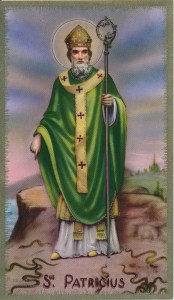
The Prayer of St. Patrick

St.Patrick
I arise today
Through the strength of heaven;
Light of the sun,
Splendor of fire,
Speed of lightning,
Swiftness of the wind,
Depth of the sea,
Stability of the earth,
Firmness of the rock.

I arise today
Through God’s strength to pilot me;
God’s might to uphold me,
God’s wisdom to guide me,
God’s eye to look before me,
God’s ear to hear me,
God’s word to speak for me,
God’s hand to guard me,
God’s way to lie before me,
God’s shield to protect me,
God’s hosts to save me
Afar and anear,
Alone or in a mulitude.

Christ shield me today
Against wounding
Christ with me, Christ before me, Christ behind me,
Christ in me, Christ beneath me, Christ above me,
Christ on my right, Christ on my left,
Christ when I lie down, Christ when I sit down,
Christ in the heart of everyone who thinks of me,
Christ in the mouth of everyone who speaks of me,
Christ in the eye that sees me,
Christ in the ear that hears me.

I arise today
Through the mighty strength
Of the Lord of creation.

Read more at http://www.beliefnet.com/Prayers/Catholic/Morning/The-Prayer-Of-St-Patrick.aspx#CRjRA6usSrQVkwdG.99

Saints For March: Saint Patrick and Saint Joseph

Image

Notecards_march

Saint Patrick  389 – 461
Feast Day is March 17
Saint Patrick is Patron Saint of Ireland,
Fear of Snakes, Faith

Though not usually considered a novena saint, Saint Patrick is called upon by many for faith in the most trying of circumstances. Since he himself was forced to submit to living in a country not of his own choosing, he assists in accepting difficult situations where there is little hope of change. The patron saint of Ireland, he is credited with single—handedly changing the beliefs of the entire Irish nation through the purity and intensity of his faith. Saint Patrick’s following has spread to wherever the Irish have settled, especially in North America and Australia. He could never have imagined the astounding impact that his work in Ireland would have on the world. Saint Patrick was born on the west coast of Great Britain of Roman—British parents. Though his father was a deacon, and his grandfather a priest, early on, Patrick showed no interest at all in God or religion. At the age of sixteen he was abducted by pirates and taken to Ireland, where he was sold into slavery. For six years he was forced to live under the direst of conditions, subject to the elements and hardship, herding sheep. When he began to pray for deliverance, he dreamed of a ship docked two hundred miles away.

By following the dream’s directions, he was able to escape from captivity, find the ship, and prevail upon the sailors to take him with them. He eventually returned to his family, and in gratitude for God’s help he became a priest. In A.D. 432 he again had a dream that changed the course of his life. In it, he was instructed to return to Ireland and to convert as many people as possible to Christianity. Though he would have preferred to perfect his studies and remain in Britain, he surrendered to the guidance of the dream and put all his faith in God by returning to Ireland. Living there at a time when the Druid religion was in decline, he nonetheless had to compete with the “wizardry” of the Druid priests. There are many fantastic tales of his magical powers. It was said that Saint Patrick could turn people into deer and that he could turn day into night. He is still invoked today by those afraid of snakes, because he was said to have obtained a promise from God that no poisonous reptiles would be allowed to live on that island. Saint Patrick expelling snakes is a common image.

Another one of his symbols is the shamrock, or three—leaf clover. This symbolizes how he explained the Holy Trinity in his preaching. Saint Patrick built his main church in Northern Ireland.

Realizing that the landowners chose the religion of their serfs for them, he set upon converting the major families first. His life as a former slave and fugitive taught him to trust God completely, and those living in similarly miserable circumstances have always been able to identify with him. He died in 461 in the monastery of Saul, and his remains are buried with those of Saint Brigid in Ulster.

Novena to Saint Patrick

O great apostle of Ireland, glorious Saint Patrick, to whom under God so many are indebted for the most precious of all treasures, the great gift of faith, receive our fervent thanks for the zeal and charity that have been to thousands the blessings so invaluable. We ask your intervention in receiving (Mention your request here). Ask for all who dwell in this land and the land of thy labors the precious light of Faith, and beg for us on whom its glorious rays have long since beamed, the grace to regulate our lives by its sacred maxims. Amen 

Say this novena nine times in a row for nine days in a row.

Saint Joseph  First Century
Feast Day is March 19
Saint Joseph is the Patron Saint of Family Protection,
Fathers and Work His patronages include a Happy Death and the countries
of Belgium, Canada and Peru

A poor carpenter and a direct descendant of the house of David, Saint Joseph was selected by God from all the men in the world to be the earthly father of Jesus Christ, an average person exalted to he highest level of respect and achievement. He readily accepted this and other directives from God and never shirked his responsibility to his family. Thus, Joseph epitomizes the role of father—protector. Many of the greatest saints have called on Joseph for protection. His novena is considered to be powerful, one that can be invoked for any trouble. Saint Teresa of Avila said, “I don’t recall up to this day ever having petitioned him for anything that he fails to grant. It is an amazing thing, the great many favors God has granted me through the meditation of this blessed saint.”

In Italy, where his feast is a major religious holiday, Saint Joseph is believed to have the power to break all natural law. It is said that since Jesus always obeyed Joseph when he was his father on earth, Joseph is accorded the same power in heaven. The only information known about Joseph is written in the Gospels. Because of the chasteness of his marriage to Mary, it is often assumed that he was an older man. This is unlikely considering the amount of effort he exerted protecting the Holy Family. Joseph was betrothed to Mary when he learned of her pregnancy. He was prevented from leaving her when he was assured by an angel in a dream that the child she was carrying was divinely given. After the child Jesus was born in Bethlehem, Joseph was again visited by the angelic presence, instructing him to move his family into Egypt to avoid King Herod’s slaughter of the innocents. He kept his family in Egypt until the death of Herod seven years later. He then moved Jesus and Mary back to Israel, settling in the obscure town of Nazareth in Galilee. Joseph approached the responsibility of raising the son of God with great humility and simplicity, instructing the boy in the trade of carpenter. He accepted and protected his wife’s virginity and led a chaste life devoted to his faith in God. In art he is usually shown holding a lily for purity. In some images he is carrying the baby Jesus.

The last mention of Joseph in the Gospels is when Jesus was twelve years old and left his parents to preach in the temple. It is assumed that Joseph died before the wedding feast of Cana. Since he enjoyed a perfect family life with Jesus and Mary, it is also assumed that Joseph died an easy death, with his wife and son at his side. This is why one of Saint Joseph’s many patronages is for a happy death. Because of his livelihood as a carpenter, he is considered the patron of workers. He is frequently invoked by those in need of work. In the United States people bury a statue of him upside down on the properties of hard—to—sell homes.

Novena to Saint Joseph

O glorious Saint Joseph, faithful follower of Jesus Christ, to you we raise our hearts and hands to ask your powerful intercession in obtaining from the compassionate heart of Jesus all the helps and graces necessary for our spiritual and temporal welfare, particularly the grace of a happy death, and the special grace for which we now ask. Mention your request here O guardian of the Word Incarnate, we feel animated with confidence that your prayers for us will be graciously heard at the throne of God.

The following is to be said seven times in honor of the seven joys and seven sorrows of Saint Joseph. O glorious Saint Joseph, through the love you bear for Jesus Christ, and for the glory of his name, hear our prayers and grant our petitions. This novena can be practiced at any time of year. It is particularly effective if done for the seven Sundays prior to the feast of Saint Joseph in honor of his seven sorrows and seven joys.

Say this novena nine times in a row for nine days in a row.

Saints for All Occasions Notecards