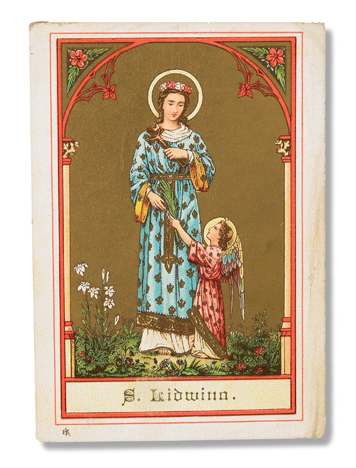
Skaters / Blessed Lydwina of Schiedam, 1380–1433,
Feast Day: April 14

A beautiful girl from the Netherlands, Lydwina became an invalid due to an ice skating accident. For the next thirty years she endured agonizing body pain as well as a series of disfiguring illnesses. She devised a system of meditative prayer, in which she concentrated on Christ’s suffering and offered up her own. Eventually, she fell into mystical experiences and her holiness served as an example to others.

Other patronages: skiers

Handicapped People / Margaret of Castello, 1287–1320, Feast Day: April 13

Blind, lame, and a dwarf, Margaret was hidden away by her parents, landed nobles. Since she liked to pray, she was sent to live in a chapel in the woods. When she was twenty, her parents took her to a Dominican convent to seek a miraculous cure. When none came, they deserted her there. She helped out in the daycare center run by the nuns. Beloved by the townspeople, she is credited with curing a crippled girl upon her death.

Other patronages: right-to-life movement; unwanted people

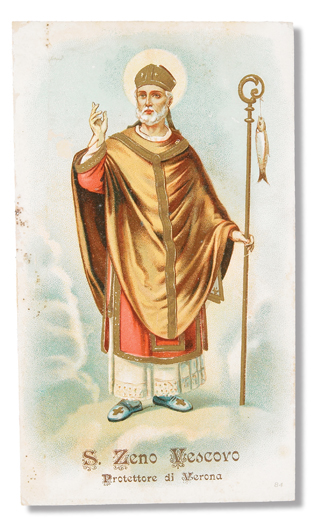
Babies / Zeno of Verona, 300–371, Feast Day: April 12

Born in Africa, Zeno was a bishop of Verona who loved to fish in the Adige river. He was a notable preacher and wrote much about baptism. When he was born, a demon took his place in his crib, and though he was suckled for eighteen years, he never grew. In the meantime, Zeno was raised by monks. When he was coincidentally sent by them to investigate this phenomenon, he forced the demon to spit up all the milk he had consumed into a great vat.

Other patronages: Verona; fishermen; children learning to speak, children learning to walk

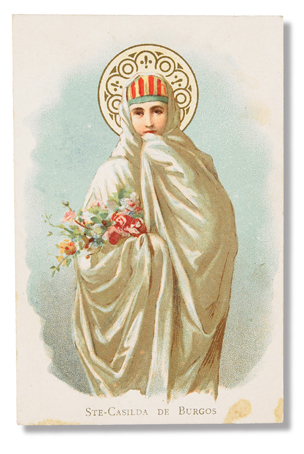
Sterility / Casilda of Toledo, d. 1050, Feast Day: April 9

The Muslim daughter of the Emir of Toledo, Casilda had great compassion for Christian prisoners, frequently sneaking them food. When she fell ill with a uterine hemorrhage, she made a pilgrimage to the sanctuary of Saint Vincent Briviseca in Burgos. She became a Christian after being healed and lived out her life as a hermit near that sanctuary.

Other patronages: Burgos (Spain), Toledo (Spain)

Invoked: against bad luck, uterine hemorrhage

Teachers / John Baptist de La Salle, 1651–1719,
Feast Day: April 7

Giving up a life of ease as canon of Rheims, John Baptist devoted his life to the education of the poor. He donated his personal fortune to create a school to educate teachers. He was the founder of the Christian Brothers, an order devoted to the education of boys. There was much animosity toward his revolutionary teaching methods; he instituted the system of eight grades for primary school that we use today.

Other patronages: school principals

Builders / Vincent Ferrer, 1350–1419,  Feast Day: April 5

A Dominican priest from Valencia, Spain, Vincent Ferrer was a healer and a highly charismatic preacher who generated crowds in the tens of thousands. Demoralized by the Great Schism in the Church, he dreamed that Saints Francis and Dominic implored him to go on apostolic missions. He traveled through Spain, France, Italy, Germany, Belgium, England, Scotland, and Ireland. He is known as patron of builders for his work in strengthening and building up the Church.

Other patronages: fields, vineyards; innkeepers, lead casters, pavement workers, plumbers, roofers, straw-hat makers, tile makers

Invoked: against epilepsy, headaches, drought, earthquakes, lightning strikes

The above patron saints are excerpted from the book: “Patron Saints:
A Feast of Holy Cards” by Barbara Calamari and Sandra DiPasqua

All images are from the holy card collection of Father Eugene Carrella


Happy Easter from Dining With the Saints

A Roman Easter Dinner

Roman Easter food has always had a big allure for me. It’s creative, seasonal Italian cooking at its best. Lamb, ricotta, eggs, artichokes, asparagus, shell peas, favas, and wheat all play a part in the Easter feast and Roman springtime celebrations. These are rich tastes, but their youth and greenness makes them renewing to the spirit, which is just what I want around this time of year.

Here’s a Roman dish that I absolutely love since it highlights the beauty of spring asparagus, and I can’t imagine Easter without asparagus (even though they’re not quite in season here yet, but California imports are pretty decent). Here you’re bringing together a few simple ingredients, asparagus, eggs, pecorino, guanciale, a handful of herbs, to create a very opulent dish. Since you leave the egg yolks soft they run all over the asparagus and the guanciale, creating a cheesy, eggy sauce. Really nice. I think it’s a great first course before another classic Roman Easter dish, braised lamb with fresh green peas. Here’s my recipe for that if you’d like to give it a try: http://ericademane.com/2002/05/05/agnello-alla-cacciatore/.

Easter Eggs with Asparagus, Guanciale, and Pecorino

 (Serves four as a first course)

1 large bunch of medium thick asparagus, trimmed and peeled

Extra virgin olive oil

1/3 cup well chopped guanciale (you can use pancetta instead)

2 garlic cloves, peeled and lightly crushed

Salt

Freshly ground black pepper

The juice from ½ a large lemon

4 extra large eggs

1/2 cup grated Pecorino Romano (get the best you can find, something that’s not overly salty)

A few chives, chopped

A few large sprigs of fresh mint, leaves left whole

Set up a pot of water and bring it to a boil. Drop in the asparagus and blanch for about 4 minutes. Drain the asparagus in a colander and then run them under cold water to stop the cooking and set their green color. Drain well.

Lay the asparagus out in a shallow baking dish.

In a large skillet heat a tablespoon of olive oil over medium heat. Add the guanciale and let it get crisp and give up its fat. Add the garlic and sauté a minute longer, just to release its flavor.

Remove the crisp guanciale bits from the skillet with a slotted spoon and scatter them over the asparagus. Discard the garlic. Season the asparagus with salt, black pepper, and the lemon juice. Reserve the guanciale cooking fat.

Poach the eggs in just simmering, lightly salted water until the whites are set but the yolks are still runny. Scoop them from the water with a slotted spoon, resting them on paper towels for a moment to blot excess water, and arrange them on the asparagus. Spoon a little of the guanciale cooking fat over the eggs (an important step for flavor) and season them with salt and black pepper.

Sprinkle on the pecorino and run the dish under a broiler until the cheese just starts to melt, about a minute or so. Garnish with the chives and the mint. Serve right away.

Dining With the Saints is a monthly column written by chef and writer Erica DeMane.

Erica DeMane.com

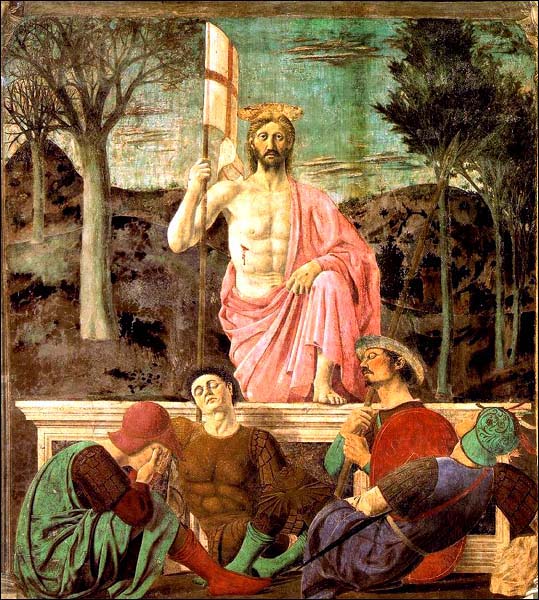
Image: “Resurrection” mural by Piero Della Francesca  1463 – 65

Novena For March

SAINT JOSEPH

First Century

Feast Day: March 19

Patron of: Austria, Belgium, Bohemia, Canada, China, Croatia, Korea, Mexico, Peru, Vietnam,  carpenters,  Catholic Church, families, fathers, homeless, pregnant women, workers

Invoked: for family protection, to find work, for a happy death, to sell a home, against doubt, against hesitation, Symbols: Lily, Baby Jesus, Flowering branch, Carpenter’s tools

  “I know by experience that the glorious Saint Joseph assists us generally in all necessities. I never asked him for anything which he did not obtain for me.” 

            Saint Teresa of Avila

          A working man descended from royal lineage, Joseph is said to have been chosen by God to protect His greatest treasures, Jesus and Mary. In the few descriptions of him in the Gospels, Joseph never speaks. He displays the depth of his faith by listening and quietly doing what he is told. In the face of possible public scandal he marries Mary when she is pregnant with a child that is not his. When an angel tells him that the child she has conceived is of the Holy Spirit, he accepts it.

         When all citizens were required to register on the tax rolls Joseph dutifully takes a very pregnant Mary with him to Bethlehem. As the city is severely overcrowded, they cannot find a proper place to sleep and Mary is forced to give birth in a stable. The holy family settles back into Nazareth until an angel warns Joseph in a dream of the impending slaughter of the innocents, and instructs him to flee with Mary and Jesus to Egypt. Without hesitation Joseph relinquishes his business and home to take his wife and young son on a perilous journey to an unknown land. Following the angel’s order, they stay in Egypt for seven years, with Joseph caring for both the financial and spiritual needs of the holy family.

            The final mention of Joseph is in the story of the twelve year old Jesus straying from his family during a pilgrimage to Jerusalem. It is believed that Joseph died well before Jesus began his public life and his patronage for a good death stems from the probability that he was surrounded by Jesus and Mary as he lay on his death bed.

            While the gospels concern Joseph only in regard to his relationship to Jesus, other histories of Joseph passed down from the fifth century state that Joseph was a widower who had been married 49 years and had six children before his first wife died. When the priests announced that all unmarried men from the tribe of Juda were to be candidates to marry Mary, Joseph went to Jerusalem with great reluctance. He was elderly and did not think he should be seriously considered. While the other men presented themselves by putting their walking sticks on the altar, Joseph held back and did not participate.  To everyone’s amazement the tip of his staff burst into a bloom of flowers, a sign from God that he was to be named the fiancee of Mary.           This tale is where the early visual depictions of Joseph as an elderly man with a flowering branch come from.  It was also thought that since Joseph had to respect Mary’s virginity throughout their marriage, that in all probability he would have been older.

            During the beginnings of the church, only martyrs were recognized as saints. Despite the importance of Joseph in the life of Christ, his cult was only found in the East. It did not arrive in the West until the ninth century when he was honored in church as the Foster Father of Our Lord.  The Carmelite order brought his cult to Europe when they were driven out of Jerusalem during the Crusades and the first church dedicated to him was in 1129 in Bologna, Italy.             

European Evangelists recognized Joseph’s reputation as the perfect father figure as useful in gaining conversions.  Common people forced to put the needs of their family before personal ambition saw Joseph’s life mirror their own. Church mystics and scholars Bernard of Clairvaux, Thomas Aquinas and Bridget of Sweden all stressed the importance of Saint Joseph in their religious devotions. While reforming the Carmelite order in Spain, Teresa of Avila chose him to be the patron of her Discalced Carmelite order.  She did much to spread his public devotion spread throughout the Spanish Kingdom. During the Middle Ages when drought and famine struck Sicily, residents throughout that island prayed to Saint Joseph for help. At midnight on March 19th rain began pouring and good weather immediately followed. Sicilians have venerated Saint Joseph ever since, by setting up altars, cooking special food and sweets which are given to friends and to the poor. These festivities were adapted by the rest of Italy where Saint Joseph is greatly revered. It is said that Saint Joseph has the power to overturn natural law, because Jesus had to obey his earthly father while he was a boy, that he would still do whatever Saint Joseph asked of him.

            With the advent of the Industrial Revolution, and the new class of laborers it produced, patronage to Saint Joseph became universal. By the end of the 19th Century he was named patron of the Catholic Church out of gratitude for the care he took of Jesus. Because Joseph had to move on a moment’s notice with the flight into Egypt and was responsible for providing shelter for his family, he is invoked for buying or selling a home.  The tradition of burying a Saint Joseph’s statue on the grounds of a home to initiate a quick sale goes back to the 17th Century. When Teresa of Avila was in need of more land to set up her religious houses, she had her nuns bury their Saint Joseph’s medals in the ground. Gradually, these medals evolved into a statue of Saint Joseph that would be buried upside down until the house was sold, then dug up and taken to the new home. Today, even nonCatholics do this as a superstitious rite, buying Saint Joseph’s Home Sale Kits off the internet.

            In art, Saint Joseph is always depicted with the infant Jesus. He sometimes has carpenter tools and because of his chastity he carries a lily for purity. The flowering staff became a popular attribute for him because it is also the emblem of shepherd kings who forcefully defended their flock. This staff is also the ancestor of the Bishop’s crook. An additional feast day was declared for Saint Joseph as May 1st.  May Day to the rest of the world, the church in its attempt to combat Communism dedicated this day set aside for the working man to the Patron of Workers.

Prayer for Saint Joseph’s Intercession


                                     Remember, O most chaste spouse of the Virgin Mary,

                                That never was it known that anyone who implored your help

                                          and sought your intercession was left unassisted.

                                                     Full of confidence in your power,

                                                 I fly unto you and beg your protection.

                                            Despise not, O foster father of the Redeemer,

                                                 My humble supplication, (request here)

                                             but in your bounty, hear and answer me. 

            Amen

Excerpted from the book “Saints:Ancient and Modern” by Barbara Calamari and Sandra DiPasqua.

Dining with the Saints in Honor of Saint Joseph

More on Saint Joseph

Dining With The Saints

St. Patrick’s Day


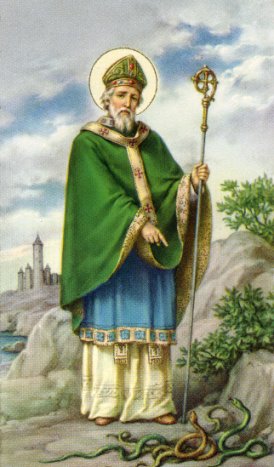
The Irish have observed St. Patrick’s feast day of March 17th for over 1,000 years and even though it falls during lent, the church for this celebration has long waved the prohibitions against meat. This is a huge national holiday throughout the country and people traditionally celebrate with a meal of Irish bacon cooked with cabbage, lots of beer, and lots of dancing.
Fresh salmon, one of Ireland’s finest food offerings and a springtime treat, is fast becoming a contender for the centerpiece of the St. Patrick’s Day meal. Especially popular is salmon poached or baked and then finished with a cream sauce. Sounds rich, and it is. I’ve lightened this dish a bit by adding white wine, lemon zest, and capers to the cream. I think this salmon would be perfect with a side of steamed asparagus and boiled new potatoes tossed with butter and parsley.

Baked Salmon with White Wine, Cream, and Capers

(Serves four)
A 2 1/2 pound piece of wild salmon fillet (a thick center cut), skinned
Unsalted butter
½ cup dry white wine
1 large shallot, very thinly sliced
Salt
Freshly ground black pepper
A few big scrapings of freshly ground nutmeg
½ cup of heavy cream
The grated zest from 1 small lemon
A palmful of small capers, rinsed
A few large dill sprigs, chopped
Preheat the oven to 350 degrees.
Lightly butter the bottom of a large baking dish (one that gives the salmon a little room to breath, about 2 inches on all sides is perfect). Place the salmon in the dish and pour on the white wine. Season it with salt, black pepper, and the nutmeg. Scatter on the shallots and dot the top with small pieces of butter. Cover with foil and bake until the salmon is just tender and still a little pink at the center, about 15 minutes or so (it should flake at the thinner ends but still be a bit pink at the thickest point).
Take the salmon from the oven and gently, with a large, long spatula, transfer it to a warmed serving platter. Cover it with aluminum foil to keep it hot.
Place the baking dish with the salmon cooking juices over a high flame and boil the juices down until you have about 3 tablespoons. Add the cream and the lemon zest and boil that down until it’s reduced by about ½, adding a little salt and fresh black pepper. Strain the cream sauce and pour it over the salmon. Scatter on the capers and the dill. Serve right away.
 
Written by Erica De Mane, chef and food writer. Check out her blog at www.ericademane.com
 

Patron Saints for March

ONE-ARMED PEOPLE: JOHN DAMASCENE

 676 – 749                                FEAST DAY: MARCH 27

 A Syrian Christian who was the chief financial officer for the Muslim Caliph, John was extremely well educated. When the Patriarch of Constantinople ordered the destruction of icons as graven images, John wrote the treatise In Defense of Icons. Thisbrought the common people into the debate. In revenge, the Patriarch made false charges against him to the Caliph, and John’s writing hand was cut off as punishment. He spent the night praying before an icon of the Virgin Mary, and it was miraculously reattached. Because of the wisdom of his writings he is one of the Doctors of the Church.

 Other Patronage: Iconographers