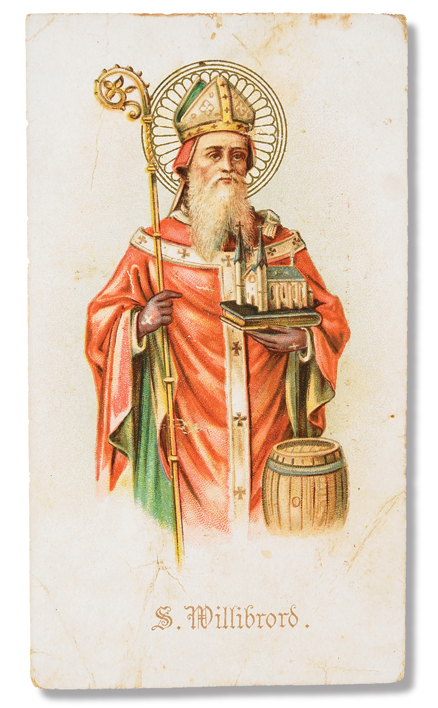
Convulsions / Willibrord, 658–739, Feast Day: November 7

Born in England, Willibrord was a missionary in Denmark and Holland. He died founding a Benedictine monastery in Luxembourg. At his shrine there, a dance procession lasting several hours is performed in honor of his role in ending an epidemic of St. Vitus’ dance. The dance consists of three steps forward and five steps back, circling the saint’s tomb, and then leaving the church. This dance is also supposed to have curative powers for those with nervous disorders.

Other patronages: Luxembourg, the Netherlands

Invoked: against chorea, epilepsy, herpes, lumbago


The above Patron Saints are excerpted from the book: “Patron Saints: A Feast of Holy Cards” by Barbara Calamari and Sandra DiPasqua. All images are from the holy card collection of Father Eugene Carrella.

Novena for November

Saint Martin de Porres

1579-1639

 Universal healing and harmony are the themes of Saint Martin de Porres’s life. He was so in tune with the rhythms of nature and the universe that he was able to heal any sickness, read minds, and converse with animals. To Saint Martin, physical health was essential for spiritual growth; thus, he should be called on whenever wholeness in health or personal relationships are required. Multi-racial himself, he is the patron of racial harmony and invoked whenever racial tensions arise.

 Saint Martin was born in Lima, Peru, just thirty-five years after the conquest of Pizarro. His father was a Spanish nobleman and his mother was a free black woman. Since people of mixed race were reviled, Saint Martin might have been just another social outcast in that country’s history. Instead, he became one of Peru’s national idols.  When Martin was twelve he was apprenticed to a barber. In those times, besides being a haircutter, a barber was also a surgeon, doctor and pharmacist. By the time he was eighteen years old, Martin’s reputation as a healer was well established. Rather than pursue his profession, martin kept giving all of his money to the poor. His was a desire to serve God in a state of total childlike humility. He entered the local Dominican monastery as tertiary, the lowest possible level; there he swept the floors and dreamed of being martyred in some foreign mission.  Instead, his undeniable talent as a healer became obvious, and he was put in charge of the infirmary. Tirelessly working, he tended to African slaves, the native population, and the Spanish nobility with the same all-consuming intensity.  His power to heal any sickness was legendary, and he was so intuitive that his patients swore tha the could read their minds. Stories of his wondrous abilities spread and became more and more elaborate: he was seen walking through a locked door; he was seen in two places at one time; and some said that the could fly from one place to another.

 Because of Saint Martin’s attunement to nature and its elements, animals flocked to him. He even set up a makeshift hospital to tend sick dogs and cats. Another story has it that he made a pact with the local rats and mice that he would feed them every day if they promised to stay out of the monastery. Each noon he opened the doors of the monastery and fed the poor. No matter how many hungry people were waiting, he never ran out of food.

 Saint Martin’s holiness and miraculous cures made him famous in his own lifetime. Bishops and learned men routinely consulted him to resolve theological problems. This fame undoubtedly, was the most difficult aspect of his life, since humility and prayer were the most important things to him. Because of his earlier profession, Saint Martin de Porres is also the patron of hairdressers and barbers. In art he is often shown holding a lily for purity and a broom for humility, while standing with small animals at his feet to reflect his closeness to nature. Saint Martin de Porres died of quartan fever in 1639 when he was sixty years old. Immediately upon his burial, miraculous healings were reported all around his tomb site.

Feast Day: November 3, 2010

Patron Saint of: Racial Harmony, the Poor, Barbers, Hairdressers

Novena to Saint Martin de Porres

Saint Martin de Porres, your concern and charity embraced not only your needy brethren, but also the animals of the field. You are a splendid example of charity; we thank and praise you. From above, hear the requests of your needy brethren.

(Mention your request).

By modeling our lives after yours, and imitating your virtues, may we live content knowing that God has looked favorably upon us. Because this is so, we can accept our burdens with strength and courage in order to follow in the footsteps of our Lord and the Blessed Mother. May we reach the Kingdom of Heaven through the intercession of our Lord Jesus Christ. Amen.


Say this novena nine times in a row for nine days in a row.

(Excerpted from the book: “Novena: The Power of Prayer” by Barbara Calamari and Sandra DiPasqua.)


All Saints Day November 1

Novena for All Saints Day

Image: Tapestry, “Communion of the Saints”  by John Nava

Saint Jude Thaddeus

Apostle

 First Century

Feast Day: October 28

Patron of: impossible causes

Invoked: in times of desperation

Symbol: Flame over head, club, cloth with image of Jesus

“…in accordance with his surname Thaddeus (meaning generous or loving), he will show himself most willing to give help.”

               Bridget of Sweden, 15th century

              Saint Jude was one of the original 12 apostles of Jesus. During his lifetime, his compassion and love for others was profoundly evident. Now, thousands of years after his death, his relief aid in seemingly hopeless situations ensures his place as one of the most popular and invoked saints in the world.

                      Jude Thaddeus was said to be a cousin of Jesus and the brother of James the Less. As an apostle of Christ, Jude learned first-hand the power of God to bring about healing and protection for what some might call “lost causes”. The most intriguing example can be found in the legends of Edessa (a city in Mesopotamia).  As the story goes, King Abgar suffered greatly from leprosy and, desperate for relief, wrote a letter to Christ saying,  “I have heard about you and the cures you effect, that you do this without medicaments or herbs, and that with a word you cause the blind to see, the lame to walk, lepers to be cleansed and the dead to live again. Having heard all this, I have decided in my mind that you are either a god and have come down from heaven to do what you do, or you are the Son of God and so do these things…” 

        Jesus was happy that King Abgar believed in Him without even seeing Him; however,  He did not have time to visit the king. When the king realized he would never see Christ Himself, he sent an artist to draw a portrait. The artist was so overcome with the radiance emanating from Christ’s eyes, his hands shook and he could not accomplish his task. Jesus took a cloth and wiped and His face in it, leaving His image imprinted in the cloth. Jude was sent back to Edessa to present this portrait to the king who rubbed in on his own body and was instantly cured of his disease.

            In a different version of the story, Jude presented the burial cloth of Christ to King Agbar by carrying the precious material  seared with Christ’s image, folded up as a portrait. The king was cured when he touched the shroud. His subsequent baptism by Jude established Christianity in Edessa. Jude’s role as a helper to the despondent was sealed, as was his influence in this region of the world. The shroud, of course, has become  known as the Holy Shroud of Turin.

             After the death, resurrection, and ascension of Christ, Jude and the apostle Simon were sent back to Mesopotamia (present day Iraq), Persia, Armenia and Southern Russia to preach. They became popular with the local population for their keen intellect, clever dialogue and the amusing ways in which they outwitted sorcerers and magicians in public discourses and arguments. When invited to choose, as was the custom of the day, how their losing antagonists were to be executed, Jude and Simon would reply, “We are not here to kill the living but to bring the dead back to life.” They would then joyfully preach the message of Christ, converting thousands at a time.

            Jude and Simon were not without detractors, however, and in the Epistle of Jude, his only writings to survive him, Jude exhorts recent converts in the East in 60 AD, to stay strong in the face of persecution and to persevere through harsh and difficult circumstances. These persecutions caught up with both Simon and Jude just five years later when they were martyred together for their evangelizing. Today, their relics are buried under the main altar of Saint Peter’s Basilica.

             Over the centuries Saint Jude became confused with Judas Iscariot, the apostle who sold Christ for 30 pieces of silver. ( In many instances, to avoid this confusion, he is referred to as “Thaddeus” in the writings of the evangelists.) Because he shared a name with such a notorious character few Christians invoked Saint Jude for help. The mystical saints Bernard of Clairvaux in the 12th Century and Bridget of Sweden in the 15th were exceptions. According to a vision, Jesus told Saint Bridget of Sweden to dedicate an altar to Saint Jude, because “in accordance with his surname, Thaddeus (meaning generous or loving) he will show himself most willing to give help.”        

            Few Catholics took these words seriously until the 19th Century when a tradition began that when Saint Jude would answer the most impossible of prayers, the petitioner in tuen, must thank the saint in a public way. The advent of inexpensive newspapers made this obligation possible and to this day,  weekly and daily periodicals all have their share of “Thank you Saint Jude” personal ads. Perhaps the grandest gesture of public thanks to this saint is the world- famous Saint Jude’s Children Hospital in Memphis, Tennessee. It was built by the entertainer Danny Thomas as a tribute to Jude for answering his prayers when he was struggling to support his family. This hospital serves children with “hopelessly incurable diseases” and has become a groundbreaking research institution, saving the innumerable young lives on its premises and even more internationally through its discoveries. From its great success, the name Saint Jude has become a common name for research hospitals all over the world.

                Since he was present at the Pentecost Saint Jude is always depicted with the flame of the Holy Spirit over his head. His principal attribute is the cloth with Christ’s image, sometimes displayed on his body in a medallion form. He carries the club or axe he was beaten to death with and also displays the palms of  the   martyr.                                                                          

                                                                Prayer to Saint Jude


                                    Saint Jude, glorious Apostle, faithful servant and

                                    friend of Jesus,

                                    The name of the traitor has caused you to be forgotten

                                    by many,

                                    But the true Church in invokes you universally as the patron

                                    Of things despaired of; pray for me,

                                    that I may receive the consolations and the help of

                                    heaven in all my necessities, tribulations and sufferings,

                                    particularly (here make your request) and that I

                                    may bless God with the elect throughout eternity.

                                    St. Jude, Apostle, martyr and cousin of our Lord Jesus Christ,

                                    intercede for us. Amen.

Excerpted from the book: “Saints:Ancient and Modern”  by Barbara Calamari and Sandra DiPasqua.

Image: Saint Jude by El Greco
Dining With the Saints


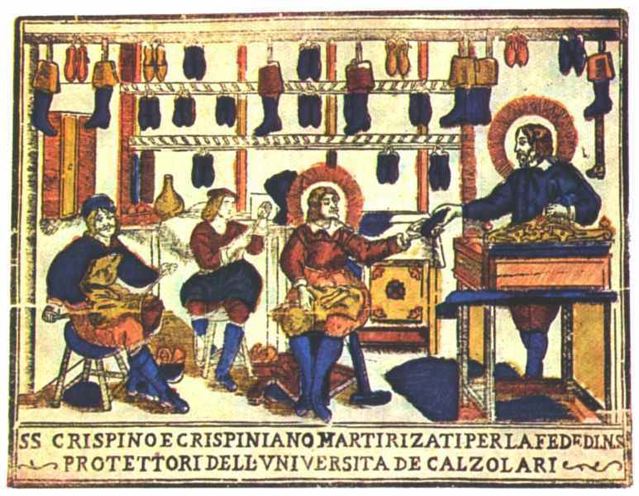
The Feast Day of San Crispino


Every year on October 25, in the Puglian town of Acquaviva delle Fonte, the Feast of San Crispino is celebrated with a Sagra del Calzone, a huge calzone festival. The star of the day is a particular calzone filled with ricotta, sauteed red onion, a local, sweet variety called Tropea, roasted tomatoes, and black olives, all cooked in wood burning ovens.


San Crispino was born in the 3rd century of noble Roman birth, but became a cobble so he could relate to the common people. He is often depicted holding or making shoes. He is the patron Saint of cobblers, tanners, and all leather workers and as a result has been adopted by groups as diverse as equestrians and people who just like to wear leather, such as the Hell’s Angels. What this all has to do with calzones is somewhat of a mystery, but the calzone has been a feast day symbol in Italy for decades. It’s a delicious and convenient street food, perfect to eat while strolling and shopping, since many faithful buy a new pair of shoes each year on San Crispino’s feast day.

Since it’s hard to find Tropea onions in the U.S., I made a version of this calzone using leeks, which are in season now at many greenmarkets.

Calzone with Spiced Leeks, Ricotta, and Roasted Tomatoes

 (Makes two large calzones)

For the dough:

1 cup warm water (approximately 110 degrees)

1 tablespoon extra virgin olive oil

1 package active dry yeast

A generous pinch of salt

2 ½ cups of all-purpose flour


 For the filling:

2 pints of grape tomatoes

Extra virgin olive oil

Salt

5 medium leeks, using only the tender white and very light green parts

A pinch of sugar

¼ teaspoon ground cloves

1 bay leaf

Freshly ground black pepper

A splash of dry Marsala

1/2 cups whole milk ricotta, drained if watery

1/2 cup grated grana padano cheese

A handful of flat leaf parsley, leaves lightly chopped


Plus, about ½ cup of corn meal


For the dough:

Pour the warm water and olive oil into a large bowl. Sprinkle the yeast and the salt over the water and give it a stir. Let stand for about 5 minutes to give the yeast a chance to develop. Add 1 cup of the flour and stir well. Mix in 1 more cup of the flour to form a sticky ball.

Transfer the dough to a well floured surface, leaving behind any crumbly bits that have not been incorporated. Knead the dough until smooth and elastic, about 5 minutes, adding a bit more flour if needed to prevent sticking. Transfer the dough to a lightly oiled bowl, turn to coat the dough in oil, and cover the bowl with a damp kitchen towel. Let it rise in a warm place until doubled in size, about an hour or so.

Punch the dough down and divide it into 2 equal pieces. Form each into a ball. Transfer the dough balls onto a floured work surface and let them rise again for about 15 minutes.

 While the dough is going through it’s first rising, preheat the oven to 425 degrees. Place the tomatoes on a sheet pan. Drizzle them with olive oil and season with a little salt. Mix them around with your hands until they’re well coated. Roast until lightly browned and just starting to burst, about 12 minutes. Take them from the oven and let them cool a bit.

 I a large skillet, heat 2 tablespoons of olive oil over medium heat. Add the leeks, sugar, cloves, bay leaf, salt, and some black pepper. Sauté until the leeks are just starting to turn very lightly golden, about 10 minutes. Add the splash of Marsala and let it bubble away. Remove from the heat and let it cool for a few minutes.

 In a medium bowl combine the ricotta, the grana padano, and the parsley, seasoning it with a little salt and black pepper.

Place a pizza stone in the oven and turn the heat up to 500 degrees.

On a floured work surface, roll one of the dough balls out to an approximately 11 inch round. Sprinkle a pizza peel or baking sheet with a little cornmeal and slide the dough onto it. Spoon half of the ricotta mixture on one half of the dough, heaving a 1 inch margin. Top with half of the leeks and half of the tomatoes. Fold the dough over to form a half moon shape and pinch the edges together, making little tucks to close it well. Poke a few holes in the top to let out stem. Brush the top lightly with olive oil.

 Slide the calzone onto the pizza stone and bake for about 18 minutes, or until golden. Serve hot or warm. Make another calzone exactly the same way.

Dining with the Saints is a monthly column written by Erica De Mane. To see more of her recipes, please go to http://www.ericademane.com, her own food blog.


SAINT URSULA

Fourth Century

Feast Day: October 21

Patronage: British Virgin Islands, Cologne, Germany, University of Paris, Educators, Girls, Drapers, Orphans, Archers

Invoked for a Holy Death, the education of girls and women, against shipwrecks on rivers and for a happy marriage.

Symbol: Arrows, Cloak, Ship, Crown, Pilgrim’s Staff with white flag and red cross.

“For this most chaste and golden army

crossed the sea with maidenly, flowing hair.

O who has ever heard such great things?”  – From “Chants for the Feast of Saint Ursula” by     Hildegarde von Bingen, 12th Century

             The story of Saint Ursula and her virgin army of 11,000 maidens was a major influence on the creative world of the Middle Ages and the Renaissance.  For hundreds of years, the tales of Ursula and her army of 11,000 Virgins made a fascinating subject for artists of all disciplines. The early Middle Ages are filled with accounts of mystics communicating with the souls of the young maidens. Images of thousands of girls sailing around in their own ships captured the popular imagination. Their tragic and daring tale of martyrdom inspired one of the finest pieces of liturgical music ever written, “Chants for the Feast of Saint Ursula” and the artists Caravaggio, Giovanni Bellini and Claude Lorrain have all celebrated her as a famous subject. Almost every country of Europe has a famous visual rendition of Ursula’s story created by some of the greatest painters in history. The Reliquary of Saint Ursula can be found in Bruges and is said to contain an arm of the saint. It is adorned with six miniatures by Hans Memling. The Scuola di San’ Orsola in Venice commissioned the artist Carpaccio to create his greatest work “The Dream of Saint Ursula” , a series of paintings based on the life of the saint that tell her story in an almost cinematic way.

            There are many different versions of this story, the first known one appearing in the eighth century when the local Cult of  Saint Ursula was strong. The authenticity of her legend is based on ten lines carved in the fifth century, now found in the church of Saint Ursula at Cologne, Germany. The words were written by a senator named Clematius who attests that due to a spiritual vision, he is dedicating a church on the grounds of an older basilica built to honor the virgins of Cologne martyred on that site on October 21.

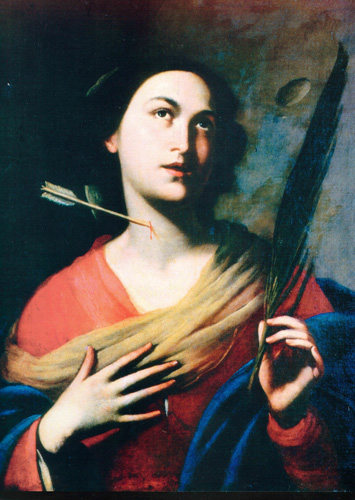
            The first written accounts of her martyrdom come a century later and nearly five hundred years after her death. They depict Ursula  as the Christian daughter of a British king who in order to avoid a war, agrees to an arranged marriage to a pagan prince. On the advice of an angel received in a dream, Ursula requested that she travel three years visiting the holy shrines of the Christians along with ten noblewomen who would each be accompanied by one thousand virgin companions. So great was Ursula’s beauty, that the neighboring king and his son readily agreed to her request. They helped amass the 11,000 virgins from kingdoms all over the known world.  Men being unwelcome on such a voyage, Ursula and her virgins were trained in sailing their 11 massive ships which first sailed to Cologne, Germany and then on to Basle where the women proceeded on foot through the Alps down to Rome. Gradually, these accompanying maidens converted from their pagan faiths to Christianity, and they were given a joyous reception by the Pope and the Christian community. On their return voyage, they stopped again at Cologne which had been overrun by the Huns. The invaders hated the prospect of so many future Christian mothers taking over the continent, and the virgins were massacred. Ursula was spared for her beauty, and the leader of the Huns demanded that she marry him. When she refused, he shot her in the chest with an arrow.  After her death, an army of 11,000 angels chased the Huns from Cologne and the grateful population converted to Christianity and erected a basilica in honor of Ursula and her Virgins.

             It is thought the very early stories of the virgin martyrs actually only included eleven young women, Ursula, being one of them. As the tale was recorded in Latin, the number 11 was transposed into 11,000, making the original story more fantastic with each recounting of it. In mythology, Urschel is also the name of the Teutonic moon goddess who welcomed the souls of dead maidens. It is thought that the history of this early virgin martyr could have been confused and combined with the legend of this goddess who also sailed up the Rhine river with a boatload of virginal companions.

                        It is in Ursula’s influence on a woman who lived 1,000 years after her own death that we feel her impact in modern times. In the 16th century, the Italian Saint Angela Merici was inspired by her own personal visions of Saint Ursula and her Virgins to found an order of nuns dedicated to educating young women. This was considered a revolutionary concept at a time where women were scarcely allowed to leave their homes. These were the first schools established for girls and young women in Europe, later coming to the Americas in the 17th Century. Today, Ursuline Academies and Colleges seriously follow their mandate to educate young women throughout the world and this order of teaching nuns maintains Saint Ursula as their patron.

             Though her cult is most popular in Germany and Eastern Europe, Saint Ursula can be found on the flag of the British Virgin Islands where her Feast Day, October 21 is a national holiday. The islands were discovered by Columbus on his second voyage in 1493. He named a larger island Saint Ursula and the surrounding ones, Once Mil Virgines (The Eleven Thousand Virgins). Eventually, this name was shortened to the Virgin Islands which is what they are known as today. Since Ursula was a British princess, she is depicted with a crown and the flag she carries is the banner of Saint George, the Christian flag of England. She is frequently sheltering young girls under a cloak, for this reason she is the patron saint of drapers. Because her fiancee was so agreeable to granting her request, she is invoked for happy marriages. She was martyred by an arrow, so she is the patron saint of archers. Saint Ursula is most associated with the education and empowerment of young girls.

                                                             Prayer to Saint Ursula

             By the merits of our Lord Jesus Christ, accept, O God,

            The prayers offered to you through the intercession of Saint Ursula,

            Faithful imitator of the virtues of the Heart of your Son,

            And grant us the favors we are confidently asking for. Amen.

             Saint Ursula, pray for us!

Excerpted from the book: “Saints: Ancient and Modern” by Barbara Calamari and Sandra DiPasqua.


Patron Saints for October

Pastures / Wendelin, 554–617, Feast Day: October 21

The pious son of a Scottish king, Wendelin made a pilgrimage to Rome, where he was advised to follow his heart. He toured religious sites in Europe and settled in Germany, where he tended sheep, which enabled him to pray most of the day. Eventually he founded a community of religious hermits that became the Benedictine Abbey of Thole.

Other patronages: farmers, shepherds

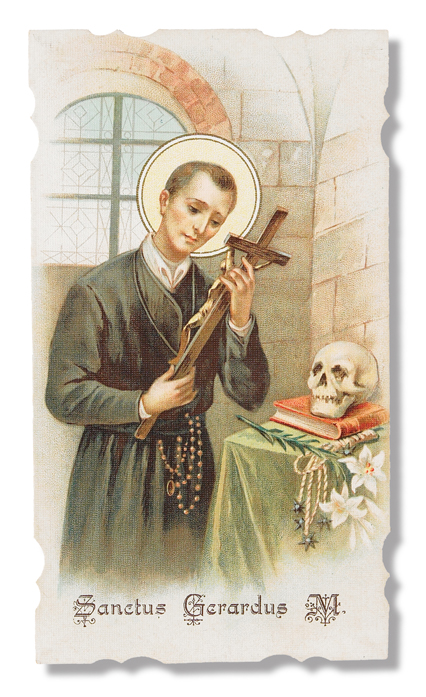
Pregnancy / Gerard Majella, 1725–1755,
Feast Day: October 16

A simple-minded lay brother, Gerard was known for working wonders. Once, after he had been visiting friends, their daughter tried to return a handkerchief he had left behind. He refused it, telling her it might be useful to her one day. Years later, she had it brought to her when she was dying in childbirth. She lived to deliver a healthy baby, and the handkerchief is still a popular relic for expectant mothers.

Other patronages: lay brothers, mothers

Invoked: against infertility

Novena to Saint Gerard Majella

Headaches / Teresa of Ávila, 1515–1582,
Feast Day: October 15

An intellectual and a reformer, Teresa was one of the most popular religious figures of her time and is still widely read today. Because her searing mystical visions would leave her in intense mental anguish, she is invoked against headaches.

Other patronages: Spain; lace makers

Invoked: against fires of purgatory, heart ailments

More on Teresa of Avila

Separated Spouses / Edward the Confessor, 1003–1066, Feast Day: October 13

Called “the Confessor” because he was a witness to his faith, Edward came out of exile to become the last Anglo-Saxon king of England. During his reign, his country enjoyed twenty years of peace. Edward and his wife, Edith, had no children since they were said to be celibate. Edward was generous to the poor, distributing rings as gifts. He had the power to heal, and he built Westminster Abbey in lieu of going on a much-desired pilgrimage to Rome.

Other patronages: England; kings; difficult marriages