Patron Saints for November

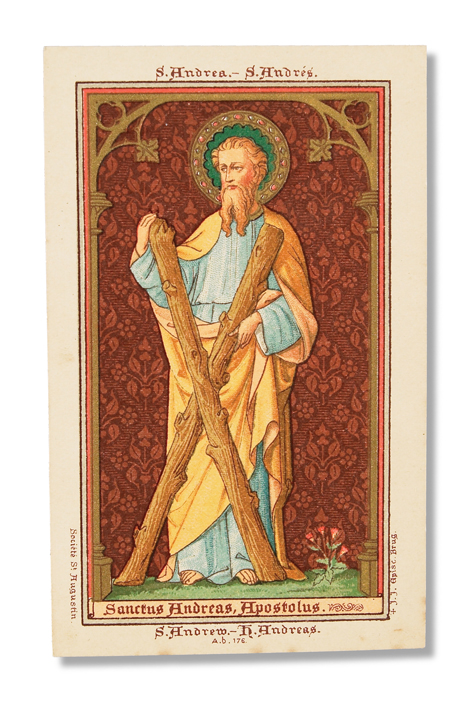
Greece / Andrew the Apostle, first century a.d.,
Feast Day: November 30

One of the original twelve apostles, Andrew was given Scythia, in what is now Russia, for his mission. It is doubtful whether he ever reached it. He was executed in Greece for converting the wife of the governor of Patras. He was tied to an X-shaped cross (known as a saltire cross), from which he preached for two days before dying. In the eleventh century, his remains were taken to Scotland, where his cross is on the national flag.

Other patronages: Amalfi (Italy), Burgundy (France), Russia, Scotland; fish dealers, golfers, sailors, singers; spinsters

Invoked: by women who wish to be mothers; against sore throat, gout, neck problems

Cyclists / Catherine of Alexandria, 287–305,
Feast Day: November 25

An Egyptian noblewoman, Catherine complained to the emperor about the persecution of the Christians in such a way that she converted his wife and the fifty philosophers who came to argue against her. When all except Catherine were executed, the emperor demanded to marry her. Because she refused, he ordered her to be broken on a spiked wheel, which crumbled to pieces at her touch. She was then beheaded. Because of the wheel, many careers that use wheels were put under her patronage.

Other patronages: University of Paris; knife grinders, librarians, mechanics, millers, nurses, philosophers, potters, spinners, students, wheelwrights; dying people, unmarried girls

Invoked: to find a husband; against diseases of the tongue

Musicians / Cecilia, d. 117, Feast Day: November 22

A girl from an illustrious Roman family, Cecilia was secretly a Christian. She had an arranged marriage with a pagan, and it is said that, on her wedding day, as the instruments were being played, Cecilia sang in her heart to God alone. After her marriage, she convinced her husband to follow her ways. He was found out and executed. When the Romans tried to behead her in her own home, she took three days to die. Her house became one of the first Christian churches. Some legends credit Cecilia with the invention of the organ.

Other patronages: composers, makers of musical instruments, poets

More on Saint Cecilia

Wolves / Edmund of East Anglia, 841–870,
Feast Day: November 20

Known as a fair and just ruler, Edmund was a king in eastern England. When the Danes invaded, he was captured and told to turn over his followers. When he refused, he was beaten, shot with arrows, and beheaded. When his followers came to claim his body, they could not find his head. They heard a voice in the woods calling and, following it, found a wolf cradling Edmund’s head between its paws.

Other patronages: kings; torture victims

Invoked: against epidemics, plague

Buisnesswomen / Hilda, 614–680, Feast Day: November 17

The daughter of English nobility, Hilda was an abbess. She founded the influential Abbey of Whitby, a double monastery that educated both men and women. Her order was devoted to the arts and sciences, and she was the patroness of the first English poet, Caedmon. Her management skills and wisdom were legendary; many important rulers and kings asked for her advice and guidance.

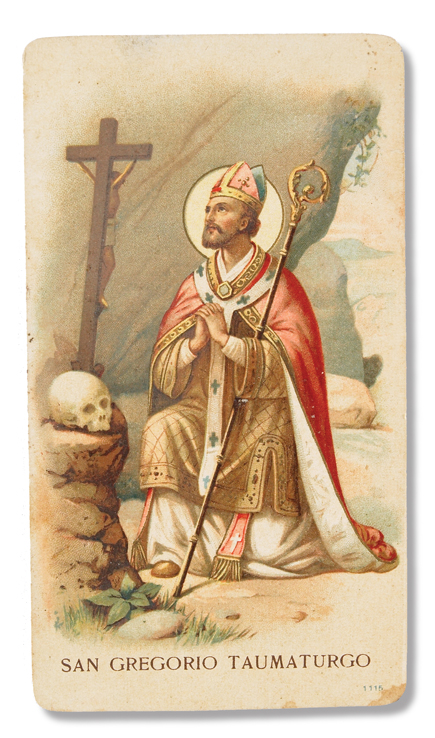
Earthquakes / Gregory Thaumaturgus, 213–270,
Feast Day: November 17

As a wealthy young law student in Beirut, Gregory converted to Christianity. Upon his return to his native city he was named the bishop of the seventeen Christians who lived there. By the time of his death, all but seventeen pagans had been converted by him. Known for his healing abilities, he could dry up streams and move great boulders with the commands of his word.

Other patronages: Armenia; desperate and forgotten causes

Invoked: against flooding

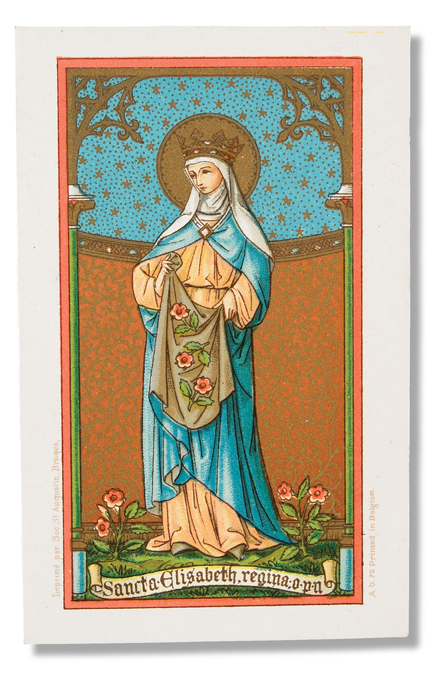
Hospital Workers / Elizabeth of Hungary, 1207–1231,
Feast Day: November 17

Daughter of the king of Hungary, Elizabeth had a happy marriage to the prince of Thuringia. Her
in-laws were at odds with her interest in caring for the poor and sick. When her husband died on his way to the Crusades, she and her children were turned out by his family. She became a Franciscan tertiary, donating whatever money she had left to building a hospital for the abandoned sick.

Other patronages: Germany; charitable associations, Franciscans, hospitals, Knights of the Teutonic Order, Sisters of Charity; bakers; beggars, orphans, unjustly persecuted people, widows

Invoked: against in-law problems, plague, ringworm, toothache

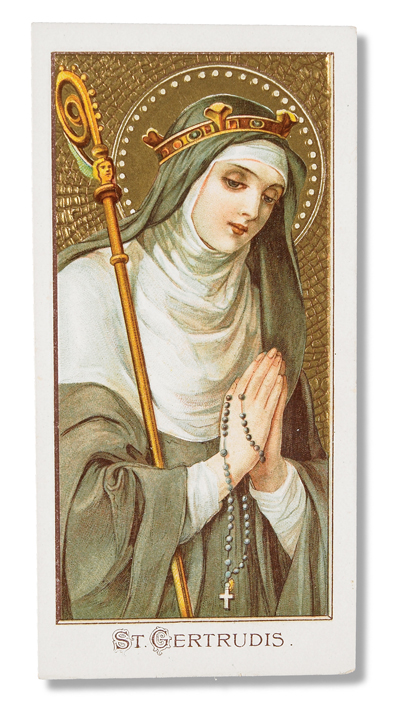
West Indies / Gertrude the Great, 1256–1302,
Feast Day: November 16

Placed in the Cistercian abbey at Helfta in Saxony at the age of five, Gertrude never left the convent. She had a phenomenal intellect and was a student of Saint Mechtild. At the age of twenty-five, she had a vision of Christ that changed the course of her life. She lost all interest in secular studies, concentrating instead on religious literature. Her own mystical writings influenced many future saints, and she was the first to meditate on the sacred heart of Jesus. Her name was entered into the canon of the mass in 1677, and the king of Spain had her named as patron of the West Indies.

Other patronages: nuns, travelers

Stepparents / Leopold III, 1073–1136,
Feast Day: November 15

The military governor of Austria, Leopold married Agnes, daughter of the emperor. She was a widow with two children, whom he raised. He and Agnes had an additional eighteen children, eleven of whom survived childhood. Refusing the crown of the Holy Roman Empire, Leopold founded Benedictine, Cistercian, and Augustinian monasteries, developing new towns and cities in Austria.

Other patronages: Austria; death of children, large families

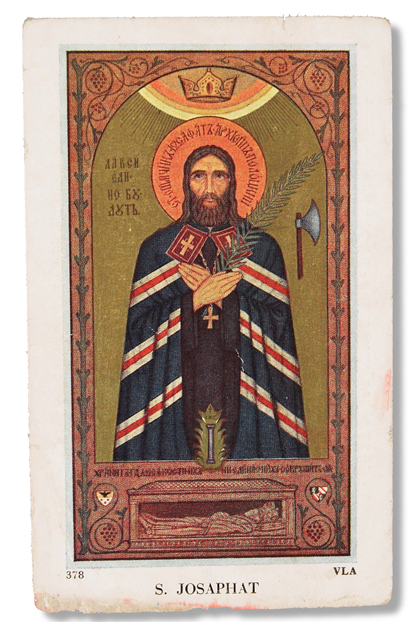
Ukraine / Josaphat, 1580–1623, Feast Day: November 12

The first Eastern Orthodox saint recognized by the Vatican, Josaphat was intent on repairing the Great Schism, which divided the Eastern and Western churches. His virtuous example as a bishop in Belarus inspired many to reunite with the Roman Church. This became a political problem, and when rioting ensued, he traveled to Vitebsk to quell the violence. He was martyred by an angry mob who split his head open with an axe. When his uncorrupt body was recovered from the river, his enemies, ashamed of what they had done, had a complete change of heart on uniting the churches.