Dentists / Apollonia, d. 249, Feast Day: February 9

During festivities celebrating the Roman occupation of Egypt, a violent mob began attacking Christians. Apollonia, a revered deaconess, was repeatedly hit in the face until her teeth were broken. Confronted with a raging bonfire if she did not denounce her faith, she voluntarily threw herself into the flames. Another version of this story says that she was tortured by having her teeth pulled with pincers before being burned.

Invoked: against toothache

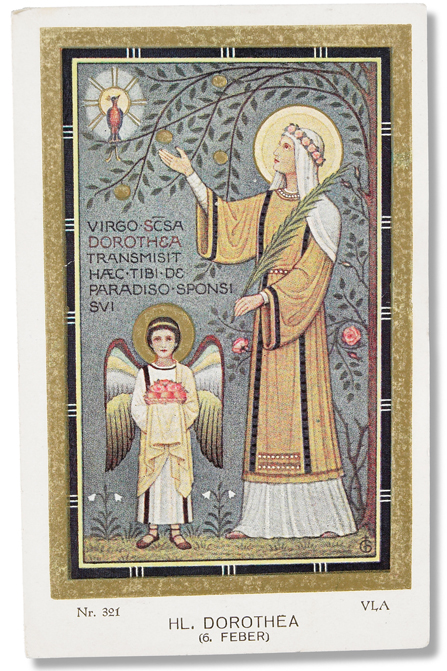
Florists / Dorothy of Caesarea, d. 311,
Feast Day: February 6

Her name means “gift of God.” Dorothy was a young Christian girl living in what is now Turkey. As she was being led away to her martyrdom, a lawyer in the jeering crowd mocked her by asking her to send him some flowers and fruits from the heavenly garden to which she was going. After her death, a child came by his house with Dorothy’s veil. Wrapped in it were three apples and three roses; this was in the middle of winter. The lawyer immediately converted and suffered the same fate as Dorothy.

Other patronages: brewers, gardeners, midwives; brides, newlyweds

Denmark / Ansgar, 801–865, Feast Day: February 3

Born in northern France, Ansgar earned the title of “Apostle of the North” by accompanying the newly baptized King Harald home to Denmark, where he set up the first Christian missions in Scandinavia. He was invited to Sweden, where he erected the first Christian church in an area extremely hostile to the new faith. As the bishop of Bremen, Ansgar witnessed the destruction of all he had worked for when the Vikings leveled his churches. His visions assured him his work would not be in vain. Two hundred years after his death, missionaries succeeded in evangelizing these northern countries in his name.

Other patronages: Germany, Iceland, Sweden

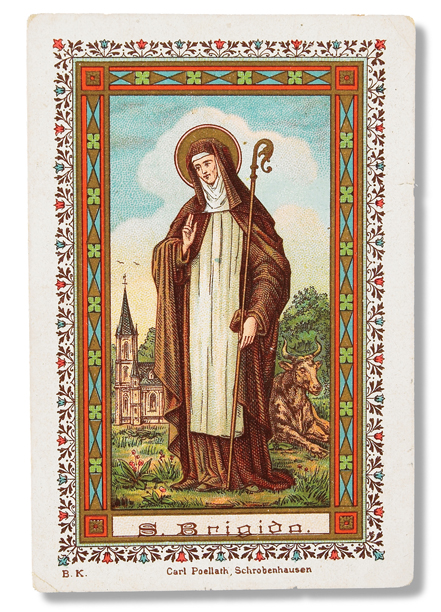
Dairy Workers / Brigid of Ireland, 453–523,
Feast Day: February 1

The daughter of a pagan king and a Christian slave, Brigid helped her mother run her owner’s  dairy with great success, despite the fact that she gave away more than they sold. After refusing to marry, Brigid entered into religious service and started the great Monastery of Kildare for men and women, which had a world-famous art school. She traveled extensively, founding religious houses throughout Ireland, and is buried with Saints Patrick and Columba.

Other patronages: Ireland, New Zealand; nuns, poultry workers, sailors, scholars, travelers; children with unmarried parents, fugitives, newborns

Invoked: against fire

Above Patron Saints excerpted from the book: “Patron Saints: A Feast of Holy Cards” by Barbara Calamari and Sandra DiPasqua. All images are from the collection of Father Eugene Carrella.

Novena for February

   Saint Blaise

One of the Fourteen Holy Helpers

D. 316     Feast Day: February 3

An Armenian bishop known for his healing powers, Blaise took refuge in a forest during a time of persecution. When many animals stayed by his side, angry hunters reported him to the authorities. While in prison, he healed a boy choking on a fishbone by praying in his cell. Condemned to death, he then promised to protect all who brought a candle to church on his feast fay. He is commemorated on his feast during the “Blessing of the Throats.”

Other Patronages:  Croatia, sick cattle, wild animals, builders, carders, laryngologists, mattress makers, swineherds, wind musicians, wool workers

Invoked against: Goiter, Throat Disease

(Above excerpt from the book, “Patron Saints: A Feast of Holy Cards” by Barbara Calamari and Sandra DiPasqua. Image from the collection of Father Eugene Carrella.)

Novena to St. Blaise to Cure Disorders of the Throat

O God, deliver us through the intercession of Thy holy bishop and martyr Blaise, from all evil of soul and body, especially from all ills of the throat; and grant us the grace to make a good confession in the confident hope of obtaining Thy pardon, and ever to praise with worthy lips Thy most holy name. Through Christ our Lord. Amen.

St. Blaise, gracious benefactor of mankind and faithful servant of God, who for the love of our Saviour didst suffer so many tortures with patience and resignation; I invoke thy powerful intercession. (Your intention here.)Preserve me from all evils of soul and body. Because of thy great merits God endowed thee with the special grace to help those that suffer from ills of the throat; relieve and preserve me from them, so that I may always be able to fulfil my duties, and with the aid of God’s grace perform good works. I invoke thy help as special physician of souls, that I may confess my sins sincerely in the holy sacrament of Penance and obtain their forgiveness. I recommend to thy merciful intercession also those who unfortunately concealed a sin in confession. Obtain for them the grace to accuse themselves sincerely and contritely of the sin they concealed, of the sacrilegious confessions and communions they made, and of all the sins they committed since then, so that they may receive pardon, the grace of God, and the remission of the eternal punishment. Amen.

My Lord and my God! I offer up to Thee my petition in union with the bitter passion and death of Jesus Christ, Thy Son, together with the merits of His immaculate and blessed Mother, Mary ever virgin, and of all the saints, particularly with those of the holy Helper in whose honor I make this novena.

Look down upon me, merciful Lord! Grant me Thy grace and Thy love, and graciously hear my prayer. Amen.

Novena to Saint Agatha  Feast Day: February 5

Novena to Our Lady of Lourdes  Feast Day: February 11

Dining With the Saints

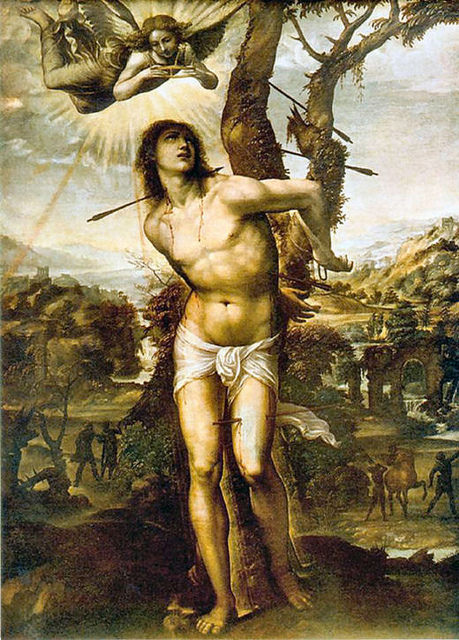
The Feast of San Sebastian

The image of San Sebastian, his young body riddled with arrows, is a strikingly familiar one to religious and non-believers alike. He was martyred for converting Christians, but has also become in recent times a symbol for the persecution of homosexuals, and his image is used in much gay art and literature.

He is a patron saint of athletes because of his physical endurance (he actually recovered from his arrow wounds), and for his energetic way of spreading and defending the faith. Saint Sebastian is also patron to all soldiers.

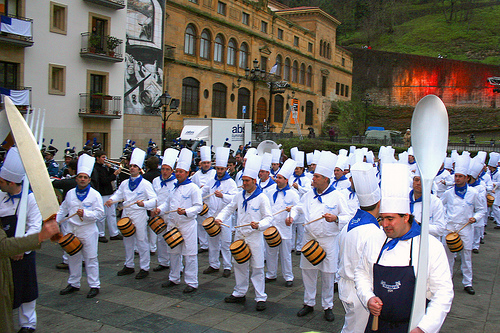
La Tamborrada is celebrated in the town of San Sebastian in Basque Spain on January 20th, San Sebastian’s feast day. This is a loud and exuberant affair where the people hit the streets to a crescendo of drum and barrel playing. The action starts at midnight on the 19th in the Parte Vieja (the old quarter) when the mayor raises the city’s flag in Plaza Konstituzioa.

People dress as soldiers and march around the town accompanied by their ear bending percussion. But the ceremony has also taken on a culinary tradition in more recent years. Nobody is completely sure why this connection was made, but people also dress as chefs and marchers representing San Sebastian’s gastronomic societies, most of which only allow male members, are always present. As you can imagine food has become the theme of this celebration and many Basque specialties are offered. One of my favorites is this traditional dish of braised tuna with potatoes and the region’s famous dried chilies. Many fine Basque wines are consumed during this festival. If you’d like to try one to accompany this lovely dish, see if you can locate a Txacoli, a crisp white DO wine from the province of Getariako Txakolina.

Marmitako

(Serves five as a main course)

2 dried ancho chiles

Spanish extra virgin olive oil (such as Nunez de Prado)

1 large sweet onion, such as a Vidalia, cut into medium dice

1 red bell pepper, seeded and cut into thin strips

2 garlic cloves, very thinly sliced

5 or 6 large thyme sprigs, leaves chopped

3 large all-purpose potatoes, peeled and cut into ½ inch cubes

½ tablespoon Piment d’Espelette (Basque semi-spicy paprika)

Salt

1 ½ pounds fresh tuna, cut into 1 ½ inch cubes

A handful of flat leaf parsley leaves, lightly chopped

Place the chilies in a small saucepan and cover them with water. Bring this to a boil over high heat. Turn off the heat and let the chilies sit in the water until softened, about ½ hour. Now slit them open and seed them. Scrape out all the flesh with a sharp knife and set it aside (you’ll have a little pile of soft chili paste).

In a large casserole heat about ¼ cup of olive oil over medium heat. Add the onion and the pepper strips and sauté until they’re just starting to soften, about 5 minutes. Now add the garlic, thyme, potatoes, the reserved chili paste, and the Piment d’ Espelette. Season with salt and sauté for a minute to blend all the flavors.  Now add warm water to cover by about 2 inches. Cover the casserole, turn the heat down a bit and simmer until the potatoes are tender, about 20 minutes.

Uncover the casserole and add the tuna. Turn off the heat and let it stand on the turned off burner for 5 minutes (the residual heat from the casserole will cook the tuna through gently. Now add a generous drizzle of fresh olive oil.

Let the casserole sit, off the burner for another 5 minutes or so to develop flavor. If you like, you can mash up a few of the potato cubes to thicken the sauce. Add the parsley. Serve in warmed soup bowls with bread that has been toasted, rubbed with a cut garlic clove and brushed with Spanish olive oil.
Dining With the Saints is written by Chef and Writer, Erica DeMane. Find her at her website: EricaDemane.com

Painting:”Martyrdom of  Saint Sebastian” by Il Sodoma (Giovanni Antonio Bazzi) 1525

Bottom photo: Feast Day of Saint Sebastian as celebrated in San Sebastian, Spain.

Patron Saints for January

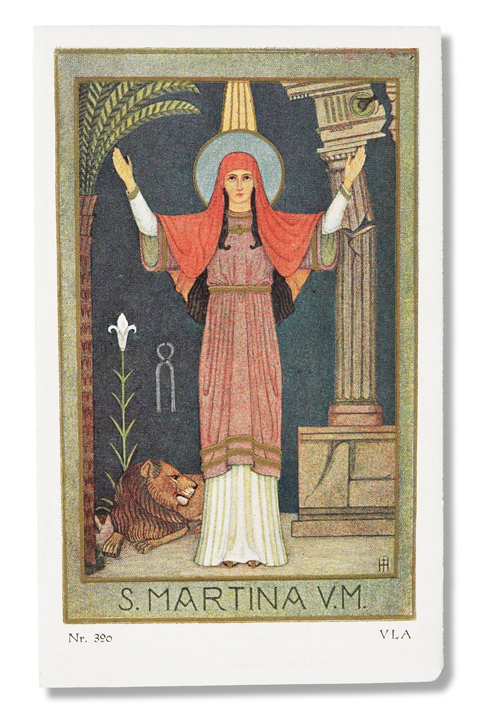
Breastfeeding / Martina, d. 228, Feast Day: January 30

A Roman noblewoman who converted to Christianity after being orphaned, her remains were discovered in the seventeenth century. Martina was said to have been tortured for days, and when she was executed with a sword, milk flowed from her body instead of blood. A church was built for her in the Roman Forum.

Other patronages: Rome

Deafness / Francis de Sales, 1567–1622,
Feast Day: January 24

A priest with great influence on the laity, Francis wrote the most popular spiritual book of the seventeenth century, Introduction of the Devout Life. He is credited with inspiring a resurgence of faith in France and Switzerland. At a time when the deaf were considered mentally deficient, he developed a method of teaching the catechism to a deaf man by using his own set of symbols and sign language.

Other patronages: Catholic Press, editors, journalists, writers

Floods / Margaret of Hungary, 1242–1271,
Feast Day: January 18

A princess whose parents promised her to God in thanks for stopping an enemy invasion, Margaret refused to leave the convent where she was placed. As an act of penance, she refused to wash and tended the hopelessly ill. Her father built her a convent of her own on an isle in the middle of the Danube River. Whenever it was threatened by flooding, she protected it with prayer.

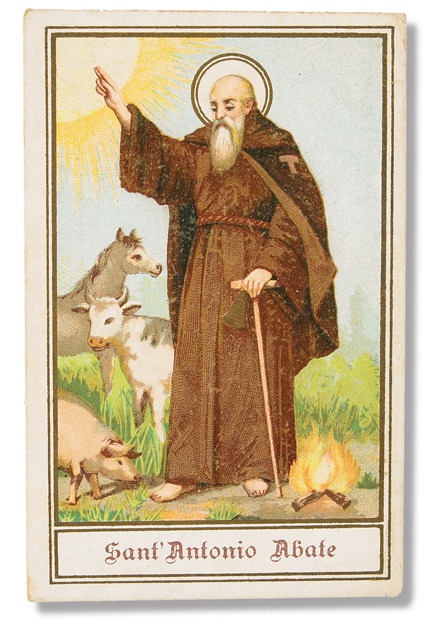
Skin Diseases / Anthony the Abbot, 251–356,
Feast Day: January 17

Known as the father of Christian monasticism, Anthony lived a solitary existence in the desert under the motto “pray and work.” Constantly tempted by the Devil, he is frequently depicted with his pet pig. In the Middle Ages, pig products were used to calm skin inflammations, and praying to Anthony was said to relieve the pain of shingles and a contagious skin disease known as “St. Anthony’s Fire.”

Other patronages: domestic animals, pigs; bell makers, bell ringers, butchers, brush makers, firefighters, gravediggers, grocers, hermits, swineherds

Invoked: against the fires of hell, infections

Dining With the Saints in Honor of Saint Antonio Abate