Saint Rita of Cascia  1377–1447. Feast Day: May 22. Patron of: Impossible Causes. Marital Problems.
Married to an abusive man who was murdered, Rita tried to join the local Augustinian convent after the death of her two sons. She was refused three times. Saint John the Baptist, Saint Nicholas of Tolentino, and Saint Augustine appeared to her and advised her to try again. She was accepted and became known for the power of her prayers. She meditated on Christ’s passion and is shown with a thorn in her head because she begged to feel a part of Christ’s suffering. She is always depicted with roses because upon her death, the roses in her garden bloomed off season so that they could adorn her casket.

Novena to Saint Rita of Cascia

More on Saint Rita of Cascia

Dining With the Saints in honor of Saint Rita of Cascia

Saint Walburga  710–779. Feast Day: February 25. May 1.
Patron of: Cough sufferers. Famine. Storms at sea. Antwerp, Belgium. The daughter of one of the Saxon kings, Walburga was born in Wessex, England. As a Benedictine nun she moved to Germany where she became Abbess of several religious communities of men and women. She wears a crown denoting her royal birth and holds the Abbess’s staff. In her hand is the closed book of mysterious knowledge. On the book and at her feet are flasks of the oil which still oozes at her shrine and is reputed to have curative powers.

The above saints for May are excerpted from the book: “Holy Cards” by Barbara Calamari and Sandra DiPasqua. All images are from the collection of Father Eugene Carrella.

Dining With the Saints

The Feast of San Isidro

One of the most important holidays in Madrid is held on May 15, the Feast Day of San Isidro, the city’s patron Saint and also the patron Saint of farmers. The festival is celebrated in the Pradera del Santo, a large, open square in the heart of the city.

San Isidro had a long life, born in Madrid in 1082 and living ninety years. Legend has it that San Isidro miraculously made a spring gush by banging the ground while he was ploughing. A hermitage dedicated to him was built on this spot in 1528. Drinking fresh spring water is still a tradition observed by the people of Madrid on his Saint’s Day.

Another tradition is baking rosquilles, a ring shaped doughnut flavored with anise. There are two types; one is called listas, which means smart and it’s coated in sugar, the other, a plainer version, is referred to as tontas, meaning stupid. Make of that what you will. Both are delicious.

Here’s a recipe for smart rosquilles

Rosquilles

3 large eggs

1 ½ cups whole milk

¾ cup melted butter

3/4 cup Anisette

1 1/2 cups sugar

2 cups all-purpose flour

2 teaspoons baking powder

Extra virgin olive oil for frying

In a large bowl, add the eggs, the milk, the melted butter, the anisette, and ½ cup of the sugar. Mix well and then add the flour and the baking powder, little by little until you have a thick dough. Turn the dough out onto a well floured surface and knead until it’s smooth. Flatten out the dough and cut in into strips. Shape the strips into little rings about 2 inches in diameter.

Set up a large pot and fill it with olive oil about 5 inches deep. Heat over medium flame until hot. Drop in the dough rings a few at a time and fry until golden. Lay them out on paper towels for a minute to soak up excess oil and then roll them in the remaining sugar. Serve warm or at room temperature.

 Dining With the Saints is written by writer and chef Erica DeMane. Visit her at EricaDeMane.com.

Novena for April

Saint Louis Marie Grignon de Montfort

1673 – 1716

Feast Day: April 28

A strong believer in the power of the rosary, Saint Louis de Montfort was a priest, preacher, poet and writer who influenced many popes and religious orders with his devotion to the Virgin Mary.  Representing the French school of Spirituality, his books are still widely read to this day.

“If you say the Rosary faithfully until death, I do assure you that, in spite of the gravity of your sins you shall receive a never fading crown of glory. Even if you are on the brink of damnation, even if you have one foot in Hell, even if you have sold your soul to the devil as sorcerers do who practise black magic, and even if you are a heretic as obstinate as a devil, sooner or later you will be converted and will amend your life and save your soul, if—-and mark well what I say—-if you say the Holy Rosary devoutly every day until death for the purpose of knowing the truth and obtaining contrition and pardon for your sins.

——St. Louis De Montfort, The Secret of the Rosary

Novena to Saint Louis Montfort

Great Apostle and son of Our Lady, Saint Louis de Montfort, your only desire was to set aflame the world with the love of Jesus, through Mary. We implore you to obtain for us a perfect and constant devotion to Mary, that we may participate in the faith, hope and charity of Our Lady and that we may receive the favor we ask of you in this novena… (mention your petition).

(1 Our Father, 1 Hail Mary, 1 Glory Be).

Saint Louis Marie Grignon de Montfort pray for us (3 times)

Say this novena nine times in a row for nine days in a row.

Image: Photograph of sculpture in the upper niche of Saint Peter’s Basilica by Giacomo Parisini


Dining With the Saints

Homemade Ricotta for Easter

So many traditional Southern Italian Easter dishes use ricotta as a foundation, and these are some of the glories of the Italian kitchen. Pastiera, the sweet ricotta pie studded with wheat berries and perfumed with orange flower water is in my opinion a work of genius. My mother’s family made something similar using rice instead of the wheat, creating a kind of crustless, firm pudding that was cut into squares.  Pizza rustica, the savory version of ricotta cake, stuffed with little chunks of  provolone and salami, and ravioloni filled with ricotta and finished with butter and fresh sage are two other dishes that showed up on our Easter table when I was a kid.

If you’ve never made your own home-made ricotta, Easter is a great time for you to start. There are few things, culinarily speaking, that are easier and that produce such huge rewards for the cook.  Nothing you can buy is comparable to your own home-made, still warm ricotta, drizzled with olive oil and sea salt, or with honey and a sprinkling of nutmeg, or folded into a bowl of al dente spaghetti, or used to make any of the elegant Easter dishes, such as pastiera, that I mentioned earlier.

Even though traditional ricotta is made by recooking whey leftover from cheese making, you can make a wonderful version at home using whole milk. It involves adding an acid, like lemon, to whole milk, and gently heating it until it curdles. You don’t need any fancy equipment; just a big pot and a piece of cheesecloth or a fine mesh strainer, and possibly a kitchen thermometer as a security blanket, if it’s your first time.

In my book The Flavors of Southern Italy I give a sort of standard recipe for homemade ricotta using lemon juice.  Almost everyone I know makes it this way. The results are good but occasionally can be a little drier than I like. In the several years since I wrote that recipe, I’ve continued to experiment with ricotta making and have decided that adding buttermilk instead of lemon as the curdling agent gives a moister result. I’ve even gone ahead and added a little heavy cream, so the ricotta is extra rich and soft.

Homemade Ricotta for Easter

(Makes about 4 cups)


1 gallon whole milk

1 pint heavy cream (optional but recommended)

1 quart buttermilk

1teaspoon salt

Put all the ingredients in a large, nonreactive pot (stainless steel or enamel both work well), and place it on a medium flame. Let it heat, uncovered, stirring once or twice, until little bubbles form on the surface. This will take about 10 minutes or so. Then let it bubble, without stirring, for about 5 minutes. You’ll see curds start to form and will notice the liquidy whey just starting to separate from the solids. The temperature should get up to 170 degrees (a kitchen thermometer is helpful the first few times, until you get the feel of it). Turn off the heat, and let the pot sit there, undisturbed, for 10 minutes (don’t be tempted to stir; it’ll break up the curds while they’re forming). You’ll now notice the faintly greenish whey separating more cleanly from the white curds. Gently pour the mix into a strainer lined with cheesecloth (or into a fine mesh strainer), scraping the bottom of the pan to loosen any stuck-on ricotta. Let drain until all the whey runs off but the cheese is still moist.

I love eating it still warm, but the ricotta will keep in the refrigerator for several days.

(Erica De Mane is a writer and chef. Visit her website: EricaDemane.com)

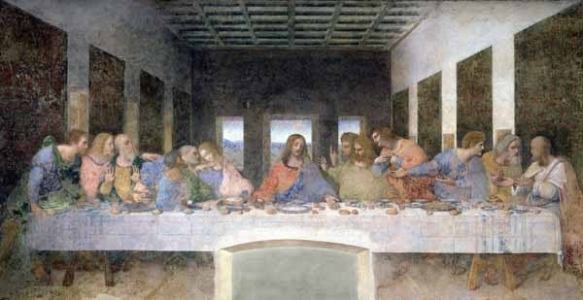
Image: “The Last supper by Leonardo Da Vinci, 1497.

Saints for April

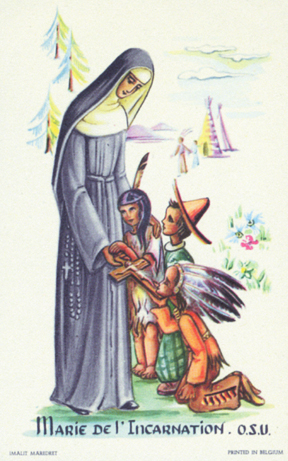
Blessed Marie of the Incarnation  1599–1672.
Feast Day: April 30.

Marie was a widow who joined the new Ursuline order in France when her son turned twelve. She founded the Ursuline convent in Quebec, Canada, in 1639. She worked with young Indian and French settlers’ children for the next thirty three years. Her writings are important records of the harsh existence of the first Europeans in Canada.

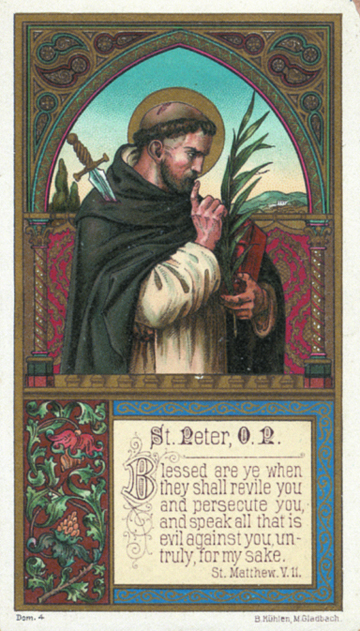
Saint Peter of Verona  1205–1252. Feast Day: April 29. Patron of: Inquisitors.

The son of Cathar heretics, he converted after hearing Saint Dominic preach. He joined the Dominicans and, as the Inquisitor for Northern Italy, did much to silence heresy. He was murdered for this and while he was dying wrote with his own blood on the ground, “Credo in unum Deo.” “I believe in one God…” The dagger he was killed with is in his back. He is silencing heresy while clutching his martyr’s palms and the closed book of secret knowledge.

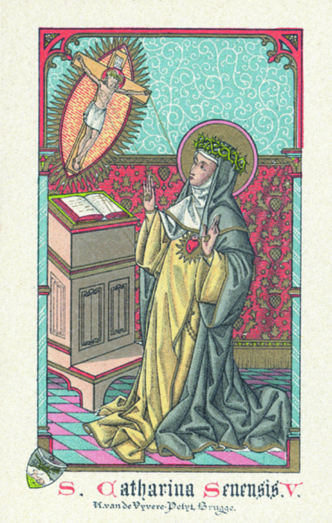
Saint Catherine of Siena  1347–1380. Feast Day: April 29. Patron of: Italy. Fire Protection. Nurses.
Doctor of the Church.

A Dominican tertiary, Catherine was known for her spiritual writings as well as her willingness to care for those with the most repulsive diseases. She is shown with the crown of thorns because she received the stigmata. The open book is for her writings, many of which she dictated while in a trance. They are still considered to be great literature and studied to this day.

Novena to Saint Catherine of Siena

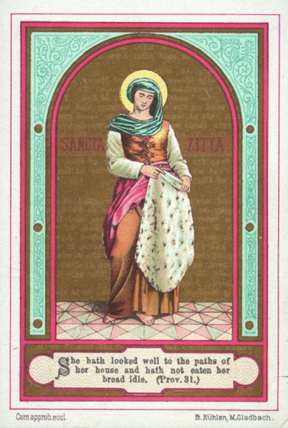
Saint Zita  1218–1278. Feast Day: April 27.
Patron of: Servants.

Those who lose their keys. From Lucca, Italy, Zita was a domestic servant known for her charity and mystical experiences. When she gave her master’s fur coat to a beggar, an angel returned it to her the next day. She is always shown wearing an apron. In this card she holds the returned fur.

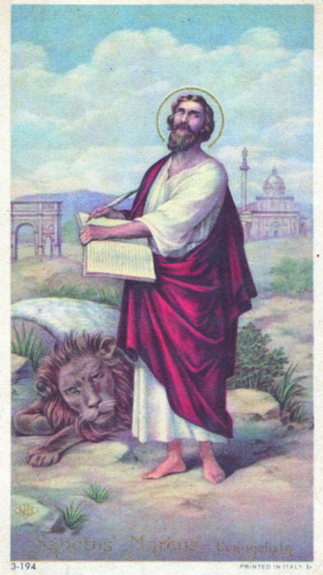
St. Mark

St. Mark, First centuryAssistant to St. Peter, his gospel was written in a.d. 49. He was martyred in Alexandria by being dragged through the streets. In 815 his body was stolen by the Venetians, who interred it in the basilica built in his name. His attribute is the lion, representing the resurrection.