Novena App Saints of Health: Saint John of God, Patron of Heart Ailments

detail from a painting of Saint John of God saving sick people from a fire at the royal hospital, by Manuel Gomez-Moreno Gonzalez, 1880; Museo de Bellas Artres, Granada, Spain; swiped from Wikimedia Commons; click for source image

1495 – 1550

Feast Day: March 8

Quote: “I give myself to God. What I have is yours.”

Key Words: alcoholism, heart ailments, the dying, the sick, hospitals, booksellers, firefighters, nurses, printers

Patron of: heart ailments

Symbols: pomegranate, cross, humbly serving


A Portuguese mercenary who fought in several wars, sold slaves, and lived hard, John was known to “think with his heart” by acting impulsively. At the age of 40, retired from the army and a book dealer in Granada, he heard a sermon that changed his life. He became as extreme in his dedication to his religious life as he had once been to his life as a soldier. He tested the physical limits of his own heart by serving the sick and poor with an intense fervor. He is invoked by those plagued with heart conditions for protection against heart attacks.

Brought up by pious and simple people, John  had left home for a life of adventure when he was still a young boy. He worked as a shepherd and as soon as he was able, he enlisted in an army regiment. By the time his regiment disbanded, John was weary of the immoral life he led as a soldier. When he went to find his parents, he was told by an uncle that they had both died grief stricken over his disappearance. John vowed to live a better life and began selling pious pictures from town to town. On the road to Granada he met a barefoot child on the road who he offered to carry. To his surprise the child became heavier and heavier. When John put the child down at a fountain, the child gave him the title he would always be known as, saying, “John of God, Granada shall be your cross,” before disappearing. It was in Granada that he opened his book store and heard the sermon of John of Avila which shattered his existence. The thought of all the wrongs he committed in his life drove him to madness. Incarcerated in a filthy hospital, he suffered the mistreatment of the insane first hand.  As he recovered his sanity, he began helping the nursing staff. Upon his release, he devoted the rest of his life to the sick and destitute, never forgetting how terribly they were treated in the local institutions. He founded the Order of the Brother Hospitallers and opened a hospital, funding it by begging in the streets. When his hospital was burning down, he ran in and carried each patient out one by one. He is frequently depicted carrying a hospital patient. Because of this he is also considered a patron of firefighters.

While recovering from an illness, John of God leapt into a river in an unsuccessful attempt at rescuing a drowning boy. He died on his 55th birthday from an over-exhausted heart.

The symbol of Granada is the pomegranate, it is also a fruit with many seeds, which John’s Order took as a symbol of their founder’s spiritual influence.

Invoked against: alcoholism, heart attack


 NOVENA PRAYER TO SAINT JOHN OF GOD FOR A CURE

Saint John of God, heavenly Patron of the Sick, I come to you in prayer to seek your help in my present sickness. Through the love which Jesus had for you in choosing you for the sublime vocation of serving the sick, and through the tender affection with which the Blessed Virgin Mary placed upon your head a crown of thorns as a symbol of the sufferings you would undergo in the service of the sick to attain to your crown of glory, I beg you to intercede for me to Jesus and Mary that They may grant me a cure, if this should be according to the Will of God.

How patiently you bore the sufferings of your own disease! Teach me to carry with cheerful resignation the cross that God has given me. Let me never complain or lose courage. Help

me to understand that suffering is a very important means of sanctifying my soul, of atoning for my many sins, and of reaping a plentiful harvest of merit for Heaven. I trust in your great love for the sick and in the power of your intercession to help them. Help me, good St. John, and beg the God whose name you bear to touch me as He touched the sick while on earth, that through His almighty power health may return to my body. And as you derived strength in your own sufferings from the crucifix, so may I be able to say what you did to Jesus Crucified: “Lord, Thy thorns are my roses and Thy sufferings my paradise.”

Good Saint John, lover of those who suffer and special Patron of the Sick, I confidently place before you my earnest petition.

(Mention your request.)

I beg you to recommend my request to Mary, the Mother of Sorrows and Health of the Sick, that both Mary and you may present it to Jesus, the Divine Physician.

Saint John of God, patron of the Sick and beloved of Jesus and Mary, pray to Them for me and obtain my request. (Three times.)

In honor of Saint John of God:

Our Father, Hail Mary, Glory Be.

Saint John of God, Patron of the Sick, pray for us.


Say this novena nine times in a row for nine days in a row.

Click here for this and 35 other saints on the Novena App

Giveaway—40 Days of Lent— 40 novena app’s, 2018

NOVENA_APP_SPLASH_PAGE (2)To the first 40 people who send us their email, we will gift you novena app for the iPhone or iPad. Send email to dipasqua@nyc.rr.com.

36 Saints, prayer, history and artwork.

The saints, having been human, lived every type of earthly existence and it is in the details of their life stories that we find their patronages. By invoking the saints, we ask for guidance in overcoming our own earthly trials, much like one would ask advice of a family member or friend. Meditating on the lives of these remarkable people inspires us to conquer our own personal obstacles.

A novena is a nine day period of prayer. Usually the novena prayer is recited nine times in a row for nine consecutive days, the repetitive nature of the prayer serves to bring on a quiet and meditative state. When ones mind quiets down, it allows the solution to a problem to appear or even help in the acceptance of an unchangeable life challenge.

To help you find a saint that can aid you with your specific dilemma, we have divided this app of thirty-six saints into four categories: Health, Occupations, Situations and States of Life. You can find your saint by personally relating to their history, by being drawn to the illustrated depictions in their holy cards, or by searching the Glossary of extensive problems and life situations.

Our beautiful vintage holy cards depict the saints with the enigmatic attributes and symbols that are commonly used to represent them. Brief explanations of these symbols are given to help decipher the visual iconography in their images. The prayers in this app are universally known and have been used for centuries as tools in obtaining clarity and peace of mind. All are free to utilize them, regardless of one’s faith or religious belief.

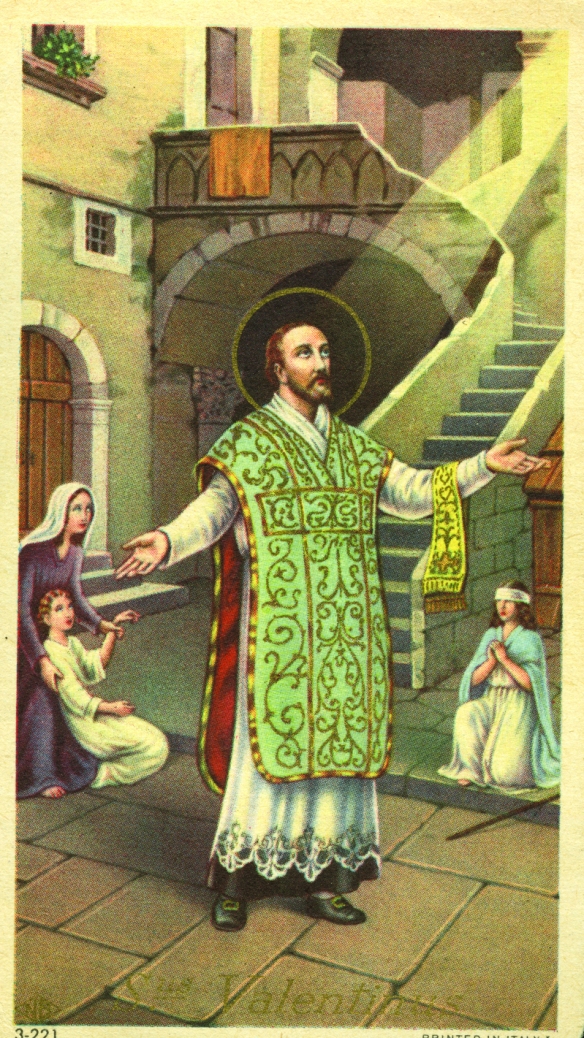
Saint Valentine

st.v2

His feast day is embedded in Western civilization. His name has become synonymous with a certain type of romantic card, yet few realize that Valentine actually existed. As a saint, his first great work was to unite young couples in marriage. In the year a.d. 269, when the Roman Empire was under constant attack from barbarian tribes, Emperor Marcus Aurelius Claudius issued an edict outlawing marriage for young men. He speculated that more soldiers would join the legions to defend it if they were unfettered by wives and children. Valentine was a respected healer and priest in the outlawed Christian faith. He had great sympathy for those young couples whose plans for a life together were shattered by the state and he encouraged anyone who wished to wed to come to him to be married in secret. He was arrested and imprisoned in Rome for defying the emperor. But his reputation as a learned man remained untarnished and many of his followers would visit him in prison for counseling; others came for health cures.

Personally afflicted with epilepsy, Valentine was particularly drawn to treating those also suffering from the disease. The jailer, having witnessed many successful healings at Valentine’s cell door, asked the saint to treat his daughter, who had been blind since birth. During her subsequent visits to the prison, Valentine read to the girl, taught her mathematics, and beautifully described the natural world. Valentine’s wisdom and kindness so impressed the jailer and his family that they converted to Christianity despite the fact that the young girl remained blind. This conversion established Valentine’s status as a true threat to the state, a charge punishable by death. His execution came on February 14, the eve of the Roman festival of Lupercalia. Valentine was beaten with clubs and then beheaded. Before his sentence was carried out however, he sent a yellow crocus to the jailer’s daughter enclosed with a note that read, “With love, from your Valentine.” The bright color of this flower was the first thing she ever saw, her eyesight having been miraculously restored. She is said to have planted an almond tree on Valentine’s grave, and to this day the almond tree is considered a symbol of friendship and devotion. Valentine was buried on the Flaminian Way in a catacomb that still bears his name. A church was dedicated to him there in a.d. 496. The wall of the city, the original Flaminian Gate, was a pilgrim’s first stop upon entering Rome and was known as Porta S. Valentino until the seventeenth century, when it was renamed Porta del Popolo. In the ninth century, relics of the early martyrs were removed from the catacombs and transferred to local Roman churches. Valentine, too, was reinterred in the church. His body was moved to the church of Saint Praxedes, very near his original burial place. Many cities besides Rome claim his relics, among them Terni, Italy; Madrid, Spain; Dublin, Ireland; Glasgow, Scotland; and Rocamador, France.

It is no coincidence that the liturgical feast day of the patron saint of love falls on the eve of Lupercalia, an erotic Roman fertility festival. It was common practice for church holidays to coopt pagan celebrations. The Romans considered this the official beginning of Spring, a time of reawakening fertility and warming weather. One of the activities held in honor of the goddess Februata Juno consisted of the city’s bachelors drawing the names of unmarried women out of an urn. They would then become a couple for the rest of the year, with many of these matches resulting in marriage. In twelfth century southern France, this practice was reawakened as part of the Langue d’Oc poetry movement. This was a time when art and literature took on a heightened importance to the ruling classes. Noble youths known as gallants wrote missives of love they called galantines. The local pronunciation confused this with the word valentine and Valentines clubs sprang up.

On February 14, after a Mass in honor of Love, a silver casket containing the names of unmarried local men was presented to the single women in town. The men whose names each woman drew was required to be the guardian of that lady, providing her with flowers, poems, and gifts throughout the year. He was to guard her honor chivalrously. Marriage between these Valentines was strictly forbidden. Because of the wide dispersal of his remains, the cult of Saint Valentine became extremely popular in Northern Italy, southern France, and England. His head, which was reputed to be in England, was said to bestow incredible miracles and healings on those who kissed it. Since the middle of February was considered the time of year when birds began to pair, the English, like the Romans a thousand years before them, looked upon this as the beginning of mating season. Celebrating the Feast of Saint Valentine by citing the fidelity of doves seems to be an English tradition.

The oldest valentine note in existence today was written by Charles, Duke of Orleans, to his wife in 1415, while he was imprisoned in the tower of London. By the middle, nineteenth century sending and receiving anonymous Valentine’s cards and poems declaring one’s love became common in both America and England. By then, the story of the saint who had inspired this industry might have faded away, but his name and feast day is celebrated universally.

Prayer to Saint Valentine

O glorious advocate and protector, Saint Valentine, look with pity upon our wants, hear our requests, attend to our prayers, relieve by your intercession the miseries under which we labor, and obtain for us the divine blessing, that we may be found worthy to join you in praising the Almighty for all eternity; through the merits of Our Lord Jesus Christ. Amen.

Novena App: OUR LADY OF GUADALUPE

Feast Day: December 12

Patron of: Motherly Comfort, Mexico, The Americas

Quote: “Am I not your mother?”


Keywords: the Americas, compassion, love, forgiveness, mercy, motherly comfort, protection


Symbols: mandorla (body halo), roses, stars, crescent moon, angel


This image of Mary is the preeminent cultural icon of Mexico and the American Southwest, cherished by Catholics and non-Catholics alike. Unlike other apparitions of Mary, where she sometimes issues warnings to mankind, in her visitation to the Aztec people, she promised hope, love and comfort at a time when their own way of life had been destroyed.   We invoke Our Lady of Guadalupe anytime we need the wisdom and comfort of a motherly force.


In December of 1531, the world of the once great Aztec civilization lay in ruins. The native inhabitants of what would become Mexico City were suffering brutally under the domination of Spanish Colonialists who had first invaded in 1519. Within two short years the forces of Hernan Cortes, with the help of native enemies of the Aztecs had completely overrun and destroyed a dual culture of light and dark, one of gracious cities and blood filled temples. Believing that their superiority and way of life depended on feeding their gods human sacrifices, the Aztecs routinely invaded neighboring tribes, sacrificing tens of thousands of captives a week. Gradually, the images of their own gods, particularly the female ones, took on more monstrous and grotesque features. The Spanish responded  to these sacred sites by wreaking havoc and destruction upon them. Within ten years the remaining Aztec residents were heart-sick, depressed and dying off.


On December 9, 1531, and Aztec convert to Catholicism called Juan Diego, was on his way to mass. Distracted by the singing of birds on a hillside, he stopped. He then heard the kindly calling of his name in his native Nahuatl language. He approached the noble Aztec woman n the hill and was stunned at the heightened glow of her surroundings. She introduced herself as the perfect maiden Saint Mary, honorable mother of the true God. She asked him to go to the bishop and request a temple be built to her on the hill. She added, “I am the compassionate mother of you and your people, here in this land and of all the people who love me, search for me and confide in me…”  After a long wait, the bishop told Juan Diego that he needed a sign proving that this was a true appearance of Mary. In subsequent days, when Juan Diego again saw the woman on the hill, he begged her to get someone who the bishop would respect more to deliver her request. She kindly replied that he was the perfect one for her message. The next day Juan Diego walked another way into town in order to avoid the woman as his uncle was sick and he did not want to waste any time doing her errands. Nonplussed, she came down from the other side of the hill to meet him. Flustered, he told her he had to tend to his uncle and had no time to wait for the bishop who did not believe him anyway. The woman assured him that his uncle was already well and then told him to gather roses among the rocks.  This being winter he was amazed at how many roses were in full bloom. The woman arranged the roses in his cloak and again sent him off to the bishop. When he was finally granted this audience, it was the bishop’s turn to gasp in amazement. As Juan Diego unwrapped his cloak of roses, there imprinted on his cloak was the exact image of the lady on the hill. The bishop fell to his knees and begged Juan’s forgiveness. Today, tens of millions of pilgrims flock to Mexico City to see this original cloth which is in the cathedral named after this apparition of Mary, Our  Lady of Guadalupe.


The Virgin Mary appears to each visionary as a member of their own culture.  This image of a kindly, loving mother figure so impressed the native people of Mexico, that thousands of them came to be baptized within the first few months of the cloth being put on display.


Explanation of images:

Mandorla: a body halo which signifies that Mary is wrapped in the grace of God.

Robe of stars: By wearing the stars she is showing that her God is more powerful than the stars. Blue is the color of royalty and virginity.

Crescent Moon: to Christians, Mary’s virginity. To Indian’s Mary is stronger than the moon god, the god of darkness.

Angel:  Carried there by heaven.


Novena to Our Lady of Guadalupe


Our Lady of Guadalupe, according to your message in Mexico I venerate you as “the Virgin Mother Of the true God for whom we live, the Creator of all the world, maker of heaven and earth.” In spirit I kneel before your most holy image which you miraculously imprinted

upon the cloak of the Indian Juan Diego. And with the faith of the countless numbers of pilgrims

who visit your shrine, I beg you for this favor: (mention your request).


Remember, O Immaculate Virgin, the words you spoke to your devout client, “I am a merciful Mother to you and to all your people who love me and trust in me and invoke my help. I listen to their lamentations and solace all their sorrows and their sufferings.” I beg you to be a merciful Mother to me, because I sincerely love you and trust in you and invoke your help. I entreat you, Our Lady of Guadalupe, to grant my request, if this should be the will of God, in order that I may

bear witness to your love, your compassion, your help and protection. Do not forsake me in my needs. Amen.


Our Lady of Guadalupe, pray for us.

Buy Novena App


Novena App: Saint Francis Xavier, Patron Saint of Missionaries


1506 – 1552

Feast Day: December 3

Keywords: foreign missions, grace, hurricanes, missionaries, plague, sailors, tourists


Quote: “It is not the actual physical exertion that counts towards one’s progress, nor the nature of the task, but the spirit of faith with which it is undertaken.”

Symbols: crucifix, lily, flaming heart, torch


Credited with converting hundreds of thousands of people, St. Francis Xavier is considered the most successful missionary since St. Paul. In his own life, he evolved from being a sheltered, wealthy intellectual to becoming a fearless explorer travelling to newly discovered lands, happily living  among the lowest castes of people, improving their lives with love and grace. The novena in his honor, the Miraculous Novena of Grace is said to bring the force of grace into our lives, creating  a more harmonious relationship with the world around us.

Born in the Kingdom of Navarre, the Basque region of Spain, Francis grew up in his family’s castle. Much admired for his intellectual gifts, he was sent to the University of Paris where it was thought that he would become one of its more gifted professors. His life changed drastically when he met an older student named Ignatius Loyola who had a small band of followers. Together with Loyola, St. Francis Xavier formed a new religious order, The Society of Jesus (now known as the Jesuits) with the intention of spreading Christ’s word to the farthest corners of the earth. The King of Portugal sent Francis Xavier on his first mission to Goa in India where his country had a colony. He was concerned about the lack of religious practice available to his people and Francis’s mandate was to form a ministry for his Portuguese subjects. However, the European merchants and traders were more interested in gambling, drinking, slave trading and prostitution than in any religious preachings. When Francis Xavier attempted to meet with the Brahmin or wealthy local people, he was equally rebuffed. He then decided he would work with the lowest of the low, shocking both European and upper caste Indians by openly treating beggars, prostitutes, prisoners and the illegitimate as equals. The many eloquent letters he wrote about his life and work among society’s outcasts are still enlightening reading today. Gifted in languages, Francis Xavier had the ability to easily communicate in the various dialects spoken in the region. He is credited with saving the Paravas, an indigenous people who were pearl divers on the coastal islands from decimation and enslavement by the various Arab and European traders who plagued them.

Excited by his great success, Francis Xavier travelled throughout the Far East and he was the first missionary to travel to Japan. Not always met with the same respect and openness that he offered others, he endured his frustration with good spirits. He died on the island of Chang-Chuen-Shan, never realizing his dream of reaching mainland China. His body was put in quicklime and taken back to Goa, where it lies in a much visited shrine.


Miraculous Novena of Grace to St. Francis Xavier


Most amiable and most loving Saint Francis Xavier, in union with you I reverently adore the Divine Majesty. I rejoice exceedingly on account of the marvelous gifts which God bestowed upon you. I thank God for the special graces he gave you during your life on earth and for the great glory that came to you after your death. I implore you to obtain for me, through your powerful intercession, the greatest of all blessings, that of living and dying in the state of grace. I also beg of you to secure for me the special favor I ask in this novena. In asking this favor, I am fully resigned to the Divine Will. I pray and desire only to obtain that which is most conducive to the greater glory of God and the greater good of my soul. 

Amen.

(Here you may mention the grace, spiritual or temporal that you wish to obtain).

(Recite one Our Father, one Hail Mary, one Glory Be).

 There are two times a year when the Miraculous Novena of Grace is considered especially powerful: from March 4 to March 12 and from November 25 to December 3.


Download the Novena App


Novena App: Saint Catherine of Alexandria, Patron Saint of Philosphers

290 – 305

Feast Day: November 25

Patron of: Philosophers


Keywords: librarians, mechanics, millers, nurses, philosophers, potters, scholars, students, wheels, unmarried women

Symbols: crown, sword, martyrs palms, wheel

Quote: “If you are ruled by the mind you are king, if by the body you are a slave.”


Brilliant and beautiful, Catherine of Alexandria was a force to be reckoned with. While still in her teens she had mastered philosophy, several languages and medicine. Because of her clarity of mind, she had great poise and self-confidence. One of the Fourteen Heavenly Helpers, the people of the Middle Ages believed she was one of the most powerful of early saints and invoked her for everything. Definite in her beliefs, we call on her for help in our studies or before we begin a major project, as she will clearly guide us.

The daughter of a governor, Catherine lived in a sumptuous palace among beautiful objects and scientific wonders. It is said she told her mother that she refused to marry anyone who was not as brilliant or beautiful as herself. Her mother readily agreed, not realizing that Catherine had discovered Christianity in her philosophical studies and had vowed herself to Christ. While working in her palace she heard the screams of a group of Christians who were being tortured . for refusing to give up their faith. Catherine went straight to the Emperor Maxentius and demanded he stop this persecution. Charmed by Catherine’s beauty, he invited her to debate the leading philosophers in the region to see if she could be persuaded to abandon Christianity by reasonable arguments. Instead of these fifty great scholars winning over the young girl with their scholarly knowledge, Catherine converted them to Christianity. Enraged, the Emperor had all fifty of these great men burned in the public square.

The Emperor then tried to charm Catherine with promises of great riches if she would become his concubine. Reminding him of her promise to  Christ, she refused and was instantly imprisoned. While Maxentius was away on a trip, his wife visited Catherine in prison aand Catherine converted her to Christianity along with her prison guards and the Captain of the Emperor’s Legion. Upon his return to Alexandria, Maxentius was outraged at what he regarded to be the betrayal of his wife and legion. He ordered Catherine to be killed by being rolled on a spiked wheel. Catherine was fastened to the giant wheel and just as it was about to be rolled, her straps broke and she was released as the wheel shattered into hundreds of pieces killing many in the crowd. Catherine was then beheaded by sword. According to legend, angels then transported her body to the top of Mount Sinai, where a monastery and church devoted to Saint Catherine still exists.

St. Catherine is always depicted with a wheel and she is the patron of any occupation that requires a wheel. During the Middle Ages St. Catherine was viewed as an exemplary example for unmarried women. Therefore, in France and England St. Catherines’s Day is celebrated by unmarried women asking for husbands.

Invoked: to find a husband

Explanation:

Spiked Wheel: her instrument of torture which broke

Sword: used to behead her

Palms: symbol of martyrdom


Novena to St. Catherine of Alexandria

Almighty and eternal God! With lively faith and reverently worshiping Thy divine Majesty, I prostrate myself before Thee and invoke with filial trust Thy supreme bounty and mercy. Illumine the darkness of my intellect with a ray of Thy heavenly light and inflame my heart with the fire of Thy divine love, that I may contemplate the great virtues and merits of Saint Catherine of Alexandria in whose honor I make this novena, and following her example imitate, like her, the life of Thy divine Son. 

Moreover, I beseech Thee to grant graciously, through the merits and intercession of this powerful Helper, the petition which through him I humbly place before Thee, devoutly saying, “Thy will be done on earth as it is in heaven.”  (Mention your request here.) Vouchsafe graciously to hear it, if it redounds to Thy greater glory and to the salvation of my soul.


Saint Catherine of Alexandria, pray for us!

Amen.

Excerpted from Novena App


Novena App: Mother Cabrini, Patron of Immigrants

1850-1917

Feast Day: November 13

“We must pray without tiring, for the salvation of mankind does not depend on material success; nor on sciences that cloud the intellect. Neither does it depend on arms and human industries, but on Jesus alone.”

Keywords: immigrants, the poor, orphanages, orphans, displaced persons, the homeless, hospital administration, business, obedience, meditation

Symbols: Sacred Heart of Jesus, Immigrants

The first American citizen to be named a saint, St. Frances Xavier Cabrini never desired to travel to, much less spend her life in her adopted country of the United States of America.  Born Maria Francesca Cabrini in northern Italy, she intended to use her schoolteacher’s degree to work as a missionary in China. Suffering through a smallpox epidemic which killed her parents, she was turned down by two convents she attempted to join.  When she was finally accepted by one, she was sent to a small town to run an orphanage which was eventually closed. Enthralled by the works of Saint Francis Xavier, the Jesuit Missionary, she took his name  and founded an order of nuns, the Missionary Sisters of the Sacred Heart. Many were shocked to see how quickly her new order was approved by the Pope. Instead of granting her wish to continue her namesake’s work in China, Pope Leo XIII told her, “Your China will be the United States.”

At that time 50,000 Italian immigrants lived crammed in a filthy ghetto in New York City. There was no one there to help or intercede for them. Arriving with six other nuns, Mother Cabrini was told to go home by the archbishop of New York. Instead, she moved her nuns into the Italian slums and immediately opened an orphanage. Through her personal tenacity as well as her willingness to live among the poor, Mother Cabrini set an impressive example for those trying to enact social reforms. Gifted with an innate business sense, and due to the great success her order had in caring for the destitute and displaced, Mother Cabrini was able to raise money from all levels of society.  Within a few short years the Missionary Sisters of the Sacred Heart had opened orphanages, schools, hospitals and nurse’s homes throughout the United States, Central America, Argentina, Brazil, France, Spain, England and Italy. She became a United States citizen in 1909.

Though she was a tireless worker and an excellent administrator, Mother Cabrini felt the most important part of her day was the time she spent in mediation. Devoted to the Sacred Heart of Jesus, she felt great strength was to be found in humility, obedience and a quiet atmosphere. In her own case, by following the Pope’s orders at the expense of her personal dreams, she found more success in her mission than she could ever imagine was possible. At the time of her death, she had sixty seven foundations and over thirteen hundred missionaries carrying out her work.

Novena to Saint Frances Xavier Cabrini

O loving Savior, infinitely generous, seeking only our interest, from your Sacred Heart, came these words of pleading love: “Come to me all you that labor    and are burdened and I will refresh you.” Relying on this promise of your infinite charity, we come to you and in the lowliness of our hearts earnestly beg you to grant us the favor we ask in this novena, (mention your request here) through the intercession of your faithful servant, Saint Frances Xavier Cabrini. Amen.

Excerpted from the Novena App

Novena App Mystics: Saint Martin de Porres

1579-1639

Feast Day: November 3

Patron of: Mixed Race People

“Compassion, my dear brother, is preferable to cleanliness. Reflect that with a little soap I can easily clean my bed covers but even with a torrent of tears I would never wash from my soul the stain that my harshness toward the unfortunate would create.”

Keywords: barbers, wonder worker, harmony, nature, rats, mice, dogs, healer, animals, nature, charity black people, hairdressers, hoteliers, interracial justice, jurists, mixed race people, the poor, public health organizations, public schools, racial harmony,

Symbols: broom, mice, cats, dogs

Born in Peru, with a Spanish noble father and an African freed slave mother, St. Martin de Porres is one of the most popular saints in the New World. A great healer, he was so in tune with the innate rhythms of nature, he could read minds, heal any sickness, communicate with animals and even levitate. Being a person of mixed race he is called on to quell racial tensions, but his patronage extends to bringing harmony to all situations and he is invoked to heal both physical and spiritual wounds.

Martin and sister had a poor and difficult childhood, as people of mixed race were reviled. At the age of twelve Martin was apprenticed to a barber. 17th Century barbers did more than just cut hair, they also performed medical procedures, made medicines and prescribed treatments for every ailment. A naturally devout boy, Martin meditated on Christ’s passion as he mixed his herbs and it is said he healed as many people with his prayers as with his potions. By the time he was eighteen, Martin had a very successful practice. People from all walks of life sought his abilities. Instead of pursuing a lucrative career in town, Martin joined the local Dominican Convent as a Lay Brother, secretly wishing to become a foreign missionary

While the monastery was founded to tend to Spanish nationals working in Peru, Martin taught his European brethren the true meaning of Christian charity when helping out in the infirmary during a plague. He cared for nobility, slaves, soldiers, merchants and natives with the same respect. The incredible success of his treatments made his superiors install him as the head of the infirmary. Knowing Lima and its citizens as a native of that city made him a very effective fundraiser for the monastery. His superiors gave him full autonomy on dispersing whatever monies he raised to the poor. Every day at noon he opened the doors of the monastery distributing food to whoever needed it,

To Martin  all creatures in creation were equally loved and he inaugurated the first shelters for stray cats and dogs. When the monastery was overrun by rodents, his superiors ordered poison to be set out. Instead, Martin went out to the garden and called the rodents out their hiding places. He promised to feed them, if they promised to stay out of the building. Both sides kept to their agreement, and Martin has been invoked ever since, to prevent mice and rat infestation. Martin used menial labor as a time of prayer and communion with God. He developed deep wisdom from this form of mediation and Archbishops, city officials and students came to him for spiritual guidance. Because of this he is the patron of jurists.

Explanation of symbols:

Mice: Martin fed the mice everyday in exchange for them keeping out of the monastery.

Cats: Martin started the first animal shelters.

Grain: Martin nurtured both humans and animals with the same degree of compassion and love.

Novena to Saint Martin de Porres

Saint Martin de Porres, your concern and charity embraced not only your needy brethren, but also the animals of the field. You are a splendid example of charity; we thank and praise you. From above, hear the requests of your needy brethren.

(mention your request here).

By modeling our lives after yours, and imitating your virtues, may we live content knowing that God has looked favorably upon us. Because this is so, we can accept our burdens with strength and courage in order to follow in the footsteps of our Lord and the Blessed Mother. May we reach the Kingdom of Heaven through the intercession of our Lord Jesus Christ. Amen.

Excerpted from the Novena App.

Feast of Saint Jude, Patron Saint of Impossible Causes

Saint Jude Thaddeus

First Century

Patron of: Impossible Causes

Feast Day: October 28

Invoked: for help in Desperate Times

Attributes: Club, Cloth with image of Jesus, Flame over head

When all else fails, when we are in the most difficult of situations, we turn to Saint Jude, “Helper of the Helpless” and Saint of the Impossible.

One of the original 12 apostles, Jude is depicted with the flame of knowledge received from the Holy Spirit at the Pentecost burning above his head. Brother of James the Lesser and cousin of Jesus, Jude was one of Christ’s earliest followers.  He earned his title of Patron Saint of Impossible Causes because of a letter he wrote in 60AD to persecuted Christian converts in the East, exhorting them to stay strong in the face of all difficulties.

The name Jude means giver of joy and the name Thaddeus means great hearted one and  this saint was said to live up to his name, attracting immense crowds by preaching in an entertaining way, outwitting magicians and local priests.   Abgar, the King of Edessa was quite impressed with Jude and appealed to Jesus cure his leprosy. He sent an artist to draw Christ’s image. The artist was so shaken by the glow in Christ’s eyes, he could not draw. Christ wiped his face with a cloth and the image of his face was transferred to it. Jude brought the cloth back to Abgar and the king rubbed the cloth over his body, curing himself of leprosy. Many depictions and statues of Saint Jude include this cloth with Christ’s image on it. Jude was martyred along with Saint Simon in the city of Samir by being beaten with a club. This club, as well as the palms of martyrdom are also part of his iconography

The cult of Saint Jude all but died out after the Middle Ages because people confused him with Judas Iscariot, the apostle who betrayed Christ. Despite being cited as a great influence by the mystics Saint Bernard of Clairvaux and Saint Bridget of Sweden, Jude was rarely invoked by the faithful for anything. It is said that because of this, he became the saint to call on in the most impossible of situations. So anxious was he to be of help, he would turn heaven and earth to rectify a desperate situation. By the nineteenth century, it became customary to thank the saint for help with answered prayers by taking an ad in the newspaper. This helped to resurrect his popularity and these small “Thank you Saint Jude” ads can be found in many weekly and daily periodicals in present day.

Unfailing Prayer to Saint Jude

Glorious apostle, Saint Jude Thaddeus, I salute you through the Sacred Heart of Jesus. Through his heart I praise and thank God for all the graces he has bestowed upon you. I implore you, through his love, to look upon me with compassion. Do not despise my poor prayer. Do not let my trust be confounded! God has granted to you the privilege of aiding mankind in the most desperate cases. Oh, come to my aid that I may praise the mercies of God! All my life I will be your grateful client until I can thank you in heaven.

(Mention your request here).

Saint Jude, pray for us, and for all who invoke your aid.

Excerpted from the Novena App