St. Frances Xavier Cabrini 1850-1917

mother cabrini

“We must pray without tiring, for the salvation of mankind does not depend on material success; nor on sciences that cloud the intellect. Neither does it depend on arms and human industries, but on Jesus alone.”
Invoked For: Help for Immigrants

The first American citizen to be named a saint, St. Frances Xavier Cabrini never desired to travel to, much less spend her life in her adopted country of the United States of America. Born Maria Francesca Cabrini in northern Italy, she intended to use her schoolteacher’s degree to work as a missionary in China. Suffering through a smallpox epidemic which killed her parents, she was turned down by two convents she attempted to join. When she was finally accepted by one, she was sent to a small town to run an orphanage which was eventually closed. Enthralled by the works of Saint Francis Xavier, the Jesuit Missionary, she took his name and founded an order of nuns, the Missionary Sisters of the Sacred Heart. Many were shocked to see how quickly her new order was approved by the Pope. Instead of granting her wish to continue her namesake’s work in China, Pope Leo XIII told her, “Your China will be the United States.”

At that time 50,000 Italian immigrants lived crammed in a filthy ghetto in New York City. There was no one there to help or intercede for them. Arriving with six other nuns, Mother Cabrini was told to go home by the archbishop of New York. Instead, she moved her nuns into the Italian slums and immediately opened an orphanage. Through her personal tenacity as well as her willingness to live among the poor, Mother Cabrini set an impressive example for those trying to enact social reforms. Gifted with an innate business sense, and due to the great success her order had in caring for the destitute and displaced, Mother Cabrini was able to raise money from all levels of society. Within a few short years the Missionary Sisters of the Sacred Heart had opened orphanages, schools, hospitals and nurse’s homes throughout the United States, Central America, Argentina, Brazil, France, Spain, England and Italy. She became a United States citizen in 1909.

Though she was a tireless worker and an excellent administrator, Mother Cabrini felt the most important part of her day was the time she spent in mediation. Devoted to the Sacred Heart of Jesus, she felt great strength was to be found in humility, obedience and a quiet atmosphere. In her own case, by following the Pope’s orders at the expense of her personal dreams, she found more success in her mission than she could ever imagine was possible. At the time of her death, she had sixty seven foundations and over thirteen hundred missionaries carrying out her work.

Prayer

O loving Savior, infinitely generous, seeking only our interest, from your Sacred Heart, came these words of pleading love: “Come to me all you that labor and are burdened and I will refresh you.” Relying on this promise of your infinite charity, we come to you and in the lowliness of our hearts earnestly beg you to grant us the favor we ask in this novena, (mention your request here) through the intercession of your faithful servant, Saint Frances Xavier Cabrini. Amen.

Saint Martin de Porres

St.Martin de

Feast Day: November 3

Patron of: Peru, barbers, blacks, hairdressers, hoteliers, interracial justice, jurists, those of mixed races, the poor, public health, public schools, racial harmony

Symbols: broom, cat, crucifix, dog, dove

“Compassion, my dear brother, is preferable to cleanliness. Reflect that with a little soap I can easily clean my bed covers but even with a torrent of tears I would never wash from my soul the stain that my harshness toward the unfortunate would create.”

As a mixed-race man born in Peru, Saint Martin de Porres is a representative of three continents; his mother was of African descent, his father was from Spain, and he himself was born in the New World. A highly esteemed healer and friend to all living creatures, Martin is one of the most popular saints in Latin America.

Born in Lima, Peru, Martin was the illegitimate child of a Spanish knight and a freed black woman from Panama, whose family had been African slaves. Dark complected like his mother, he was not legally recognized by his father until he was a teenager. He and his sister shared a poor and neglected childhood, and at the age of twelve, he was apprenticed to a barber so that he might have a trade. In those days, in addition to cutting hair, barbers performed surgery, made medicines, and were much sought out for cures of every ailment.

Deeply religious, it was Martin’s habit to pray as he mixed his herbal healing potions, and it was said that he healed as many with his prayers as with his herbs. He met with great success in his new profession, but in his desire to serve God with childlike humility, he routinely gave all his money to the poor. By the age of fifteen he wanted to become a foreign missionary and decided to enter the Dominican Rosary Convent as a Third Order Tertiary or Lay Brother. He chose to perform the lowliest house chores, all the while meditating on the Passion of Christ, a subject of much fascination for him. As a farm laborer and gardener, Martin developed a deep attunement to nature. Animals flocked to him and he in turn showed them a respect and kindness that bewildered his European brothers.

Since the majority of the Dominican priests were from Spain, they had little experience with people from other cultures. Believing in the superiority of their own civilization, they were basically in the New World to minister to the newly arrived soldiers and merchants from their mother country. During a plague, Martin quietly taught them the true meaning of Christian charity when he volunteered to help out in the infirmary. He ceaselessly nursed African slaves, the native population, and Spanish nobility with the same grace and ardor. Because of the spectacular success of his treatments, he was installed as head of the infirmary, a job he claimed to be unworthy of. One day, when the infirmary was overcrowded with the sick, Martin was told not to admit anyone else. Yet when he found an Indian bleeding to death from a knife wound, he immediately took the man in and treated him. Martin’s Superior chastised him for this open disobedience of his order, and Martin replied, “Forgive my error, and please instruct me, for I did not know that the precept of obedience took precedence over that of charity.” From then on, Martin was given the liberty to follow his own decisions on treating patients. Martin proved to add such a valuable contribution to his religious community that, at the insistence of his prior, racial stipulations were abolished so that he could be made a fully professed brother in the Dominican Order.

As a priest, Martin put his missionary instincts to work, traveling through the city to tend the sick of Lima. He was particularly devoted to improving the lot of the poor and the racially oppressed. Having great practical instincts, he opened hospitals and orphanages, raising money from the newly wealthy Spanish elite. Because of his ability to budget and allocate the charitable donations he was given, Martin was promoted to almoner of the monastery at a time when it was floundering for financial support. He amassed steady donations totaling two thousand dollars per week, an astounding sum at that time, to cover the monastery’s operating expenses as well as, provide food for the hungry. Every day at noon he had the gates of the monastery opened so that he could distribute food to anyone who needed it. Regardless of the number of people waiting, no one was ever turned away. His charity extended to the animal kingdom, and he inaugurated the first shelter for stray cats and dogs. It was his sincere belief that all creatures were equally loved by God so all were deserving of his compassion and servitude–even those of the lowliest order. An example of this belief was evident when the monastery became overrun by mice and rats. The prior ordered poison to be set out to end the infestation. Martin went out to the garden and softly called the rodents out of their hiding places. He reprimanded them for invading the monastery and promised to feed them every day out in the garden if they would stay away from the building. Both sides kept to this agreement, and Saint Martin is still invoked today to prevent infestations of these pests.

If Martin’s great love for animals seemed inexplicable to his Spanish brethren, they grew to accept it as just another proof of his sanctity. He ceaselessly prayed and enjoyed menial tasks because they enabled him to keep his silent union with God. Martin’s wisdom seemed to come from a source deep within him and was much sought after. Archbishops and students of religion came to him for spiritual guidance and direction.

This was no doubt a difficult role for him, since he preferred a life of humility and anonymity. But with such mystical gifts, he could not remain overlooked. In the chapel, he would go so deeply into meditation that he would levitate off the ground. His intuitive abilities enabled him to read minds and slip through locked doors. Like other mystical saints, he was gifted with bilocation, the ability to be in two places at once, transcending all laws of time and space. Spanish traders who knew him from Lima reported meeting him in the Philippines and Japan. An African slave who Martin treated in Peru told Martin that he was extremely happy to see him again and asked how his voyage was. When he was told by another brother that Martin had never left Lima in his life, the slave vehemently dsagreed. He insisted that Martin had come to the slaves in the hull of the boats as they were transported in irons, offering consolation and comfort. By the time of his death from a high fever, Martin de Porres was a great celebrity in Lima.

The poor considered him a folk hero and called him The Father of Charity, and he was honored by the upper classes for his good works and ability as a healer. His funeral was open to the entire city and was attended by noblemen, ex-slaves, and religious authorities whom he had served and advised with equal respect in life. After his death, Martin maintained the love of the Peruvian people, and his cult is particularly strong in South America. In art, Saint Martin de Porres is depicted in a Dominican habit with a broom, little animals at his feet as a reminder of the life of humility he led, doing menial work, his love for all of God’s creatures evident. The dove of the Holy Spirit is also present, stressing the divine wisdom Martin had. He carries a cross because of his devotion to Christ’s Passion. Since Martin was of mixed race, he is the patron of racial harmony. Because he began his life as a barber, barbers and hairdressers claim him. He is the patron of jurists because so many important people came to him for advice.

Prayer to Saint Martin de Porres
To you Saint Martin de Porres we prayerfully lift up our hearts filled with serene confidence and devotion. Mindful of your unbounded and helpful charity to all levels of society and also of your meekness and humility of
heart, we offer our petitions to you. [state request here] Pour out upon our families the precious gifts of your solicitous and generous intercession. Show to the people of every race and color the paths of unity and of justice. Implore from our Father in heaven the coming of His kingdom, so that through mutual benevolence in God men may increase the fruits of grace and merit the rewards of eternal life. Amen.
Saint Jude Thaddeus, First Century

“When all else fails, when we are in the most difficult of situations, we turn to Saint Jude, “Helper of the Helpless” and Saint of the Impossible.”

Patron of: Impossible Causes

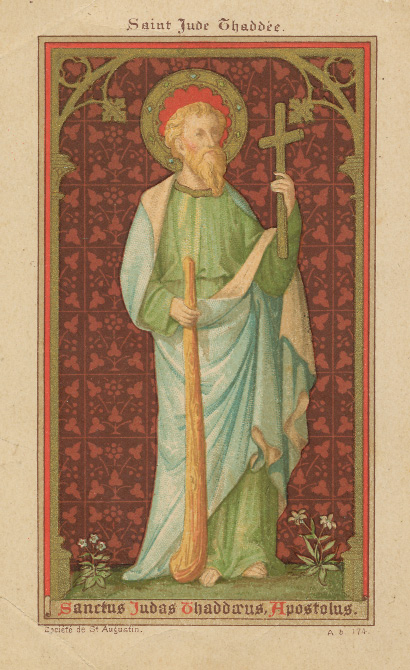
One of the original 12 apostles, Jude is depicted with the flame of knowledge received from the Holy Spirit at the Pentecost burning above his head. Brother of James the Lesser and cousin of Jesus, Jude was one of Christ’s earliest followers. He earned his title of Patron Saint of Impossible Causes because of a letter he wrote in 60AD to persecuted Christian converts in the East, exhorting them to stay strong in the face of all difficulties.

The name Jude means giver of joy and the name Thaddeus means great hearted one and this saint was said to live up to his name, attracting immense crowds by preaching in an entertaining way, outwitting magicians and local priests. Abgar, the King of Edessa was quite impressed with Jude and appealed to Jesus cure his leprosy. He sent an artist to draw Christ’s image. The artist was so shaken by the glow in Christ’s eyes, he could not draw. Christ wiped his face with a cloth and the image of his face was transferred to it. Jude brought the cloth back to Abgar and the king rubbed the cloth over his body, curing himself of leprosy. Many depictions and statues of Saint Jude include this cloth with Christ’s image on it. Jude was martyred along with Saint Simon in the city of Samir by being beaten with a club. This club, as well as the palms of martyrdom are also part of his iconography.

The cult of Saint Jude all but died out after the Middle Ages because people confused him with Judas Iscariot, the apostle who betrayed Christ. Despite being cited as a great influence by the mystics Saint Bernard of Clairvaux and Saint Bridget of Sweden, Jude was rarely invoked by the faithful for anything. It is said that because of this, he became the saint to call on in the most impossible of situations. So anxious was he to be of help, he would turn heaven and earth to rectify a desperate situation. By the nineteenth century, it became customary to thank the saint for help with answered prayers by taking an ad in the newspaper. This helped to resurrect his popularity and these small “Thank you Saint Jude” ads can be found in many weekly and daily periodicals in present day.

Prayer to St. Jude Thaddeus

Glorious apostle, Saint Jude Thaddeus, I salute you through the Sacred Heart of Jesus. Through his heart I praise and thank God for all the graces he has bestowed upon you. I implore you, through his love, to look upon me with compassion. Do not despise my poor prayer. Do not let my trust be confounded! God has granted to you the privilege of aiding mankind in the most desperate cases. Oh, come to my aid that I may praise the mercies of God! All my life I will be your grateful client until I can thank you in heaven.
(Mention your request here).
Saint Jude, pray for us, and for all who invoke your aid.

St. Gerard Majella 1726 – 1755

St.Gerald

“Who except God can give you peace? Has the world ever been able to satisfy the heart?”
Feast Day: October 16
Patron of: expectant mothers, infertility, lay brothers, mothers, pregnancy
Mystics

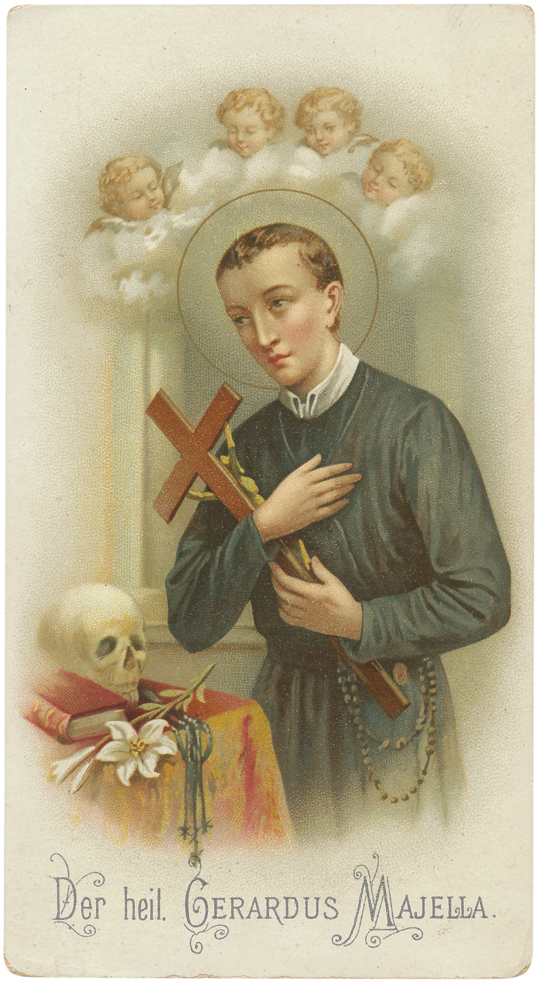
A quiet and humble lay brother in the newly found Redemptorist order, St. Gerard Majella did not display his great mystical gifts until the last three years of his life. Before his early death at the age of twenty-nine, he was known as “The Wonderworker of the Eighteenth Century”, for his ability to read consciences, predict the future, be in two places at once, heal the dying and infuse his surroundings with serenity. He is most invoked by women who want to conceive a child and though there are many different novenas to him, The Prayer for Motherhood is particularly popular throughout the world.

Born in a town south of Naples to a tailor and his wife, Gerard was a sickly child, contemplative by nature. At the age of twelve, his father died, plunging his family into poverty. Gerard was apprenticed to a tailor in order to support his mother and three sisters. He suffered brutally at the hands of this abusive man and eventually got a job as a servant for the local bishop. His hopes of entering the Capuchin order were dashed due to his poor health. Upon returning home, his devout nature and his kindness, especially to children, was noticed by St. Alphonsus Liguori, the founder of the Redemptorist order. He invited Gerard to join as a lay brother and work in the slums among the poor. It was while he was serving on this mission that Gerard faced the greatest challenge of his life. A young woman accused him of fathering her unborn child. When Gerard refused to comment on these charges or defend himself, the Redemptorists had no choice but to deprive him of the privilege of working with them. Months later when the woman admitted that she had lied, a bewildered Alphonse Liguori asked Gerard why he had remained silent. He answered that he had complete faith in God and that silence was the only answer to unjust accusations.

Raised as the only male in a household of women, St. Gerard was particularly sensitive to the problems women had in conceiving and giving birth. While visiting family friends, he dropped his handkerchief while leaving. The young woman of the family ran to give it to him and he refused to take it saying, “Keep it. One day it will be of service to you.” Though puzzled, she did as he said. Years later, while dying in childbirth she remembered his words and had the handkerchief brought to her and placed on her womb. All deadly complications stopped and she gave birth to a healthy baby. The handkerchief of St. Gerard’s was passed from mother to mother until his canonization in 1904. The remaining shred is still used to bless relics for those seeking to conceive a child or have a safe delivery.

Novena Prayer to the Saint Gerard Majella for Motherhood
O good St Gerard, powerful intercessor before God and wonder worker of our day, confidently I call upon you and seek your aid. On Earth you always fulfilled God’s designs, help me now to do the holy will of God. Implore the Master of Life, from whom all paternity proceeds, to render me fruitful in offspring, that I may raise up children to God in this life, and in the world to come, heirs to the Kingdom of His Glory.
Amen.

One of the many Saints you can pray with on novena app.

 St. Francis of Assisi 1182 – 1226

St.Francis“Lord make me an instrument of they peace, where there is hatred let me sow love.
Patron of: animals, ecology, grace, green technology, light, love, merchants, nature, peace, pets, tapestry workers, harmony, dying alone
Type: Mystic

Love for God and everything in creation so consumed St. Francis of Assisi, that he was able to commune with the natural world on a divine level. Taming wolves, quieting flocks of birds and infusing peace and contentment to the humanity he interacted with, we call on Francis of Assisi to bring us into the harmonious rhythms of the universe, where all of nature and mankind are at one with the divine force of creation.

An unlikely mystic, Francis was born Giovanni Bernadone in the town of Assisi. His father, a proud member of the upper classes was a wealthy cloth merchant married to a woman from Provence. Because he frequently conversed in French with his mother, Giovanni was soon known as “Francesco” or “the Frenchman” by his friends and neighbors. Confident that his son would follow in his footsteps, the elder Bernadone indulged and catered to Francesco’s every whim and the youth enjoyed a pleasure filled existence in the company of others in his social caste. On a lark he set off with friends to take part in a war with Perugia. Much to his shock, he was taken prisoner and it took his family a year to ransom him back. Upon his return, he was bedridden and seriously ill. But in recovering his health, Francesco seems to have lost his identity. He suffered a great spiritual crisis as all interest in his old life and his father’s business waned and disappeared. While wandering the countryside he stopped into the deserted church of San Damiano and heard the crucifix say to him, “Francis, go and repair my house, which you see is falling down.” Happy to have some direction in his life, he took the request literally and began rebuilding the structure with his bare hands. Ultimately, his father disowned him and when Francis, renouncing his inheritance threw his clothing in the street, he donned the simple brown garment given him by the Bishop of Assisi.

Begging for supplies, Francis continued his work on San Damiano. Eventually he was joined by other disenchanted young men looking for a higher meaning in life. By simply following the exact tenets of Christ, this little band of friars, never owning anything, bartering labor for food and shelter began a movement of religious seekers that revolutionized the Church by the simple and loving way they spread the gospel. Instead of writing in church Latin he used colloquial Italian and in an effort to explain the story of Christ’s birth, he created a living tableau of animals and people – the first Christmas crèche.

A great poet and mystic, Francis was the first saint to receive the stigmata while in a meditative rapture. Filled with humility and though he founded one of the world’s greatest religious orders, Francis of Assisi was never ordained a priest. Upon his death he requested to be buried in the cemetery for criminals, but the people of Assisi so loved him that they took his body and interred it under the altar of their great cathedral. Just as popular with nonCatholics as Catholics, Francis has inspired great artists, composers and writers. Assisi, Italy remains a great pilgrimage site for those wishing to pay him tribute.

Prayer

O Beloved Saint Francis, gentle and poor, your obedience to God, and your simple, deep love for all God’s creatures led you to the heights of heavenly perfection and turned many hearts to follow God’s will. Now in our day, in our ministry to the many who come here searching for peace and intercede for us we come before the Lord with our special requests…

(Mention your special intentions here.)

O Blessed Saint of God, from your throne among the hosts of heaven, present our petitions before our faithful Lord. May your prayers on our behalf be heard and may God grant us the grace to lead good and faithful lives. Amen

Saint Francis of Assisi, pray for us.

PADRE PIO, MYSTIC AND WONDERWORKER

Image result for padre pio

1887-1968
Feast Day: September 23

Patron of: Forgiveness

Keywords: healing, miracles

Quote: “Pray, hope, and don’t worry.”

Symbols: crucifix, stigmata

Denounced by Vatican officials as a fraud, and his mystical gifts frequently viewed with suspicion by his immediate superiors, Pio of Pietracelina was sequestered away in the remote monastery of San Giovanni Rotondo where it was expected that he would labor as a monk in obscurity. His adeptness in both physical and spiritual healing and his ability to read hearts and minds while in confession made him wildly popular among the common people of that impoverished region of Italy. Today, the town of San Giovanni Rotondo is the second most visited place by religious pilgrims who venture there to pay homage to one of the most popular saints of the twentieth century, Padre Pio. Made a saint in 2002, Padre Pio has no official patronage. Because of his devotion to the powers of the Sacred Heart of Jesus and his own suffering due to the mistrust of his superiors, he is frequently invoked to bring the grace of forgiveness to a situation.

Born Francesco Forlione in Pietracelina, a town north of Naples, he was named for his patron saint, Francis of Assisi. Coming from a religious family, he said he had spiritual visions of Christ and the Virgin Mary from a very young age. He never mentioned them to anyone as he assumed all people had such gifts. He was ordained as a Capuchin friar in 1910 taking the name Pio (meaning “Pious”) but was sent home due to a diagnosis of tuberculosis. While convalescing he offered himself as a conduit of suffering in exchange for the salvation of others. Eventually, in 1916 he was conscripted into the army where he contracted such a high fever that he was sent home to die. Upon his miraculous recovery from this illness, the Capuchin order sent him to the very remote monastery of Our Lady of Grace in San Giovanni Rotondo in Puglia, a province of Southern Italy. On September 20, 1918, while praying in the stillness of the church, Pio went into a trancelike state where he saw Christ standing before him bleeding from the wounds of the crucifixion. Pio’s heart almost burst in sympathy before coming out of the state in intense pain. Upon regaining consciousness he found himself to be afflicted with the same wounds of the crucifixion. It was this condition which only ended at his death in 1968, which would bring him under intense scrutiny by church officials for the rest of his life.

Pio’s talents for deciphering what people meant to tell him during confession but were too embarrassed or ashamed to bring up, became immediate apparent to the local townspeople and he developed a great following among them. They credited him with an incredible capacity of healing, mending physical ills, familial squabbles, and curing spiritual desolation. When Vatican Officials severely limited his official duties, the one mass he was allowed to say at 5 AM, had thousands lining up the night before so that they may be with him. Without ever leaving the monastery, he was known as “the living saint” as he sighted in hospitals and at sickbeds hundreds of miles away. The onset of World War Two spread his cult on an international level as soldiers from Australia, other parts of Europe, and the United States witnessed his miraculous abilities. By the late 1940’s he was receiving hundreds of international prayer requests per day. He eventually founded a hospital for the hopelessly ill, the internationally acclaimed House for the Relief of Suffering, which treats tens of thousands of people each year and survives solely on charitable donations.

The animosity that many Vatican officials had against Padre Pio was dissolved in 2002 when Pope John Paul II declared him a saint. This pope knew Pio’s powers firsthand as he had visited him fifty years before as a young seminarian in the hopes of obtaining a cure for a friend. Not only did his friend’s cancer go into remission, but Pio’s strange prediction of this obscure Polish priest’s rise to pope also came true.

Novena to Padre Pio

(It is important to note that Padre Pio himself recited the Novena to the Sacred Heart of Jesus for the intentions of those who requested his prayers every day.)

Dear God, Thou hast generously blessed Thy servant, St. Pio of Pietrelcina, with the gifts of the Spirit. Thou hast marked his body with the five wounds of Christ Crucified, as a powerful witness to the saving Passion and Death of Thy Son. Endowed with the gift of discernment, St. Pio labored endlessly in the confessional for the salvation of souls. With reverence and intense devotion in the celebration of Mass, he invited countless men and women to a greater union with Jesus Christ in the Sacrament of the Holy Eucharist.

Through the intercession of St. Pio of Pietrelcina, I confidently beseech Thee to grant me the grace of (mention your intentions here). Amen.

Recite three Glorias.

from the Novena App

Read more about Padre Pio in “Saints: Ancient and Modern”


MOTHER OF SORROWS

Image result for mother of sorrows

Feast Day: September 15

Patron of: Grief

Quote: “…And you yourself shall be pierced with a sword – so that the thoughts of many hearts may be laid bare.” Luke 2:34-35

Keywords: grief, solace, mourning

When we are overwhelmed with grief, we turn to Mary, Mother of Jesus for help in our suffering. Throughout her life she endured much pain and sorrow and is fully able to empathize with anyone’s personal anguish. She endured the shame of being pregnant and unmarried, being poor, homelessness and having her only son unjustly imprisoned and executed. Most astonishing, Mary knew what was to befall her son yet had to see these events from God’s point of view and have faith that this was all for the good of mankind.

By meditating on the Seven Sorrows of Mary, a devotion from the Middle Ages, which uses scenes from the life of the Virgin Mother as a meditation on accepting the sorrowful part of life with grace.

The Seven Sorrows of Mary are:

1) The Prophecy of Simeon. As a young child, when his parents presented him in the temple, Jesus was met by the holy man Simeon who predicted everything that would happen to him in his address to Mary: “Behold, this child is destined for the fall and rise of many in Israel, and to be a sign that will be contradicted – and you yourself a sword will pierce so that thoughts of many hearts will be revealed.” (Luke 2:34-35).

2) The Flight into Egypt. In Bethlehem, after the birth of Christ, Joseph had a vision of an angel warning him of the impending slaughter of any male child under the age of two by King Herod in order to prevent the coming Messiah. The Holy Family had to travel a secretive route to Egypt and remain in that country until Herod died. Mary not only worried for the welfare of her own son but mourn for the murdered children left behind.

3) The Loss of the Child Jesus in the Temple. While on a pilgrimage to Jerusalem, the 12 year old Jesus vanished from his family. His heartsick parents finally found him three days later, arguing with elders in the temple.

4) The Meeting of Jesus with His Cross. Mary watched helplessly as her son was ridiculed and mocked as he stumbled, carrying the cross he was to be executed on.

5) The Crucifixion. As he was nailed to the cross, most of his disciples ran away. Mary never wavered as she stood at the foot of the cross, witnessing her son’s agony and death.

6) Jesus Taken Down from the Cross. Mary held her dead son’s wound covered body. This, her greatest sorrow is known as the “Pieta”.

7) The Burial of Jesus. As the stone was rolled, closing up his tomb, Mary had to say her final goodbye to her earthly son. Her faith had to be sincerely tested as there was no hint of the resurrection to come.

Symbols: Knives pricking Mary’s heart. Symbols of the crucifixion: crown of thorns, nails.

Novena to the Mother of Sorrows

Most holy and afflicted Virgin, Queen of Martyrs, you stood beneath the cross, witnessing the agony of your dying son. Look with a mother’s tenderness and pity on me, who kneel before you. I venerate your sorrows and I place my requests with filial confidence in the sanctuary of your wounded heart.

Present them, I beseech you, on my behalf to Jesus Christ, through the merits of his own most sacred passion and death, together with your sufferings at the foot of the cross. Through the united efficacy of both, obtain the granting of my petition. To whom shall I have recourse in my wants and miseries if not to you, Mother of Mercy? You have drunk so deeply of the chalice of your son, you can compassionate our sorrows.

Holy Mary, your soul was pierced by a sword of sorrow at the sight of the passion of your divine son. Intercede for me and obtain from Jesus (mention your request) if it be for his honor and glory and for my good. Amen.

excerpted from the Novena App

read about The Mother of Sorrows in Novena: the Power of Prayer


SAINT RAYMOND NONNATUS: PATRON OF NEWBORNS

Image result for saint raymond nonnatus

1204-1240

Feast Day: August 31

Patron of: Newborns

Keywords: midwives, obstetricians, expectant mothers, women in labor, falsely accused, secrets, fever

Quote: “For many hours you did not die in the womb of your dead mother and you were successfully delivered from her side to be the joy of the world.”

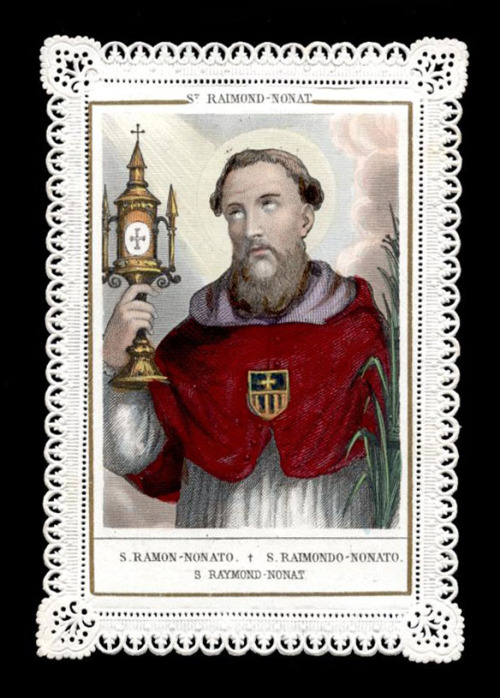
Symbols: monstrance, palms with three crowns, cardinal’s hat, padlock

‘Non natus’ is Latin for “never born” and Saint Raymond was given his surname because his mother had died in labor two days before he was delivered by cesarean section. The fact that he did not die in his mother’s womb was considered an extraordinary event in the early thirteenth century, when a good number of mothers and infants were lost during childbirth.  Because of the extraordinary circumstances of his birth, he always felt an affinity for the precarious state of women in labor and their infants. For this reason, midwives, obstetricians and expectant mothers call on him for help in the safe delivery of healthy newborns.

Hailing from Catalonia in Spain, Raymond’s family were from a noble class.  His father attempted to train him to take over the family farms but because of his great devotion to the Virgin Mary, he chose instead to join the Mercedarians, a religious order dedicated to ransoming Christian slaves from the Moors, who occupied much of Spain. The Mercedarians also spiritually administered to Christian slaves in Moorish regions. As the Spanish territory was recaptured, and the Moors driven into North Africa, Raymond Nonnatus followed Christian slaves into Algeria. It was said he spent his entire inheritance ransoming slaves and when he ran out of money he substituted himself for another man’s freedom. He was soon imprisoned for his religious proselytizing and when he succeeded in converting several of his jailers, the Moors bored holes in his lips and sealed his mouth shut with an iron padlock to keep him from preaching. Though he was sentenced to death, the Mercedarians managed to ransom him home to Spain. As he was enroute to Rome to receive the hat of a cardinal, he was struck down by a fever and died in Cardona, 60 miles from Barcelonia. It was said that angels fed and administered communion to Raymond on his deathbed and he is frequently depicted in the company of angels.

Because of the padlock put on his lips, Raymond Nonnatus is invoked against gossip and the temptation to gossip. He is also invoked for help in keeping secrets as well as by priests for protection of keeping the sacred silence of the confessional. On the feast of Saint Raymond Nonnatus, it is customary for those who are victims of slander and gossip to put locks on the saint’s altar to silence their persecutors. In many images Saint Raymond Nonnatus carries the palm of martyrs signifying life defeating death, his palm has three crowns, for chastity, eloquence, and martyrdom.

Invoked for: safe childbirth, a healthy newborn, to silence gossip, against fever

Prayer to St. Raymond Nonnatus

(Prayer to obtain some special favor through the intercession of St. Raymond. Novena from August 23-31.)

Glorious St. Raymond, filled with compassion for those who invoke thee and with love for those who suffer heavily leaden with the weight of my troubles, I cast myself at thy feet and humbly beg of thee to take the present affair which I recommend to thee under thy special protection. ( your request here) Vouchsafe to recommend it to the Blessed Virgin Mary and lay it before the Throne of Jesus, so that He may bring it to a happy issue. Cease not to intercede for me until my request is granted. Above all obtain for me the grace of one day beholding my God face to Face, and with thee and Mary and the saints praising and blessing to all eternity. Amen.

Good St. Raymond, pray for us and obtain our request.

Good St. Raymond, pray for us and obtain our request.

Good St. Raymond, pray for us and obtain our request.

Our Father, Hail Mary and Glory be.


excerpted from the novena app


SAINT MONICA: PATRON OF WAYWARD CHILDREN

Image result for saint monica la cathedral

331 – 387
Feast Day: August 28

Patron of: Wayward Children

Quote: “Nothing is far from God.”

Keywords: abuse victims, adultery victims, alcoholics, housewives, married women, mothers, patience, wayward children

Symbols: tears, girdle

Though she was greatly hurt and disappointed by her firstborn son, St. Monica never gave up the idea that he would change his way of living. After 17 years of what seemed like fruitless prayers, her son turned his life around, converted to her faith and became one of the world’s greatest philosophers and Catholic saints, St. Augustine of Hippo. We invoke St. Monica to help us when our own children disappoint us. She serves as a reminder that there are no lost causes in this world and that absolutely anyone can reform and change their life.

Born into a Berber tribe in North Africa, Monica was brought up a Christian. Her parents arranged her in marriage with a prominent pagan Roman citizen of Carthage by the name of Patricius. Monica had a hard time in her early married years as she had to put up with a cantankerous mother-in-law as well as a dissolute husband. There are some accounts which say that she turned to alcohol and was herself an alcoholic who recovered her sobriety through faith and prayer. She had three children who she raised as Christians. The eldest, Augustine, was the most brilliant and his parents had high hopes for his career. Both Patricius and Monica worked hard to get the best education for their son and it was the greatest sorrow of Monica’s life when Augustine turned out to live a lazy, pleasure-filled life. It hurt her even more when he threw out his Christian beliefs to embrace the Manichean heresy – a popular cult believing in the natural good and evil of every soul. In order to keep his blasphemous beliefs from misleading her younger children, Monica forbade Augustine to come back to their home. Inconsolable in her grief, Monica had a vision of a radiant being pointing to Augustine in a beam of light next to her, saying, “Your son is with you.” When she related this vision to Augustine he laughingly said it would all be true if she would only give up her religious piety. “He did not say that I was with you,” she answered him. “He said you were with me.”

When Augustine openly took a mistress and further humiliated his mother by having an illegitimate son, Monica turned to her Bishop for help. He advised her to pray and be patient saying, “It is not possible that the son of so many tears should perish.” After the death of his father, Augustine decided to move to Rome to increase his worldly success, Monica vowed to follow him. In his own great treatise “Confessions”, Augustine relates how as his mother spent the night in prayer before their voyage, he tricked her and slipped away on an earlier ship. Devastated, she traveled to Rome anyway. By the time she arrived Augustine, had already left that city for Milan. By the time Monica tracked him down, she was overjoyed to find that Augustine was no longer a Manichean. He had met Ambrose, the bishop of Milan and was studying with him. Eventually, after several more years, Monica lived to see Augustine baptized a Christian. While waiting for a ship at Ostia to take mother and son back to Africa, Monica told her son that she had accomplished everything that she had set out to do in this life and did not need to live any longer. She died in Ostia, never returning to her native land.

It is interesting to note that there are many great saints from Africa, especially the earliest ones and they are rarely depicted as anything but European in visage.

Explanation:
Light from sky: Grace. Through prayer, Monica channeled grace to convert her son.
Outstretched arms: pointing to Africa, her homeland.
Palm tree: the shore of Ostia Antica, where Monica’s earthly life ended.

Novena Prayer to Saint Monica

Dear Saint Monica, once the sorrowing mother of a wayward son, be pleased to present our petition to the Lord God of heaven and earth. (Your intention here.) Look down upon our anxieties and needs, and intercede for us, as you did so fervently for Augustine, your firstborn.

We have full confidence that your prayers will gain favorable hearing in heaven. Mother of a sinner-turned saint; obtain for us patience, perseverance, and total trust in God’s perfect timing. In His appointed hour, in His merciful way, may He respond to your prayer and ours, which we offer through you. Amen

excerpted from the Novena App


St. Clare of Assisi

FullSizeCard_1
St. Clare

Feast Day: August 11
Keywords: clarity, blindness, embroiderers, eye diseases, gilders, goldsmiths, laundry workers, telephones, telegraphs, television
Mystic

Together with her mentor and friend, Francis of Assisi, St. Clare shook the foundations of Medieval society by revolutionizing religious expression. Her given name, Chiara means clarity and we call on St. Clare whenever we need to shine a light on a situation or to find a way to communicate more clearly. She is also invoked to protect the blind and to help those with eye trouble. Chiara Offreduccio, as the beautiful daughter of minor royalty was offered every worldly advantage available to one in her social class. When she heard St. Francis preach the Lenten service at her church in 1212, his simple message of living with complete trust in God inspired her to abandon going through with her arranged marriage in order to join the Franciscan movement. The first followers of Saint Francis were the wealthy sons of his town of Assisi. Their act of turning their backs on the material world to live at the mercy of the elements and on whatever alms they could beg was disturbing and controversial to both their families as well as to the church authorities. Attracted by the joyous way in which they comported themselves, as well as the enthusiasm they brought to religious worship, Clare was the first woman to join their order. Fervently believing in a life devoted to the precepts of the gospel, the Franciscans did not believe in personal property. When Clare escaped her family to join them on Palm Sunday, Francis himself cut off her long blond hair and handed her the simple woolen robe worn by his followers. He then left her in the local Benedictine convent as there were no facilities in his order for women. It was not long before her entire family attempted an intervention type rescue of the girl. Revealing her shorn hair to her horrified father made them realize that she would never return to their world. Her younger sister, as well as other wellborn young women from the town soon followed her. In 1215, Saint Francis installed Clare as the Abbess of the Order of Poor Ladies. True to the Rule of St. Francis, they accepted no dowries from their families as other religious orders did. When they were left inheritances, the money was distributed to the poor. Highly intelligent, and known for the efficacy of her prayers, popes, cardinals, royalty and St. Francis himself came to her for spiritual advice. Her own correspondence shows her to be a clever, happy person.

Devoted to the Eucharist and frequently immersed in prayer, the stories of miraculous occurrences around Clare abound. The most famous is that while she was ill, her convent which was outside of the walls of Assisi was attacked by the Saracen mercenaries of Frederick II . As the invaders stormed the walls with ladders, Clare calmly held up a monstrance containing the host. A child’s voice emanated from inside the monstrance, “I will always guard and defend you.” A feeling of dread overtook the invaders and they ran away from the town.

St. Clare was named the patron saint of television writers and workers due to a vision she had while too ill to attend Christmas Eve mass. She was able to view and hear the entire mass on the wall of her room. She spent much time embroidering linens for use in mass, so she is the patron of embroiderers. Because that trade is hard on the eyes and because of her name, she is the patron of those with eye problems and the blind.

Prayer
O Glorious St. Clare! God has given you the power of working miracles continually, and the favor of answering the prayers of those who invoke your assistance in misfortune, anxiety, and distress. We beseech you, obtain from Jesus through Mary His Blessed Mother, what we beg of you so fervently and hopefully, (mention your petition) if it be for the greater honor and glory of God and for the good of our souls. Amen