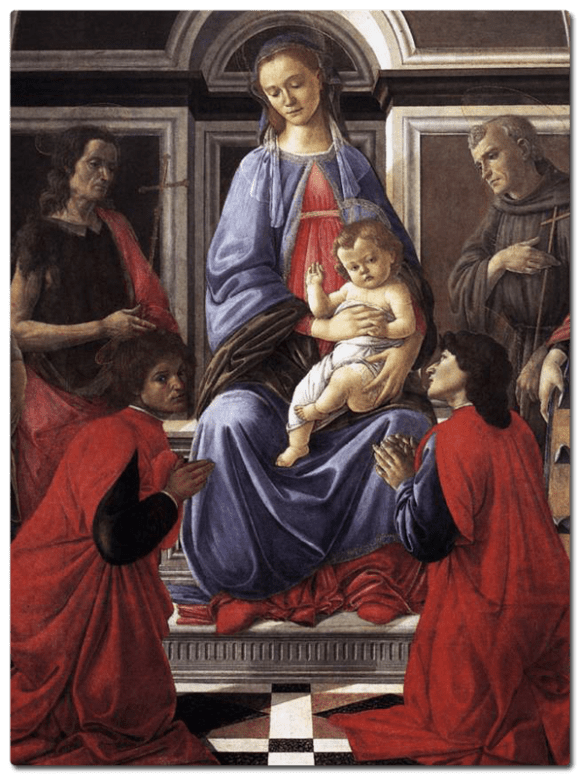
Madonna and Child with Six Saints (Sant’Ambrogio Altarpiece) – Sandro Botticelli – 1470
Mother and Child
Reply
Madonna and Child with Six Saints (Sant’Ambrogio Altarpiece) – Sandro Botticelli – 1470
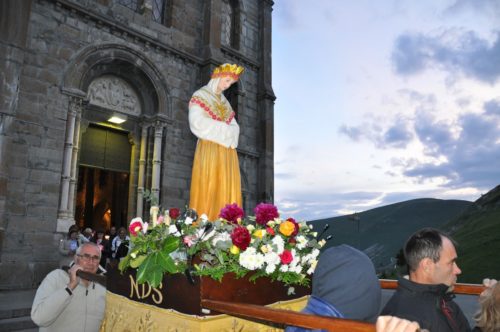
Our Lady of La Salette is the patroness of France.
The Feast of Our Lady of La Salette is September 19.
One of the most controversial of the Church-approved apparitions of Mary is her visit to La Salette in the French Alps. The seers who saw her were two poor shepherd children, half wild, unwanted by their parents and unschooled. They had little credibility with the people in their region and even less with the local clergy. Yet because of the complete conversion or change of heart of the little town, this apparition was approved within four years.
On September 19, 1846, two shepherds, fourteen-year-old Melanie Calvat and eleven-year-old Maximin Giraud were tending their cows in the Alpine hamlet of La Salette, France, approximately 6,000 feet above sea level. Both children had only recently met, the younger of the two, Maximin, was outgoing and friendly. He had insisted on their working together in order to stave off the boredom and loneliness of their tedious job. Melanie Calvat begrudgingly accepted his company. She was known to have a difficult and taciturn nature. She had worked as a shepherd from the time of her tenth birthday, and her master considered her disobedient and lazy. She was the fourth of tenth children, and many people in the village remember her mother as abusive and violent. On this Saturday afternoon in September the children had only been working together for a few days. They had taken a nap after lunch and upon awakening realized that their cows had wandered off. As they scrambled up into the pasture to retrieve them, they saw what seemed to them to be a globe of fire near a little hollow, which looked “as though the sun had fallen on that spot.” Upon closer inspection, the light took on a form and the figure of a beautiful woman weeping could be made out. The woman was sitting on a rock with her face buried in her hands. She saw the children and got up, saying, “Come near, my children, do not be afraid. I am here to tell you great news.”
Reassured and extremely curious, Maximin and Melanie ran over to the woman. They later reported that she was tall and everything about her radiated light. She wore clothing typical of the women of that area; a long dress with an apron, and a shawl crossed over her breast and tied around her back. Her dress, however was studded in pearls, and her bonnet was a strange crown-shaped hat that exuded bright rays. Hanging from her neck she wore a large crucifix with a figure of Christ on it. Beneath the arms of the cross there were, to the left a hammer, and to the right, pincers. An even brighter radiance emanated from this crucifix. There were garlands of roses around her head, the edge of her shawl and around her feet. Throughout her conversation with the children the woman continually wept.
“If my people will not obey, I shall be compelled to loose my Son’s arm. It is so heavy, so pressing that I can no longer restrain it. How long I have suffered for you! If my Son is not to cast you off, I am obliged to entreat Him without ceasing. But you take no least notice of that. No matter how well you pray in the future, no matter how well you act, you will never be able to make up to me what I have endured for your sake.”
Then the woman pointed out how no one in the village took Sunday off from work. She added, “The cart drivers cannot swear without bringing in my Son’s name. These are the two things which make my Son’s arms so burdensome.”
She went on to say that if the village continued to act impiously there would be a great famine coming and it would be the people’s own fault. She added that if the people would change their ways, the rocks would become piles of wheat and the potatoes would sow themselves. Melanie later reported that since the lady was speaking French and she was not familiar with the French word for “potato,” the lady stopped what she was saying and added, “Ah, but you do not speak French!” and she continued her dialogue to them in the local patois. She then gave each child a secret that the other could not hear. She questioned them on whether they said their prayers. When they answered “no,” she said, “Ah, my children, it is very important to say them, at night and in the morning. When you don’t have time at least say an ‘Our Father’ and a ‘Hail Mary.’ When you can, say more.” She continued in a tearful voice: “Only a few old women go to mass in the summer. All the rest work every Sunday throughout the summer. And in winter, when they don’t know what to do with themselves, they go to mass only to poke fun at religion. During Lent they flock to the butcher shop like dogs.”
The lady went on to ask if either of them had ever seen spoiled grain before. Maximin quickly answered, “No.”
The lady reminded him that this was not so, “But my child, you must have seen it once near Coin, with your papa. The owner of a field said to your papa, ‘Come and see my spoiled grain.’ The two of you went. You took two or three ears of grain in your fingers. You rubbed them, and they crumbled to dust. Then you came back from Coin. When you were but a half hour away from Corps, your papa gave you a piece of bread and said, ‘Well, my son, eat some bread this year, anyhow. I don’t know who will be eating any next year, if the grain goes on spoiling like that.’”
Maximin immediately recalled this experience but was astounded as to how this lady could know it.
In French the lady said, “My children, you will make this known to all my people.” She turned from them and started to glide away. She stopped and paused, repeating one more time, “My children, you will make this known to all my people.”
The children returned with their cows at the end of the day. Melanie was not inclined to tell anyone of their adventure with the lady. Maximin however, told his employer all about it. When both children were questioned independently, they told the same story. The priest and the town officials were doubtful. To them, these were just two ignorant children making up a fantasy. But there was something in the tone of the story that affected the people of the town. This lady was not using religious metaphors, she was speaking in an accessible, straightforward manner. When the villagers went to visit the spot where the lady appeared, a spring had started flowing. It was thought at first that this was a coincidence, since it had rained the day before and it was common for small springs to appear for a day or so than dry up. But this spring behaved differently, freely flowing no matter what the weather. People who drank from the spring reported dramatic healing activity. The demeanor of the village totally changed. By 1846, France, once a nation dedicated to the Virgin Mary, was now actively a nation trying to live without religious conviction. In the search for material wealth, spiritual values had fallen by the wayside. Though La Salette had only five hundred inhabitants, they, too, had adapted the slack lifestyle of the bigger cities. The lady was right; religious devotion had become a joke. Recognizing the truth in the lady’s examples of their behavior, the village church started to fill up with earnest worshipers, and most of the village began honoring Sunday as the Sabbath. The spring itself, became a pilgrimage site with devotees of Mary coming from far distances. It is thought that Mary speaking her final words in French was a message to the French nation to reform themselves and their values. La Salette became an approved apparition in 1851.
The seers of La Salette went on to lead troubled lives. Maximin drifted in and out of employment and died by his fortieth birthday. Melanie became a nun. She reveled in the attention she received for being a visionary and felt neglected by the local clergy. In 1879 she published a book alleging what her secret had been. It was a gruesome description of Satan let loose upon the world in 1864 and predictions of mass destruction and the anti-Christ. Because she had fallen under the influence of apocalyptic books and various conspiracy theorists, her book was thought to be purely imaginative and was not sanctioned by the Church. She continually had a small band of followers who believed in these later visions. She died in 1904.
In 1879 a magnificent basilica, Our Lady of La Salette was consecrated on the site of the apparition.
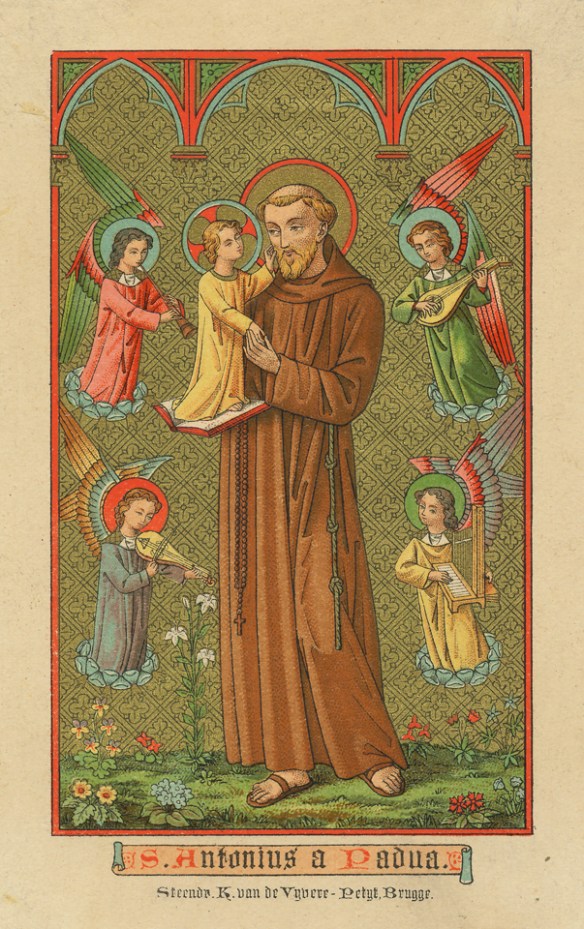
Wonder and miracles are infused with every story of Saint Anthony. Though he has been dead for almost 800 years, he is still the most popular saint in the world and his statue is found in every Catholic Church. Saint Anthony is best known as the patron saint of lost articles but he is invoked for help in all life situations. In his own day he was called the “Wonder Worker’ and credited with the ability to stop the rain, raise the dead and reattach severed limbs. He was such a charismatic preacher that when a crowd of heretics in Rimini refused to listen to his preaching, the fish raised themselves out of the water to hear him. Born Fernando de Bulhes in Lisbon, Portugal, he disappointed his noble family by rejecting his luxurious life and joining the Augustinian religious order.
A scholar by nature, he read every book in the monastery, devoting his time to contemplative prayer. Eventually, he befriended a group of itinerant Franciscan monks and became fascinated with this new religious order. Much impressed by their dedication to simplicity, poverty and their belief in returning to the original words of Christ, he joined their ranks, changing his name to Anthony in honor of Saint Anthony of the Desert, the patron of their little church. Returning home from a failed missionary venture in Morocco, his ship was blown off course and he wound up in Messina, Sicily. A group of Franciscan friars insisted he go north with them for a great gathering of all Franciscans, with their founder Francis of Assisi. Anthony remained in Italy and discovered his great gift of preaching when a superior ordered him to speak at an ordination, telling him to say whatever the holy spirit had infused into him.
He astonished his audience, not only by his skills as an orator but by the depth of his knowledge. He was sent throughout northern Italy and southern France on evangelical preaching missions which gathered crowds in the tens of thousands. His popularity among the people increased as he used his position to get real changes enacted for their protection. While based in Padua, he observed the crushing power of debt upon the common people. At Anthony’s insistence, the local municipality enacted a law protecting those who could not pay their debts that is still enforced today. Anthony exhausted himself preaching out in fields and in piazzas as there was not cathedral large enough to hold all who came to hear him. At the age of thirty six, his health began to fail him and a local Count donated a woodland retreat for his recovery.
One morning the Count heard the sounds of a baby giggling and he looked out to see Anthony surrounded in light, playing with the baby Jesus. That Christ would choose to appear to one of his saints in such a vulnerable state is a testament to the loving and kind nature of Saint Anthony. Because he is depicted holding a baby, women having trouble conceiving invoke his aid.
Being of Portuguese descent, Anthony’s feast day is very auspicious for marriages in Portugal and Brazil and in those cultures, he is known to assist women seeking a husband. According to legend, Saint Anthony earned the title patron saint of lost articles when a novice borrowed his psalter and failed to return it. Saint Anthony prayed to get it back and the novice was visited by terrifying visions that sent him running back to Anthony with the book. In iconography, Anthony always holds the baby Jesus and a lily for purity. Many times the returned book of the gospels is included. Patron of: Lisbon, Portugal, Padua, amputees, barren women, domestic animals, draftees, oppressed people, orphans, paupers, the poor, pregnant women, prisoners, sailors.
Novena to Saint Anthony
Holy Saint Anthony, gentle and powerful in your help, Your love for God and charity for His creatures, made you worthy when on earth, to possess miraculous powers. Miracles waited on your word, which you were always ready to request for those in trouble or anxiety. Encouraged by this thought, I implore you to obtain for me
(mention your request here).
The answer to my prayer may require a miracle. Even so, you are the saint of miracles. Gentle and loving Saint Anthony, whose heart is ever full of human sympathy, take my petition to the Infant Savior for whom you have such a great love, and the gratitude of my heart will be ever yours. Amen
It is customary to donate to Saint Anthony’s Bread, a charity started in Saint Anthony’s lifetime, in gratitude to answered novena prayers.
If you live or are visiting New York City please visit Saint Francis of Assisi Church
on 31 Street. They have a Saint Anthony Shrine and you can donate money
for Saint Anthonys bread.

“Behold the heart which has so much loved men that it has spared nothing, even exhausting and consuming itself in testimony of its love….”
Patron of: family peace, anything
Feast Day: June 8
The iconography of the Sacred Heart speaks to us on such a basic level that its image can be found everywhere in everyday life – from tattoos on bikers to stained glass windows in cathedrals. Traditionally, many Catholic homes display the Sacred Heart of Jesus to insure domestic peace and a loving atmosphere. This ancient concept depicting Christ’s heart in flames was first meditated on in privacy by the 4th century hermits in the desert and taken up by mystics in religious communities in the 11th and 12th centuries; it did not become a popular devotion until the 17th century.
On December 27, 1673, a young Visitation nun in Burgundy, France, named Margaret Mary Alacoque was praying in the convent chapel when she heard a strong inner voice identifying itself as Jesus Christ. In later visits the voice requested that she begin a devotion to an image of Christ’s heart in flames, bleeding and encircled by thorns. The flames were for His ardent love for mankind, the thorns were to remind us of His sacrifice on the cross and the blood was because He was God made man. There is no indication that Margaret Mary Alacoque had ever seen this image before. Indeed, she was puzzled by it and greatly mistrusted herself as being qualified to relay any spiritual messages no matter who they purportedly came from. When she reported her communications to her Mother Superior she was scoffed at as delusional and forbidden to perform any of the devotions she was instructed to carry out. It was only after her Confessor, Claude de La Columbiere heard her describe her visions that she was taken seriously.
Unlike the Mother Superior or Margaret Mary, he was well aware of the private devotions of Bernard of Clairvaux and Mechtilde of Helfta, religious mystics who lived centuries before, inspired by same image. La Columbiere did much to publicize devotion to the Sacred Heart based on the messages Christ gave to Margaret Mary. According to her, Christ was greatly troubled by the indifference and sacrilege He was being treated with by the average person.
As a reward for contemplating this image He promised: 1. I will give them all the graces necessary for their state of life. 2. I will give peace in their families. 3. I will console them in all their troubles. 4. I will be their refuge in life and especially in death. 5. I will abundantly bless all their undertakings. 6. Sinners shall find in my Heart the source and infinite ocean of mercy. 7. Tepid souls shall become fervent. 8. Fervent souls shall rise speedily to great perfection. 9. I will bless those places wherein the image of My Sacred Heart shall be exposed and venerated. 10. I will give to priests the power to touch the most hardened hearts. 11. Persons who propagate this devotion shall have their names eternally written in my Heart. 12. In the excess of the mercy of my Heart, I promise you that my all powerful love will grant to all those who will receive Communion on the First Fridays, for nine consecutive months, the grace of final repentance: they will not die in my displeasure, nor without receiving the sacraments; and my Heart will be their secure refuge in that last hour.
Since there is no way to physically depict the soul, it is thought that the image of the Sacred Heart comes closest. The heart is the seat of love in the body and the wounded heart represents Christ’s sacrifice at the crucifixion as well as His ongoing pain at the state of mankind.
Novena:
O Lord, Jesus Christ, to your most Sacred Heart I confide this intention. Only look upon me, then do what your love inspires. Let your Sacred Heart decide. I count on you. I trust in you. I throw myself on your mercy. Lord Jesus, you will not fail me.
(Mention your request.)
Sacred Heart of Jesus I trust in you. Sacred Heart of Jesus I believe in your love for me. Sacred Heart of Jesus, your kingdom come. Sacred Heart of Jesus, I have asked you for many favors, but I earnestly implore this one. Take it, place it in your open heart. When the Eternal Father looks upon it, he will see it covered with your Precious Blood. It will no longer be my prayer, but yours, Jesus. Sacred Heart of Jesus, I place all my trust in you. Let me not be disappointed. Amen.

Our Lady of Perpetual Help is the patroness of Haiti and Italy.
The feast day of Our Lady of Perpetual Help is June 27.
Icons are visual prayers. Artists who painted them were usually monks who spent whole days in contemplation, meditating on the mysteries of God. In the East, icons not only serve as instructive visual stories but because of the spiritual atmosphere in which they are channeled, they are also venerated along with the word of God. Our Lady of Perpetual Help is an icon whose style bridges both Eastern and Western Churches. Its subject is called the Virgin of the Passion, because it deals with Mary’s role in the Crucifixion of Christ. Like most of these works, the artist is anonymous but most likely came out of the Andrea Rizo de Candia (1422–1499) school of Crete. This mesmerizing picture, which spent years in anonymity, is now venerated and honored in all corners of the world and enjoys universal devotion.
Written remembrances of the image date back to the 1400s, when it was venerated in a church on the island of Crete as The Miraculous Picture of the Mother of God. In the late 1490s, a local merchant aware of all the wondrous stories surrounding the icon, stole it and took it with him to Rome. During the voyage over, a violent storm terrified the crew. Aware that the merchant was traveling with the painting, they had him take it out for them to pray in front of. They attributed their safe crossing to the intercession of the Virgin in the picture. While in Rome, the merchant became mortally ill. Repenting of his theft, he asked the friend he was staying with to promise to see that the painting was given to a church. The friend agreed and took the painting upon the merchant’s death. However, the man’s wife was so charmed by the image, she hung it in her bedroom and the merchant’s request was never honored. Mary appeared twice to the family’s six-year-old daughter, and it was in these visions that she first announced herself as Our Lady of Perpetual Help. She asked that the family stop hoarding the picture and give it to a church that was located between Santa Maria Maggiore and San Giovanni in Laterano. After consulting with a priest, the family gave the painting to the Church of San Matteo, an obscure, out-of-the-way parish. It was installed on March 27, 1499. Almost immediately, pilgrims from all walks of life came to seek comfort in contemplation in front of the icon. For the next three hundred years, the painting known as The Madonna di San Matteo, remained undisturbed as it acquired a loyal group of devotees. In 1798, Napoléon’s troops conquered Rome, and San Matteo was one of the thirty churches destroyed by the French army. The Irish Augustinian monks who were in charge of the church brought the icon to the Monastery of Saint Mary in Posterula in the Trastevere section of Rome and placed it in a private chapel. Its existence was all but forgotten as the original band of monks from San Matteo were dispersed to Ireland and America.
Michael Marchi, an altar boy who served Mass at Saint Mary in Posterula remembered one of the last of the old monks: “This good brother used to tell me with a certain air of mystery and anxiety, especially during the years 1850 and 1851, these precise words, ‘Make sure you know, my son, that the image of the Virgin of Saint Matthew is upstairs in the chapel; don’t ever forget it . . . do you understand? It is a miraculous picture.’ At that time the brother was almost totally blind.”
Michael Marchi entered into religious life, taking orders in the Redemptorist Missionaries. In 1855 they purchased Villa Caserta in Rome to house their order. What they did not realize was, that this estate had been built over the ruins of the Monastery and Church of San Matteo. An investigation into the history of the property turned up writings about an ancient icon of the Mother of God that had enjoyed “great veneration and fame for its miracles,” which was once housed in San Matteo. In 1863 a famous Jesuit preacher came and gave a sermon about the now lost icon of The Virgin of Perpetual Help. Father Marchi realized this was the same dust-laden picture he had always seen above the altar of the house chapel of the Augustinian Fathers at Saint Mary in Posterula.
“There was no devotion to it, no decorations, not even a lamp to acknowledge its presence . . . it remained covered with dust and practically abandoned, many were the times when I served Mass there, that I would stare at it with great attention.”
This providential discovery came to the attention of Pope Pius IX, who remembered praying before the image in San Matteo as a boy. He ordered that the icon of Our Lady of Perpetual Help be brought to the new church of Saint Alfonso for public veneration. Situated on the Esquiline Hill, this is the exact location, between the two basilicas of Santa Maria Maggiore and San Giovanni in Laterano, that the Virgin Mary had originally requested for it to be placed. Pilgrims come from all over the world to be in the presence of the icon.
The pope did not give the Redemptorists the icon just to keep in their church for visiting pilgrims, but rather to make it their mission to disseminate this image of Mary throughout the world. Copies of this icon are considered just as capable of working miracles as the original. Shrines and legions of devotees to Our Lady of Perpetual Help can be found in the United States, Haiti, Ecuador, Peru, Suriname, Chile, Brazil, Mexico, Ireland, Italy, Poland, France, Spain, Singapore, and the Philippines.
Mary is the largest figure in this icon, but the focal point or center of the picture is her hand being clutched by her Son’s. Jesus is a young boy who has just run to his mother in such a fright that one of His sandals is dangling off his feet. Mary calmly shields Him, confident of her power to protect and comfort Him. On either side of them are the objects of the Child’s fear. The archangels Gabriel and Michael have revealed to Him the Cross, the spear, and the sponge, foreshadowing his future torment and execution. Since the birth of her Son, Mary knew He was destined to suffer and die for humankind, yet she firmly believed in His redemption. Therefore, she was able to calm the Child Jesus in this moment of anxiety. If God Himself can reach out to Mary for refuge, then anyone is able to approach her, no matter what we fear, our future or our past actions. Regardless how we judge ourselves, she has total belief and faith in us. Greek letters on either side of Mary’s head are abbreviations for the title, “Mother of God.” Beside the head of Jesus are the Greek letters for “Jesus Christ.” It is important to note that Mary is not holding Jesus’s hand in a tight grip but she leaves it open in invitation to the viewer to join them. Jesus has his hand palm turned down into His mother’s. This symbolizes the grace and favors that He distributes through her intercession. Mary looks directly at the viewer, offering love and comfort to all who gaze at the image.
It is said that Our Lady of Perpetual Help never refuses a request, no matter how small or frivolous it may seem. Many who have felt unworthy to call on her in their direst need report hearing a calm voice saying, “Why don’t you just ask?”
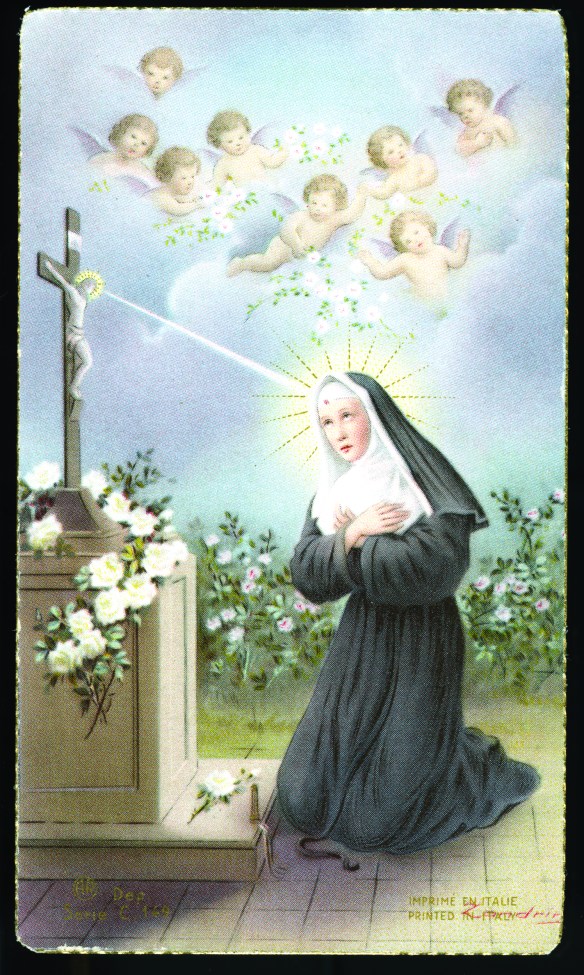 “…In patience and fortitude you are a model of all the states in life.”
Feast Day: May 22
Patron of: Bad Marriages
An abused wife, a mother who’s children died, a widow of a murdered husband, and finally, a nun, Saint Rita experienced many lives in her time on earth. Knowing the powerlessness and despair of those in bad marriages she is invoked for help in desperate times. In her own lifetime she was famous for the power of her prayers to change any situation and it was said that she could accomplish the impossible. Canonized almost 500 years after her birth, she is the first declared female saint of the 20th Century.
Margarita Lotti was born to an older farming couple in Roccaporena, Italy. She was called Rita because of a vision of an angel her mother had who named the baby while declaring, “You will give birth to a daughter marked with the seal of sanctity, gifted with every virtue, a helper to the helpless and an advocate of the afflicted.” As proof of this prophecy, bees, a sign of divine presence, always hovered over her crib as she slept, never harming or waking her.
Though she had always wanted to be a nun, Rita’s parents feared for her future security as there was a schism in the church and many religious orders were closing their doors.
Instead, she had to accept a marriage they contracted for her with a man named Paolo Mancini. Though he was a good provider, he soon proved to be an abusive, promiscuous husband. Settling his personal disputes with violence, Mancini created a tense family environment for Rita and the two sons she had with him. Never wavering in her devotion to God, Rita prayed that her husband would change his ways. After 18 years of marriage, Paolo had a vision of himself as others saw him and begged for his wife’s forgiveness. A lifetime of enemies caught up with Paolo and he was murdered, his mutilated body dumped on his family’s doorstep. Rita begged her two teenaged sons not to pursue a vendetta against his killers, but they refused. She prayed to God to prevent her sons from murdering anyone. Both of them came down with serious illnesses and died before they could act on their vendetta.
Alone in the world, Rita petitioned to join the Augustinian convent. Because several of the nuns there had family members who were involved in Paolo’s murder, the convent refused her, not wanting tensions to carry over from the outside world. Rita prayed and entreated Paolo’s family to forgive his killers. Much to everyone’s surprise, they acquiesced and Rita was admitted to the convent on her third try. While there she spent her days nursing the older nuns and concentrating on Christ’s suffering. When she begged to feel what Christ felt on the cross, a thorn from the crown of thorns on a crucifix struck her on the head and became embedded there. It left a deep wound that never healed. Because this wound became infected and foul smelling Rita was shunned by the other nuns and remained in her cell praying and meditating. The January before she died, a cousin asked her if there was anything she needed and she asked for a rose from her childhood garden. The cousin was shocked to see that there was indeed two roses growing in that garden in the middle of January. Upon her death, her cell was filled with the smell of roses. Rita is always depicted with the thorn in her head, in her Augustinian habit, meditating on the crucified Christ.
Prayer
O holy protectress of those who art in greatest need, O you who shine as a star of hope in the midst of darkness, blessed Saint Rita, bright mirror of God’s grace, in patience and fortitude you are a model of all states in life. I unite my will with the will of God through the merits of my Savior, Jesus Christ, and in particular through his patient wearing of the crown of thorns, which with tender devotion you daily contemplated. Through the merits of the holy Virgin Mary and your own graces and virtues, I ask you to obtain my earnest petition, provided it be for the greater glory of God and my own sanctification. Guide and purify my intention, O holy protectress and advocate, so that I may obtain the pardon of all my sins and the grace to persevere daily, as you did in walking with courage, generosity, and fidelity down the path of life. (Mention your request).
Saint Rita, advocate for the impossible, pray for us.
Saint Rita, advocate of the helpless, pray for us.
(Recite Our Father, Hail Mary and the Glory Be three times each).
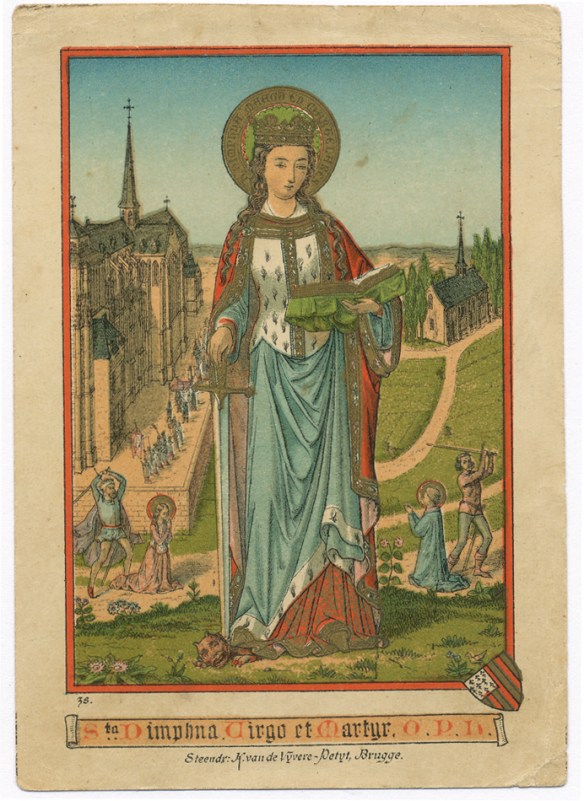 “Saint Dymphna, renowned for many miracles, please hear my plea.”
Patron of: As a victim of a mentally ill father, Saint Dymphna offers much solace.
Feast day: May 15
As a victim of a mentally ill father, Saint Dymphna offers much solace to those suffering from psychological problems as well as their families. She is invoked to bring peace to the unbalanced as well as create an aura of calm and consolation for those who live in the midst of instability. Having lived such a short life so long ago, there is very little factual information available about Saint Dymphna. According to a written report commissioned by the Bishop of Cambrai seven hundred years after her death, Dymphna was born an Irish princess. Her mother was a devout Christian married to Damon, a pagan king. Dymphna’s mother made sure her daughter was brought up as a Christian, having installed her own confessor, Gerebran into her household. At the age of fourteen Dymphna lost her mother and her father went mad with grief. After a period of mourning, he searched all of Ireland for a new companion but could not find a woman who even remotely resembled his first wife. Because Dymphna was almost the exact image of her mother, Damon decided to marry her and make her his queen, disregarding the fact that she was his own daughter. In order to thwart this plan, Gerebran and Dymphna escaped the castle and went abroad to Antwerp. Eventually settling in Gheel in Belgium, they lived as religious hermits.
Dymphna studied to be an anchoress which was a woman who lived in a room connected to a church with a window open to the street. Towns in the middle ages usually supported these people who offered their knowledge to those in need of advice. It took Damon and his men a year to find Dymphna and Gerebran. The priest was executed immediately and Dymphna was offered her father’s kingdom in exchange for returning home with him. When she refused, he decapitated her in a rage. Both bodies were immediately buried. Since epilepsy and mental illness were all thought to be caused by demonic possession, those suffering from mental afflictions were never welcomed to live in one place and were doomed to wander from town to town. Soon after Dymphna’s death, a group of five of these social pariahs slept at the site of her murder and were instantly healed by the blood in the earth.
In the 13th century, the remains of an unknown man and woman were accidentally disinterred at Gheel. The name DYMPNA was written on a brick over the woman’s remains. As the remains were reinterred in a tomb, miraculous healings of the mentally ill and epileptics in the region were recorded. Gheel became a pilgrimage site for anyone suffering from any form of mental illness. By the end of the thirteenth century a major hospital and treatment center was built there for those suffering from nervous disorders. To this day, Gheel offers the most advanced and humane treatment for the mentally ill in the world. Saint Dymphna’s remains, in the church named for her there continues to be a place of pilgrimage.
Novena to Saint Dymphna
O God, we humbly beseech you through your servant Saint Dymphna, who sealed with her blood the love she bore you, to grant relief to those who suffer from mental afflictions and nervous disorders, especially (mention the afflicted person).
Saint Dymphna, helper of the mentally afflicted, pray for us.
Saint Dymphna, comforter of the despondent, pray for us.
Saint Dymphna, renowned for many miracles, please hear my plea. Amen.
(Recite one Glory Be).
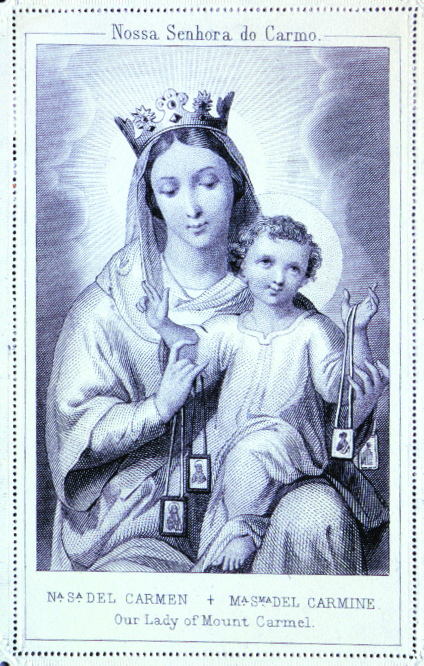
“Receive my beloved son, this habit of thy order: this shall be to thee and to all Carmelites a privilege, that whosoever dies clothed in this shall never suffer eternal fire. . . . It shall be a sign of salvation, a protection in danger, and a pledge of peace.”— Our Lady of Mount Carmel
Mount Carmel, in what is today northern Israel, has always been a place rich in mystical tradition. The word hakkarmel means “the garden” in Hebrew, and true to its title, there is a remarkable profusion of plants and wildflowers on this mountain. It is considered a natural paradise and a sacred place, and in biblical times it was forbidden to disturb any of the natural life on it. Those who wanted to ascend the mountain for meditation lived in caves so as not to intrude on the landscape with unnatural structures. In about 860 b.c., the prophet Elijah (also known as Elias) arrived on this holy mountain to begin a life of contemplation and prayer. The First Book of Kings is filled with tales of wonders he performed and prophesies he gave. In his prophetic visions on Mount Carmel, Elijah became aware of the coming of the mother of the Messiah. He and his followers mystically dedicated themselves to her, setting an example as the first monks.
The descendants of these ancient contemplatives were among the first to accept the teachings of Christ and to be baptized by His apostles. Upon meeting Mary after Christ’s Ascension, they were so overcome by her sanctity that they returned to the mountain to build a chapel in her honor. For the next thousand years Mount Carmel continued to be a place where hermits devoted themselves to prayer. By the twelfth century, pilgrims from Europe who had followed the Crusades to the Holy Land settled with the ascetics on Carmel and started a religious holy order known as Brothers of the Blessed Virgin Mary of Mount Carmel.
Their rule, which was given in 1209 by the Patriarch of Jerusalem, says that all converges toward the contemplation of God. The Rule of Mysticism exhorts those who follow it to live a life of continual prayer, obedience to a superior, perpetual abstinence and fasting, manual work, and total silence. Simon Stock, an English pilgrim, had joined the group on a visit to Jerusalem.
At this time, Saracen invaders forced the monks out of their spiritual home on Mount Carmel. All those who would not leave were murdered. Simon Stock was instrumental in getting the order to move to Aylesford, England, where the Baron de Grey gave them a manor house. The Carmelite lifestyle of contemplation, poverty, and silent prayer was not easily accepted in Europe, particularly among the clergy who enjoyed almost the same status and privilege as royalty. Reading into the life of Mary, Simon Stock was inspired by her unquestioning acceptance of all that befell her: her virgin pregnancy; her raising and loving a child doomed to be executed; and her staying at the foot of the Cross while others ran away. It was through his insistence that the Carmelites evolved from a band of hermit ascetics who regretted the loss of their home on Mount Carmel into a traveling society of mendicant friars, opening schools and mission houses in the major capitals of Europe.
Still, it was difficult for many monks to accept the alteration of the rule of the order to adapt to European conditions. Their presence was also shunned and not easily tolerated by other religious orders. The people thought these hermits strange and did not accept that they chose to live in such absolute poverty and isolation. In order to preserve what was left of their order, the Carmelites invoked their patroness, the Virgin Mary, for help in establishing their new life. The answer came in a vision to Saint Simon Stock on July 16, 1251, when he was alone in his cell. Mary appeared to him holding the scapular of his order. She told him, “Receive my beloved son, this habit of thy order: this shall be to thee and to all Carmelites a privilege, that whosoever dies clothed in this shall never suffer eternal fire. . . .It shall be a sign of salvation, a protection in danger, and a pledge of peace.”
The scapular, two pieces of brown wool joined at the shoulders and hanging down the back and breast, was not new to the Carmelite order. For hundreds of years before Saint Simon Stock’s vision, monks in Europe had worn scapulars. But it is thought that the brown scapular that Mary delivered was referencing Elijah’s camel-hair garment on Mount Carmel. Eventually, the brown scapular became reduced in size for laypeople to wear under their clothing. This is a special devotion to Mary worn as a sign to commemorate her faith in both God and humankind. This gift from Mary helped the Carmelites explain the historical significance of their order to the laypeople; it served as a reminder that belief in Mary as the Mother of God extended back to the Old Testament with the prophet Elijah.
After Pope John XXII (r. 1316–1334) had a vision of Mary where she promised those wearing the brown scapular, “I, the Mother of Grace, shall descend on the Saturday after their death and whomsoever I find in Purgatory, I shall free, so that I may lead them to the holy mountain of everlasting life,” the scapular became extremely popular among the common people. By the end of the sixteenth century it had become smaller in size and very similar to the one that is worn today. Admiration for the Carmelite Order spread as their adherence to the rules of solitude and prayer produced some of the greatest mystical saints in Catholicism, all of whom had visions of or openhearted communications with Mary. Among them are Saint Simon Stock, Saint Teresa, Saint John of the Cross, and Saint Thérèse of Lisieux. Though the original scapular handed to Saint Simon Stock was brown wool cloth without a picture, the Carmelite scapular that is now worn and the one that is most favored now has an image of Our Lady of Mount Carmel holding the Baby Jesus while she offers the scapular.
The other piece of cloth often has a picture of Jesus as a man. Neither image is prescribed. Wearing the scapular is a form of prayer and is considered a visible sign of consecrating oneself to Mary and to accepting her maternal protection. Devotion to Our Lady of Carmel can be found wherever the Carmelites founded a monastery or convent.
Many small towns in Italy have churches named after this aspect of Mary. As the townspeople emigrated to other countries, they brought the devotion with them. In many cities in the United States these churches have great celebrations in honor of Our Lady of Mount Carmel. Artistic representations of Our Lady of Mount Carmel depict her either appearing in the sky over Mount Carmel itself or holding Jesus as a toddler. In both versions the figure of Mary is often depicted offering the scapular to the viewer.
Tradition has it that the prophet Elijah saw Mary appear in the clouds over Mount Carmel eight hundred years before her birth. Sometimes this representation includes her handing the scapular to Saint Simon Stock. The other version of this aspect of Mary illustrates the Sabbatine privilege where Mary vows to take the souls of those who died wearing the brown scapular out of purgatory on the Saturday after their death. Purgatory is depicted in flames because it is a place where the soul goes to have its sins burned away.
Our Lady of Mount Carmel is the patroness of the Carmelite Order, Chile, and Bolivia. Her feast day is July 16.
Our Lady of Light is the patroness of Egypt.
The Coptic Church in Egypt celebrates thirty-two feast days in honor of the Virgin Mary. The last one of these falls on April 2 and commemorates Mary under her title of Our Lady of Light. The great majority of Egypt’s population is Muslim. The Copts are a Christian sect whose members did not convert when that country was invaded in the eighth century. They make up about 10 percent of Egypt’s population. The Copts have a great reverence for the Holy Family since it was to Egypt that Joseph and Mary took the Infant Jesus to hide from Herod. One place where the family rested was Zeitoun near Cairo. When Mary appeared over the Coptic Church of Saint Mark on April 2, 1968, she was seen by a diverse religious crowd. Islamic tradition also has great reverence for Mary. A hadith of the Prophet Muhammad states, “Every child is touched by the devil as soon as he is born and this contact makes him cry. Excepted are Mary and her Son.” Like Catholics, the Muslims believe that Mary was a virgin when she conceived Jesus and that she was spiritually superior to all other humans. She is one of eight people who have their own chapter in the Koran. When Mary appeared in Egypt she was welcomed by Coptic Christians, the Protestant Church, the pope’s envoy, and the Muslim population.
On April 2, 1968, at 8:30 at night, the mechanics and bus drivers who worked out of the Public Transport Authority heard a disturbance in the street. A young woman dressed in white was on the dome of the Church of Saint Mark across from the garage. Frightened that she was about to kill herself, the Muslim mechanic implored her to be careful, while his compatriot ran to alert the priests. Since it was impossible to walk on the curved dome of the church, the onlookers gathering in the street were astounded to see the woman move onto the dome, bowing and kneeling in front of a cross. It was then that someone yelled out, “It is our Holy Mother Mary!” Cries of “Virgin Mary!” went up from the crowd. As the night sky darkened, the figure of Mary on the roof glowed luminously.
This was the start of a series of hundreds of apparitions that was to last three years. In all of them Mary remained silent but brought a sense of peace and harmony to the hundreds of thousands in the crowds who would gather to be with her. Not everyone in the crowd saw her, some saw only lights. Others, Muslims as well as Christians viewed her with great clarity. The apparitions became so well-known that they were even broadcast on Egyptian television to an audience of one million people. The Marxist president of Egypt, Abdul Nasser, was among the many political dignitaries who would stand in the street, waiting for Mary.
The Egyptian government went so far as to tear down buildings around the church to make room for the ever-expanding crowds. This silent apparition never appeared at the same time and would come two to three times a week. It was instantly declared a miracle by the Coptic Church when the first man who saw Mary, the mechanic from the garage, went the next day to have a gangrenous finger amputated. Doctors unwrapping his bandages were shocked to find his finger totally healed. Many nights the Virgin would bow to the crowd and bless it; sometimes she appeared with a baby in her arms; many times she waved an olive branch of peace; other times a luminous mist spread everywhere, giving off the scent of incense. A priest at the church has written, “I have seen the Virgin myself reflected against the surface of the moon whose disk got bigger as the moon got nearer to the church. The Virgin made her apparition carrying a babe in her arms.”
Another witness who watched from his brother’s apartment said, “I saw her twice. She was very tall, and she did not stand on the ground. She shone more than the moon, all completely white, sometimes with her arms together and sometimes with her arms outstretched. Every night there were doves, and doves, you know, do not fly at night.” A woman remembering the time of the apparitions said, “There were Muslims and Christians, and everyone was as one, one religion together.” Scientific studies were launched within a fifteen-mile radius of the church. It was thought that the apparition was being projected from somewhere, but no evidence of such an elaborate hoax was ever found. Pope Pius VI’s envoy, who witnessed several of the apparitions in the first month, recommended these visions as legitimate visits by Mary. They were widely reported in the newspapers, though not in the West. Several reasons were suggested for why Mary chose this time and place to appear. One was the disastrous defeat Egypt suffered in the 1967 Six Day War with Israel. Because of it, the Coptic holy sites in Jerusalem were off-limits to Egyptians. Not only was Mary soothing the people in their defeat, she was visiting them when they could not go to the Holy Land to visit her. Another reason was that Zeitoun had sheltered the Holy Family during their flight from Herod, and Mary was revisiting a place that had protected her.
The apparitions ended in 1971, when the Egyptian government started to charge admission to stand in the street. There are many black-and-white photographs of these
sightings, but original witnesses insist they serve as poor documentation of the luminous visions they remember.
I promise salvation to those who embrace devotion to my Immaculate Heart. Their souls will be loved by God as flowers placed by me to adorn His throne. These souls will suffer a great deal but I will never leave them. My Immaculate Heart will be their refuge, the way that will lead them to God.—Our Lady of Fatima
The twentieth century was the first time in history where we had the ability to destroy not only the entire human race but all other forms of life on this planet. During World War I, the violence of which people had never seen before, Mary came to Fatima, Portugal, with a very serious warning. Expressing the belief that humankind had drifted away from God, she wanted the world to offer up reparations for the disastrous state of the earth. Fatima is the most prophetic of Mary’s apparitions. She correctly foretold the suffering imposed by the Communist states and the carnage of World War II. The third secret of Fatima was deemed too terrifying to release.
It was finally revealed by the Vatican on May 13, 2000, in the hopes that what it had predicted had passed. Others strongly disagree with the Vatican’s interpretation and insist it is a portent of the end of the world. Our Lady of Fatima is an angry, pained mother, demanding that her children take action before it is too late.
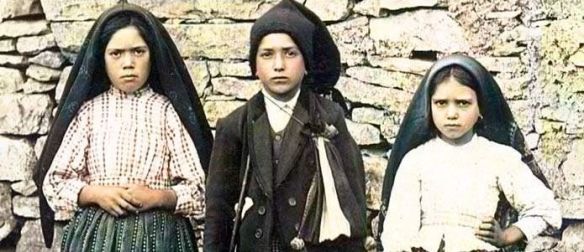
It is said that Mary usually appears to the simplest and least complicated of people because they do not try to judge or interpret what she says, they merely report it. For this reason, many times her visionaries are children. In 1916, a nine-year-old girl from Fatima named Lucia dos Santos was out tending sheep with her two younger cousins, Francisco and Jacinta. They were happily playing a little game with stones when they saw an immense light come from the sky in their direction. At the center of the light was a translucent angelic form. “Do not be afraid!” he said. “I am the Angel of Peace. Pray with me.” Kneeling, he bowed down until his forehead touched the ground. He taught them a prayer that he made them repeat three times. “My God, I believe, I adore, I trust and I love You! I ask pardon of You for those who do not believe, do not adore, do not trust and do not love You.” Rising, he told them, “Pray thus. The hearts of Jesus and Mary are attentive to the words of your prayers.”
This was not the first time Lucia had seen this angel. When she had previously tended sheep with other companions, she had witnessed the light of the angel overhead. When her friends had told their parents what they had seen, they were all accused of fabricating a story out of boredom. Because of this, Lucia convinced her younger cousins to keep the angelic visit a secret. All three children began praying in the manner taught to them by the angel. Toward the end of summer they received another visit from the angel, admonishing them for frittering away so much time in play. He told them he was Guardian Angel of Portugal and that God was offended by the sins of others. He advised the children to pray more and “Above all, accept and bear with submission, all the suffering which the Lord allows in your lives. In this way you will draw down peace upon your country.”
Before winter came they received one more visit from this angel in which he told them that Jesus Christ was outraged by ungrateful and indifferent men. He implored them to keep praying and gave them Communion. The children continued to work, play, and pray together throughout the winter months. On Sunday, May 13, 1917, they were leading their flocks to a grazing field called the Cova da Iria. They were frightened by flashes of lightning and were shocked to see a beautiful lady who glowed brighter than the sun. When she spoke to them, Lucia was the only one who could hear her, “Fear not, I will not harm you. I am from heaven.” When Lucia asked her what it was she wanted, the lady answered, “I ask you to come here for six consecutive months, on the thirteenth day at this same hour. I will tell you later who I am and why I have come to you. I shall return here again a seventh time.” Lucia asked if they could go to heaven with the lady, and she was told that they would all come to heaven with her but that “Francisco must pray many rosaries.”
The lady added, “Let him pray the rosary. In that way he too will be able to see me.” Francisco had only seen Lucia talking to a bright light. He said one decade of the rosary, and he, too, was able to see the lady. Streams of light radiated onto the children from the lady’s hands. As she left them, she told the children, “Say the rosary every day to earn peace for the world and the end of the war.” Lucia’s family and friends greeted her story about the lady with scorn and mockery.
Her cousins had a different experience. Their father, believing that they truly had some sort of celestial vision, protected and respected them. On June 13 about fifty people accompanied the children to the Cova da Iria. Lucia called Jacinta out of a group of playing children. Lightning had started to flash even though it was a beautiful day. Lucia, Jacinta, and Francisco ran toward the oak tree where they had seen the lady a month before. Though others in the crowd could not see her, some reported hearing a “buzzing noise” or a “tiny little voice.” The lady, enveloped in a mystical light, taught the children a prayer, and made the following promise to the world, “I promise salvation to those who embrace devotion to my Immaculate Heart. Their souls will be loved by God as flowers placed by me to adorn His throne. These souls will suffer a great deal but I will never leave them. My Immaculate Heart will be their refuge, the way that will lead them to God.”
She again showered the children with light from her hands. People in the crowd heard a “rushing sound” and the three children shouted, “There she goes, there she goes!” as they pointed to the sky in the east. To everyone’s amazement, the branches of the tree, which had been standing straight up a few minutes before, were also pointing to the east. The third visit, which took place on July 13, was attended by thousands of believers, cynics, and those searching for miracles. Lucia has written that between the past month and this day she was continually tormented by self-doubt.
No one in her immediate family seemed to believe her, perhaps this was all a trick of her mind. The large crowd quieted down as they heard a buzzing sound. A cloud moved in over the oak tree. They watched as Lucia, enraptured, appeared to be having a conversation with the cloud. At one point, the girl cried out in horror. After a few minutes, there was the sound of thunder and the cloud lifted. The children waved good-bye to it. When asked what made her cry out, Lucia said, “It was a secret.” In her own memoirs, she wrote that as the lady started to appear all her doubts about whether this was really happening or not left her forever.
In this visit, the famous Three Secrets of Fatima were imparted to the children. The local government looked upon the growing interest in the alleged apparitions in Fatima as a dangerous threat to its sovereignty. The royalists had recently been driven out of government and religion was looked upon as equaling royalism. Many monasteries and parochial schools had been closed down. The prime minister had promised that within twenty years all trace of religion would be gone from Portugal. The fourth apparition of the lady took place on August 13. Almost fifteen thousand people were gathered in the Cova da Iria, but Lucia, Jacinta, and Francisco were locked in the town jail.
Even without the seers the crowd witnessed the cloud hovering over the oak tree, there were sounds of explosions, and the ground shook. A mystical light showered the crowd, reflecting all the colors of the rainbow. While this was happening, each of the children were separately questioned for hours. They refused to give up the secrets they were told by the lady. Though each was told that the others had completely recanted their story of the lady, not one of them would change their personal account. As a last resort the mayor told them that obviously there were no secrets, and he was going to boil them in oil if they did not admit the apparitions were all a lie. Instead of collapsing in hysteria, the three remained silent, and the children were released on August 15.
The lady came to them in the area near their village and told them she wanted them to continue their pilgrimages to the Cova da Iria on the thirteenth of the month. She also told them to pray the rosary every day. “Pray. Pray very much, and make sacrifices for sinners. So many souls go to hell because there is no one to pray and to make sacrifices for them.” The seriousness with which the children took her words greatly altered their personalities. Neighbors who once mocked them became their biggest defenders. By the September 13 apparition, there were over thirty thousand people in the Cova da Iria. In the middle of a cloudless sky, many witnessed a luminous globe moving from east to west. According to Lucia, the lady asked the people to pray the rosary to obtain the end of the war. She also promised that she would perform a miracle on her next and last visit so that everyone would believe.
The apparition of October 13 is widely documented and was reported by newspapers all over the world. Even the most anticlerical Portuguese news agencies reported “strange natural phenomena” that had occurred in front of a crowd of at least fifty thousand people. Despite heavy rains, pilgrims arrived to the little town, most of them on foot. A few minutes before 1:30 in the afternoon it stopped raining. What happened next has been detailed by news reporters (most of whom were extremely skeptical of the children), eyewitnesses in the crowd, professors from the university, government officials, and even those who lived miles away. The sun appeared through the clouds, shone very brightly, and began to tremble and dance, whirling through the sky at a dizzying speed, it cast all the colors of the rainbow on the crowd. The crowd began shouting for the Virgin Mary.
The strange movements and light from the sun lasted a few minutes before it returned to its natural place in the sky. The crowd, who had been soaked to the skin, was now completely dry. As for the children, they were unaware of any “dance of the sun,” they had been communing with Mary. According to Lucia, “When Our Lady disappeared in the immense distance of the sky, next to the sun we saw Saint Joseph holding the Child Jesus and Our Lady dressed in white with a blue mantle. Saint Joseph seemed to be blessing the world, making the sign of the cross. Shortly after this vision had vanished, I saw Our Lord and Our Lady who reminded me of Our Lady of Sorrows. Our Lord was blessing the world as was Saint Joseph. This vision vanished too, and it seemed to me I again saw Our Lady in a form resembling that of Our Lady of Mount Carmel.” The story of Our Lady of Fatima had worldwide repercussions, and Fatima became a major pilgrimage site. It is visited by five million Marian devotees a year.
The three seers were hounded by the sick, the desperate, and the curious. Jacinta and Francisco died during the flu epidemic of 1918. Lucia joined a convent in May 1921. She is still alive at this writing. In 1941, Lucia allowed the first two secrets of Fatima to be released. According to her memoir, The first part is the vision of hell. Our Lady showed us a great sea of fire which seemed to be under the earth. Plunged in this fire were demons and souls in human form, like transparent burning embers, all blackened or burnished bronze, floating about in the conflagration, now raised into the air by flames that issued from within themselves together with great clouds of smoke, now falling back on every side like sparks in a huge fire, without weight or equilibrium, and amid shrieks and groans of pain and despair, which horrified us and made us tremble with fear. The demons could be distinguished by their terrifying and repulsive likeness to frightful and unknown animals, all black and transparent.
This vision lasted but an instant. How can we ever be grateful enough to our kind heavenly mother, who had already prepared us by promising, in the first apparition, to take us to heaven. Otherwise, I think we would have died of fear and terror. We then looked up at Our Lady, who said to us so kindly and sadly, “You have seen hell where the souls of poor sinners go. To save them, God wishes to establish in the world devotion to my Immaculate Heart. If what I say to you is done, many souls will be saved and there will be peace. The war is going to end: but if people do not cease offending God, a worse one will break out during the Pontificate of Pius XI. When you see a night illumined by an unknown light, know that this is the great sign given you by God that he is about to punish the world for its crimes, by means of war, famine and persecutions of the Church. The good will be martyred; the Holy Father will have much to suffer; various nations will be annihilated. In the end, my Immaculate Heart will triumph.
The Holy Father will consecrate Russia to me, and she shall be converted, and a period of peace will be granted the world. Lucia was so confused by the content of the third secret that she placed it in an envelope and sent it to the Vatican with the instructions that it was not to be opened until the year 1960. Pope John XXIII chose not to release it upon reading it, Paul VI also kept it a secret. On May 13, 1981, the Feast of Our Lady of Fatima, an assassin fired a bullet at Pope John Paul II as he was out greeting the pilgrims in Saint Peter’s Square. He impulsively bent down to hug a little girl wearing an Our Lady of Fatima medal and the bullet only wounded him instead of killing him.
He has always credited Our Lady of Fatima with saving his life. It was he who decided to release the third secret on May 13, 2000, to mark the beatification of Francisco and Jacinta. Lucia met with him beforehand and approved of the action. This is the third secret as released by the Vatican: After the two parts which I have already explained, at the left of Our Lady and a little above, we saw an Angel with a flaming sword in his left hand; flashing, it gave out flames that looked as though they would set the world on fire; but they died out in contact with the splendor that Our Lady radiated towards him from her right hand: pointing to the earth with his right hand, the angel cried out: And we saw in an immense light that is God: something similar to how people appear in a mirror when they pass in front of it, a bishop dressed in white, we had the impression it was the Holy Father.
Other bishops, priests, men and women religious going up a steep mountain, at the top of which there was a big cross of rough-hewn trunks of a cork-tree with the bark; before reaching there the Holy Father passed through a big city half in ruins and trembling with halting step, afflicted with pain and sorrow, he prayed for the souls of the corpses he met on his way. Having reached the top of the mountain, on his knees at the foot of the big cross he was killed by a group of soldiers who fired bullets and arrows at him, and in the same way there died one after another the other bishops, priests, men and women religious, and various laypeople of different ranks and positions.
Beneath the two arms of the cross there were two angels each with a crystal aspersorium in their hands, in which they gathered up the blood of the martyrs and with it sprinkled the souls that were making their way to God. Pope John Paul II felt that this last secret was a symbol of the attempt on his life. The Russian Revolution brought into the world a society that outlawed spirituality and religious practices. By the last half of the twentieth century, communism had engulfed many nations under this umbrella. Coming from Poland, Pope John Paul II was a force to be reckoned with. He inspired many in Russia and Poland to rebel against totalitarian systems. He felt the prayers Our Lady of Fatima asked for and the visions given to the three children helped to change the course of history.
 novena.com